
Chapter 5 Valuing Stocks
Chapter Overview
The Opening Focus discusses CNBC’s Fast Money interview with Anthony Scaramucci (aka The
Hedge) made a pitch to investors that Aeropostale, the teen fashion retailer, was undervalued. Scar-
amucci urged investment into the company because of its earnings multiples. He said they had fat
profit margins and plenty of free cash flow. Hedge fund managers use tools like the ones Scar-
amucci used all the time. Some use cash flow methods like in Chapters 3 and 4 and others rely on
“market multiples”. Which do you think works best?
Opening Focus Discussion Questions:
1. What are the elements of Aeropostale’s business that would be valued by fund managers
shareholders?
2. What key valuation features in this example might one expect to be applicable more generally
to valuing any business?
This chapter discusses:
5-1. The Essential Features of Preferred and Common Stock
5-2. Valueing Preferred and Common Stock
Technology
1. Smart Practices Video interviews David Baum, co-head of mergers and acquisitions for
Goldman Sachs in the Americas, talking about innovations in the investment banking business.
3. Smart Ethics Video interviews Kent Womack, Dartmouth College, about potential conflicts
of interests among analysts.
5. Smart Concepts explains a variable growth model problem, step by step.
7. Smart Excel Animation explains a free cash flow valuation using excel.
8. Smart PracticesVideo quotes investment banker Bill Eckmann concerning DCF vs. compara-
Chapter 5 Valuing Stocks 131
10. Smart Solutions provides a step-by-step solution to Problem P5-12, a dividend discount model
problem.
Lecture Guide
This is another key chapter, introducing stock valuation models. Not only do individual investors
want to know how to value these securities, but corporate managers need to know about valuation.
A firm may be in the market for debt or equity financing, and a manager who wants to maximize
share price also needs to know the valuation models and factors that affect stock price.
5-1 The Essential Features of Preferred and Common Stock
Note that debt is less risky than equity. Debt holders have first claim on the firm’s assets
in the event of bankruptcy. Debt holders have a legal contract with the firm with a variety of pro-
visions to protect the bondholders, for example, provisions concerning minimum amounts of debt
the firm can have or certain net worth or current ratios.
Although shareholders don’t have the protections that bondholders have, they have the po-
tionship in finance: investors who take on more risk expect higher returns.
While preferred stock sounds like an equity security, in reality it acts more like a debt se-
curity. Like a bond coupon interest payment, a preferred stock dividend is also fixed, and if the
company does well, preferred shareholders do not have a claim on that wealth. Typically, pre-
ferred shareholders, who normally have no say in corporate governance, will have a say if the firm
becomes financially distressed.
Nonconvertible preferred stock is primarily issued by two very different kinds of investors,
mature, stable regulated utilities and financially-distressed companies. Utilities issue preferred
stock because the utility business is very capital intensive and such firms need large amounts of
holders will get a seat on the firm’s board of directors if a preferred dividend is missed, and usually
132 Instructor’s Manual
preferred dividends are cumulative; in other words, all back preferred dividends must be paid be-
fore common stock dividends can be paid. Most preferred stock is owned by corporations rather
than individuals since a corporation can exclude most of its dividend income from its taxes, giving
preferred stock a higher after-tax yield to corporate investors than to individual investors.
Overall, there is relatively little preferred stock issued by firms, compared to the amount of
common stock outstanding
Note that market capitalization or market cap shows how investors value a firm. It may be
completely unrelated to a firm’s book value equity on its balance sheet. Concerning treasury stock,
While shareholders do have a say in corporate governance, an individual shareholder has little
power on his or her own. Ask students how many own shares and then, what is their role in the
operations of the company. They will likely all agree that they have no say in the decisions the
firm makes. Ask if any have sent in their proxy to vote in corporate elections or attended an annual
5-2 Valuing Preferred and Common Stock
Valuation of preferred stock is done through a mathematically easy to use formula, the sta-
ble perpetuity formula. Valuing preferred stock is as easy as it seems; simply divide the dollar
amount of the dividend by the required return on the preferred stock. Note that the required return
5.2a Preferred Stock Valuation
Common stock with a non-growing dividend can be valued exactly like preferred stock, with the
easy to use stable perpetuity formula. Valuing preferred stock is a very easy process. Note, how-
5.2b Common Stock Valuation Equation
The concept that stock can be valued as a growing perpetuity can sometimes be difficult
5.2c Zero Growth
Here valuing common stock is identical to valuing preferred stock.
5.2d Constant Growth (or Gordon Growth Model)
It is also true that a company’s dividends do not grow at the same rate forever. However, for a
mature, stable company this may be a close enough approximation. Most managers state that an
even growth rate is a company goal, and will give close enough answers concerning stock valua-
tion. Typically as a company matures, it will settle into a low, long term growth around the rate of
5.2e Variable Growth
Note that analysts often use a variable growth model, recognizing that dividends may grow
at a higher rate in the early years of a company and then may settle into a steady-state growth rate.
134 Instructor’s Manual
you use dividend in year 5, you will calculate a price in year 4 dollars. If you use a dividend in
year 68, you will calculate a price in year 67 dollars.
The growing perpetuity model can be used even if the growth rate is negative. Stock price will
simply be exponentially declining. For example, if a company just pays a dividend of $1 (D0 = $1),
and the appropriate discount rate is 10%. If the growth rate is 5%, price is 1(1.05)/(.1-0.05) =
Estimating growth rate is the most difficult part of using the constant growth model equation.
There are many security analysts who publish expectations of future growth, or an industry average
could be used. Unfortunately, there is a low correlation between past growth and future growth. A
Chan, Karceski and Lakonishok study found almost no correlation between past and future growth.
In general, they found that growth was high in the early years of a company, became lower as new
firms entered the market and then became high as firms exited the market, making the remaining
firms more profitable. This makes it hard to predict long-term trends.
The concept of present value of growth opportunities, PVGO, is gaining popularity. Investors
distinguish between growth stocks, which they expect will provide them with capital gains, and
income stocks, which they expect will provide them with dividends. A share of stock in essence
5.2f How to Estimate Growth
The central component in many stock pricing models is the growth rate – but how do we
find an accurate growth rate? A firm’s growth rate depends on several factors – sales, dividends,
Chapter 5 Valuing Stocks 135
5.2g What If There Are No Dividends?
This is a common question most students ask – Yahoo, a consistent growth stock – has not
paid a dividend yet. So to value this firm – one must either believe they will one day pay out divi-
5.3 Free Cash Flow Approach to Common Stock Valuation
The free cash flow model is like the dividend growth model, except that cash flows are
used in place of dividends. Like the dividend growth model, it also works best for more mature,
stable firms. The FCF represents total cash available to all investors. Using the simple FCF for-
5.4 Other Approaches to Common Stock Valuation
5.4a Liquidation Value and Book Value
The liquidation value estimates the cash that would remain after a firm’s assets are sold
5.4b Market Multiples of Comparable Firms
In multiples valuation, a variety of multiples can be used to approximate the value of a
company. These tend to be industry-specific. For example, you could value a hospital as a multi-
ple of the number of beds in the hospital or a HMO as a multiple as the number of subscribers.
Price/earnings multiples are very widely used, and work best when net income is high relative
136 Instructor’s Manual
• Note also that differences in marketability can lead to big variations in value of
companies that are otherwise equal. If an investor is not sure about his/her ability
compared to similar publicly traded companies.
There could also be a key person discount applied to private companies. If a firm is very de-
pendent on a key executive, whose leaving could harm the firm, the company’s value may be lower
to reflect the possibility of departure. Depending on the nature of the business, there could also be
adjustments for key customers or suppliers (if a company were overly depend on a customer or
supplier). In addition, if the purchaser is buying a controlling interest, then a control premium must
be added in.
Selecting comparable companies is at least as much art as science. Comparable companies
should ideally have similar lines of business, capital structures, growth prospects., size, maturity,
diversification, etc.
• Student Interaction: Ask students which they think is better – using comparables
5.5 Primary and Secondary Markets for Equity Securities
5.5a Key Investment Banks and the Primary Market
Few firms offer stock directly to non-employed investors. A firm typically must use the
services of an investment bank to price and market its new equity issues. A seasoned equity offer-
ing is a fairly infrequent occurrence. Firms rely more on internal finance, and then debt financing,
before issuing new equity. There have been some very prominent initial public offerings. Google
• Perhaps there are changes in firm risk. If “everyone” is doing an IPO, then the riskier and
harder to price companies may be in the market. When there is more risk, and when it is hard-
er to evaluate the risk of a company, there will be more underpricing.
• There may be momentum in hot markets. Investors may be willing to pay more, bidding up the
price of a new issue, because they believe the overall market is going up. This can make first
Chapter 5 Valuing Stocks 137
• There may be “windows of opportunity,” periods of time when investors are very optimistic
about the growth potential of new companies.
The peak of the technology boom saw a record number of IPOs and money raised from IPOs
An IPO or a secondary offering after an IPO can be very profitable for a company’s founders.
For example, eBay’s founder received close to $130 million from the sale of 790,000 of his 37.6
million shares of stock in eBay’s secondary offering in April 1999. (The company did its IPO in
September 1998.) In another example, 20-year-old Christopher Klaus founded Internet Services
Systems in 1994. The firm went public in 1998, giving Klaus a $160 fortune in his remaining 26%
• Note that investment banks are not investors – they are advisors in the issue pro-
cess. Investment banks competed with commercial banks – in some transactions
IBs accepted credit risk, traditionally a mainstream banking function, by providing
short term loans to firms to help with mergers and acquisitions, called bridge loans
IB fees can be very high, particularly relatively speaking. In 1999, a peak IPO year, in particu-
lar a peak technology/internet IPO year, 1/3 of the companies that issued shares that year paid more
in investment banking fees than they had in revenues for the previous 12 months.
At the peak of the IPO boom, many companies, in particular internet companies, had a huge
first day “pop”, in other words a large increase in price on the opening day of trading. The IPO
“boom” began in September 1998 with a 606% first day gain for theglobe.com. One of the highest
gains was VA Linux Systems IPO, in which the stock closed at $239.25, up 700% on the first day

138 Instructor’s Manual
5.5b Secondary Markets for Equity Securities
Note that more trading is done electronically, with less need for a physical location for an ex-
change. A group of exchange students at one university were excited about touring the Paris
Bourse, or stock exchange, only to find no one was there – all the traders were at their computers at
Chapter 5 Resource Articles
“What Makes a Stock a Value?,” Money, July 2011. This article discusses some of the more
common methods used to value a stock including price/earnings measures. She discusses the ter-
minology and what to look for in P/E measures to find a valuable stock.
companies.
Enrichment Exercise
1. Ask students if they think managers can manipulate stock prices by increasing dividends?
The answer is that perhaps they can over the short term. An announcement that dividends
appear to be undervalued according to the multiple method?
Answers to Concept Review Questions
1. Common stockholders are residual owners because they are entitled to receive cash only after
all other creditors and preferred shareholders have been paid. Because common stockholders
receive their compensation from “the residual” or whatever is left over after everyone else has
Chapter 5 Valuing Stocks 139
Relative to each other, preferred shareholders have a riskier position than bondholders because
bondholders have a more senior claim against assets. Consequently, the expected return for
preferred shareholders is higher than the return for bondholders.
2. Outside shareholders clearly have less control of the firm relative to top management in this
3. It’s appropriate to use the perpetuity formula from Chapter 3 to estimate the value of preferred
4. Selling a share of common stock bestows the right to receive all future payments paid by the
5. Using a dividend forecast of $2.79, a required return of 10%, and a growth rate of 2.75 %, we
obtained a price for Intgrys Energy Group of $38.48. If the market’s required return on In-
6. Valuing firms that pay no dividends using a dividend discount model is difficult because it is
very hard to predict when the firm will start paying dividends, how large the initial dividend
payment will be, and how fast it might grow. The free cash flow approach to valuing an enter-
7. Book value measures the costs of a firm’s assets, net of accumulated depreciation. Subtract off
the historic value of the firm’s liabilities and you have the book value of the firm’s equity. Liq-
8. A firm may have a high P/E ratio simply because E is unusually small in a particular quarter or
year. Also, the P/E ratio can be influenced by how risky the firm is. If we have two firms with
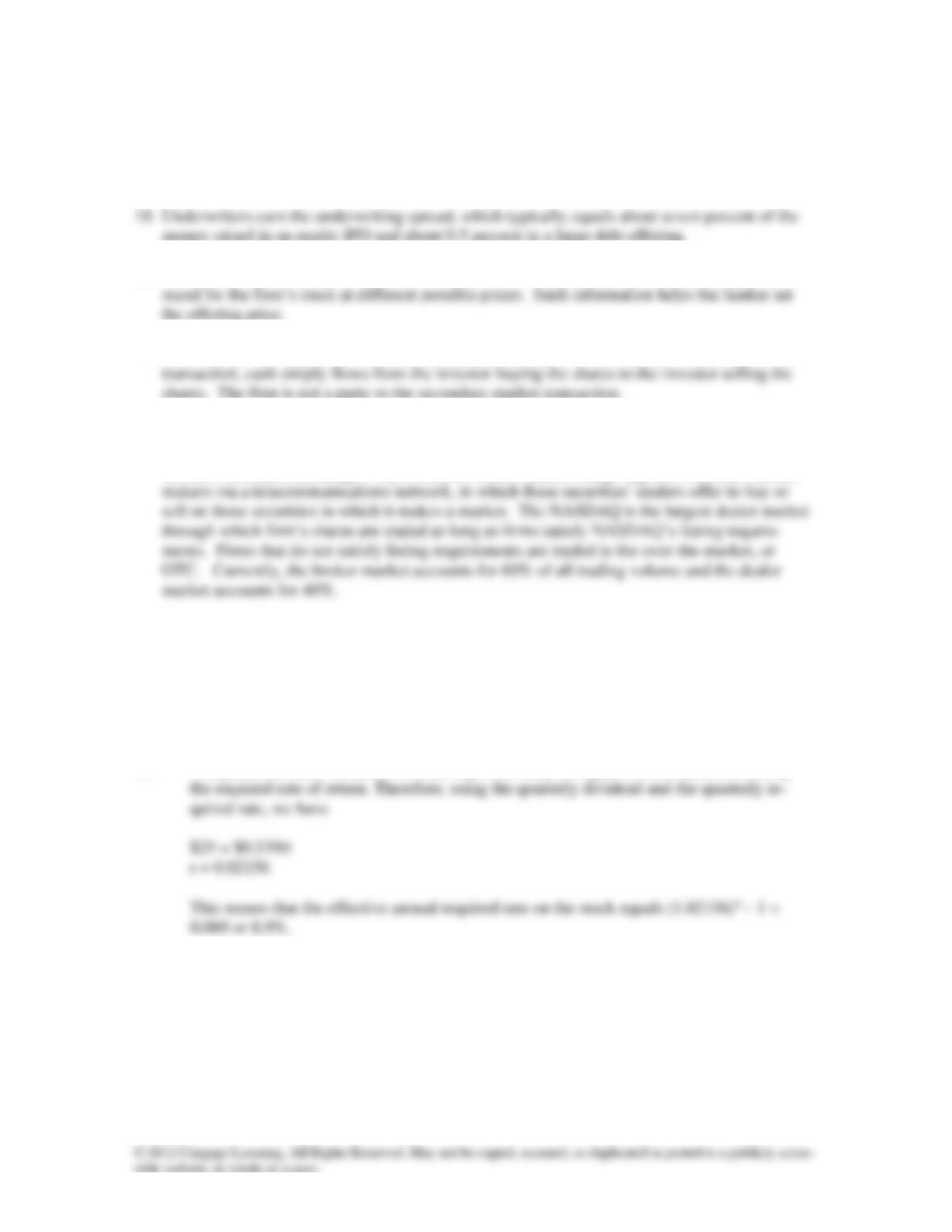
9. “Primary market” refers to a firm’s first particular security issuance. The secondary market
allows liquidity for those who hold those securities, since it is where the daily back and forth
140 Instructor’s Manual
trading of securities takes place. Organized exchanges are physical locations where investors
come together to trade, while the OTC market is a decentralized market of interconnected trad-
ers and dealers.
11. Road shows allow firms and their investment bankers to preliminarily assess the degree of de-
12. The issuing firm only receives cash in the primary market transaction. In a secondary market
13. A broker market is characterized by a centralized trading floor within larger exchanges such as
the NYSE and AMEX and smaller regional exchanges such as the Midwest, Philadelphia, Bos-
ton and Cincinnati Exchanges. By contrast, a dealer market brings together securities market
Answers to Self-Test Problems
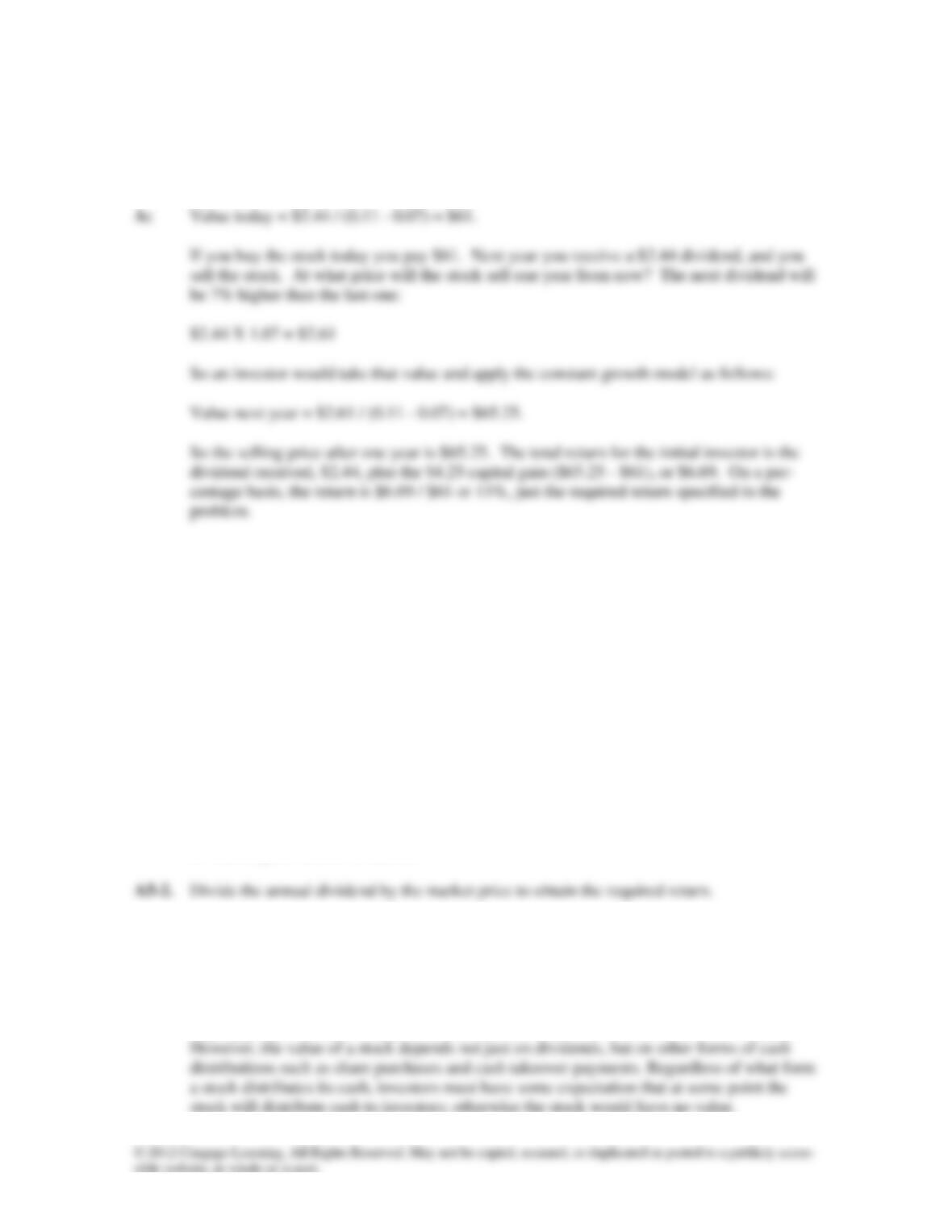
ST5-1. Omega Healthcare Investors (ticker symbol, OHI) pays a dividend on its Series B preferred
stock of $0.539 per quarter. If the price of Series B preferred stock is $25 per share, what
quarterly rate of return does the market require on this stock, and what is the effective an-
nual required return?
A: The preferred stock valuation formula says that the price equals the dividend divided by
ST5-2. McDonald’s Corporation ) announced an increase of their quarterly dividend from $0.55 to
$0.61 per share in September 2010. This continued a long string of dividend increases.
McDonald’s was one of a few companies that had managed to increase its annual dividend
at a double-digit clip for many years, including through the financial crisis and recession
from 2007-2009.. Suppose you want to use the dividend growth model to value McDon-
ald’s stock. You believe that dividends will grow at 7 % per year indefinitely, and you
think the market’s required return on this stock is 11 %. Let’s simplify by assuming that
McDonald’s pays dividends annually and that the next annual dividend is expected to be
$2.44 per share. The dividend will arrive in exactly one year. What would you pay for
Chapter 5 Valuing Stocks 141
McDonald’s stock right now? Suppose you buy the stock today, hold it just long enough to
receive the next dividend, and then sell it. What rate of return will you earn on that invest-
ment?
Answers to End-of-Chapter Questions
Q5–1. How is preferred stock different from common stock?
A5-1. Common stock usually grants the investor to vote on important corporate decisions. Pre-
ferred stock does not. Preferred shareholders have a higher priority claim than common
shareholders do because common shareholders cannot receive dividends unless all divi-
dends owed to preferred stockholders have been paid. Both common and preferred stock
have a lower priority claim than debt, however. Finally, preferred dividends are usually set
at a fixed percentage of par value, while common dividends vary with the profitability of
the company.
Q5–2. How do you estimate the required rate of return on a share of preferred stock if you know
its market price and its dividend?
Q5–3. The value of common stocks cannot be tied to the present value of future dividends be-
cause most firms don’t pay dividends. Comment on the validity, or lack thereof, of this
statement.
A5-3. It is true that most stocks don’t pay dividends, and forecasting when those stocks will
begin paying dividends is very difficult, so in that sense the statement has some validity.