ANSWERS TO CHAPTER QUESTIONS
Chapter 5 Financial Statements Analysis
1) A balance sheet is a financial statement that presents household assets and
2) Segregation by type of assets and liabilities can better assess household
availabilities versus household needs. For example the amount of money set aside
3) A cash flow statement is a presentation of the household’s cash inflow and
4) The sections of a functional cash flow statement include:
a) Income
b) Non-discretionary expenses
5) A functional cash flow details cash flow by type of household activity. A
traditional cash flow statement only breaks things into inflows and outflows. They
both use and provide the same statistics as represented by the net cash flow figure.
6) An increase in debt is a plus from a cash flow standpoint. That is because it
7) A pro forma statement is one that contains projections. Its goal is to understand
8) Some expenses that cannot use inflation to project growth or indicate rate on a pro
forma include:
a) Insurance – Actual contracted for figures or anticipated future rates based
on projected expense patterns.
b) Mortgage Interest – Fixed-rate mortgages lead to declining interest and
9) Accounting attempts to portray a pairing of income and expenses to arrive at a
proper representation of profits for a period. It includes noncash items such as
10) In an ideal world perhaps accounting’s profitability would provide a good
benchmark for results for a period. However, inevitably judgment and self-interest
can enter into results done under accounting’s generally accepted accounting
Finance makes no attempt at a profit standard but its cash flow benchmark is more
objective since net cash flow figures for the year can be easily checked by using a
11) A person can have a poor cash flow but still be in good financial health when:
a) Job-related cash flow is growing materially while expenses are flattish.
12) One of the major differences between household accounting and business
13) The two approaches to the cash flow statement are the common rate and the
separate rate. The common rate is the rate of increase in household expenses and
14) Household equity is the net worth of all the assets and liabilities associated with
the household. Household equity is calculated by the difference of Assets less
ANSWERS TO CASE APPLICATION QUESTIONS
Chapter 5 Financial Statements Analysis
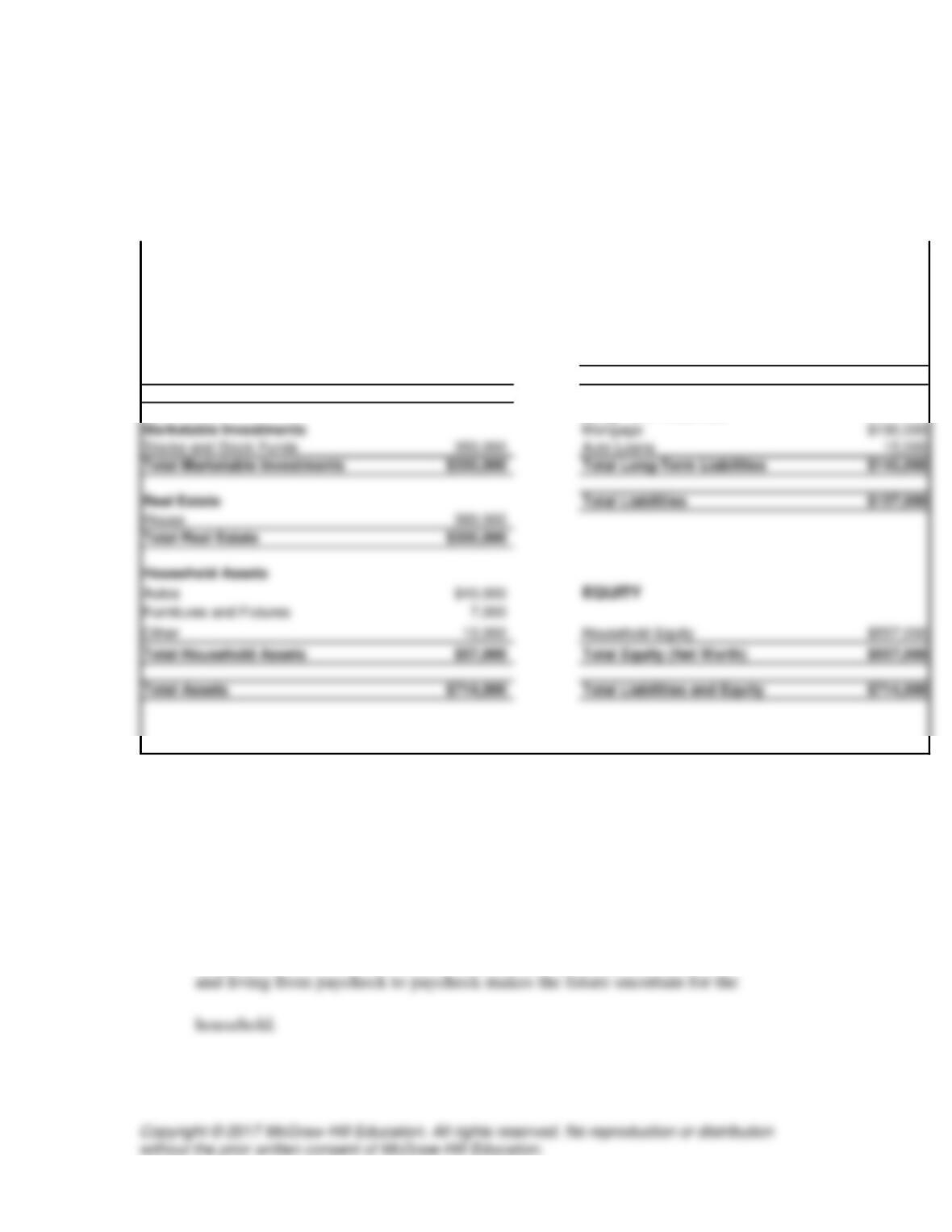
1) Balance Sheet for Richard and Monica
ASSETS LIABILITIES
Current Assets Current Liabilities
Money Market Funds $2,000 Credit Card Debt $12,000
Bonus Due 5,000 Total Current Liabilities $12,000
Total Current Assets $7,000
Long-Term Liabilities
Marketable Investments Mortgage $130,000
Total Marketable Investments $350,000 Total Long-Term Liabilities $145,000
Real Estate Total Liabilities $157,000
Total Real Estate $300,000
Household Assets
Total Assets $714,000 Total Liabilities and Equity $714,000
2) Household equity is fairly strong, but for a person in their stage of life with their
goals it isn’t strong enough.
3) It would be best to tell them it wasn’t strong enough as a means to motivate
Richard to change his beliefs and practices. Basically his attitude in taking risks

Answers to CFP® Questions
Question
Answer
Question 5.1
B
Question 5.2
D
Question 5.3
D