44 Berk/DeMarzo, Corporate Finance, Fourth Edition
b. If x is the increase in the royalty rate then Diana will be indifferent if
4-31. Your brother has offered to give you $100, starting next year, and after that growing at 3% for
the next 20 years. You would like to calculate the value of this offer by calculating how much
money you would need to deposit in the local bank so that the account will generate the same
cash flows as he is offering you. Your local bank will guarantee a 6% annual interest rate so long
as you have money in the account.
a. How much money will you need to deposit into the account today?
b. Using an Excel spreadsheet, show explicitly that you can deposit this amount of money into
the account, and every year withdraw what your brother has promised, leaving the account
with nothing after the last withdrawal.
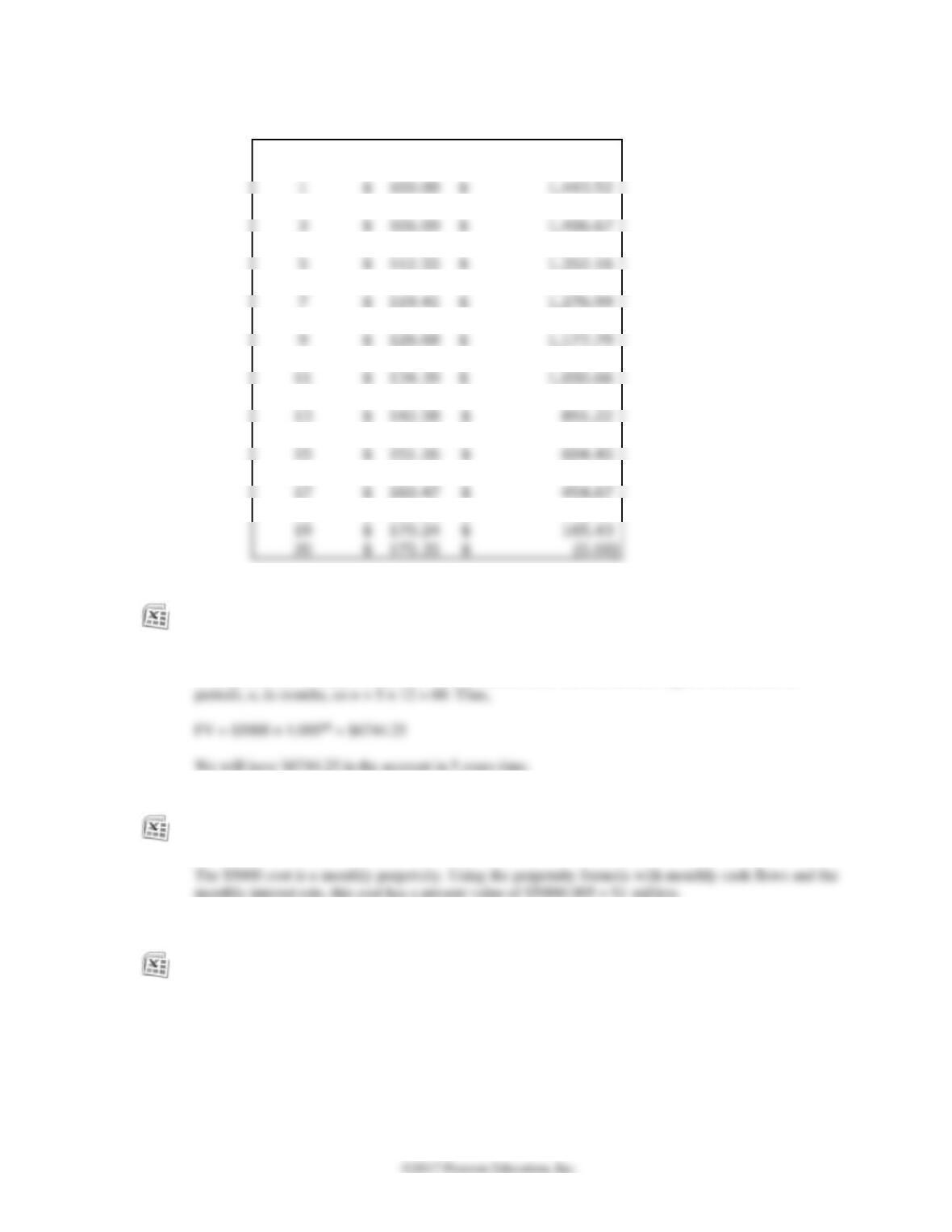
a. The amount to be deposited in the account is $1456.15.
Year Cash flows of Brother’s deal PV of Brother’s deal with 6% discount factor
0 – –
1 100.00$ 94.34$
3 106.09$ 89.08$
5 112.55$ 84.10$
7 119.41$ 79.41$
9 126.68$ 74.98$
11 134.39$ 70.80$
13 142.58$ 66.85$
15 151.26$ 63.12$
17 160.47$ 59.59$
19 170.24$ 56.27$
Chapter 4/The Time Value of Money 45
b.
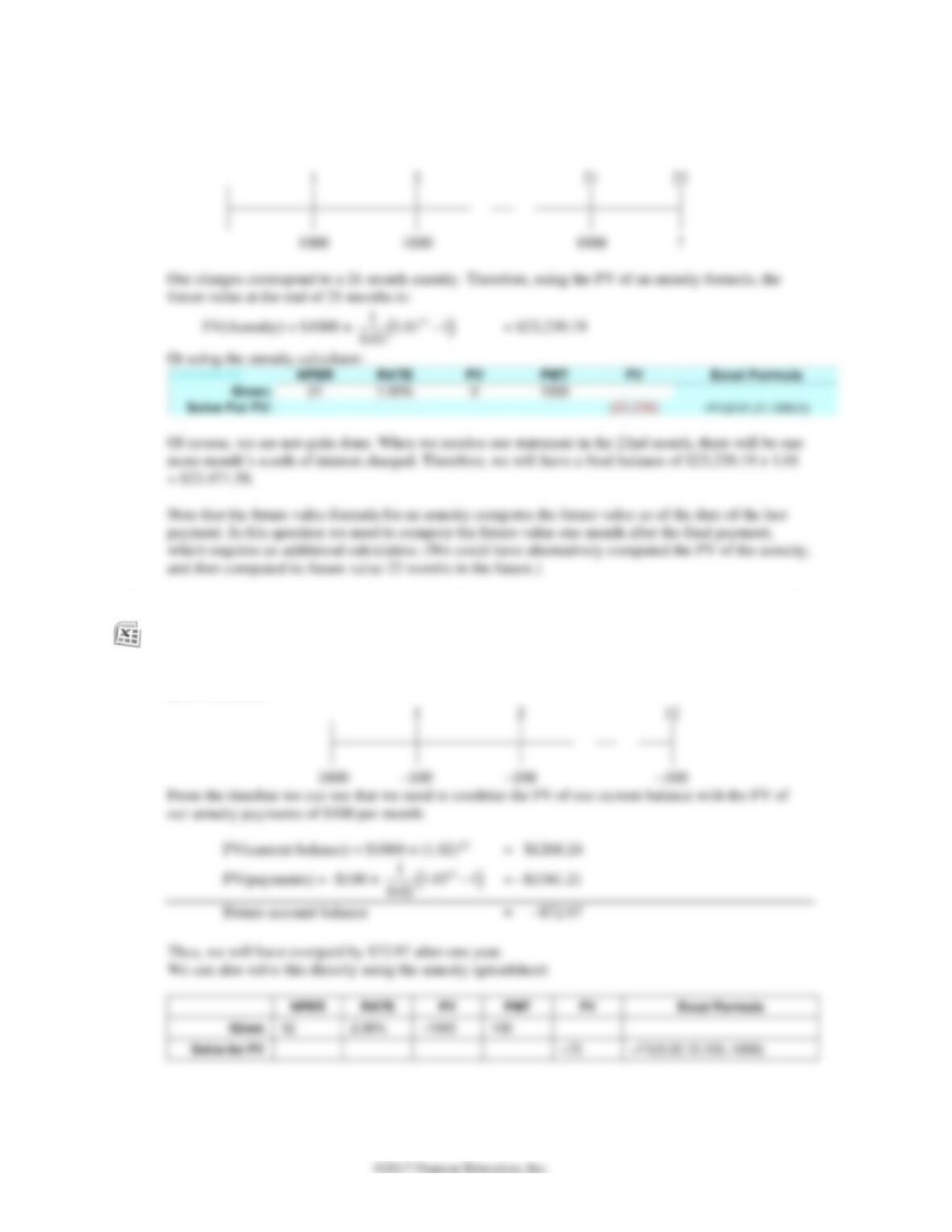
Year Payout Remaining Balance
0 –$ 1,456.15$
2 103.00$ 1,427.13$
4 109.27$ 1,381.80$
6 115.93$ 1,317.36$
8 122.99$ 1,230.63$
10 130.48$ 1,117.98$
12 138.42$ 975.28$
14 146.85$ 797.84$
16 155.80$ 580.32$
18 165.28$ 316.67$
4-32. Suppose you currently have $5000 in your savings account, and your bank pays interest at a rate
of 0.5% per month. If you make no further deposits or withdrawals, how much will you have in
the account in 5 years?
We calculate the future value as FV = C × (1+r)n. The initial amount C = $5000 and the interest rate r =
0.5% per month. Because we have a monthly interest rate, we also need to express the number of
4-33. Your firm spends $5000 every month on printing and mailing costs, sending statements to
customers. If the interest rate is 0.5% per month, what is the present value of eliminating this
cost by sending the statements electronically?
4-34. You have just entered an MBA program and have decided to pay for your living expenses using
a credit card that has no minimum monthly payment. You intend to charge $1000 per month on
the card for the next 21 months. The card carries a monthly interest rate of 1%. How much
money will you owe on the card 22 months from now, when you receive your first statement post–
graduation?
46 Berk/DeMarzo, Corporate Finance, Fourth Edition
We want to compute the future value of our account balance. Let’s begin with the timeline over the
next 12 months:
4-35. Your credit card charges an interest rate of 2% per month. You have a current balance of $1000,
and want to pay it off. Suppose you can afford to pay off $100 per month. What will your
balance be at the end of one year?
We want to compute the future value of our account balance. Let’s begin with the timeline over the
next 12 months:
4-36. You have decided to buy a perpetuity. The bond makes one payment at the end of every year
forever and has an interest rate of 5%. If you initially put $1000 into the bond, what is the
payment every year?
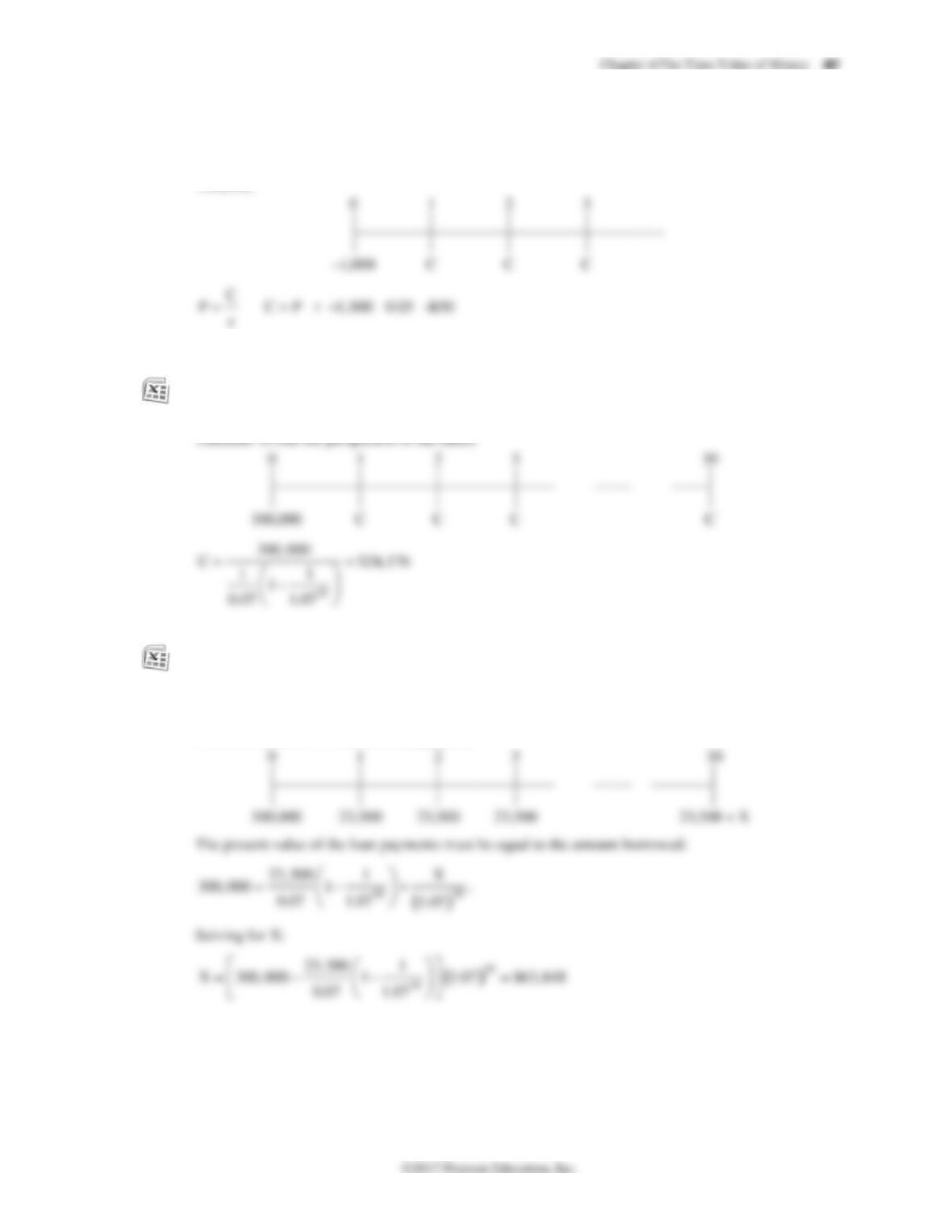
Timeline:
4-37. You are thinking of purchasing a house. The house costs $350,000. You have $50,000 in cash that
you can use as a down payment on the house, but you need to borrow the rest of the purchase
price. The bank is offering a 30-year mortgage that requires annual payments and has an
interest rate of 7% per year. What will your annual payment be if you sign up for this mortgage?
4-38. You would like to buy the house and take the mortgage described in Problem 36. You can afford
to pay only $23,500 per year. The bank agrees to allow you to pay this amount each year, yet still
borrow $300,000. At the end of the mortgage (in 30 years), you must make a balloon payment;
that is, you must repay the remaining balance on the mortgage. How much will this balloon
payment be?
Timeline: (where X is the balloon payment.)
4-39. You have just made an offer on a new home and are seeking a mortgage. You need to borrow
$600,000.
a. The bank offers a 30-year mortgage with fixed monthly payments and an interest rate of
0.5% per month. What is the amount of your monthly payment if you take this loan?
b. Alternatively, you can get a 15-year mortgage with fixed monthly payments and an interest
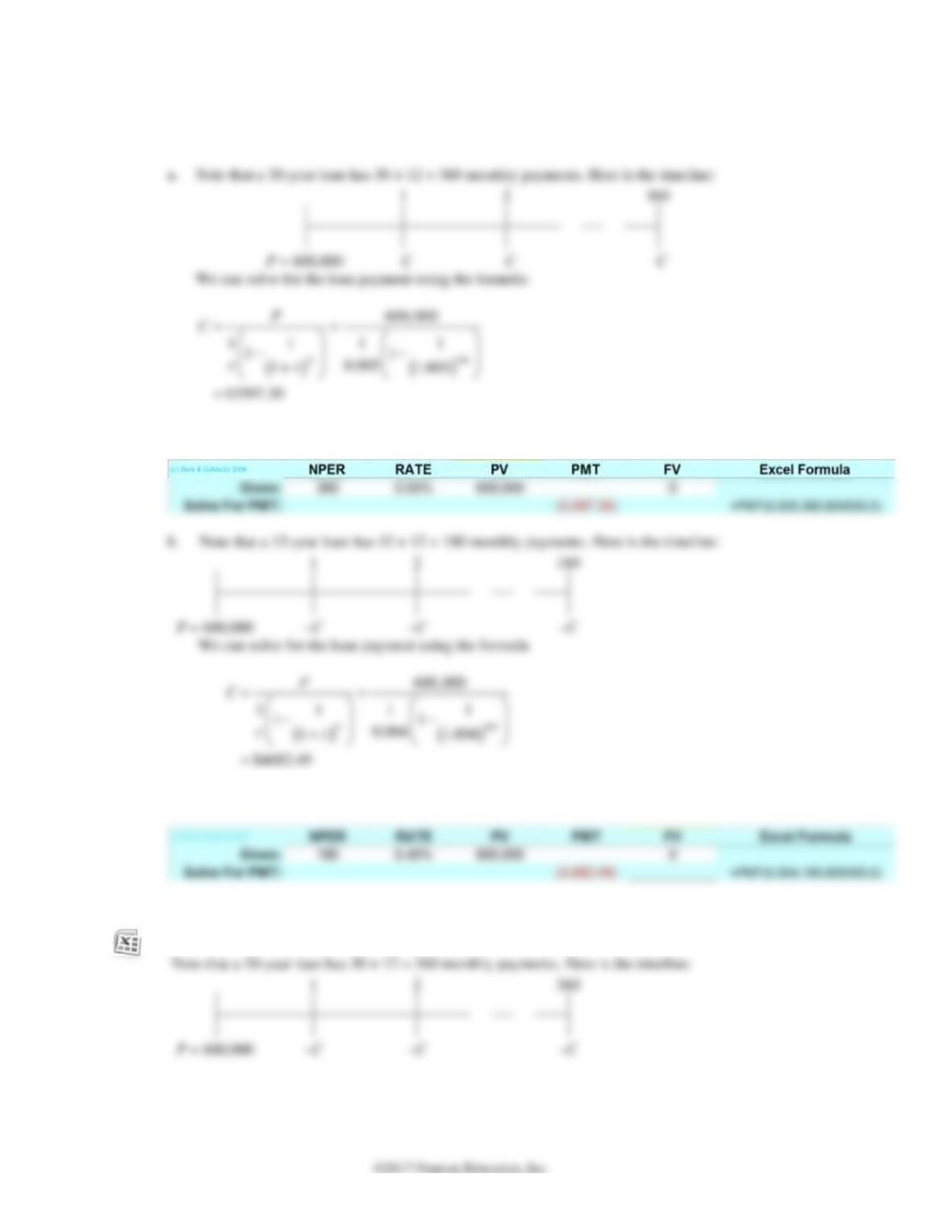
48 Berk/DeMarzo, Corporate Finance, Fourth Edition
rate of 0.4% per month. How much would your monthly payments be if you take this loan
instead?
Or, using the annuity calculator:
Or, using the annuity calculator:
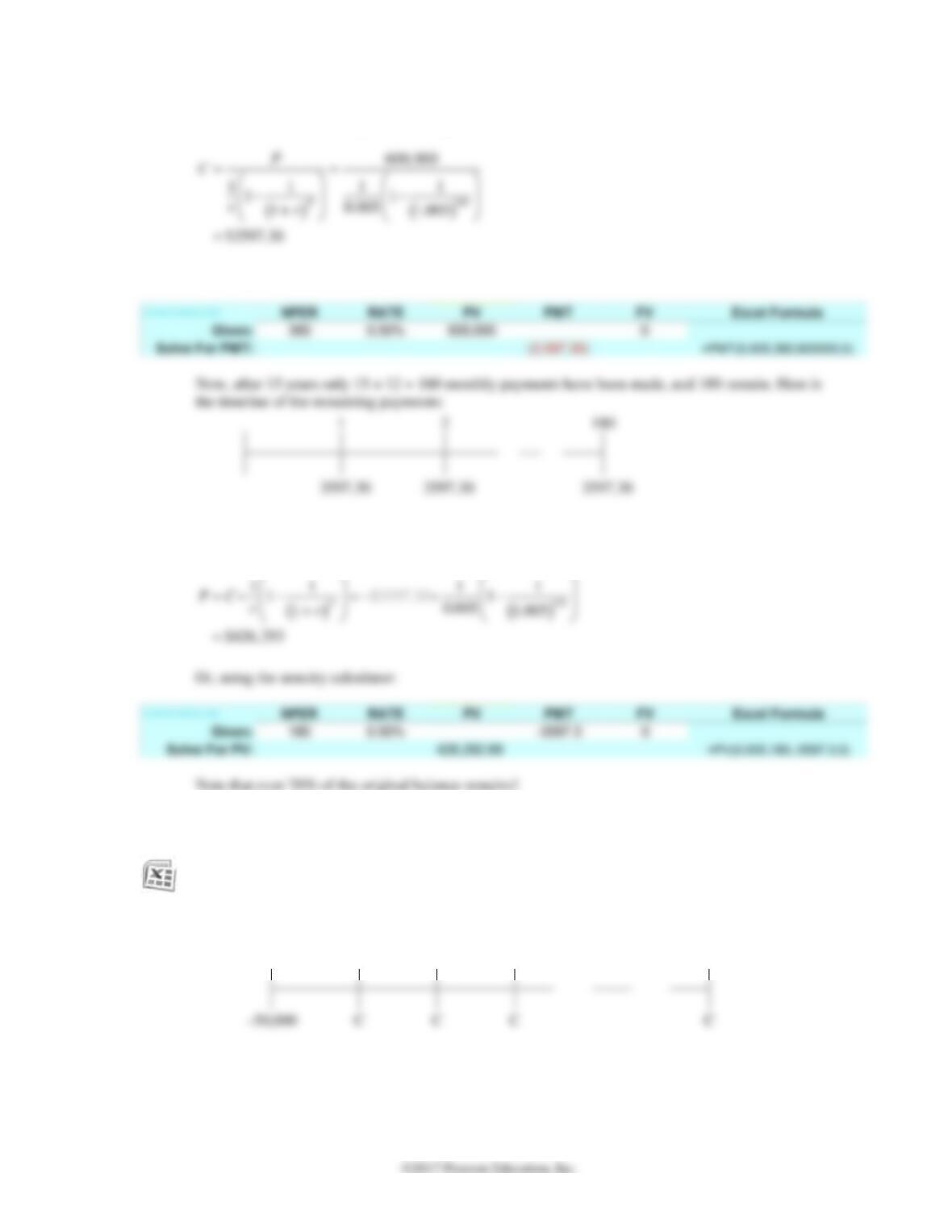
4-40. Suppose you take the 30-year mortgage described in Problem 38 part (a). How much will you
still owe on the mortgage after 15 years?
Chapter 4/The Time Value of Money 49
We can solve for the loan payment using the formula:
Or, using the annuity calculator:
We can solve for the remaining loan amount by calculating the present value of these payments at the
loan rate:
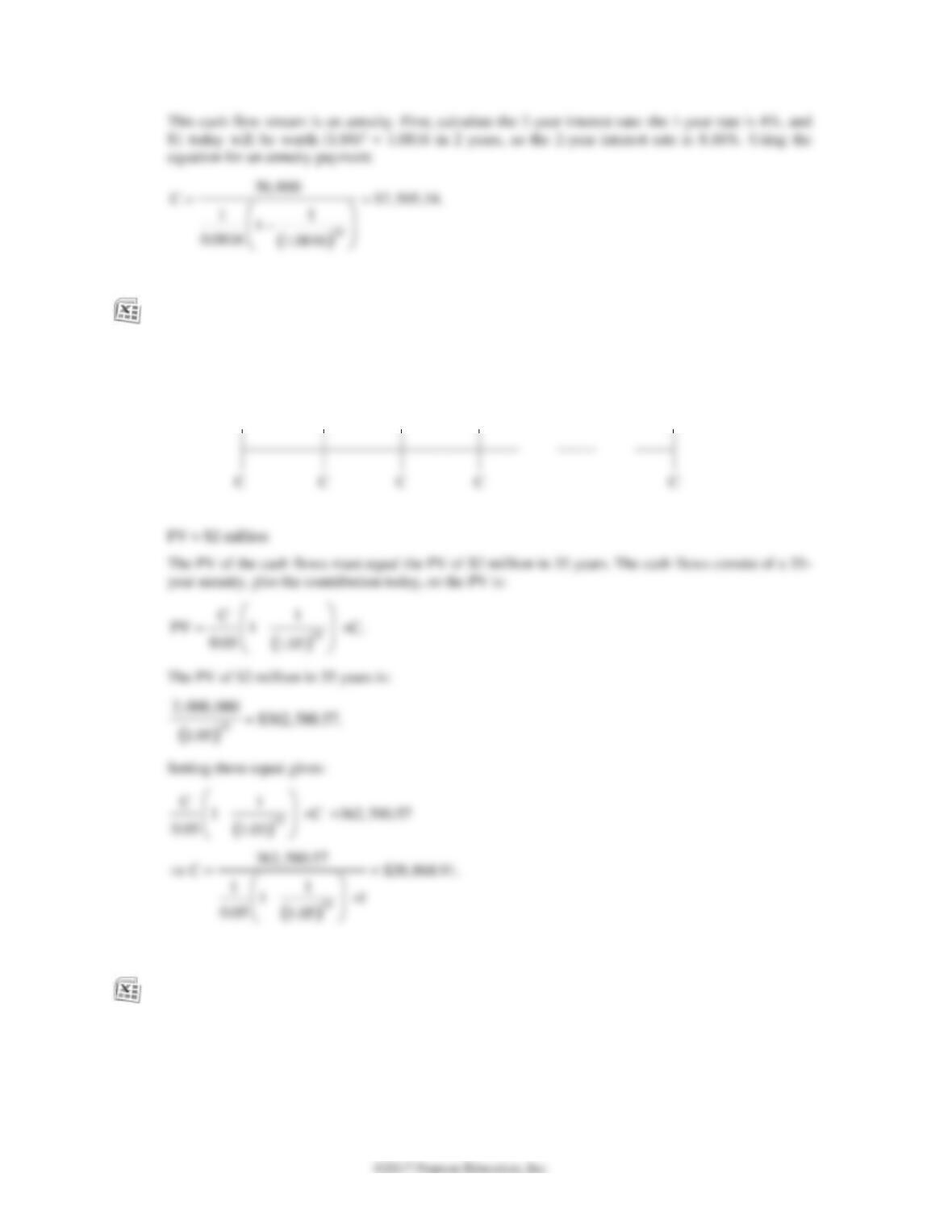
4-41. You are thinking about buying a piece of art that costs $50,000. The art dealer is proposing the
following deal: He will lend you the money, and you will repay the loan by making the same
payment every two years for the next 20 years (i.e., a total of 10 payments). If the interest rate is
4% per year, how much will you have to pay every two years?
Timeline:
0
2
4
6
20
0
1
2
3
10
50 Berk/DeMarzo, Corporate Finance, Fourth Edition
4-42. You are saving for retirement. To live comfortably, you decide you will need to save $2 million
by the time you are 65. Today is your 30th birthday, and you decide, starting today and
continuing on every birthday up to and including your 65th birthday, that you will put the same
amount into a savings account. If the interest rate is 5%, how much must you set aside each year
to make sure that you will have $2 million in the account on your 65th birthday?
Timeline:
30
31
32
33
65
0
1
2
3
35
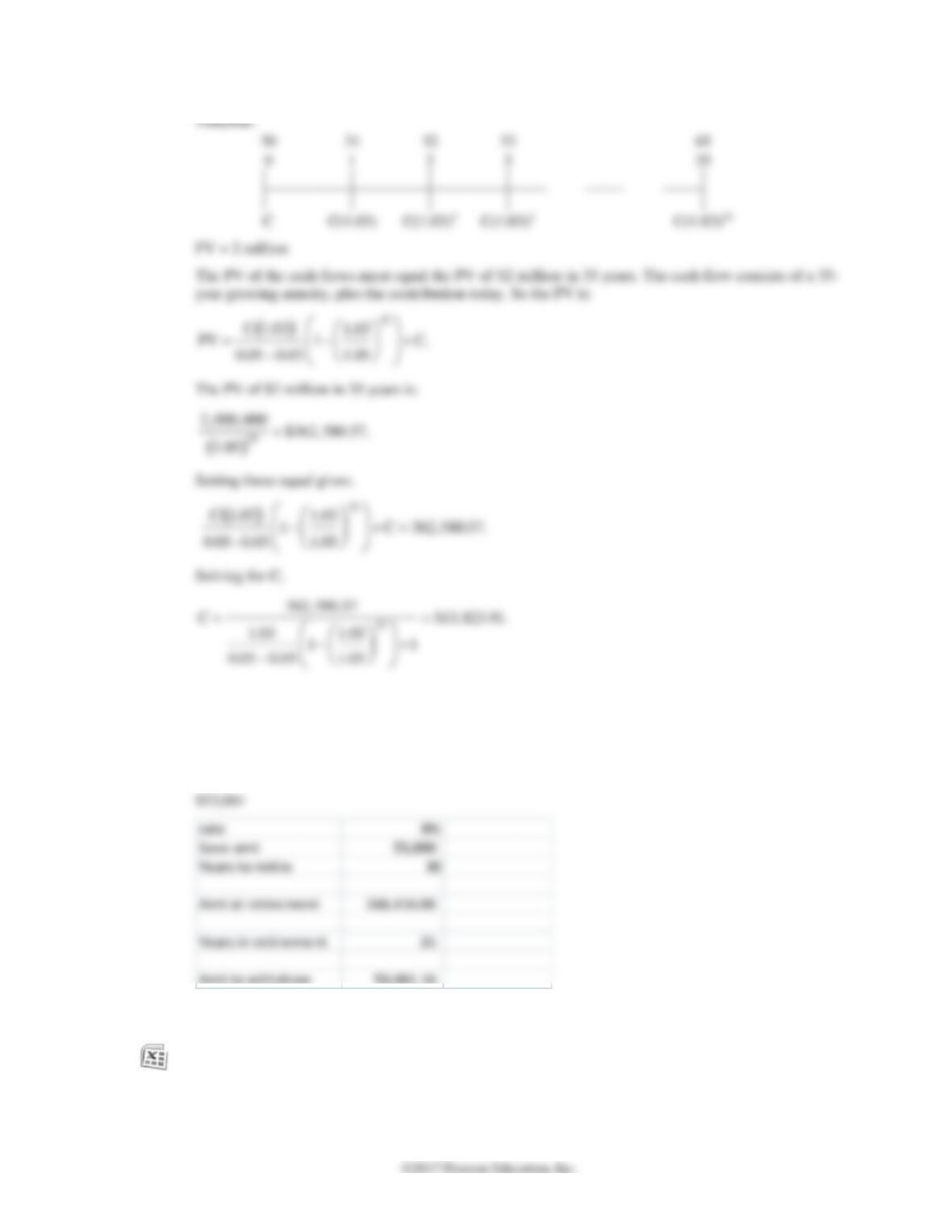
4-43. You realize that the plan in Problem 42 has a flaw. Because your income will increase over your
lifetime, it would be more realistic to save less now and more later. Instead of putting the same
amount aside each year, you decide to let the amount that you set aside grow by 3% per year.
Under this plan, how much will you put into the account today? (Recall that you are planning to
make the first contribution to the account today.)
Chapter 4/The Time Value of Money 51
4-44. You are 35 years old, and decide to save $5000 each year (with the first deposit one year from
now), in an account paying 8% interest per year. You will make your last deposit 30 years from
now when you retire at age 65. During retirement, you plan to withdraw funds from the account
at the end of each year (so your first withdrawal is at age 66). What constant amount will you be
able to withdraw each year if you want the funds to last until you are 90?
4-45. You have just turned 30 years old, have just received your MBA, and have accepted your first
job. Now you must decide how much money to put into your retirement plan. The plan works as
follows: Every dollar in the plan earns 7% per year. You cannot make withdrawals until you
retire on your sixty-fifth birthday. After that point, you can make withdrawals as you see fit.
You decide that you will plan to live to 100 and work until you turn 65. You estimate that to live
comfortably in retirement, you will need $100,000 per year starting at the end of the first year of
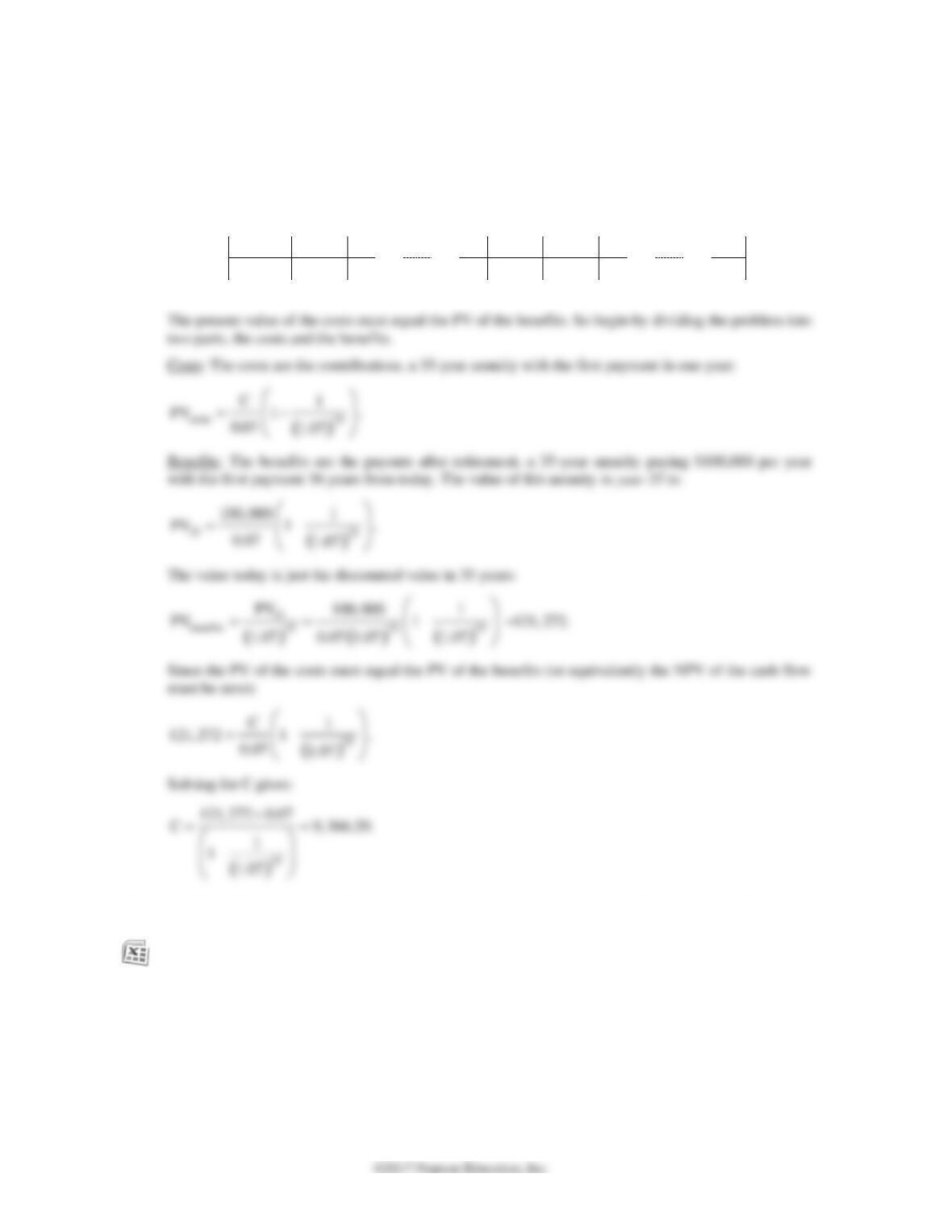
52 Berk/DeMarzo, Corporate Finance, Fourth Edition
retirement and ending on your 100th birthday. You will contribute the same amount to the plan
at the end of every year that you work. How much do you need to contribute each year to fund
your retirement?
Timeline:
30
31
32
65
66
67
100
0
1
2
35
36
37
70
–C
–C
–C
100
100
100
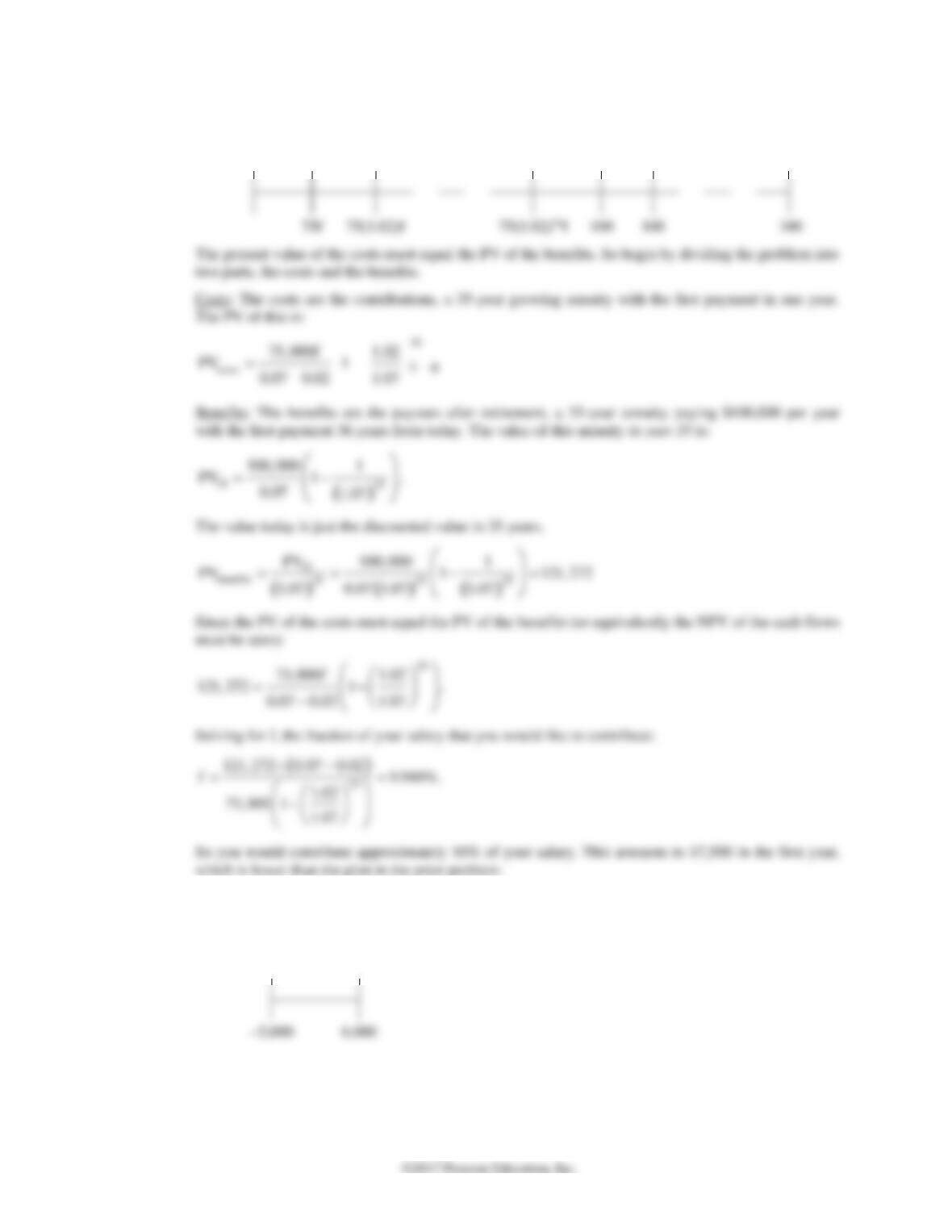
4-46. Problem 45 is not very realistic because most retirement plans do not allow you to specify a fixed
amount to contribute every year. Instead, you are required to specify a fixed percentage of your
salary that you want to contribute. Assume that your starting salary is $75,000 per year and it
will grow 2% per year until you retire. Assuming everything else stays the same as in Problem
45, what percentage of your income do you need to contribute to the plan every year to fund the
same retirement income?
Chapter 4/The Time Value of Money 53
Timeline: (f = Fraction of your salary that you contribute)
30
31
32
65
66
67
100
0
1
2
35
36
37
70
100
4-47. You have an investment opportunity that requires an initial investment of $5000 today and will
pay $6000 in one year. What is the IRR of this opportunity?
Timeline:
0
1
6,000
54 Berk/DeMarzo, Corporate Finance, Fourth Edition
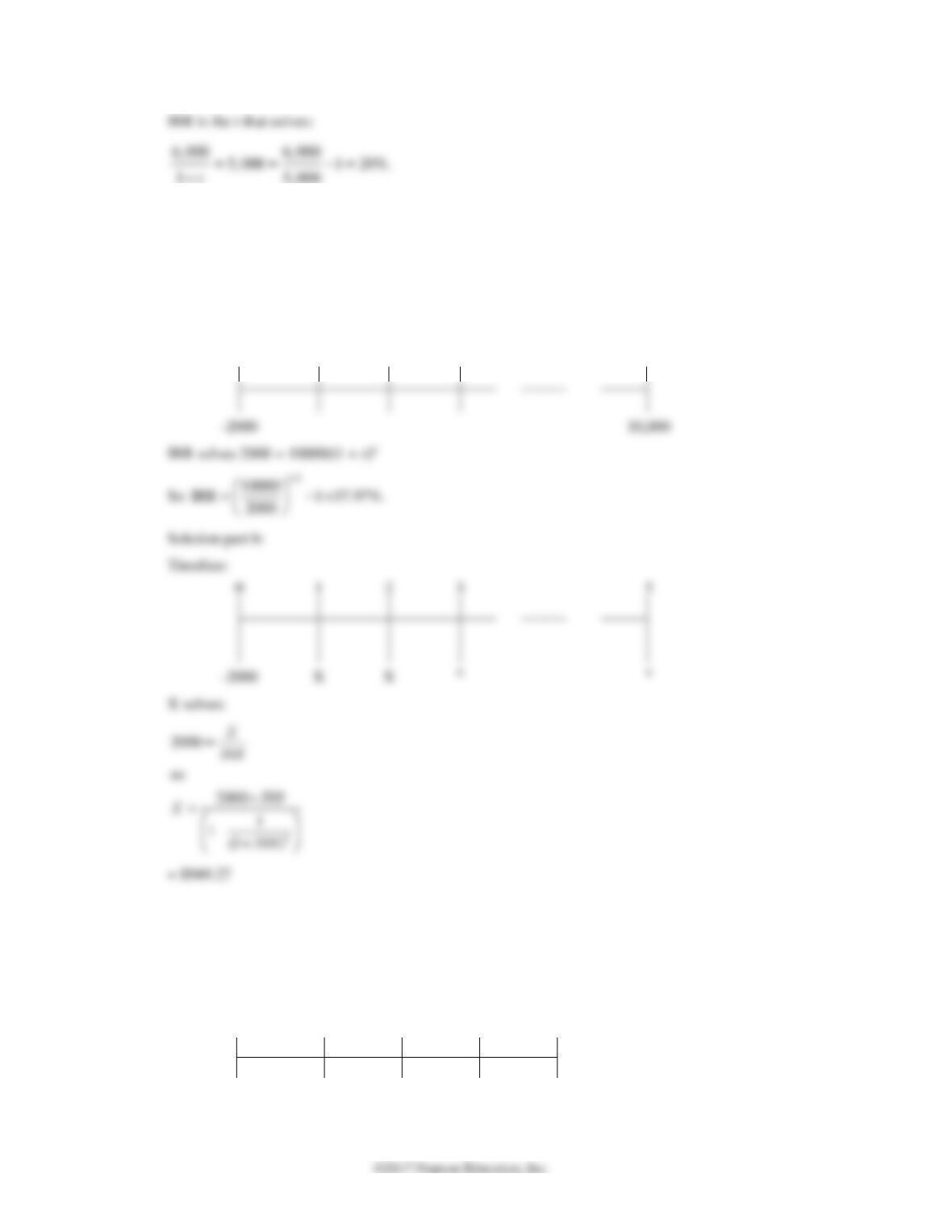
4-48. Suppose you invest $2000 today and receive $10,000 in five years.
a. What is the IRR of this opportunity?
b. Suppose another investment opportunity also requires $2000 upfront, but pays an equal
amount at the end of each year for the next five years. If this investment has the same IRR as
the first one, what is the amount you will receive each year?
Timeline:
0
1
2
3
5
0
1
2
3
5
4-49. You are shopping for a car and read the following advertisement in the newspaper: “Own a new
Spitfire! No money down. Four annual payments of just $10,000.” You have shopped around and
know that you can buy a Spitfire for cash for $32,500. What is the interest rate the dealer is
advertising (what is the IRR of the loan in the advertisement)? Assume that you must make the
annual payments at the end of each year.
Timeline:
0
1
2
3
4
–32,500
10,000
10,000
10,000
10,000
Chapter 4/The Time Value of Money 55
The PV of the car payments is a 4-year annuity:
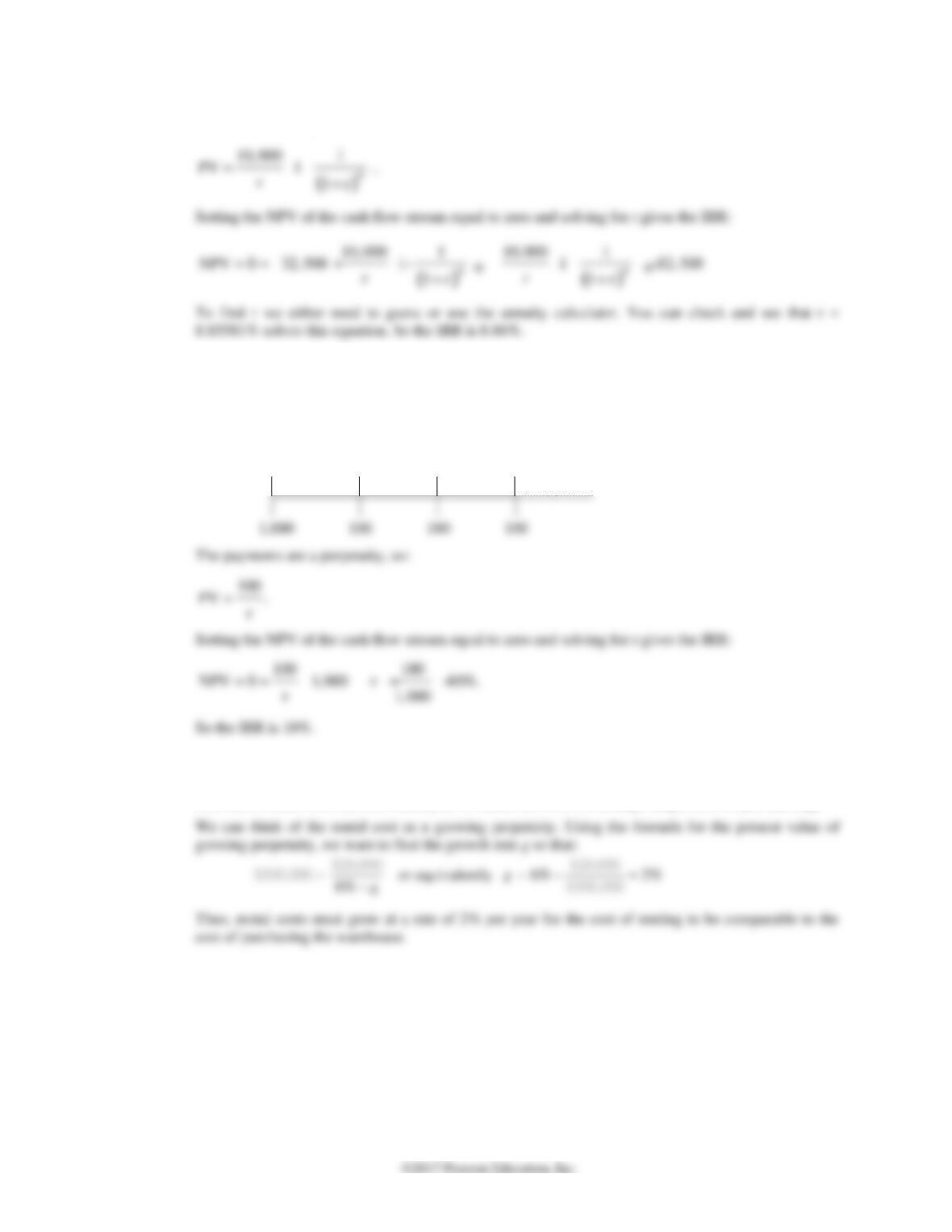
4-50. A local bank is running the following advertisement in the newspaper: “For just $1000 we will
pay you $100 forever!” The fine print in the ad says that for a $1000 deposit, the bank will pay
$100 every year in perpetuity, starting one year after the deposit is made. What interest rate is
the bank advertising (what is the IRR of this investment)?
Timeline:
0
1
2
3
4-51. You are considering purchasing a warehouse. The cost to purchase the warehouse is $500,000.
Renting the equivalent space costs $20,000 per year. If the annual interest rate is 6%, at what
rate must rental cost increase each year to make the cost of renting comparable to purchasing?
4-52. The Tillamook County Creamery Association manufactures Tillamook Cheddar Cheese. It
markets this cheese in four varieties: aged 2 months, 9 months, 15 months, and 2 years. At the
shop in the dairy, it sells 2 pounds of each variety for the following prices: $7.95, $9.49, $10.95,
and $11.95, respectively. Consider the cheese maker’s decision whether to continue to age a
particular 2-pound block of cheese. At 2 months, he can either sell the cheese immediately or let
it age further. If he sells it now, he will receive $7.95 immediately. If he ages the cheese, he must
give up the $7.95 today to receive a higher amount in the future. What is the IRR (expressed in
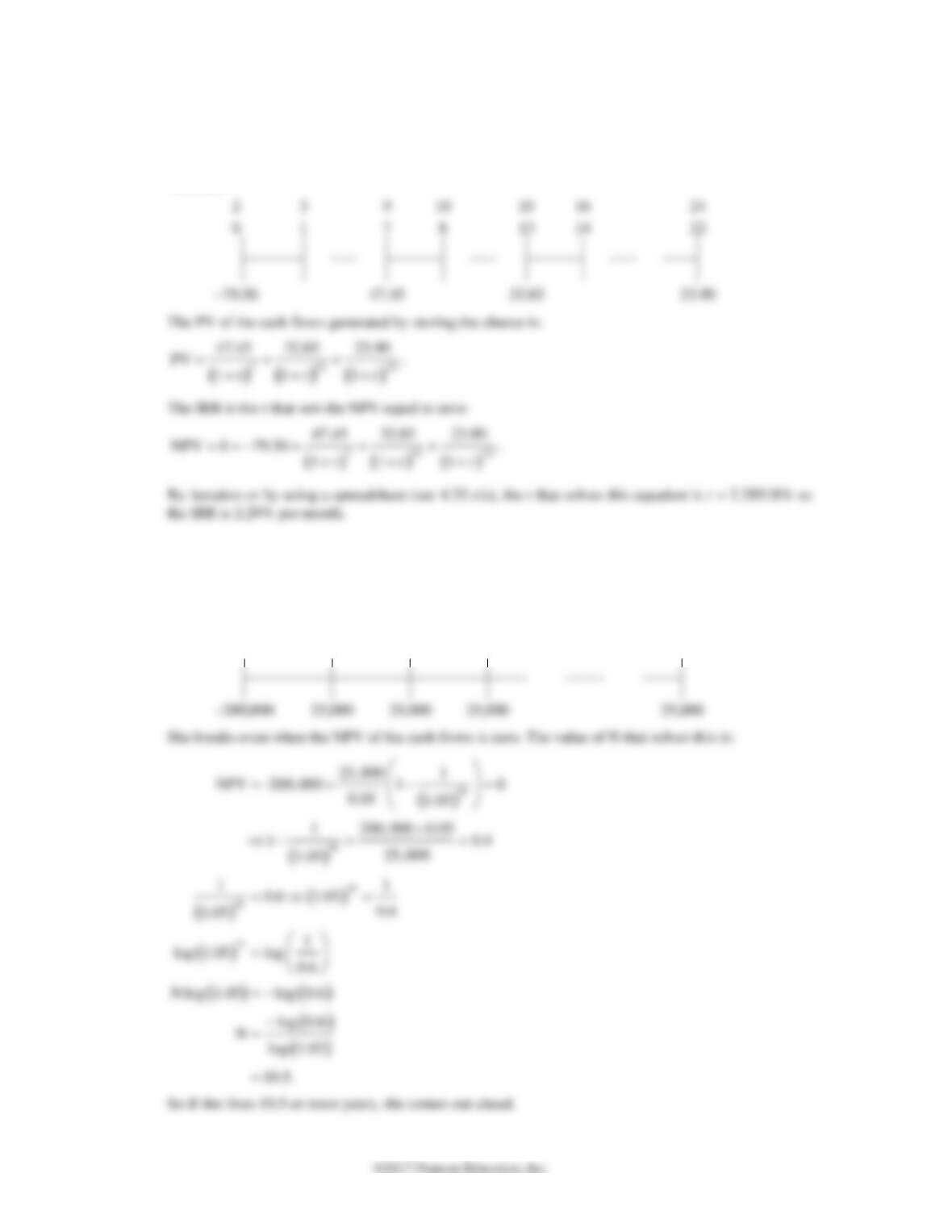
percent per month) of the investment of giving up $79.50 today by choosing to store 20 pounds of
56 Berk/DeMarzo, Corporate Finance, Fourth Edition
cheese that is currently 2 months old and instead selling 10 pounds of this cheese when it has
aged 9 months, 6 pounds when it has aged 15 months, and the remaining 4 pounds when it has
aged 2 years?
Timeline:
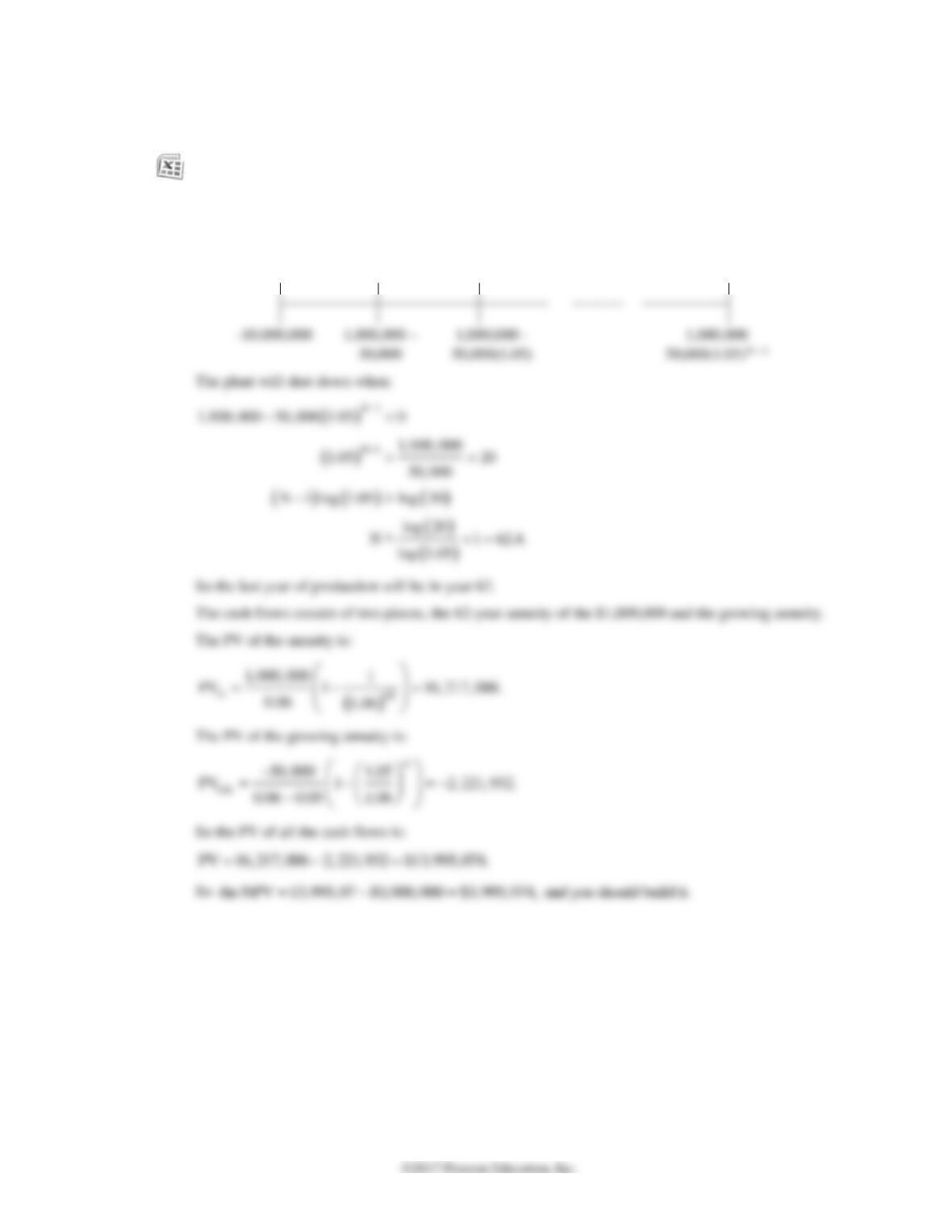
4-A.1. Your grandmother bought an annuity from Rock Solid Life Insurance Company for $200,000
when she retired. In exchange for the $200,000, Rock Solid will pay her $25,000 per year until
she dies. The interest rate is 5%. How long must she live after the day she retired to come out
ahead (that is, to get more in value than what she paid in)?
Timeline:
0
1
2
3
N
Chapter 4/The Time Value of Money 57
4-A.2. You are thinking of making an investment in a new plant. The plant will generate revenues of $1
million per year for as long as you maintain it. You expect that the maintenance cost will start at
$50,000 per year and will increase 5% per year thereafter. Assume that all revenue and
maintenance costs occur at the end of the year. You intend to run the plant as long as it continues
to make a positive cash flow (as long as the cash generated by the plant exceeds the maintenance
costs). The plant can be built and become operational immediately. If the plant costs $10 million
to build, and the interest rate is 6% per year, should you invest in the plant?
Timeline:
0
1
2
N