Mini Case: 4 – 32
h. 4. What is the effective annual rate (EAR or EFF%)? What is the EFF% for a
nominal rate of 12%, compounded semiannually? Compounded quarterly?
Compounded monthly? Compounded daily?
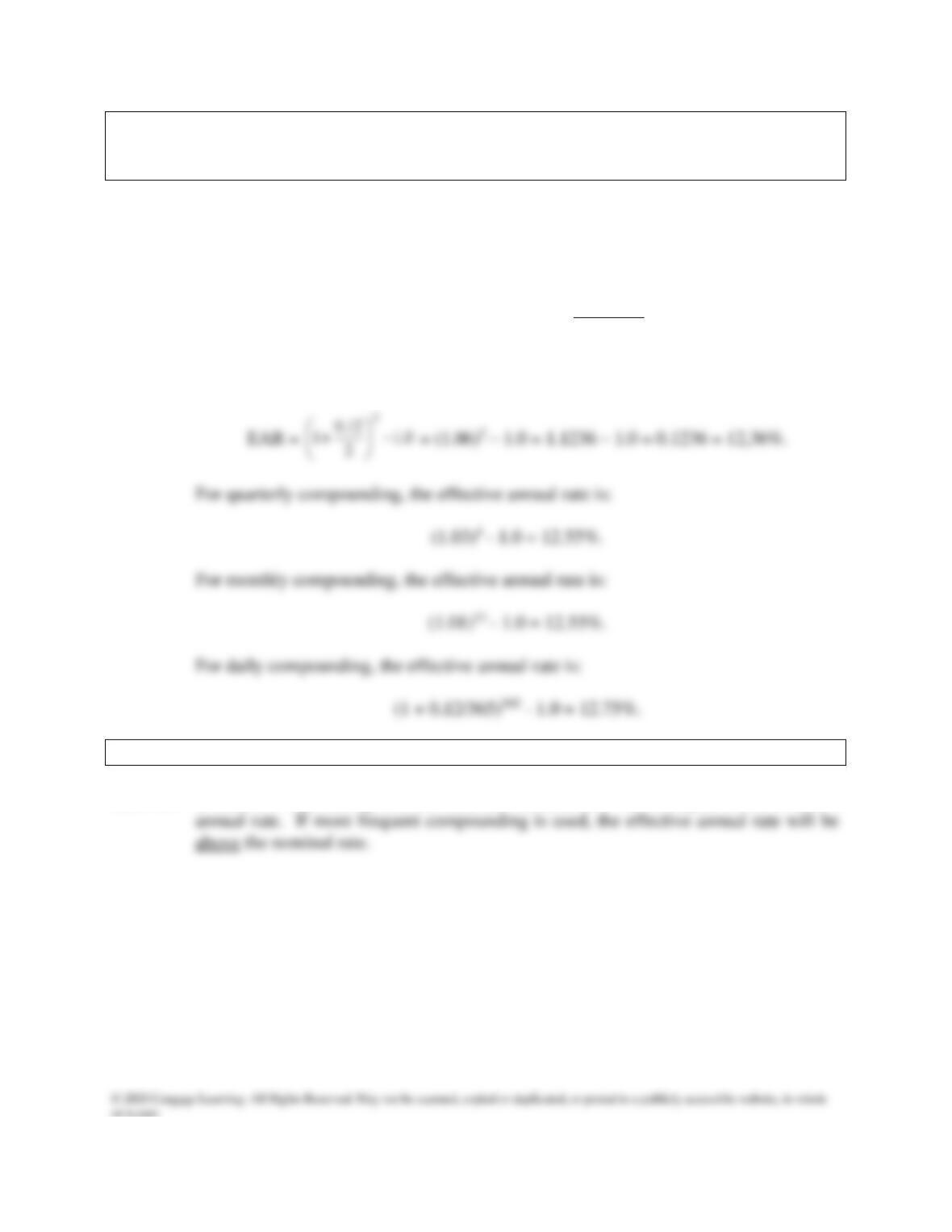
Answer: The effective annual rate is the annual rate that causes the PV to grow to the same FV
as under multi-period compounding. For 12 percent semiannual compounding, the ear
is 12.36 percent:
EAR = Effective Annual Rate =
.0.1
M
I1 M
NOM −
+
IF iNom = 12% and interest is compounded semiannually, then:
i. Will the effective annual rate ever be equal to the nominal (quoted) rate?
Answer: If annual compounding is used, then the nominal rate will be equal to the effective
Mini Case: 4 -33
j. 1. Construct an amortization schedule for a $1,000, 10% annual rate loan with 3
equal installments.
2. What is the annual interest expense for the borrower, and the annual interest
income for the lender, during Year 2?
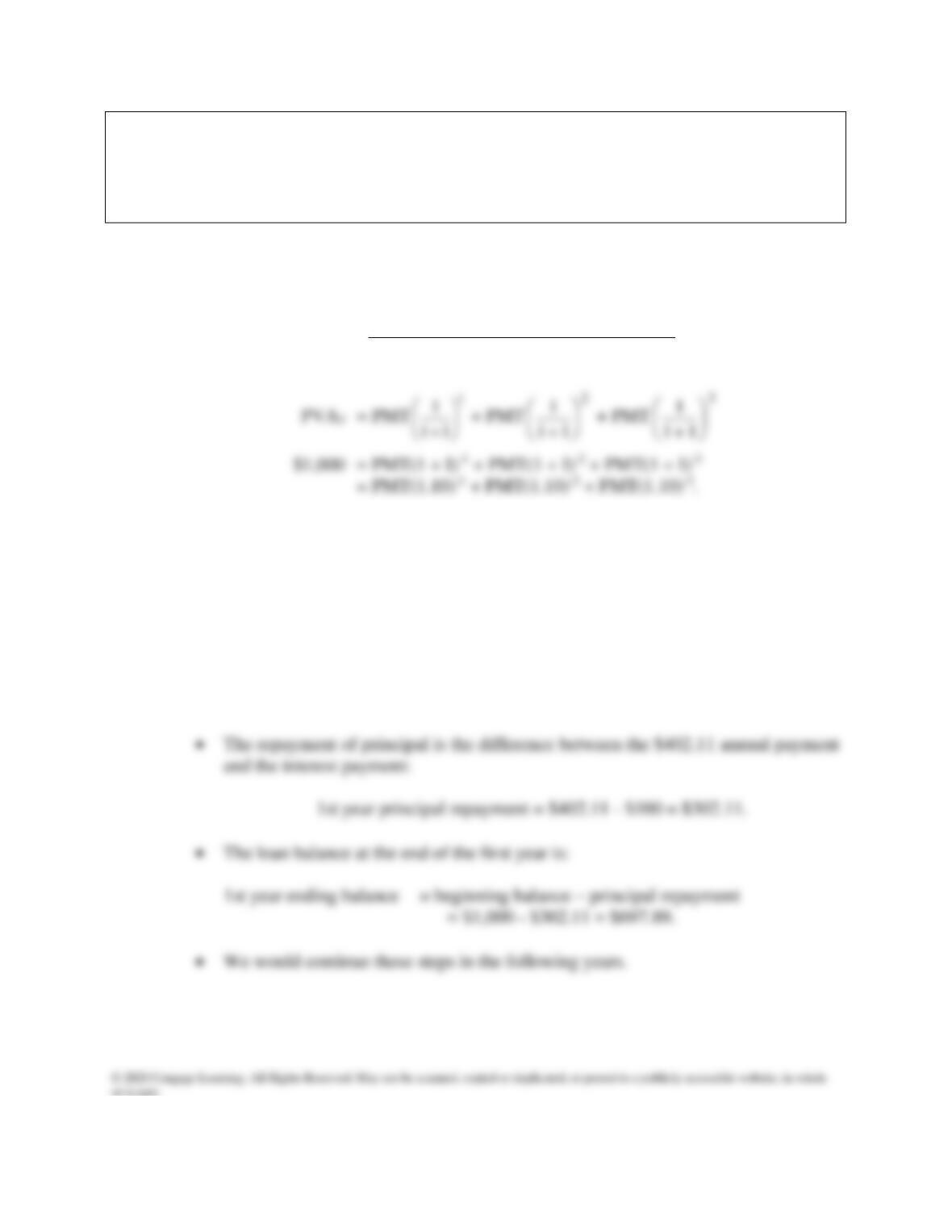
Answer: To begin, note that the face amount of the loan, $1,000, is the present value of a 3-year
annuity at a 10 percent rate:
0 1 2 3
| | | |
-1,000 PMT PMT PMT
We have an equation with only one unknown, so we can solve it to find PMT. The
easy way is with a financial calculator. Input N = 3, I/YR = 10, PV = -1,000, FV = 0,
and then press the PMT button to get PMT = 402.1148036, rounded to $402.11.
Now make the following points regarding the amortization schedule:
• The $402.11 annual payment includes both interest and principal. Interest in the
first year is calculated as follows:
1st year interest = I beginning balance = 0.1 $1,000 = $100.
10%
• Notice that the interest each year declines because the beginning loan balance is
declining. Since the payment is constant, but the interest component is declining,
the principal repayment portion is increasing each year.
• Most financial calculators have amortization functions built in.
k. Suppose on January 1 you deposit $100 in an account that pays a nominal, or
quoted, interest rate of 11.33463%, with interest added (compounded) daily. How
much will you have in your account on October 1, or 9 months later?
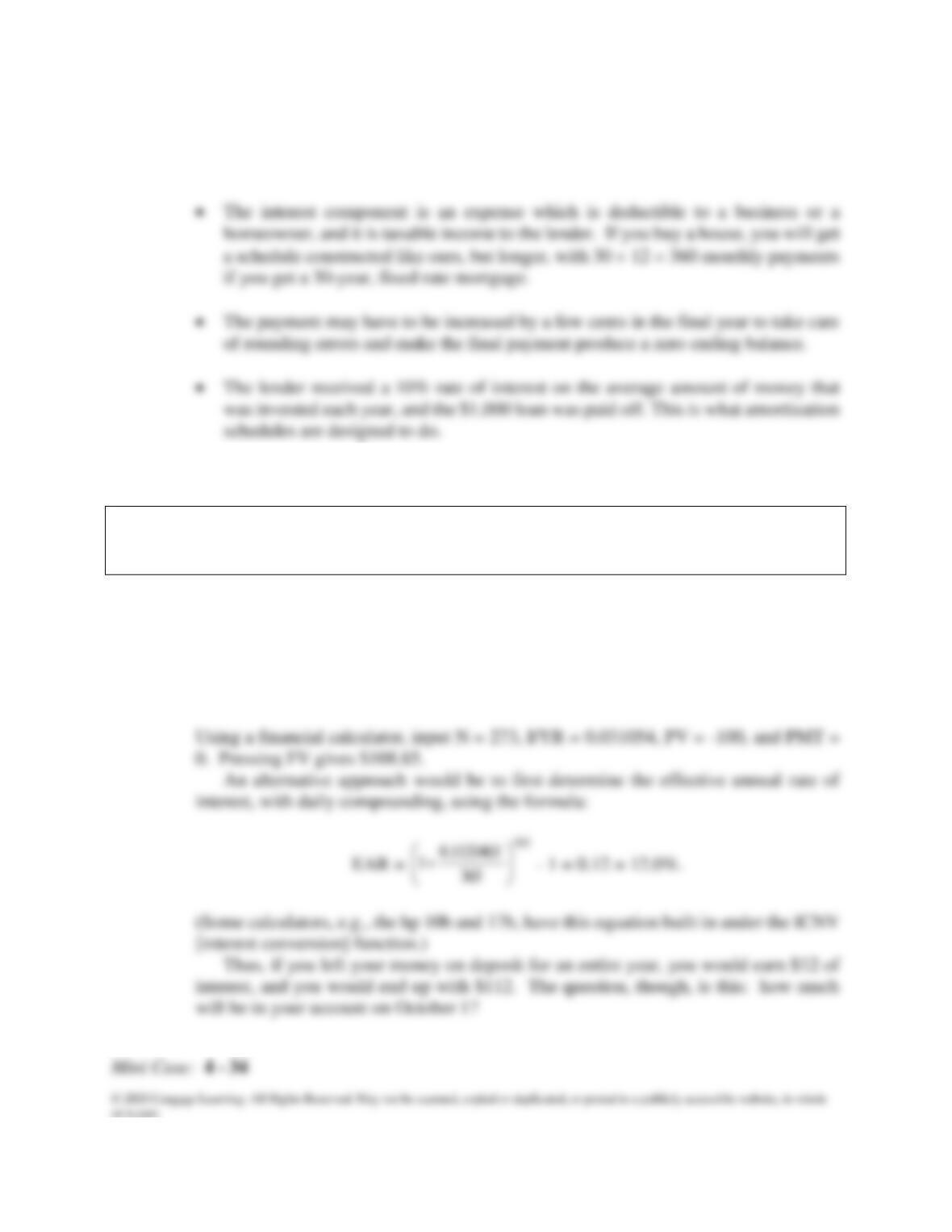
Answer: The daily periodic interest rate is IPER = 11.3346%/365 = 0.031054%. There are 273
days between January 1 and October 1. Calculate FV as follows:
FV273 = $100(1.00031054)273
= $108.85.
Mini Case: 4 -35
This is slightly different from our earlier answer, because n is actually 273/365 =
0.7479 rather than 0.75.
Fractional time periods
Thus far all of our examples have dealt with full years. Now we are going to look at
the situation when we are dealing with fractional years, such as 9 months, or 10 years.
In these situations, proceed as follows:
• As always, start by drawing a time line so you can visualize the situation.
• Then think about the interest rate—the nominal rate, the compounding periods per
year, and the effective annual rate. If you have been given a nominal rate, you may
have to convert to the ear, using this formula:
EAR =
1
M
I
1
M
NOM −
+
.
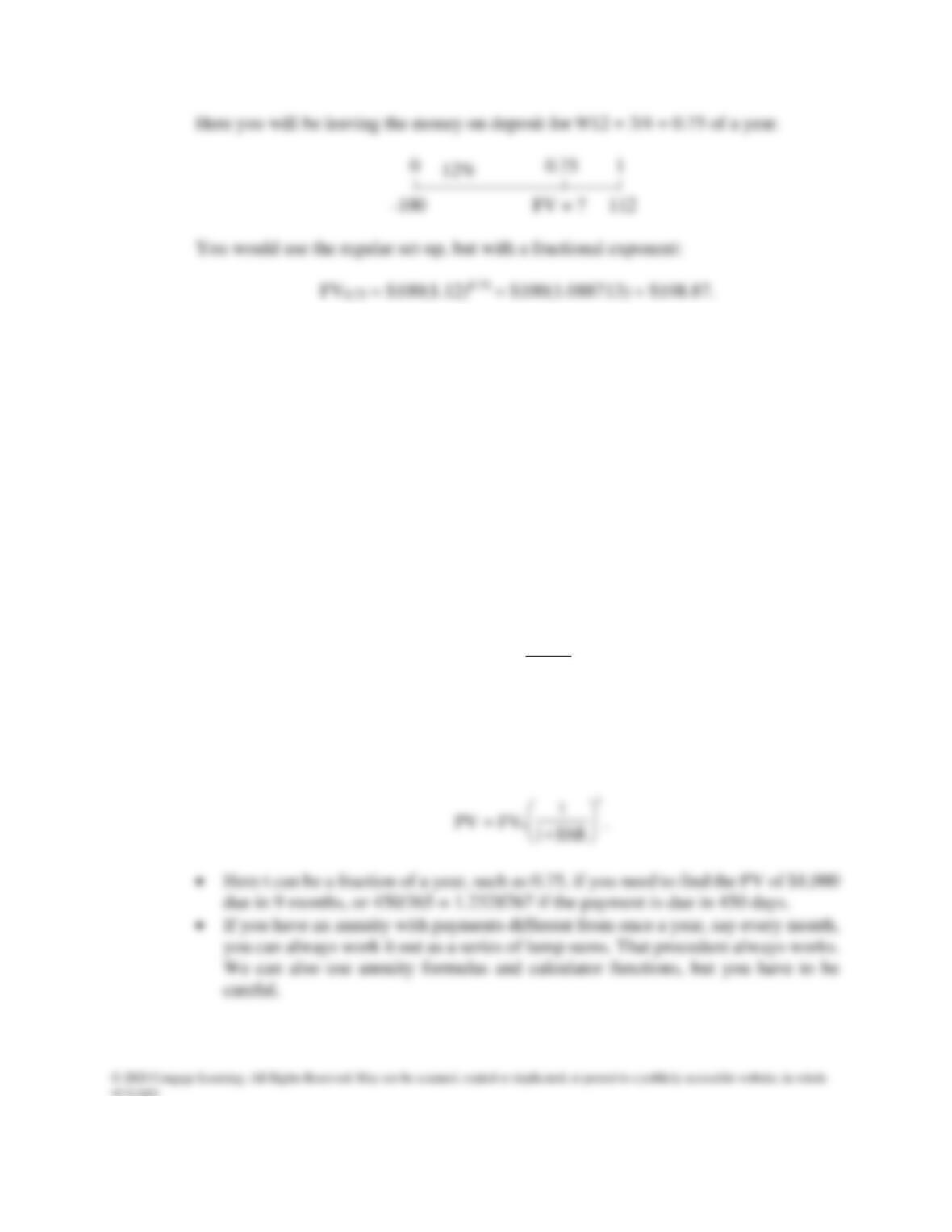
• If you have the effective annual rate—either because it was given to you or after you
calculated it with the formula—then you can find the PV of a lump sum by applying
this equation:
Mini Case: 4 – 36
l. 1. What is the value at the end of Year 3 of the following cash flow stream if the
quoted interest rate is 10%, compounded semiannually?
0 1 2 3 Years
| | | | | | |
100 100 100
Answer: 0 1 2 3
| | | | | | |
100 100 100
110.25 = 100(1.05)2
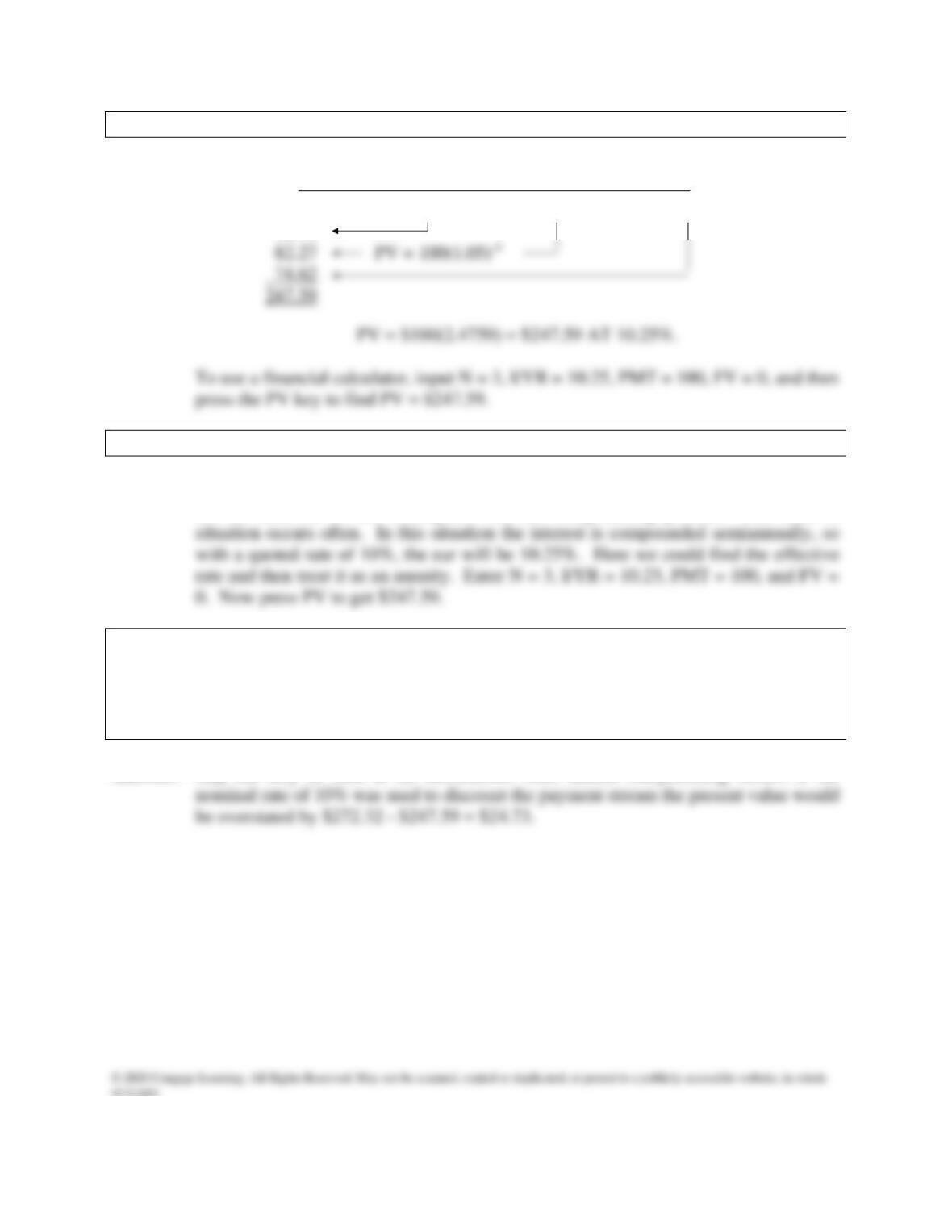
Here we have a different situation. The payments occur annually, but compounding
occurs each 6 months. Thus, we cannot use normal annuity valuation techniques.
There are two approaches that can be applied: (1) treat the cash flows as lump sums, as
was done above, or (2) treat the cash flows as an ordinary annuity, but use the effective
annual rate:
5%
Mini Case: 4 -37
l. 2. What is the PV of the same stream?
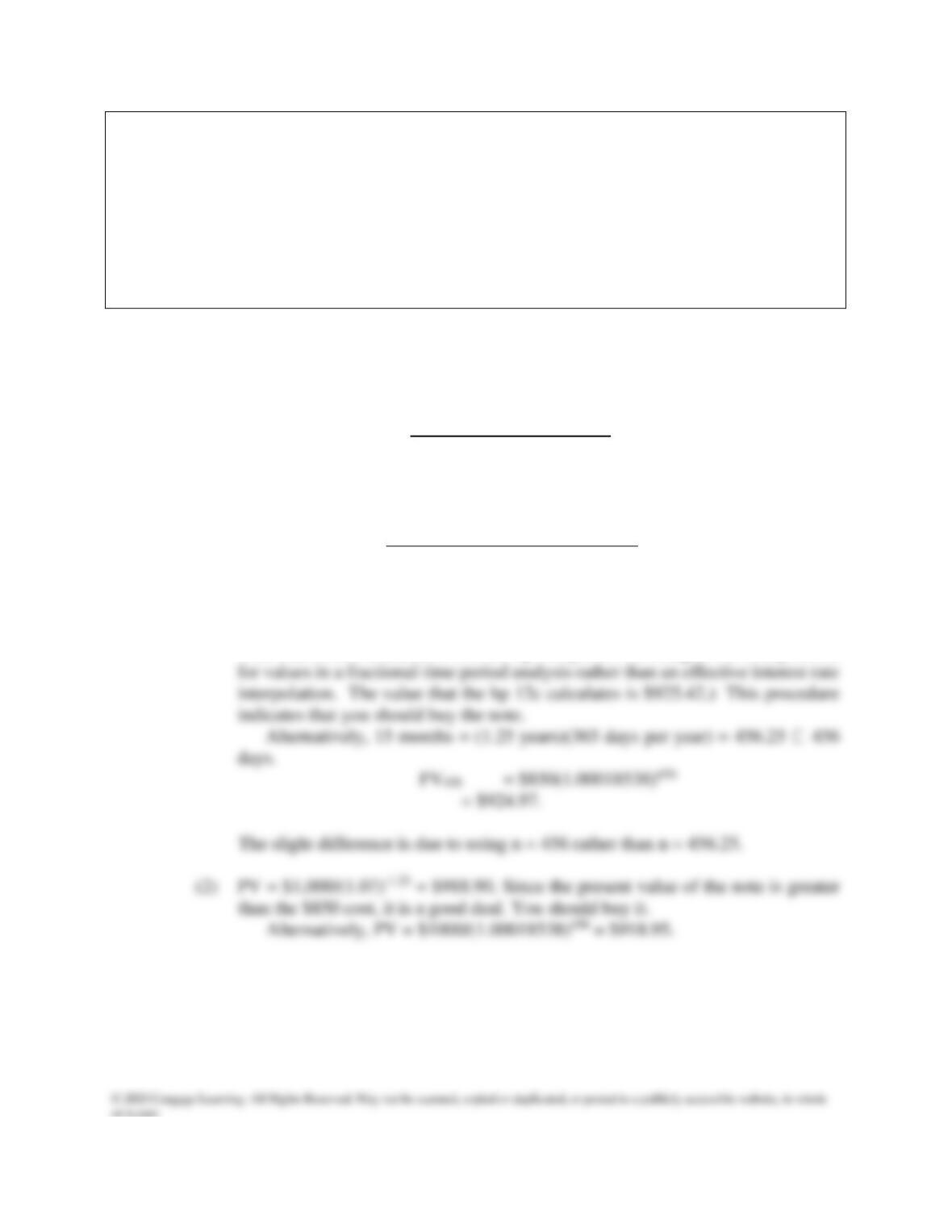
Answer: 0 1 2 3
| | | | | | |
100 100 100
l. 3. Is the stream an annuity?
Answer: The payment stream is an annuity in the sense of constant amounts at regular intervals,
but the intervals do not correspond with the compounding periods. This kind of
l. 4. An important rule is that you should never show a nominal rate on a time line or
use it in calculations unless what condition holds? (Hint: Think of annual
compounding, when INOM = EFF% = IPER.) What would be wrong with your
answer to questions l(1) and l(2) if you used the nominal rate (10%) rather than
the periodic rate (INOM /2 = 10%/2 = 5%)?
5%
Mini Case: 4 – 38
m. Suppose someone offered to sell you a note calling for the payment of $1,000 15
months from today. They offer to sell it to you for $850. You have $850 in a bank
time deposit which pays a 6.76649% nominal rate with daily compounding, which
is a 7% effective annual interest rate, and you plan to leave the money in the bank
unless you buy the note. The note is not risky—you are sure it will be paid on
schedule. Should you buy the note? Check the decision in three ways: (1) by
comparing your future value if you buy the note versus leaving your money in the
bank, (2) by comparing the PV of the note with your current bank account, and
(3) by comparing the EFF% on the note versus that of the bank account.
Answer: You can solve this problem in three ways—(1) by compounding the $850 now in the
bank for 15 months and comparing that FV with the $1,000 the note will pay, (2) by
finding the PV of the note and then comparing it with the $850 cost, and (3) finding the
effective annual rate of return on the note and comparing that rate with the 7% you are
now earning, which is your opportunity cost of capital. All three procedures lead to
the same conclusion. Here is the time line:
0 1 1.25
| | |
-850 1,000
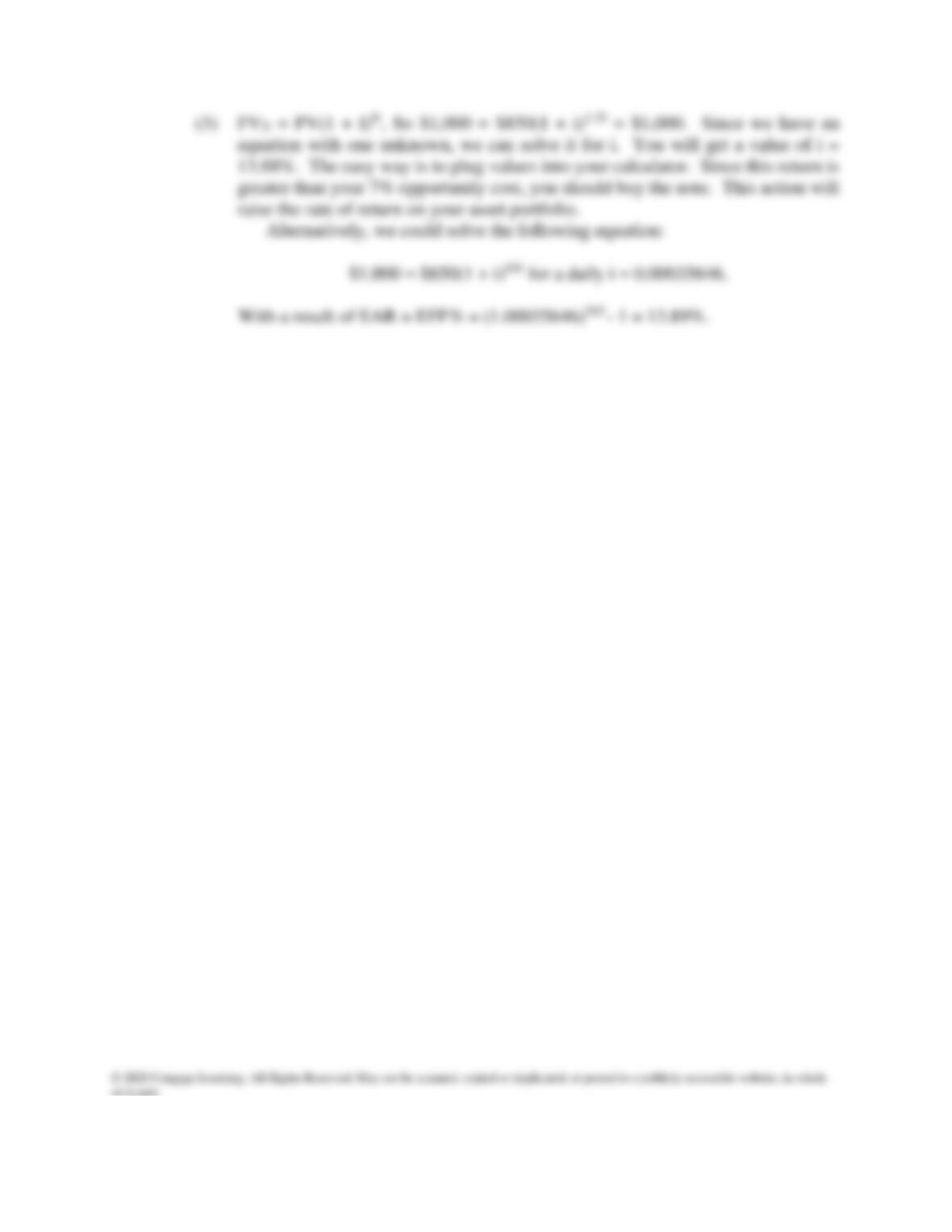
(1) FV = $850(1.07)1.25 = $925.01 = amount in bank after 15 months versus $1,000
if you buy the note. (Again, you can find this value with a financial calculator.
Note that certain calculators like the hp 12c perform a straight-line interpolation
7%
Mini Case: 4 -39
Web Extension 4B: 4 – 40
Web Extension 4B Continuous Compounding and Discounting
Solutions to Problems
4B-1 FV15 = $15,000e0.06(15) = $36,894.05.
4B-2 PV = FVN/eIN = $200,000/e0.09(7) = $200,000/1.8776= $106,518.36.
4B-4 Calculate the growth factor using PV and FV which are given:
FVN = PVeIN; $40,000 = $20,000eI6
eI6 = 2.0.
Take the natural logarithm of both sides:
I(6)ln e = ln 2.00.
The natural log of e = 1.0.
Inputs: 2.0. Press LN key. Output: LN = 0.6931.
I(6)ln e = ln 2.0
I(6) = 0.6931
I = 0.1155 = 11.55%.
Web Extension 4B: 4 –41
4B-7 e(0.03)(10) =
20
NOM
2
I
1
+
e0.3 =
20
NOM
2
I
1
+
e0.3/20 = 1 +
2
INOM
1.01511 = 1 +
2
INOM
2
INOM
= 0.01511
INOM = 0.0302 = 3.02%.
4B-8 Step 1: Calculate the FV of the $2,000 deposit at 8% with continuous compounding:
Using ex key: