Answers and Solutions: 4 -1
Chapter 4
Time Value of Money
ANSWERS TO END-OF-CHAPTER QUESTIONS
4-1 a. PV (present value) is the value today of a future payment, or stream of payments,
discounted at the appropriate rate of interest. PV is also the beginning amount that will
grow to some future value. The parameter i is the periodic interest rate that an account
pays. The parameter INT is the dollars of interest earned each period. FVn (future
value) is the ending amount in an account, where n is the number of periods the money
outflow (a deposit, a cost, or an amount paid). We distinguish between the terms cash
flow and PMT. We use the term cash flow for uneven streams, while we use the term
PMT for annuities, or constant payment amounts. An uneven cash flow stream is a
series of cash flows in which the amount varies from one period to the next. The PV
(or FVn) of an uneven payment stream is merely the sum of the present values (or future
the future value of an uneven cash flow stream.
Answers and Solutions: 4 – 2
g. Compounding is the process of finding the future value of a single payment or series
of payments. Discounting is the process of finding the present value of a single
payment or series of payments; it is the reverse of compounding.
effective annual rate is greater than the nominal rate. The nominal annual interest rate
is also called the annual percentage rate, or APR. The periodic rate, iPER, is the rate
charged by a lender or paid by a borrower each period. It can be a rate per year, per 6–
month period, per quarter, per month, per day, or per any other time interval (usually
one year or less).
4-2 The opportunity cost rate is the rate of interest one could earn on an alternative investment
with a risk equal to the risk of the investment in question. This is the value of i in the TVM
equations, and it is shown on the top of a time line, between the first and second tick marks.
It is not a single rate—the opportunity cost rate varies depending on the riskiness and
maturity of an investment, and it also varies from year to year depending on inflationary
expectations.
4-3 True. The second series is an uneven payment stream, but it contains an annuity of $400
for 8 years. The series could also be thought of as a $100 annuity for 10 years plus an
additional payment of $100 in Year 2, plus additional payments of $300 in Years 3 through
10.
Answers and Solutions: 4 -3
The term (1 + I)10 is the FVIF for I percent, 10 years. We can find I in one of two ways:
4-5 For the same stated rate, daily compounding is best. You would earn more “interest on
interest.”
Answers and Solutions: 4 – 4
SOLUTIONS TO END–OF-CHAPTER PROBLEMS
4-1 0 1 2 3 4 5
| | | | | |
Cash: PV = 10,000 FV5 = ?
4-2 0 5 10 15 20
| | | | |
Cash: PV = ? FV20 = $5,000
With a financial calculator enter the following: N = 20, I/YR = 7, PMT = 0, and FV =
5000. Solve for PV = $1,292.10.
4-3 0 18
4-4 0 N = ?
| |
Cash: PV = $1
FVN = $2
4-5 0 1 2 N – 2 N – 1 N
| | | • • • | | |
PV = $42,180.53 $5,000 $5,000 $5,000 $5,000 FV = 250,000
7%
6.5%
12%
10%
Answers and Solutions: 4 -5
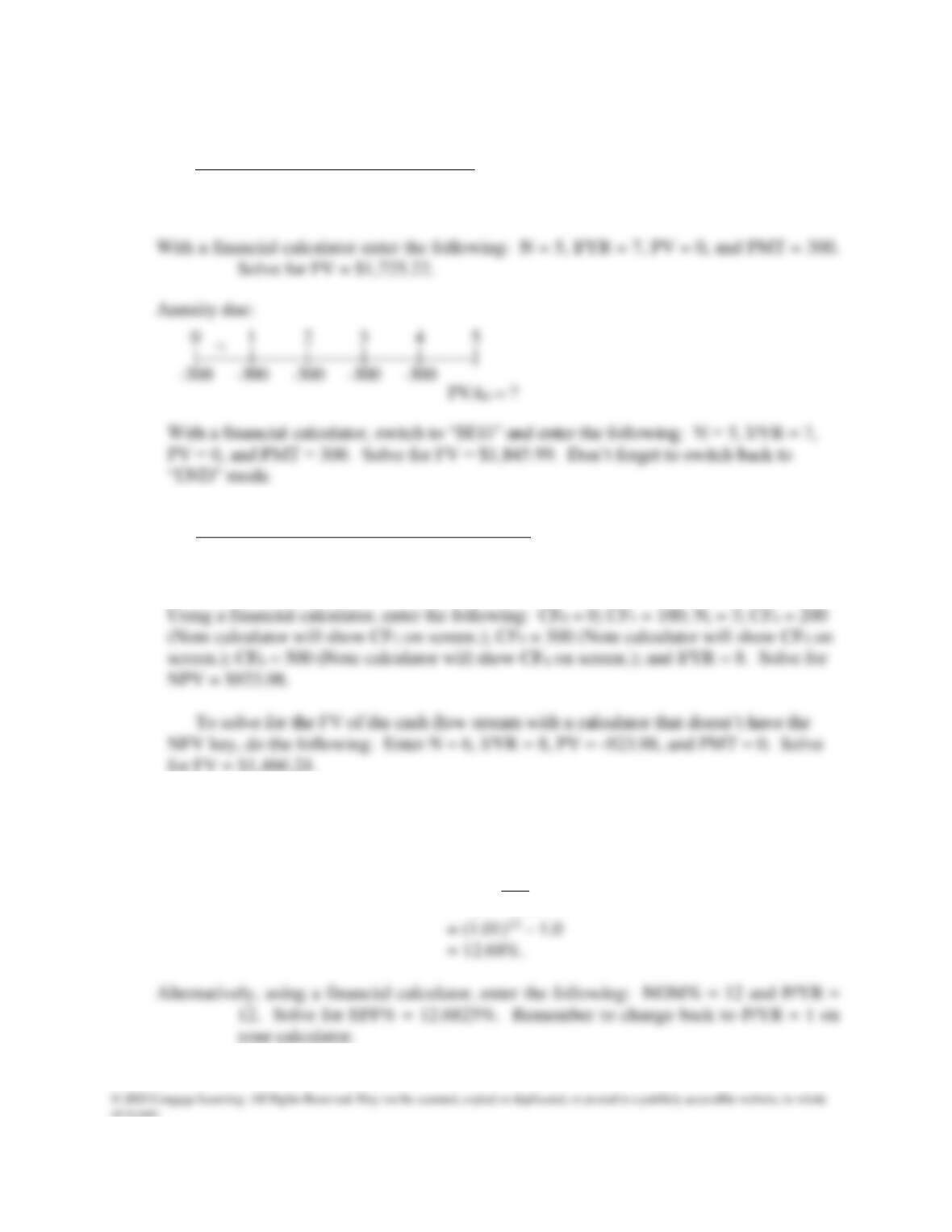
4-6 Ordinary annuity:
0 1 2 3 4 5
| | | | | |
–300 –300 3–00 –300 -300
FVA5 = ?
4-7 0 1 2 3 4 5 6
| | | | | | |
100 100 100 200 300 500
Cash: PV = ? FV = ?
4-8 Using a financial calculator, enter the following: N = 60, I/YR = 1, PV = -20000, and FV
= 0. Solve for PMT = $444.89.
EAR =
M
NO M
M
I
1
+
– 1.0
7%
8%
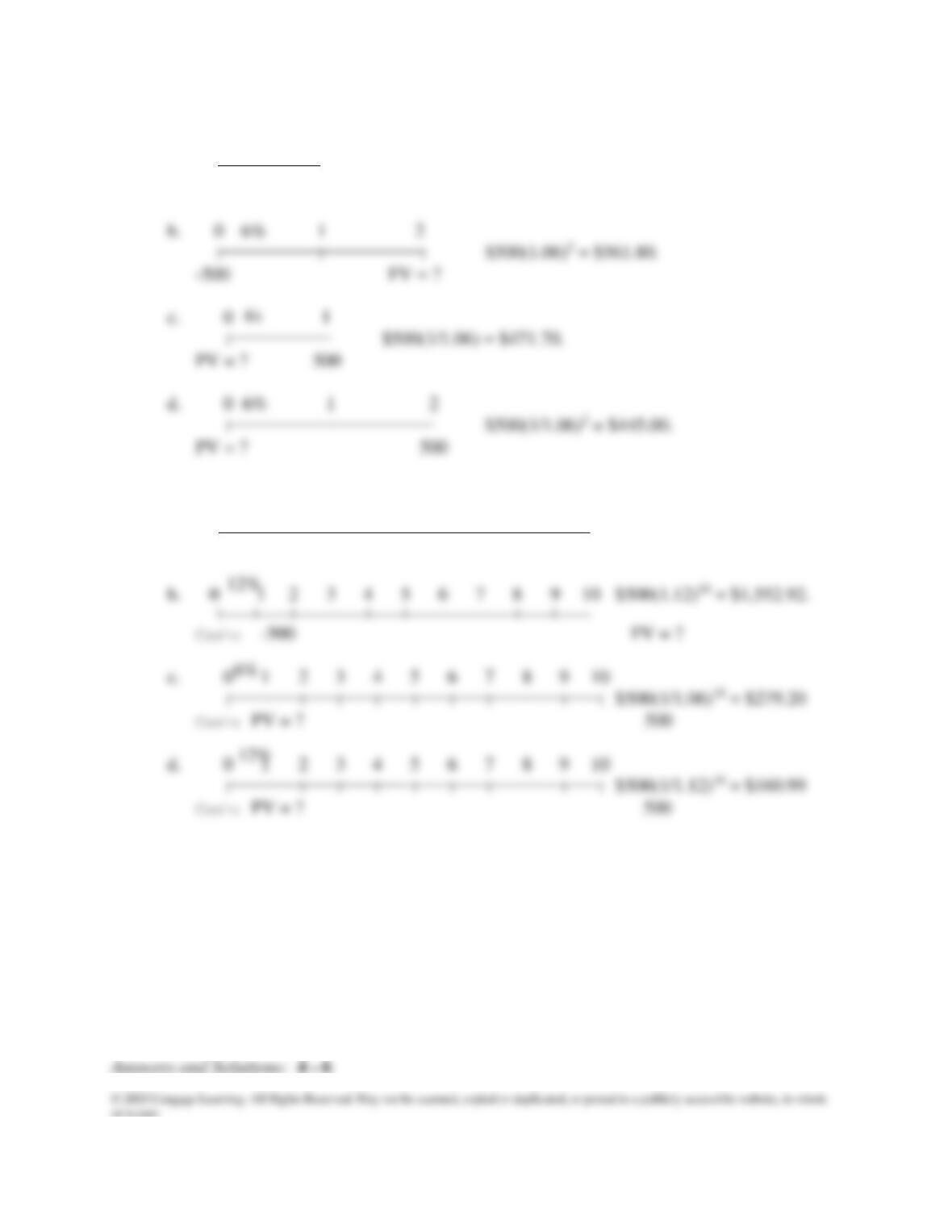
4-9 a. 0 1
| | $500(1.06) = $530.00.
-500 FV = ?
4-10 a. 0 1 2 3 4 5 6 7 8 9 10 $500(1.06)10 = $895.42.
| | | | | | | | | | |
Cash: -500 FV = ?
6%
6%
Answers and Solutions: 4 -7
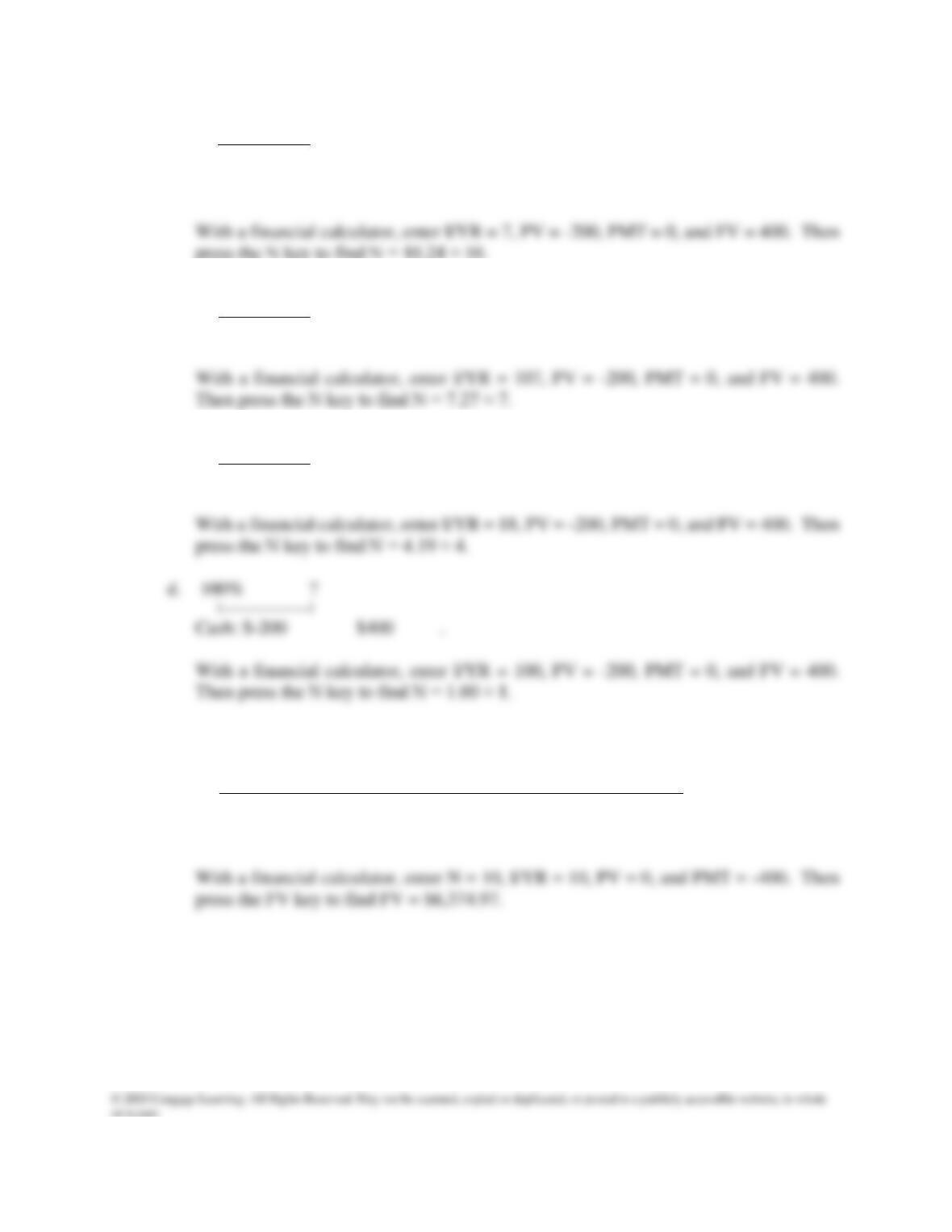
4-11 a. ?
| |
Cash: $-200 $400
press the N key to find N = 10.24 ≈ 10.
b. ?
| |
Cash: $-200 $400 .
c. ?
| |
Cash: $-200 $400 .
4-12
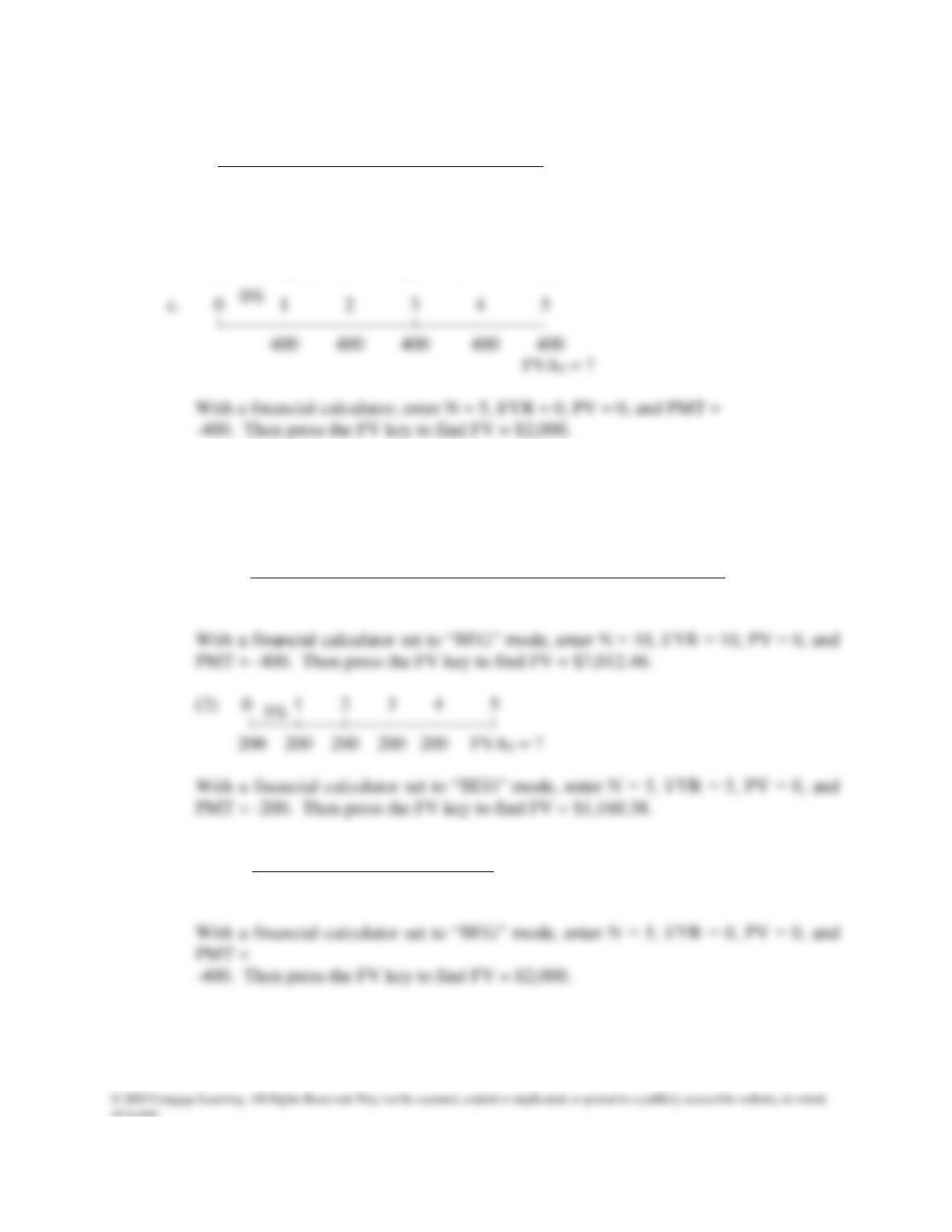
a. 0 1 2 3 4 5 6 7 8 9 10
| | | | | | | | | | |
400 400 400 400 400 400 400 400 400 400
FVA10 = ?
7%
10%
18%
10%
Answers and Solutions: 4 – 8
b. 5%
0 1 2 3 4 5
| | | | | |
200 200 200 200 200
FVA5 = ?
With a financial calculator, enter N = 5, I/YR = 5, PV = 0, and PMT =
-200. Then press the FV key to find FV = $1,105.13.
0%
d. To solve Part d using a financial calculator, repeat the procedures discussed in Parts a,
b, and c, but first switch the calculator to “BEG” mode. Make sure you switch the
calculator back to “END” mode after working the problem.
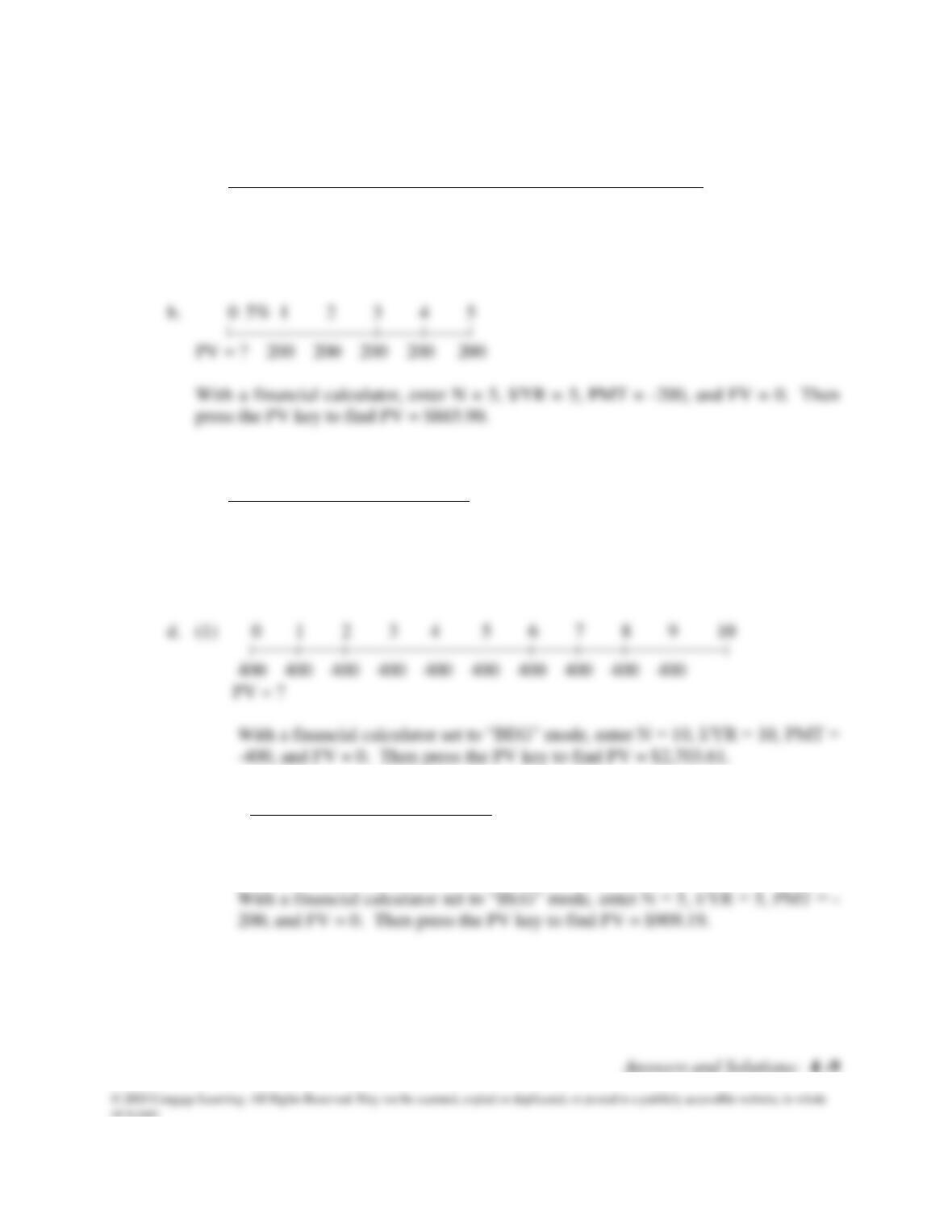
(1) 0 1 2 3 4 5 6 7 8 9 10
| | | | | | | | | | |
400 400 400 400 400 400 400 400 400 400 FVA10 = ?
(3) 0 0% 1 2 3 4 5
| | | | | |
400 400 400 400 400 FVA5 = ?
10%
4-13
a. 0 1 2 3 4 5 6 7 8 9 10
| | | | | | | | | | |
PV = ? 400 400 400 400 400 400 400 400 400 400
With a financial calculator, enter N = 10, I/YR = 10, PMT = -400, and FV = 0. Then
press the PV key to find PV = $2,457.83.
c. 0 1 2 3 4 5
| | | | | | $400(5) = $2,000.00.
PV = ? 400 400 400 400 400
With a financial calculator, enter N = 5, I/YR = 0, PMT = -400, and FV = 0. Then
press the PV key to find PV = $2,000.
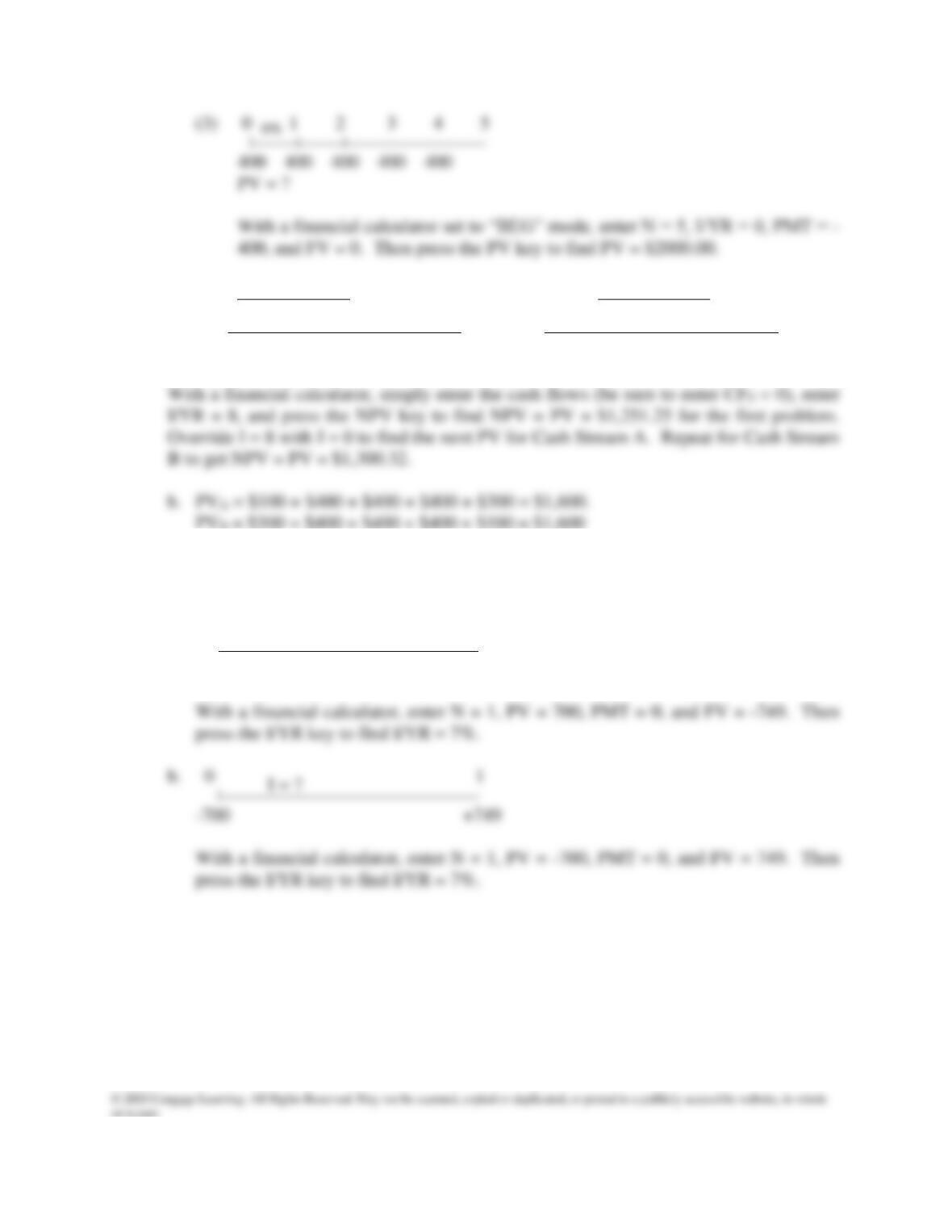
(2) 0 5% 1 2 3 4 5
| | | | | |
200 200 200 200 200
PV = ?
10%
Answers and Solutions: 4 – 10
4-14 a. Cash Stream A Cash Stream B
0 1 2 3 4 5 0 1 2 3 4 5
| | | | | | | | | | | |
PV = ? 100 400 400 400 300 PV = ? 300 400 400 400 100
4-15 These problems can all be solved using a financial calculator by entering the known values
shown on the time lines and then pressing the I/YR button.
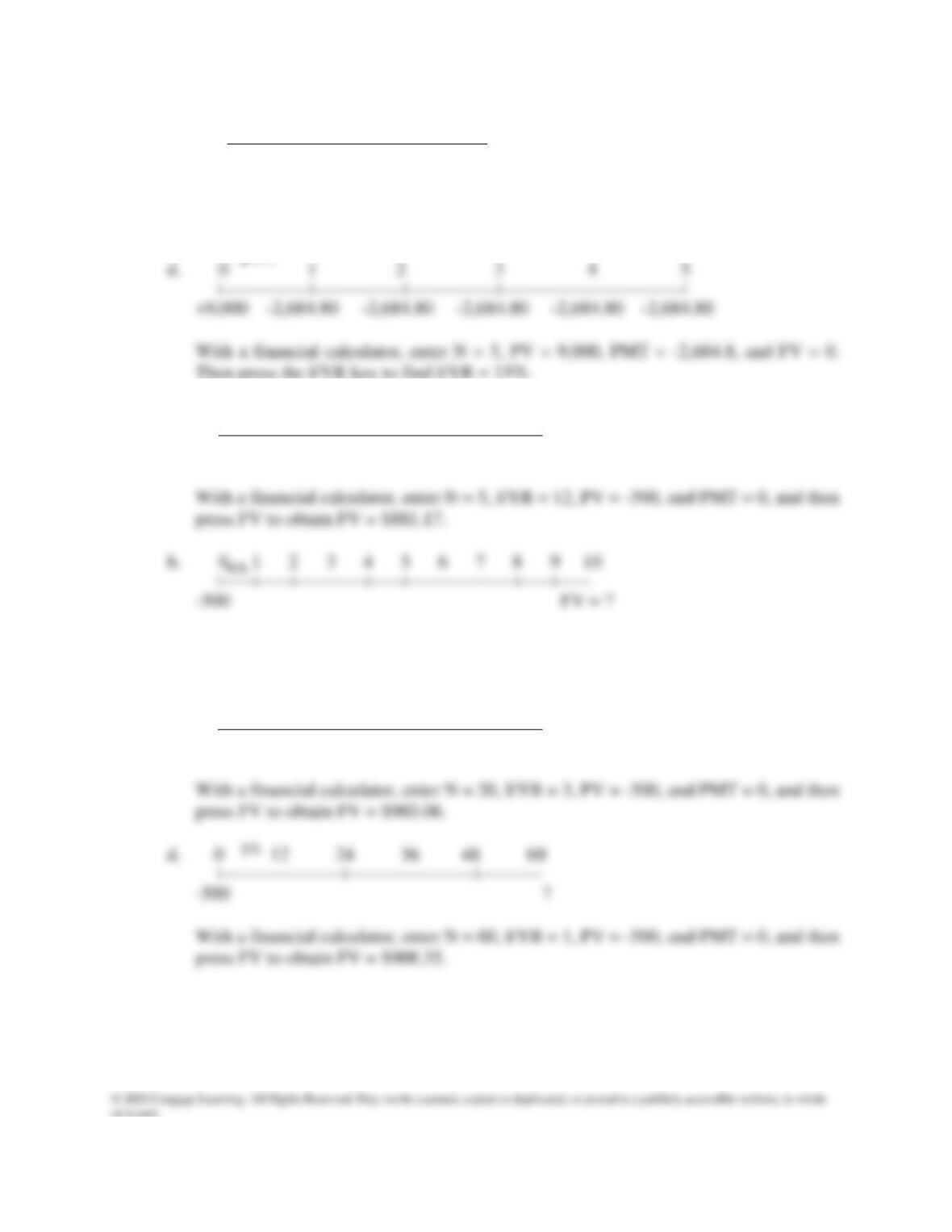
a. 0 1
| |
+700 -749
8%
8%
I = ?
Answers and Solutions: 4 -11
c. 0 10
| |
+85,000 -201,229
With a financial calculator, enter N = 10, PV = 85,000, PMT = 0, and FV = -201,229.
Then press the I/YR key to find I/YR = 9%.
4-16 a. 0 12% 1 2 3 4 5
| | | | | |
-500 FV = ?
With a financial calculator, enter N = 10, I/YR = 6, PV = -500, and PMT = 0, and then
press FV to obtain FV = $895.42.
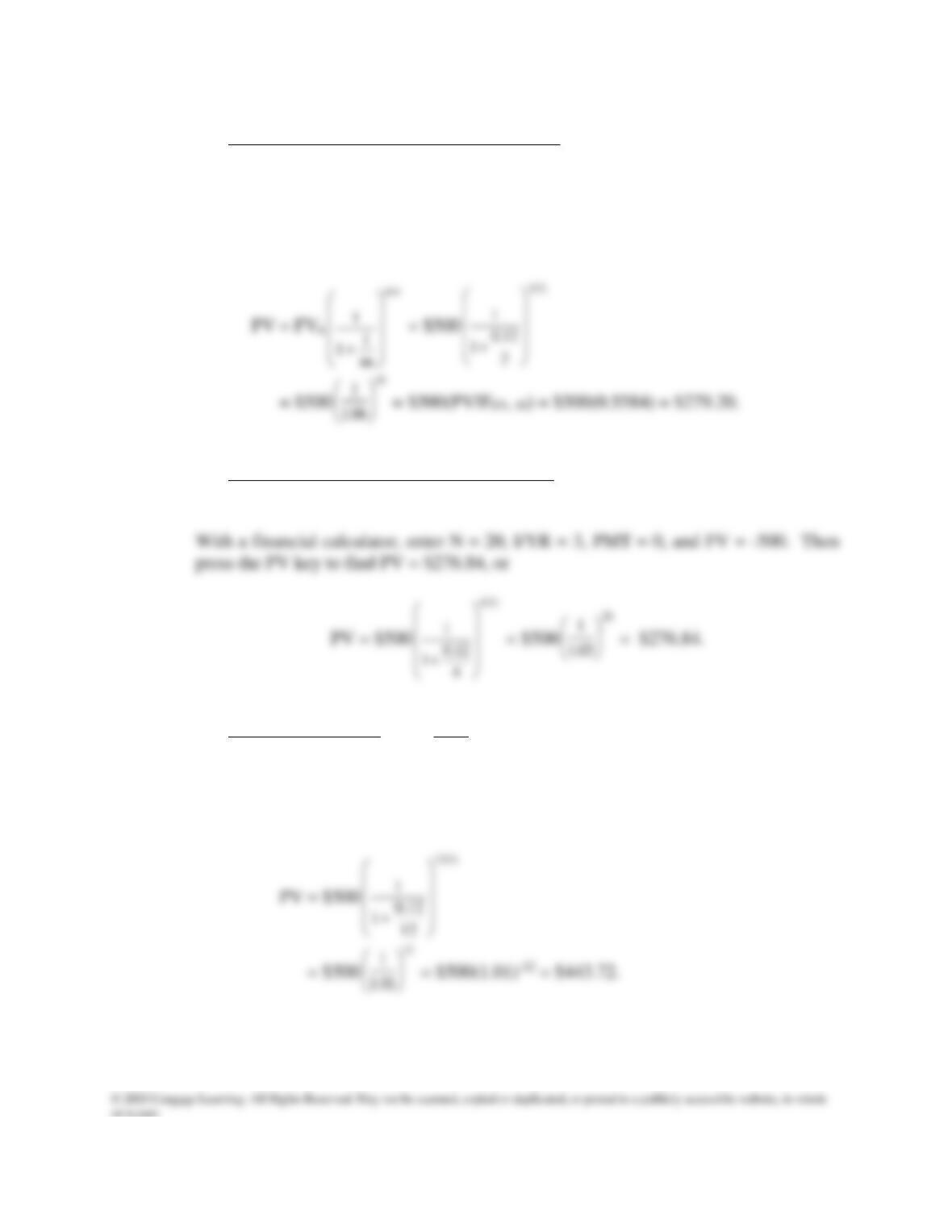
c. 0 4 8 12 16 20
| | | | | |
-500 FV = ?
I = ?
3%
Answers and Solutions: 4 – 12
4-17 a. 0 2 4 6 8 10
| | | | | |
PV = ? 500
With a financial calculator, enter N = 10, I/YR = 6, PMT = 0, and FV = –500. Then
press the PV key to find PV = $279.20.
Alternatively,
b. 0 4 8 12 16 20
| | | | | |
PV = ? 500
c. 0 1 2 12
| | | • • • |
PV = ? 500
With a financial calculator, enter N = 12, I/YR = 1, PMT = 0, and FV = –500. Then
press the PV key to find PV = $443.72, or
6%
3%
1%
Answers and Solutions: 4 -13
4-18 a. 0 1 2 3 9 10
| | | | • • • | |
400 400 400 400 400
FVA10 = ?
c. The annuity payments in Part b occur more frequently than those in Part a, which means
that interest is earned on interest more frequently. In addition, the first annuity payment
for Part b occurs earlier in the year than the first payment for the annuity in Part a, so
interest on Part b’s Month-3 payment begins compounding before interest begins
compounding on Part a’s Month–6 semiannual payment. The same is true for Part b’s
Month–9 payment relative to Part a’s Month-12 end-of-year payment
4-19 a. Universal Bank: Effective rate = 7%.
Regional Bank:
b. If funds must be left on deposit until the end of the compounding period (1 year for
Universal and 1 quarter for Regional), and you think there is a high probability that you
will make a withdrawal during the year, the Regional account might be preferable. For
6%
Answers and Solutions: 4 – 14
4-20 a. With a financial calculator, enter N = 5, I/YR = 10, PV = -25000, and FV = 0, and then
press the PMT key to get PMT = $6,594.94. Then go through the amortization
procedure as described in your calculator manual to get the entries for the amortization
table.
Repayment Remaining
Year Payment Interest of Principal Balance
1 $ 6,594.94 $2,500.00 $ 4,094.94 $20,905.06
2 6,594.94 2,090.51 4,504.43 16,400.63
3 6,594.94 1,640.06 4,954.88 11,445.75
4 6,594.94 1,144.58 5,450.36 5,995.39
5 6,594.93* 599.54 5,995.39 0
$32,974.69 $7,974.69 $25,000.00
*The last payment must be smaller to force the ending balance to zero.
4-21 a. 0 I=? 1 2 3 4 5
| | | | | |
-6 12 (in millions)
With a calculator, enter N = 5, PV = -6, PMT = 0, FV = 12, and then solve for I/YR =
14.87% ≈ 15%.
Answers and Solutions: 4 -15
4-23 0 1 2 3 4 30
| | | | | • • • |
85,000 -8,273.59 -8,273.59 -8,273.59 -8,273.59 -8,273.59
With a financial calculator, enter N = 30, PV = 85000, PMT = -8273.59, FV = 0, and then
solve for I/YR = 9%.
4-24 a. 0 1 2 3 4
| | | | |
PV = ? -10,000 -10,000 -10,000 -10,000
(2) Zero after the last withdrawal.
4-25 0 1 2 ?
| | | • • • |
Payments: $12,000 $-1,500 $-1,500 $-1,500
I = ?
7%
9%
4-26 0 1 2 3 4 5 6
| | | | | | |
1,250 1,250 1,250 1,250 1,250 ?
FV = 10,000
With a financial calculator, get a “ballpark” estimate of the years by entering I/YR = 12,
PV = 0, PMT = -1250, and FV = 10000, and then pressing the N key to find N = 5.94 years.
This answer assumes that a payment of $1,250 will be made 94/100th of the way through
4-27 PV = $100/0.07 = $1,428.57. PV = $100/0.14 = $714.29.
When the interest rate is doubled, the PV of the perpetuity is halved.
4-28 0 1 2 3 4
| | | | |
PV = ? 50 50 50 1,050
8.24%
12%
Answers and Solutions: 4 -17
4-29 This can be done with a calculator by specifying an interest rate of 5% per period for 20
periods with 1 payment per period to get the payment each 6 months: N = 10 2 = 20,
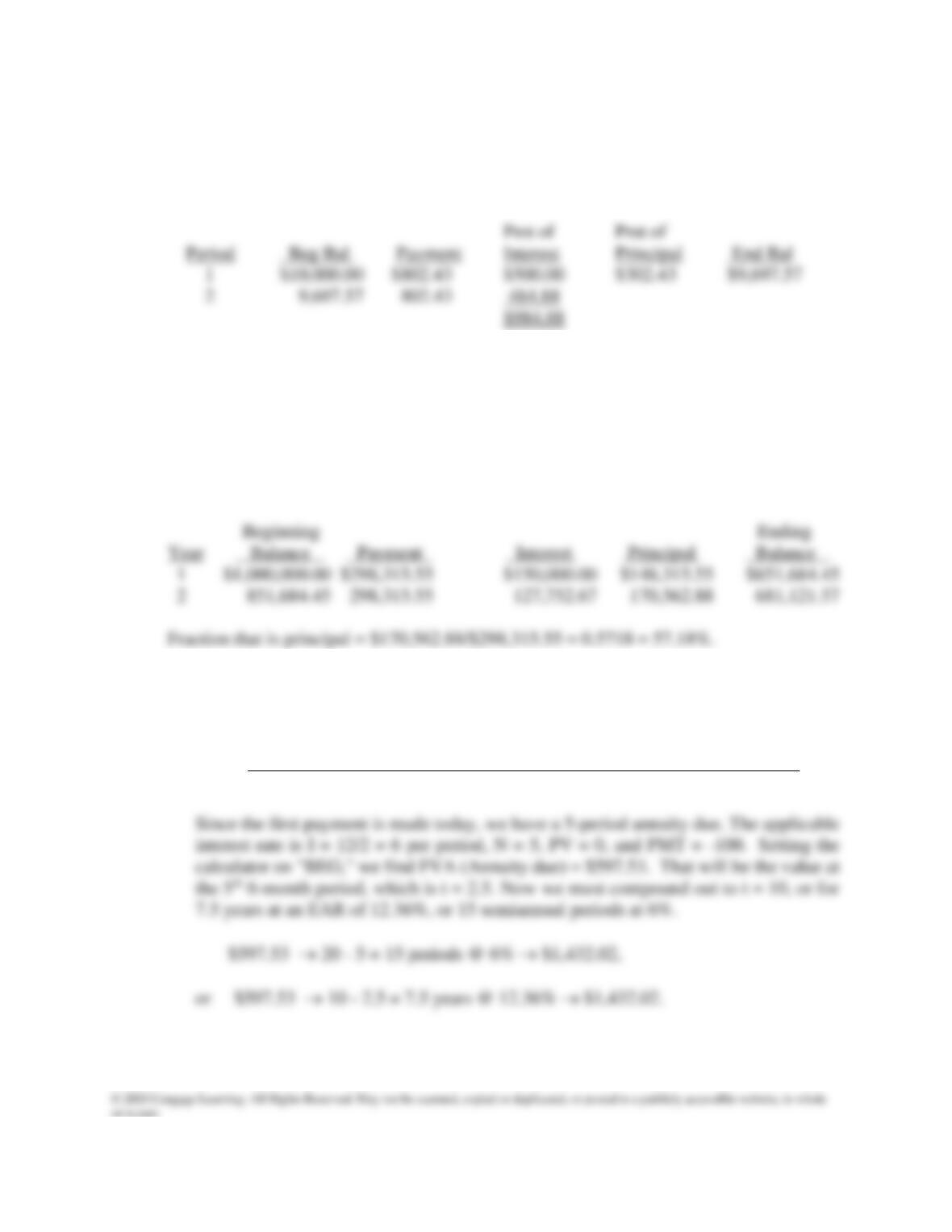
I/YR = 10%/2 = 5, PV = -10000. FV = 0. Solve for PMT = $802.43. Set up amortization
table as below:
You can also work the problem with a calculator having an amortization function. Find
the interest in each 6-month period, sum them, and you have the answer. Even simpler,
with some calculators such as the HP-10B, allow you to find the interest paid during a
particular period of time.
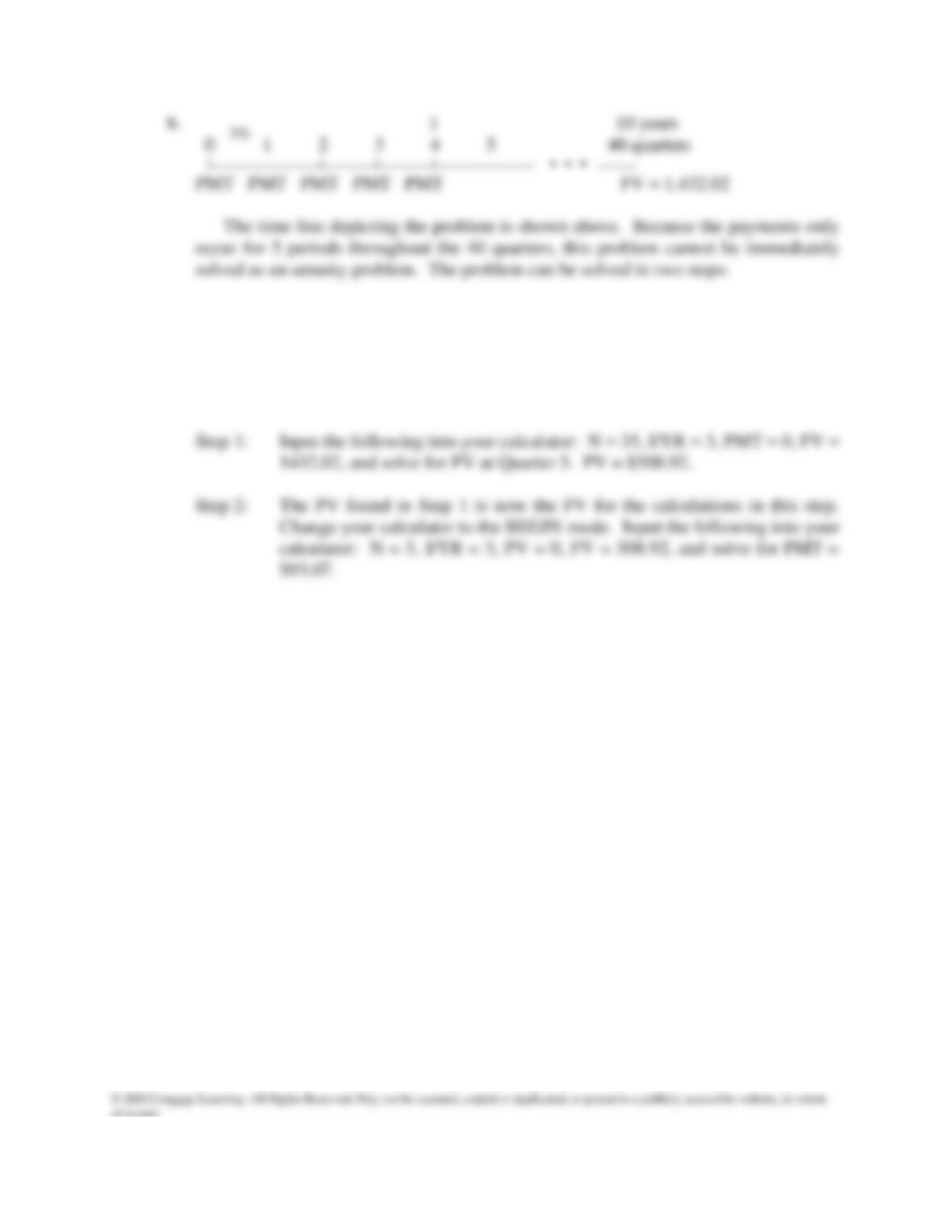
4-30 First, find PMT by using a financial calculator: N = 5, I/YR = 15, PV = -1000000, and FV
= 0. Solve for PMT = $298,315.55. Then set up the amortization table:
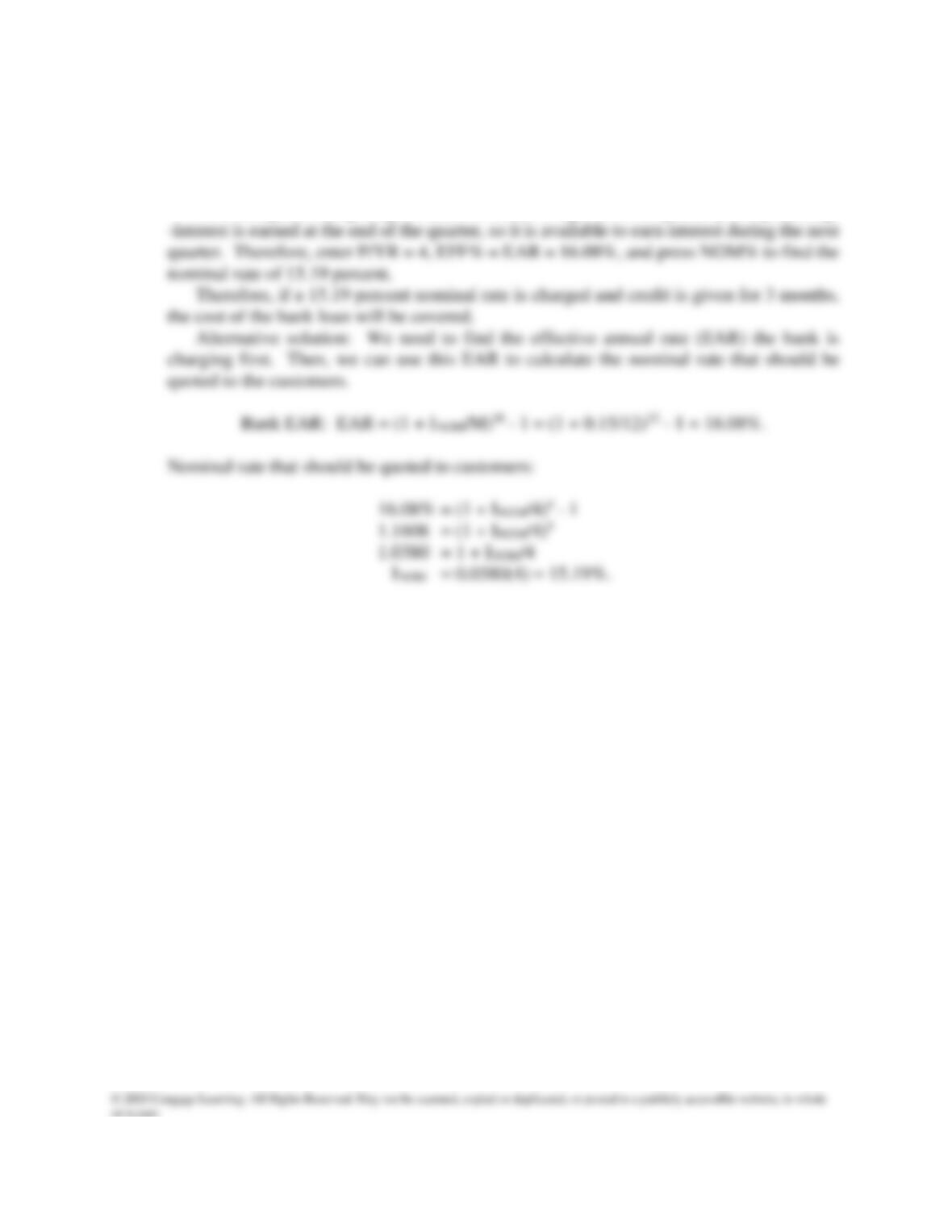
4-31 a. Begin with a time line:
6-mos. 0 1 2 3 4 5 6 8 10 12 14 16 18 20
Years 0 6% 1 2 3 4 5 6 7 8 9 10
| | | | | | | | | | | | | | | | | | | | |
100 100 100 100 100 FVA
Answers and Solutions: 4 – 18
(1) Discount the $1,432.02 back to the end of Quarter 5 to obtain the PV of that future
amount at Quarter 5.
(2) Then solve for PMT using the value solved in Step 1 as the FV of the five-period
annuity due.
Answers and Solutions: 4 -19
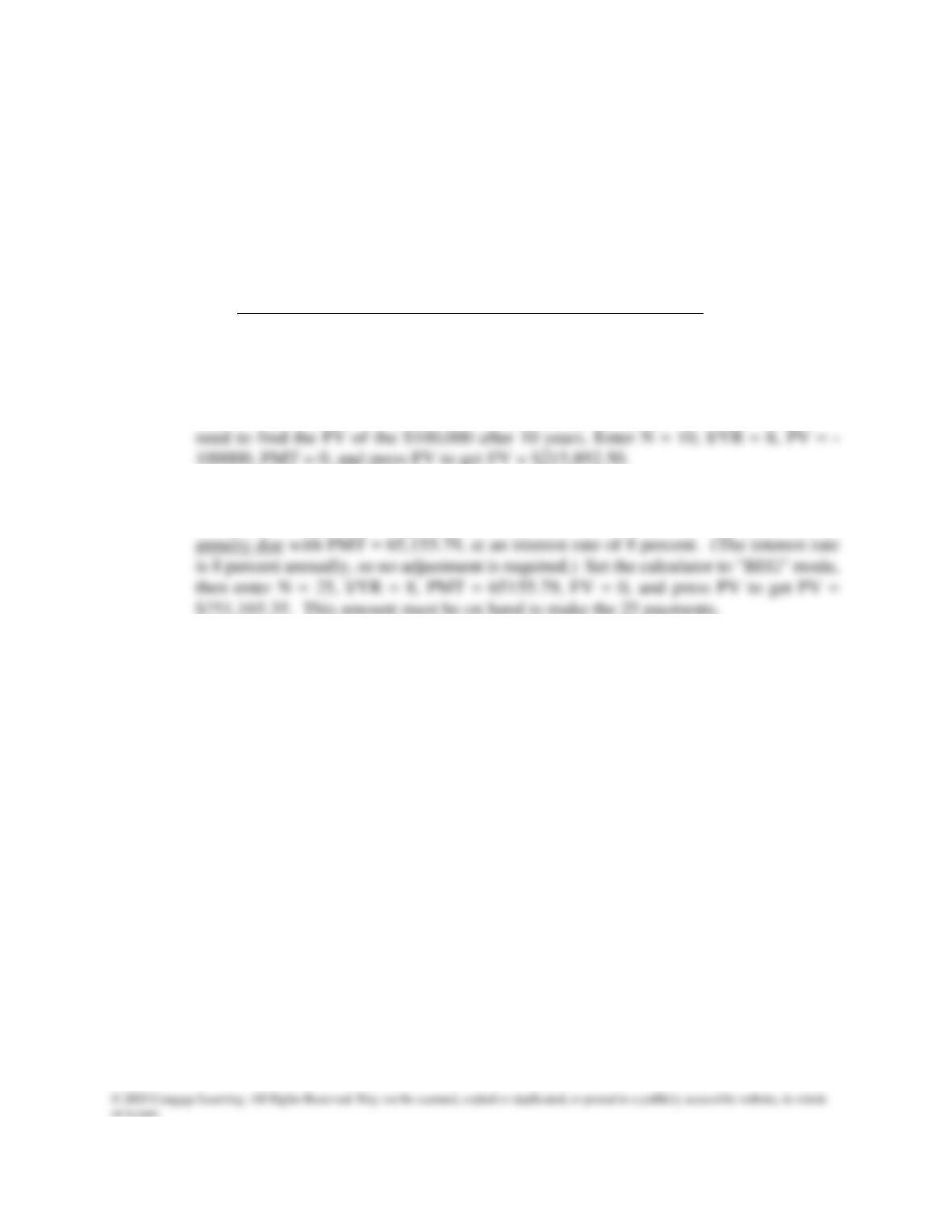
4-32 Here we want to have the same effective annual rate on the credit extended as on the bank
loan that will be used to finance the credit extension.
First, we must find the EAR = EFF% on the bank loan. Enter NOM% = 15, N = P/YR
= 12, and press EFF% to get EAR = 16.08%.
Now recognize that giving 3 months of credit is equivalent to quarterly compounding-
Answers and Solutions: 4 – 20
4-33 Information given:
1. Will save for 10 years, then receive payments for 25 years.
2. Wants payments of $40,000 per year in today’s dollars for first payment only. Real
income will decline. Inflation will be 5 percent. Therefore, to find the inflated fixed
payments, we have this time line:
0 5 10
| | | | | | | | | | |
40,000 FV = ?
Enter N = 10, I/YR = 5, PV = –40000, PMT = 0, and press FV to get FV = $65,155.79.
3. He now has $100,000 in an account which pays 8 percent, annual compounding. We
4. He wants to withdraw, or have payments of, $65,155.79 per year for 25 years, with the
first payment made at the beginning of the first retirement year. So, we have a 25-year
5. Since the original $100,000, which grows to $215,892.50, will be available, we must
save enough to accumulate $751,165.35 – $215,892.50 = $535,272.85.
6. The $535,272.85 is the FV of a 10-year ordinary annuity. The payments will be
deposited in the bank and earn 8 percent interest. Therefore, set the calculator to
“END” mode and enter N = 10, I/YR = 8, PV = 0, FV = 535272.85, and press PMT to
find PMT = $36,949.61.
5%