Chapter 4 CFIN6
Chapter 4 Solutions
(Most solutions are rounded in the final answers, not in the intermediate computations.)
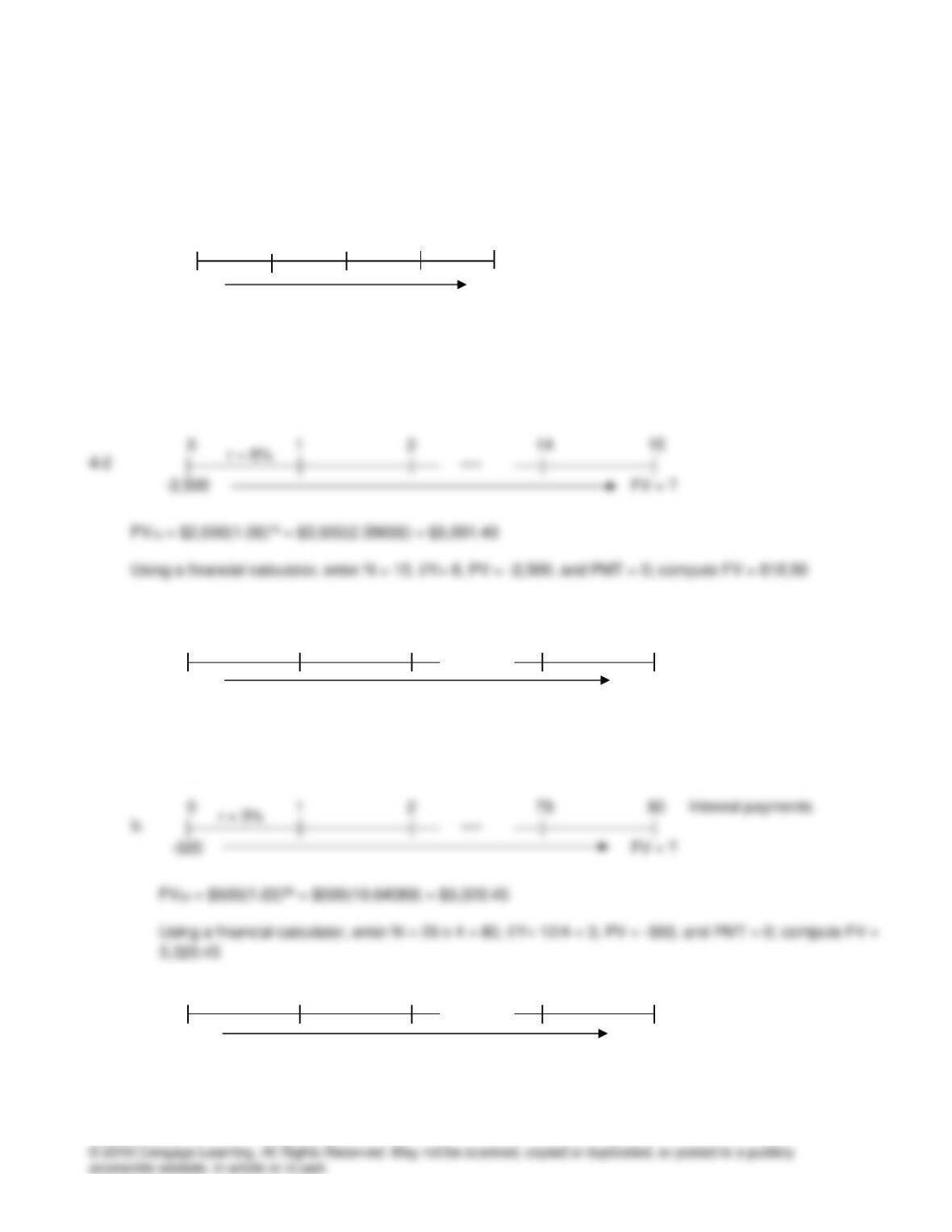
0 1 2 3 4
4-1
-700 FV = ?
FV4 = $700(1.04)4 = $700(1.16986) = $818.90
Using a financial calculator, enter N = 4, I/Y= 4, PV = -700, and PMT = 0; compute FV = 818.90
r = 6%
…
0 1 2 14 20
4-3 a.
–500 FV = ?
FV20 = $500(1.12)20 = $500(9.64629) = $4,823.15
Using a financial calculator, enter N = 20, I/Y= 12, PV = –500, and PMT = 0; compute FV = 4,823.15
r = 3%
Interest payments
…
0 1 2 239 240
c.
–500 FV = ?
FV20 = $500(1.01)240 = $500(10.89255) = $5,446.28
r = 4%
r = 12%
…
r = 1%
Interest payments
Interest payments
…
Chapter 4 CFIN6
Using a financial calculator, enter N = 20 x 12 = 240, I/Y= 12/12 = 1, PV = –500, and PMT = 0; compute
FV = 5,446.28
r = 0.6%
Interest payments
…
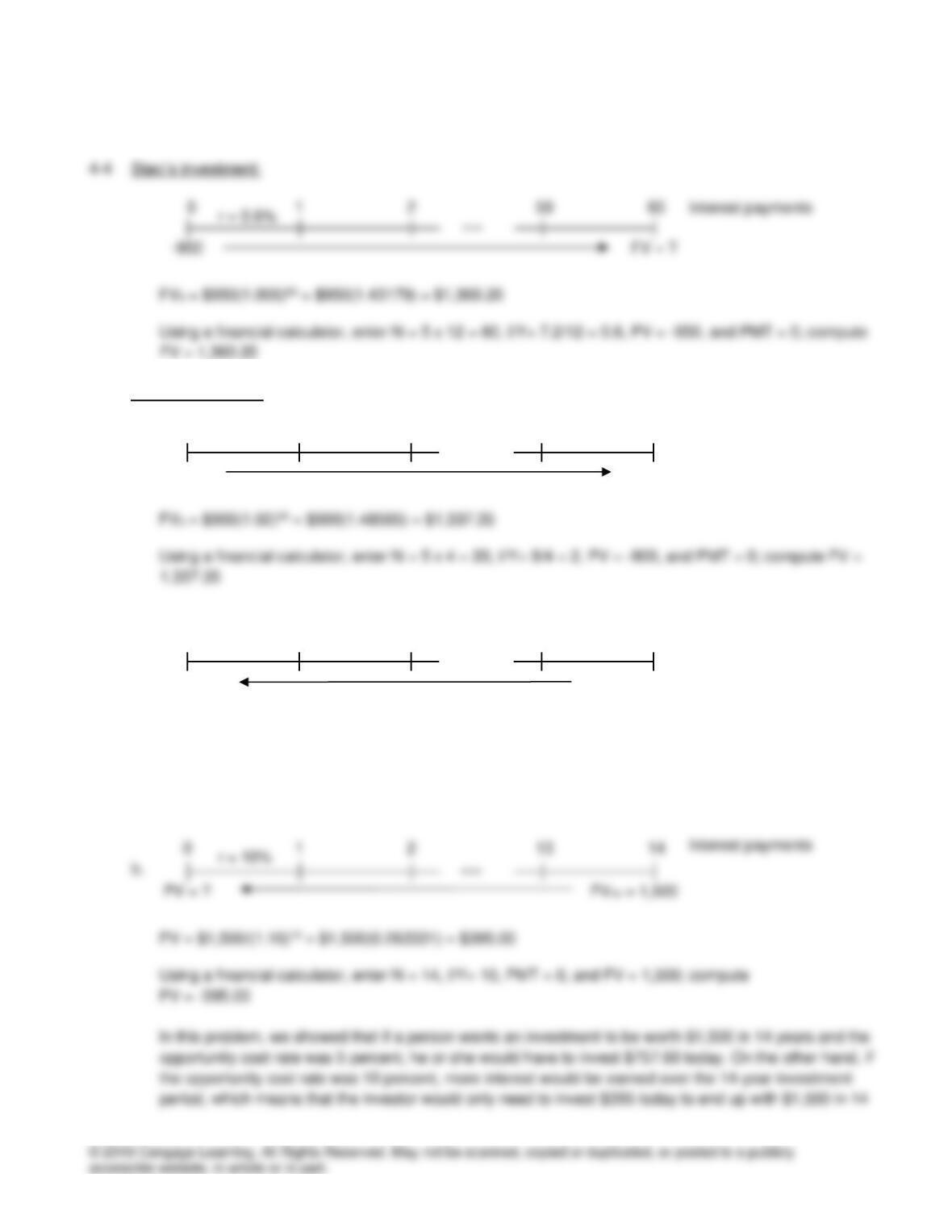
Shelli’s investment:
0 1 2 19 20
–900 FV = ?
0 1 2 13 14
4-5 a.
PV = ? FV14 = 1,500
PV = $1,500/(1.05)14 = $1,500(0.505068) = $757.60
Using a financial calculator, enter N = 14, I/Y= 5, PMT = 0, and FV = 1,500; compute
PV = -757.60
r = 10%
Interest payments
…
r = 2%
Interest payments
r = 5%
Interest payments
…
…
Chapter 4 CFIN6
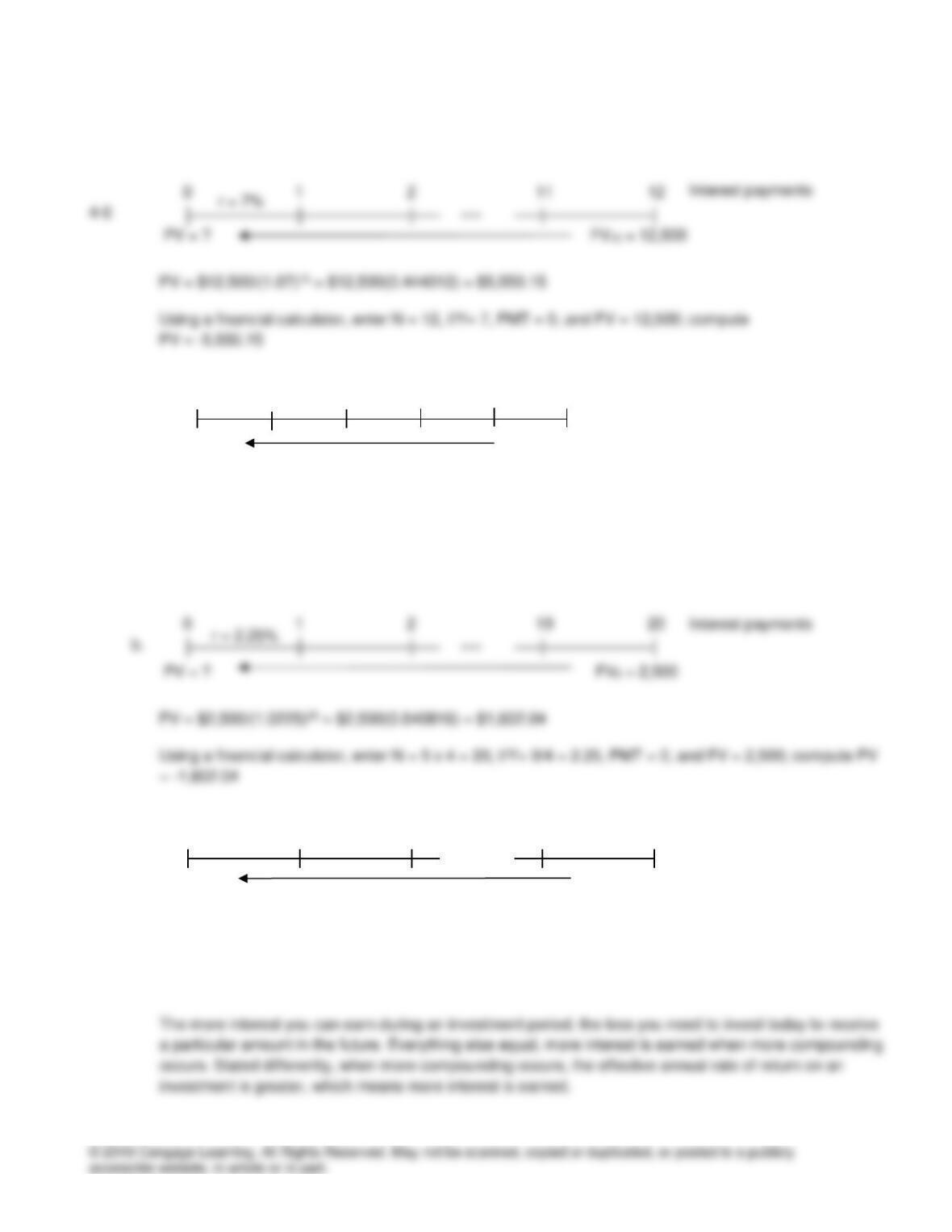
years. Simply stated, the more interest you can earn during an investment period, the less you need to
invest today to receive a particular amount in the future.
r = 7%
Interest payments
…
0 1 2 3 4 5
4-7 a.
PV = ? FV5 = 2,500
PV = $2,500/(1.09)5 = $2,500(0.649931) = $1,624.83
Using a financial calculator, enter N = 5, I/Y= 9, PMT = 0, and FV = 2,500; compute
PV = -1,624.83
Interest payments
…
0 1 2 59 60
c.
PV = ? FV5 = 2,500
PV = $2,500/(1.0075)60 = $2,500(0.638700) = $1,596.75
Using a financial calculator, enter N = 5 x 12 = 60, I/Y= 9/12 = 0.75, PMT = 0, and FV = 2,500; compute
PV = -1,596.75
r = 9%
Interest payments
r = 0.75%
Interest payments
…
Chapter 4 CFIN6
r = 1%
…
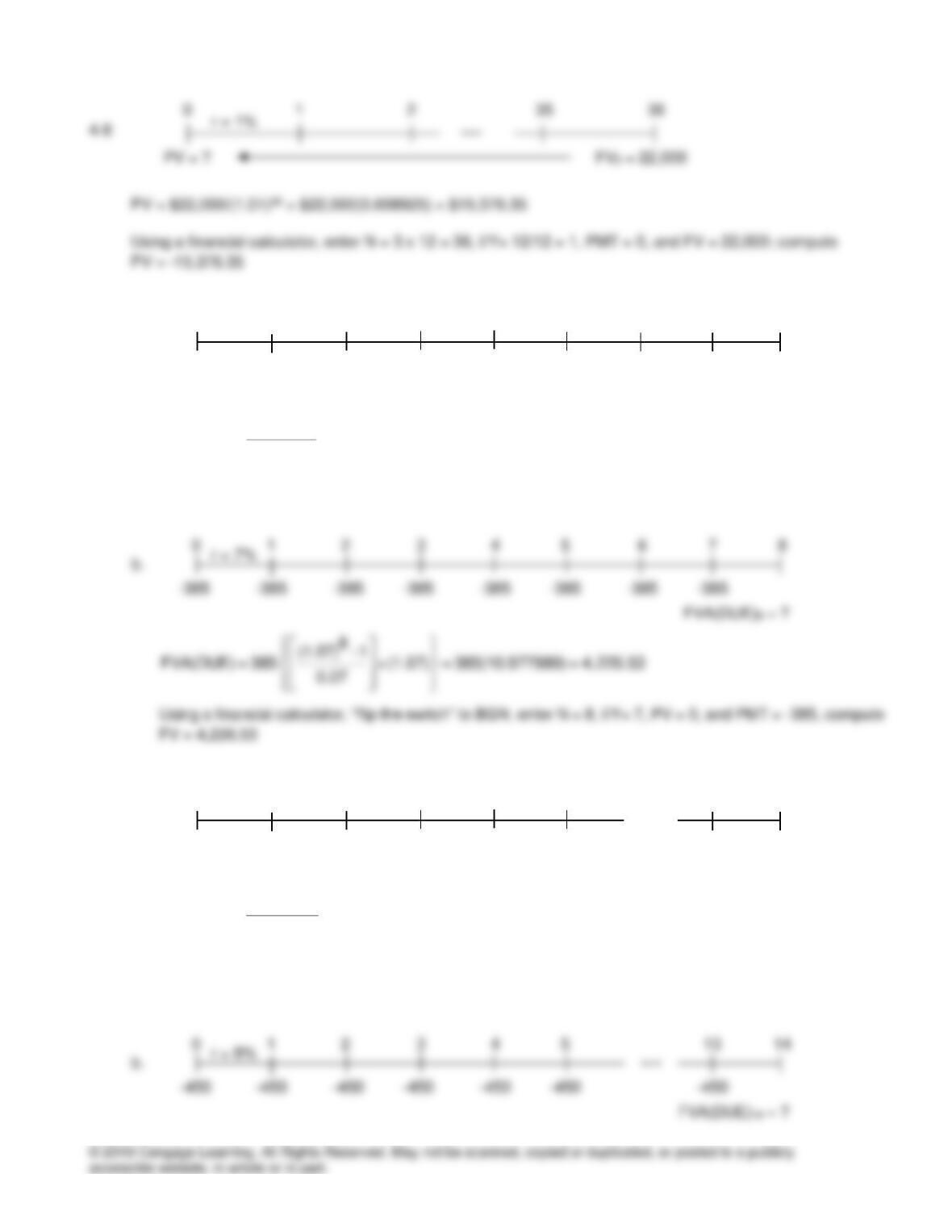
0 1 2 3 4 5 6 7 8
4-9 a.
–385 –385 –385 –385 –385 –385 –385 –385
FVA8 = ?
8
(1.07) –1
FVA = 385 = 385(10.259803) = 3,950.02
0.07
Using a financial calculator, enter N = 8, I/Y= 7, PV = 0, and PMT = –385, compute FV = 3,950.02
0 1 2 3 4 5 13 14
4-10 a.
-450 –450 –450 –450 –450 –450 –450
FVA14 = ?
14
(1.08) –1
FVA = 450 = 450(24.214920) =10,896.71
0.08
Using a financial calculator, enter N = 14, I/Y= 8, PV = 0, and PMT = –450, compute FV = 10,896.71
r = 8%
…
r = 7%
r = 8%
…
Chapter 4 CFIN6
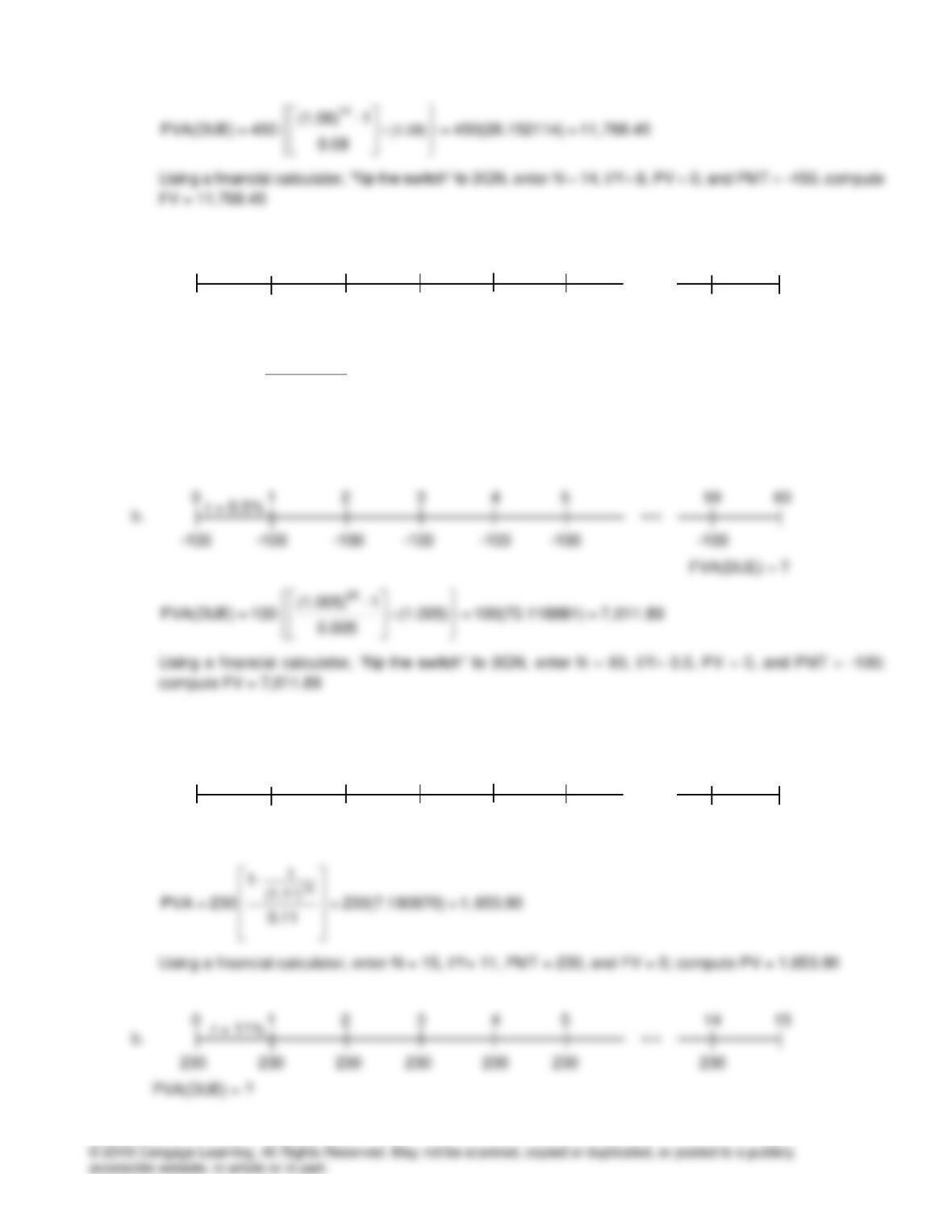
0 1 2 3 4 5 59 60
4-11 a.
–100 –100 –100 –100 –100 –100 –100
FVA = ?
60
(1.005) –1
FVA =100 =100(69.770031) = 6,977.00
0.005
Using a financial calculator, enter N = 5 x 12 = 60, I/Y= 6/12 = 0.5, PV = 0, and PMT = -100; compute FV
= 9,977
r = 0.5%
…
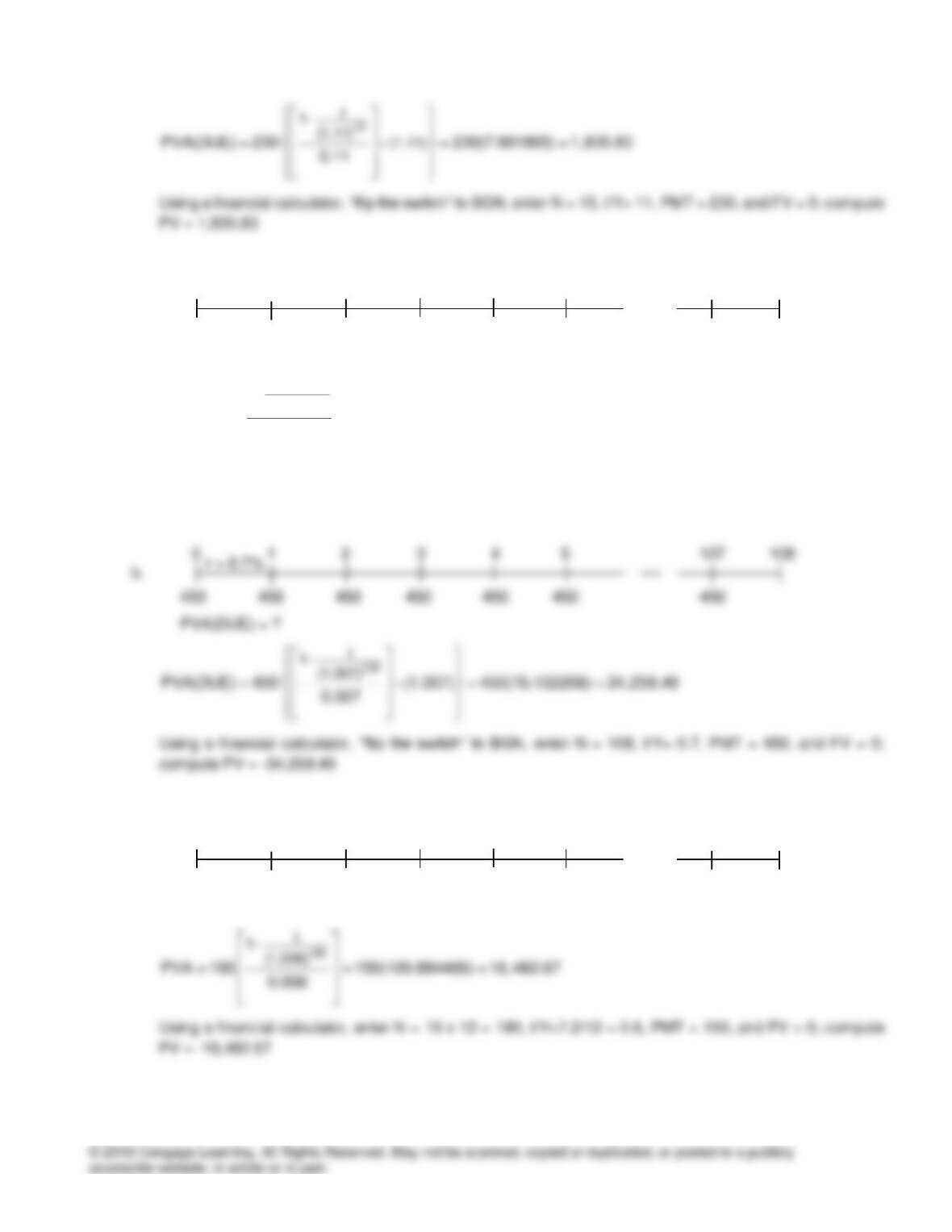
0 1 2 3 4 5 14 15
4-12 a.
PVA = ? 230 230 230 230 230 230 230
r = 11%
…
r = 11%
…
r = 0.5%
…
Chapter 4 CFIN6
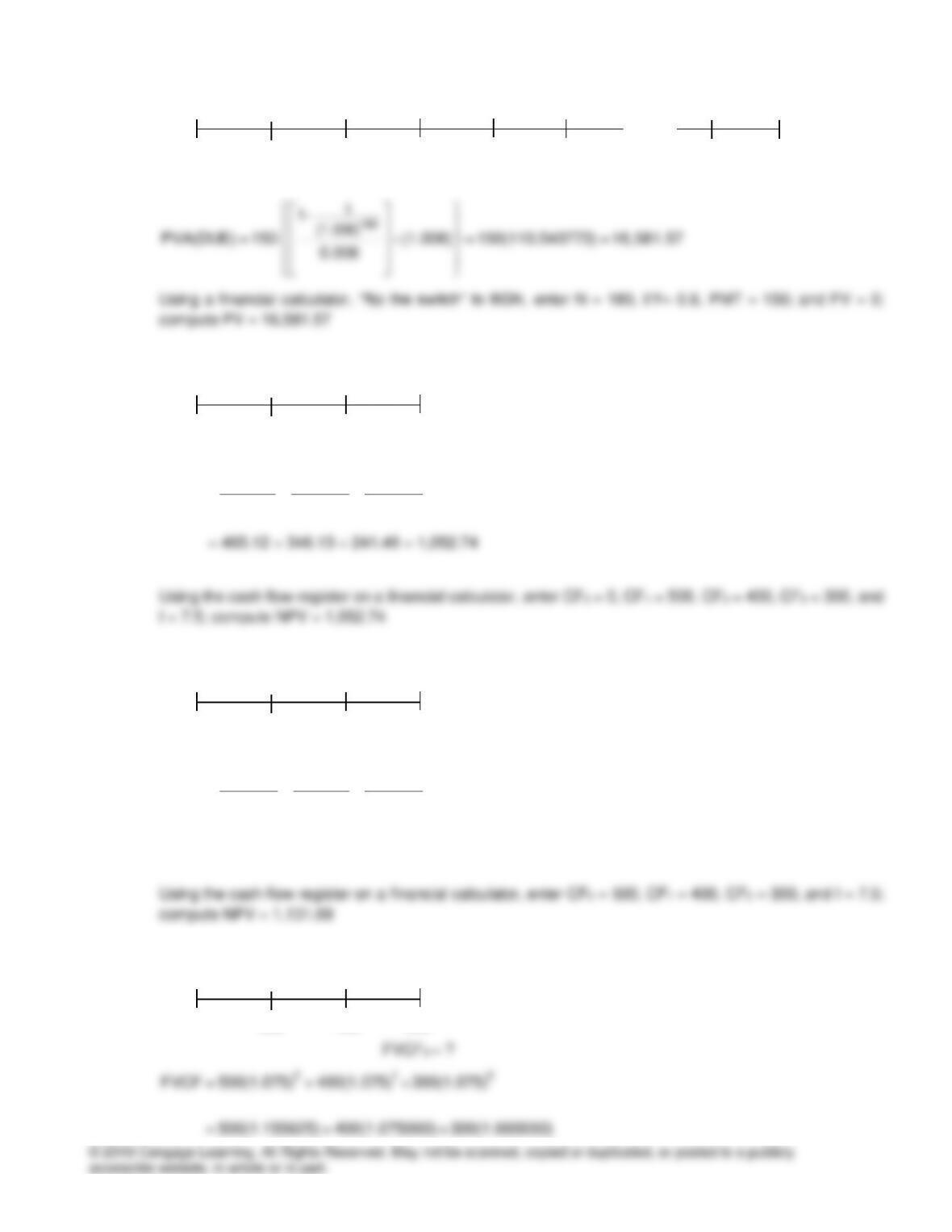
0 1 2 3 4 5 107 108
4-13 a.
PVA = ? 450 450 450 450 450 450 450
108
1
(1.007)
1-
PVA = 450 = 450(75.602985) = 34,021.34
0.007
Using a financial calculator, enter N = 9 x 12 = 108, I/Y= 8.4/12 = 0.7, PMT = 450, and FV = 0; compute
PV = -34,021.34
r = 0.7%
…
0 1 2 3 4 5 179 180
4-14 a.
PVA = ? 150 150 150 150 150 150 150
r = 0.7%
…
r = 0.6%
…
Chapter 4 CFIN6
0 1 2 3 4 5 179 180
b.
150 150 150 150 150 150 150
PVA(DUE) = ?
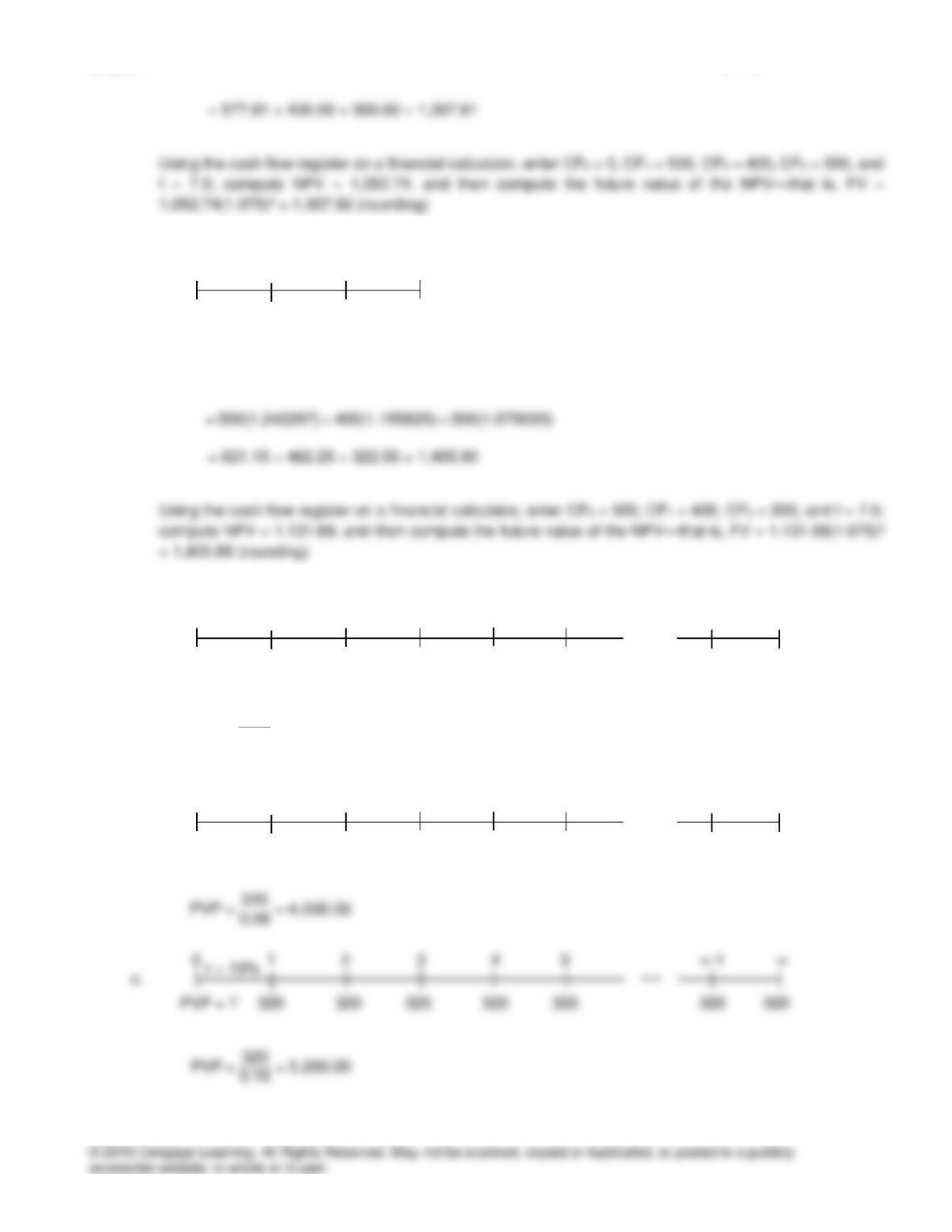
0 1 2 3
4-15 a.
PVCF3 = ? 500 400 300
+
1 2 3
500 400 300
PVCF = + = 500(0.930233)+ 400(0.865333)+ 300(0.804961)
(1.075) (1.075) (1.075)
0 1 2 3
b.
500 400 300
+
0 1 2
500 400 300
PVCF = + = 500(1.000000)+ 400(0.930233)+ 300(0.865333)
(1.075) (1.075) (1.075)
= 500.00 + 372.09 + 259.60 = 1,131.69
0 1 2 3
4-16 a.
500 400 300
r = 0.6%
…
r = 7.5%
r = 7.5%
r = 7.5%
Chapter 4 CFIN6
0 1 2 3
b.
500 400 300
3 2 1
+FVCF = 500(1.075) + 400(1.075) 300(1.075)
0 1 2 3 4 5 -1
4-17 a.
PVP = ? 320 320 320 320 320 320 320
320
PVP = = 8,000.00
0.04
0 1 2 3 4 5 -1
b.
PVP = ? 320 320 320 320 320 320 320
r = 10%
r = 7.5%
r = 4%
…
r = 8%
…
Chapter 4 CFIN6
When more interest is earned during an investment period, less money must be invested today to
receive a particular amount in the future.
0 1 2 8 9 10
4-18
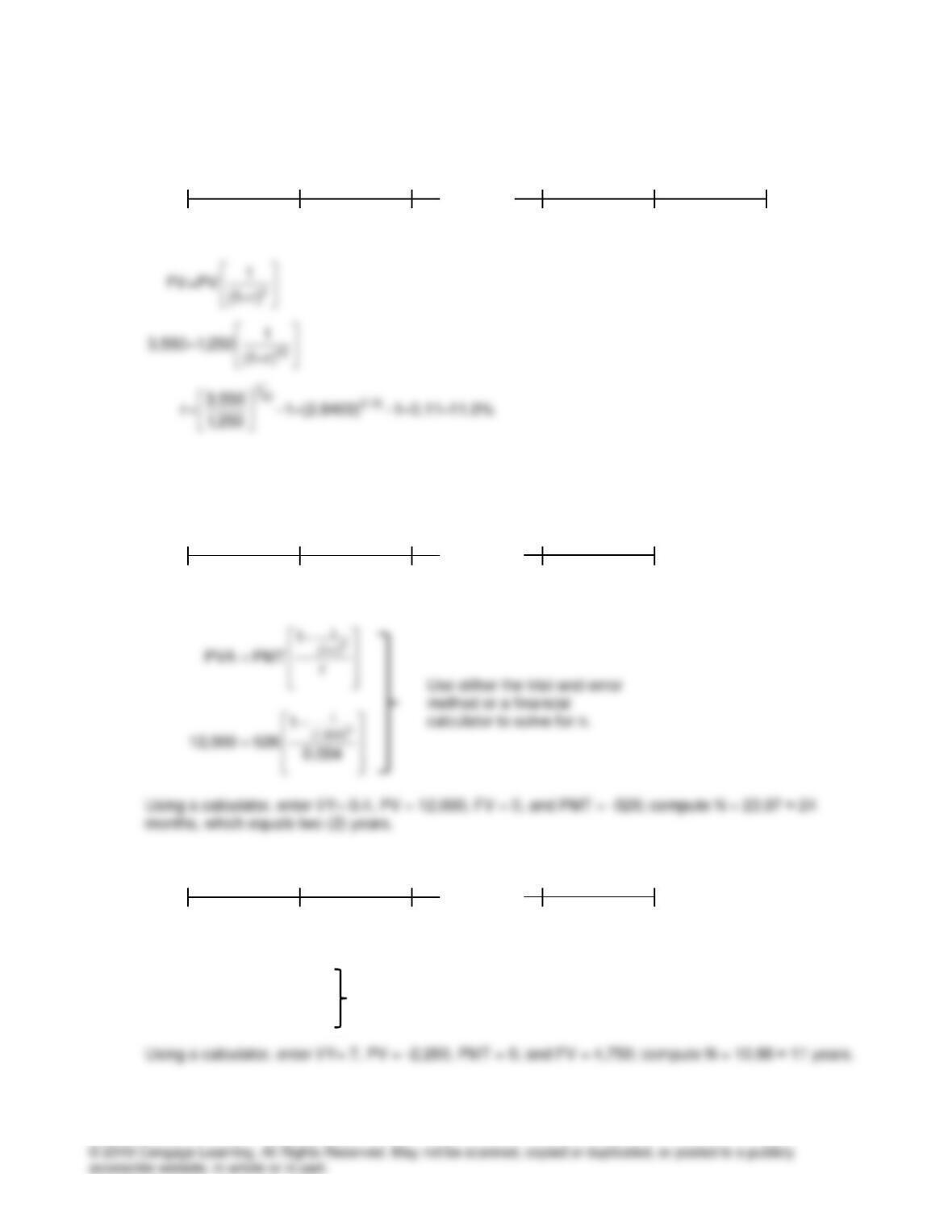
-1,250 3,550
Using a calculator, enter N = 10, PV = -1,250, PMT = 0, and FV = 3,550; compute I/Y= 11%.
4-19 0 1 2 n-1 n Months
12,000 -526 -526 -526 -526
Use either the trial-and-error
calculator to solve for n.
4-20 0 1 2 n-1 n Years
–2,260 4,750
n
n
FV PV(1 r)
4,750 2,260(1.07)
=+
=
r = ?
…
r = 0.4%
…
r = 7%%
…
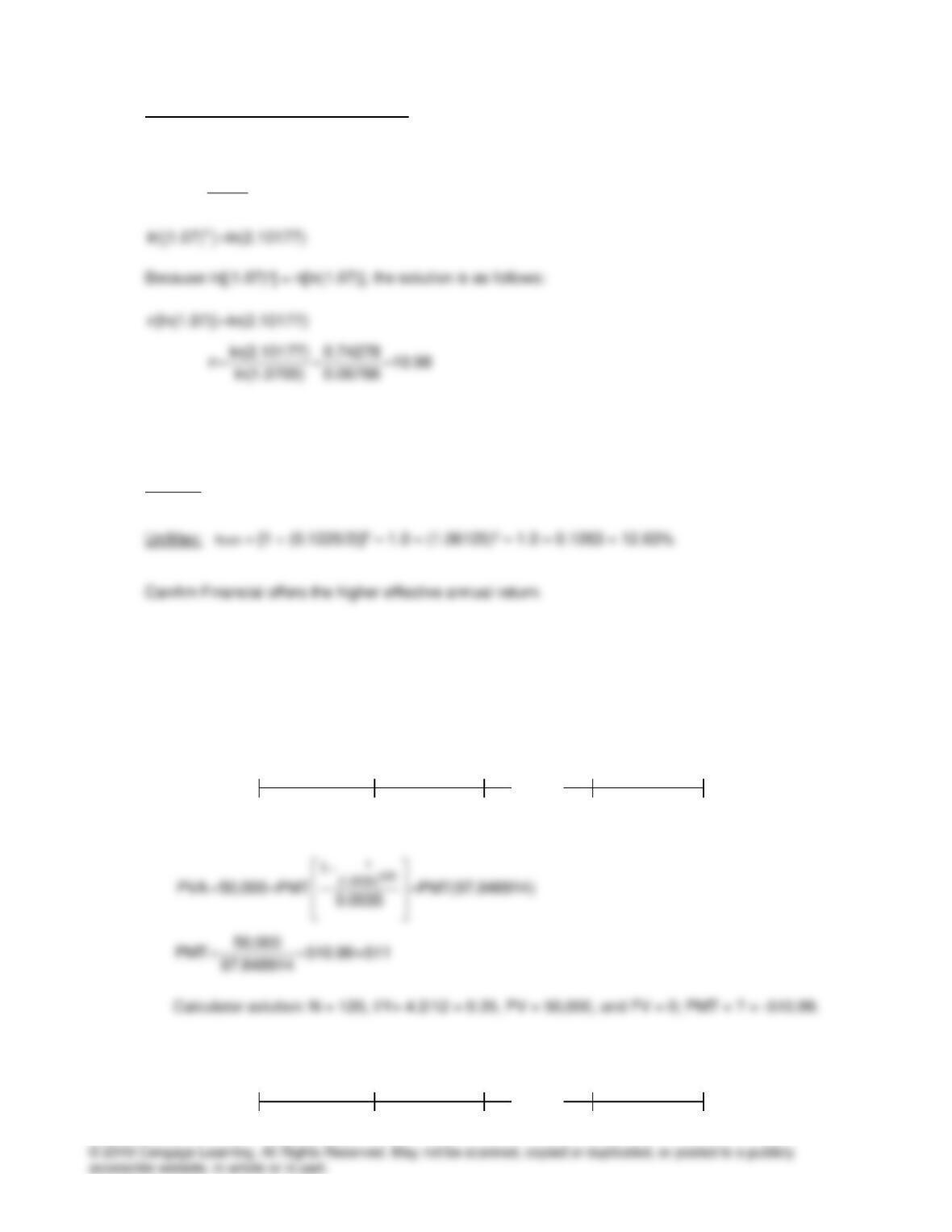
Solve for n using logarithms,
the trial-and-error method, or
a financial calculator.
Chapter 4 CFIN6
Alternative solution (using logarithms):
n
n
4,750 2,260(1.07)
4,750
(1.07) 2.10177
2,260
=
==
4-21 rEAR = (1 + r/m)m – 1.0
CanAm: rEAR = [1 + (0.12/12)]12 – 1.0 = (1.01)12 – 1.0 = 0.1268 = 12.68%
4-22 a. APR = 6.0%
b. rEAR = [1 + (0.06/12)]12 – 1.0 = (1.005)12 – 1.0 = 0.0617 = 6.17%
4-23 a. 0 1 2 119 120 Months
PVA = 50,000 PMT PMT PMT PMT
b. After three years of payments, William is faced with the following cash flow timeline:
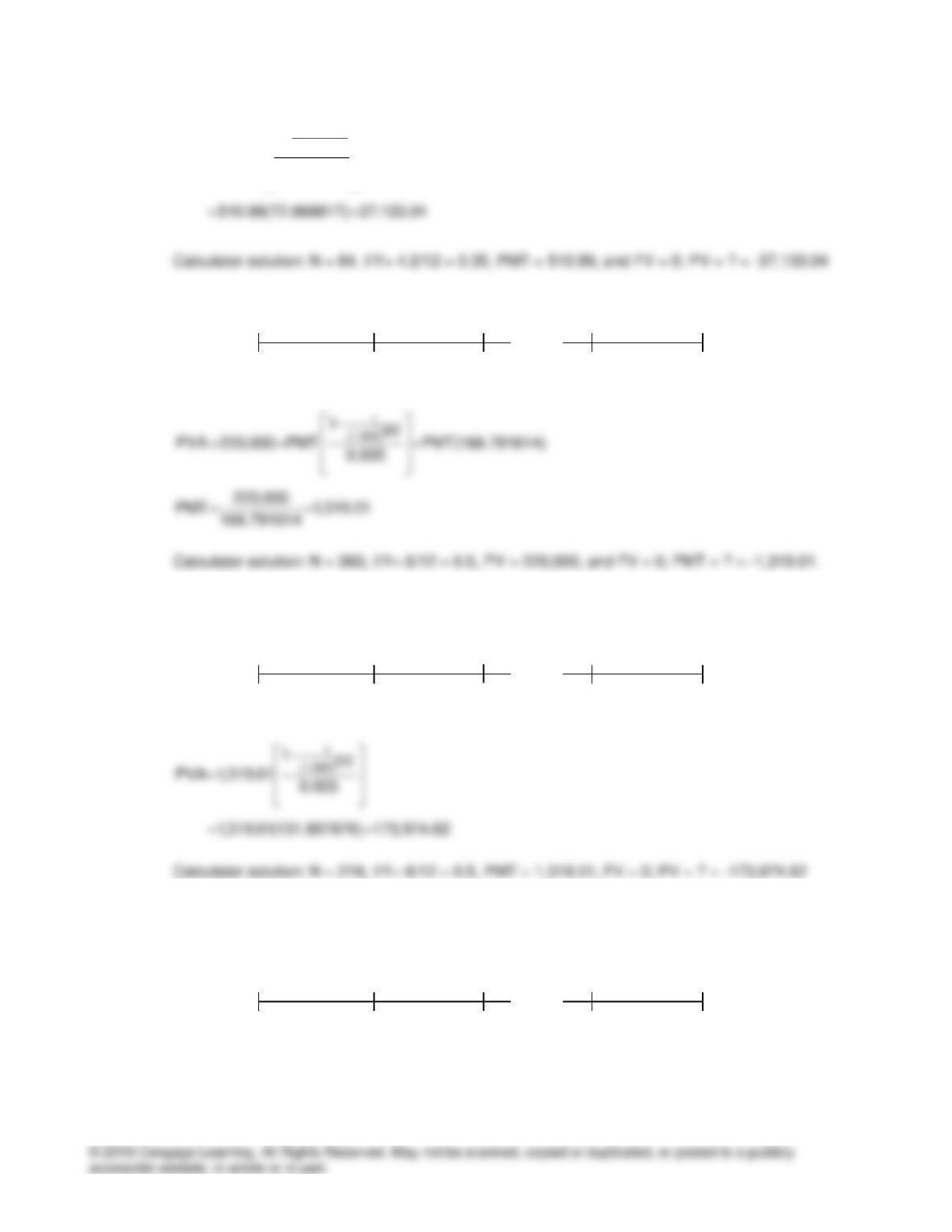
0 1 2 83 84 Months
PVA = ? 511 511 511 511
…
r = 0.35%
…
r = 0.35%
Chapter 4 CFIN6
184
(1.0035)
1
PVA 510.99 0.0035
−
=
4-24 a. 0 1 2 359 360 Months
PVA = 220,000 PMT PMT PMT PMT
b. Because it is 12 years after she bought the house, Sarah Jean has 216 = (30 – 12) x 12 payments
remaining and she is now faced with the following cash flow timeline:
0 1 2 215 216 Months
PVA = ? 1,319 1,319 1,319 1,319
This is an ordinary annuity because Sarah Jean made her most recent mortgage payment today,
which means her next payment is due in one month, not today.
4-25 a. 0 1 2 59 60 Months
PVA = 32,000 PMT PMT PMT PMT
…
r = 0.5%
…
r = 0.5%
…
r = 0.25%
Chapter 4 CFIN6
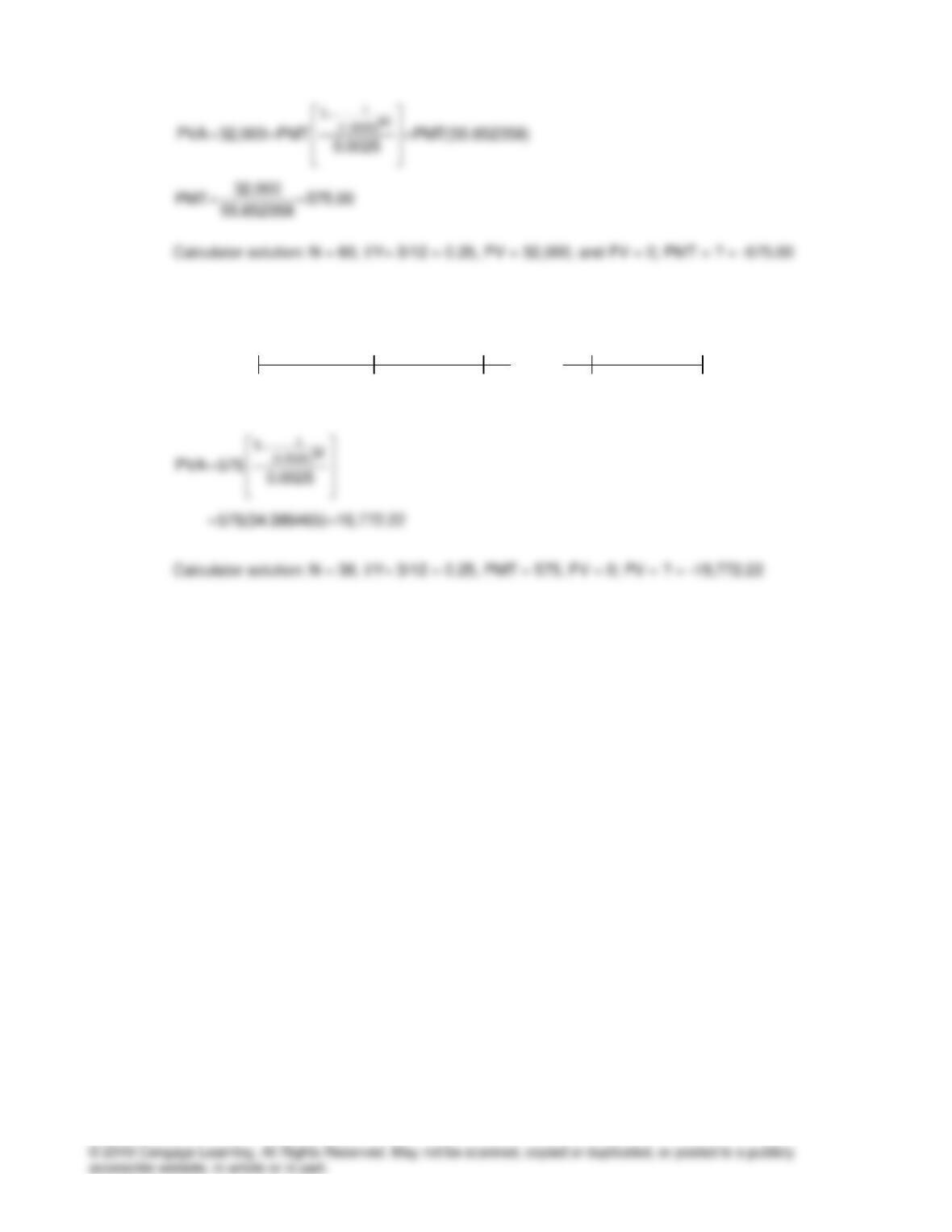
b. After making 24 payments, Nona would have 36 payments remaining and she would be faced with
the following cash flow timeline:
0 1 2 35 36 Months
PVA = ? 575 575 575 575
…
r = 0.25%