Managing Your Cash and Savings
Chapter 4
How Will This Affect Me?
Finding the best mix of alternative cash management accounts and assets requires careful
cost/benefit analysis based on your personal objectives and constraints.
This chapter presents a variety of different alternatives and focuses on key characteristics that
include minimum balances, interest rate returns and costs, liquidity, and safety. Cash
LEARNING GOALS
LG1 Understand the role of cash management in the personal financial planning process.
In personal financial planning, efficient cash management ensures adequate funds for both
household use and an effective savings program. Exhibit 4.1 lists the various liquid assets and
their related representative rates of return. The rates will change but the relation between the
LG2 Describe today’s financial services marketplace, both depository and nondepository
financial institutions.
LG3 Select the checking, savings, electronic banking, and other bank services that meet your
needs.
LG4 Open and use a checking account.
I think the text covers this and class time is not needed. The importance of the monthly bank
reconciliation should be noted. Exhibit 4.6 discusses the steps to take in reconciling your
account. If the students try to get by with a quarterly or longer reconciliation, the checking
The differences between travel checks, cashier checks, and certified checks may be a new topic
to your students. It will be useful to spend a short moment on these services. Should married
couples have two checking accounts [His and Hers] or only one account with two set of checks?
A short discussion of this issue will be useful.
LG5 Calculate the interest earned on your money using compound interest and future value
techniques.
The first step to investment is saving. The goal of a saving program is to meet liquidity needs
LG6 Develop a cash management strategy that incorporates a variety of savings plans.
The importance of an emergency fund [6 to 9 months of take home pay] and liquid assets in your
investment portfolio needs to be emphasized. While both involves liquid assets, their purposes
Financial Facts or Fantasies?
These may be used as “teasers” to get the students on the right page with you. Also, they may be
used as quizzes after you covered the material or as “pre–test questions” to get their attention.
Financial Fact or Fantasy?
1. An asset is considered liquid only if it is held in the form of cash.
2. Today’s financial marketplace offers consumers a full range of financial products and
services, many times all under one roof.
Fact: The financial marketplace offers financial products such as checking and savings accounts,
3. Unlike money market mutual funds, money market deposit accounts are federally insured.
Fact: Money market deposit accounts are funds deposited in special, higher-paying savings
4. At most banks and other depository institutions, you will be hit with a hefty service
charge if your checking account balance falls even just $1 below the stipulated minimum amount
for just one day out of the month.
Fact: Many depository institutions use the daily balance in your account, rather than the average
5. In all but a few cases, the nominal (stated) interest rate on a savings account is the same
as its effective rate of interest.
Fantasy: It is the opposite. In only a few cases are the two rates the same. Because the nominal
.6. U.S. Series EE and I savings bonds are not a very good way to save.
Fantasy: Investing in Series EE and I savings bonds are excellent ways to save. The bonds are
Financial Facts or Fantasies?
These may be used as a quiz or as a pre-test to get the students interested.
1. True False An asset is considered liquid only if it is held in the form of cash.
2. True False Today’s financial marketplace offers consumers a full range of financial
products and services, many times all under one roof.
3. True False Unlike money market mutual funds, money market deposit accounts are
federally insured.
4. True False At most banks and other depository institutions, you will be hit with a
hefty service charge if your checking account balance falls even just $1
below the stipulated minimum amount for just one day out of the month.
5. True False In all but a few cases, the nominal (stated) interest rate on a savings
account is the same as its effective rate of interest.
6. True False U.S. Series EE and I savings bonds are not a very good way to save.
YOU CAN DO IT NOW
The “You Can Do It Now” cases may be assigned to the students as short cases or problems.
They will help make the topic more real or relevant to the students. In most cases, it will only
take about ten minutes to do, that is, until the student starts looking around at the web site. But
they will learn by doing so.
Shop for the Best Short-Term Interest Rates
Most of us get in the habit of choosing the most conveniently located bank, and its
have a good sense of where you and your current bank stand—you can do it now.
Reconcile Your Checkbook
In this era of online and mobile banking, it’s easy to keep up with the current balance in your
Financial Impact of Personal Choices
Read and think about the choices being made. Do you agree or not? Ask the students to discuss
the choices being made. Five minutes of class discussion will be useful.
Josie Likes Cash – Too Much?
Josie has a good job that pays $65,000 a year. She invests the maximum amount allowable in her
work-based retirement plan. During the financial crisis a few years ago her retirement
investments fell about 40 percent in value! While her investments have more than recovered,
Josie is very risk conscious and has consequently built up an emergency fund of $60,000, which
Applying Personal Finance
Manage Your Cash!
What difference does it make where you keep your money? The returns are so low on checking
and savings accounts that you certainly won’t grow rich on their earnings! It’s no wonder that
many people tend to overlook the importance of managing their cash and liquid assets. This
project will help you evaluate your cash management needs and the various financial service
providers available so that you can select the one best suited to your needs.
Solutions to Financial Planning Exercises
1. Adapting to a low interest rate environment. Your parents are retired and have expressed
concern about the really low interest rates they’re earning on their savings. They’ve been
approached by an advisor who says he has a “sure–fire” way to get them higher returns.
What would you tell your parents about the low-interest-rate environment, and how would
you advise them to view the advisor’s new prospective investments?
While it is true that low interest rates will result in reduced income to retirees, and the search for
higher current returns has led many individuals to make investments of questionable risk. You
probably would be best to urge your parents to be very skeptical of “sure–fire” claims for higher
2. Comparing banks online. What type of bank serves your needs best? Visit the Web sites
of the following institutions and prepare a chart comparing the services offered, such as
traditional and online banking, investment services, and personal financial advice. Which
one would you choose to patronize, and why?
Individual student answers will vary depending upon the needs of the student.
Commercial banks offer checking and savings accounts and a full range of financial products and
services. They can offer non-interest-paying checking accounts (demand deposits). They are the
Savings banks are similar to S&Ls, but are located primarily in the New England states. Most are
mutual associations, which means their depositors are their owners and thus receive a portion of
the profits in the form of interest on their savings.
3. Exposure from stolen ATM Card. Suppose that someone stole your ATM card and
withdrew $950 from your checking account. How much money could you lose according to
federal legislation if you reported the stolen card to the bank: (a) the day the card was
stolen, (b) 6 days after the theft, (c) 65 days after receiving your periodic statement?
If your ATM card was stolen and $950 was withdrawn from your checking account, you
would be liable for:
4. Choosing a new bank. You’re getting married and are unhappy with your present bank.
Discuss your strategy for choosing a new bank and opening an account. Consider the
factors that are important to you in selecting a bank—such as the type and ownership of
new accounts and bank fees and charges.
Factors that typically influence the choice of where to maintain a checking account are
convenience, services, and cost. Many people choose a bank based solely on convenience
5. Calculating the net costs of checking accounts. Determine the annual net cost of these
checking accounts:
a. Monthly fee $4, check-processing fee of 20 cents, average of 23 checks written per month
Per-month cost = $4 + 23($.20) = $ 8.60
Annual cost = 12 × $8.60 = $103.20
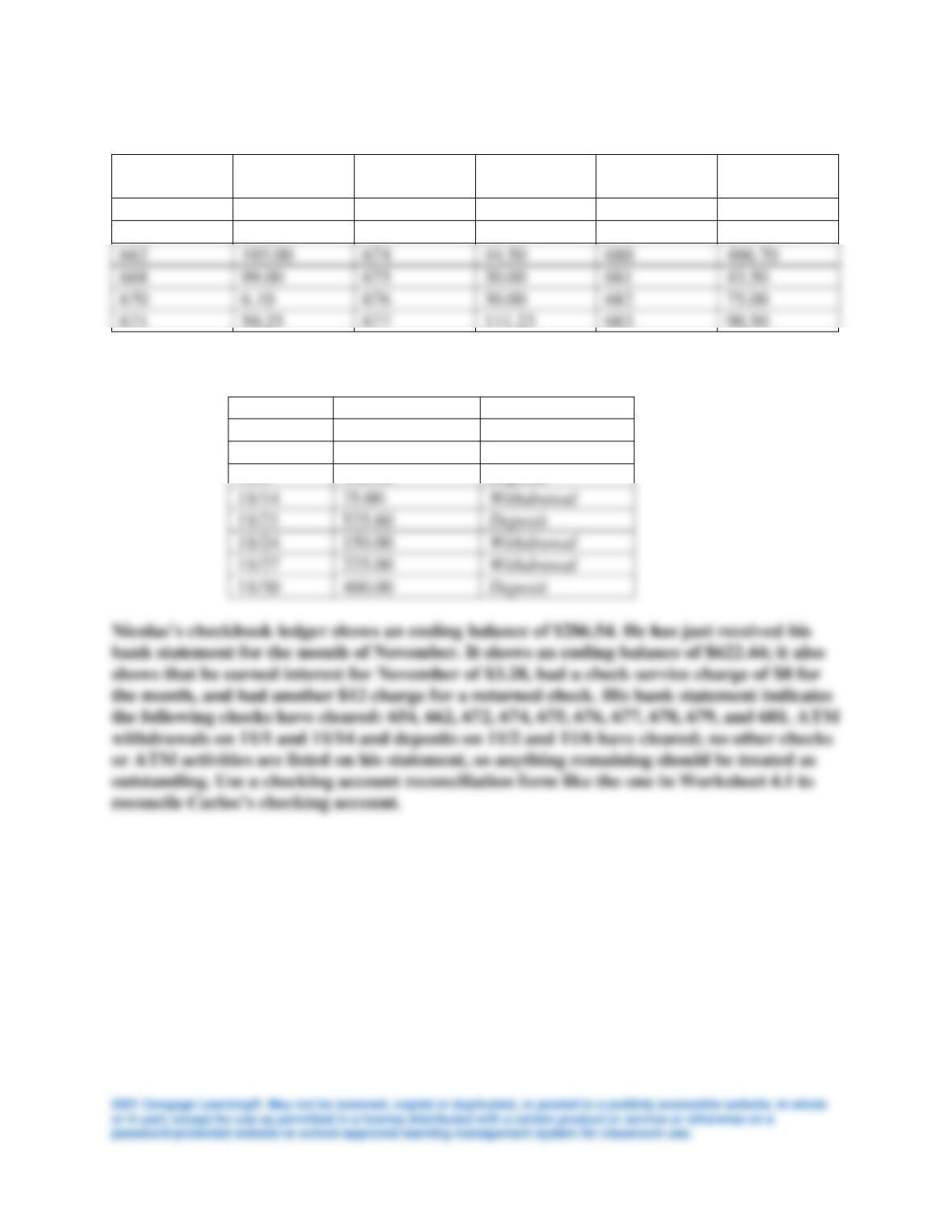
6. Checking account reconciliation. Use Worksheet 4.1. Nicolas Cruz has a NOW account at
the Second National Bank. His checkbook ledger lists the following checks:
Check
Number
Amount
Check
Number
Amount
Check
Number
Amount
654
206.05
672
24.90
678
38.04
658
55.22
673
32.45
679
97.99
662
103.00
674
44.50
680
486.70
668
99.00
675
30.00
681
43.50
670
6.10
676
30.00
682
75.00
671
50.25
677
111.23
683
98.50
Nicolas also made the following withdrawals and deposits at an ATM near his home:
Date
Amount
Transaction
11/1
$50.00
Withdrawal
11/2
525.60
Deposit
11/6
100.00
Deposit
11/14
75.00
Withdrawal
11/21
525.60
Deposit
11/24
150.00
Withdrawal
11/27
225.00
Withdrawal
11/30
400.00
Deposit
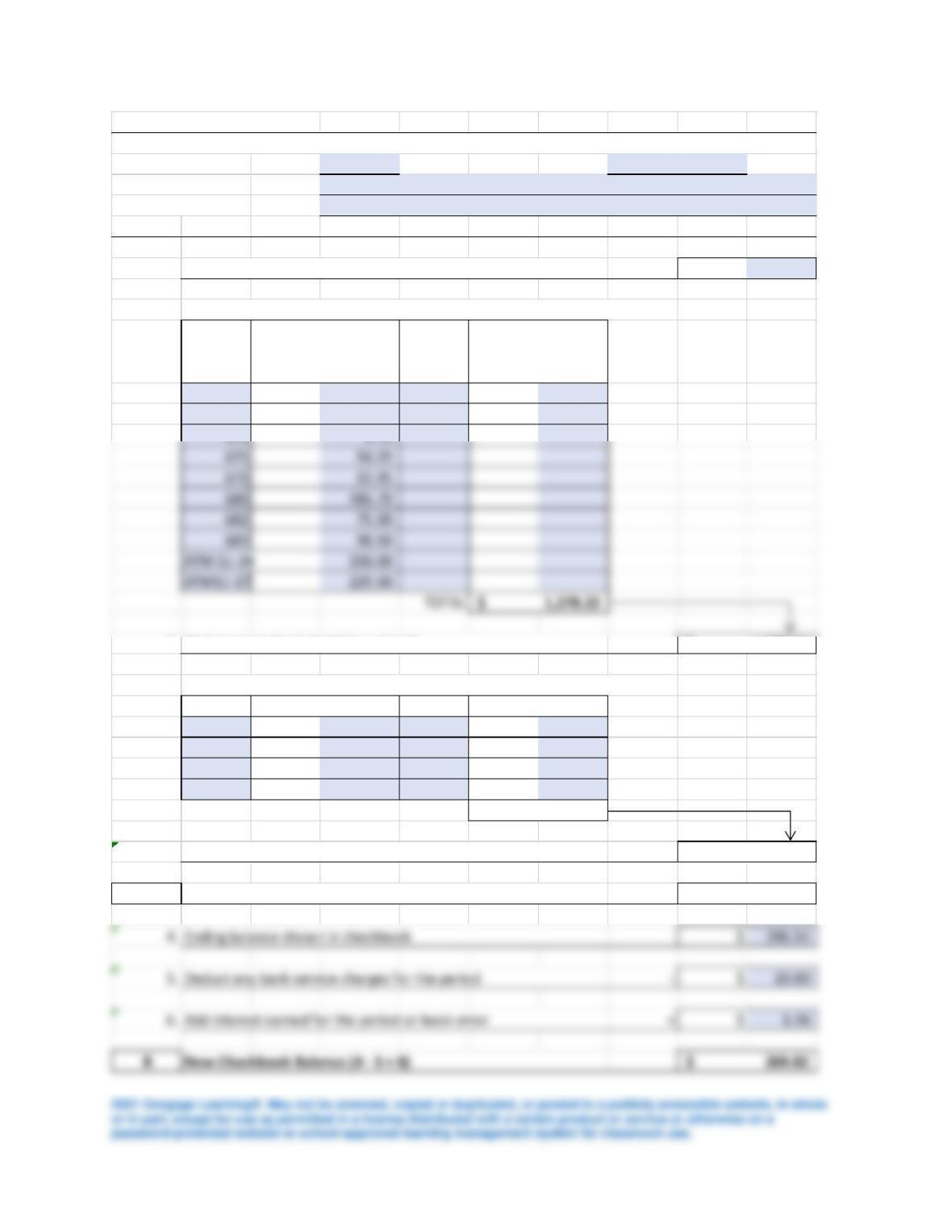
Ending balance shown in checkbook
Deduct any bank service charges for the period
Add interest earned for the period or book error
New Checkbook Balance (4 – 5 + 6)
269.82$
Worksheet 4.1 Problem 4.6
November , 20
1. $ 622.44
Check
Number
or Date
Check
Number
or Date
658 $ 55.22 $
668 99.00
1,278.22$
2. –
Date Date
11/21/20 525.60
11/30/20 400.00
TOTAL
3. +
A
Adjusted Bank Balance (1 – 2 + 3)
269.82$
Add total deposits still outstanding
925.60$
Ending balance shown on bank statement
Add up checks and withdrawals still outstanding:
Amount
Amount
Deduct total checks/withdrawals still
1,278.22$
Add up deposits still outstanding:
Amount
Amount
925.60$
Type of Account
Individual
CHECKING ACCOUNT RECONCILIATION
For the month of
20
Accountholder Name(
Nickolas Cruz
7. Determining the right amount of short-term, liquid investments. Evan and Sara Myers
together earn approximately $82,000 a year after taxes. Through an inheritance and some
wise investing, they also have an investment portfolio with a value of almost $150,000.
a. How much of their annual income do you recommend they hold in some form of liquid
savings as reserves? Explain.
b. How much of their investment portfolio do you recommend they hold in savings and
other short-term investment vehicles? Explain.
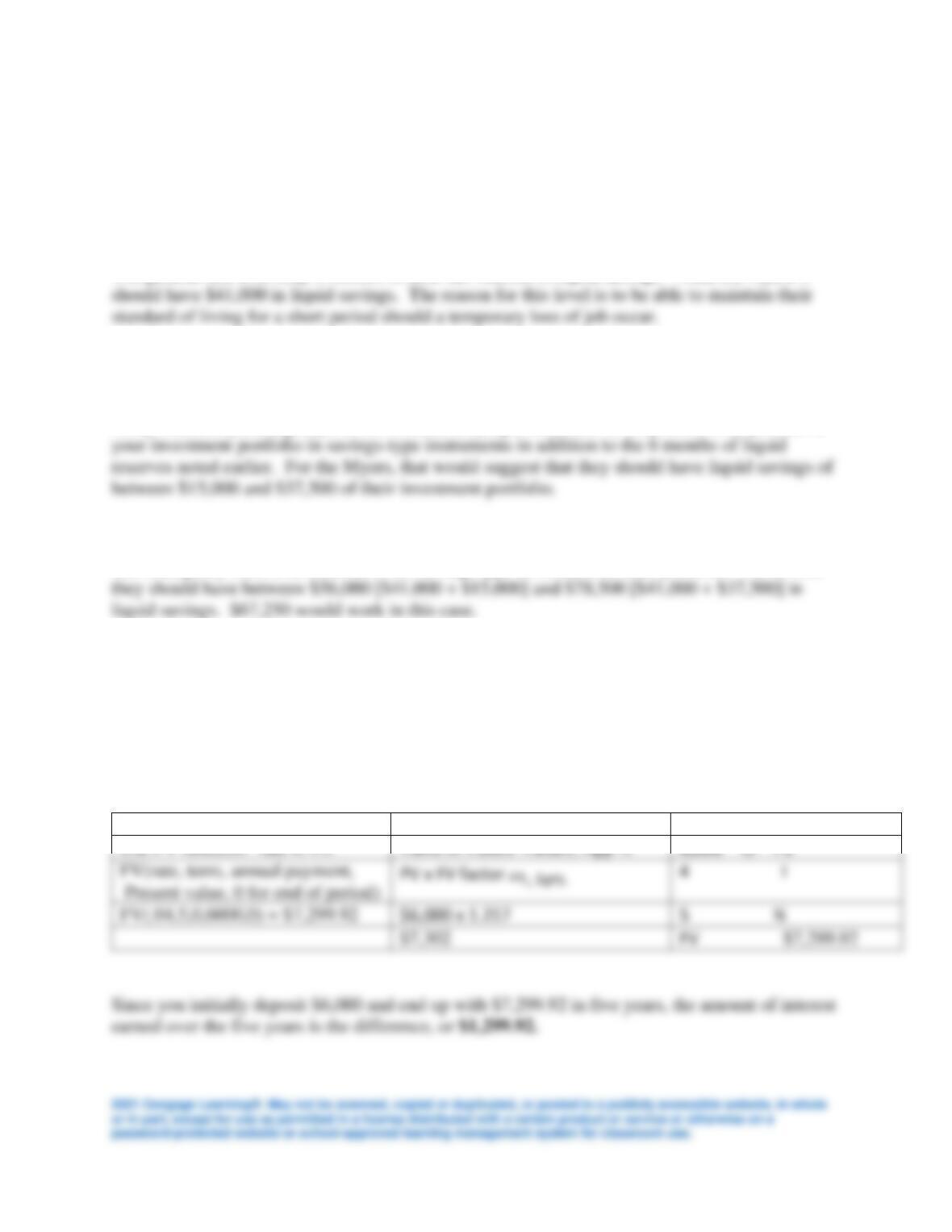
Many financial planning experts recommend keeping a minimum of 10 percent to 25 percent of
c. How much, in total, should they hold in short-term liquid assets?
The emergency fund is in addition to the savings type investment in their portfolio. So, in total
8. Calculating interest earned and future value of savings account. If you put $6,000 in a
savings account that pays interest at the rate of 4 percent, compounded annually, how
much will you have in 5 years? (Hint: Use the future value formula.) How much interest
will you earn during the 5 years? If you put $6,000 each year into a savings account that
pays interest at the rate of 4 percent a year, how much would you have after 5 years?
EXCEL
TABLE
CALCULATOR
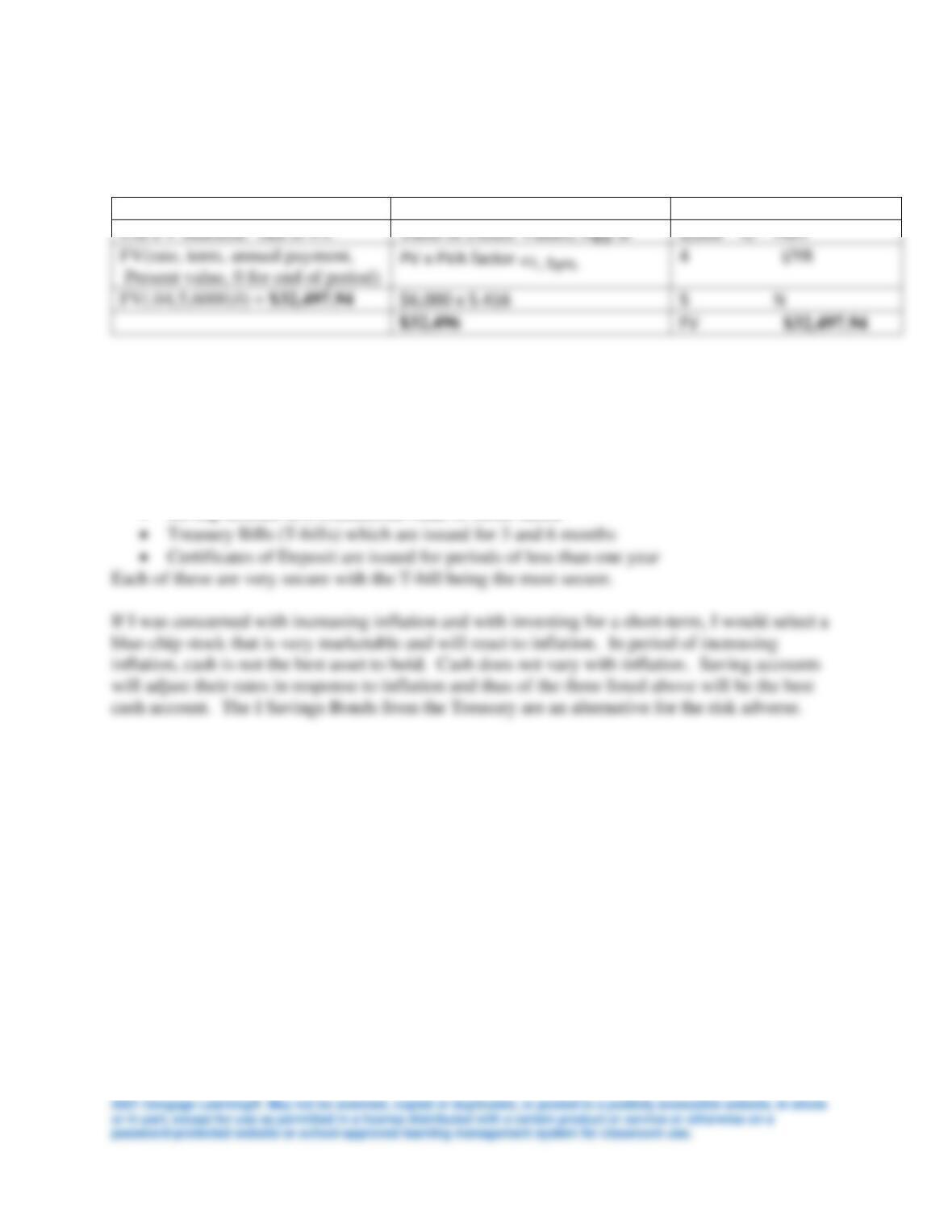
Calculate the future value of a series of 5 yearly $6,000 payments compounding at 4% per year
using the financial calculator, set on END MODE and 1 P/YR:
EXCEL
TABLE
CALCULATOR
9. Short-term investments and inflation. Describe some of the short-term investment
vehicles that can be used to manage your cash resources. What would you focus on if you
were concerned that inflation will increase significantly in the future?
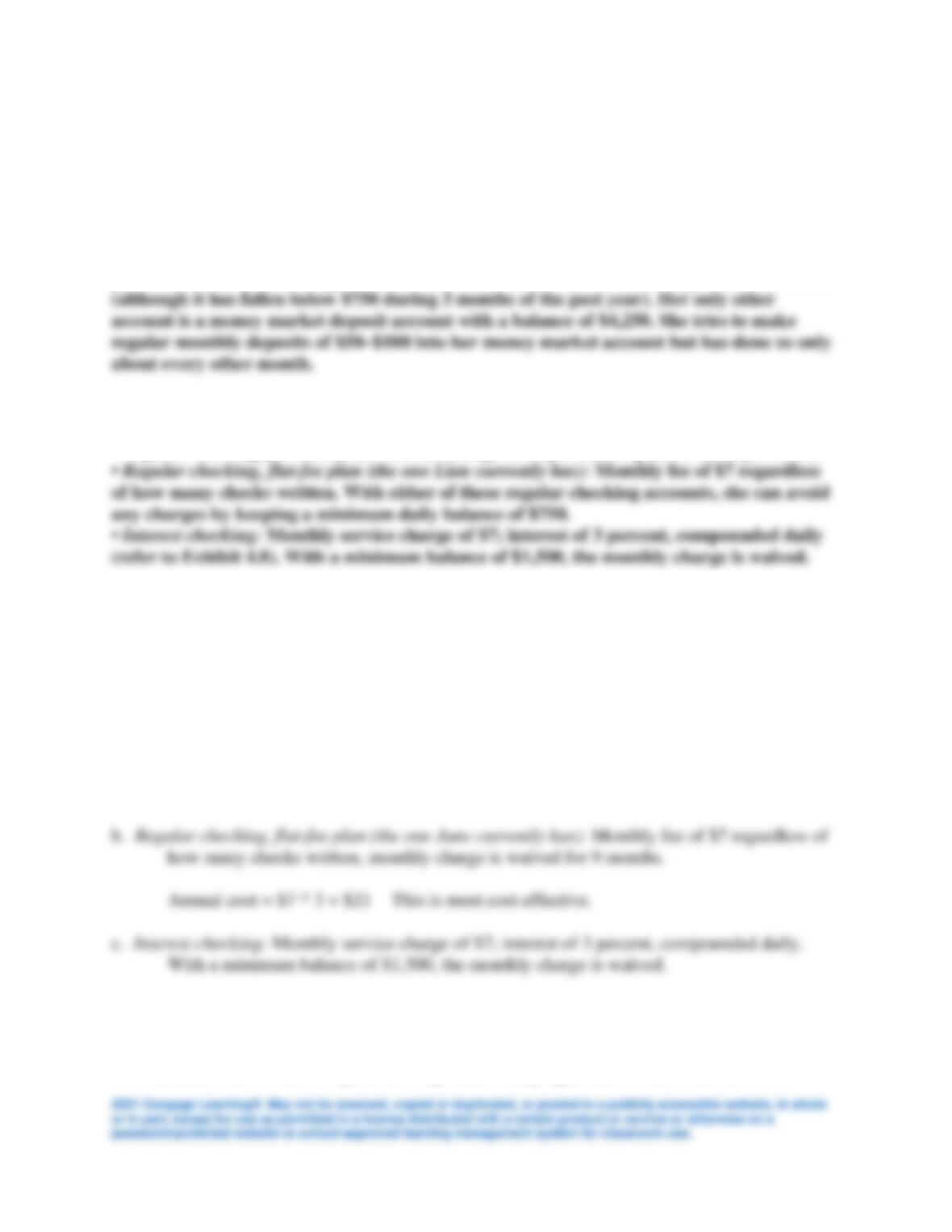
Short-term is generally understood to be less than a year. Given this short period the options are:
Critical Thinking Cases
4.1 Lian Chen’s Savings and Banking Plans
Lian Chen is a registered nurse who earns $3,250 per month after taxes. She has been
reviewing her savings strategies and current banking arrangements to determine if she
should make any changes. Lian has a regular checking account that charges her a flat fee
per month, writes an average of 18 checks a month, and carries an average balance of $795
Of the many checking accounts Lian’s bank offers, here are the three that best suit her
needs.
• Regular checking, per-item plan: Service charge of $3 per month plus 35 cents per check.
Lian’s bank also offers CDs for a minimum deposit of $500; the current annual interest
rates are 3.5 percent for 6 months, 3.75 percent for 1 year, and 4 percent for 2 years.
Critical Thinking Questions
1. Calculate the annual cost of each of the three accounts, assuming that Lian’s banking
habits remain the same. Which plan would you recommend and why?
a. Regular checking, per-item plan: Service charge of $3 per month plus 35 cents per check.
Monthly charge $3 + Per check charge $0.35 * 18 = $9.30 per month
Total annual charge, monthly charge is waived for 9 months, $27.90 of $ (3 * $9.30)
Since Lian’s balance is always under $1,500, she will have monthly charges each month.
Annual monthly service charge $7 * 12 = $84; Less interest earned $795 * .0305 = $24.25
Net annual cost = $59.75
From Exhibit 4.8, interest of 3 percent compounded daily equals an effective rate of 3.05%.
Of the three, her current flat fee plan is most cost effective
.
2. Should Lian consider opening the interest checking account and increasing her
minimum balance to at least $1,500 to avoid service charges? Explain your answer.
In order to maintain $1,500 minimum balance, Lian would have to move $705 from her money
3. What other advice would you give Lian about her checking account and savings
strategy?
Lian should start automatically transfer $100 per month to her money market account. The
automatic transfer feature will assure that the money is transferred each month without Lian
4.2 Reconciling the Wells Family’s Checking Account
Vivian and Rowen Wells are college students who opened their first joint checking account
Critical Thinking Questions
1. From this information, prepare a bank reconciliation for the Wells Family’s as of
October 5, 2020, using a form like the one in Worksheet 4.1.
Note: The problem information is not reproduced here. The bank reconciliation using
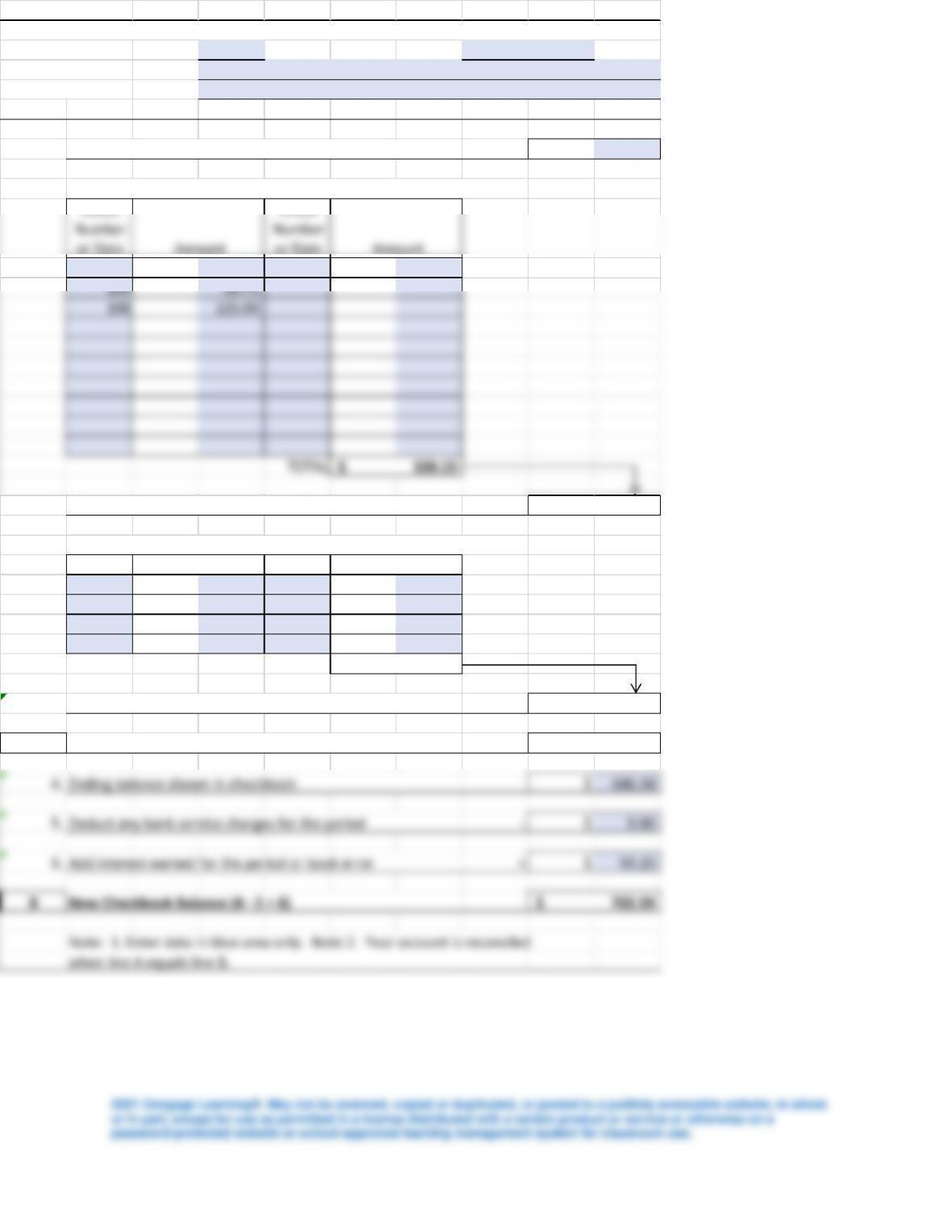
Worksheet 4.1
September
,
20
1.
$
397.74
Check
Number
Check
Number
Amount
Amount
102
$
58.40
$
TOTAL
2.
–
Date
Date
10/05/20
625.00
TOTAL
3.
+
A
4.
$
646.34
6.
+
$
59.25
Type of Account
Joint
CHECKING ACCOUNT RECONCILIATION
For the month of
20
Accountholder Name(s)
Vivian and Rowen Wells
Add total deposits still outstanding
625.00
$
Ending balance shown on bank statement
Add up checks and withdrawals still outstanding:
Deduct total checks/withdrawals still
320.15
$
Add up deposits still outstanding:
Amount
Amount
625.00
$
Adjusted Bank Balance (1 – 2 + 3)
702.59
$