CHAPTER 4: PARITY CONDITIONS IN INTERNATIONAL FINANCE/CURRENCY FORECASTING
1
CHAPTER 4
PARITY CONDITIONS IN INTERNATIONAL FINANCE
AND CURRENCY FORECASTING
This chapter emphasizes that currency prices are determined in the same way that other asset prices are,
by the interaction of supply and demand curves. The key concept is the relationship between inflation and
exchange rate changes – the internal devaluation of a currency (inflation) eventually leads to its external
devaluation.
KEY POINTS
1. Inflation is the logical outcome of an expansion of the money supply in excess of real output growth.
As the supply of one commodity increases relative to supplies of all other commodities, the price of
2. The international parallel to inflation is domestic currency depreciation relative to foreign currencies.
3. Although the nominal or actual money exchange rate may fluctuate all over the place, we would
normally expect the real, or inflation-adjusted exchange rate, to remain relatively constant over time.
4. Four additional equilibrium economic relationships tend to hold in international financial markets:
5. These equilibrium relationships are at the heart of a working knowledge of international financial
2. It is difficult to outperform the market’s own forecasts of future exchange rates as embedded in
3. Those with inside information about events that will affect the value of a currency or of a security
should benefit handsomely.
5. Given the widespread availability of information and the many knowledgeable participants in the
foreign exchange market, only the latter situation – government manipulation of exchange rates –
6. The black-market rate is a good indicator of where the official rate is likely to go if the monetary
authorities give in to market pressure. However, although the official rate can be expected to move
toward the black-market rate, we should not expect to see it coincide with that rate because of the bias
induced by government sanctions. The black-market rate seems to be most accurate in forecasting the
CHAPTER 4: PARITY CONDITIONS IN INTERNATIONAL FINANCE/CURRENCY FORECASTING
3
SUGGESTED ANSWERS TO CHAPTER 4 QUESTIONS
1.a. What is purchasing power parity (PPP)?
ANSWER. In its absolute version, PPP states that price levels should be equal worldwide when expressed
1.b. What are some reasons for deviations from purchasing power parity?
ANSWER. PPP might not hold because:
1.c. Under what circumstances can PPP be applied?
2. One proposal to stabilize the international monetary system involves setting exchange rates at
their PPP rates. Once exchange rates are correctly aligned (according to PPP), each nation
would adjust its monetary policy to maintain PPP. What problems might arise from using the
PPP rate as a guide to the equilibrium exchange rate?
ANSWER. The proposal to adjust monetary policy to maintain PPP assumes that the PPP rate is the
3. Suppose the dollar/rupiah rate is fixed but Indonesian prices are rising faster than U.S. prices.
Is the Indonesian rupiah appreciating or depreciating in real terms?
4. Comment on the following statement: “It makes sense to borrow during times of high inflation
because you can repay the loan in cheaper dollars.”
5. Which is likely to be higher, a 150% ruble return in Russia or a 15% dollar return in the U.S.?
6. The interest rate in England is 12%, while in Switzerland it is 5%. What are possible reasons
for this interest rate differential? What is the most likely reason?
7. Over the period 1982-1988, Peru and Chile stand out as countries whose interest rates are not
7.a. How would you characterize the real interest rates of Peru and Chile (e.g., close to zero,
highly positive, highly negative)?
7.b. What might account for Peru’s low interest rate relative to its high inflation rate? What are
the likely consequences of this low interest rate?
7.c. What might account for Chile’s high interest rate relative to its inflation rate? What are the
likely consequences of this high interest rate?
7.d. During the same period, Peru had a small interest differential and yet a large average
exchange rate change. How would you reconcile this experience with the IFE and with your
answer to part b?
8. Over the period 1982-1988 numerous countries (e.g., Pakistan, Hungary, Venezuela) had a
small or negative interest rate differential and a large average annual depreciation against the
dollar. How would you explain these data? Can you reconcile these data with the IFE?
9. What factors might lead to persistent covered interest arbitrage opportunities among countries?
10. In early 1989, Japanese interest rates were about 4 percentage points below U.S. rates. The
wide difference between Japanese and U.S. interest rates prompted some U.S. real estate
developers to borrow in yen to finance their projects. Comment on this strategy.
ANSWER. The U.S. developers were gambling that the 400 basis point differential did not reflect market
11. Recently, Japanese and German interest rates rose while U.S. rates fell. At the same time, the
yen and DM fell against the U.S. dollar. What might explain the divergent trends in interest
rates?
12. In late December 1990, one-year German Treasury bills yielded 9.1%, whereas one-year U.S.
12.a. Are these inflation and interest rates consistent with the Fisher Effect?
12.b. What might explain this difference in interest rates between the U.S. and Germany?
13. The spot rate on the euro is $0.91 and the 180-day forward rate is $0.93. What are possible
reasons for the difference between the two rates?
14. German government bonds, or Bunds, are currently paying higher interest rates than
comparable U.S. Treasury bonds. Suppose the Bundesbank eases the money supply to drive
down interest rates. How is an American investor in Bunds likely to fare?
15. In 1993 and early 1994, Turkish banks borrowed abroad at relatively low interest rates to fund
their lending at home. The banks earned high profits because rampant inflation in Turkey
forced up domestic interest rates. At the same time, Turkey’s central bank was intervening in
the foreign exchange market to maintain the value of the Turkish lira. Comment on the
Turkish banks’ funding strategy.
ANSWER. This strategy, while profitable in the short run, exposes the Turkish banks to significant and
predictable exchange risk. It will work only so long as the Turkish central bank is able to maintain a fixed
ADDITIONAL CHAPTER 4 QUESTIONS AND ANSWERS
1. If the dollar is appreciating against the Polish zloty in nominal terms but depreciating against
the zloty in real terms, what do we know about Polish and U.S. inflation rates?
2. Suppose the nominal peso/dollar exchange rate is fixed. If the inflation rates in Mexico and the
U.S. are constant (but not necessarily equal), will the real value of the peso/dollar exchange rate
also be constant over time?
3. If the average rate of inflation in the world rises from 5% to 7%, what will be the likely effect
on the U.S. dollar’s forward premium or discount relative to foreign currencies?
4. Comment on the following statement: “It makes sense to borrow during times of high inflation
because you can repay the loan in cheaper dollars.”
5. The empirical evidence shows that there is no consistent relationship between the spot exchange
rate and the nominal interest rate differential. Why might this be?
6. During 1988, the U.S. prime rate (the rate of interest banks charge on loans to their best
customers) stood at 9.5% while Japan’s prime rate was about 3.5%. Given that discrepancy, a
number of commentators argued that the cost of capital must come down for U.S. business to
remain competitive with Japanese companies. What additional information would you need to
properly assess this claim? Why might interest rates be lower in Japan than in the U.S.?
ANSWER. To begin, 3.5% in yen is not the same as 9.5% in dollars. Absent government controls or
subsidized financing, the expected cost of the two loans should be about the same when measured in the
7. In the late 1960s, Firestone Tire decided that Swiss francs at 2% were cheaper than U.S. dollars
at 8% and borrowed about SFr 500 million. Comment on this choice.
8. Comment on the following quote from the Wall Street Journal (August 27, 1984, p. 6) that
discusses the improving outlook for Britain’s economy: “Recovery here will probably last longer
than in the U.S. because there isn’t a huge budget deficit to pressure interest rates higher.”
9. Comment on the following headline that appeared in the Wall Street Journal (December 19,
1990, p. C10): “Dollar Falls Across the Board as Fed Cuts Discount Rate to 6.5% From 7%.”
(The discount rate is the interest rate the Fed charges member banks for loans.)
10. In late 1990, the U.S. government announced that it might try to reduce the budget deficit by
imposing a 0.5% transfer tax on all sales and purchases of securities in the U.S., with the
exception of Treasury securities. It projected the tax would raise $10 billion in federal
revenues – an amount derived by multiplying 0.5% by the value of the $2 trillion trading on
the New York Stock Exchange each year.
10.a. What are the likely consequences of this tax? Consider its effects on trading volume in the
U.S. and stock and bond prices.
ANSWER. This classic example of static revenue analysis assumes that making trading in the U.S. more
expensive and less profitable will not reduce the number of trades executed there. In fact, investors are
10.b. Why does the U.S. government plan to exclude its securities from this tax?
10.c. Critically assess the government’s estimates of the revenue it will raise from this tax.
ANSWER. One of the axioms of tax economics is that you should try to tax behavior that won’t change
much in response to the imposition of the tax. Here, the government is considering a tax on one of the
11. It has been argued that the U.S. government’s economic policies, particularly as they affect the
U.S. budget deficit, are severely constrained by the world’s financial markets. Do you agree or
disagree? Discuss.
ANSWER. Agree. To finance its huge budget deficits (which have recently turned into surpluses), the U.S.
government has needed continual access to the world’s capital markets. Given deficits, if investors begin
to believe that the U.S. would pursue economic policies that are inflationary, they would immediately
12. In 1991, the U.S. government imposed a stiff import tariff on the active-matrix LCD screens
that now appear in next-generation laptop computers.
12.a. Assess the likely consequences of the import duty for U.S. laptop computer manufacturers.
ANSWER. U.S. laptop manufacturers will find their costs rising significantly, particularly since the active–
12.b. How are these manufacturers likely to react to this import duty?
13. “High real interest rates can be a cause for celebration, not alarm.” Discuss.
ANSWER. The most likely reason for a rise in real interest rates is a pickup in economic activity.
Historically, an increase in real interest rates has usually signaled good economic times, while a real
14. In an integrated world capital market, will higher interest rates in, say Japan, mean higher
interest rates in, say, the U.S.?
15. In France in 1994, short-term interest rates and bond yields remained higher than in
Germany, despite a better outlook for inflation in France. Does this situation indicate a
violation of the Fisher Effect? Explain.
ANSWER. No. The Fisher Effect is based on expected future inflation. Investors were saying that they
believed Germany would likely have a lower rate of inflation in the future, despite its higher current rate
16. On February 15, 1993, President Clinton previewed his State of the Union message to Congress
in a toughly worded speech about how the growing federal budget deficit made tax increases
necessary. Financial markets reacted by pushing bond prices up and pummeling stock prices.
President Clinton said that the rise in Treasury bond prices was a “very positive” response to
his televised speech the night before. How would you interpret the reaction of the financial
markets to President Clinton’s speech?
17. At the same time that it was talking down the dollar, the Clinton Administration was talking
about the need for low interest rates to stimulate economic growth. Comment.
18. One idea to curb potentially destabilizing international movements of capital has been devised
18.a. Why would the Tobin tax have a disproportionate impact on short-term investments?
ANSWER. A given cost of buying and selling foreign exchange would be a larger percentage of
18.b. Is the Tobin tax likely to accomplish its objective? Explain.
ANSWER. No. A Tobin tax would be easy to avoid by moving currency trades to a country that does not
SUGGESTED SOLUTIONS TO CHAPTER 4 PROBLEMS
1. From base price levels of 100 in 2000, Japanese and U.S. price levels in 2006 stood at 98 and
109, respectively.
1.a. If the 2000 $:¥ exchange rate was $0.00928, what should the exchange rate be in 2006?
1.b. In fact, the exchange rate in 2006 was ¥1 = $0.00860. What might account for the
discrepancy? (Price levels were measured using the consumer price index.)
2. Two countries, the U.S. and England, produce only one good, wheat. Suppose the price of wheat
is $3.25 in the U.S. and is £1.35 in England.
2.a. According to the law of one price, what should the $:£ spot exchange rate be?
2.b. Suppose the price of wheat over the next year is expected to rise to $3.50 in the U.S and to
£1.60 in England. What should the one-year $:£ forward rate be?
2.c. If the U.S. government imposes a tariff of $0.50 per bushel on wheat imported from England,
what is the maximum possible change in the spot exchange rate that could occur?
3. If expected inflation is 100% and the real required return is 5%, what will the nominal interest
rate be according to the Fisher Effect?
4. Suppose the short-term interest rate in France was 3.7%, and forecast French inflation was
1.8%. At the same time, the short-term German interest rate was 2.6% and forecast German
inflation was 1.6%.
4.a. Based on these figures, what were the real interest rates in France and Germany?
4.b. To what would you attribute any discrepancy in real rates between France and Germany?
5. In July, the one-year interest rate is 12% on British pounds and 9% on U.S. dollars.
5.a. If the current exchange rate is $1.63:£1, what is the expected future exchange rate in one year?
5.b. Suppose a change in expectations regarding future U.S. inflation causes the expected future
spot rate to decline to $1.52:£1. What should happen to the U.S. interest rate?
6. Suppose that in Japan the interest rate is 8% and inflation is expected to be 3%. Meanwhile,
the expected inflation rate in France is 12%, and the English interest rate is 14%. To the
nearest whole number, what is the best estimate of the one-year forward exchange premium
(discount) at which the pound will be selling relative to the French franc?
7. An economic analysis firm has just published projected inflation rates for the U.S. and
Germany for the next five years. U.S. inflation is expected to be 10% per year, and German
inflation is expected to be 4% per year.
7.a. If the current exchange rate is $0.95/€, what should the exchange rates be for the next five
years?
7.b. Suppose that U.S. inflation over the next five years turns out to average 3.2%, German
inflation averages 1.5%, and the exchange rate in five years is $0.99/€. What has happened to
the real value of the euro over this five-year period?
ANSWER. According to Equation 4.7, the real value of the euro at the end of five years is
8. During 1995, the Mexican peso exchange rate rose from Mex$5.33/U.S.$ to Mex$7.64/U.S.$. At
the same time, U.S. inflation was approximately 3% in contrast to Mexican inflation of about
48.7%.
8.a. By how much did the nominal value of the peso change during 1995?
8.b. By how much did the real value of the peso change over this period?
ANSWER. Using Equation 4.7, the real value of the peso by the end of 1995 was $0.1890:
9. Suppose three-year deposit rates on Eurodollars and Eurofrancs (Swiss) are 12% and 7%,
respectively. If the current spot rate for the Swiss franc is $0.3985, what is the spot rate implied
by these interest rates for the franc three years from now?
ANSWER. If rus and rsw are the associated Eurodollar and Eurofranc nominal interest rates, then the IFE
says that
10. Assume the interest rate is 16% on pounds sterling and 7% on euros. At the same time,
inflation is running at an annual rate of 3% in Germany and 9% in England.
10.a. If the euro is selling at a one-year forward premium of 10% against the pound, is there an
arbitrage opportunity? Explain.
10.b. What is the real interest rate in Germany? In England?
10.c. Suppose that during the year the exchange rate changes from €1.8/£1 to €1.77/£1. What are
the real costs to a German company of borrowing pounds? Contrast this cost to its real cost
of borrowing euros.
10.d. What are the real costs to a British firm of borrowing euros? Contrast this cost to its real
cost of borrowing pounds.
11. Suppose the Eurosterling rate is 15%, and the Eurodollar rate is 11.5%. What is the forward
premium on the dollar? Explain.
12. Suppose the spot rates for the euro, pound sterling, and Swiss franc are $0.92, $1.13, and
$0.38, respectively. The associated 90-day interest rates (annualized) are 8%, 16%, and 4%;
the U.S. 90-day rate (annualized) is 12%. What is the 90-day forward rate on an ACU (ACU 1
= €1 + £1 + SFr 1) if interest parity holds?
13. Suppose that three-month interest rates (annualized) in Japan and the U.S. are 7% and 9%,
respectively. If the spot rate is ¥142:$1 and the 90-day forward rate is ¥139:$1:
13.a. Where would you invest?
13.b. Where would you borrow?
13.c. What arbitrage opportunity do these figures present?
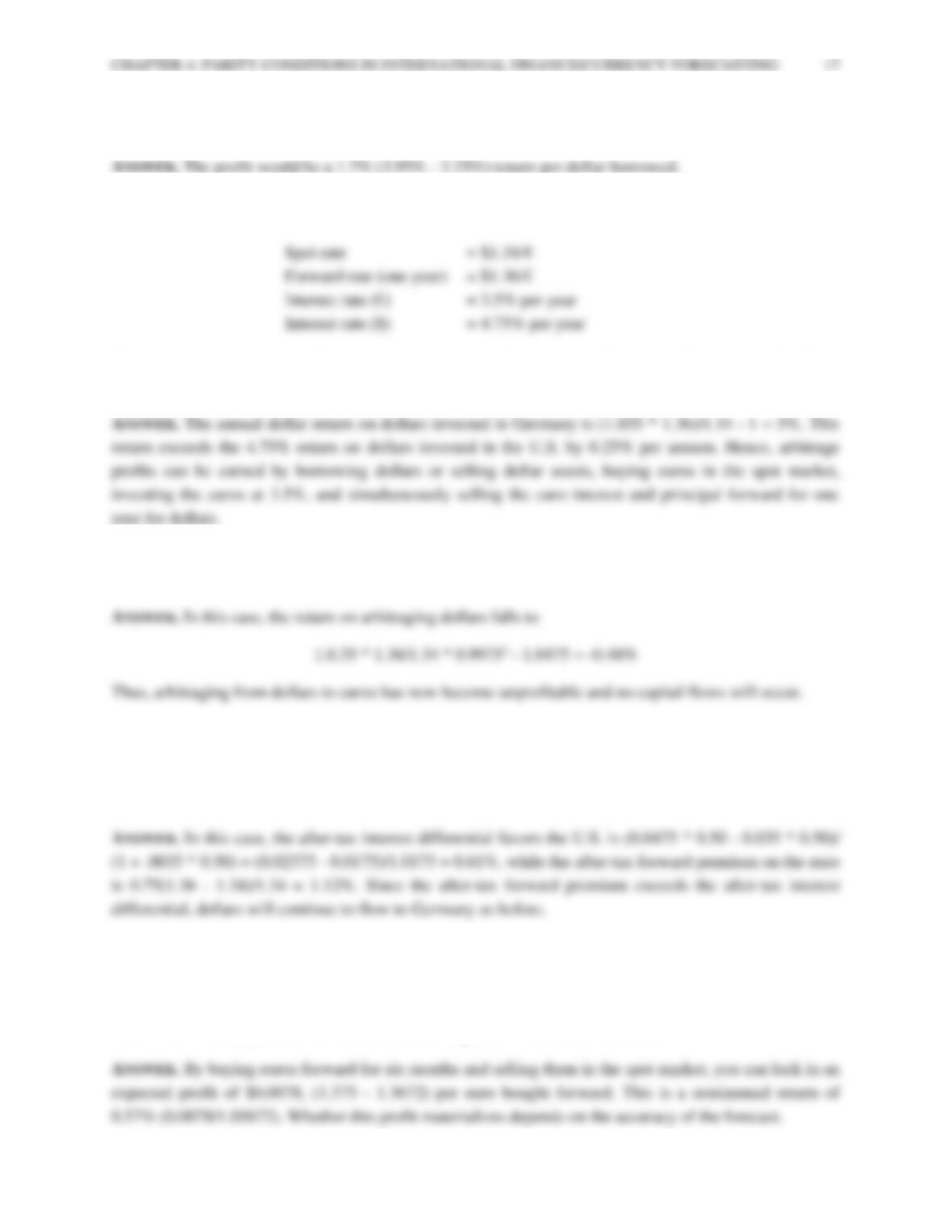
13.d. Assuming no transaction costs, what would be your arbitrage profit per dollar or dollar–
equivalent borrowed?
14. Here are some prices in the international money markets:
14.a. Assuming no transaction costs or taxes exist, do covered arbitrage profits exist in the above
situation? Describe the flows.
14.b. Suppose now that transaction costs in the foreign exchange market equal 0.25% per
transaction. Do unexploited covered arbitrage profit opportunities still exist?
14.c. Suppose no transaction costs exist. Let the capital gains tax on currency profits equal 25%
and the ordinary income tax on interest income equal 50%. In this situation, do covered
arbitrage profits exist? How large are they? Describe the transactions required to exploit
these profits.
15. Suppose today’s exchange rate is $1.35/€. The six-month interest rates on dollars and euros
are 6% and 3%, respectively. The six-month forward rate is $1.3672. A foreign exchange
advisory service has predicted that the euro will appreciate to $1.375 within six months.
15.a. How would you use forward contracts to profit in the above situation?
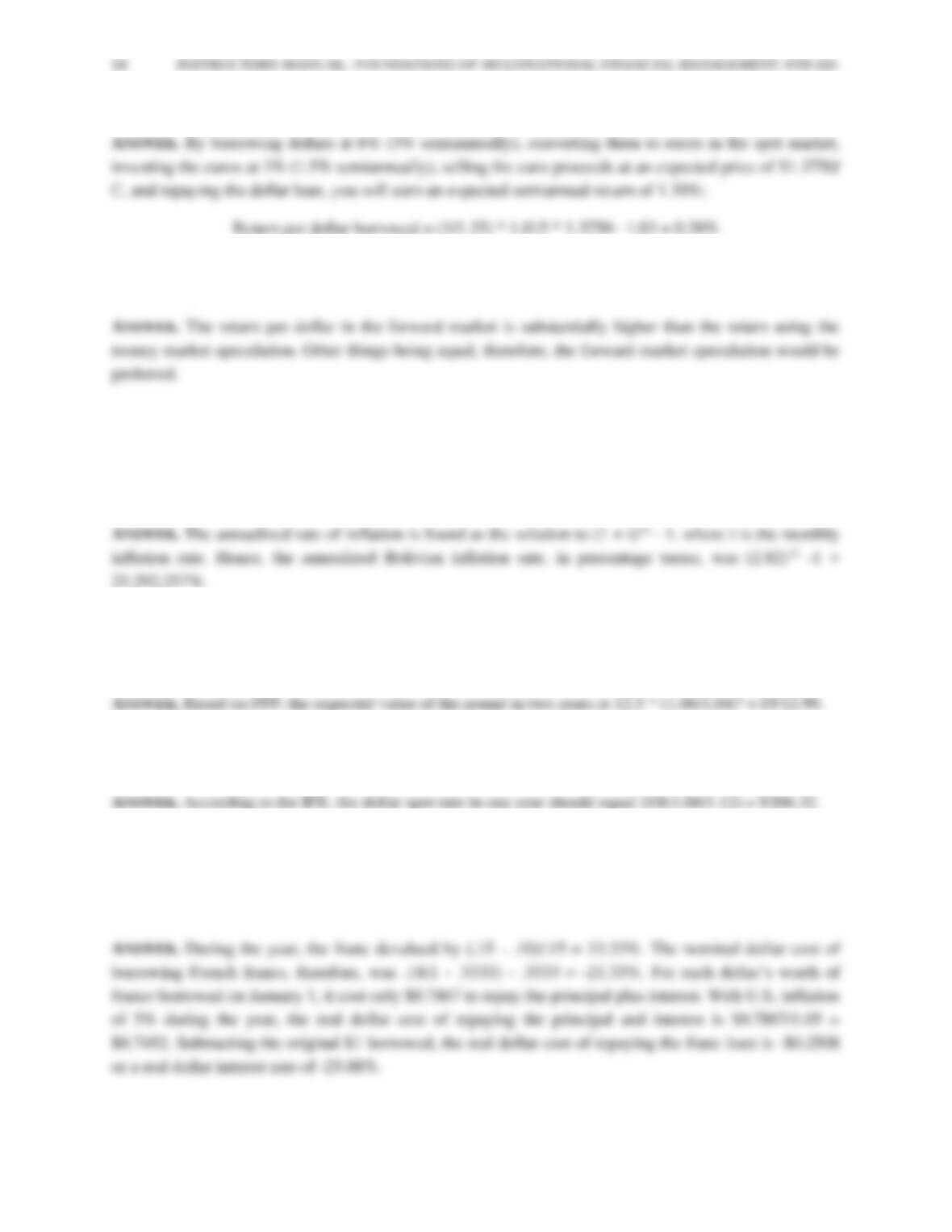
15.b. How would you use money market instruments (borrowing and lending) to profit?
15.c. Which alternatives (forward contracts or money market instruments) would you prefer?
Why?
ADDITIONAL CHAPTER 4 PROBLEMS AND SOLUTIONS
1. In February 1985, Bolivian inflation reached a monthly peak of 182%. What was the
annualized rate of inflation in Bolivia for that month?
2. The inflation rate in Great Britain is expected to be 4% per year, and the inflation rate in
France is expected to be 6% per year. If the current spot rate is £1 = FF 12.50, what is the
expected spot rate in two years?
3. If the $:¥ spot rate is $1 = ¥218 and interest rates in Tokyo and New York are 6% and 12%,
respectively, what is the expected $:¥ exchange rate one year hence?
4. Suppose that on January 1, the cost of borrowing French francs for the year is 18%. During the
year, U.S. inflation is 5% and French inflation is 9%. At the same time, the exchange rate
changes from FF1 = $0.15 on January 1 to FF1 = $0.10 on December 31. What was the real U.S.
dollar cost of borrowing francs for the year?
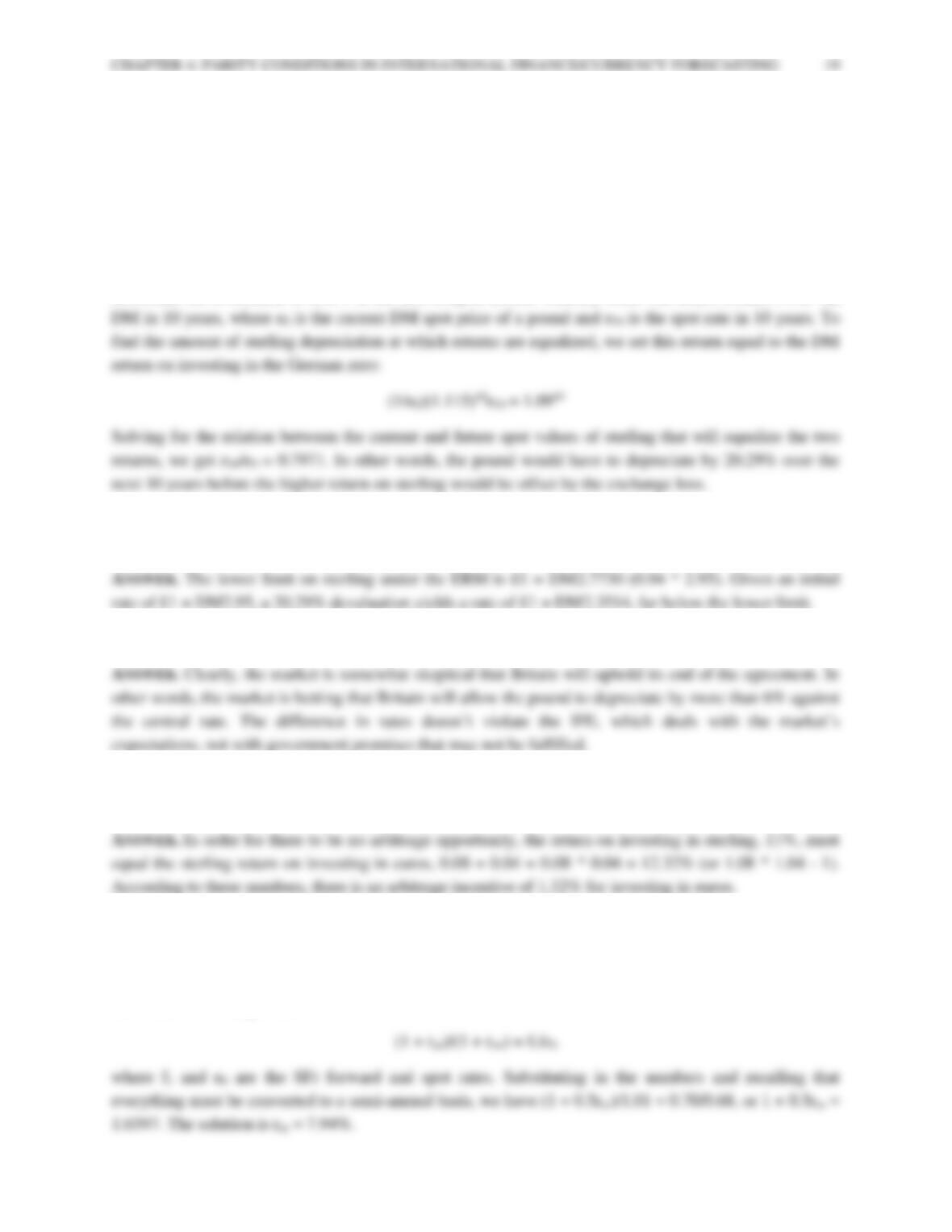
5. In late 1990, following Britain’s entry into the exchange-rate mechanism of the European
Monetary System, 10-year British Treasury bonds yielded 11.5% and the German equivalent
offered a yield of just 9%. Under terms of its entry, Britain established a central rate against
the DM of DM 2.95 and pledged to maintain this rate within a band of +/– 6%.
5.a. By how much would sterling have to fall against the DM over a 10-year period for the
German bond to offer a higher overall return than the British one? Assume the Treasuries
are zero-coupon bonds with no interest paid until maturity.
ANSWER. An investment of DM 1 in the zero-coupon British Treasury bond will return (1/e0)(1.115)10e10
5.b. How does the exchange rate established in 5.a compare to the lower limit that the British
government is pledged to maintain for sterling against the DM?
5.c. What accounts for the difference between the two rates? Does this difference violate the IFE?
6. Assume the interest rate is 11% on pounds and 8% on euros. If the euro is selling at a one-year
forward premium of 4% against the pound, is there an arbitrage opportunity? Explain.
7. If the Swiss franc is $0.68 on the spot market and the 180-day forward rate is $0.70, what is the
annualized interest rate in the U.S. over the next six months? The annualized interest rate in
Switzerland is 2%.
ANSWER. According to IRP,
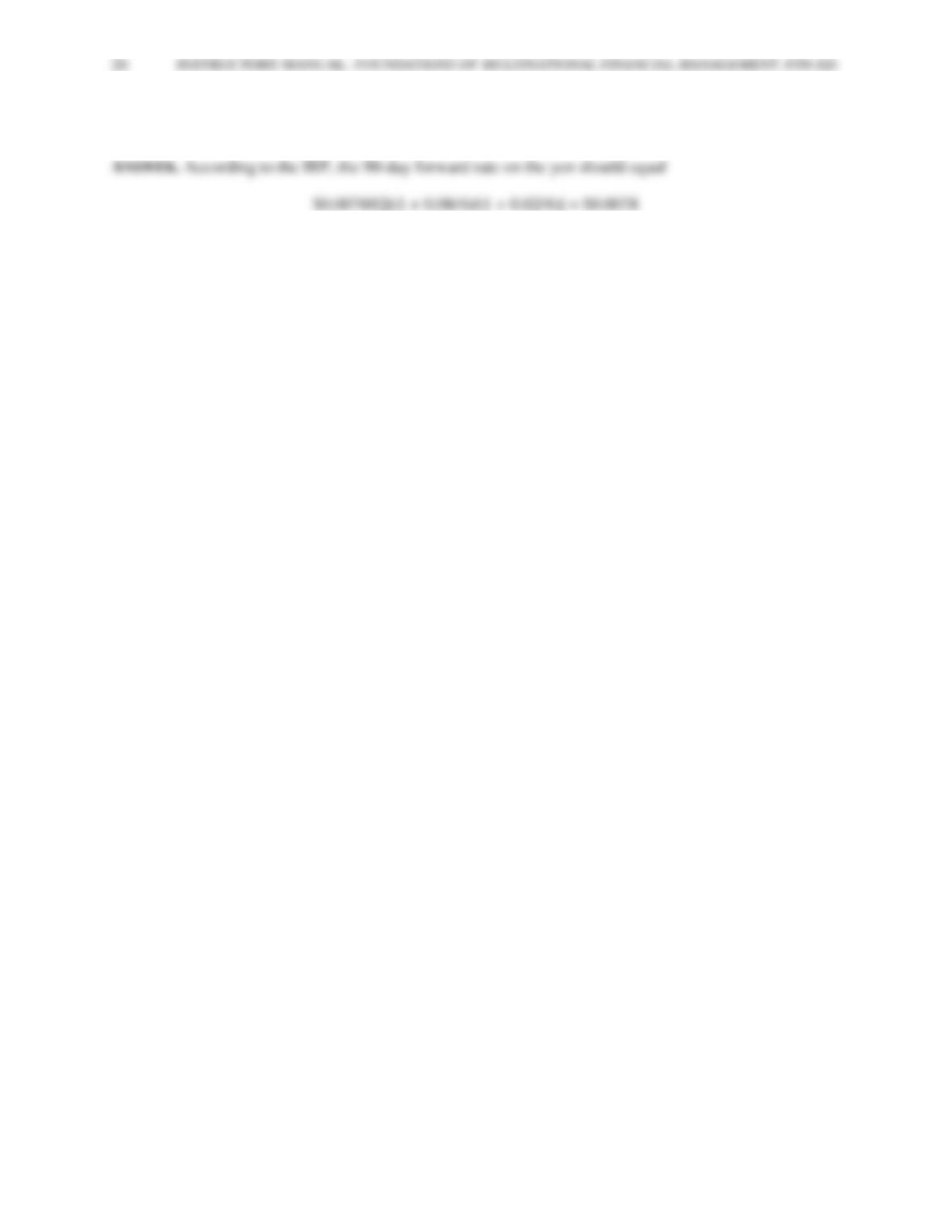
8. The interest rate in the U.S. is 8%; in Japan the comparable rate is 2%. The spot rate for the
yen is $0.007692. If IRP holds, what is the 90-day forward rate on the Japanese yen?