2. Given your answer to Question 1, what, if any, adjustments will the Wells Family need to
make in their checkbook ledger? Comment on the procedures used to reconcile their
checking account and their findings.
They do not have the $3 bank charges or the additional deposit of $59.25 recorded. Since this
3. If the Wells Family’s earned interest on their idle balances because the account is a
money market deposit account, what impact would this have on the reconciliation process?
Explain.
Perhaps the bank charges could be avoided by using a money market account. Also, there would
Test Yourself Questions
4-1 What is cash management, and what are its major functions?
Cash management is an activity that involves the day-to-day administration of cash and near-
cash liquid resources by an individual or family. The major functions of cash management are
4-2 Give two reasons for holding liquid assets. Identify and briefly describe the popular
types of liquid assets.
Liquid assets are held for two broad reasons: (1) to meet known, near-term spending needs
4-3 Explain the effects that historically low interest rates have on borrowers, lenders,
savers, and retirees.
The current low interest rate encourages businesses to rely on debt which increases the risk of
going into business. Also, the low rate discourages saving which has negative impact for the
4-4 Briefly describe the basic operations of—and the products and services offered by—
each of the following financial institutions: (a) commercial bank, (b) savings and loan
association, (c) savings bank, (d) credit union, (e) stock brokerage firm, and (f) mutual
fund.
Exhibit 4.2 gives a brief description of services offered by commercial banks, savings and loan
associations, savings banks, credit union.
From Exhibit 4.2: Depository Financial Institutions
Savings and loan association (S&L) Channels the savings of depositors primarily into
mortgage loans for purchasing and improving homes. Also offers many of the same checking,
saving, and lending products as commercial banks. Often pays slightly higher interest on savings
than do commercial banks.
Nondepository Financial Institutions:
Stock brokerage firms offer several cash management options, including money market mutual
funds that invest in short-term securities and earn a higher rate of interest than bank accounts,
special “wrap” accounts, and credit cards.
4-5 What role does the FDIC play in insuring financial institutions? What other federal
insurance program exists? Explain.
The FDIC provides deposit insurance on accounts up to $250,000 for commercial banks
and thrift institutions. The FDIC insurance requires a deposit account at the financial
4-6 Would it be possible for an individual to have, say, six or seven checking and savings
accounts at the same bank and still be fully protected under federal deposit insurance?
Explain. Describe how it would be possible for a married couple to obtain as much as
$1,500,000 in federal deposit insurance coverage at a single bank.
A married couple can obtain as much as $1,500,000 in coverage, apart from the coverage of CDs
noted below, by setting up several accounts:
4-7 Distinguish between a checking account and a savings account.
A checking account held at a financial institution is a demand deposit, meaning, that the bank
4-8 Define and discuss (a) demand deposits, (b) time deposits, (c) interest-paying checking
accounts.
a. Demand deposit refers to an account held at a financial institution from which funds can
be withdrawn (in check or cash) upon demand by the account holder. As long as
sufficient funds are in the account, the bank must immediately pay the amount indicated
when presented with a valid check or when accessed with a debit card or when the
financial institutions in the late 1970s and early 1980s, depositors now have the
4-9 Briefly describe the key characteristics of each of the following forms of interest paying
checking accounts: (a) NOW account, (b) MMDA, and (c) MMMF.
a. NOW accounts (or negotiable order of withdrawal accounts) have been popular since
the removal, beginning in 1986, of all interest rate restrictions. The account itself pays
b. Money market deposit accounts (MMDAs) are vehicles offered by banks, S&Ls, and
other depository institutions to compete with money market mutual funds. Unlike
MMMFs, MMDAs are federally insured. Depositors have access to their funds through
c. Money market mutual funds (MMMFs) are offered by investment companies and pool
the funds of many small investors to purchase high-yielding, short-term marketable
securities offered by the U. S. Treasury, major corporations, large commercial banks, and
various government organizations. The main advantage of these types of accounts to the
4-10 Describe the features of an AMA, its advantages, and its disadvantages.
The AMA [Asset Management Account] is a comprehensive deposit account that combines
checking, investing, and borrowing activities and is offered primarily by brokerage houses and
4-11 Briefly describe (a) debit cards, (b) banking at ATMs, (c) preauthorized deposits and
payments, (d) bank-by-phone accounts, and (e) online banking and bill-paying services.
These are alternative forms of Electronic Funds Transfers systems. They provide convenience to
the customers and cost savings to the banks. Security is always an issue. The customer must
safeguard their passwords [PIN] and the bank must have security procedures for its system.
With sophisticated hackers, the risk of electronic funds transfers is a concern.
b. An automated teller machine (ATM) is a remote computer terminal at which bank
customers can make deposits, withdrawals, and other types of basic transactions. The
ATM can operate 24 hours a day, seven days a week. Banks and other depository
institutions locate them in places convenient to shopping, offices, and travel facilities.
Most banks do not charge their customers for this service. If not a customer, they do
d. Bank-by-phone accounts allow customers to make many types of banking
transactions using their telephones. They can either talk to a customer service
representative or use a touch-tone phone to verify balances, find out whether a check has
cleared, transfer funds, and, at some banks, pay bills.
e. Online banking and bill payment services enable one to handle nearly all account
transactions from a personal computer at any time of the day or night and on any day of
the week. Basically, with an online banking setup the customer instructs the bank to pay
4-12 What are your legal rights and responsibilities when using EFTSs?
You are responsible for your actions. To prevent unauthorized charges you must notify the
4-13 What are the key factors to consider when opening a checking account? Discuss the
advantages and disadvantages of individual versus joint accounts.
Factors that typically influence the choice of where to maintain a checking account are
convenience, services, and cost. Many people choose a bank based solely on convenience
factors: business hours, location, number of drive-thru windows, and number and location of
4-14 Is it possible to bounce a check because of insufficient funds when the checkbook
ledger shows a balance available to cover it? Explain what happens when a check bounces.
Can you obtain protection against overdrafts?
It is possible to bounce a check due to insufficient funds when the checkbook ledger
shows a balance available to cover it if certain deposits added to the checkbook ledger
have not yet been credited to the account by the bank. This situation could also arise
when certain service fees are deducted from the account by the bank, but the account
holder has not yet been notified and therefore has not yet deducted them from his or her
checkbook ledger.
4-15 Describe the procedure used to stop payment on a check. Why might you wish to
initiate this process?
Payment on a check is stopped by notifying the bank. Normally, the account holder fills
out a form with the check number and date, amount, and the name of the payee. Some
4-16 What type of information is found in the monthly bank statement, and how is it used?
Explain the basic steps involved in reconciling an account.
Your monthly bank statement contains an itemized listing of all transactions (checks
written, deposits made, electronic funds transfer transactions such as ATM withdrawals
and deposits and automatic payments) within your checking account. It also includes
The basic steps in the account reconciliation process are:
1. Upon receipt of the bank statement, arrange all canceled checks in descending
numerical order based on their sequence numbers or issuance dates.
2. Compare each check amount, from the check itself or the statement, with the
corresponding entry in the checkbook ledger to make sure that no recording errors
exist. Place a checkmark in the ledger alongside each entry compared. Also check off
any other withdrawals, such as from ATMs or automatic payments, and make sure to
add any checks written or deposits made which are shown on the bank statement, but
you forgot to record in your checkbook.
4-17 Briefly describe each of these special types of checks:
a. A cashier’s check is drawn on the bank, rather than a personal or corporate account, so
that the bank is actually paying the recipient. There is a service fee in addition to the face
amount.
4-18 In general, how much of your annual income should you save in the form of liquid
reserves? What portion of your investment portfolio should you keep in savings and other
short-term investment vehicles? Explain.
Although opinions differ as to how much you should keep as liquid reserves, the post-crisis
consensus is that most families should have an amount equal to at least 6 months of after-tax
income.
4-19 Define and distinguish between the nominal (stated) rate of interest and the effective
rate of interest. Explain why a financial institution that pays a nominal rate of 4.5 percent
interest, compounded daily, actually pays an effective rate of 4.6 percent.
The nominal rate of interest is the stated rate of interest, so in this instance the financial
institution nominal interest rate is 4.5%. The effective rate of interest is the interest rate
4-20 What factors determine the amount of interest you will earn on a deposit account?
Which combination provides the best return?
The amount of interest earned depends on several factors, including frequency of
compounding, how the bank calculates the balances on which interest is paid, and the
interest rate itself. Look for daily or continuous compounding and a balance calculation
4-21 Briefly describe the basic features of each of the following savings vehicles:
(a) CDs, (b) U.S. Treasury bills, (c) Series EE bonds, and (d) I savings bonds.
a. Certificates of deposit (CDs) are savings instruments that require funds to remain on
deposit for a specified period of time and can range from seven days to a year or more.
Although it is possible to withdraw funds prior to maturity, an interest penalty usually
makes withdrawal somewhat costly. While the bank or other depository institution can
taxes. They are almost as liquid as cash, because they can be sold at any time in a very
active secondary market without any interest penalty. If they should be sold before
maturity, however, one can lose money if interest rates have risen. In addition, broker’s
fees have to be paid in order to sell T-bills prior to maturity.
d. I Savings Bonds are similar to Series EE bonds in numerous ways. Both are issued
by the U.S. Treasury and are accrual-type securities. I bonds are available in
denominations between $25 and $10,000. Interest compounds semiannually for 30 years
on both securities. Like Series EE bonds, I savings bonds’ interest remains exempt from
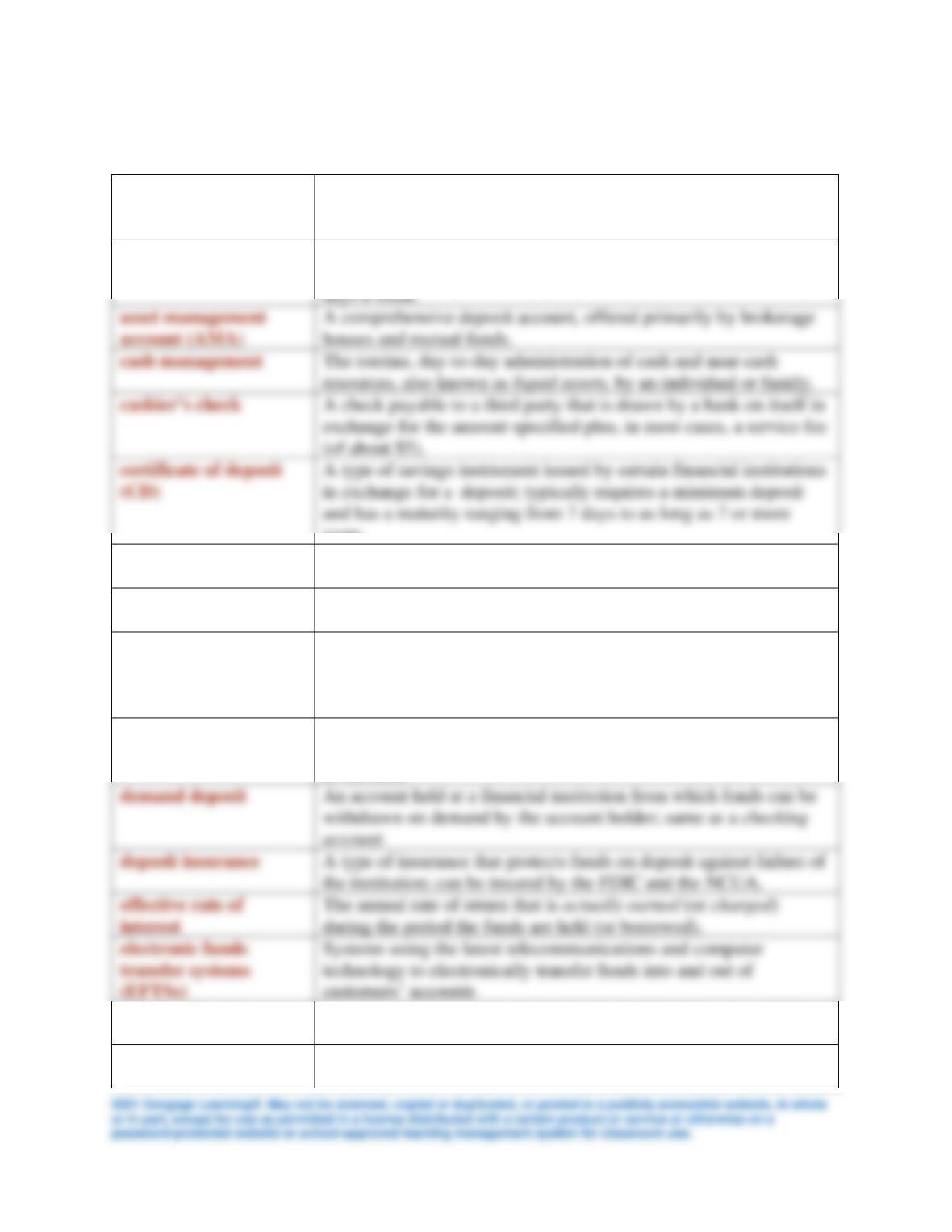
Key Terms
account
reconciliation
Verifying the accuracy of your checking account balance in relation
to the bank’s records as reflected in the bank statement, which is an
itemized listing of all transactions in the checking account.
automated teller
machine (ATM)
A remote computer terminal that customers of depository
institutions can use to make basic transactions 24 hours a day, 7
days a week.
asset management
account (AMA)
A comprehensive deposit account, offered primarily by brokerage
houses and mutual funds.
A check payable to a third party that is drawn by a bank on itself in
exchange for the amount specified plus, in most cases, a service fee
(of about $5).
(CD)
in exchange for a deposit; typically requires a minimum deposit
and has a maturity ranging from 7 days to as long as 7 or more
years.
certified check
A personal check that is guaranteed by the bank on which it is
drawn.
checkbook ledger
A booklet, provided with a supply of checks, used to maintain
accurate records of all checking account transactions.
compound interest
When interest earned in each subsequent period is determined by
applying the nominal (stated) rate of interest to the sum of the
initial deposit and the interest earned in each prior period.
debit cards
Specially coded plastic cards used to transfer funds from a
customer’s bank account to the recipient’s account to pay for goods
or services.
deposit insurance
A type of insurance that protects funds on deposit against failure of
the institution; can be insured by the FDIC and the NCUA.
electronic funds
transfer systems
(EFTSs)
Systems using the latest telecommunications and computer
technology to electronically transfer funds into and out of
I Savings bond
A savings bond, issued at face value by the U.S. Treasury, whose
partially fixed rate provides some inflation protection.
Internet bank
An online commercial bank.
password-protected website or school-approved learning management system for classroom use.
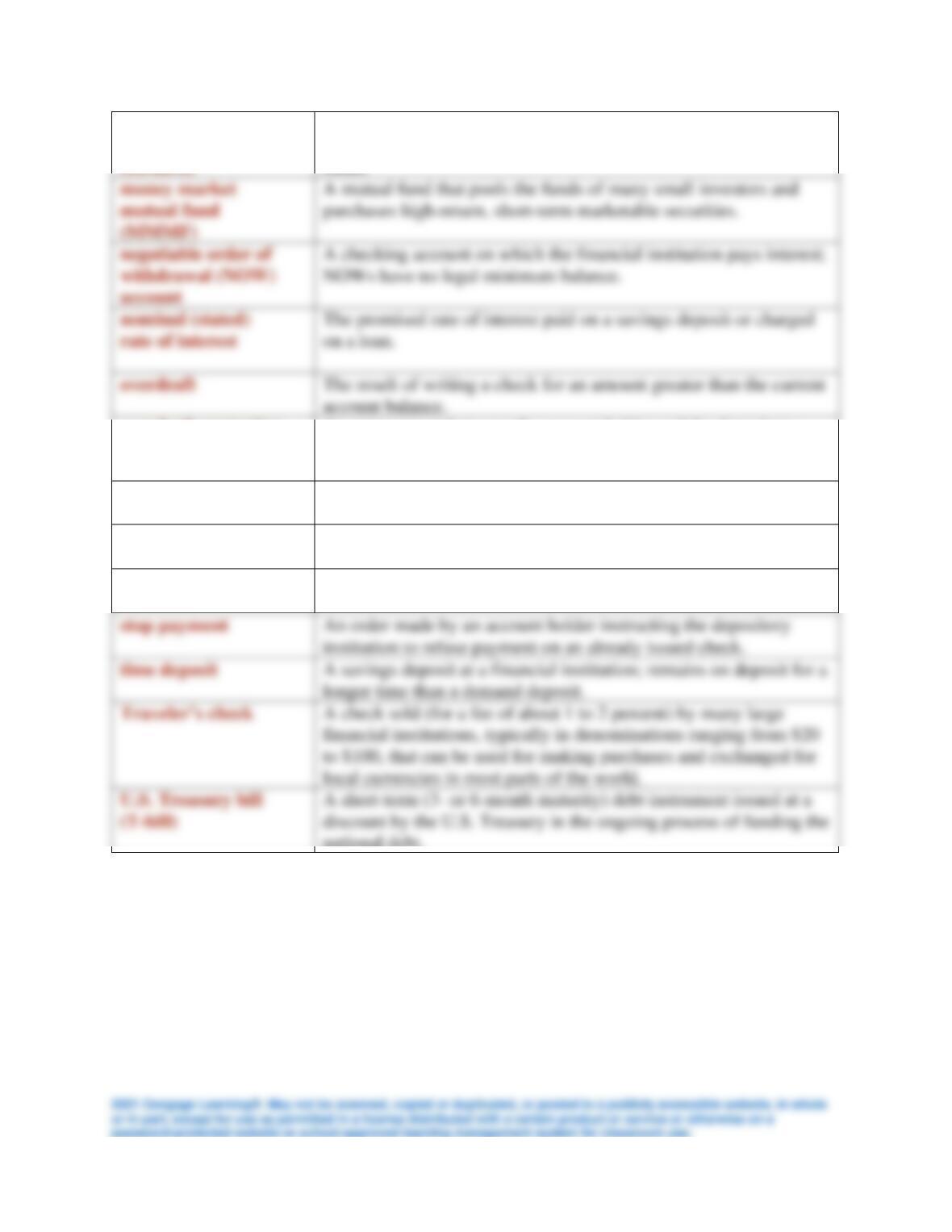
money market
deposit account
money market
mutual fund
(MMMF)
A mutual fund that pools the funds of many small investors and
purchases high-return, short-term marketable securities.
negotiable order of
withdrawal (NOW)
account
A checking account on which the financial institution pays interest;
NOWs have no legal minimum balance.
nominal (stated)
rate of interest
The promised rate of interest paid on a savings deposit or charged
on a loan.
overdraft
The result of writing a check for an amount greater than the current
account balance.
A federally insured savings account, offered by banks and other
depository institutions that competes with money market mutual
overdraft protection
An arrangement between the account holder and the depository
institution wherein the institution automatically pays a check that
overdraws the account.
Series EE bond
A savings bond issued in various denominations by the U.S.
Treasury.
share draft account
An account offered by credit unions that is similar to interest-
paying checking accounts offered by other financial institutions
simple interest
Interest that is paid only on the initial amount of the deposit.
time deposit
A savings deposit at a financial institution; remains on deposit for a
longer time than a demand deposit.
financial institutions, typically in denominations ranging from $20
to $100, that can be used for making purchases and exchanged for
local currencies in most parts of the world.
U.S. Treasury bill
A short-term (3- or 6-month maturity) debt instrument issued at a
discount by the U.S. Treasury in the ongoing process of funding the
national debt.
Chapter 4
Managing Your Cash and Savings
Chapter Outline
Learning Goals
I. The Role of Cash Management in Personal Financial Planning
A. The Problem with Low Interest Rates
Test Yourself
II. Today’s Financial Services Marketplace
A. Types of Financial Institutions
Test Yourself
III. A Full Menu of Cash Management Products
A. Checking and Savings Accounts
1. Checking Accounts and Savings Accounts
B. Electronic Banking Services
1. Electronic Funds Transfer Systems
a. Debit Cards and Automated Teller Machines
C. Regulation of EFTS Services
D. Other Bank Services
Test Yourself
IV. Maintaining a Checking Account
A. Opening and Using Your Checking Account
1. The Cost of a Checking Account
B. Monthly Statements
1. Account Reconciliation
C. Special Types of Checks
1. Cashier’s Check
Test Yourself
V. Establishing a Savings Program
A. Starting Your Savings Program
B. Earning Interest on Your Money
1. The Effects of Compounding
C. A Variety of Ways to Save
1. Certificates of Deposit
Test Yourself
Summary
Key Financial Relationships
Financial Planning Exercises
Applying Personal Finance
Manage Your Cash!
Critical Thinking Cases
4.1 Lian Chen’s Savings and Banking Plans