Chapter 4
The Time Value of Money
I. Chapter Outline
The following chapter outline is correlated to the PowerPoint Lecture Slides. The PowerPoint slides
are referenced in bold. Alternative Examples to selected textbook examples are also available in the
PowerPoint Lecture Slides and are also referenced in bold.
4.1 The Timeline (Slides 8–11)
4.2 The Three Rules of Time Travel (Slide 16)
• Rule 1: Comparing and Combining Values (Slide 17)
• Rule 2: Moving Cash Flows Forward in Time (Slides 18-19)
• Figure 4.1 The Composition of Interest over Time (Slide 25)
4.3 Valuing a Stream of Cash Flows (Slides 52–53)
4.4 Calculating the Net Present Value (Slide 60)
4.5 Perpetuities and Annuities (Slides 67–68)
• Perpetuities (Slides 67–68)
• Example 4.7 Endowing a Perpetuity (Slides 69–70)
• PowerPoint Alternative Example 4.7 (Slides 71–72)
4.6 Using an Annuity Spreadsheet or Calculator (Slide 96)
4.8 Solving for the Cash Payments (Slides 104–105)
4.9 The Internal Rate of Return (Slide 110)
• Example 4.16 Computing the IRR for a Perpetuity
Chapter 4 Appendix Solving for the Number of Periods (Slide 116)
II. Learning Objectives
4-1 Draw a timeline illustrating a given set of cash flows.
4-3 Calculate the future value of
a. A single sum
4-4 Calculate the present value of
a. A single sum
Berk/DeMarzo • Corporate Finance, Fourth Edition 15
4-5 Given four out of the following five inputs for an annuity, compute the fifth: (a) present value,
4-6 Given three out of the following four inputs for a single sum, compute the fourth: (a) present
4-7 Given cash flows and present or future value, compute the internal rate of return for a series of
III. Chapter Overview
The introduction to Chapter 4 draws on the discussion of NPV in Chapter 3. The text puts a great deal
of emphasis on drawing a timeline when approaching every problem, so that students may better
visualize the problems they are solving. Another distinguishing feature of this text is that this chapter
4.1 The Timeline
4.2 The Three Rules of Time Travel
Following are the three rules of time travel:
2. To move a cash flow forward in time, you must compound it.
3. To move a cash flow backward in time, you must discount it.
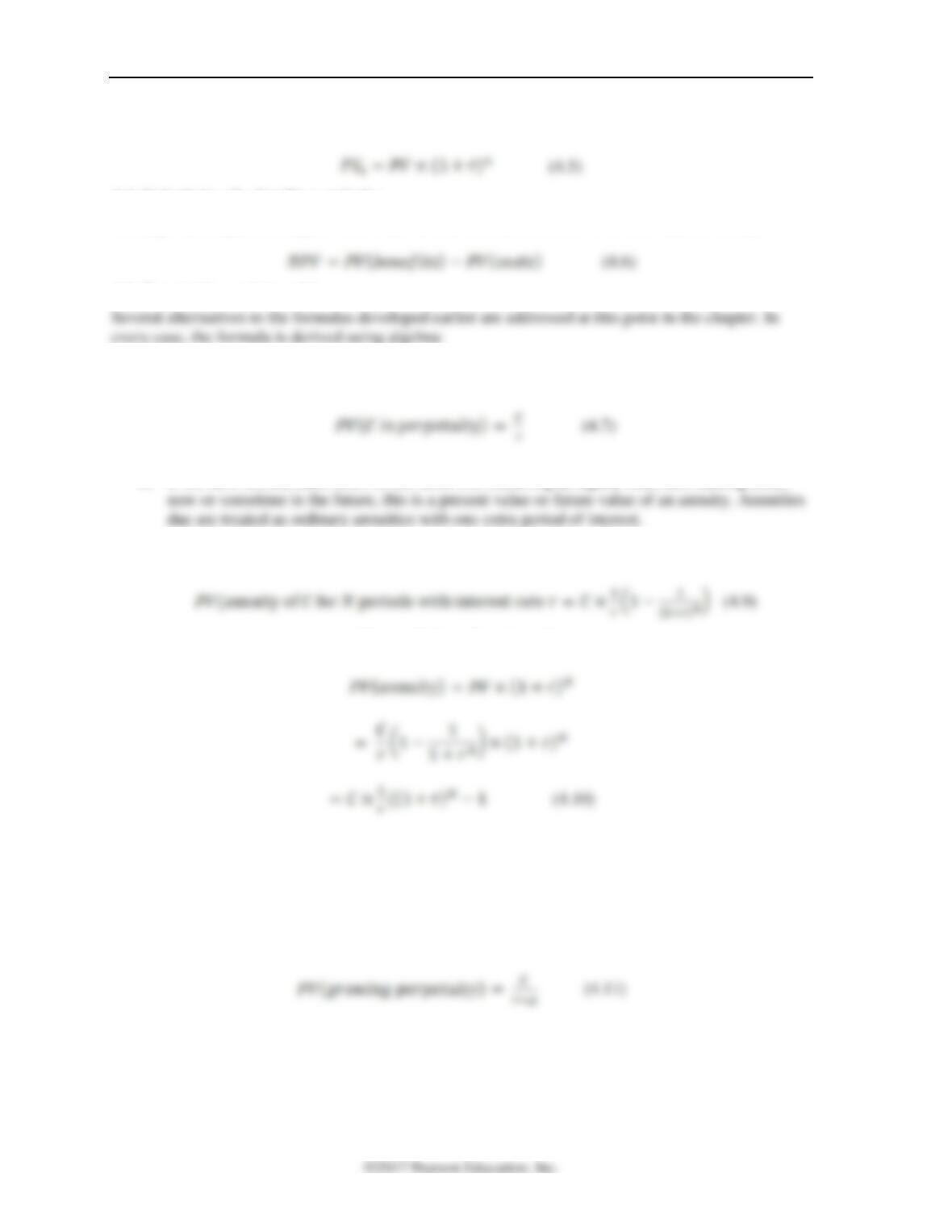
To compound cash flows, multiply the amount by (1 + r)n (Equation 4.1), where r is the periodic
4.3 Valuing a Stream of Cash Flows
This section shows how to calculate the present value or future value of an uneven cash flow stream.
Note that FV can be solved by calculating the present value (discounting each cash flow), then
compounding that total, n periods into the future. This information makes FV of an uneven cash flow
stream solvable in a financial calculator.
Present Value of a Cash Flow Stream
16 Berk/DeMarzo • Corporate Finance, Fourth Edition
Future Value of a Cash Flow Stream with a Present Value of PV
4.4 Calculating the Net Present Value
The logic developed in Chapter 3 is reexamined here in the context of the time value of money.
4.5 Perpetuities and Annuities
1. Present value of a perpetuity
2. If we have several cash flows of the same size occurring at regular intervals, starting either
Present Value of an Annuity
Future Value of an Annuity
3. The authors introduce the concept of valuing an infinite stream of cash flows that grow at a
constant rate each period, using the formula for present value of a growing perpetuity. This
development is particularly useful in later chapters.
Present Value of a Growing Perpetuity
Berk/DeMarzo • Corporate Finance, Fourth Edition 17
4. Sometimes several cash flows occur at regular intervals, which grow at a constant rate each
period. Present value or future value of a growing annuity is used.
Present Value of a Growing Annuity
4.6 Using an Annuity Spreadsheet or Calculator
Time value of money problems lend themselves well to spreadsheet solutions. The following
4.7 Non-Annual Cash Flows
4.8 Solving for Cash Payments
This section explains how to solve for the annuity payment.
Loan or Annuity Payment
4.9 The Internal Rate of Return
This section shows how to solve for the internal rate of return using algebra for perpetuities and trial
and error method and spreadsheet method for annuities.
Appendix: Solving for the Number of Periods
This appendix shows how to solve for the number of periods using both spreadsheets and logarithms.
IV. Spreadsheet Solutions in Excel
The following Problems for Chapter 4 have spreadsheet versions of the problems available: 12,