Chapter 4
Bond Valuation
ANSWERS TO BEGINNING-OF-CHAPTER QUESTIONS
4-1 The coupon rate is normally fixed, but it can be indexed so that it floats with some market
rate, such as the T-bill rate. Currently (December 2013), new GE bonds would have a
coupon rate of about 4.5% if they had a long maturity, but more like 1.7% if they had a
short maturity. GE’s currently outstanding bonds would have varying rates, depending on
the level of rates at the time they were issued.
beginning price. Interest rates, hence bond prices, move somewhat randomly, so bond
prices go up and down creating positive and negative capital gains yields. Also, as
discussed above, premium and discount bonds’ prices move toward par over time, so this
will create a tendency for such bonds to have positive or negative capital gains yields.
The reverse would hold for a bond selling at a premium.
Answers and Solutions: 4 – 2
4-2 Interest rate risk is the risk that a bond’s price will decline due to an increase in interest
rates. Note, though, that if a bond is not callable, then its value will rise if rates fall, even
though the value will decline if rates rise. Reinvestment rate risk is the risk that the
income produced by a portfolio will decline due to a drop in interest rates as maturing
bonds (and coupon payments) are reinvested at the new, lower yield. Again, for non-
4-3 At the time a bond is issued, a sinking fund is considered good by investors, as it
shortens the effective maturity and also forces the company to plan for an orderly
retirement of the issue. So, other things held constant, a sinking fund bond will carry a
lower coupon than one without a sinking fund.
However, after the bond has been issued, complications arise. The effective time to
maturity is still shortened, and orderly retirement is still required, but if rates have fallen
and the bond has gone to a premium, a call will disadvantage those bondholders whose
bonds are called. (Generally, bonds are called by a lottery process administered by the
4-4 The major bond rating agencies are Moody’s and Standard & Poor’s, with Fitch also in
the act. Ratings go from triple A to D, which is really an F because D means bankrupt.
Bond ratings are determined by the company’s financial strength as measured by its
4-5 The phenomenon of declining rates in the economy leading to declining prices on certain
bonds applies to long-term bonds backed by mortgage loans (CMOs, or collateralized
mortgage obligations). When interest rates decline, homeowners tend to refinance their
homes at the new lower rates. That means the old mortgages are paid off ahead of time.
Answers and Solutions: 4 – 4
ANSWERS TO END-OF-CHAPTER QUESTIONS
4-1 a. A bond is a promissory note issued by a business or a governmental unit. Treasury
bonds, sometimes referred to as government bonds, are issued by the Federal
government and are not exposed to default risk. Corporate bonds are issued by
corporations and are exposed to default risk. Different corporate bonds have different
b. The par value is the nominal or face value of a stock or bond. The par value of a
bond generally represents the amount of money that the firm borrows and promises to
repay at some future date. The par value of a bond is often $1,000, but can be $5,000
or more. The maturity date is the date when the bond’s par value is repaid to the
c. In some cases, a bond’s coupon payment may vary over time. These bonds are called
floating rate bonds. Floating rate debt is popular with investors because the market
Answers and Solutions: 4 – 5
d. Most bonds contain a call provision, which gives the issuing corporation the right to
call the bonds for redemption. The call provision generally states that if the bonds are
called, the company must pay the bondholders an amount greater than the par value, a
call premium. Redeemable bonds give investors the right to sell the bonds back to the
e. Convertible bonds are securities that are convertible into shares of common stock, at a
fixed price, at the option of the bondholder. Bonds issued with warrants are similar to
convertibles. Warrants are options which permit the holder to buy stock for a stated
f. Bond prices and interest rates are inversely related; that is, they tend to move in the
opposite direction from one another. A fixed-rate bond will sell at par when its
coupon interest rate is equal to the going rate of interest, rd. When the going rate of
g. The current yield on a bond is the annual coupon payment divided by the current
market price. YTM, or yield to maturity, is the rate of interest earned on a bond if it
Answers and Solutions: 4 – 6
h. Corporations can influence the default risk of their bonds by changing the type of
bonds they issue. Under a mortgage bond, the corporation pledges certain assets as
security for the bond. All such bonds are written subject to an indenture, which is a
legal document that spells out in detail the rights of both the bondholders and the
i. A development bond is a tax-exempt bond sold by state and local governments whose
proceeds are made available to corporations for specific uses deemed (by Congress)
to be in the public interest. Municipalities can insure their bonds, in which an
insurance company guarantees to pay the coupon and principal payments should the
issuer default. This reduces the risk to investors who are willing to accept a lower
coupon rate for an insured bond issue vis-a-vis an uninsured issue. Bond issues are
j. The real risk-free rate is that interest rate which equalizes the aggregate supply of,
and demand for, riskless securities in an economy with zero inflation. The real risk-
free rate could also be called the pure rate of interest since it is the rate of interest that
would exist on very short-term, default-free U.S. Treasury securities if the expected
Answers and Solutions: 4 – 7
k. The inflation premium is the premium added to the real risk-free rate of interest to
compensate for the expected loss of purchasing power. The inflation premium is the
average rate of inflation expected over the life of the security. Default risk is the risk
l. Interest rate risk arises from the fact that bond prices decline when interest rates rise.
Under these circumstances, selling a bond prior to maturity will result in a capital
loss, and the longer the term to maturity, the larger the loss. Thus, a maturity risk
m. The term structure of interest rates is the relationship between yield to maturity and
term to maturity for bonds of a single risk class. The yield curve is the curve that
n. When the yield curve slopes upward, it is said to be “normal,” because it is like this
4-2 False. Short-term bond prices are less sensitive than long-term bond prices to interest
rate changes because funds invested in short-term bonds can be reinvested at the new
4-3 The price of the bond will fall and its YTM will rise if interest rates rise. If the bond still
has a long term to maturity, its YTM will reflect long-term rates. Of course, the bond’s
4-4 If interest rates decline significantly, the values of callable bonds will not rise by as much
4-5 From the corporation’s viewpoint, one important factor in establishing a sinking fund is
that its own bonds generally have a higher yield than do government bonds; hence, the
company saves more interest by retiring its own bonds than it could earn by buying
government bonds. This factor causes firms to favor the second procedure. Investors
Answers and Solutions: 4 – 9
SOLUTIONS TO END-OF-CHAPTER PROBLEMS
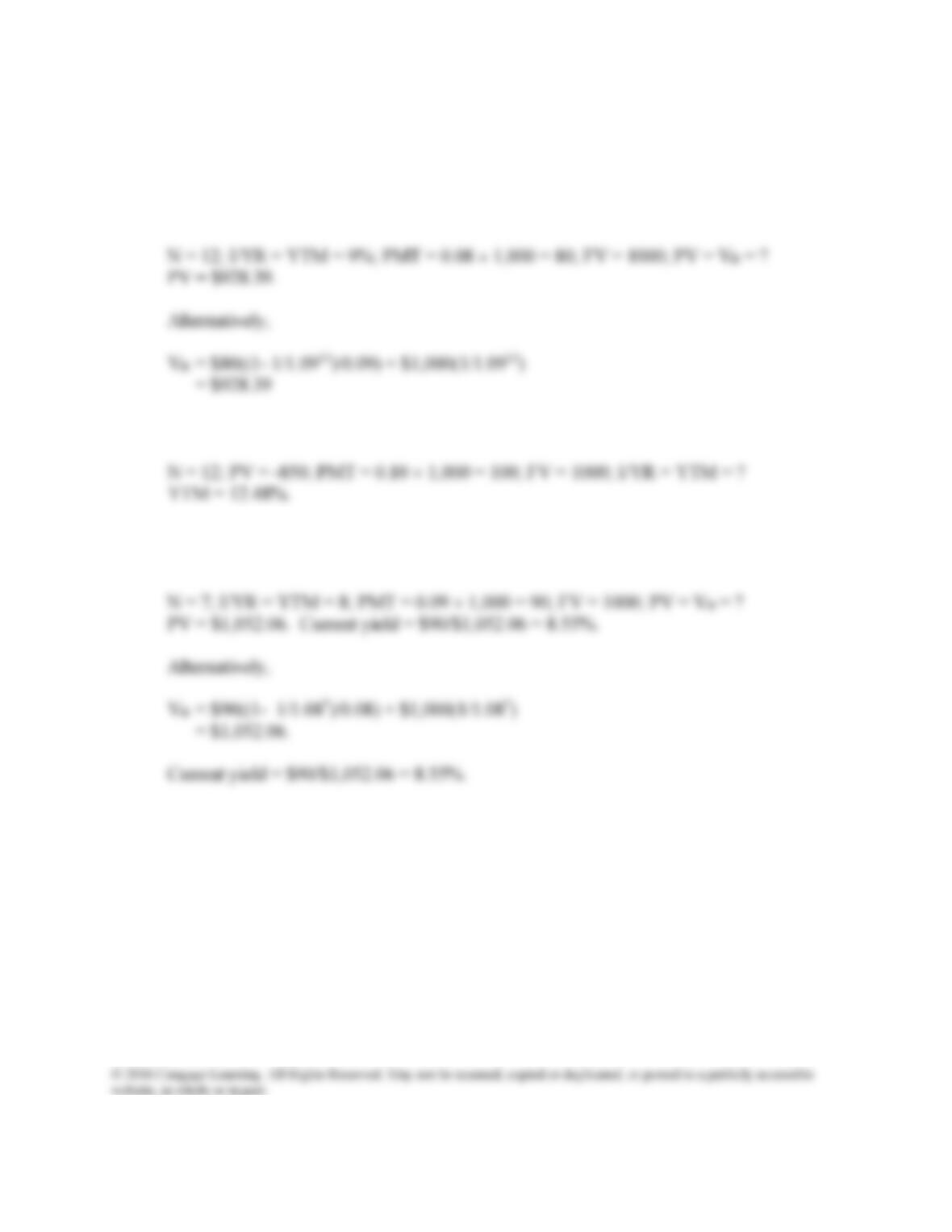
4-1 With your financial calculator, enter the following:
4-2 With your financial calculator, enter the following:
4-3 With your financial calculator, enter the following to find the current value of the bonds,
so you can then calculate their current yield:
Answers and Solutions: 4 – 10
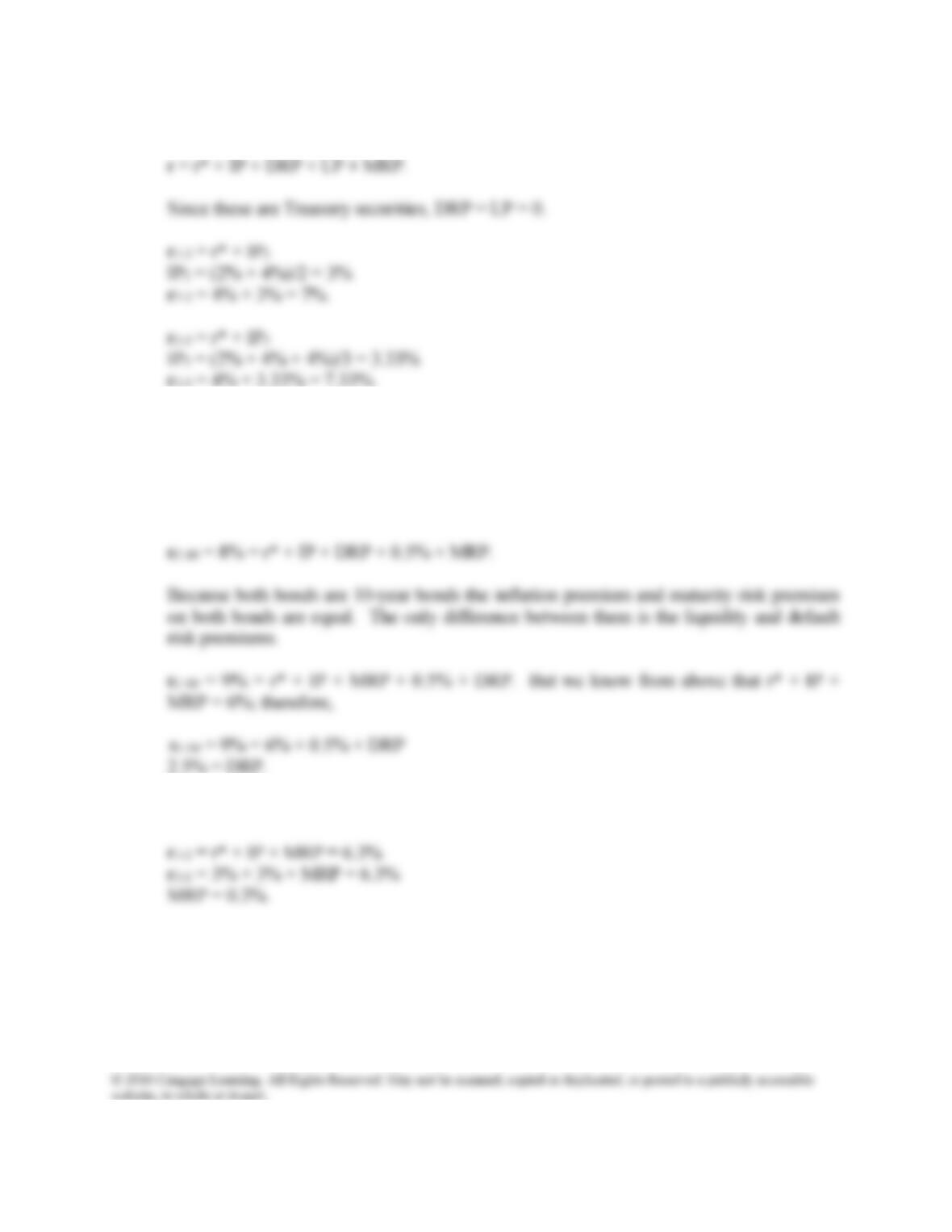
4-4 r* = 4%; I1 = 2%; I2 = 4%; I3 = 4%; MRP = 0; rT-2 = ?; rT-3 = ?
4-5 rT-10 = 6%; rC-10 = 9%; LP = 0.5%; DRP = ?
r = r* + IP + DRP + LP + MRP.
rT-10 = 6% = r* + IP + MRP; DRP = LP = 0.
4-6 r* = 3%; IP = 3%; rT-2 = 6.3%; MRP2 = ?
Answers and Solutions: 4 – 11
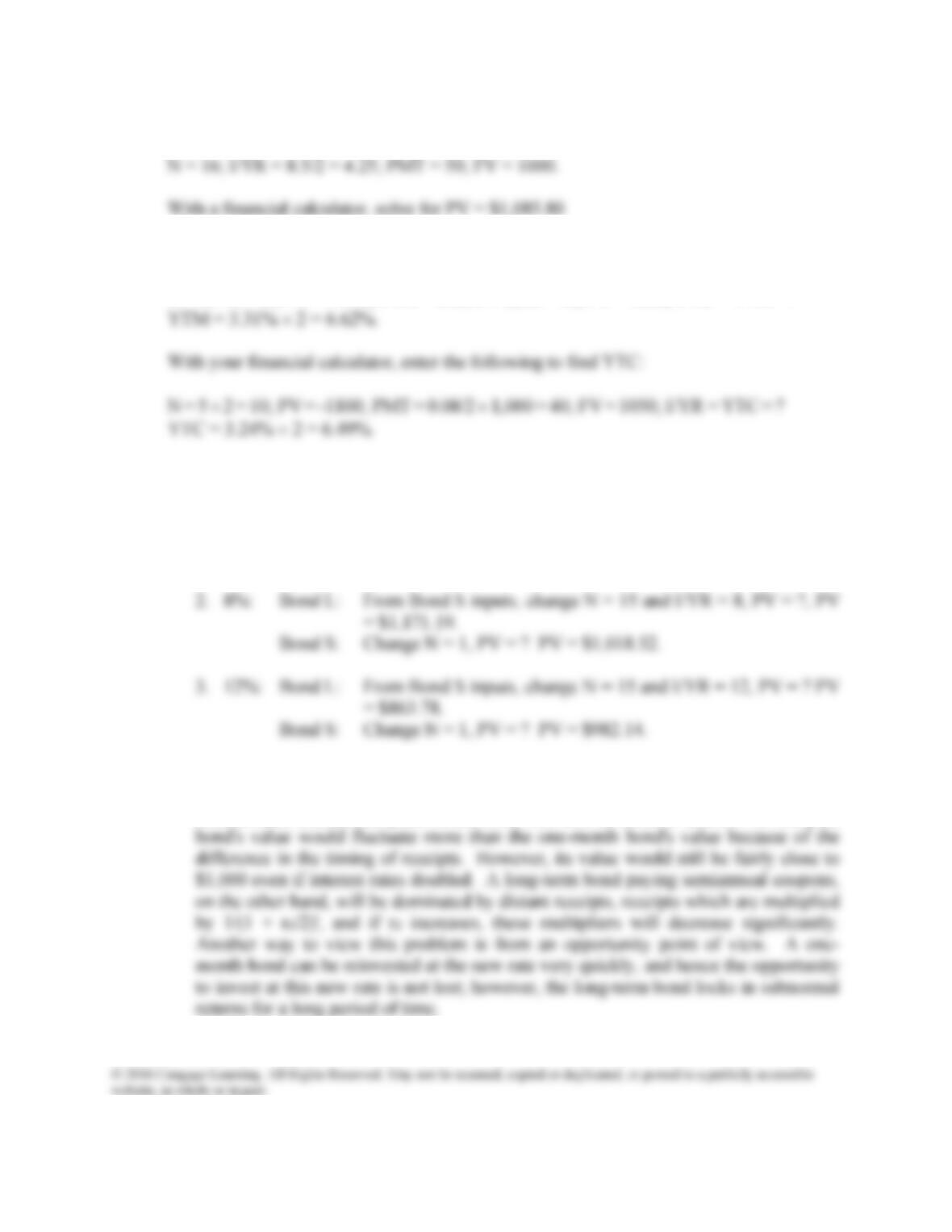
4-7 The problem asks you to find the price of a bond, given the following facts:
4-8 With your financial calculator, enter the following to find YTM:
N = 10 2 = 20; PV = -1100; PMT = 0.08/2 1,000 = 40; FV = 1000; I/YR = YTM = ?
4-9 a.
1. 5%: Bond L: Input N = 15, I/YR = 5, PMT = 100, FV = 1000, PV = ?, PV =
$1,518.98.
Bond S: Change N = 1, PV = ? PV = $1,047.62.
b. Think about a bond that matures in one month. Its present value is influenced
primarily by the maturity value, which will be received in only one month. Even if
interest rates double, the price of the bond will still be close to $1,000. A one-year
Answers and Solutions: 4 – 12
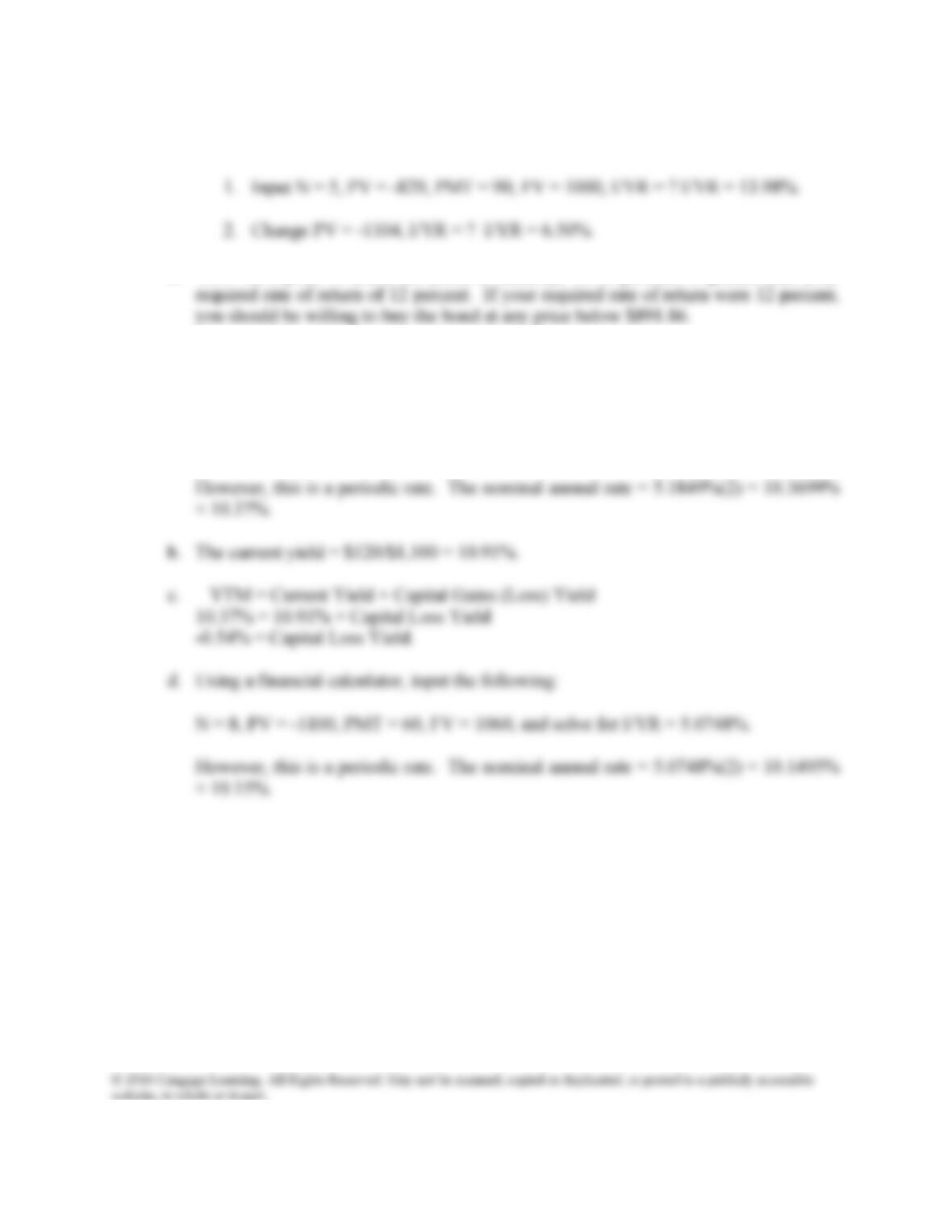
4-10 a. Calculator solution:
b. Yes. At a price of $829, the yield to maturity, 13.98 percent, is greater than your
4-11 N = 7; PV = -1000; PMT = 140; FV = 1090; I/YR = ? Solve for I/YR = 14.82%.
4-12 a. Using a financial calculator, input the following:
N = 20, PV = -1100, PMT = 60, FV = 1000, and solve for I/YR = 5.1849%.
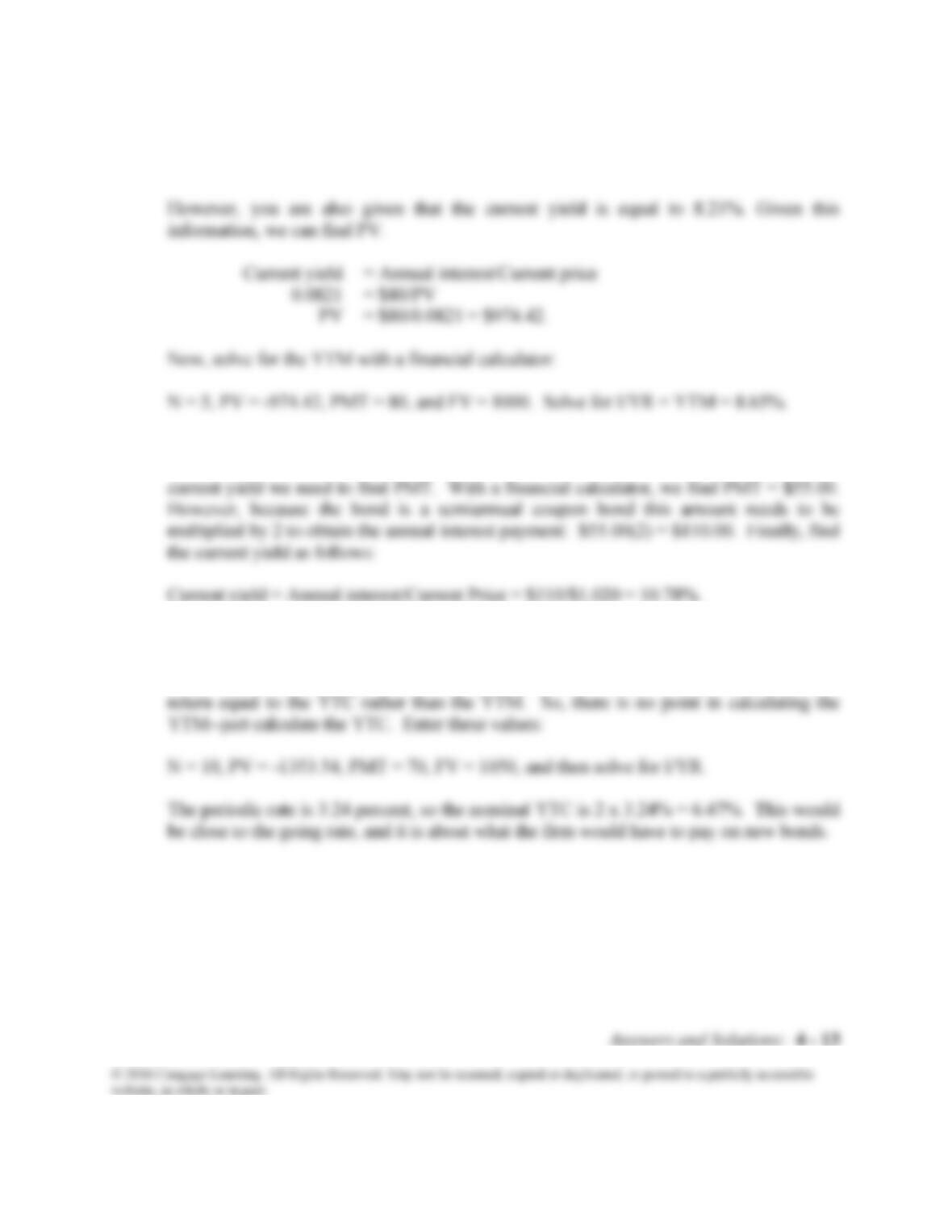
4-13 The problem asks you to solve for the YTM, given the following facts:
N = 5, PMT = 80, and FV = 1000. In order to solve for I/YR we need PV.
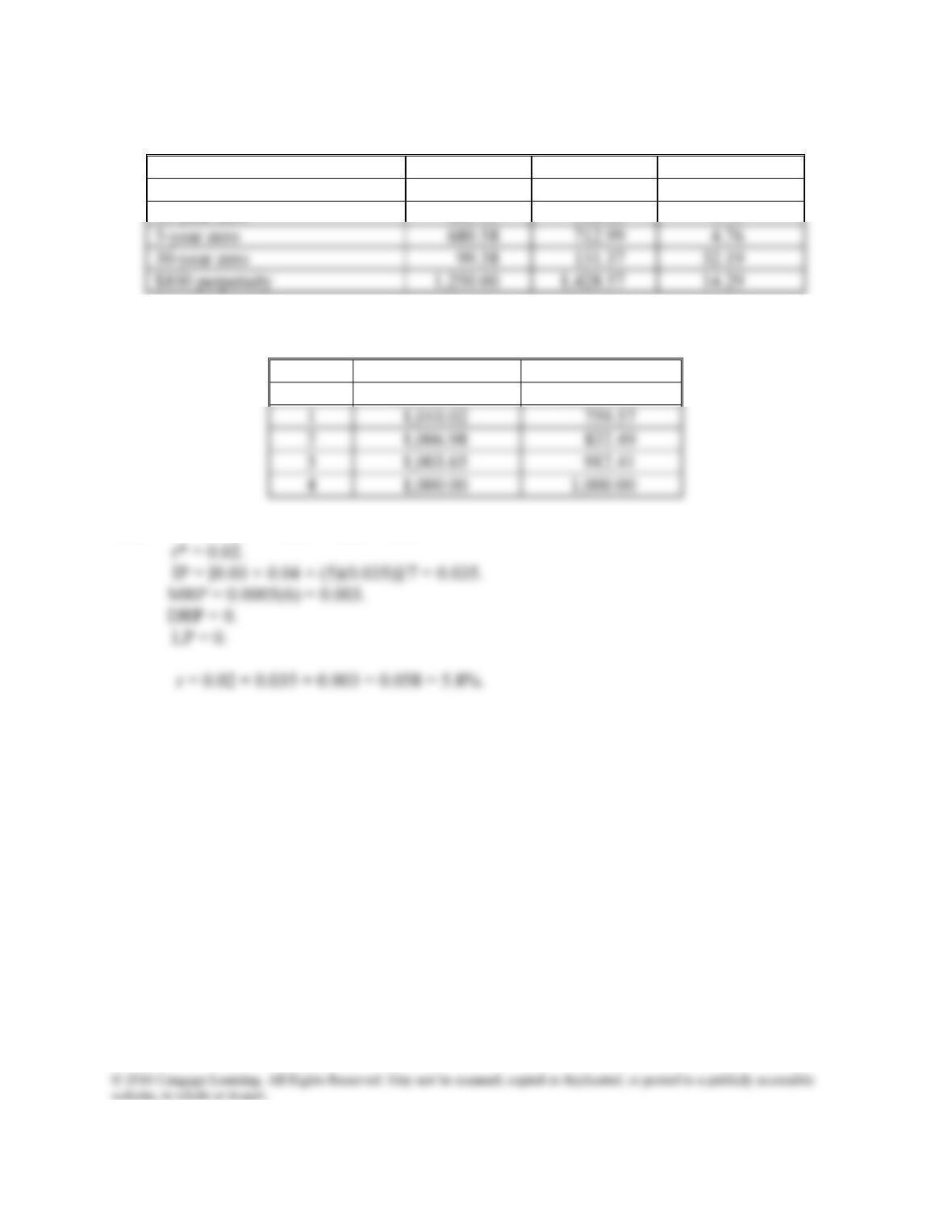
4-14 The problem asks you to solve for the current yield, given the following facts: N = 14,
I/YR = 10.5883/2 = 5.2942, PV = −1020, and FV = 1000. In order to solve for the
4-15 The bond is selling at a large premium, which means that its coupon rate is much higher
than the going rate of interest. Therefore, the bond is likely to be called–it is more likely
to be called than to remain outstanding until it matures. Thus, it will probably provide a
Answers and Solutions: 4 – 14
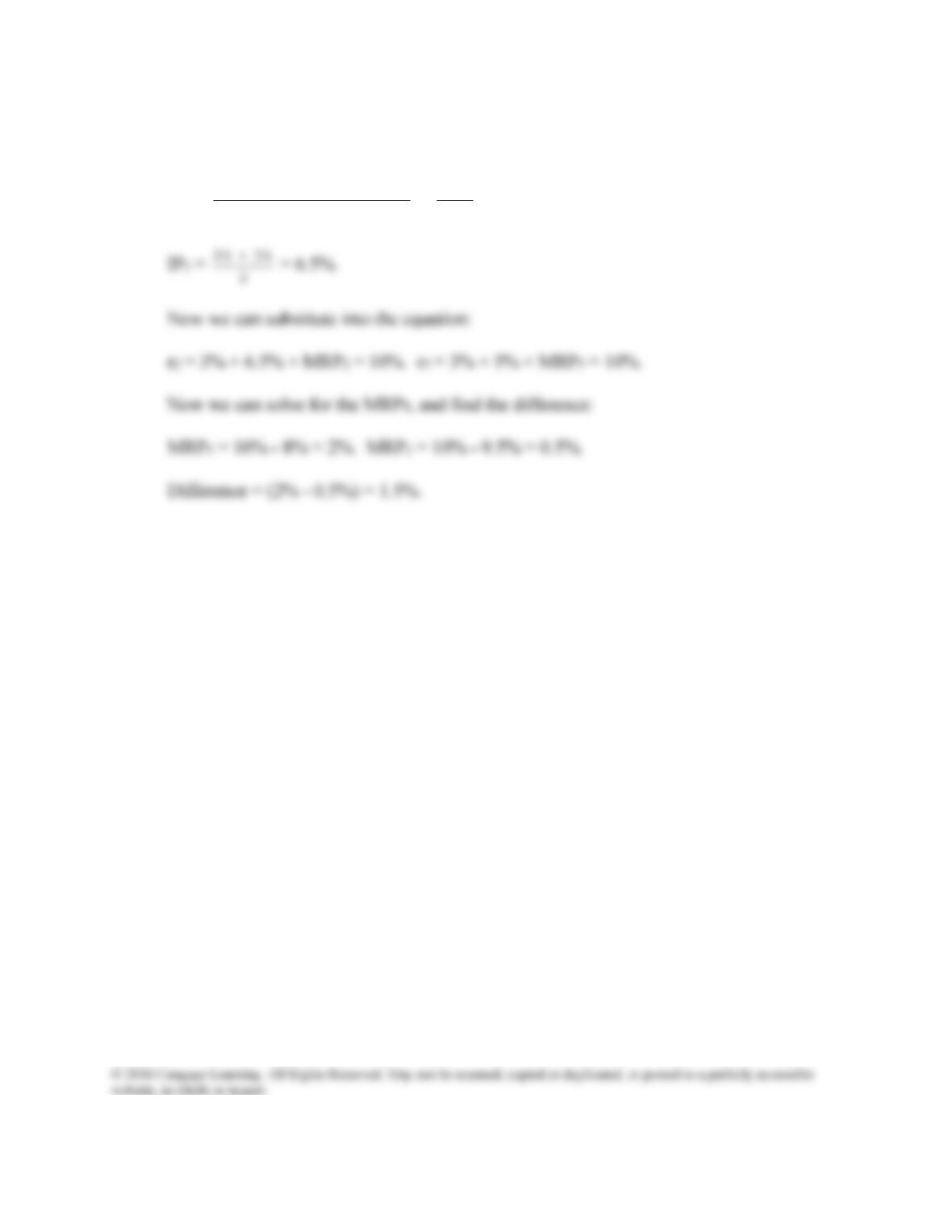
4-16
Price at 8% Price at 7% Pctge. change
10-year, 10% annual coupon $1,134.20 $1,210.71 6.75%
10-year zero 463.19 508.35 9.75
4-17
t Price of Bond C Price of Bond Z
0 $1,012.79 $ 693.04
4-18 r = r* + IP + MRP + DRP + LP.
Answers and Solutions: 4 – 15
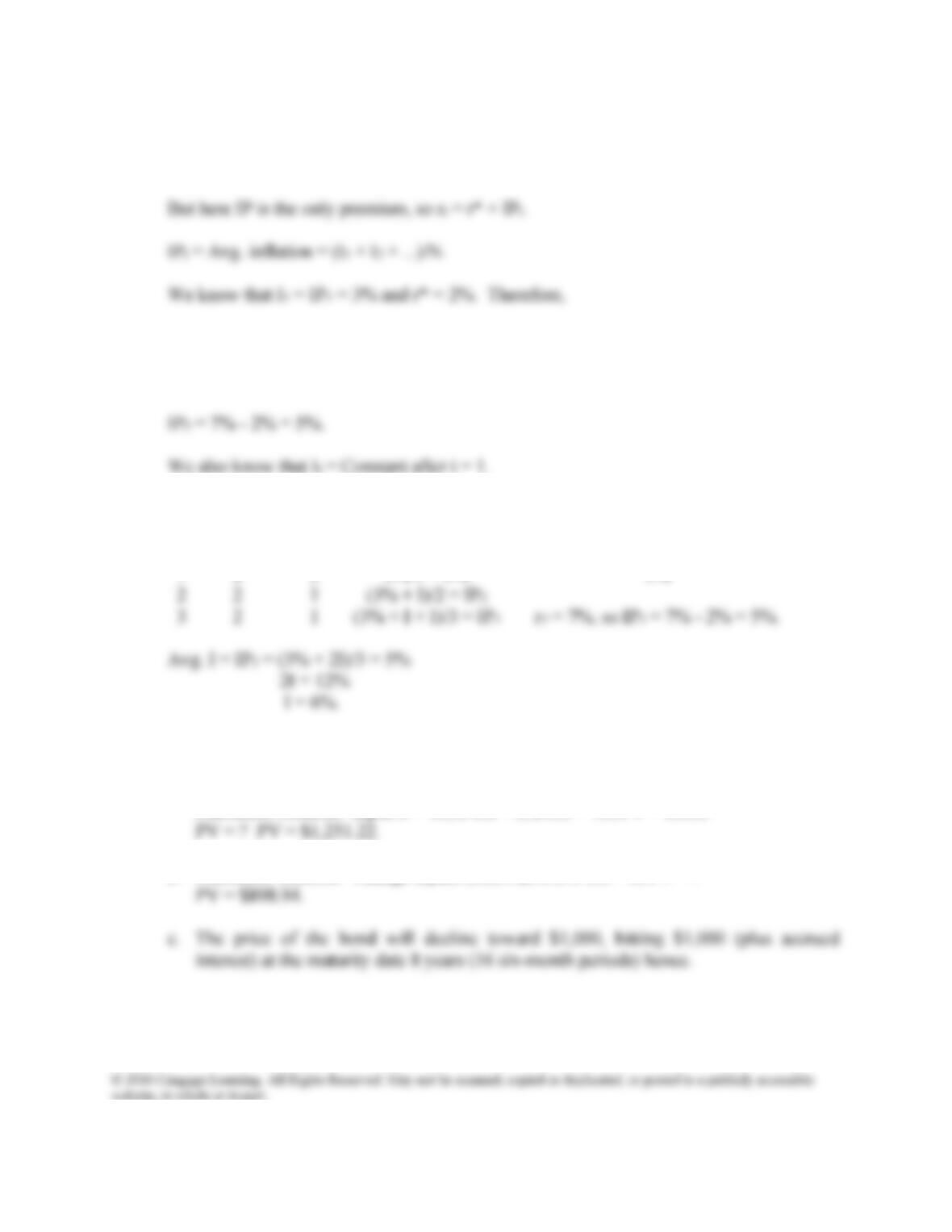
4-19 First, note that we will use the equation rt = 3% + IPt + MRPt. We have the data needed
to find the IPs:
IP5 = 5
4% + 4% + 4% + 5% + 8% = 5
25% = 5%.
Answers and Solutions: 4 – 16
4-20 Basic relevant equations:
rt = r* + IPt + DRPt + MRPt + LPt.
r1 = 2% + 3% = 5%. r3 = r1 + 2% = 5% + 2% = 7%. But,
r3 = r* + IP3 = 2% + IP3 = 7%, so
We can set up this table:
r* I Avg. I = IPt r = r* + IPt
1 2 3 3%/1 = 3% 5%
4-21 a. The bonds now have an 8-year, or a 16-semiannual period, maturity, and their value
is calculated as follows:
Calculator solution: Input N = 16, I/YR = 3, PMT = 50, FV = 1000,
b. Calculator solution: Change inputs from Part a to I/YR = 6, PV = ?
Answers and Solutions: 4 – 17
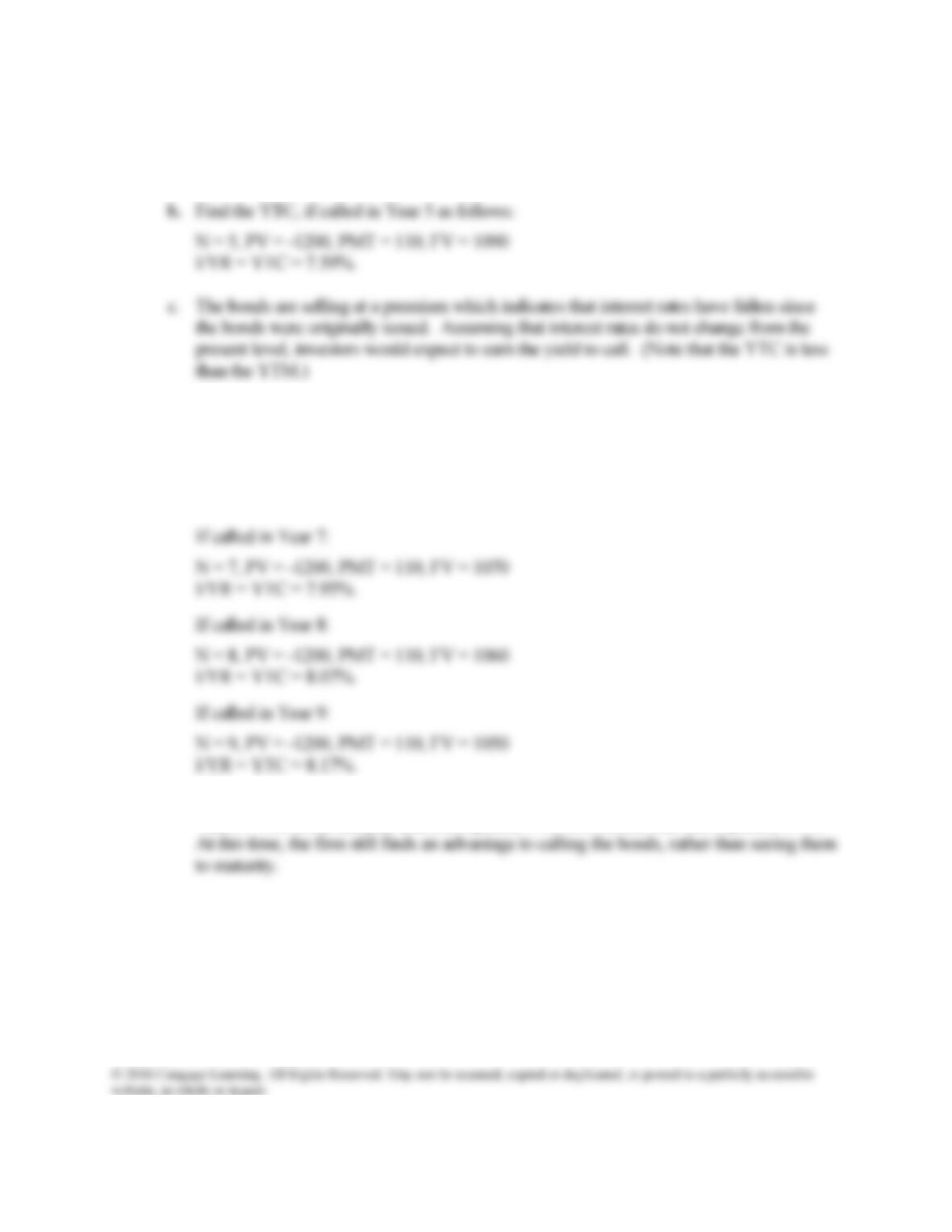
4-22 a. Find the YTM as follows:
N = 10, PV = -1200, PMT = 110, FV = 1000
I/YR = YTM = 8.02%.
d. Similarly from above, YTC can be found, if called in each subsequent year.
If called in Year 6:
N = 6, PV = -1200, PMT = 110, FV = 1080
I/YR = YTC = 7.80%.
According to these calculations, the latest investors might expect a call of the bonds is in
Year 7. This is the last year that the expected YTC will be less than the expected YTM.
Answers and Solutions: 4 – 18
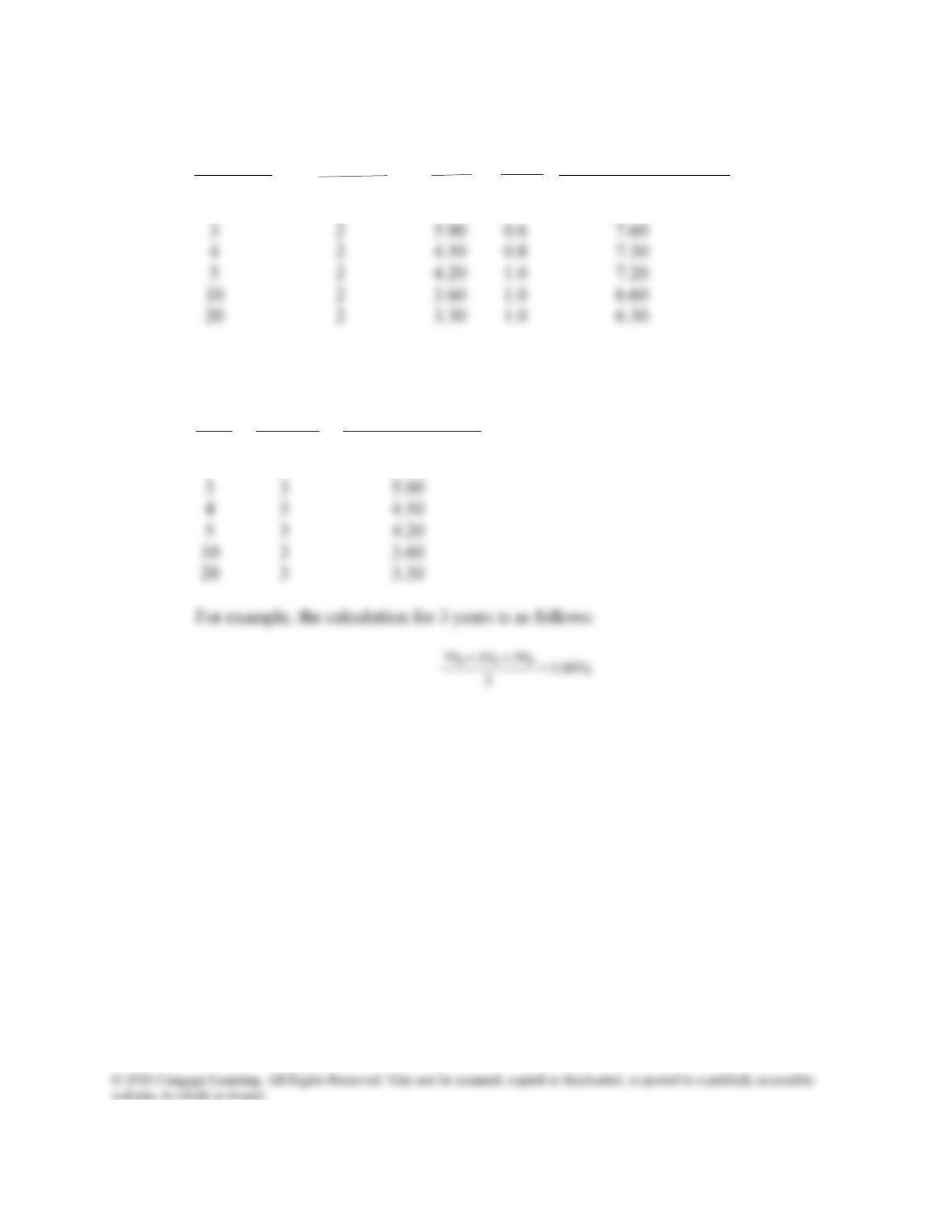
4-23 a. Real
Years to Risk-Free
Maturity Rate (r*) IP** MRP rT = r* + IP + MRP
1 2% 7.00% 0.2% 9.20%
2 2 6.00 0.4 8.40
**The computation of the inflation premium is as follows:
Expected Average
Year Inflation Expected Inflation
1 7% 7.00%
2 5 6.00
Answers and Solutions: 4 – 19
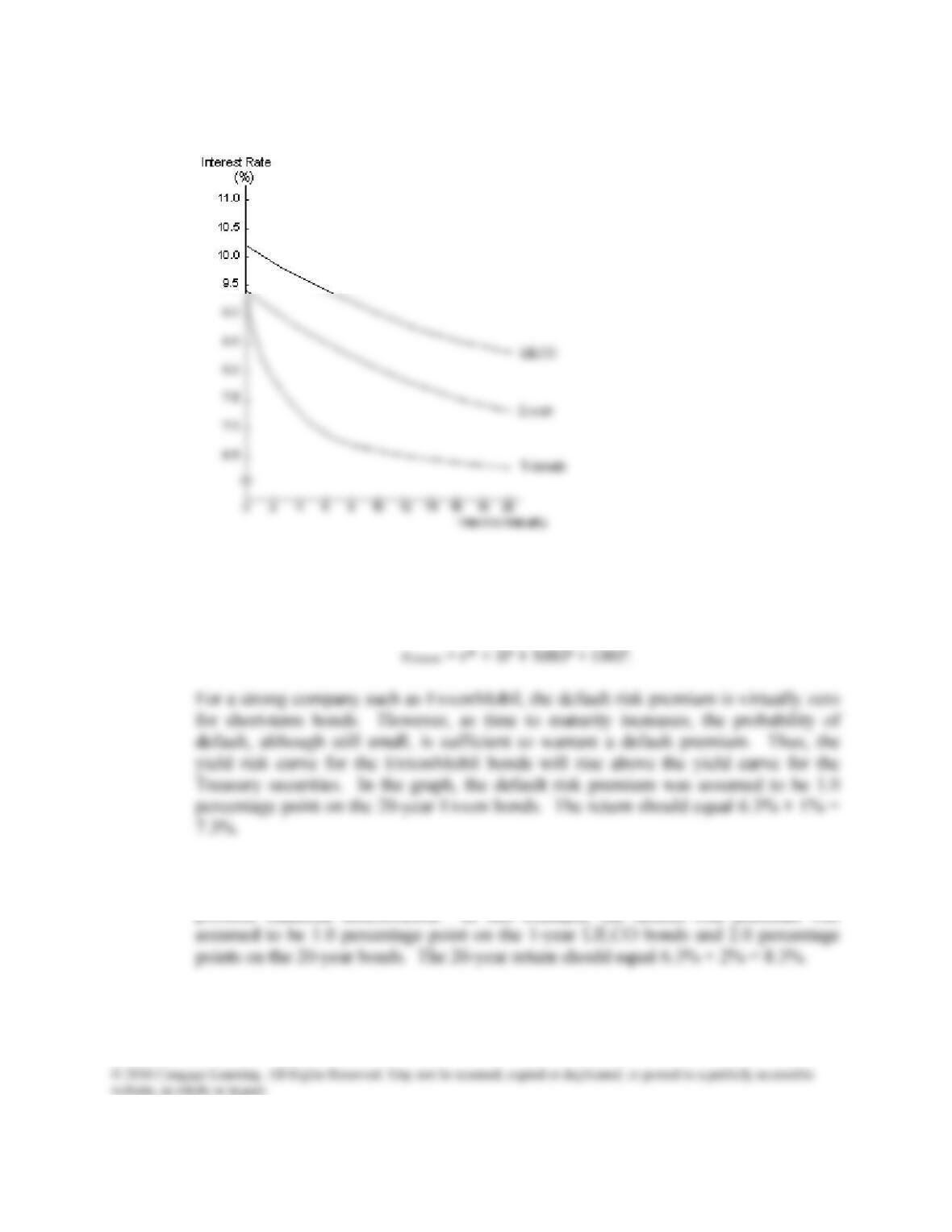
Thus, the yield curve would be as follows:
b. The interest rate on the ExxonMobil bonds has the same components as the Treasury
securities, except that the ExxonMobil bonds have default risk, so a default risk
premium must be included. Therefore,
c. LILCO bonds would have significantly more default risk than either Treasury
securities or Exxon bonds, and the risk of default would increase over time due to
possible financial deterioration. In this example, the default risk premium was

Answers and Solutions: 4 – 20
SOLUTION TO SPREADSHEET PROBLEM
4-24 The detailed solution for the problem is in the file Ch04 P24 Build a Model Solution.xls