Chapter 4: Complete Chapter Answers:
Problem 1:
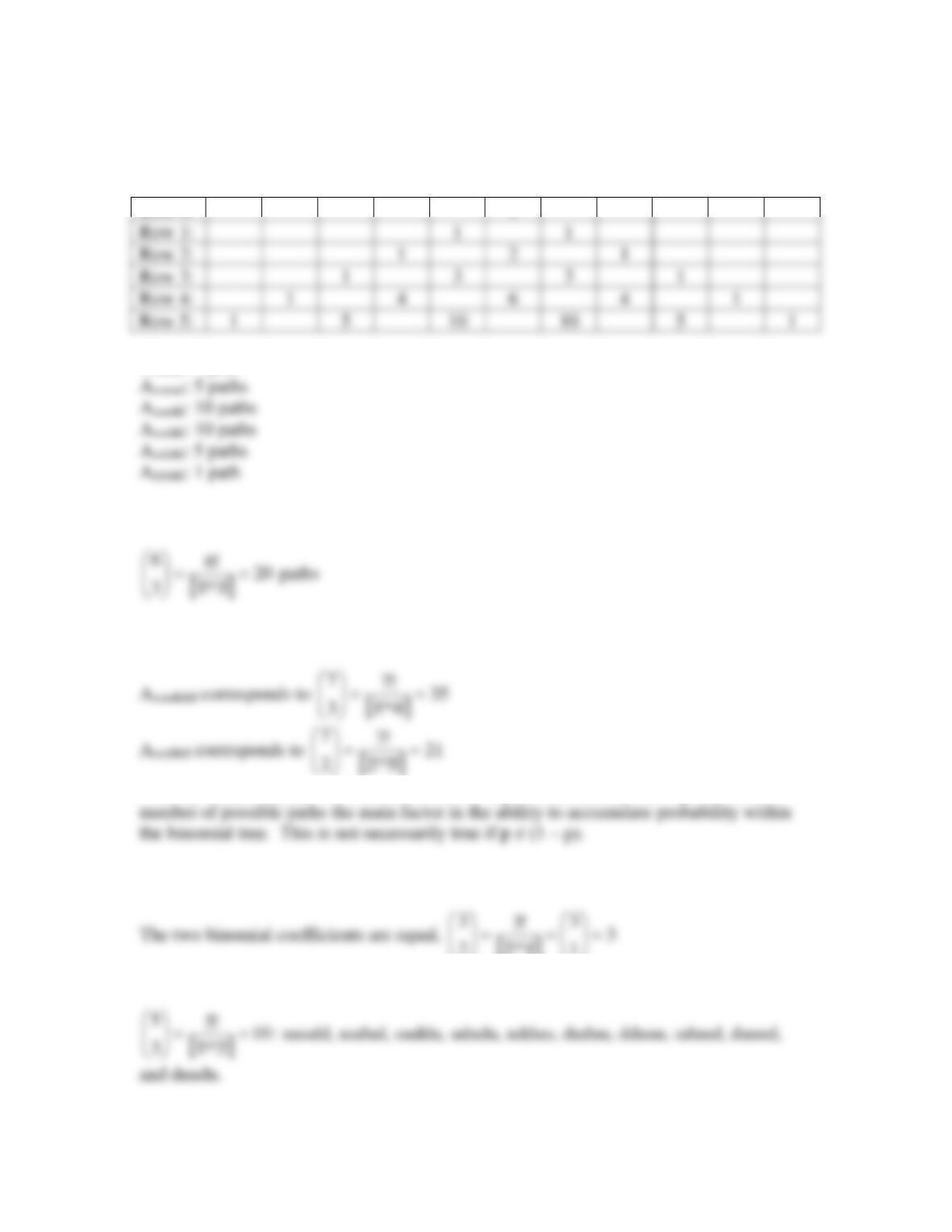
Row 0:
1
Auuuuu: 1 path
Problem 2:
Problem 3:
Consequently, Auuudddd will accumulate more chips. Remember p = (1 – p) makes the
Problem 4:
1
!1!*2
2
Problem 5:
Row 1:
1
1
Row 2:
1
2
1
Row 3:
1
3
3
1
Row 4:
1
4
6
4
1
Row 5:
1
5
5
1
Problem 6:
Problem 7:
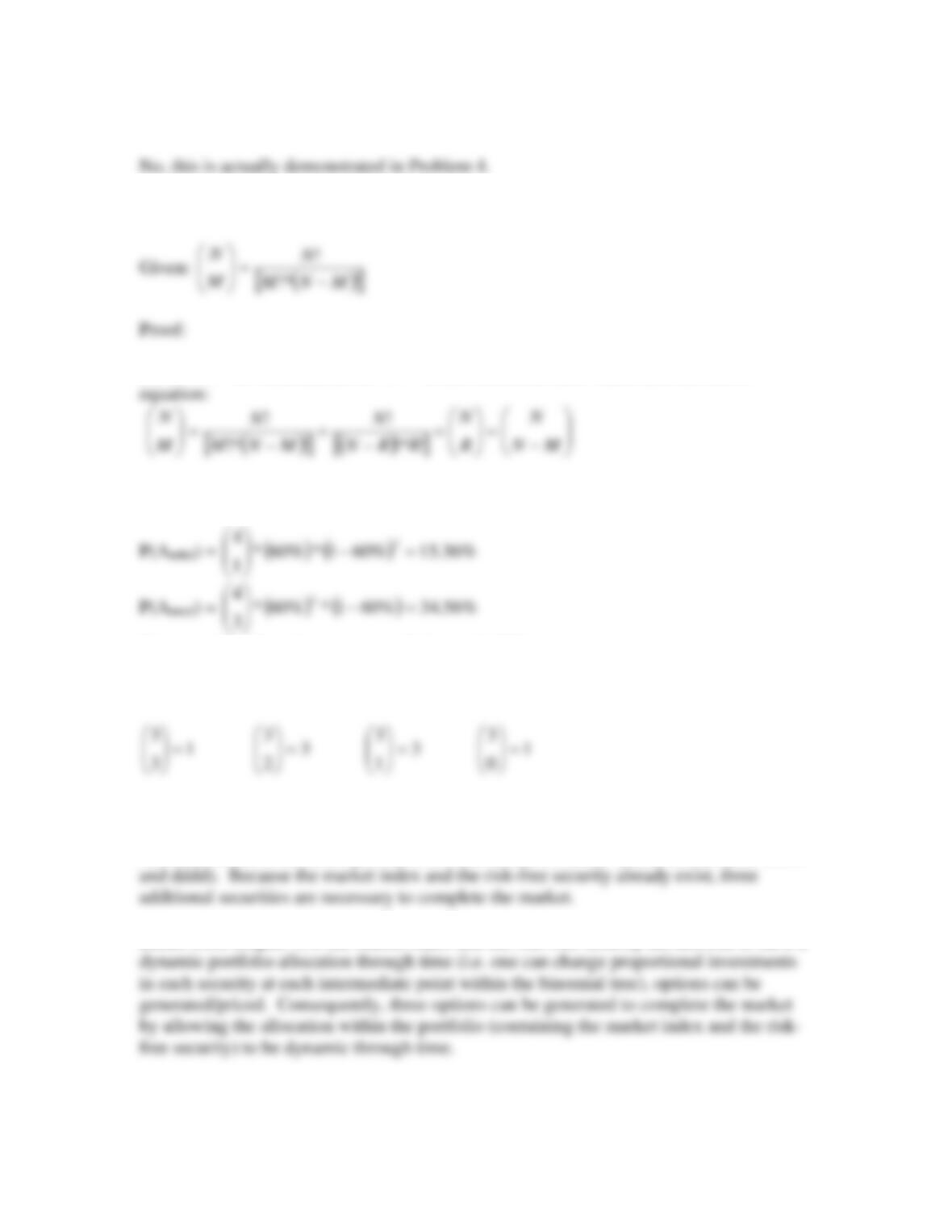
Let R = N – M which makes M = N – R and substitute these values into the above
Problem 8:
Consequently, Auuud has more cumulative probability.
Problem 9:
Problem 10:
The final nodes of the tree represent five states of the economy (uuuu, uuud, uudd, uddd.
Recall from chapter 1, if the market index and the risk-free security are allowed to have a
Problem 11
Problem 12
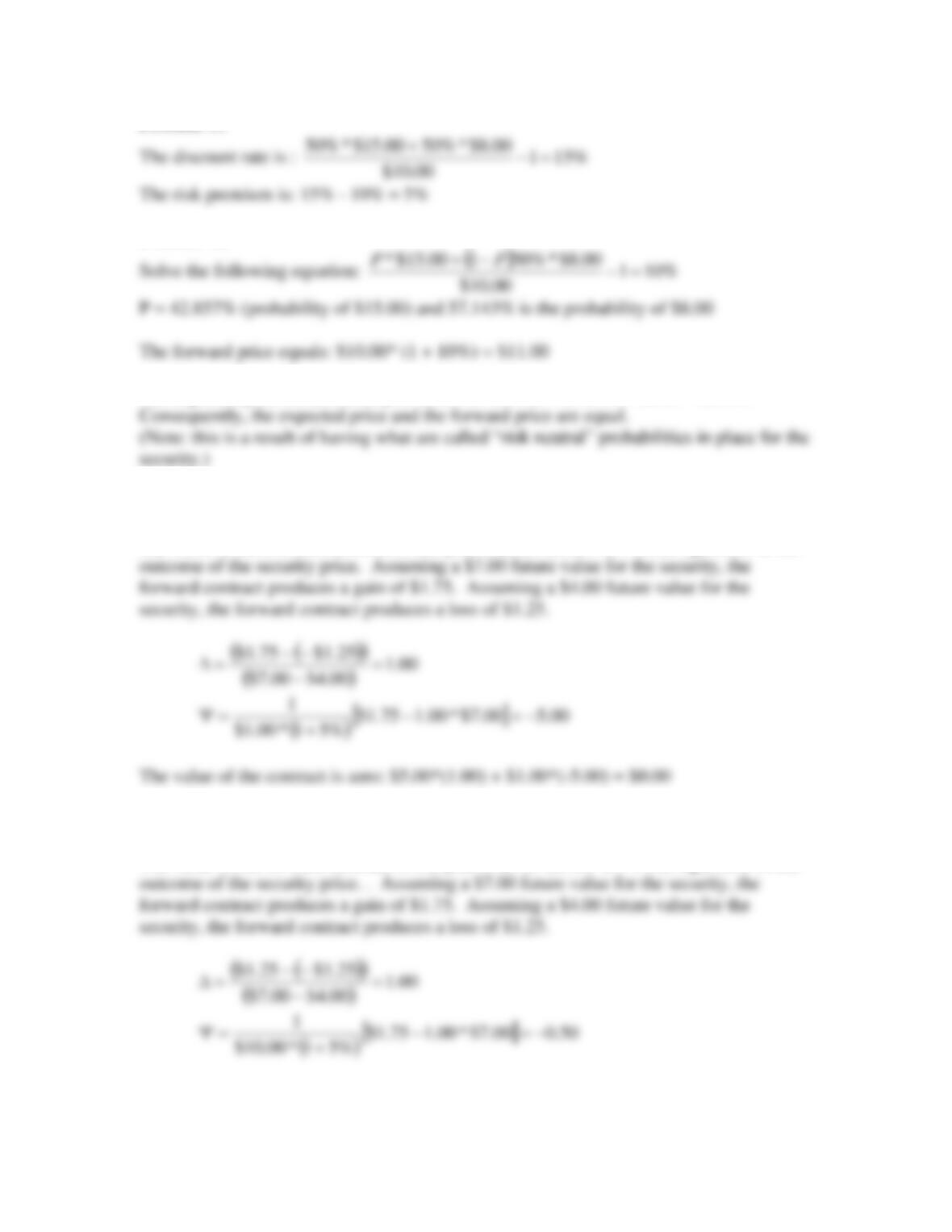
The expected price of the security is 42.857%*$15.00 + 57.143%*$8.00 = $11.00.
Problem 13
The value of the forward contract in one year is $5.25 ($5.00*(1+ 5%)) regardless of the
Problem 14
The value of the forward contract in one year is $5.25 ($5.00*(1+ 5%)) regardless of the
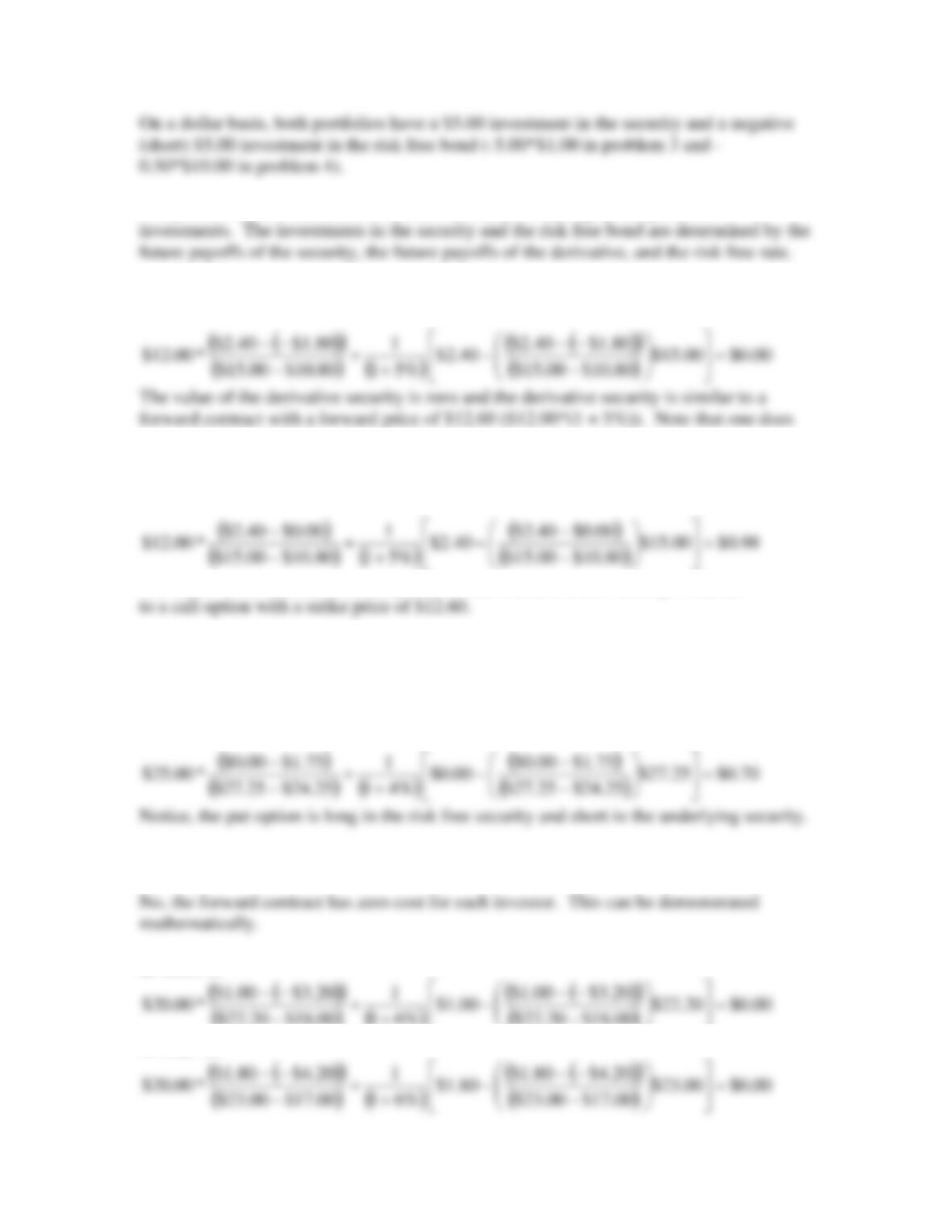
The probabilities of the future events do not matter in setting up the portfolio
Problem 15
not need the current price of the risk free bond to value the security!
Problem 16
The value of the derivative security is $0.98 and the derivative security is similar
Problem 17
The put option pays $0.00 if the security price is $27.25 and pays $1.75 is the security
price is $24.25
Problem 18
Investor A:
( ) ( ) ( )( )
( )
00.18$20.22$
%61
00.18$20.22$
−
+
−
Investor B:
Problem 19
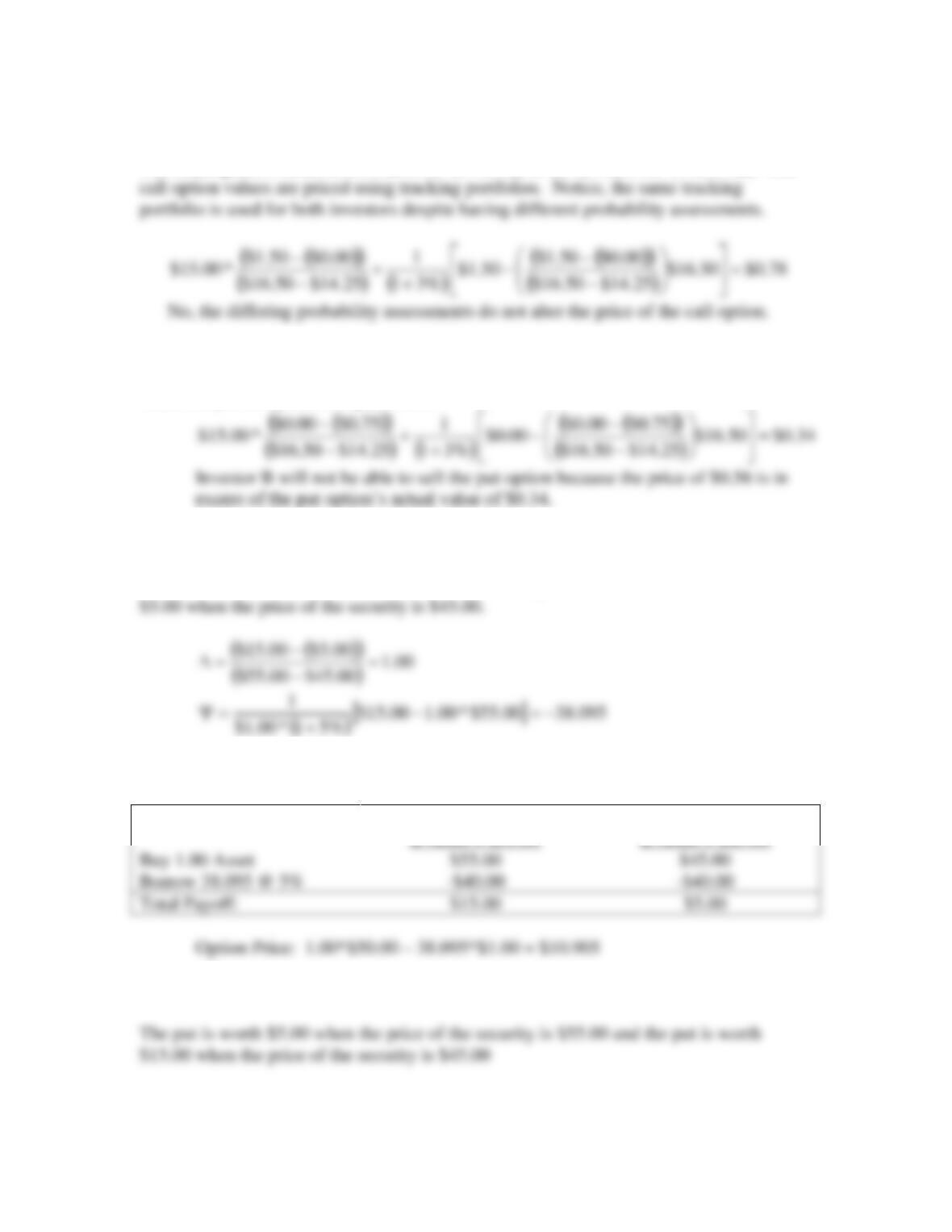
The future price is either $16.50 ($15.00*(1+10%)) or $14.25 ($15.00*(1+(-5%))). The
Problem 20
Value the put using a tracking portfolio:
Problem 21
The call is worth $15.00 when the price of the security is $55.00 and the call is worth
Arbitrage Table:
End of Period
If Asset = $55.00
If Asset = $45.00
Buy 1.00 Asset
Borrow 38.095 @ 5%
Total Payoff:
Problem 22
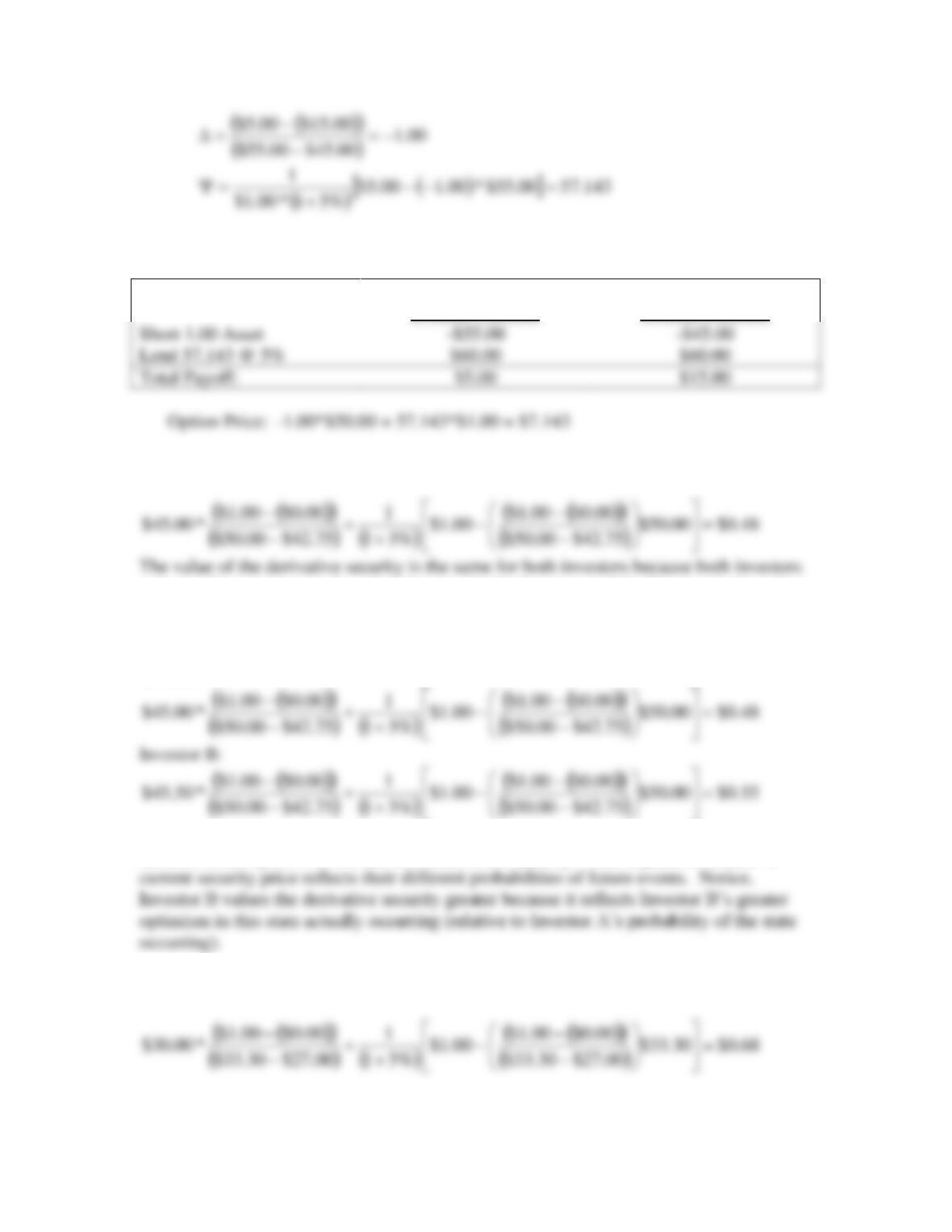
Arbitrage Table:
End of Period
If Asset = $55.00
If Asset = $45.00
Short 1.00 Asset
Lend 57.143 @ 5%
Total Payoff:
Problem 23
agree on the current security price, the annual risk free rate, and the future security prices.
Problem 24
Investor A:
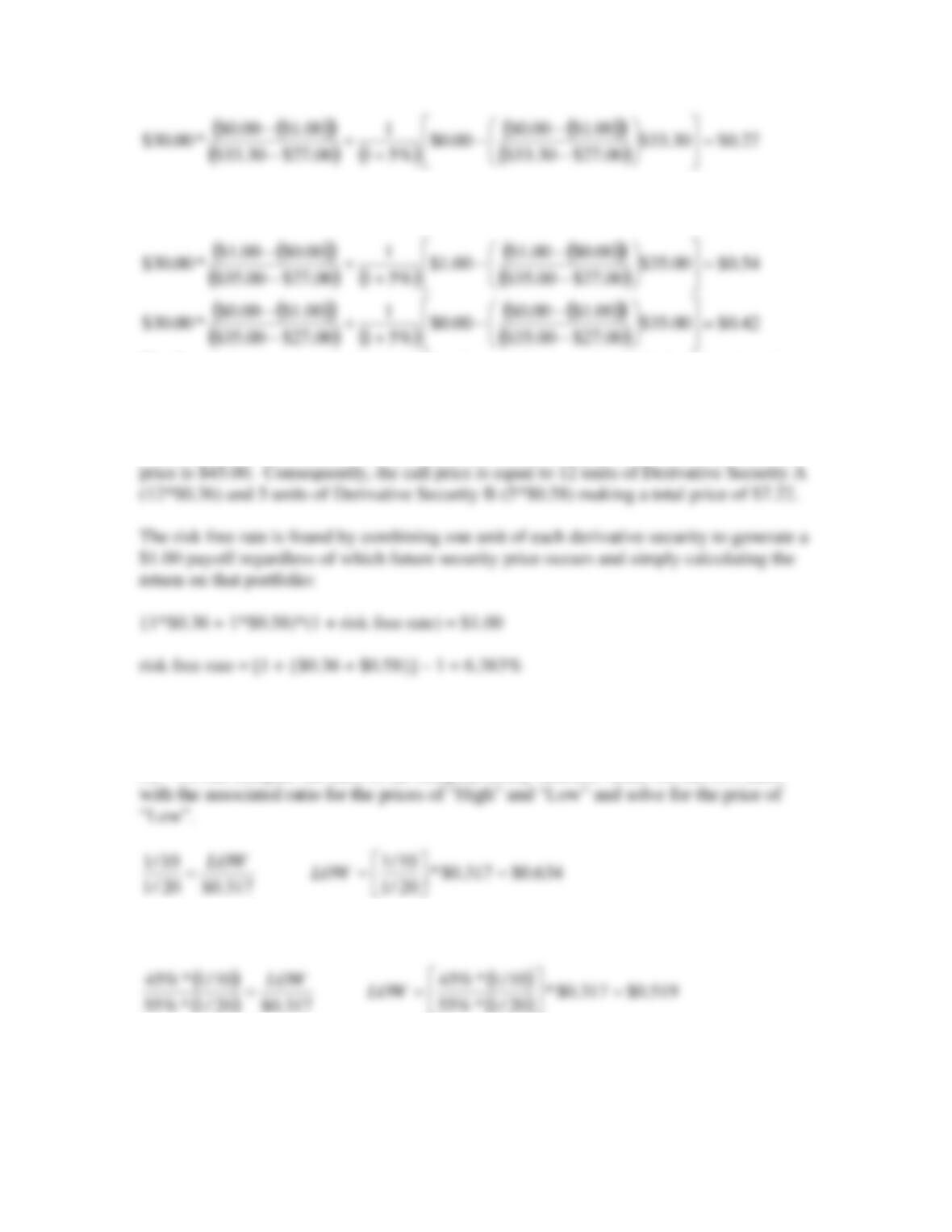
The value of the derivative security is different for each investor because each investor
has a different opinion on the current value of the security. The respective investor’s
Problem 25
Problem 26
The first derivative security decreases in price and the second security increases in price.
Problem 27
The call pays $12.00 when the security price is $52.00 and pays $5.00 when the security
Problem 28
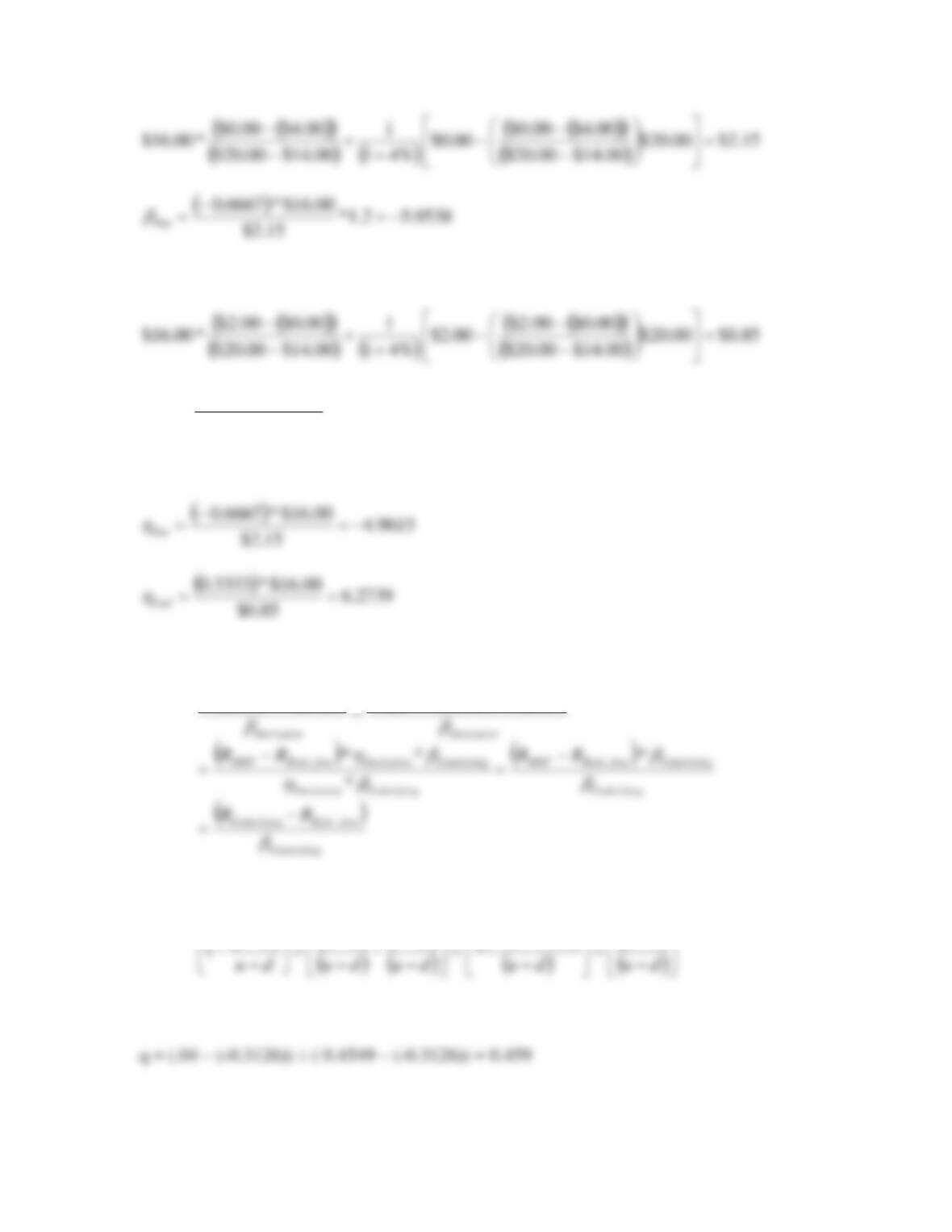
As noted in the text, a logarithmic utility function has a marginal utility function of (1 /
C). We can compare the ratio of the marginal utility function values for the two states
Problem 29
Problem 30
Problem 31
( )
2739.62.1*
85.0$
00.16$*3333.0 ==
Call
Problem 32
Problem 33
( ) ( )
DerivativefreeRiskMKT
freeRiskDerivative
RRRR
−−
−
−
*
Problem 34
( ) ( )
−
+−−
−
−
−
ru
drdu
dr
du
dr
Problem 35
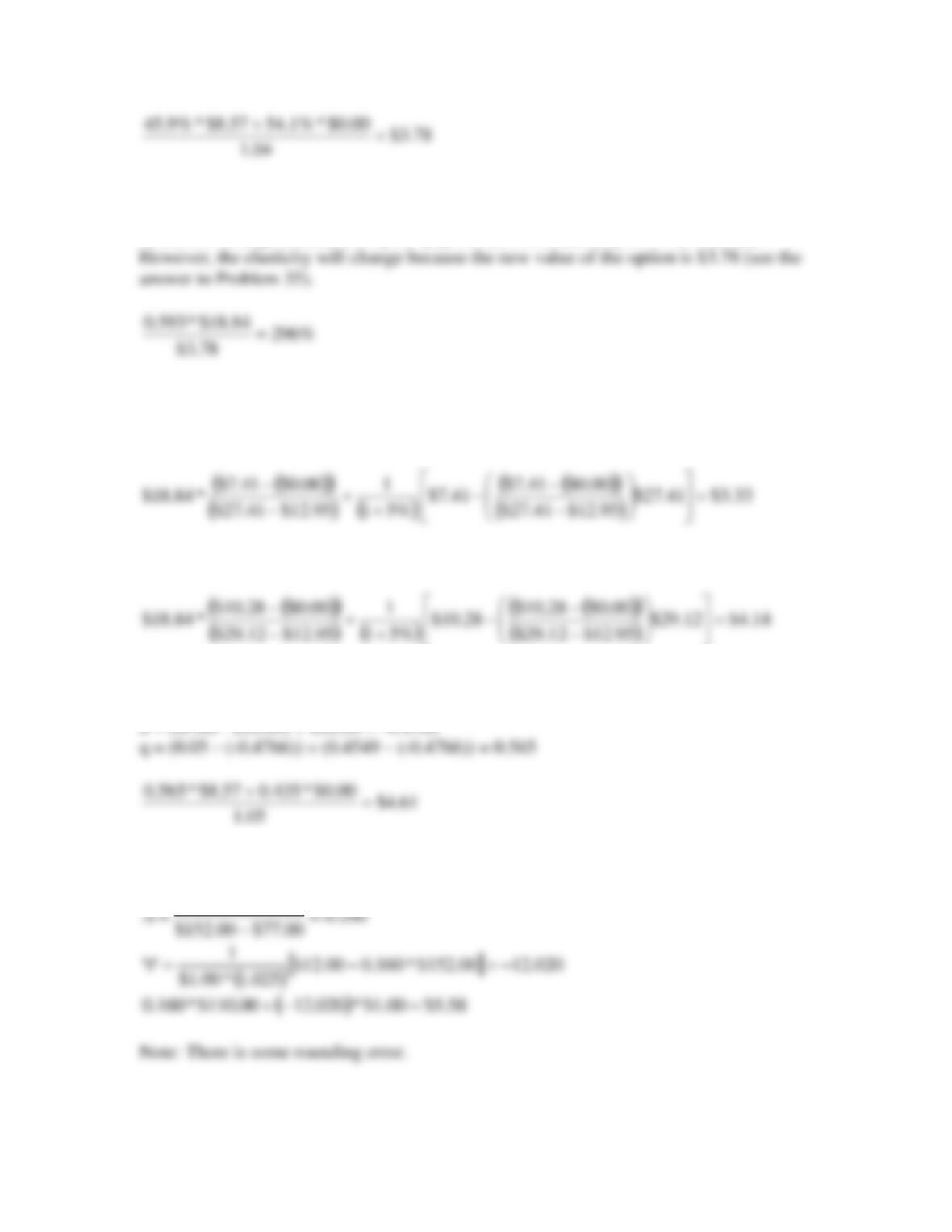
Problem 36
Δ does not change because the option payoffs are not affected by new risk free rate.
Because the option elasticity has increased, the beta for the option has also increased.
Problem 37
Problem 38
Problem 39
Problem 40
00.0$00.12$=
−
Problem 41
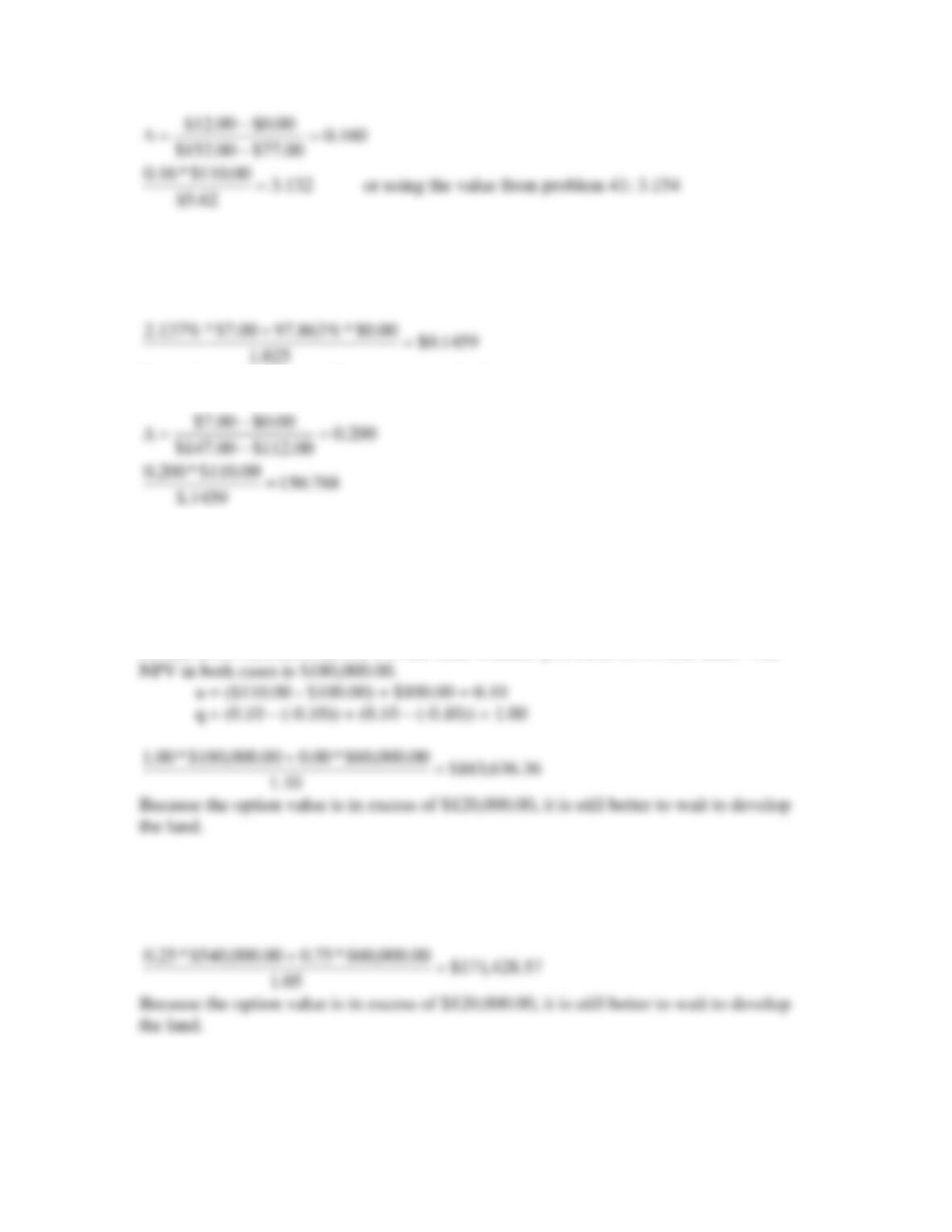
Problem 42
u = 33.64% and d = 1.82%: q = (.025 – .0182) ÷ (.3364 – .0182) = 2.137%
The option has lost a significant amount of value.
The option is less risky, which is why its value drops so greatly. Notice, the narrower
range of future values implies lower volatility in the forecast.
Problem 43
Notice, at $110,000.00, the NPV is the same whether you build six or nine units. The
Problem 44
q = (0.05 – (-0.10)) ÷ (0.50 – (-0.10)) = 0.25
Problem 45
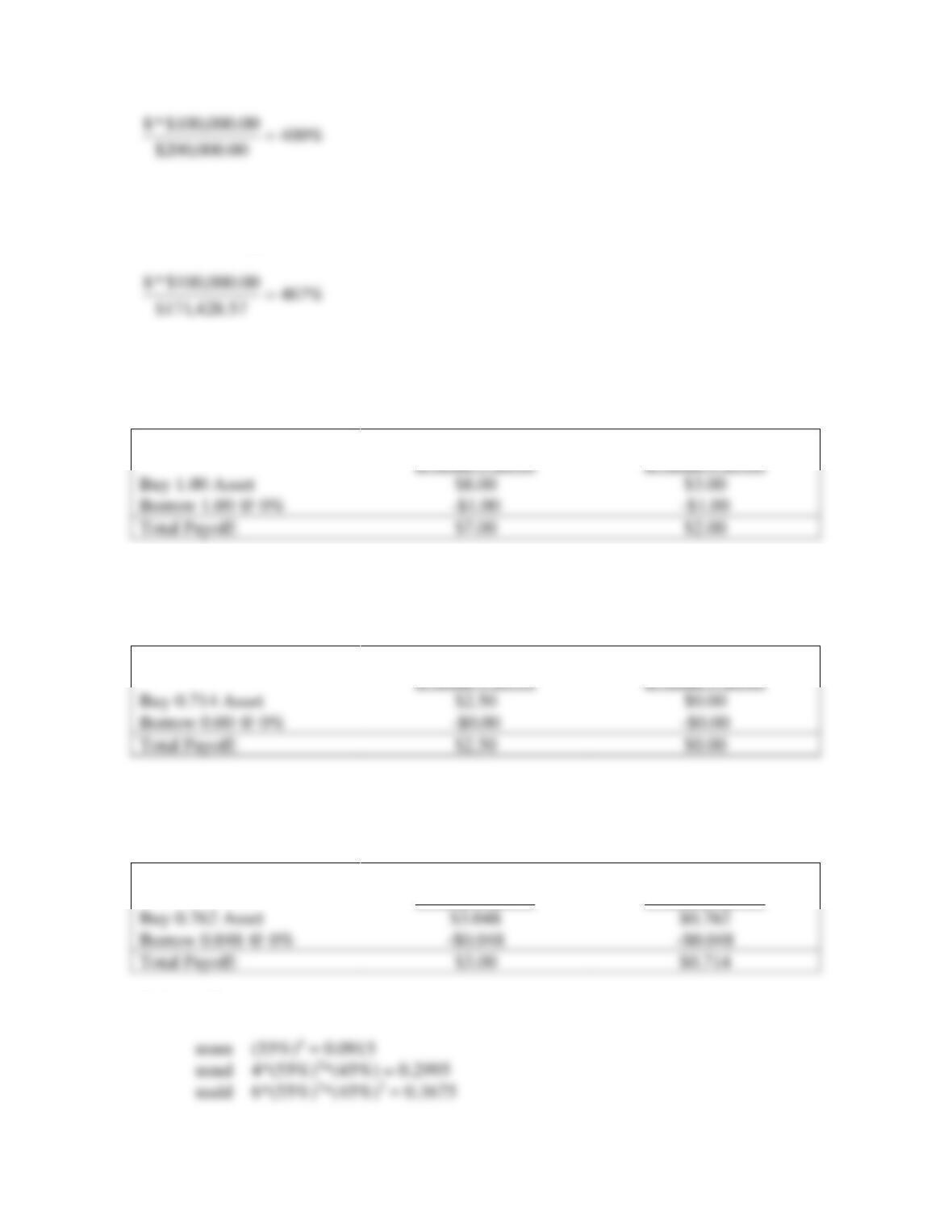
Problem 46
Based on the option value found in Problem 44:
Problem 47
Arbitrage Table:
End of Period
If Asset = $8.00
If Asset = $3.00
Buy 1.00 Asset
Borrow 1.00 @ 0%
Total Payoff:
Problem 48
Arbitrage Table:
End of Period
If Asset = $3.50
If Asset = $0.00
Buy 0.714 Asset
Borrow 0.00 @ 0%
Total Payoff:
Problem 49
Arbitrage Table:
End of Period
If Asset = $4.00
If Asset = $1.00
Buy 0.762 Asset
Borrow 0.048 @ 0%
Total Payoff:
Problem 50
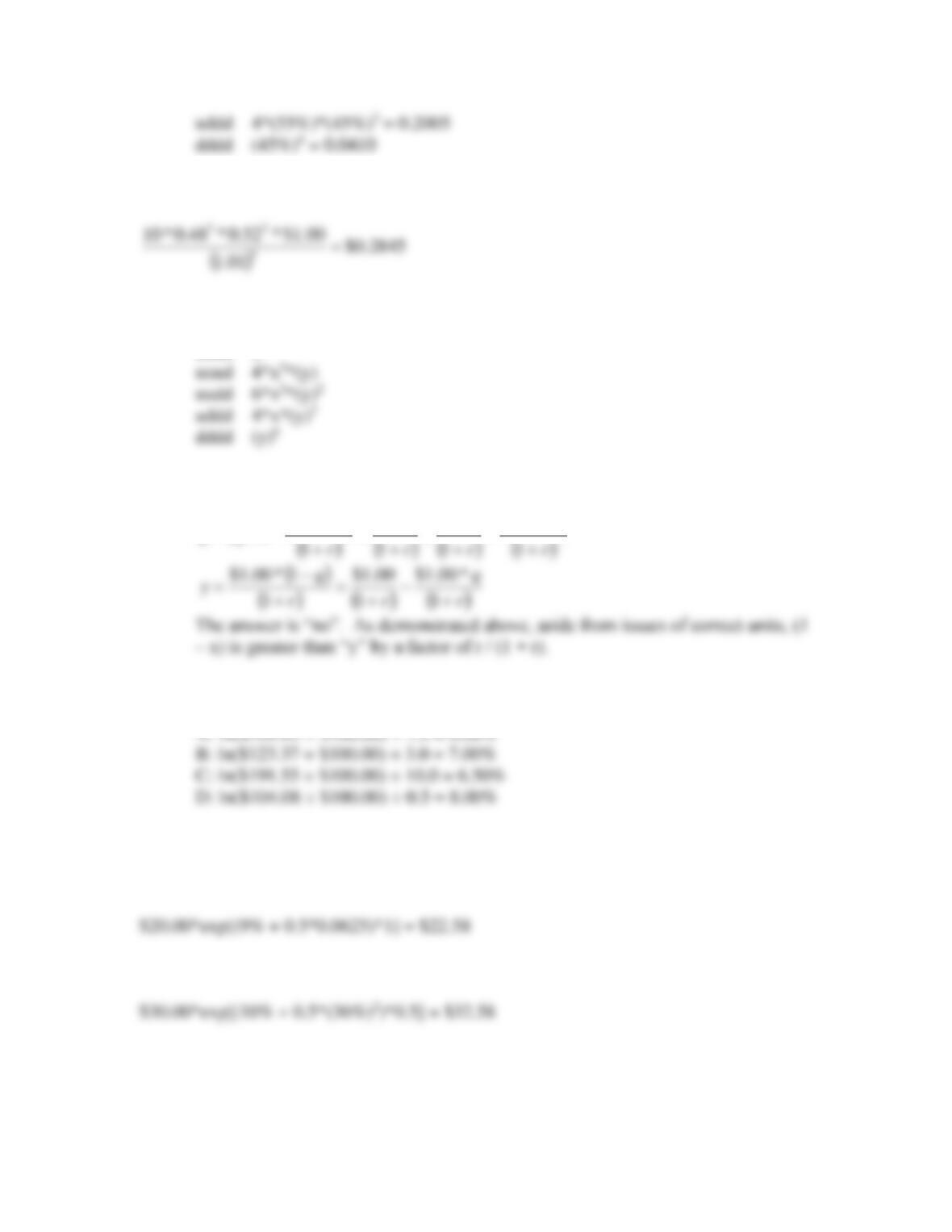
Problem 51
Problem 52
uuuu x4
Problem 53
( ) ( ) ( ) ( ) ( )
q
r
q
x+
−
+
=
−=− 1
*00.1$
1
*00.1$
11
Problem 54
A: ln($109.42 ÷ $100.00) ÷ 1.5 = 6.00%
Consequently, option “D” has the highest annual return.
Problem 55
Problem 56
Problem 57
The option has a strike price of $100,000.00 and is worth $12,132.36
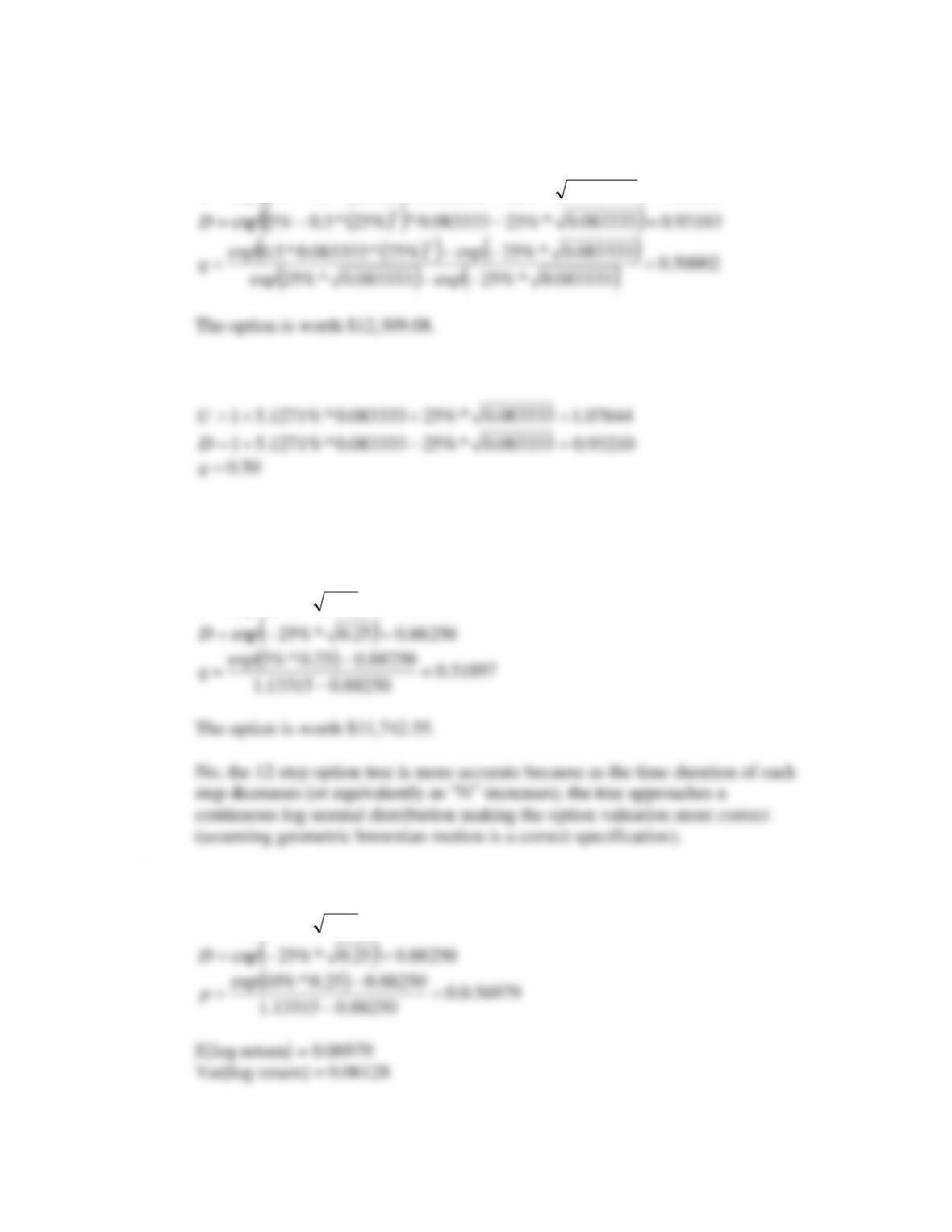
Problem 58
( )
( )
( )
07652.1083333.0*%25083333.0*%25*5.0%5exp 2=+−=U
Problem 59
The option is worth $12,370.77.
Problem 60
( )
13315.125.0*%25exp ==U
Problem 61
( )
13315.125.0*%25exp ==U
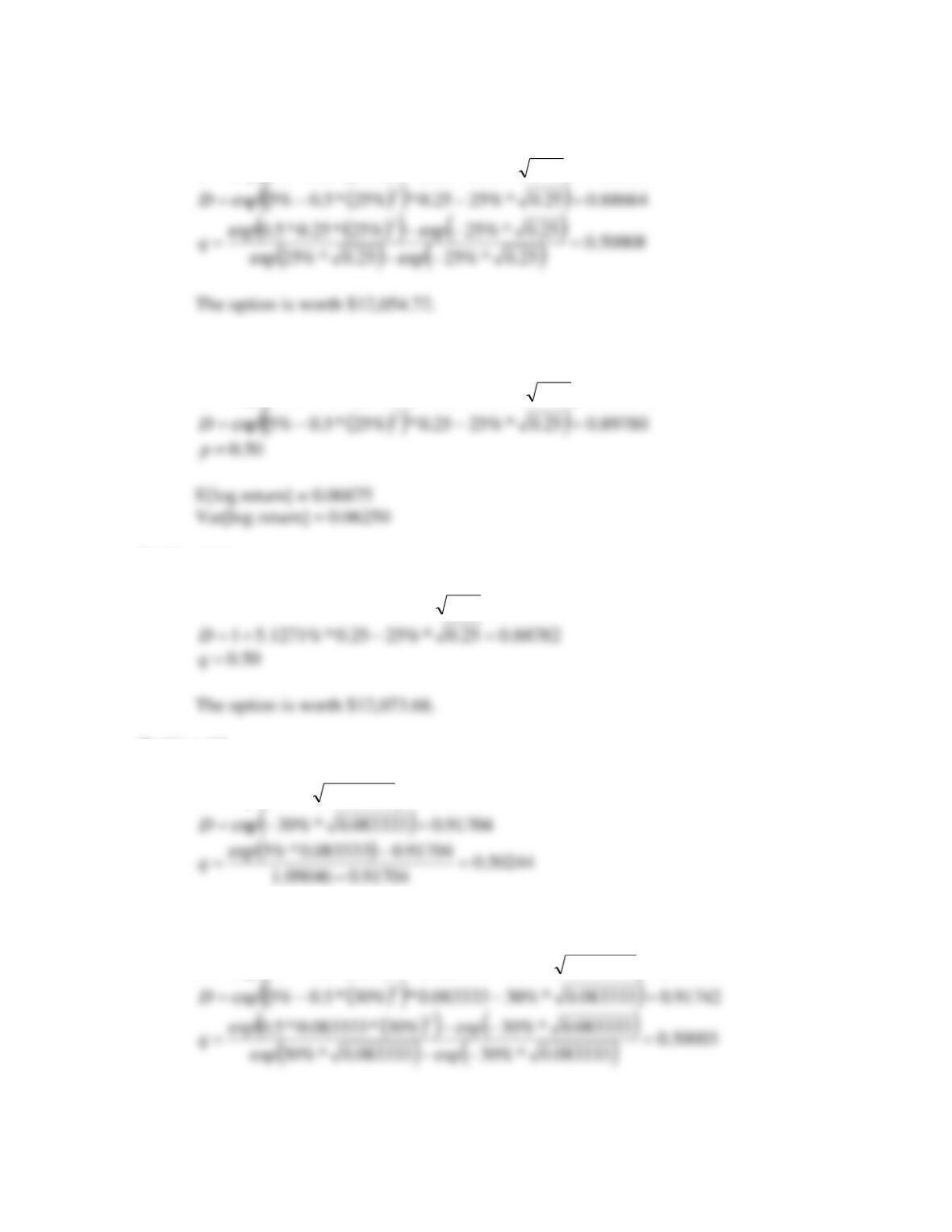
Problem 62
( )
( )
( )
13847.125.0*%2525.0*%25*5.0%5exp 2=+−=U
Problem 63
( )
( )
( )
15279.125.0*%2525.0*%25*5.0%10exp 2=+−=U
Problem 64
13782.125.0*%2525.0*%1271.51 =++=U
Problem 65
( )
09046.1083333.0*%30exp ==U
Alternative Tree:
( )
( )
( )
09092.1083333.0*%30083333.0*%30*5.0%5exp 2=+−=U
Problem 66
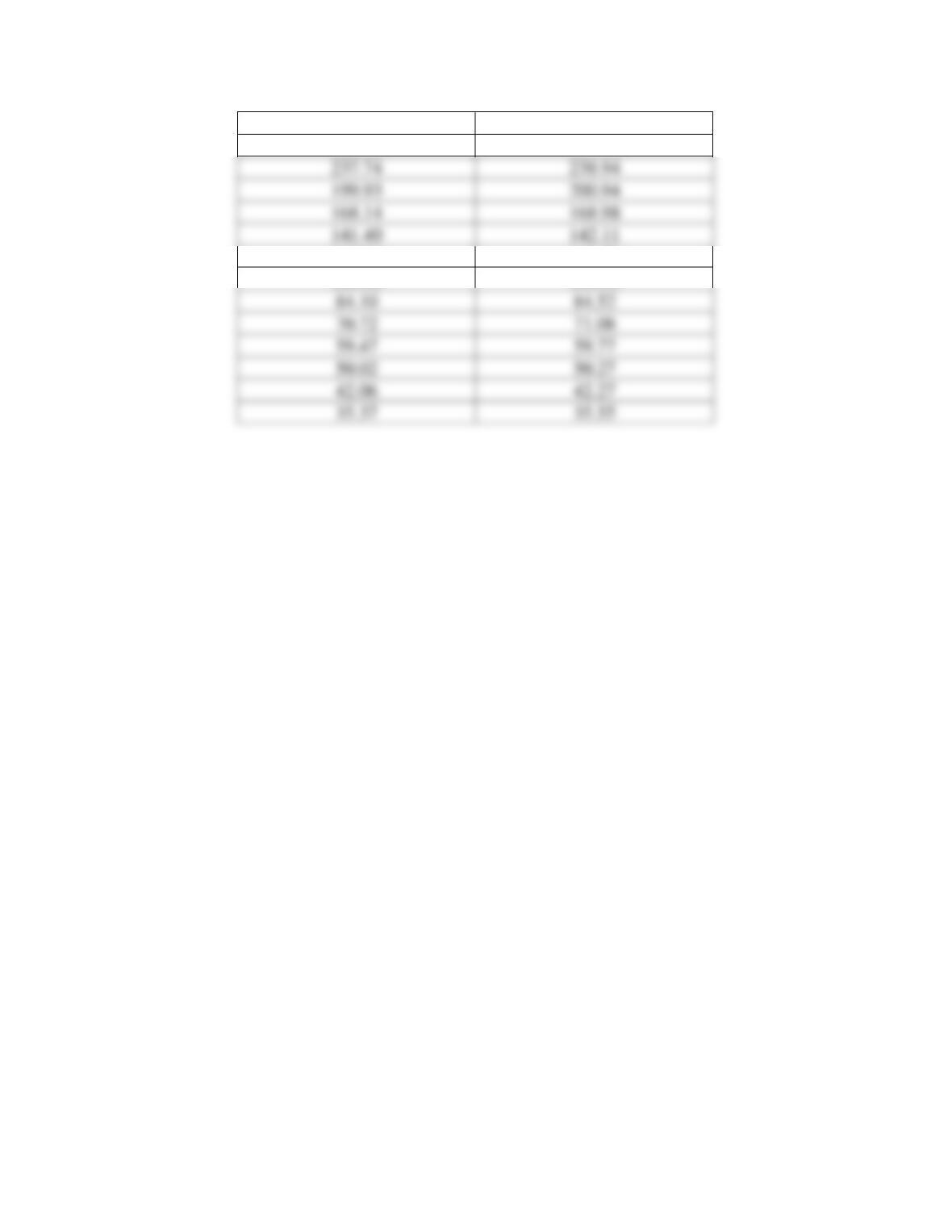
Standard Tree:
Appendix 4.1 Tree:
282.70
284.12
118.91
119.51
100.00
100.50
237.74
238.94
199.93
200.94
168.14
168.98
141.40
142.11