Chapter 4 Valuing Bonds 123
Q4–1. What is the relationship between the price of a financial asset and the return that investors
require on that asset, holding other factors constant?
A4-1. Holding an asset’s cash flows constant, if investors pay a higher price for the asset, then
Q4–2. Define the following terms commonly used in bond valuation: (a) par value, (b) maturity
A4-2. The par value is the face value of principal amount that a bond repays when it matures. It is
usually $1,000 for corporate bonds. The maturity date indicates when a bond’s final
payment is due, and it signals the end of the bond’s life. The coupon is the dollar amount
Q4–3. Under what circumstances will a bond’s coupon rate exceed its coupon yield? Explain in
economic terms why this occurs.
Q4–4. What is the difference between a pure discount bond and a bond that trades at a discount?
A4-4. A pure discount bond pays no interest. A bond that sells at a discount pays interest at a rate
Q4–5. A firm issues a bond at par value. Shortly thereafter, interest rates fall. If you calculate the
coupon rate, coupon yield, and yield to maturity for this bond after the decline in interest
rates, which of the three values is highest and which is lowest? Explain.
A4-5. As rates fall the bond’s price will rise. This does not affect the coupon rate, but it will
lower the coupon yield and the YTM. Because the bond now sells at a premium, there is a
Instructor’s Manual
124
Coupon rate > coupon yield > YTM
Q4–6. Twenty-five years ago, the U.S. government issued thirty-year bonds with a coupon rate of
A4-6. The YTM on each of these bonds would be quite similar. The bonds paying an 8% coupon
would trade at a significant premium, and the bonds paying a 5% coupon would trade at a
Q4–7. Describe how and why a bond’s interest rate risk is related to its maturity.
Q4-8. Explain why municipal bonds can offer lower interest rates than equally risky corporate
bonds.
A4-8. Interest from muni bonds is exempt from federal taxes, so the pre-tax interest rate offered
A4-9. Junk bonds represent a significant probability of default. The YTM is the return that an
investor earns if they hold a bond to maturity and all cash payments are made in full and on
Q4-10. Under the expectations theory, what does the slope of the yield curve reveal about the
future path of interest rates?
A4-10. Under the expectations hypothesis, the slope of the yield curve indicates the direction of
Q4-11. If the yield curve typically slopes upward, what does this imply about the long-term path of
interest rates if the expectations theory is true?
A4-11. This would imply that investors normally expect rates to rise.
Chapter 4 Valuing Bonds 125
a. Is the yield curve typically upward sloping, downward sloping, or flat?
A4-12. a. An upward slope is typical.
b. The yield curve moved down, especially at the short-term end, as the Fed pushed short-
term interest rates to zero to fight the recession. Short-term rates have remained near zero
from the fall of 2008 to the spring of 2011.
and click one frame at a time until August 1982. Let the animation play again until you
reach March 1989. What association do you notice between the shape of the yield curve
and the NBER’s dates for recessions?
A4-13. The yield curve usually slopes down, or inverts, at some point before a recession occurs.
the overall level of the yield curve from about mid-1979 to mid-1982. Compare that with
the level of the curve for most of the 1990s. What accounts for the differences in yield-
curve levels in these two periods?
A4-14. The yield curve was much higher in the late 1970s and early 1980s than it was in the 1990s
because inflation was much higher in the earlier period.
Solutions to End-of-Chapter Problems
Valuation Basics
P4-1. A best-selling author decides to cash in on her latest novel by selling the rights to the
book’s royalties for the next six years to an investor. Royalty payments arrive once per
year, starting one year from now. In the first year the author expects $400,000 in royalties,
followed by $300,000, then $100,000, and then $10,000 in the three subsequent years. If
the investor purchasing the rights to royalties requires a return of 7% per year, what should
the investor pay?
P4-2. An oil well produces 20,000 barrels of oil per year. Suppose the price of oil is $50 per
barrel. You want to purchase the right to the oil produced by this well for the next five
years. At a discount rate of 10%, what is the value of the oil rights? (You can assume that
the cash flows from selling oil arrive at annual intervals).
Instructor’s Manual
126
Bond Prices and Interest Rates
P4-3. A $1,000 par value bond makes two interest payments each year of $45 each. What is the
bond’s coupon rate?
P4-4. A $1,000 par value bond has a coupon rate of 8 % and a coupon yield of 9 %. What is the
bond’s market price?
P4-5. A bond sells for $900 and offers a coupon yield of 7.2 %. What is the bond’s annual
coupon payment?
P4-6. A bond offers a coupon rate of 5 %. If the par value is $1,000 and the bond sells for
$1,250, what is the coupon yield?
P4-7. A bond makes two $45 interest payments each year. Given that the bond’s par value is
$1,000 and its price is $1,050, calculate the bond’s coupon rate and coupon yield.
A4-7. Coupon yield is $90/$1,050 = 0.0857 or 8.57%. Coupon rate = $90/$1,000 = 0.09, or 9%.
P4-8. Calculate the price of a 5-year, $1,000 par value bond that makes semiannual payments,
has a coupon rate of 8 %, and offers a yield to maturity of 7 %. Recalculate the price
assuming a 9 % YTM. What is the general relationship that this problem illustrates?
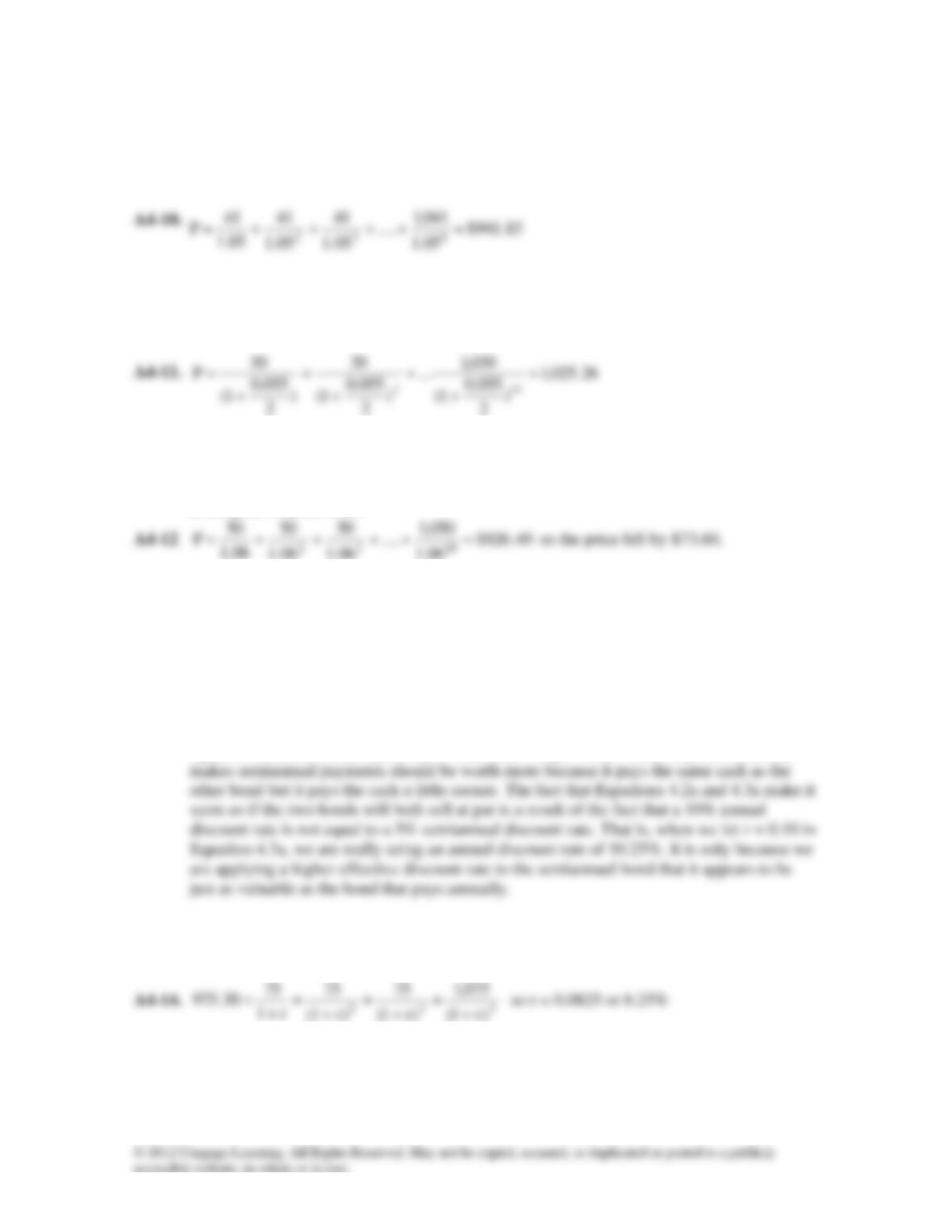
P4-9. A $1,000 par value bond makes annual interest payment of $75. If it offers a yield to
maturity of 7.5 %, what is the price of the bond?
Chapter 4 Valuing Bonds 127
P4-10. A $1,000 par value bond pays a coupon rate of 8.2 %. The bond makes semiannual
payments, and it matures in four years. If investors require a 10 % return on this
investment, what is the bond’s price?
P4-11. Griswold Travel Inc. has issued 6-year bonds that pay $30 in interest twice each year. The
par value of these bonds is $1,000 and they offer a yield to maturity of 5.5 %. How much
are the bonds worth?
P4-12. Bennifer Jewelers recently issued 10-year bonds that make annual interest payments of
$50. Suppose you purchased one of these bonds at par value when it was issued, and right
away market interest rates jumped and the YTM on your bond rose to 6 %. What happened
to the price of your bond?
P4-13. You are evaluating two similar bonds. Both mature in 4 years, both have a $1,000 par
value, and both pay a coupon rate of 10 %. However, one bond pays that coupon in annual
installments, whereas the other makes semiannual payments. Suppose you require a 10 %
return on either bond. Should these bonds sell at identical prices or should one be worth
more than the other? Use Equations 4.2a and 4.3a and let r = 10%. What prices do you
obtain for these bonds? Can you explain the apparent paradox?
A4-13. Using equation 4.2a, the bond that pays annual interest will sell at par value, and using
equation 4.3a, the semiannual bond will also sell for par value. Intuitively, the bond that
P4-14. A bond makes annual interest payments of $75. The bond matures in 4 years, has a par
value of $1,000, and sells for $975.30. What is the bond’s yield to maturity (YTM)?
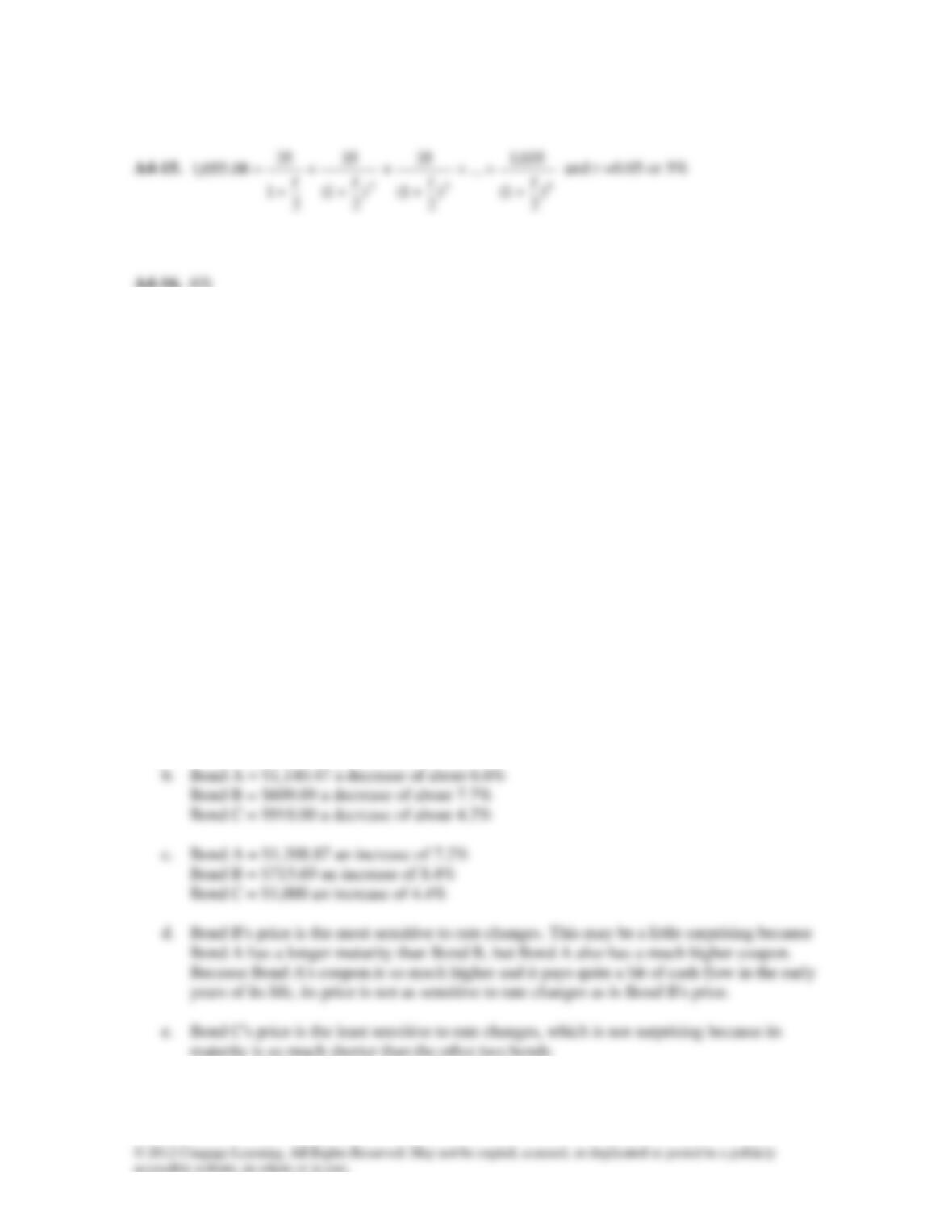
P4-15. Johanson VI Advisors issued $1,000 par value bonds a few years ago with a coupon rate of
7 %, paid semiannually. After the bonds were issued, interest rates fell. Now with three
years remaining before they mature, the bonds sell for $1,055.08. What YTM do these
bonds offer?
Instructor’s Manual
128
P4-16. A bond offers a 6 % coupon rate and sells at par. What is the bond’s yield to maturity?
A4-16. 6%
P4-17. You have gathered the following data on three bonds:
Bond Maturity Coupon %
A 10 yrs 9%
B 9 yrs 1%
C 5 yrs 5%
a. If the market’s required return on all three bonds is 6%, what are the market prices of the
bonds (you can assume annual interest payments).
b. The market’s required return suddenly rises to 7%. What are the new bonds prices, and
what is the percentage change in price for each bond?
c. If the market’s required return falls from the initial 6% to 5%, what are the new prices,
and what is the percentage change in each price relative to the answer obtained in part (a)?
d. Which bond’s price is most sensitive to interest rate movements? Does this answer
surprise you? Why or why not? Can you explain why this bond’s price is so sensitive to
rate changes?
e. Which bond’s price is least sensitive to interest rate movements? Explain.
A4-17.
a. Bond A = $1,220.80
Bond B = $659.92
Bond C = $957.88
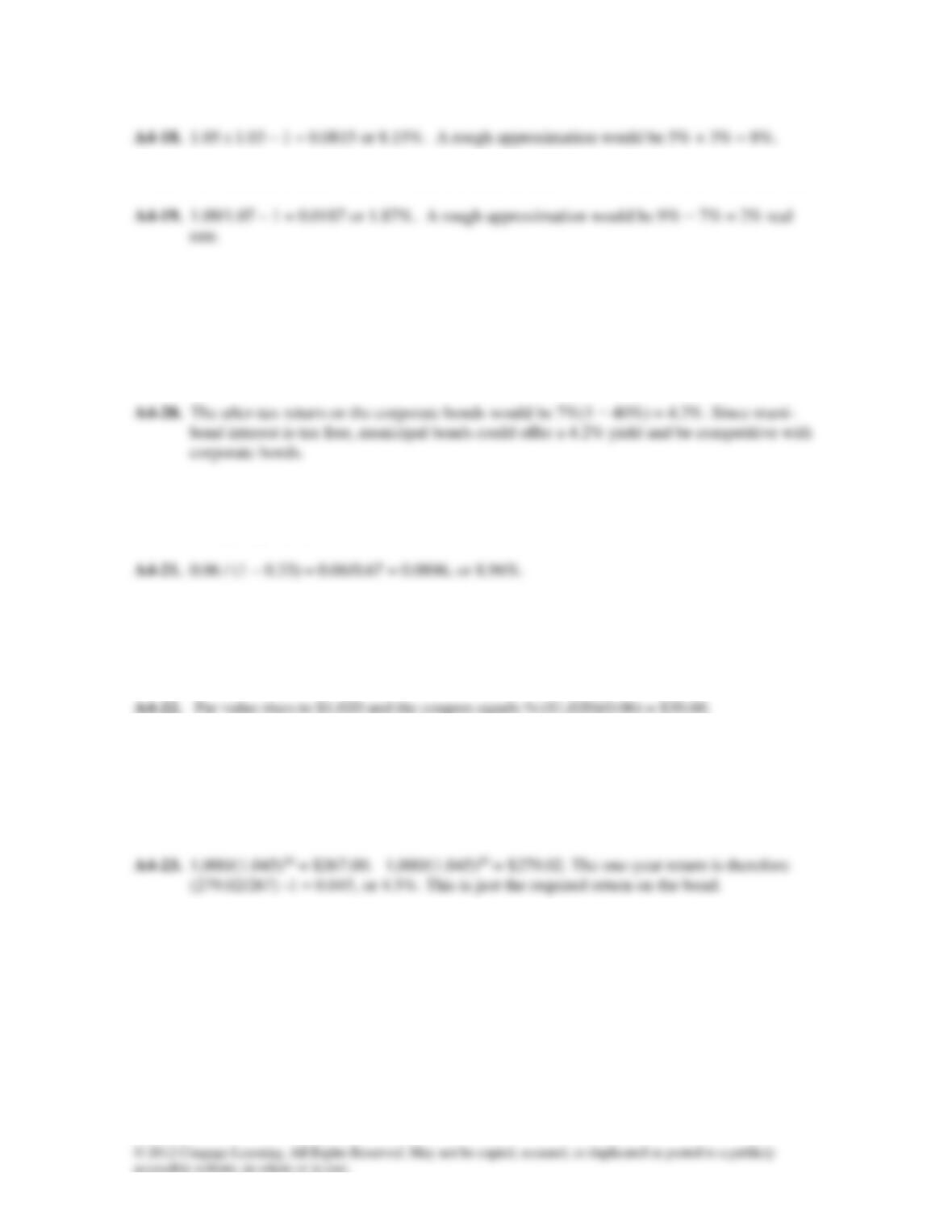
P4-18. The rate of inflation is 5 % and the real interest rate is 3 %. What is the nominal interest
rate?
Chapter 4 Valuing Bonds 129
P4.19. The nominal interest rate is 9 % and the inflation rate is 7 %. What is the real interest rate?
Types of Bonds
P4-20. Suppose investors face a tax rate of 40 % on interest received from corporate bonds.
Suppose AAA-rated corporate bonds currently offer yields of about 7 %. Approximately
what yield would AAA-rated municipal bonds need to offer to be competitive?
P4-21. Investors face a tax rate of 33% on interest paid by corporate bonds. If municipal bonds
currently offer yields of 6 %, what yield would equally risky corporate bonds need to offer
to be competitive?
P4-22. You purchase a U.S. Treasury inflation-indexed bond at par value of $1,000. The bond
offers a coupon rate of 6 % paid semiannually. During the first six months that you hold
the bond, prices in the U.S. rise by 2%. What is the new par value of the bond, and what is
the amount of your first coupon payment?
P4-23. What is the price of a zero-coupon bond that has a par value of $1,000? The bond matures
in thirty years and offers a yield to maturity of 4.5 %. Calculate the price one year later
when the bond has twenty-nine years left before it matures (assume the yield remains at
4.5%). What is the return that investors earn if they buy the bond with thirty years
remaining and sell it one year later?
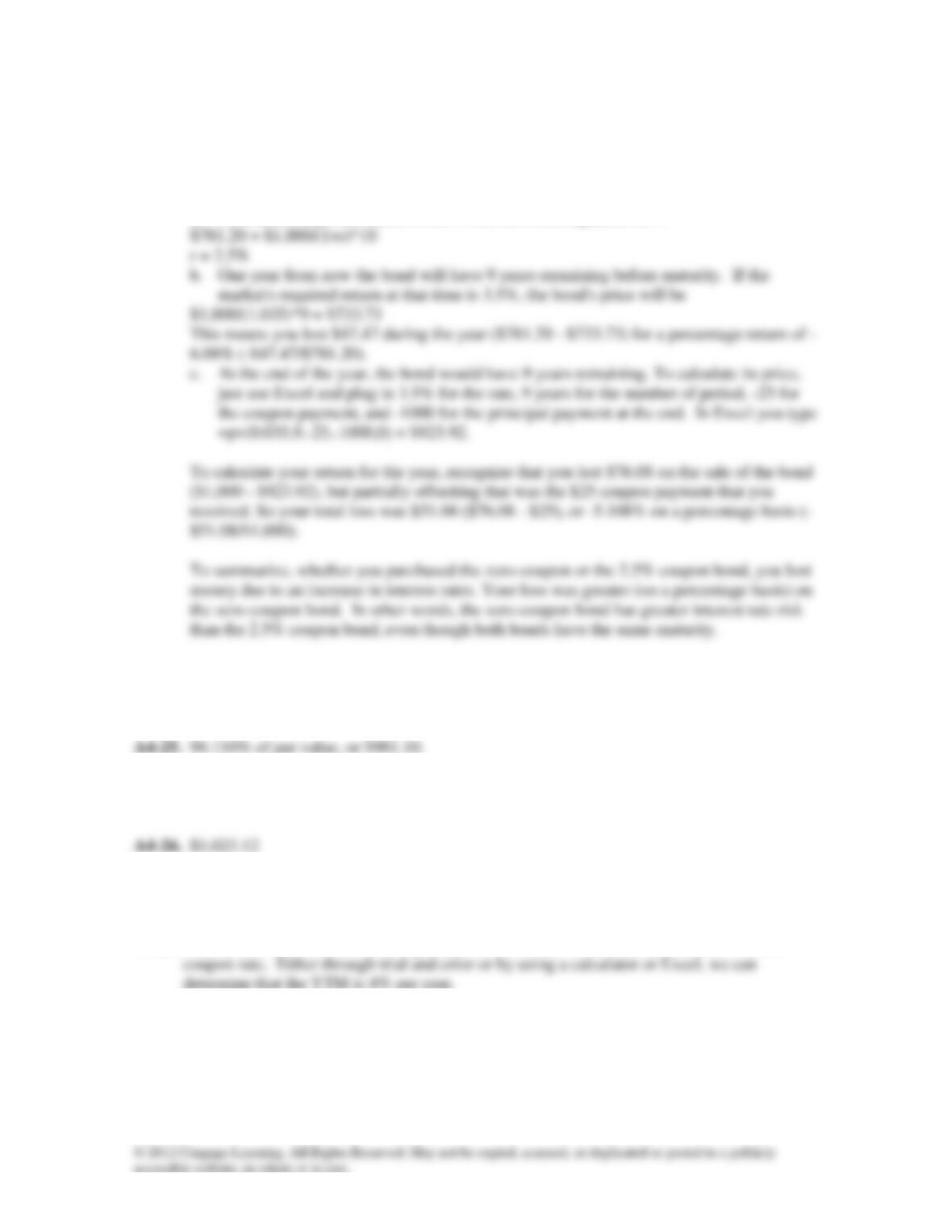
P4.24. A zero-coupon bond has a $1,000 face value, matures in 10 years, and currently sells for
$781.20.
a. What is the market’s required return on this bond?
b. Suppose you hold this bond for 1 year and sell it. At the time you sell the bond, market
rates have increased to 3.5%. What return did you earn on this bond?
c. Suppose that rather than buying the 10-year zero-coupon bond described at the start of
this problem, you instead purchased a 10-year 2.5% coupon bond (assume annual
payments). Because the bond’s coupon rate equaled the market’s required return at the time
of purchase, you paid par value ($1,000) to acquire the bond. Again assume that you held
the bond for one year, received one coupon payment, and then sold the bond, but at the
Instructor’s Manual
130
time of sale the market’s required return was 3.5%. What was your return for the year?
Compare your answer here to your answer in part (b).
A4.24.
a. To find the required return, or the YTM, solve this equation for r:
Bond Markets
P4-25. A corporate bond’s price is quoted as 98.110. What is the price of the bond if its par value
is $1,000?
P4-26. A corporate bond’s price is quoted as 102.312. If the bond’s par value is $1,000, what is its
market price?
P4.27. A corporate bond’s price is listed at 102.801. It matures in 3 years, has a coupon rate of
5%, and pays interest semiannually. What is the bond’s yield to maturity?
A4.27. First notice that the bond is selling at a premium, so its YTM must be less than 5%, the
P4.28. Refer back to Figure 4.5.
a. What is the yield spread in basis points between the Citigroup bond maturing in May
2015 and the DirectTV bond maturing in March 2015? Does this spread make sense given
the different ratings assigned to these bonds? If not, what factors might explain the
differences in yields that we observe?
Chapter 4 Valuing Bonds 131
b. What is the yield spread in basis points between the Morgan Stanley bond paying a
5.625% coupon and the Morgan Stanely bond paying a 5.500% coupon? Given that these
two bonds have the same credit rating and similar coupons, would you expect them to offer
nearly identical yields? Why or why not?
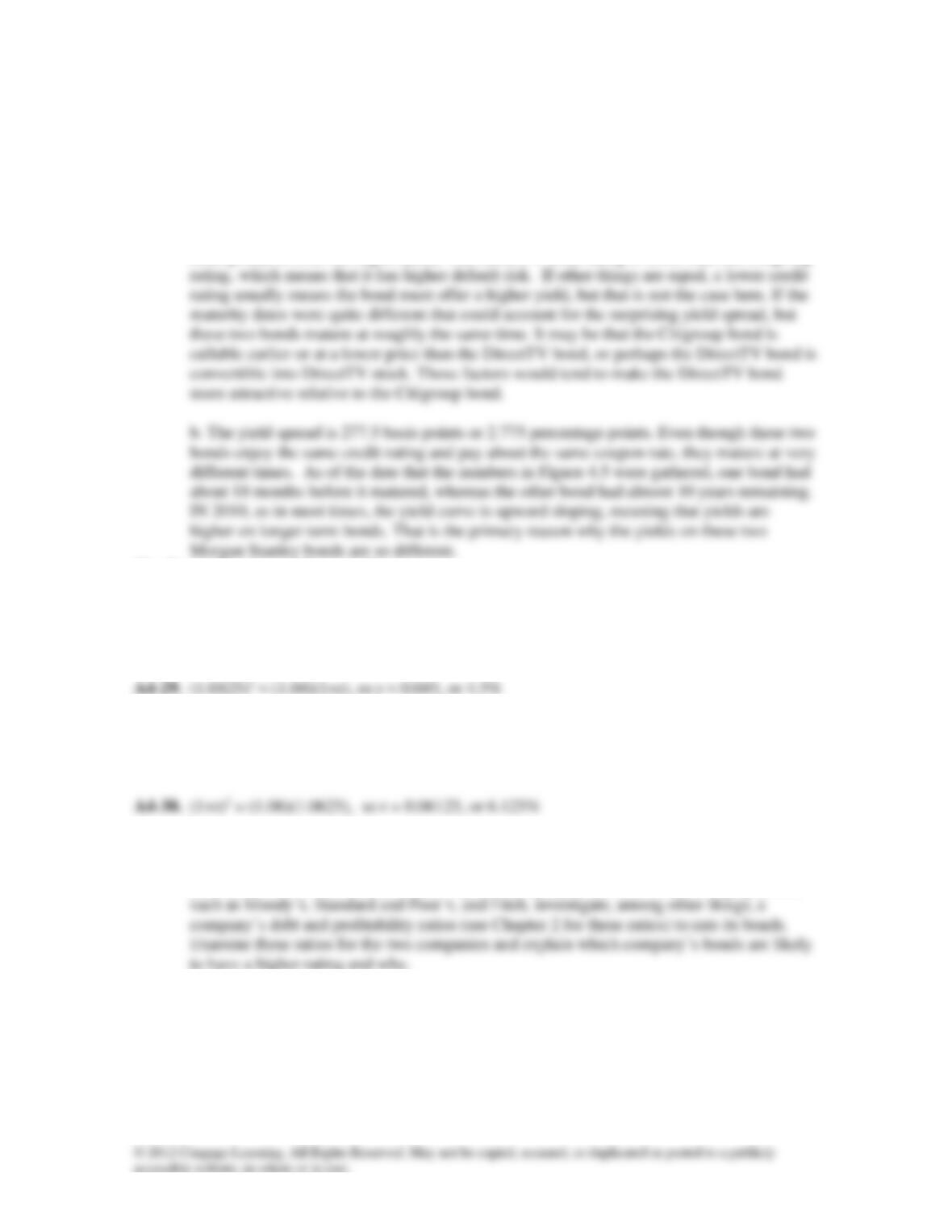
A4.28. a. The yield spread is 113.7 basis points or 1.137 percentage points, with the Citigroup
bond priced to offer the higher yield. The DirectTV bond rating is lower than the Citigroup
The Term Structure of Interest Rates
P4-29. A one-year Treasury security offers a 4 % yield to maturity (YTM). A two-year Treasury
security offers a 4.25 % YTM. According to the expectations theory, what is the expected
interest rate on a one-year security next year?
P4-30. A one-year Treasury bill offers a 6 % yield to maturity. The market’s consensus forecast is
that one-year T-bills will offer 6.25 % next year. What is the current yield on a 2-year T-
bill if the expectations theory holds?
THOMSON ONE Business School Edition:
P4-31. Which of the following two companies will have a higher bond rating: Abbott Laboratories
Inc (ticker: U:ABT) or Bristol Myers Squibb Company (U:BMY)? Bond rating agencies,
A4-31. Because this exercise is based on using a live data base, answers will vary from moment to
moment.
Instructor’s Manual
132
Answer to MiniCase
Valuing Bonds
You open your Wall Street Journal (WSJ) on the morning of February 31, 2008, and see the
following bond quote for General Mills, Incorporated. Based on this WSJ information, answer the
following questions.
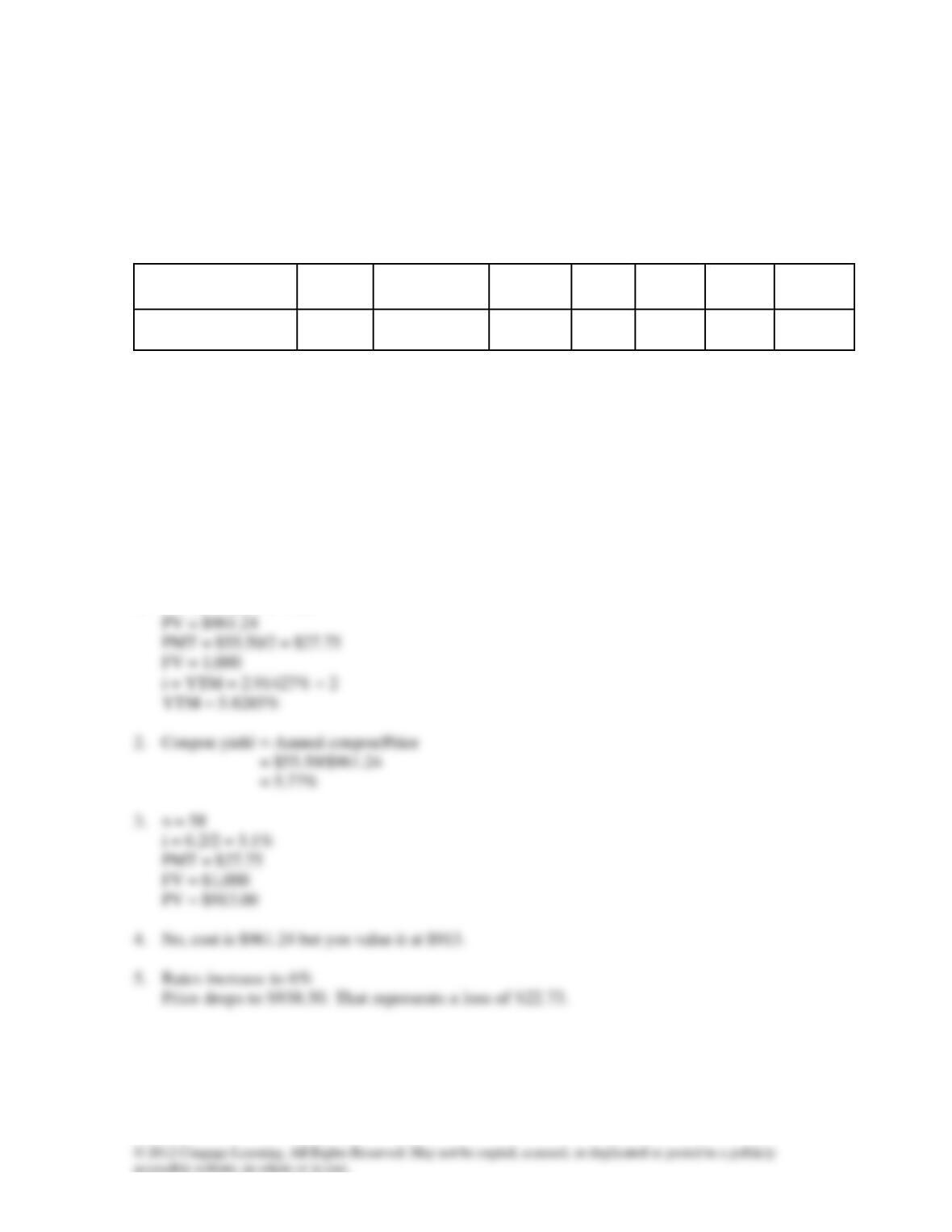
Company (ticker)
Coupon
Maturity
Last
Price
High
Low
Change
Yield %
Proctor & Gamble
CO (PG.HD)
5.550%
Mar 2037
96.124
96.124
95.933
-0.245
5.825
Assignment
1. What is the YTM for this Proctor & Gamble’s corporate bond?
2. What is the coupon yield of this bond over the next year?
3. If your required rate of return for a bond of this risk-class is 6.2 %, what value do you place on
this Proctor & Gamble bond?
4. At this required rate of return of 6.2 % are you interested in purchasing this bond?
5. If you purchased this Proctor & Gamble bond for $961.24 yesterday and the market rate of
interest for this bond increased to 6.0 % today, do you have a gain or loss? How much is that
gain or loss in dollars?
Answers
1. n = 29 Years 2 = 58