Mini Case: 4 – 21
MINI CASE
Sam Strother and Shawna Tibbs are vice-presidents of Mutual of Seattle Insurance
Company and co-directors of the company’s pension fund management division. A major
new client, the Northwestern Municipal Alliance, has requested that Mutual of Seattle
present an investment seminar to the mayors of the represented cities, and Strother and
Tibbs, who will make the actual presentation, have asked you to help them by answering
the following questions. Because the Boeing Company operates in one of the league’s cities,
you are to work Boeing into the presentation.
a. What are the key features of a bond?
Answer:
1. Par or face value. We generally assume a $1,000 par value, but par can be
anything, and often $5,000 or more is used. With registered bonds, which is what
Mini Case: 4 – 22
b. What are call provisions and sinking fund provisions? Do these provisions make
bonds more or less risky?
Answer: A call provision is a provision in a bond contract that gives the issuing corporation
the right to redeem the bonds under specified terms prior to the normal maturity date.
The call provision generally states that the company must pay the bondholders an
Mini Case: 4 – 23
c. How is the value of any asset whose value is based on expected future cash flows
determined?
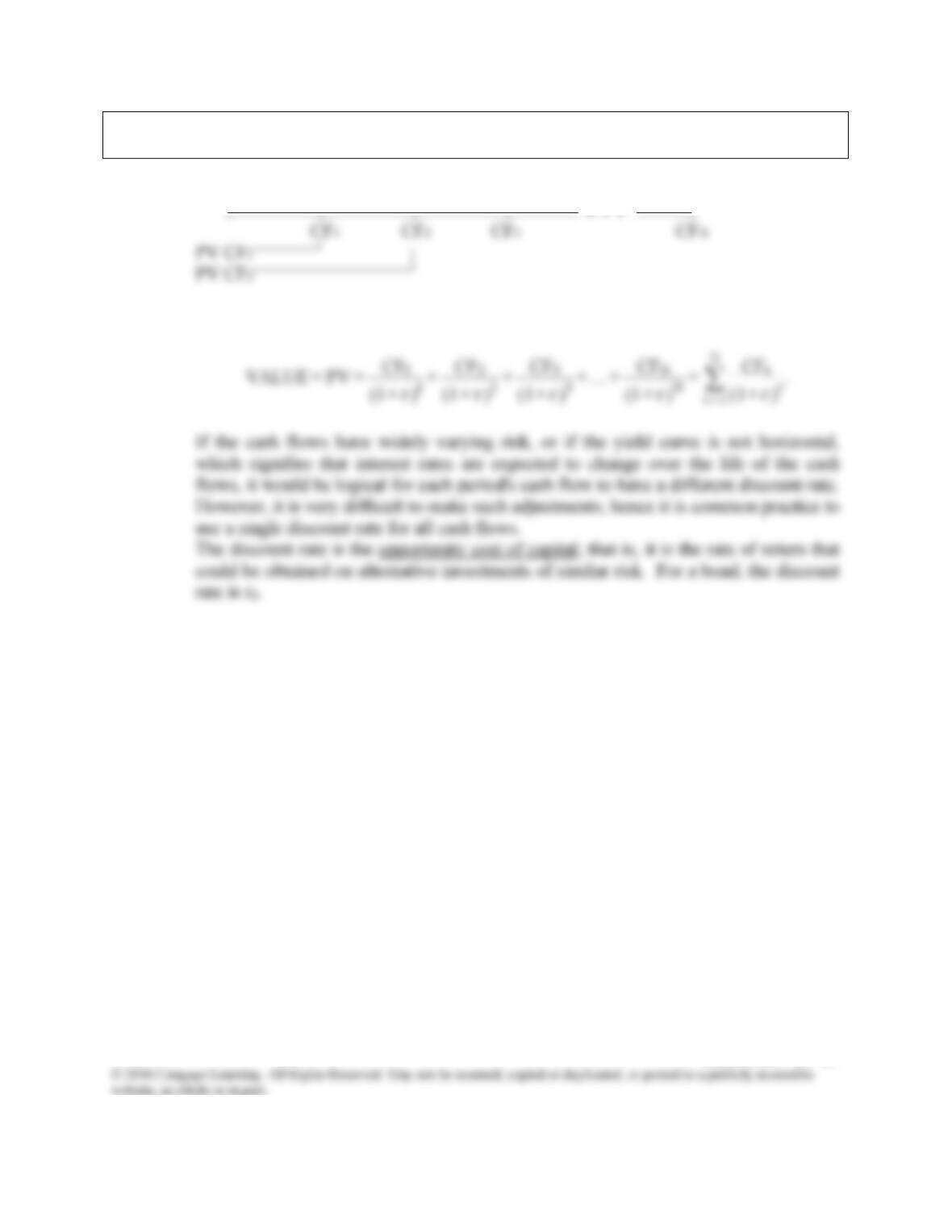
Answer: 0 1 2 3 n
The value of an asset is merely the present value of its expected future cash flows:
Mini Case: 4 – 24
d. How is the value of a bond determined? What is the value of a 10-year, $1,000
par value bond with a 10 percent annual coupon if its required rate of return is
10 percent?
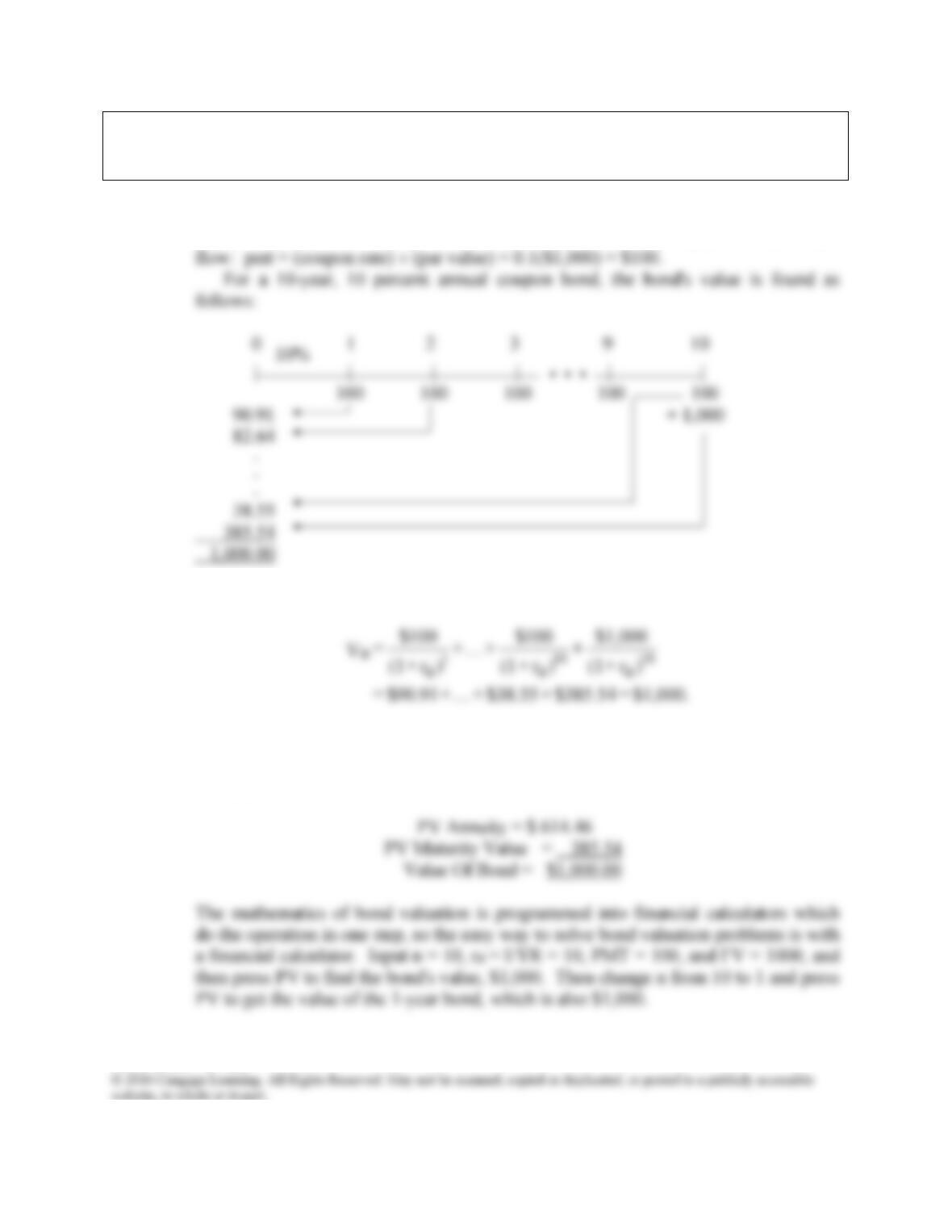
Answer: A bond has a specific cash flow pattern consisting of a stream of constant interest
payments plus the return of par at maturity. The annual coupon payment is the cash
Expressed as an equation, we have:
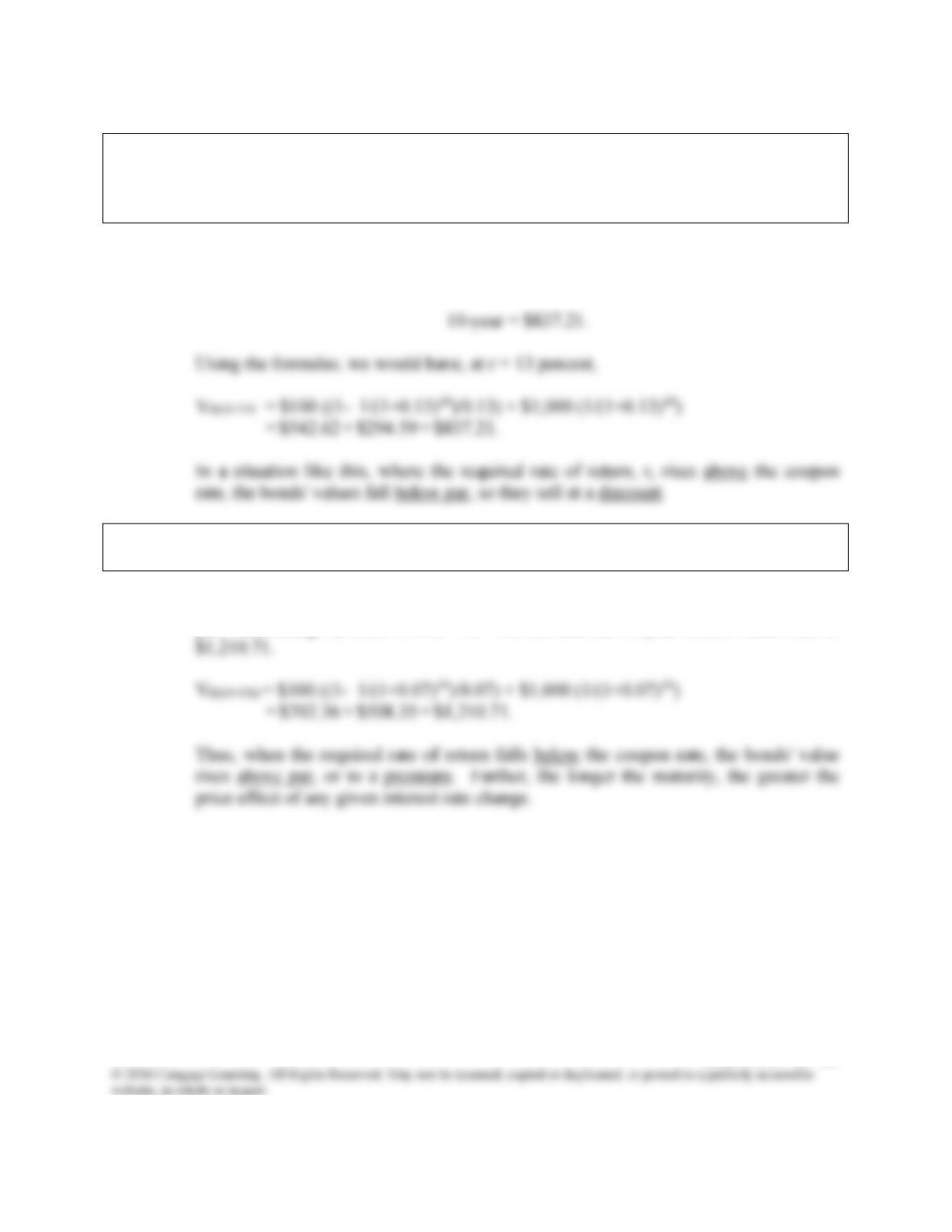
The bond consists of a 10-year, 10% annuity of $100 per year plus a $1,000 lump
sum payment at t = 10:
Mini Case: 4 – 25
e. 1. What would be the value of the bond described in part d if, just after it had been
issued, the expected inflation rate rose by 3 percentage points, causing investors
to require a 13 percent return? Would we now have a discount or a premium
bond?
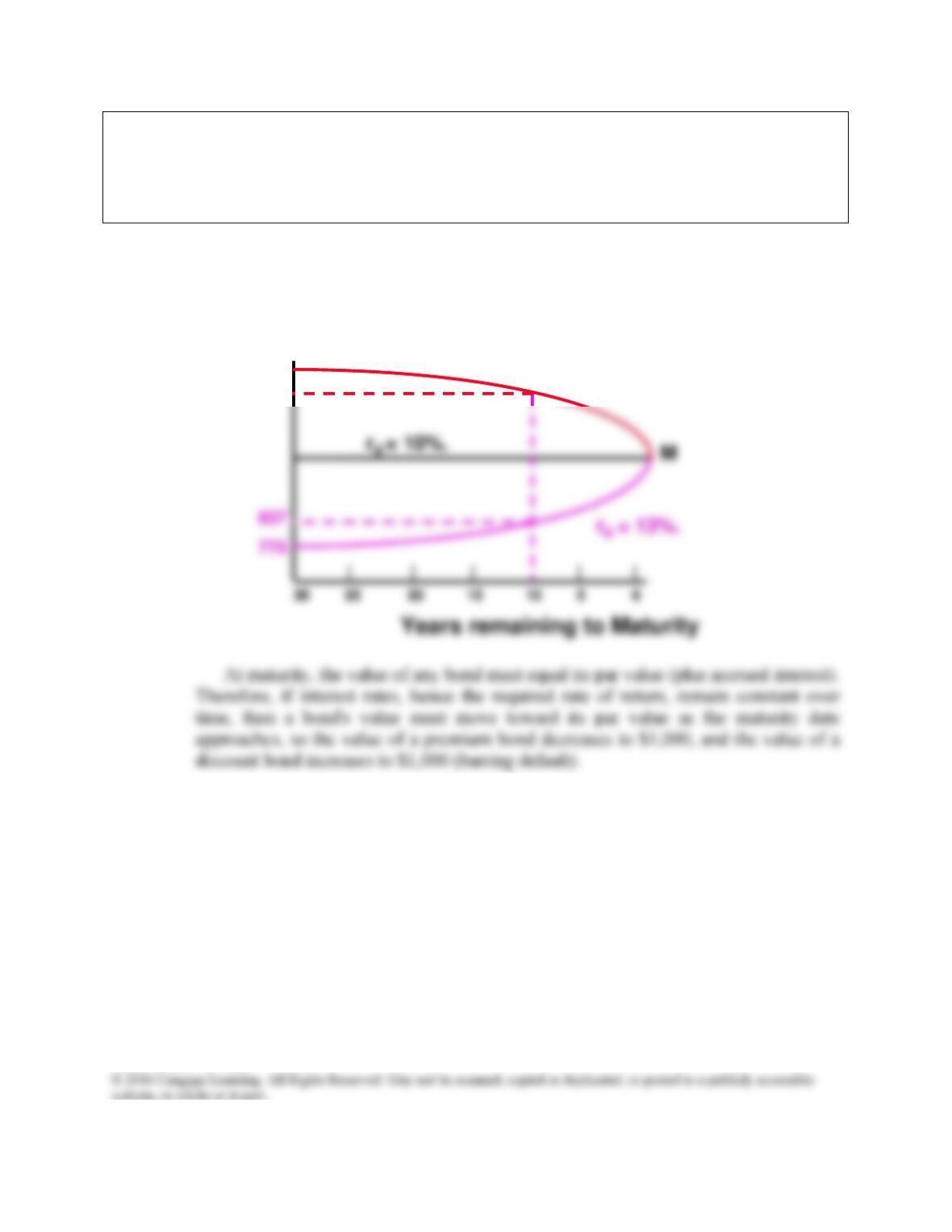
Answer: With a financial calculator, just change the value of rd = I/YR from 10% to 13%, and
press the PV button to determine the value of the bond:
e. 2. What would happen to the bonds’ value if inflation fell, and rd declined to 7
percent? Would we now have a premium or a discount bond?
Answer: In the second situation, where rd falls to 7 percent, the price of the bond rises above
par. Just change rd from 13% to 7%. We see that the 10-year bond’s value rises to
Mini Case: 4 – 26
e. 3. What would happen to the value of the 10-year bond over time if the required
rate of return remained at 13 percent, or if it remained at
7 percent? (Hint: with a financial calculator, enter PMT, I/YR, FV, and N, and
then change (override) n to see what happens to the PV as the bond approaches
maturity.)
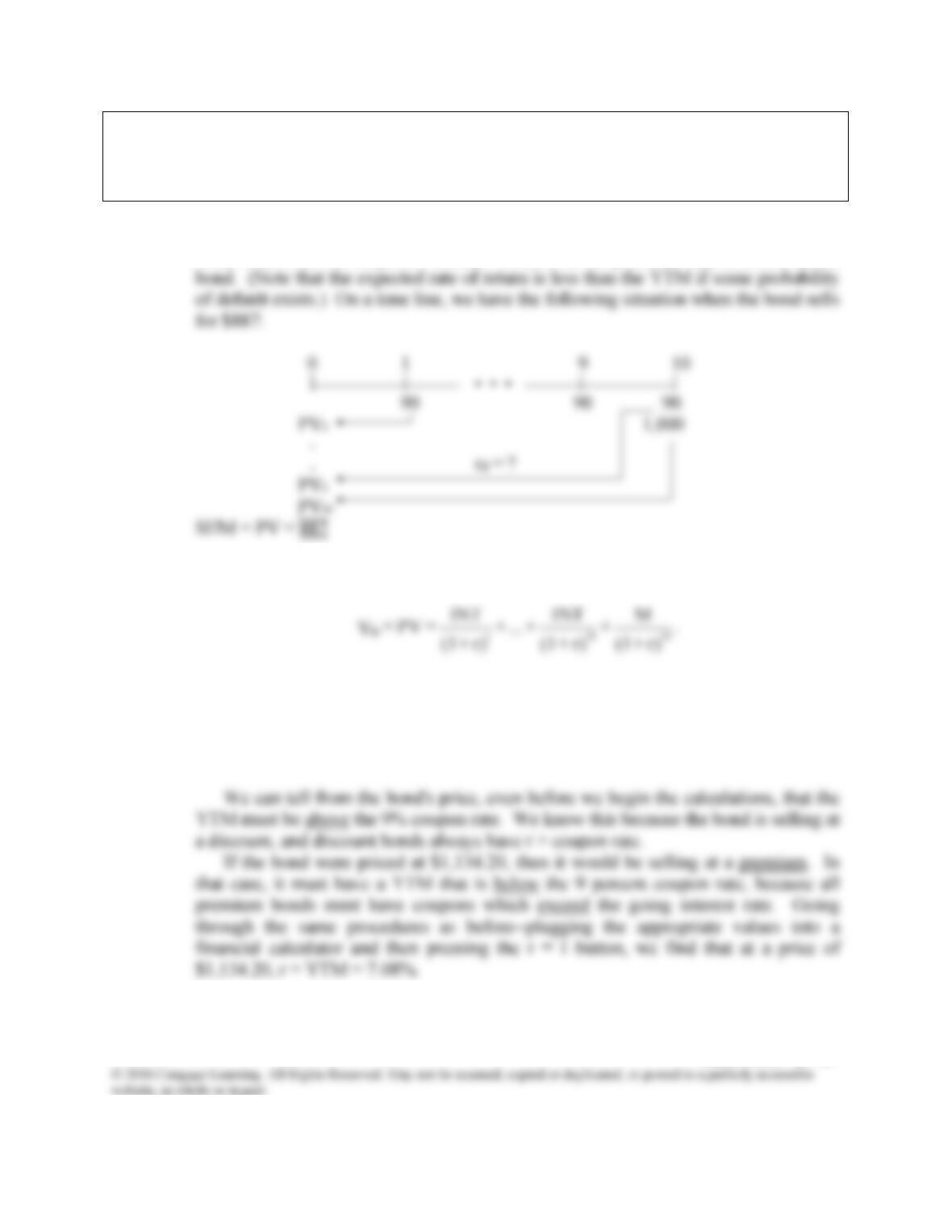
Answer: Assuming that interest rates remain at the new levels (either 7% or 13%), we could
find the bond’s value as time passes, and as the maturity date approaches. If we then
plotted the data, we would find the situation shown below:
Bond Value ($)
rd= 7%.
Bond Value ($)
rd= 7%.
Mini Case: 4 – 27
f. 1. What is the yield to maturity on a 10-year, 9 percent annual coupon, $1,000 par
value bond that sells for $887.00? That sells for $1,134.20? What does the fact
that a bond sells at a discount or at a premium tell you about the relationship
between rd and the bond’s coupon rate?
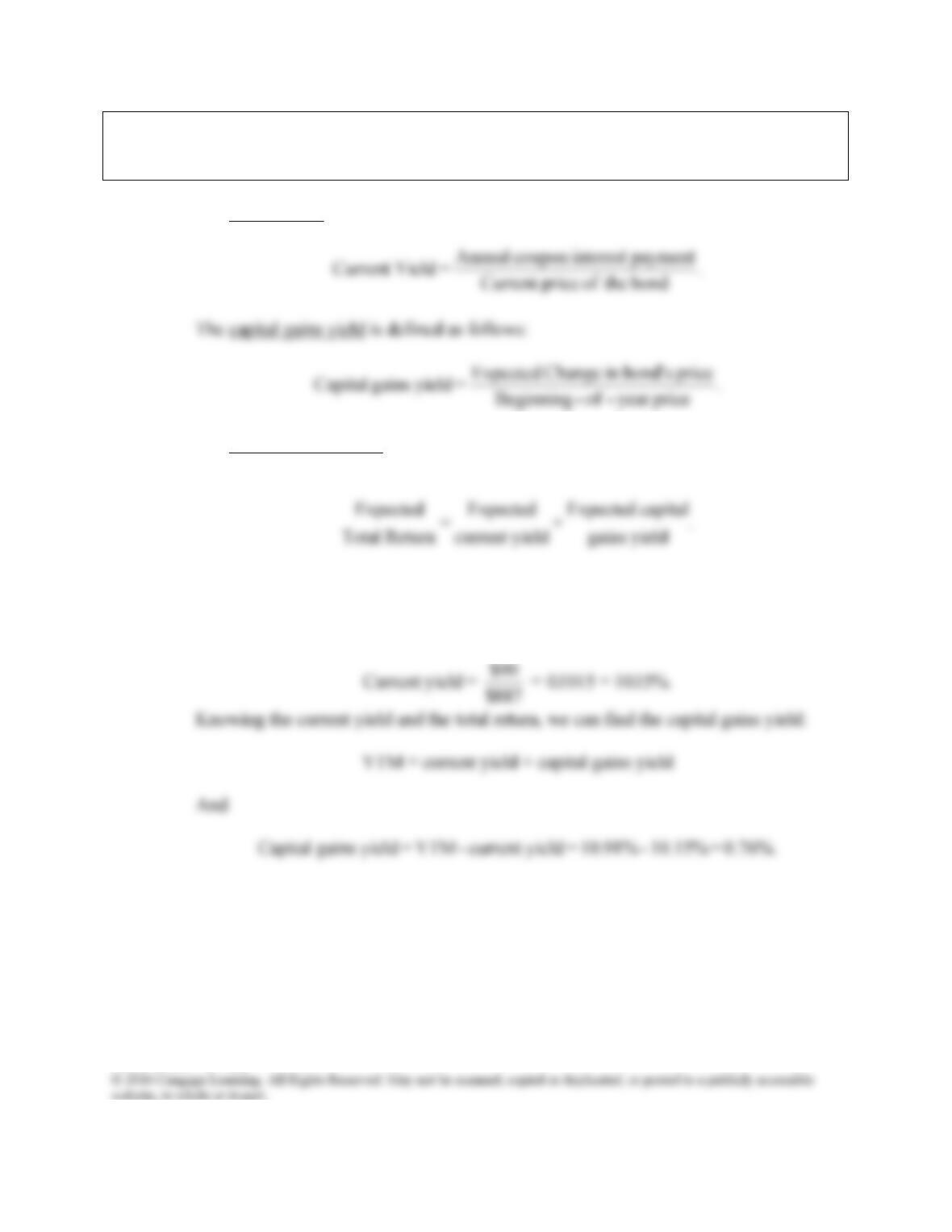
Answer: The yield to maturity (YTM) is that discount rate which equates the present value of a
bond’s cash flows to its price. In other words, it is the promised rate of return on the
We want to find r in this equation:
We know n = 10, PV = -887, PMT = 90, and FV = 1000, so we have an equation with
one unknown, rd. We can solve for rd by entering the known data into a financial
calculator and then pressing the I/YR = rd button. The YTM is found to be 10.91%.
Alternatively, we could use present value interest factors:
Mini Case: 4 – 28
f. 2. What are the total return, the current yield, and the capital gains yield for the
discount bond? (Assume the bond is held to maturity and the company does not
default on the bond.)
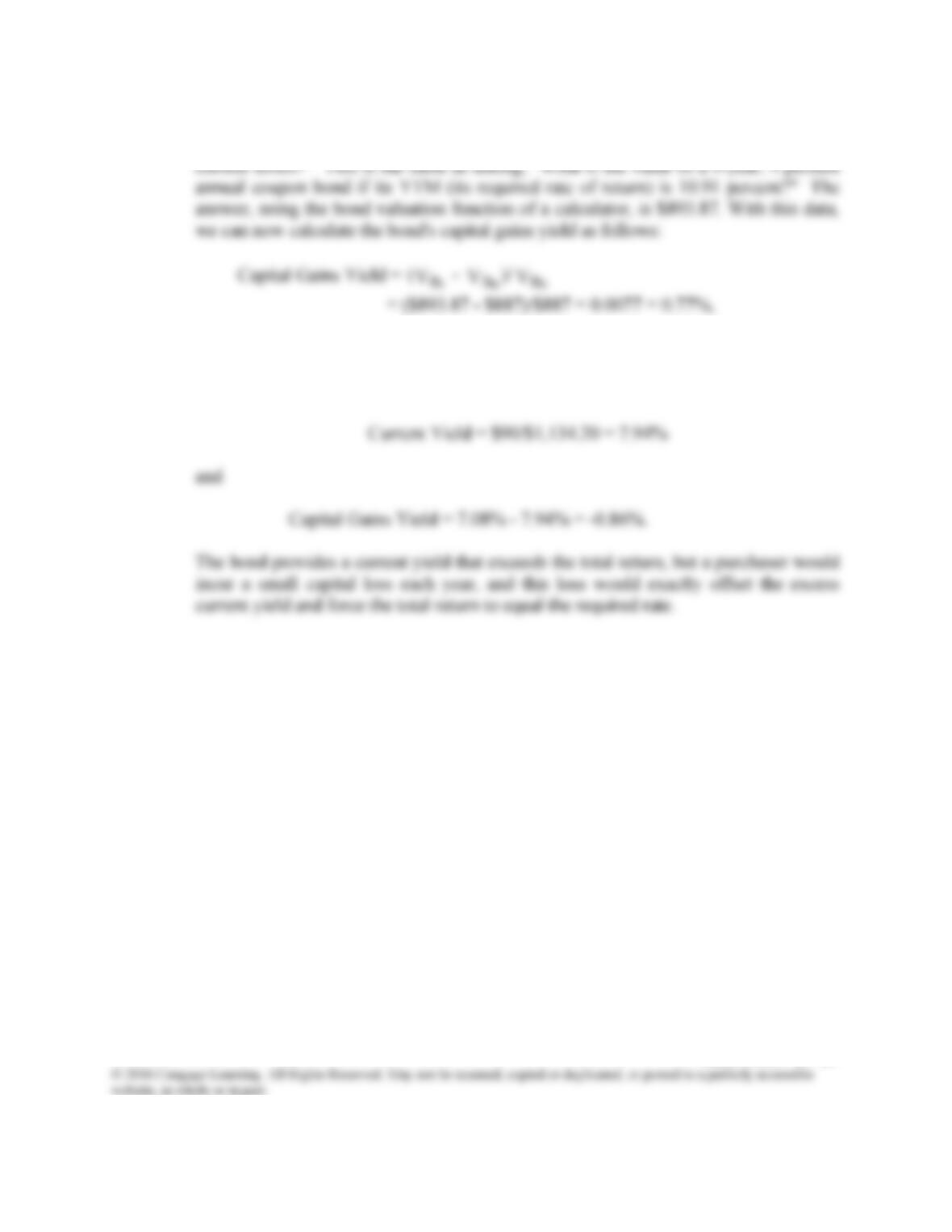
Answer: The current yield is defined as follows:
The total expected return is the sum of the current yield and the expected capital gains
yield:
For our 9% coupon, 10-year bond selling at a price of $887 with a YTM of 10.91%,
the current yield is:
Mini Case: 4 – 29
The capital gains yield calculation can be checked by asking this question: “What is
the expected value of the bond 1 year from now, assuming that interest rates remain at
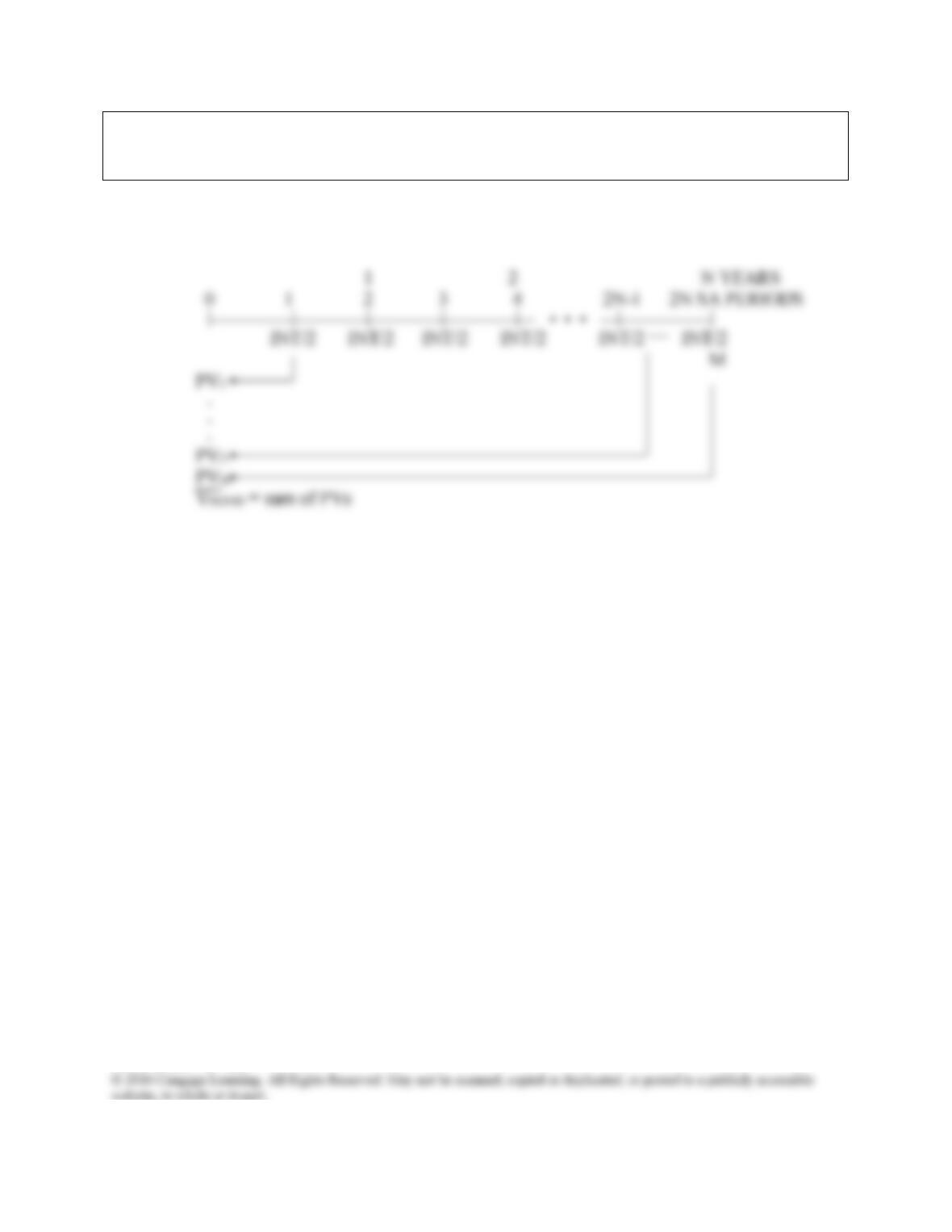
This agrees with our earlier calculation (except for rounding). When the bond is
selling for $1,134.20 and providing a total return of rd = YTM = 7.08%, we have this
situation:
Mini Case: 4 – 30
g. How does the equation for valuing a bond change if semiannual payments are
made? Find the value of a 10-year, semiannual payment, 10 percent coupon
bond if nominal rd = 13%.
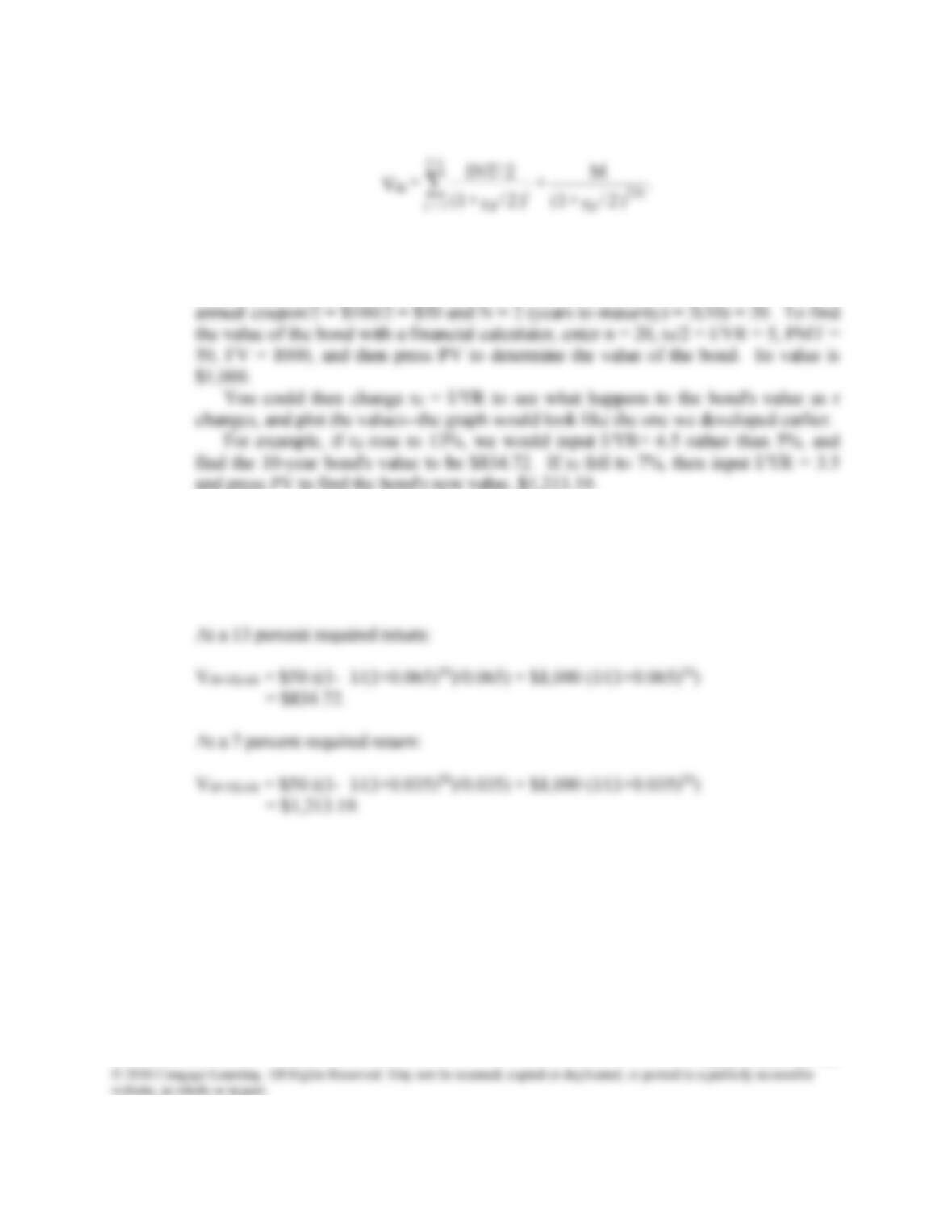
Answer: In reality, virtually all bonds issued in the U.S. have semiannual coupons and are
valued using the setup shown below:
Mini Case: 4 – 31
We would use this equation to find the bond’s value:
The payment stream consists of an annuity of 2N payments plus a lump sum equal to
the maturity value.
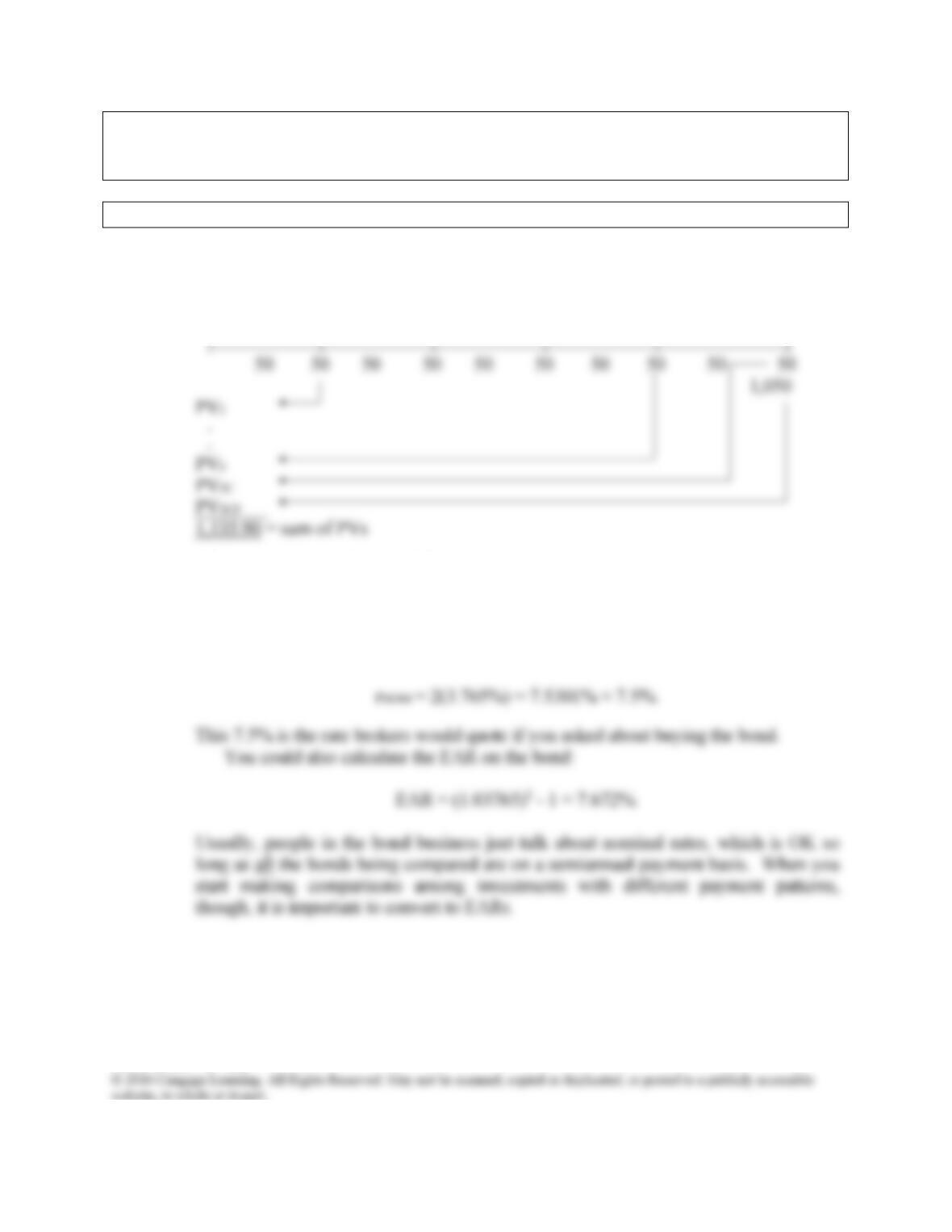
To find the value of the 10-year, semiannual payment bond, semiannual interest =
and press PV to find the bond’s new value, $1,213.19.
We would find the values with a financial calculator, but they could also be found
with formulas. Thus:
V10-YEAR = $50 ((1- 1/(1+0.05)20)/0.065) + $1,000 (1/(1+0.05)20)
= $50(12.4622) + $1,000(0.37689) = $623.11 + $376.89 = $1,000.00.
Mini Case: 4 – 32
h. Suppose a 10-year, 10 percent, semiannual coupon bond with a par value of
$1,000 is currently selling for $1,135.90, producing a nominal yield to maturity
of 8 percent. However, the bond can be called after 5 years for a price of $1,050.
h. 1. What is the bond’s nominal yield to call (YTC)?
Answer: If the bond were called, bondholders would receive $1,050 at the end of year 5. Thus,
the time line would look like this:
0 1 2 3 4 5
The easiest way to find the YTC on this bond is to input values into your calculator:
n = 10; PV = -1135.90; PMT = 50; and FV = 1050, which is the par value plus a call
premium of $50; and then press the rd = I/YR button to find I/YR = 3.765%.
However, this is the 6-month rate, so we would find the nominal rate on the bond as
follows:
Mini Case: 4 – 33
h. 2. If you bought this bond, do you think you would be more likely to earn the YTM
or the YTC? Why?
Answer: Since the coupon rate is 10% versus YTC = rd = 7.53%, it would pay the company to
call the bond, get rid of the obligation to pay $100 per year in interest, and sell
i. Write a general expression for the yield on any debt security (rd) and define
these terms: real risk-free rate of interest (r*), inflation premium (IP), default
risk premium (DRP), liquidity premium (LP), and maturity risk premium
(MRP).
Answer: r
d = r* + IP + DRP + LP + MRP.
r* is the real risk-free interest rate. It is the rate you see on a riskless security if
there were no inflation.