Chapter 30
Pension Plan Management
ANSWERS TO END-OF-CHAPTER QUESTIONS
30-1 a. Under a defined benefit plan, the employer agrees to give retirees a specifically
defined benefits package. The payments could be set in final form as of the
retirement date, or they could be indexed to increase with the cost of living.
d. The cash balance plan is a new type of retirement plan developed in the late 1990s. It
is like a defined benefit plan in some respects and like a defined contribution plan in
others. Cash balance plans work like this: An account is created for each employee.
The company promises to put a specified percentage of the employee’s monthly
salary into the plan, and to pay a specified return on the plan’s assets, often the T–bill
rate.
g. A pension plan is fully funded when the present value of expected retirement benefits
is equal to the fund’s assets on hand. If assets on hand exceed the present value of
expected benefits, then the plan is said to be overfunded. If present value of benefits
exceeds assets, then the fund is underfunded.
h. The actuarial rate of return is the rate of return at which the fund’s assets are assumed
Answers and Solutions: 30 – 1
j. The Pension Benefit Guarantee Corporation (PBGC) is a government run insurance
system created by the ERISA to ensure that employees of companies which go
bankrupt before their plans are fully funded will receive benefits.
k. FASB provides firms with current guidance for reporting pension costs, assets, and
liabilities. For defined contribution plans, FASB rules require the annual contribution
l. Funding strategy for a pension fund involves two decisions: (1) how fast should any
unfunded liability be reduced, and (2) what rate of return should be assumed in the
actuarial calculations?
m. The investment strategy for a pension plan deals with the question: Given the
o. The Jensen alpha is a numerical measure of a portfolio’s performance as compared to
a “market” portfolio, such as the S&P 500. The alpha measures the vertical distance
of a portfolio’s return above or below the Security Market Line. It represents the
extra return (positive or negative) after adjustment for the portfolio’s market risk.
p. Tapping fund assets refers to usage of pension fund assets for a corporation’s own
q. Health care benefits are offered by most companies as part of their retirement
packages, usually until the retirees reach age 65 and become eligible for Medicare.
30-2 Ideally, the employee will choose the plan that provides the incremental cash flows (both
costs and benefits) that maximize the employee’s expected utility of consumption.
30-3 From an employer’s standpoint, the defined benefit plan’s major advantage is promotion
of low employee turnover. The economic consequences of job–changing are not
desirable under a defined benefit plan, since benefits are frozen at the time of separation,
instead of adjusted for inflation over time. Thus, defined benefit plans provide incentive
to stay with the firm for a long period.
30-4 If the returns on these assets are less than perfectly positively correlated with the fund’s
other assets, then the addition of such investments as foreign stocks and precious metals
30-5 a. Defined benefit plans carry with them economic incentive to discriminate against
older workers in hiring, while defined contribution plans and cash balance plans are
neutral in this regard.
d. Pension benefits in a defined benefit plan are usually based on number of years
worked and either the final, or the last several years’ salary. This means that unions
are more likely to work with a firm to ensure its survival, and thus ensure the survival
Answers and Solutions: 30 – 4
SOLUTIONS TO END-OF-CHAPTER PROBLEMS
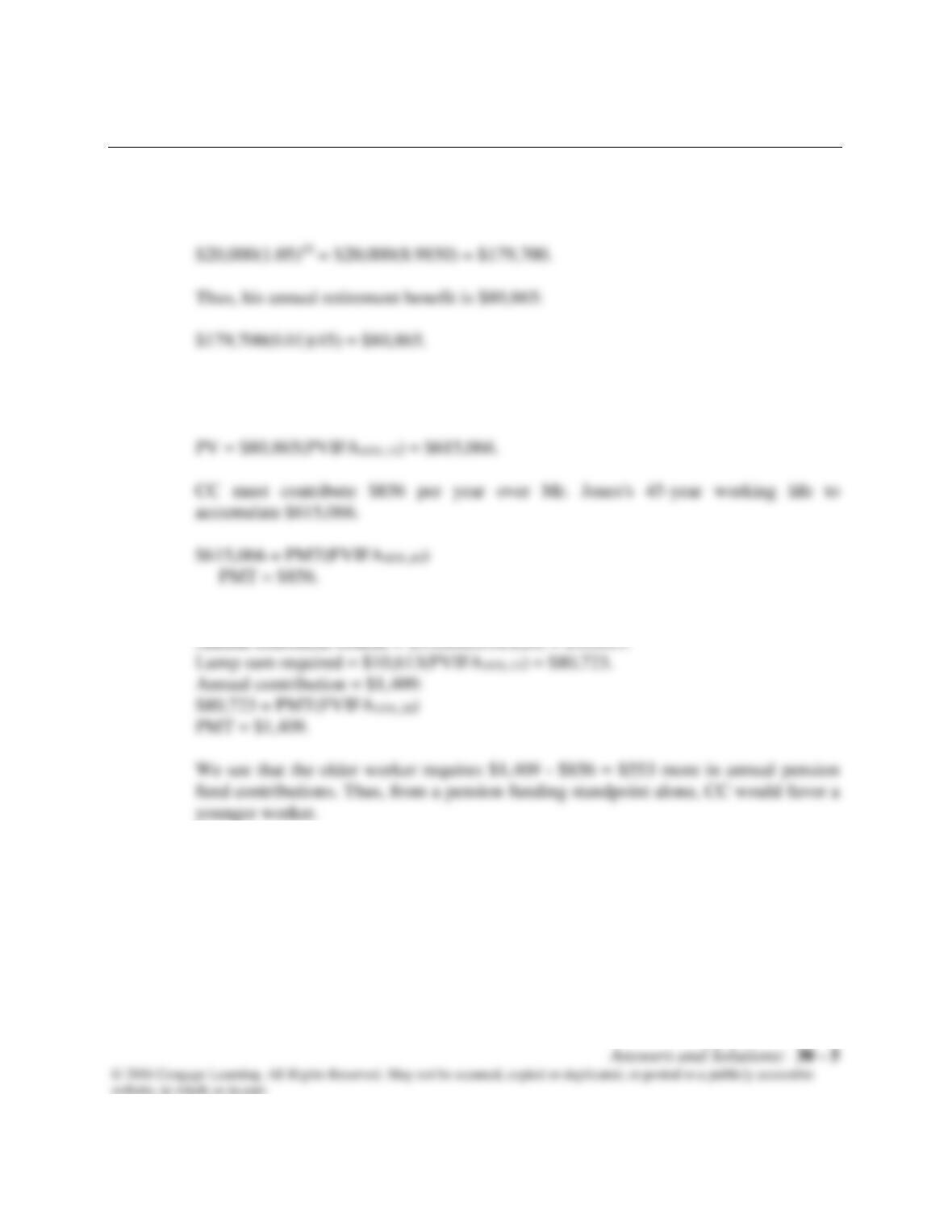
30-1 a. His wage in the final year of working is $179,700:
b. Assuming an actuarial rate of 10 percent, CC must accumulate $615,066 by the time
of Mr. Jones’s retirement:
c. Final year wage = $20,000(1.05)20 = $53,066.
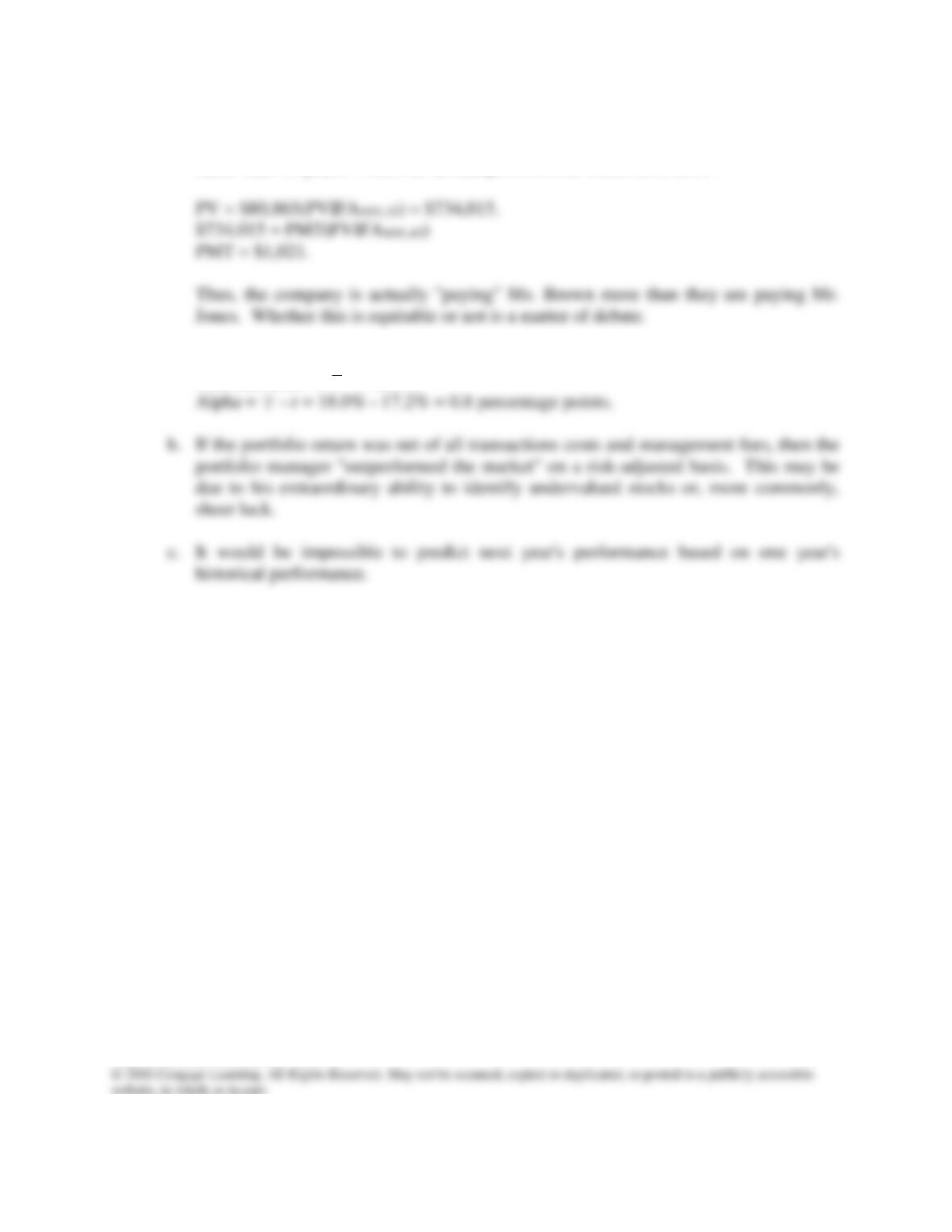
d. Ms. Brown would receive the same retirement benefit as computed for Mr. Jones in
Part a, $80,865 per year. However, Ms. Brown would receive the benefit for 25 years
rather than 15 years. Thus, her annual pension cost would be $1,021:
30-2 a. Required return = r = rRF + (rM – rRF)b = 10% + (6%)1.2 = 17.2%.
Realized return =
r
= 18.0%.
Answers and Solutions: 30 – 6
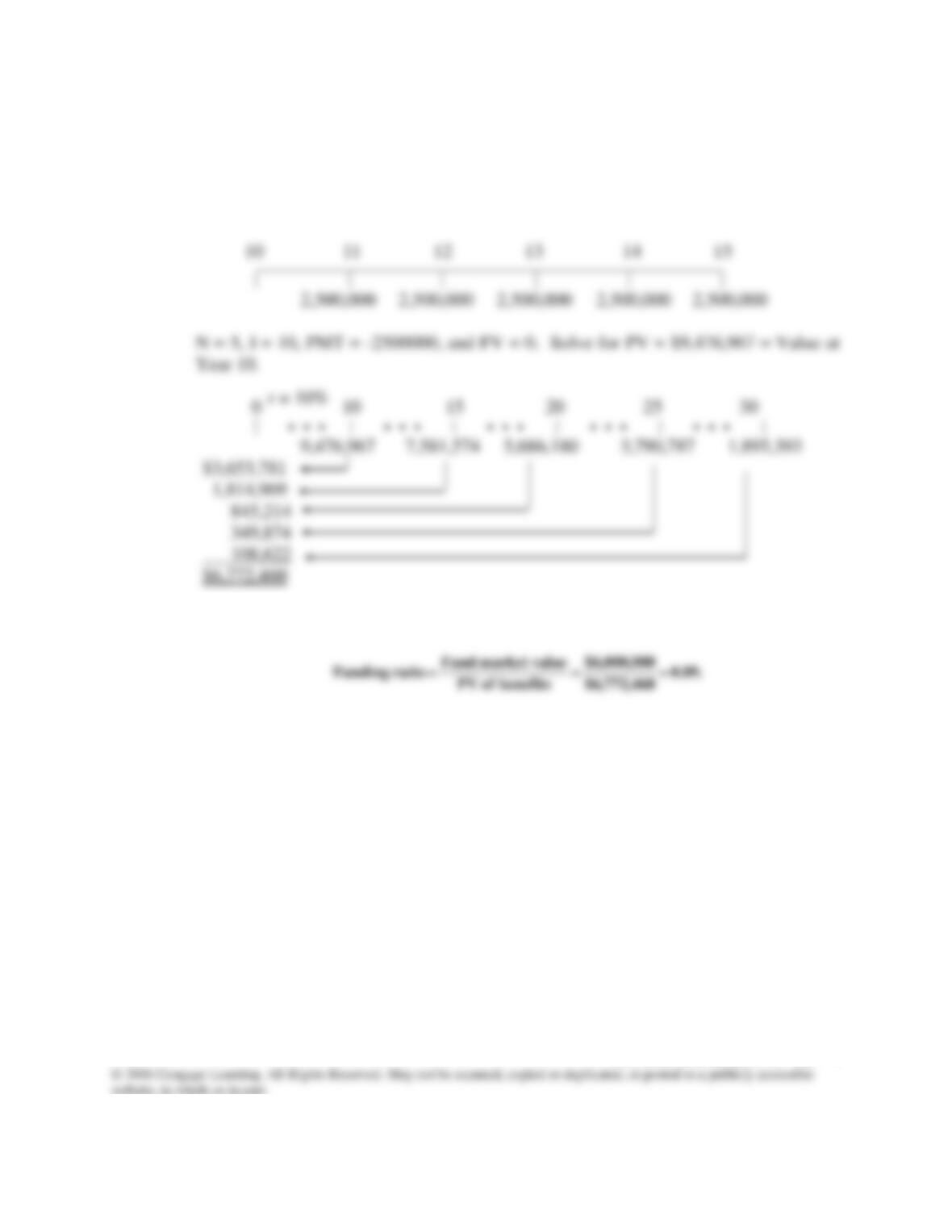
30-3 a. Find the present value (today’s value) of the firm’s obligations.
To simplify calculations, find the value of each 5–year period’s payment as of the
beginning of the period. For example, the value at Time 10 of the payments for Years
11-15 is:
b. Since the assets are less than the PV of benefits, the plan is underfunded.
Answers and Solutions: 30 – 7
MINI CASE
Southeast Tile Distributors Inc. is a building tile wholesaler that originated in Atlanta but
is now considering expansion throughout the region to take advantage of continued strong
population growth. The company has been a “mom and pop” operation supplemented by
part–time workers, so it currently has no corporate retirement plan. However, the firm’s
owner, Andy Johnson, believes that it will be necessary to start a corporate pension plan to
attract the quality employees needed to make the expansion succeed. Andy has asked you,
a recent business school graduate who has just joined the firm, to learn all that you can
about pension funds, and then prepare a briefing paper on the subject. To help you get
started, he sketched out the following questions:
a. How important are pension funds to the U. S. Economy?
Answer: Pension funds constitute the largest class of investors. In 2013, the funds had assets
b. Define the following pension fund terms:
1. Defined benefit plan
2. Defined contribution plan
3. Profit sharing plan
4. Cash balance plan
5. Vesting
6. Portability
7. Fully funded; overfunded; underfunded
8. Actuarial rate of return
9. Employee Retirement Income Security Act (ERISA)
10. Pension Benefit Guarantee Corporation (PBGC)
Answer: 1. Under a defined benefit plan, the employer agrees to give retirees a specific
Mini Case: 30 – 8
3. Under a profit sharing plan, the employer makes payments into the retirement
fund that vary with the level of corporate profits.
4. The cash balance plan is a new type of retirement plan developed in the late
1990s. It is like a defined benefit plan in some respects and like a defined
5. An employee is vested if he or she has the right to receive pension benefits even
if they leave the company prior to retirement. If the employee loses his or her
6. A portable pension plan is one that an employee can carry from one employer to
7. If the present value of expected retirement benefits is equal to plan assets on
hand, the plan is said to be fully funded. If assets exceed the present value of
benefits, then the plan is overfunded, while the plan is underfunded if the present
value of benefits exceeds assets. If the plan is underfunded, an unfunded pension
liability is said to exist.
8. The actuarial rate of return is the rate of return at which the fund‘s assets are
Mini Case: 30 – 9
c. What two organizations provide guidelines for reporting pension fund activities
to stockholders? Describe briefly how pension fund data are reported in a firm‘s
financial statements. (hint: consider both defined contribution and defined
benefit plans.)
Answer: The Financial Accounting Standards Board (FASB), together with the SEC,
establishes the rules under which a firm reports its financial results, including its
d. Assume that an employee joins the firm at age 25, works for 40 years to age 65,
and then retires. The employee lives another 15 years, to age 80, and during
retirement draws a pension of $20,000 at the end of each year. How much must
the firm contribute annually (at year–end) over the employee’s working life to
fully fund the plan by retirement age if the plan’s actuarial expected rate of
return is 10% and its assumed interest rate for discounting pension benefits also
is 10%? Draw a graph which shows the value of the employee’s pension fund
over time. Why is real–world pension fund management much more complex
than indicated in this illustration?
Answer: The employee will draw an annual pension (an annuity) of $20,000 for 15 years.
Thus, the firm must accumulate $152,121.59 in the pension plan by the time the
employee retires to fully fund the retirement:
Mini Case: 30 – 10
A graph of the employee’s pension fund assets looks like this:
e. Discuss the risks to both the plan sponsor and plan beneficiaries under the four
types of pension plans.
Answer: The defined benefit plan places most of the risks on the company, because it
guarantees to pay a more or less fixed retirement benefit regardless of its ability to
f. How does the type of pension plan influence decisions in each of the following
areas:
1. The possibility of age discrimination in hiring?
of Dollars
Thousands
160
180
of Dollars
Thousands
160
180
Mini Case: 30 – 11
Answer: Defined benefit plans are more costly to firms when older workers are hired as
f. 2. The possibility of sex discrimination in hiring?
f. 3. Employee training costs?
f. 4. The militancy of unions when a company faces financial adversity?
Answer: Since defined benefit plan benefits are usually tied to the number of years worked and
g. What are the two components of a plan’s funding strategy? What is the primary
goal of a plan’s investment strategy?
Answer: The two components of a plan’s funding strategy are:
h. How can a corporate financial manager judge the performance of pension plan
managers?
Answer: Pension plan managers can be judged in several ways. One way is to compare the
Mini Case: 30 – 12
i. What is meant by “tapping” pension fund assets? Why is this action so
controversial?
Answer: Pension fund assets are tapped when a company terminates an overfunded defined
benefit plan, uses a portion of the funds to purchase annuities which provide the
j. What has happened to the cost of retiree health benefits over the last decade?
How are retiree health benefits reported to shareholders?
Answer: Because of the increased number of retirees, and the dramatic escalation in health
care costs over the past 10 years, many companies are facing situations where retiree
Mini Case: 30 – 13