Chapter 3 – Valuation
Slide 8
Slide 8 displays Exhibits 3-1 and 3-2, the summary tables showing the four
valuation components in the Morgan Stanley team’s valuation target for eBay’s stock.
Instructors might point out that in April 2003, she applied the three valuation heuristics
Slide 8 also displays the computations used for the base cases associated with the
three heuristics. The top panel of slide 6 describes the key input assumptions for EPS,
gross merchandise sales (GMS), and Meeker’s forecasted trajectory for P/E. Instructors
The bottom panel of Exhibit 3-2 shows the terms that when multiplied together
using the heuristic equations produce the target valuations associated with the three
Chapter 3 – Valuation
Slide 9
Slide 9 displays Exhibit 3-3, showing the assumptions that underlie the Morgan
Stanley team’s DCF-based target valuation of eBay’s stock. Instructors can begin by
pointing out that Meeker discounts what she calls eBay’s free cash flows (FCFs),
According to the Morgan Stanley team, and as shown in Exhibit 3-3, the value of
the FCF stream is about $36.5 billion. This value is obtained by discounting the
forecasted FCF value for 2004 through 2010, and adding the terminal value, that being
the present value of the constant growth perpetuity associated with the period after 2010.
Instructors might explain that if eBay were an all-equity financed firm, then the
intrinsic value of its stock would be the present value of its future free cash flows.
The Morgan Stanley team makes a further modification, adding eBay’s cash to
end up with what they call eBay’s full value. This series of computations produces the
Chapter 3 – Valuation
©2018 McGraw-Hill Education. All rights reserved. Authorized only for instructor use in the
classroom. No reproduction or further distribution permitted without the prior written consent of
McGraw-Hill Education.
14
team’s DCF-based intrinsic value of eBay’s equity, which when divided by the number of
outstanding eBay shares results in an intrinsic value per share of $117.
Slide 7
Slide 7 presents some general conclusions about bias. The first bullet point in the
2003. The first term in this computation would be the present value of the FCF for
2005E, $1,012,819 divided by 1.12. The resulting present value for year-end 2004 is
about $40 billion.
For the purpose of exposition, treat free cash flows as dividends. In this case, the
expected capital gain from 2003 to 2004 would be 9.7 percent (= (40 – 36.5)/36.5), and
Doing so suggests that the target values associated with P/E and PEG are well below 12
percent, if not negative. Likewise, the target values associated with price-to-sales and
FCF are well above 12 percent. That suggests that each one of the four components
features bias.
Chapter 3 – Valuation
Slide 11
Slide 11 makes the point that the assumptions underlying the forecasts of future
cash flows might feature excessive optimism. The slide summarizes a critique in The
Wall Street Journal about the assumptions underlying analysts’ forecasts of eBay’s
revenue stream. The article notes that Mary Meeker was the most optimistic of analysts
Slide 12
Slide 12 discusses growth opportunities bias and the associated g/k condition. The
Morgan Stanley team’s assumptions are that earnings will grow above 30 percent,
tapering down to 7 percent after 2010 when eBay’s growth opportunities vanish.
Chapter 3 – Valuation
students whether this implies that the target valuations associated with the Morgan
Stanley team’s three heuristics and FCF computation are all upwardly biased relative to
fair value?
Slide 13
Slide 13 points out why linking P/E to growth can lead to errors. Instructors can
ask students if they recall how financial managers at eBay relied on PEG to assess the
value of their firm’s stock. The key point of the slide is that a firm’s P/E ratio can be
Slide 14
Slide 14 makes the point that growth opportunities are not equivalent to earnings
growth. Although eBay achieved high earnings growth, between its IPO date and June
2004, its ROE was less than its required return of 12 percent. Instructors might ask
Chapter 3 – Valuation
Slide 15
Slide 15 introduces the 1/n heuristic. This heuristic treats all choices equally,
without discrimination. In respect to valuation, Mary Meeker gave the same weight to her
PEG-based valuation as her DCF-based valuation. In averaging the 4 components using
the 1/n heuristic, where n=4, the Morgan Stanley team speaks of the resulting target price
Slide 25
At the bottom of the first page of the Morgan Stanley team’s report there appears
a statement, encased within a black border, stating that their firm does business with
companies that its analysts follow. These relationships can give rise to agency conflicts,
as managers of companies prefer favorable coverage from analysts to unfavorable
coverage. Analysts whose firms seek to do business with companies have an incentive to
generate favorable (meaning optimistic) reports.
Chapter 3 – Valuation
Additional Resources for Chapter 3 Available on the Web
On the book web site, instructors will find additional resources that relate to
Chapter 3. This material is intended for instructors who wish to delve into the main
concepts in greater depth than the level provided in Chapter 3 itself.
The material in the additional resources addresses the following three issues:
2. growth opportunities bias;
Suggested Answer to Minicase Questions
1. On the basis of the data presented in the case, use the textbook techniques to compute
the fundamental value of Palm on February 23, 2001. Clearly state all of your valuation
assumptions, as you will have to make some assumptions.
©2018 McGraw-Hill Education. All rights reserved. Authorized only for instructor use in the
classroom. No reproduction or further distribution permitted without the prior written consent of
McGraw-Hill Education.
19
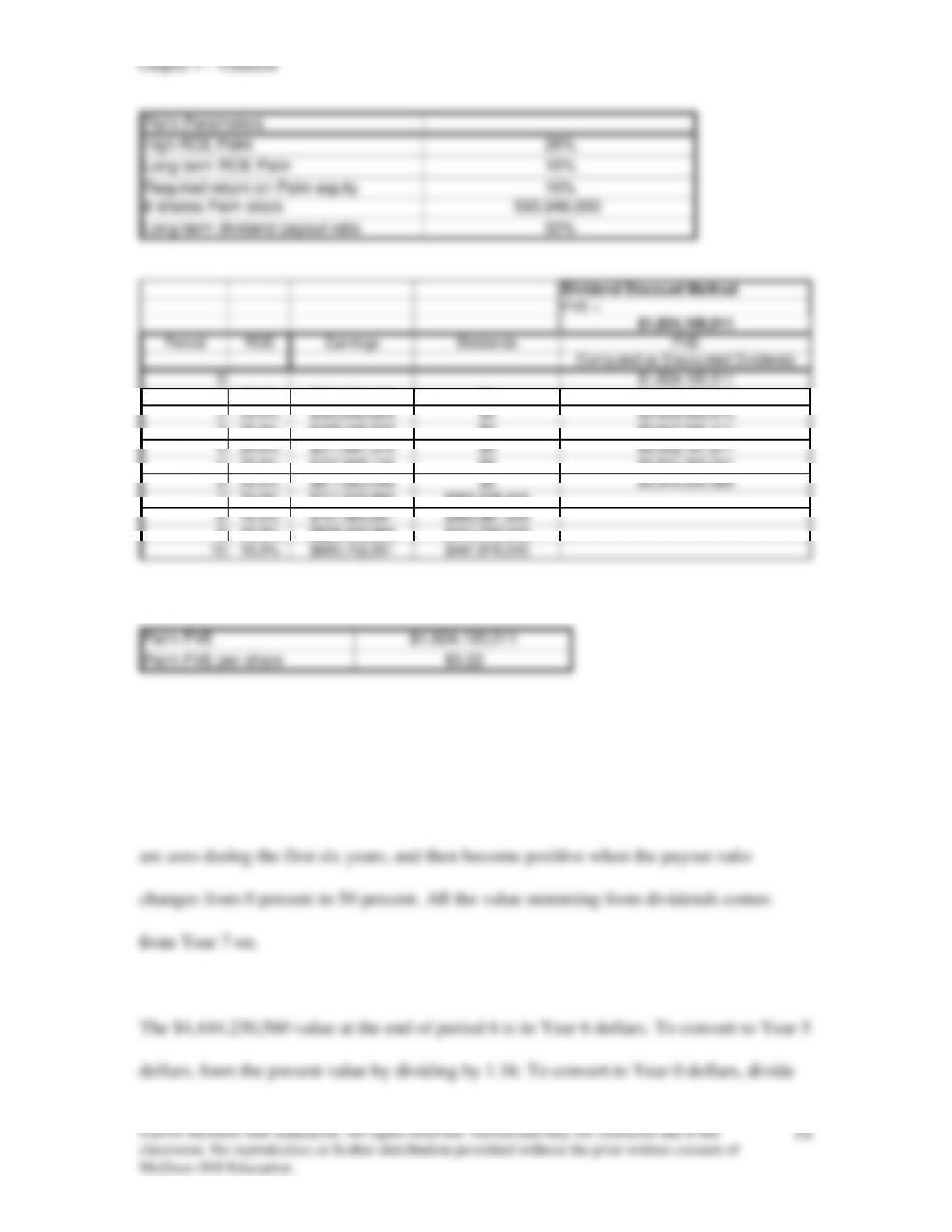
The computation above shows that earnings are 26 percent of prior year book value of
equity for six years out, and then fall to 16 percent of prior year book value. Dividends
dollars, form the present value by dividing by 1.16. To convert to Year 0 dollars, divide