
ANSWERS TO CHAPTER QUESTIONS
Chapter 3 Beginning the Planning Process
1) Behavioral finance is the study of how people actually perform in financial matters.
2) Quantitative finance typically expresses how people’s decision-making should occur.
3) Young people as a generalization are investment risk takers; they may not save much
money; they have little interest in risk management; they place a high priority on
living for today and will borrow significant sums to achieve their goals. They have
4) Nonverbal communication is the way you transmit messages to others through your
5) Listening allows you to hear and focus on what your clients believe is important
6) Four techniques that are helpful in becoming a good listener include:
a) Make eye contact
7) Ways to establish trust may include:
a) Having experience in the topic being discussed
8) Preplanning sets the stage for what is going to be discussed. It facilitates a smooth
9) Some attractive interviewing techniques include:
a) Placing the interviewee at ease before commencing with questions
b) Starting with a simple question
10) Financial counselors provide information and opinions; the decisions are made by the
11) By understanding the reason for the resistance and attempting to persuade the person
by presenting the merits of the advice. It is helpful if the discussion of the merits
13) Some common goals are:
a) To fund a comfortable retirement
b) To get out of debt
c) To raise investment returns
d) To cover insurable risk
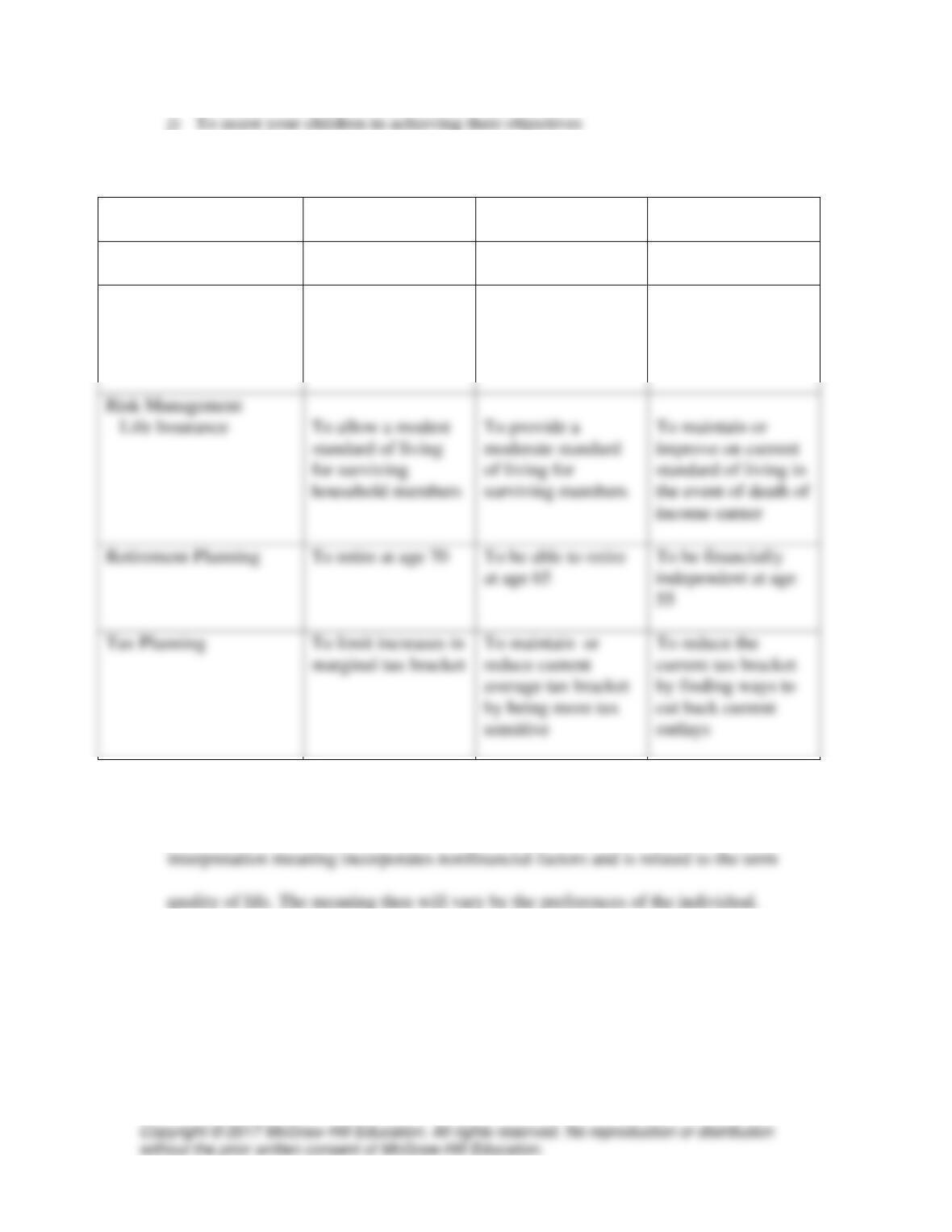
14)
Part of Financial Plan
Minimum
Satisfactory
Higher Level
Financial Investments
6% return
8% return
10% return
Non Financial
Investments
Real Estate
To own an
apartment
To own a home
income earner
55
sensitive
outlays
To have both a
primary and a
vacation home
15) Standard of living can mean the amount of money you live on. A broader
16) Financial views of financial planning place all decisions in a money framework.
Personal views recognize the importance of money measurement but extend beyond it
to broader objectives with money as a support for achieving these goals.

17) People have both short term and long term goals. However, since financial planning
18) Maslow presents a type of stepping stone of needs with financial factors supporting
the progression. The needs extend from food clothing and shelter to the ultimate
level, self-actualization.
19) Data gathering is developing the information needed to perform financial planning.
20) Data gathering provides the information from which analysis and decisions are made.
21) The six financial planning areas, and the data needed for each are as follows:
a) Cash Flow:
i) Bank Statement
ii) Credit card information

d) Risk Management:
i) Amount of life insurance
ii) Disability coverage
e) Retirement:
22) The initial interview can present broad brush information to allow the advisor to
begin to understand the goals and needs of the client. For example, the advisor may
want to determine preliminary asset and cash flow information and how financially
sophisticated the client is. Thereafter hard data and extensive analysis will refine that
preliminary assessment.
23) They can be more singularly focused than other types.
24) Feeling sympathetic for a client is being aware of their situation, showing
compassion, and feeling sorry for them. Empathy is the ability to understand a

25) There is no financial equivalent of Maslow’s Hierarchy of Needs since he covers non-
financial goals as well. The basics, his first goal, is just financial, the cost of basic
26) Constructing a segmented financial plan can be useful in giving the client a succinct
overall picture and plan of action. It can take a lot of time to develop a full plan so
this type of plan is especially useful in the beginning stages of planning.
27) It is important in these situations to state your opinions clearly and help them to
understand your reasoning without coming across as passing judgement. It can be a

ANSWERS TO CASE APPLICATION QUESTIONS
Chapter 3 Beginning the Planning Process
1) It is clear that Brad and Barbara have different views about when to start a family. An
outline of the questions that will be asked should be prepared. A note should be made
2) The interview should open with some small talk to relax the people and to establish
rapport.
3) The interview would ask such open-ended questions as:
a) Describe your upbringing.
4) What are your financial goals? What are your non financial goals? What does money
mean to you? Are there any goals that you differ that could present interpersonal or
financial difficulties?
5) Goals are relative to the person. As long as they are realistic, there are generally no

6) Financial planners differ in whether they serve as counselor or advisor. Many offer a
7) The interview process would be different if the couple hadn’t yet made up their mind
on going forward. Assuming that it is true, it would include facts that would
8) When the advisor does most of the talking it can prevent a relationship from forming.
It can also indicate that the nonparticipation of the client suggests non-engagement
9) The meeting could be ended with a summary of what went on, the next steps to be
taken and a date for which the next meeting will take place.
11) The hard information would have to do with forming an early idea of their cash flow
and the level of assets at hand. You would look at their tax return and investigate
whether there was debt outstanding. It is a good idea to identify their tolerance for

risk. In general for a couple as young as they are, the first meeting might not be as
involved as say the same meeting for their parents.