67
Chapter 3 The Time Value of Money
Chapter Overview
The Opening Focus brings home the importance of time value of money concepts. It discusses the
2009 budget deficit that Chicago Mayor Richard Daly faced and how he used the time value of
money to try earn money for Chicago. He leased the city’s 36,000 parking meters to an investment
group. To receive the revenues for the meters – the investment group paid $1.2 billion and would
receive the revenues generated for 75 years. The investment group was even allowed to increase
the fees for the parking meters. Who really benefitted the most from this deal? The investment
group or the City of Chicago? A time value of money analysis can help determine this.
1. How would the increase in revenues impact your choice of a lump sum payment up front or
the choice of revenue payments for 75 years? What fee would change this decision? What if
the amount the 1.2 could be invested went down? Went up?
2. What are other real world examples of where present value calculations would be useful?
3-2 Future Value of a Lump Sum
3-4 Additional Applications Involving Lump Sums
3-6 Present Value of Cash Flow Streams
1. Smart Concepts explains finding the value of a growing perpetuity step by step.
2. Smart Solutions provides a step-by-step solution to Problem 3-27, a future value, annuity
problem and to Problem 3-46, a present value annuity problem.
Lecture Guide
Chapter 3 introduces students to time value of money tools including present value, future value,
annuities, uneven cash flows, loan amortizations and the differences between effective and nominal
interest rates.
• This chapter provides an opportunity to make mathematical use of the opening story.
When the class is covering annuities, you can use the information in the story to calcu-
68 Instructor’s Manual
late the breakeven discount rate – at what discount rate you would be better off taking
the lump sum vs. the annuity.
o In this case, with the limited amount of information you will have to plug in
some practice variables to see if the city made a wise decision. For example, Y
= 75; PMT = (3* 39000); FV = 0; PV = ?
3.1 Introduction to the Time Value of Money
3-2 Future Value of a Lump Sum –
In order to calculate future value, you need to know how much interest the money will
earn, how long it will be earning interest and whether the money will be compounded annually or
at an interval other than annually.
3-2 a Future Value of $100 (4 years, 5% interest)
Note that in the first year, you are simply multiplying $100 x 5% interest = $5. The value of $100
$110.25. This is because you have earned interest on the first year’s interest of $5. So,
the value in the second year is $100 in principal plus $5 in simple interest plus $5 x 5%
= $0.25, the compounded interest. This is just a small difference (25 cents) in year 2,
but it grows larger each year. In year 3, the simple interest is $5 x 3 = $15.. Total in-
terest is $115.76 – $100 = $15.76. Compounded interest is $15.76 – $15.00 = .76. The
interest as a result of compounding hasn’t just doubled the first year’s 25 cents = it has
more than tripled to $.76. The relationship between interest rate and future value is not
a simple linear relationship – it is an exponential relationship. This slide shows that
time matters in the future value relationship. What about the interest rate?
3-2b The Equation for Future Value
Equation 3.1 : FV = PV x (1 + r) n
• This slide breaks down the simple interest received in the previous example. And
makes some key points:
• Note that future value interest factors are always greater than 1 – a dollar today earns
interest, and is worth more in the future because of the compounded interest it receives.
• The greater the interest rate, the greater the future value factor will be, and thus the
larger the future value. This is because each dollar earns more interest and more inter-
est on the interest received.
• The greater the time period, the larger the future value factor and the larger the future
value. This is because the longer you can allow money to accumulate interest, the
greater the future value will be.
Albert Einstein once said the most important mathematical invention of the time was com-
pound interest. This slide illustrates the exponential relationship between future value and time and
interest rate.
• Student Involvement: Ask students which line they would like to represent their retirement
savings plan.
o Most students will choose the 20% interest rate line in which $1 has grown to al-
most $40 in 20 years.
• Ask them what kind of investments they would need to make to earn 20% on their money.
What is a more realistic return for a retirement portfolio? This is an opportunity to begin to
3-3 Present Value of a Lump Sum Received in the Future
3-3a The Concept of Present Value
• Note that by algebraically rearranging the future value equation,, you have the present val-
3-3b The Equation for Present Value
• The present value or discounting factor is 1/(1+r)n.
• Note that present value factors are always less than 1. Present value is always
$228.98 received 2 years from now is 228.98/(1.07)2 = $200. Another way of looking at present is
noting that you need to start with less today if you have more time to earn interest. For example,
$174.69 today. You need less money to start with to achieve the same goal of having $200 because
you now have two years to earn interest. The further out in the future that you are to receive the
money, the less it is worth today.
The Power of High Discount Rates
3-4 Additional Applications Involving Lump Sums
You can also use the present value and future value formulas to find other variables such as
3-5 Future Value of Cash Flow Streams
Note that this is a tools chapter. This provides the necessary mathematical formulas that can be
used to solve a variety of finance problems. The students’ calculator is their friend. Point out that
2. Failing to clear previous work from the calculator
4. Put the wrong positive or negative sign on cash flows. It is important to mark outflows with a
negative sign and inflows with a positive sign.
5. Note also that some financial calculators require you to input a 0 for a time value of money
variable (PV, FV, PMT, I, N) not being used in the problem. If you have three variables you
can solve for the fourth. Some problems are both annuities and lump sums and use all five
3-5a Finding the Future Value of a Mixed Stream
The future value of any stream of cash flows at the end of a specified year is merely
the sum of the future values of the individual cash flows at the years end. We often call this
value the terminal value.
Frequently a problem may call for the discounting or compounding of a series of uneven cash
using the present value and future value of $1 tables and it can be solved using the NPV function
on a financial calculator. On the TI BAII+, for example, a student would input:
CF0 = −10,000
C01 = 3,000
F01 = 1
I = 4
CPT
The calculator then provides the present value of $5,271.7
Most calculators do not have a NFV function. A student must calculate each future value individu-
ally, as is illustrated in the slide, or the student can calculate present value using a calculator, and
then multiplying present value by 1 plus the discount rate raised to the nth power:
3-5c Future Value of Ordinary Annuity
• The instructor can solve this problem using several methods. The formula for the future
5811.5
055.0
r
=
=
5.6371. Note that 5.5811 is about halfway between the 5% factor and the 6% factor.
I = 5.5
N = 5
PV = 0
Solve for FV, $5,581.09
Chapter 3 The Time Value of Money 73
3-5d Future Value of Annuity Due,
Students should distinguish between ordinary annuities and annuities due. Using formulas, the
3-6a Present Value of a Mixed Stream
3-6b Present value of Ordinary Annuity (5 years, 5.5% interest) example:
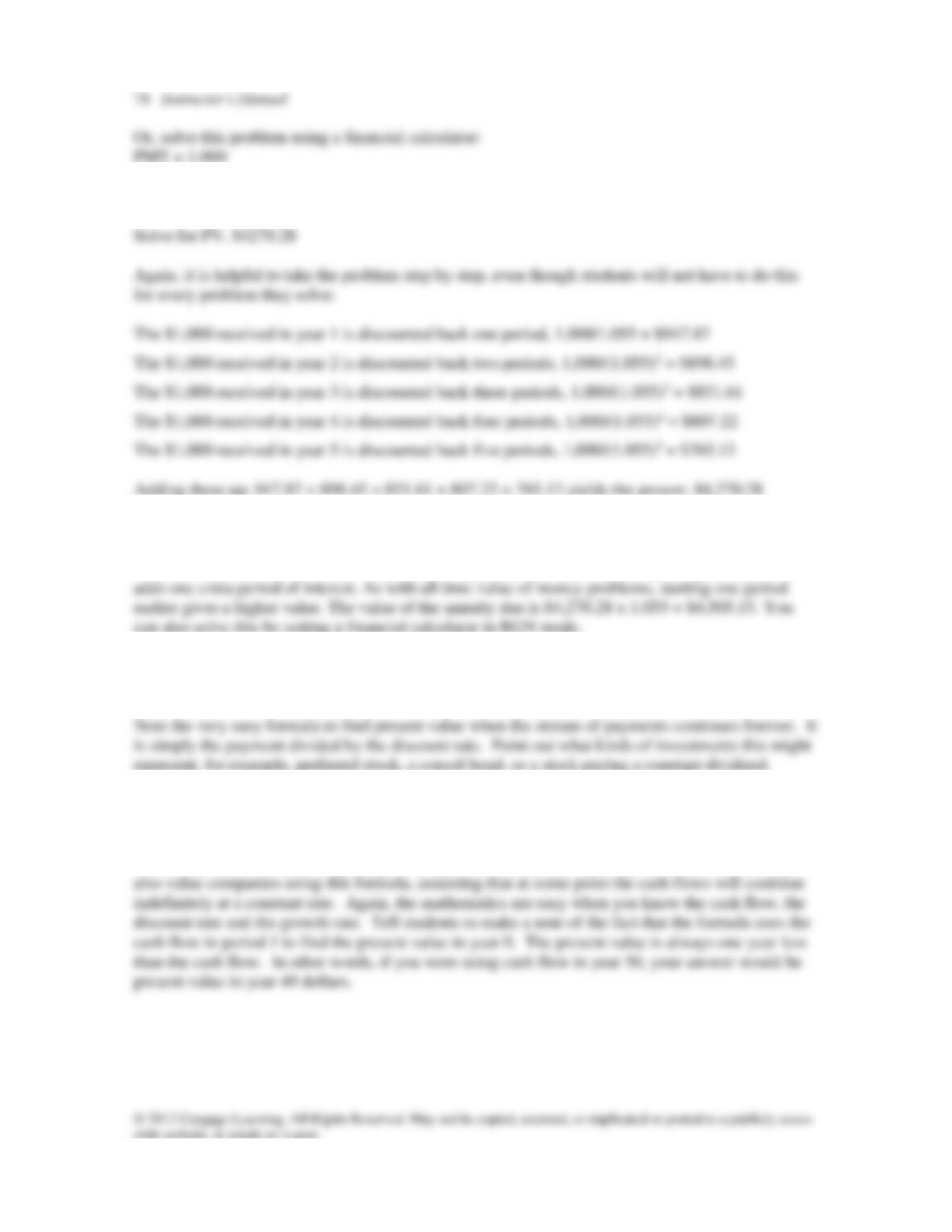
Like the future value of an annuity problem, this problem can be solved in several ways. The for-
mula for the present value of $1 received each year for n years is:
I = 5.5%
N = 5
FV = 0
3-6c Present Value of Annuity Due–
As with the future value of an annuity due, having payments made at the beginning of the period
3-6d Finding the Present Value of a Perpetuity
3-6e Finding the Present Value of a Growing Perpetuity
This is a formula more likely to be used than the non-growing perpetuity formula. In later chapters
we will assume that dividend-paying stocks grow their dividend by a constant amount. We may
Chapter 3 The Time Value of Money 75
3-7 Advanced Applications of Time Value
3-7a Compounding More Frequently than Annually
• It is frequently important to know how to compound or discount for a period other than one
year. For example, bonds make semi-annual payments, car payments and home mortgages
are made monthly, and interest on your bank account may be compounded daily or even
continuously. If the compounding period is more frequent than one year, then interest is
3-7b The Stated Rate versus the Effective Rate
• Note that r in the formula is the non-compounded rate, or annual percentage rate. This is
the rate quoted in newspapers and by lenders as “the interest rate.” The EAR, or effective
rate, or compounded rate is what you are actually paying (or receiving) in annual interest.
3-7c Calculating Deposits Needed to Accumulate a Future Sum
• A very practical need for TVM problems is the need to determine the annual deposits nec-
76 Instructor’s Manual
3-7d Loan Amortization
• Loan amortization refers to the process in which a borrower makes equal periodic pay-
ments over time to fully repay a loan. This is often used in banking and credit industries.
Chapter Summary:
• This chapter relates to one of the basic decisions a manager must make. Managers invest
their firm’s money in assets. They want to know what is the value today of the cash flows
to be received in the future.
• Ask students which choice they would make – would they prefer $1,000 today or
$1,500 today. This choice is easy; everyone would choose the higher sum of money.
• Ask one student if he/she would like all the money in their wallet, or all the money in
their wallet plus $10, no strings attached. Everyone will say they prefer more money.
Ask another student the same question, and you’ll get the same answer. The students
have just demonstrated the economic principle that more is preferred to less. Ask stu-
dents for an example in the real world when they would not desire more of a desirable
thing. Many will give answers such as chocolate, ice cream, food when you’ve already
and lenders with an interest rate determined by supply and demand for money.
Enrichment Exercises
1. Show students a transparency of a quote from Stewart Myers, “The opportunity cost of capital
depends on the use of funds, not on the source.” Ask students the meaning of this quote. Fi-
Chapter 3 The Time Value of Money 77
2. Ask student to prove whether time travel is possible. The existence of an interest rate shows
that time travel cannot exist. Suppose a time traveler puts $1,000 into a savings account earn-
http://clem.mscd.edu/~mayest/calculators/calculator_tutorials.index.htm.
4. Another source, as an instructor or student reference, is Womack, Kent L. and Andrew
6. Have the students visit Yahoo Finance/ Personal Finance/ Calculators and see how much they
Answers to Concept Review Questions
1. Assuming a positive interest rate (i.e. r > 0), then $1 in the future is always worth less than $1
2. If the interest rate ( “r” ) equals zero, then future value (FV) and present value (PV) are equal
in value. Notice, PV × (1 + r) = FV, setting “r” to zero makes PV = FV.
3. Compounded interest returns more than simple interest over multiple periods because you
earn interest on the interest, so usually a deposit made into an account paying compounding
4. A decrease in the interest rate would lower future value, while an increase in the holding peri-
od will increase future value. Decreasing the interest rate decreases the future value factor and
5. Present values and future values of a lump sum are related because the future value of an
amount of money is equal to its present value times one plus the interest rate raised to the nth
78 Instructor’s Manual
6. An increase in the discount rate will decrease the present value factor and hence the present
value: A higher interest rate means you would have to set less aside today to earn a specified
7. Allowing annual interest of 4% to accrue over 28.6 years results in a value over $3,000
($1,000(1 + 4%)28.6 = $3,070.11. Consequently, it takes less than 28.6 years to triple the value
8. An ordinary annuity generates payments at the end of each period. Annuities due, on the other
9. An ordinary annuity can easily be converted into an annuity due by multiplying the ordinary
10. The future value of a mixed stream of cash flows would be calculated by taking each individ-
ual cash flow, and then compounding it, using future value factors or the future value formula
12. A perpetuity does pay an infinite amount of cash, however, distant future cash flows have a
present value of zero making the value of a perpetuity a non-infinite value.
13. The value of a growing perpetuity is the cash flow in period 1 divided by: the interest rate mi-
nus the growth rate. In this case, the growth rate would be negative.
Chapter 3 The Time Value of Money 79
15. The total amount paid by the borrower (i.e. interest and principle) will be less with weekly
Answers to Self-Test Problems
ST3-1. Starratt Alexander is currently considering investing specified amounts in each of four in-
vestment opportunities described below. For each opportunity, determine the amount of
money Starratt will have at the end of the given investment horizon.
Investment A: Invest a lump sum of $2,750 today in an account that pays 6% annual in-
terest and leave the funds on deposit for exactly 15 years.
that pays 10% annual interest, and determine the account balance at the end of year 10.
Investment D: Make the same investment as in investment C but place the $1,200 in the
account at the beginning of each year.
A: Investment A: This problem asks you to calculate the future value of a lump sum. It is a
straightforward application of Equation 3.1 as follows: FV = $2,750 X (1 + 0.06)15 =
$6,590.53. In Excel, you could obtain the same value by entering, =fv(0.06,15,0,-2750,0).
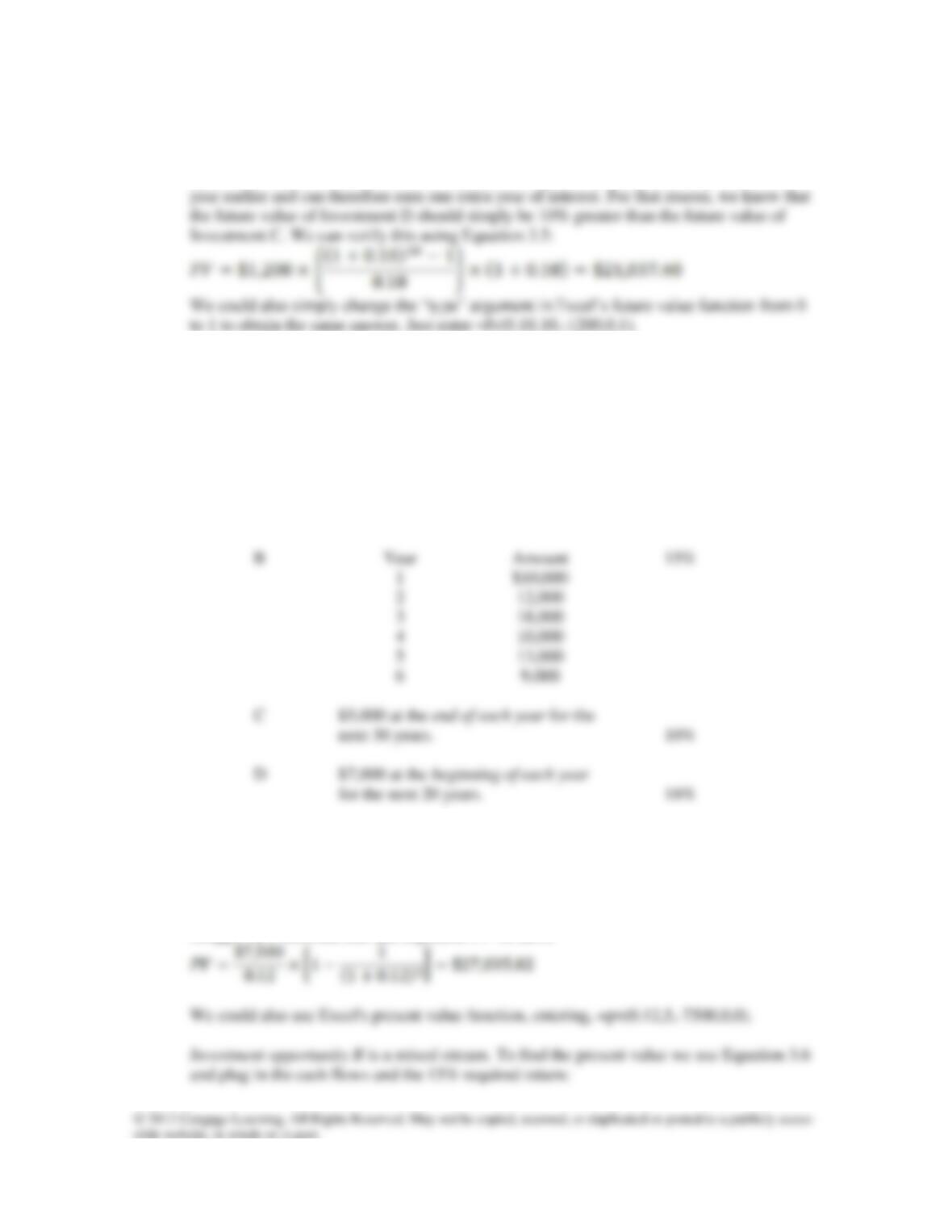
Investment B: In this problem you are trying to find the future value of a mixed stream,
Investment C: This is an ordinary 10-year annuity with $1,200 annual payments. Given
the 10% interest rate, we can apply Equation 3.4 to find the future value:
80 Instructor’s Manual
Investment D: Investment D is identical to Investment C, except that the former is an
annuity due while the latter is an ordinary annuity. In other words, the cash flows
associated with Investment D are the same as Investment C, except that they arrive one
ST3-2. Gregg Snead has been offered four investment opportunities, all equally priced at $45,000.
Because the opportunities differ in risk, Gregg’s required returns (i.e., applicable discount
rates) are not the same for each opportunity. The cash flows and required returns for each
opportunity are summarized below.
Opportunity
Cash Flows
Required Return
A
$7,500 at of 5 years.
12%
B
15%
a. Find the present value of each of the four investment opportunities.
b. Which, if any, opportunities are acceptable?
c. Which opportunity should Gregg take?
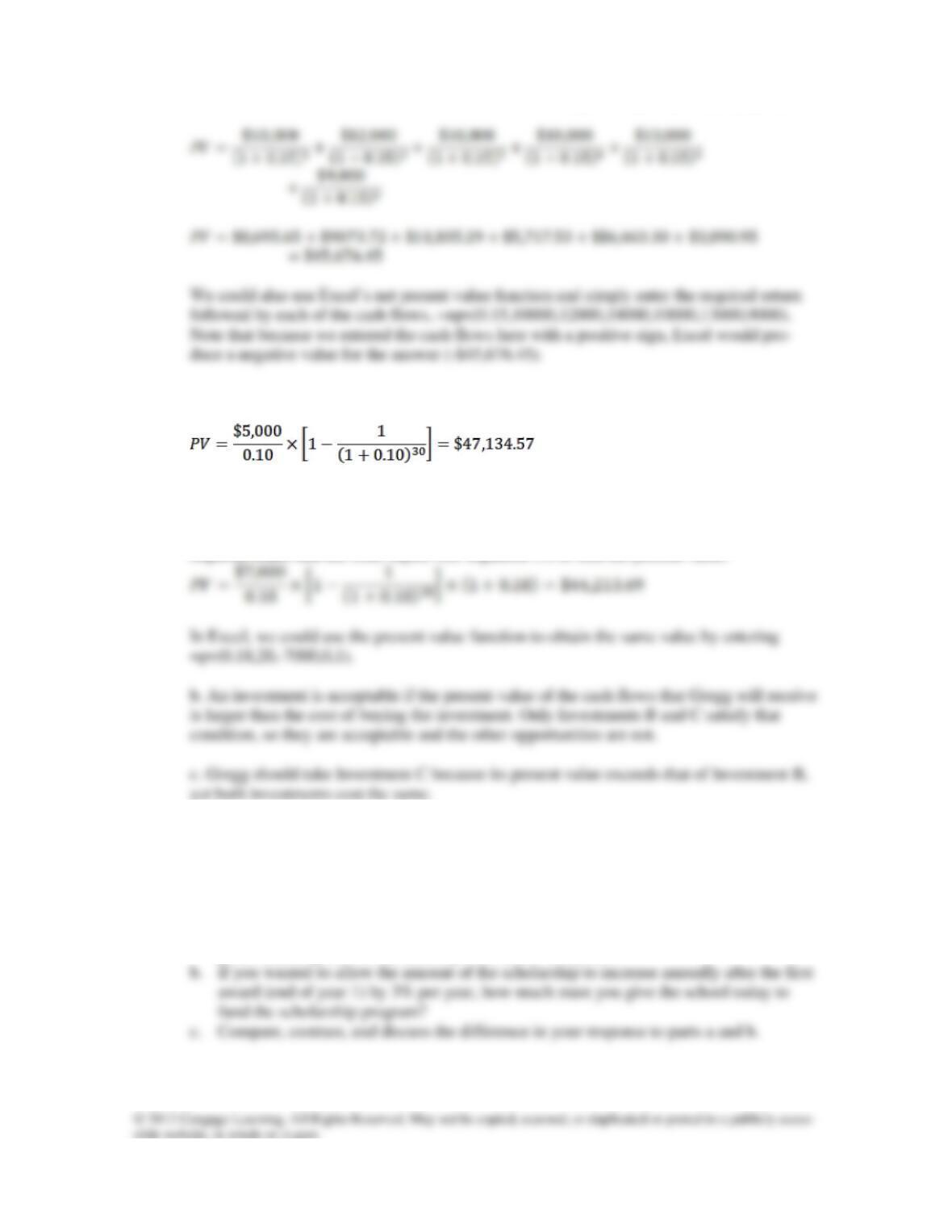
A: a. Investment opportunity A is an ordinary 5-year annuity paying $7,500 per year. Applying
Gregg’s 12% discount rate and Equation 3.7 we have:
Chapter 3 The Time Value of Money 81
Investment opportunity C is a 30-year annuity paying $5,000 annually. We can use Equa-
tion 3.7 to find the present value:
You can find the same answer by entering into Excel, =pv(0.10,30,-5000,0,0).
Investment opportunity D is a 7-year annuity due paying $7,000 annually. Plug in the 18%
required return and the other inputs into Equation 3.8 to find the present value:
ST3-3. Assume you wish to establish a college scholarship of $2,000 per year for a deserving
student at the high school you attended. You would like to make a lump-sum gift to the high
school to fund the scholarship into perpetuity. The school’s treasurer assures you that they will
earn 7.5% annually forever.
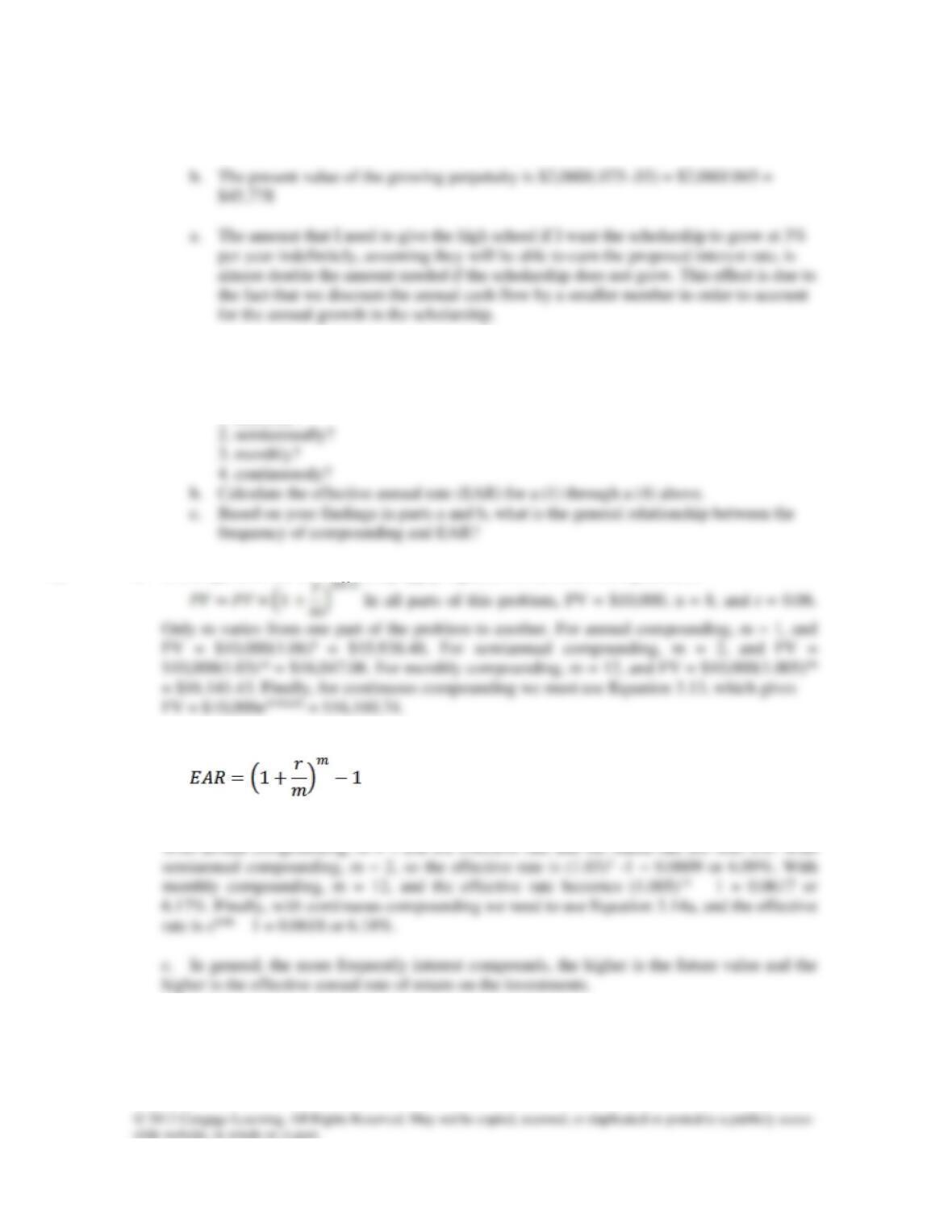
a. How much must you give the high school today to fund the proposed scholarship pro-
gram assuming the first scholarship is awarded next year?
82 Instructor’s Manual
A: a. The present value of the proposed perpetuity is $2,000/.075 = $26,667
ST3-4. Assume that you deposit $10,000 today into an account paying 6% annual interest and
leave it on deposit for exactly 8 years.
a. How much will be in the account at the end of 8 years in interest is compounded:
1. annually?
A: a. In this question we will repeatedly apply Equation 3.12, which we repeat here:
b. In this question we will repeatedly apply Equation 3.14 which appears below:
In each scenario, r = 0.06, but the value of m changes with different compounding intervals.
ST3-5. Imagine that you are a professional personal financial planner. One of your clients has
asked you the following two questions. Use the time-value-of-money techniques to develop
appropriate responses to each question.
a. I need to save $37,000 over the next 15 years to fund my 3-year-old daughter’s college
Chapter 3 The Time Value of Money 83
education. If I made equal annual end-of-year deposits into an account that earns 7%
annual interest, how large must this deposit be?
b. I borrowed $75,000 and am required to repay it in 6 equal (annual) end–of-year in-
stallments of $16,718.98 and want to know what interest am I paying?
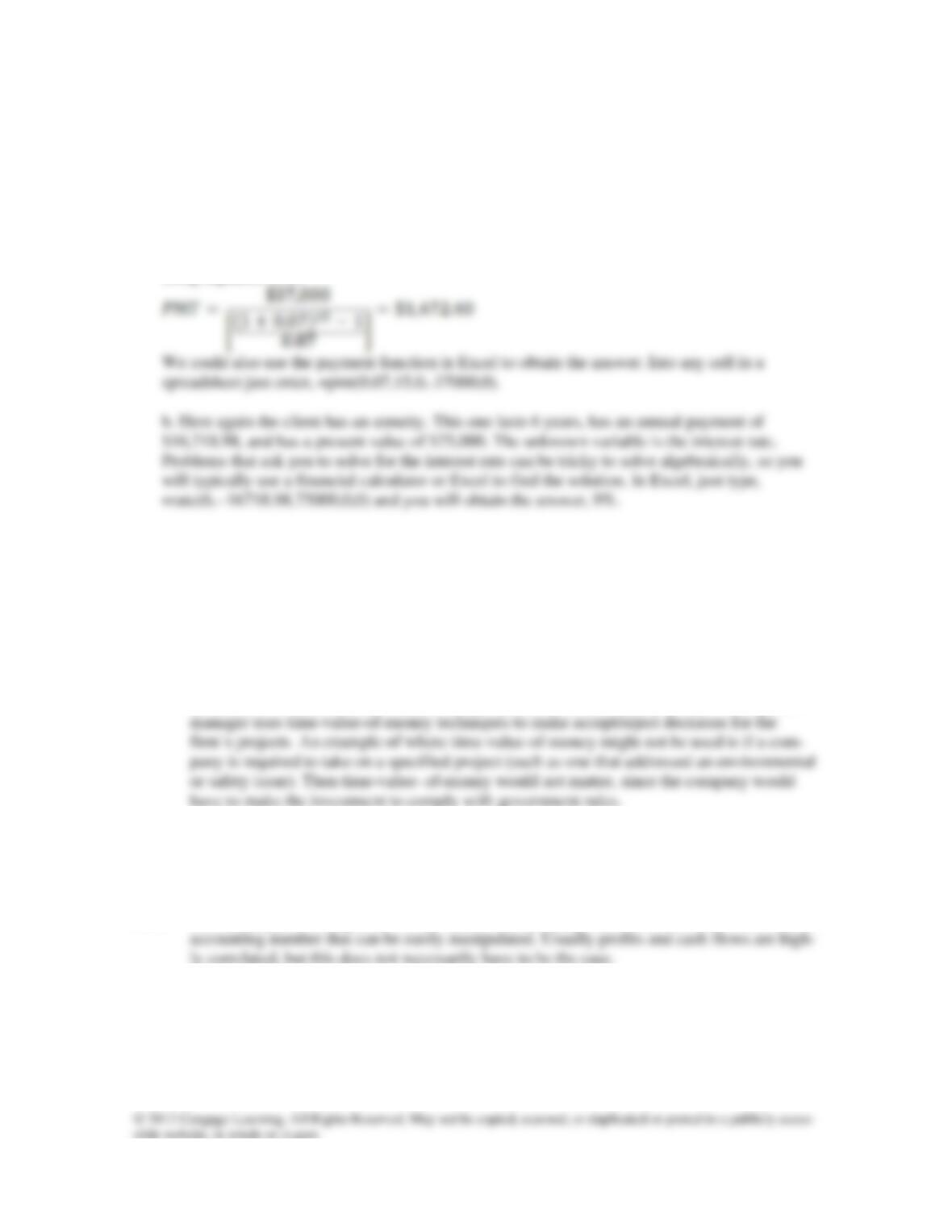
A: a. The client wants to create a 15-year annuity earning 7% which will ultimately have a future
value of $37,000. The unknown quantity here is the payment. We can solve for the payment
using Equation 3.15:
Answers to End-of-Chapter Questions
Q3–1. What is the importance to an individual of understanding time value of money concepts?
For a corporate manager? Under what circumstance would the time value of money be ir-
relevant?
A3-1. An individual would want to know time value of money techniques in order to compare
investments. Which is better—stocks, bonds, preferred stock, real estate, etc.? A corporate
Q3-2. Actions that maximize profit may not maximize shareholder wealth. What role can the time
value of money play in explaining the discrepancy between maximizing profits and max-
imizing value?
A3-2. Maximizing profits might not be the same as maximizing shareholder wealth. Profits are an
Q3–3. You are considering two investment plans. Plan A requires you to save $100 per month for
10 years. Plan B requires you to save $200 per month for 5 years. Assuming that both plans
earn the same rate of return, which plan accumulates more money?
84 Instructor’s Manual
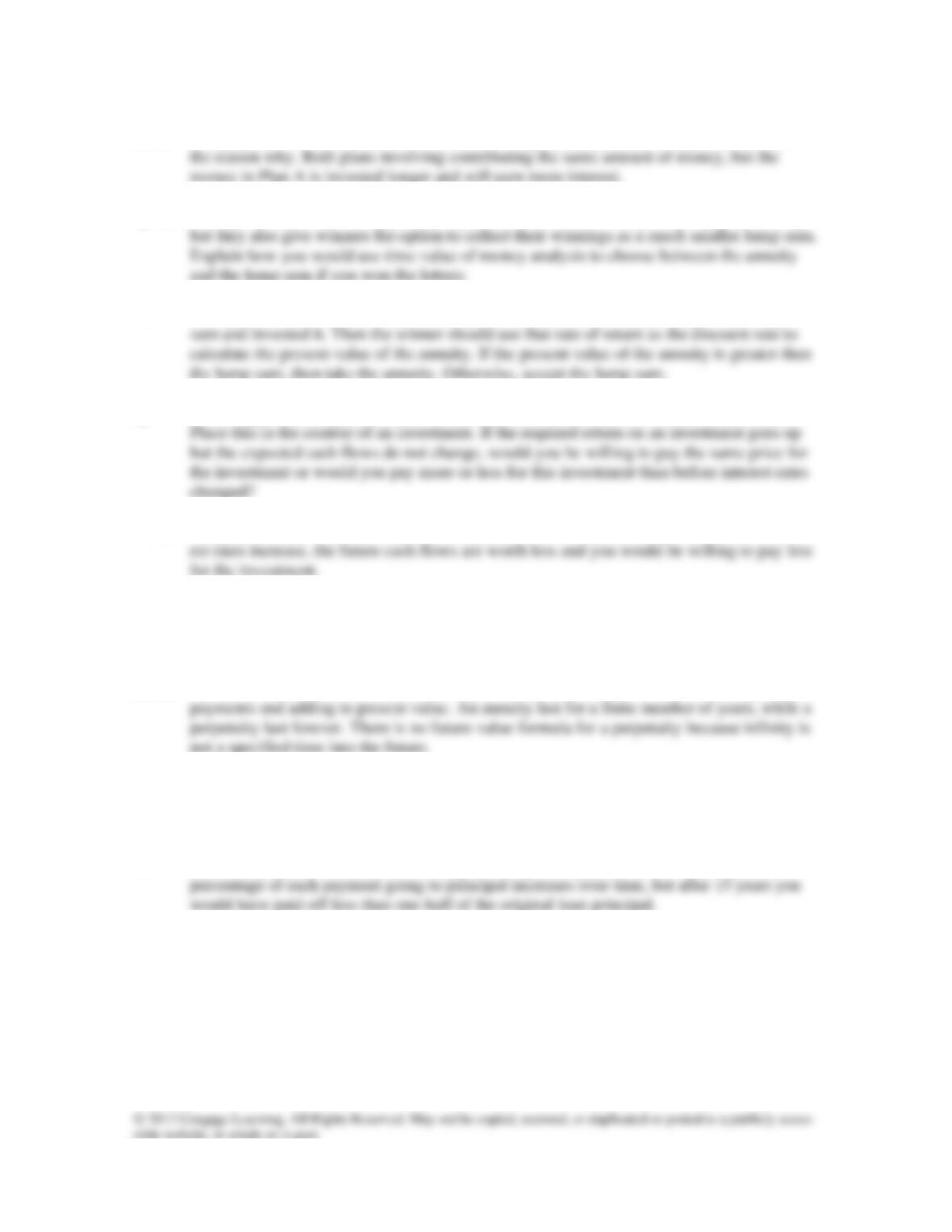
A3-3. At any positive interest rate, Plan A results in a higher future value. Compound interest is
Q3–4. Most government lotteries pay out jackpots in the form of a twenty- or thirty-year annuity,
A3-4. A lottery winner should consider what return they could earn if they accepted the lump
Q3–5. What happens to the present value of a cash-flow stream when the discount rate increases?
A3-5. The present value of a cash flow stream decreases when the interest rate increases. If inter-
Q3–6. Look at the formula for the present value of an annuity. What happens to the present value
as the number of periods increases? What distinguishes an annuity from a perpetuity? Why
is there no formula for the future value of a perpetuity?
A3-6. As the number of periods increases, the present value increases. You are receiving more
Q3–7. Suppose you borrow a large sum of money to buy a house, and you will pay back the loan
over thirty years making fixed monthly payments. After fifteen years have passed, will you
have paid off half the loan principal, more than half, or less than half? Why?
A3-7. In the early years, most of the monthly payment goes to pay interest, not principal. The
Q3-8. Under what circumstances is the effective annual rate different than the stated annual rate,
and when are they the same?
A3-8. The effective rate is greater than the stated rate as long as interest compounds more fre-
quently than once per year. If interest compounds once per year, the two are identical.
Chapter 3 The Time Value of Money 85
Solutions to End-of-Chapter Problems
Future Value of a Lump Sum Received Today
P3-1. You have $1,500 to invest today at 7% interest compounded annually.
a. How much will you have accumulated in the account at the end of the following num-
ber of years?
1. three years
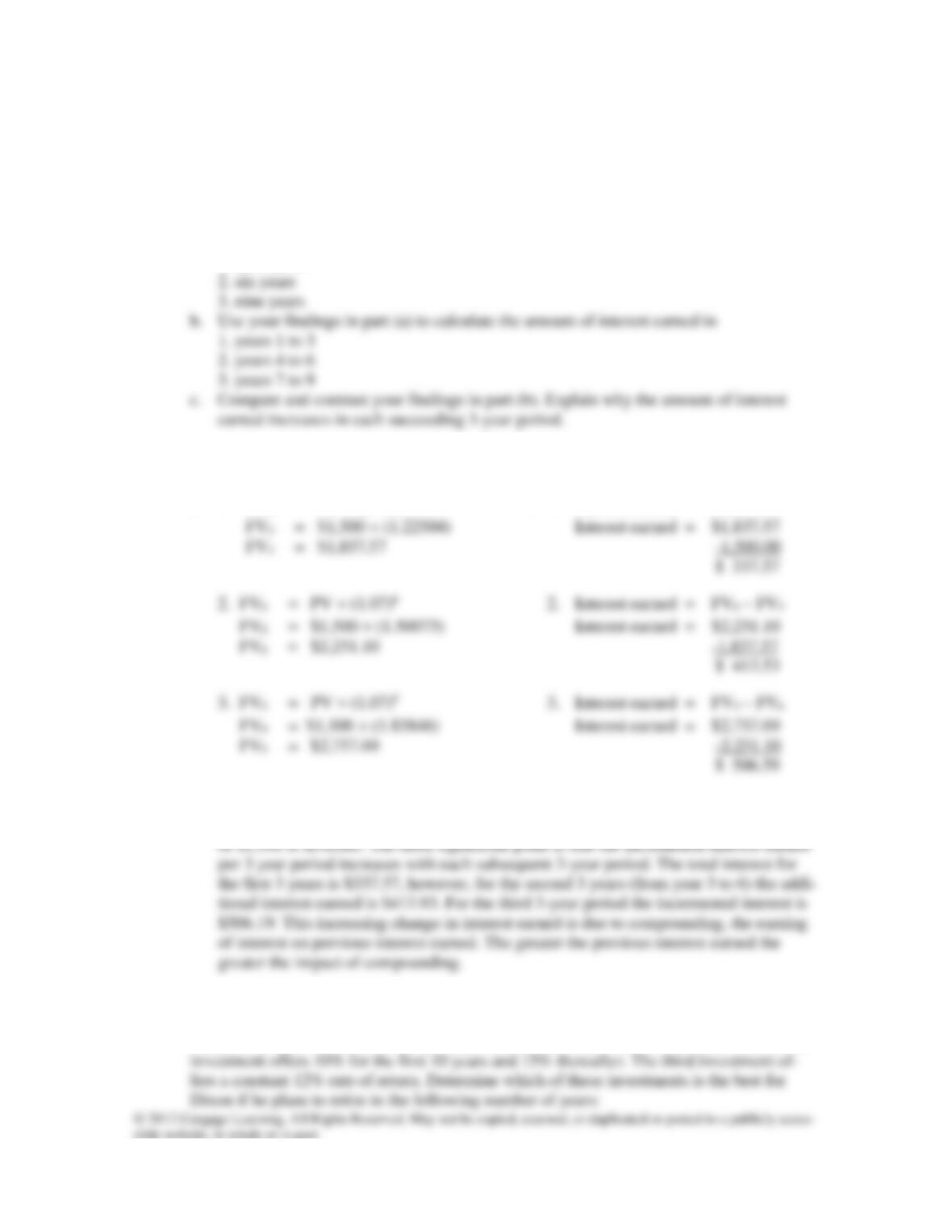
A3-1. Future Value: FVn = PV (1 + r)n or FVn = PV (FVFr%,n)
a. 1. FV3 = PV (1.07)3 b. 1. Interest earned = FV3 – PV
c. The fact that the longer the investment period the larger the total amount of interest col-
lected is not unexpected and is due to the greater length of time that the principal sum
P3-2. Dixon Shuttleworth has a large sum of money that we wants to invest to finance his retire-
ment. He has been presented with three options. The first investment offers a 5% return for
the first 5 years, a 10% return for the next 5 years, and a 20% return thereafter. The second
86 Instructor’s Manual
a. 15 years
b. 20 years
c. 30 years
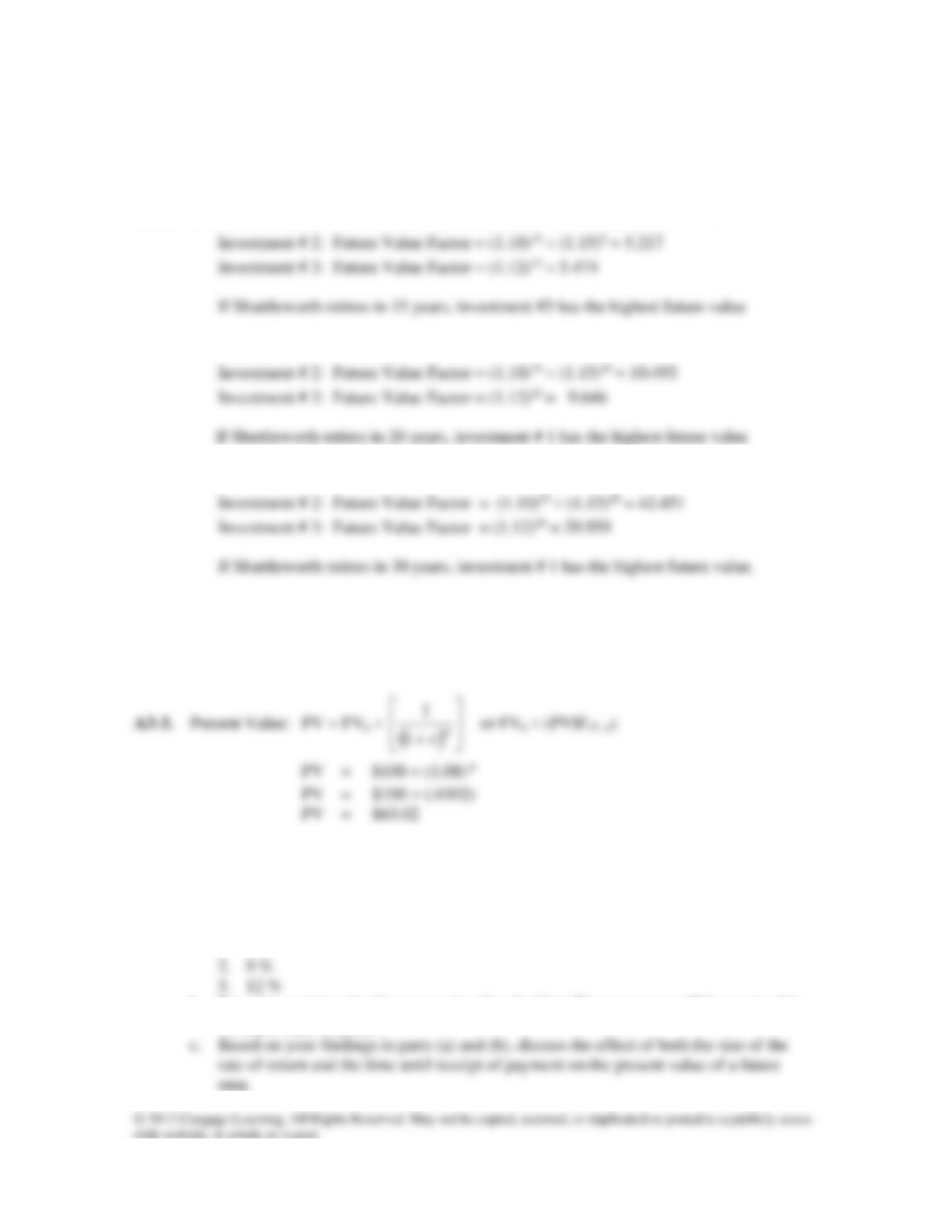
A3-2. a. Investment # 1: Future Value Factor = (1.05)5 (1.10)5 x (1.20)5 = 5.115
b. Investment # 1: Future Value Factor = (1.05)5 (1.10)5 (1.20)10 = 12.727
c. Investment # 1: Future Value Factor = (1.05)5 (1.10)5 (1.20)20 = 78.802
Present Value of a Lump Sum Received in the Future
P3-3. An Indiana state savings bond can be converted to $100 at maturity six years from pur-
chase. If the state bonds pay 8% annual interest (compounded annually), at what price must
the state sell its bonds? Assume no cash payments on savings bonds before redemption.
P3-4. You have a trust fund that will pay you $1 million exactly 10 years from today. You want
cash now, so you are considering an opportunity to sell the right to the trust fund to an in-
vestor.
a. What is the least you will sell your claim for if you could earn the following rates of
return on similar-risk investments during the 10-year period?
1. 6 %
b. Rework part (a) under the assumption that the $1 million payment will be received in
15 rather than 10 years.