CHAPTER 3
ORGANIZATION AND FUNCTIONING OF SECURITIES MARKETS
Answers to Questions
1. A market is a means whereby buyers and sellers are brought together to aid in the transfer
of goods and/or services. While it generally has a physical location, it need not
necessarily have one. Secondly, there is no requirement of ownership by those who
2. This is a good discussion question for class because you could explore with students what
are some of the alternatives that are used by investors with regards to other assets, such as
art and antiques. One primary concern is that you as seller may not know what a fair price
3. Liquidity is the ability to sell an asset quickly at a price not substantially different from
the current market, assuming no new information is available. A share of AT&T is very
4. The primary market in securities is where new issues are sold by corporations to acquire
new capital via the sale of bonds, preferred stock, or common stock. The sale typically
takes place through an investment banker.
The secondary market is simply trading in outstanding securities. It involves transactions
3 –
2
5. An example of an initial public offering (IPO) would be a small company selling
company stock to the public for the first time. By contrast, a seasoned equity refers to an
6. Student Exercise
7. In competitive-bid underwriting, the issuer is responsible for specifying the type of
security to be offered, the timing, etc. and then soliciting competitive bids from
8. NASDAQ is the largest U.S. secondary market in terms of the number of issues traded,
but the NYSE is the largest in terms of daily value of issues traded. As of 2017, The
9(a). A market order is an order to buy/sell a stock at the most profitable ask/bid prices
prevailing at the time the order hits the exchange floor. A market order implies the
9(b). A limit order specifies a maximum price that the individual will pay to purchase the stock
9(c). A short sale is the sale of stock that is not currently owned by the seller with the intent of
3 –
3
9(d). A stop-loss order is a conditional order whereby the investor indicates that he wants to sell
10. The designated market maker (or “specialist”) acts as a broker in handling limit orders
placed with member brokers. Being constantly in touch with current prices, he is in a
better position to execute limit orders because they are entered in his books and executed
as soon as appropriate. Second, he maintains a fair and orderly market by trading on his
own account when there is inadequate supply or demand. If the spread between the bid
11(a). Dark pools – Orders put into a dark pool are not displayed to other market participants in
order to reduce information leakage and minimize market impact costs and are sold to
11(b). Broker/Dealer internalization – Internalization is when retail broker/dealers internally
transact an order by buying or selling the stock against their own account on a consistent
11(c). High Frequency Traders – HFTs are professionals and institutions who used AT to create
programs that traded thousands of times a day for small profits. They bring significant
3 –
4
11(d). Algorithmic Trading – Algorithmic trading is basically creating computer programs to
make trading decisions. The decisions have become more sophisticated and complex,
3 –
5
CHAPTER 3
Answers to Problems
1(a). Assume you pay cash for the stock: Number of shares you could purchase = $40,000/$80
= 500 shares.
(1) If the stock is later sold at $100 a share, then the total shares proceeds would be
(2) If stock is later sold at $40 a share, then the total shares proceeds would be $40 x
1(b). Assuming you use the maximum amount of leverage in buying the stock, the leverage
factor for a 60 percent margin requirement is = 1/percentage margin requirement = 1/.60
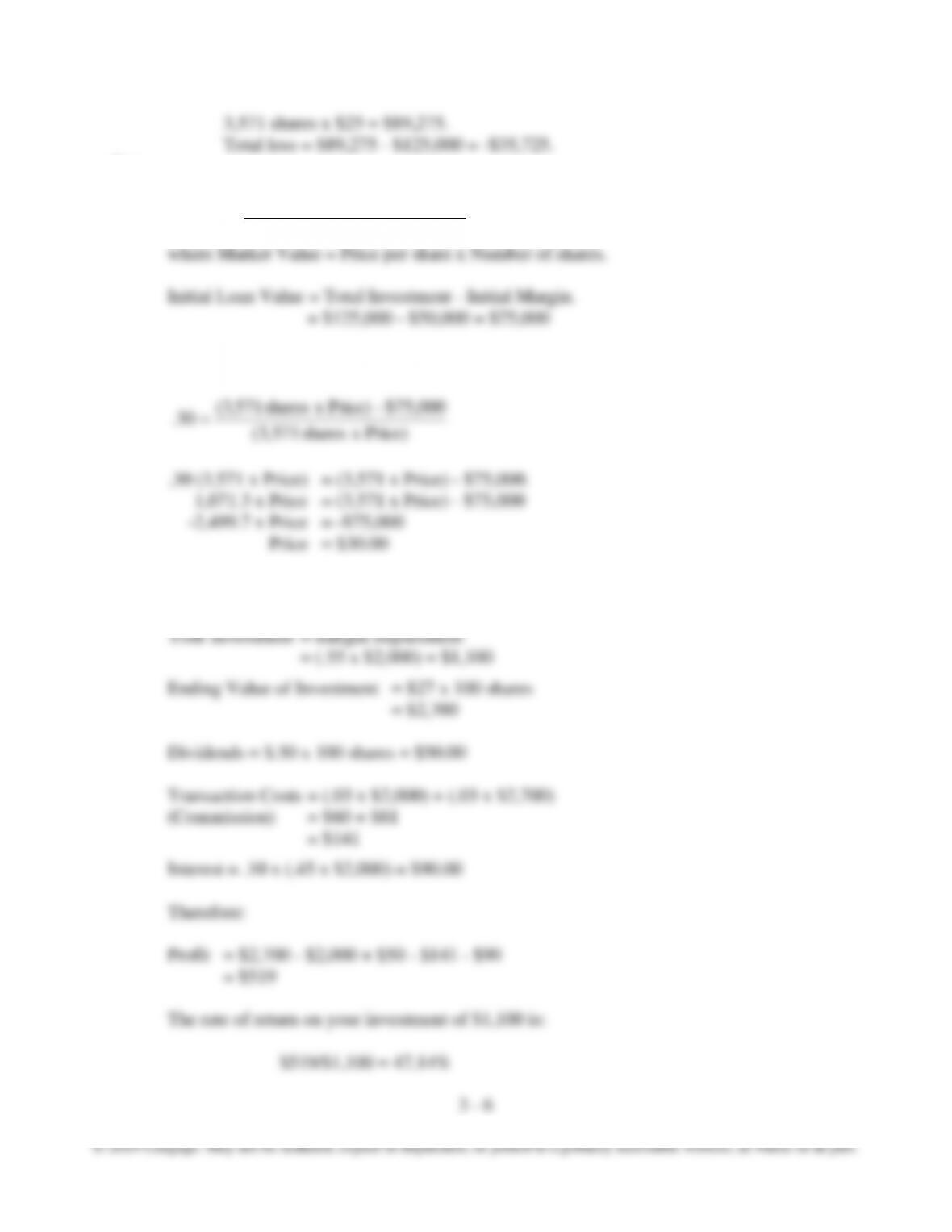
2(a). Because the margin is 40 percent and Lauren currently has $50,000 on deposit in her
margin account, if Lauren uses the maximum allowable margin, then her $50,000 deposit
2(b). Total Profit = Total Return – Total Investment
(1) If stock rises to $45/share, Lauren’s total return is:
3,571 shares x $45 = $160,695.
(2) If stock falls to $25/share, Lauren’s total return is:
%00.25
000,40$
000,40$000,50$=
−
=
%00.50
000,40$
000,40$000,20$−=
−
=
2(c)
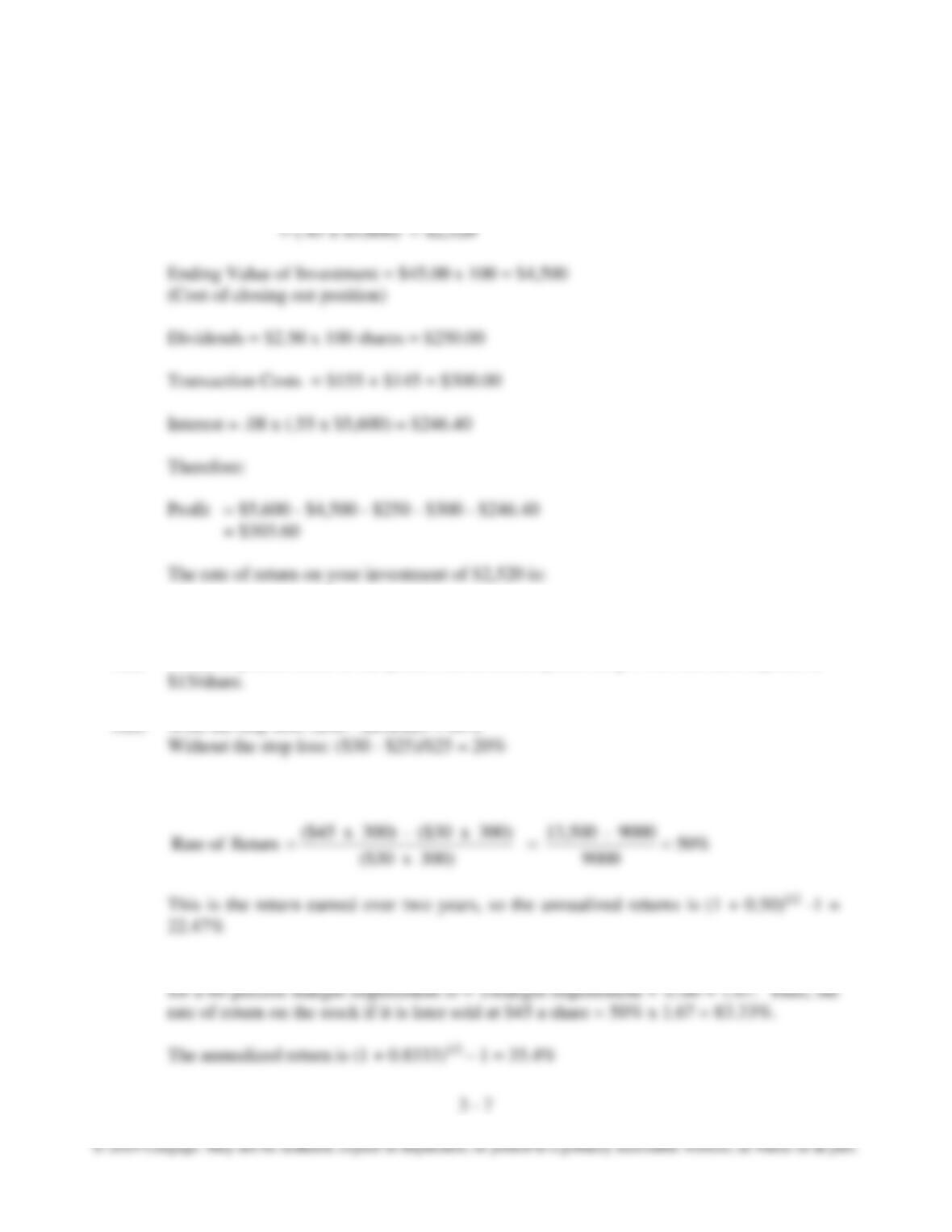
Therefore, if maintenance margin is 30 percent:
3. Profit = Ending Value – Beginning Value + Dividends – Transaction Costs – Interest
Beginning Value of Investment = $20 x 100 shares = $2,000
ValueMarket
BalanceDebit – ValueMarket
Margin =
Price) x shares (3,571
$75,000 – Price) x shares 571,3(
30.=
4. Profit on a Short Sale = Begin Value – Ending Value – Dividends -Trans. Costs – Interest
Beginning Value of Investment = $56.00 x 100 shares = $5,600
(sold under a short sale arrangement)
Your investment = margin requirement
$303.60/$2,520 = 12.05%
5(a). I want to protect some of the profit I have; should prices drop I will still have a profit of
5(b). With the stop loss: ($40 – $25)/$25 = 60%
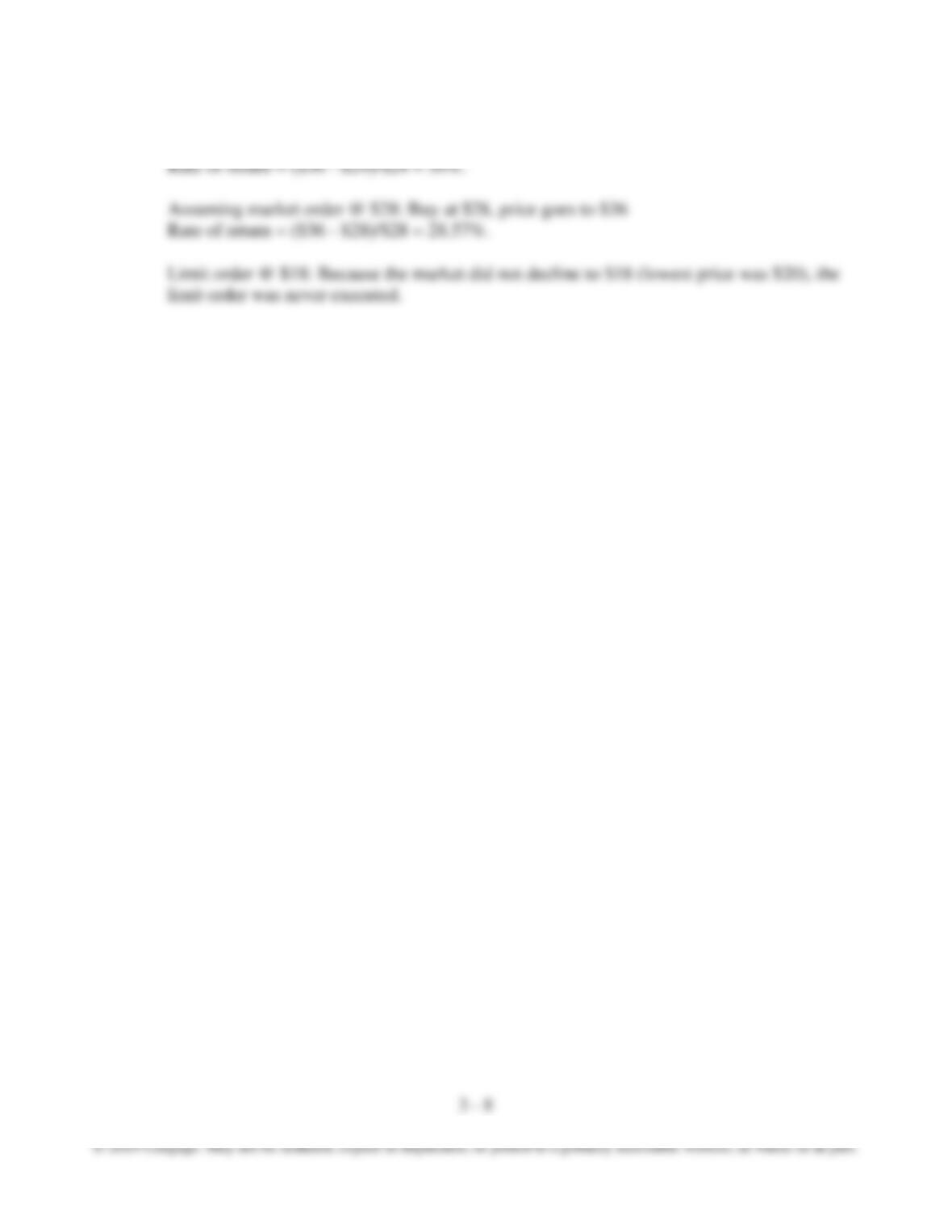
6(a). Assuming that you pay cash for the stock:
6(b). Assuming that you used the maximum leverage in buying the stock, the leverage factor
%50
9000
9000 – 13,500
300) x ($30
300) x ($30 – 300) x ($45
Return of Rate ===
7. Limit order @ $24: When the market declined to $20, your limit order was executed $24
(buy) and then the price went to $36.