Chapter 3 The Time Value of Money 101
Thus, Investment # 3 has the highest return.
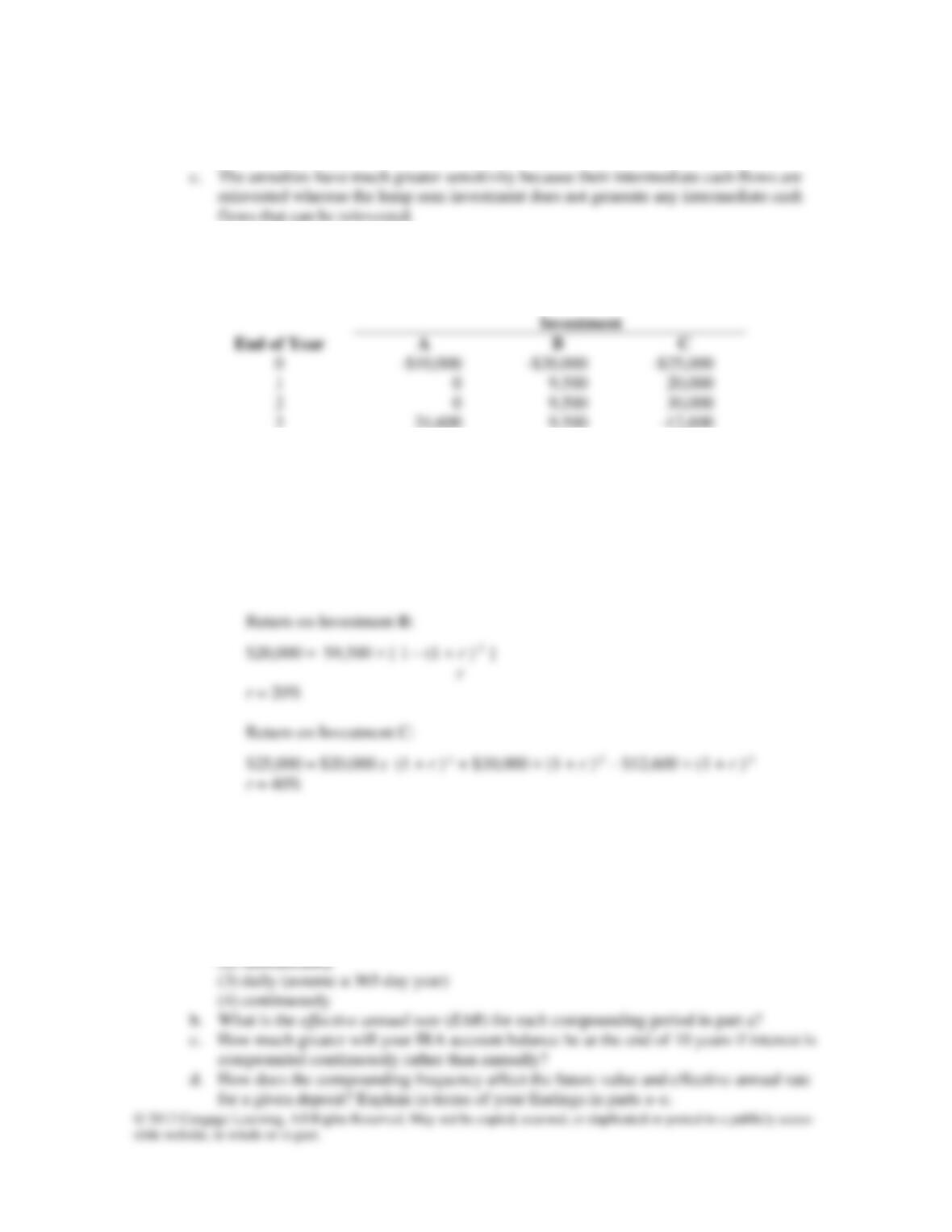
P3-28. Consider the following three investments of equal risk. Which offers the greatest rate of
return?
A3-28. Note that all returns were calculated using a financial calculator.
Return on Investment A:
$24,600 = $10,000 ( 1 + r )3
r = 35%
Advanced Applications of Time Value
P3-29. You plan to invest $2,000 in an individual retirement arrangement (IRA) today at a stated
interest rate of 8%, which is expected to apply to all future years.
a. How much will you have in the account at the end of 10 years if interest is compound-
ed as follows?
(1) annually
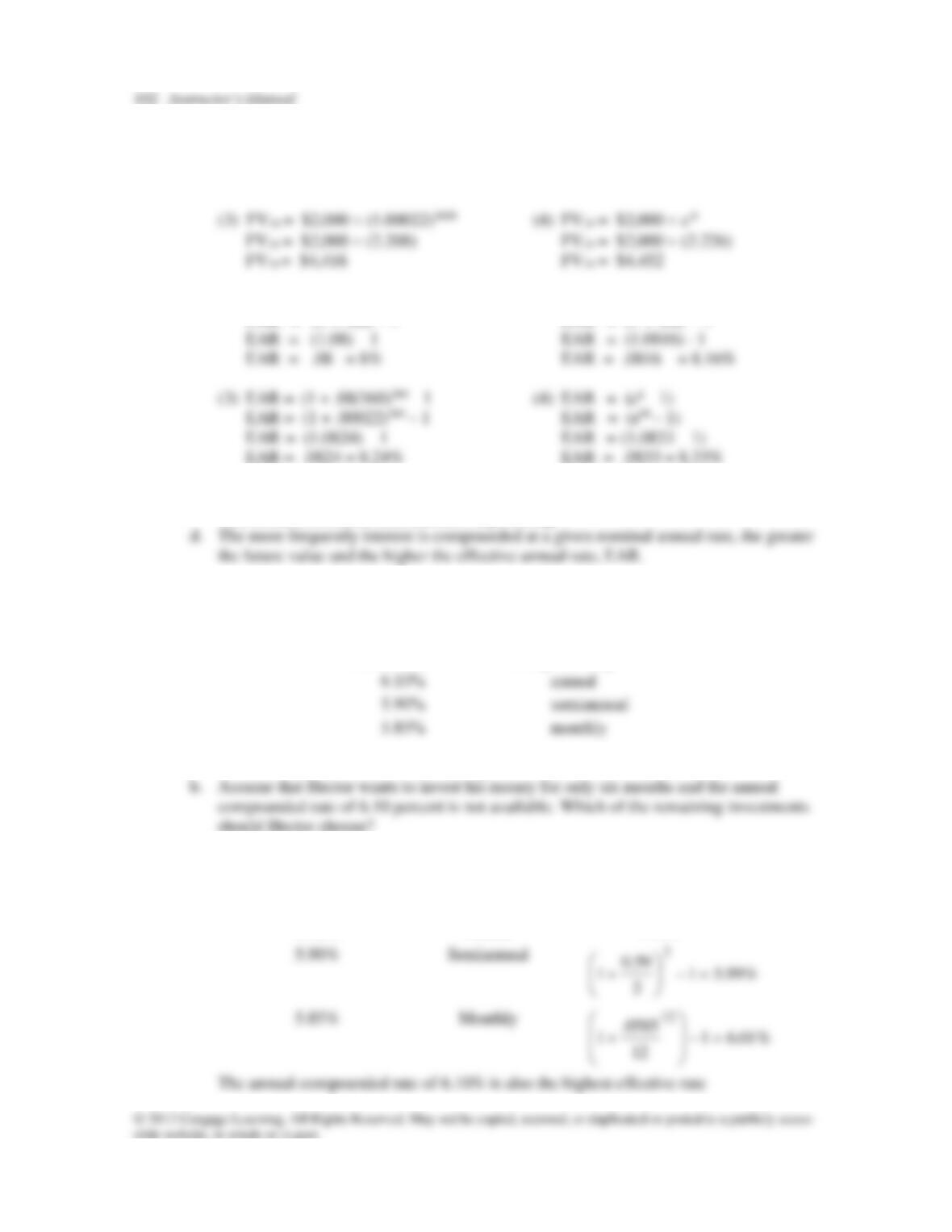
A3-29. a. (1) FV10 = $2,000 (1.08)10 (2) FV10 = $2,000 (1.04)20
FV10 = $2,000 (2.159) FV10 = $2,000 (2.191)
FV10 = $4,318 FV 10 = $4,382
b. (1) EAR = (1 + .08/1)1 –1 (2) EAR = (1 + .08/2)2-1
EAR = (1 + .08)1 – 1 EAR = (1 + .04)2 – 1
c. The IRA account balance at the end of 10 years will be $134 ($4,452 – $4,318) larger
with continuous rather than annual compounding.
P3-30. Hector Garcia has shopped around for the best interest rates for his investment of $10,000
over the next year. He has found the following:
Stated Rate
Compounding
a. Which investment offers Hector the highest effective annual rate of return?
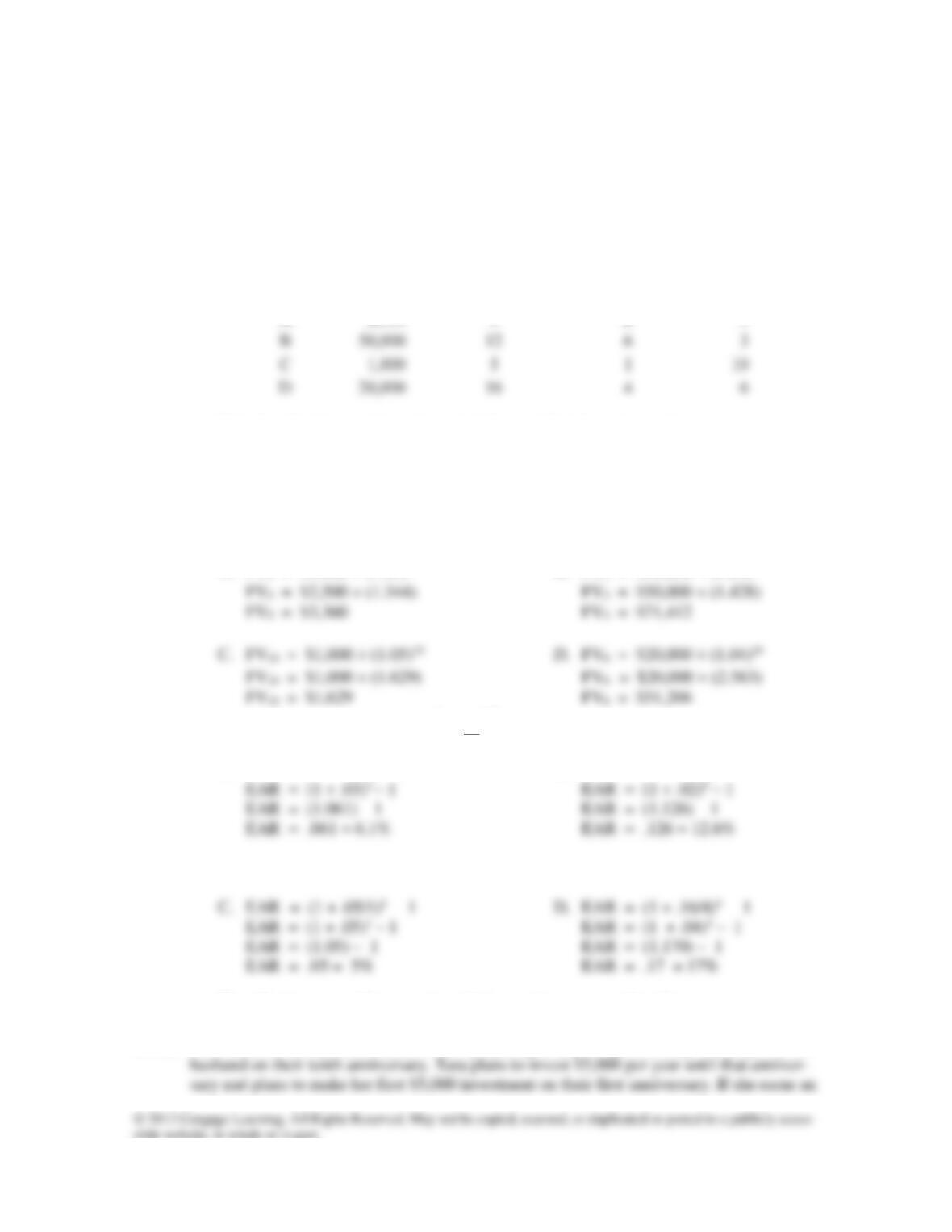
A3-30. a.
Nominal Rate
Compounding
Effective Annual Rate
6.10%
Annual
6.10%
Chapter 3 The Time Value of Money 103
b. He would prefer the monthly compounding case because it offers a slightly higher ef-
fective annual rate of interest.
P3-31. Answer parts a–c for each of the following cases.
Case
Amount
of Initial
Deposit
($)
Stated An-
nual Rate, r
(%)
Compounding
Frequency, m
(times/year)
Deposit
Period
(years)
A
2,500
6
2
5
B
12
6
3
C
1,000
5
1
D
16
4
6
a. Calculate the future value at the end of the specified deposit period.
b. Determine the effective annual rate (EAR).
c. Compare the stated annual rate (r) to the effective annual rate (EAR). What relationship
exists between compounding frequency and the stated and effective annual rates?
A3-31. a. Compounding Frequency: FVn = PV (1 + r)n
A. FV5 = $2,500 (1.03)10 B. FV3 = $50,000 (1.02)18
b. Effective Annual Rate: EAR =
1
m
r
1
m
−
+
A. EAR = (1 + .06/2)2– 1 B. EAR = (1 + .12/6)6
c. The effective rates of interest rise with increasing compounding frequency.
P3-32. Tara Cutler is newly married and is now preparing a surprise gift of a trip to Europe for her
104 Instructor’s Manual
8% rate on her investments, how much will she have saved for their trip if the interest is
compounded in each of the following ways?
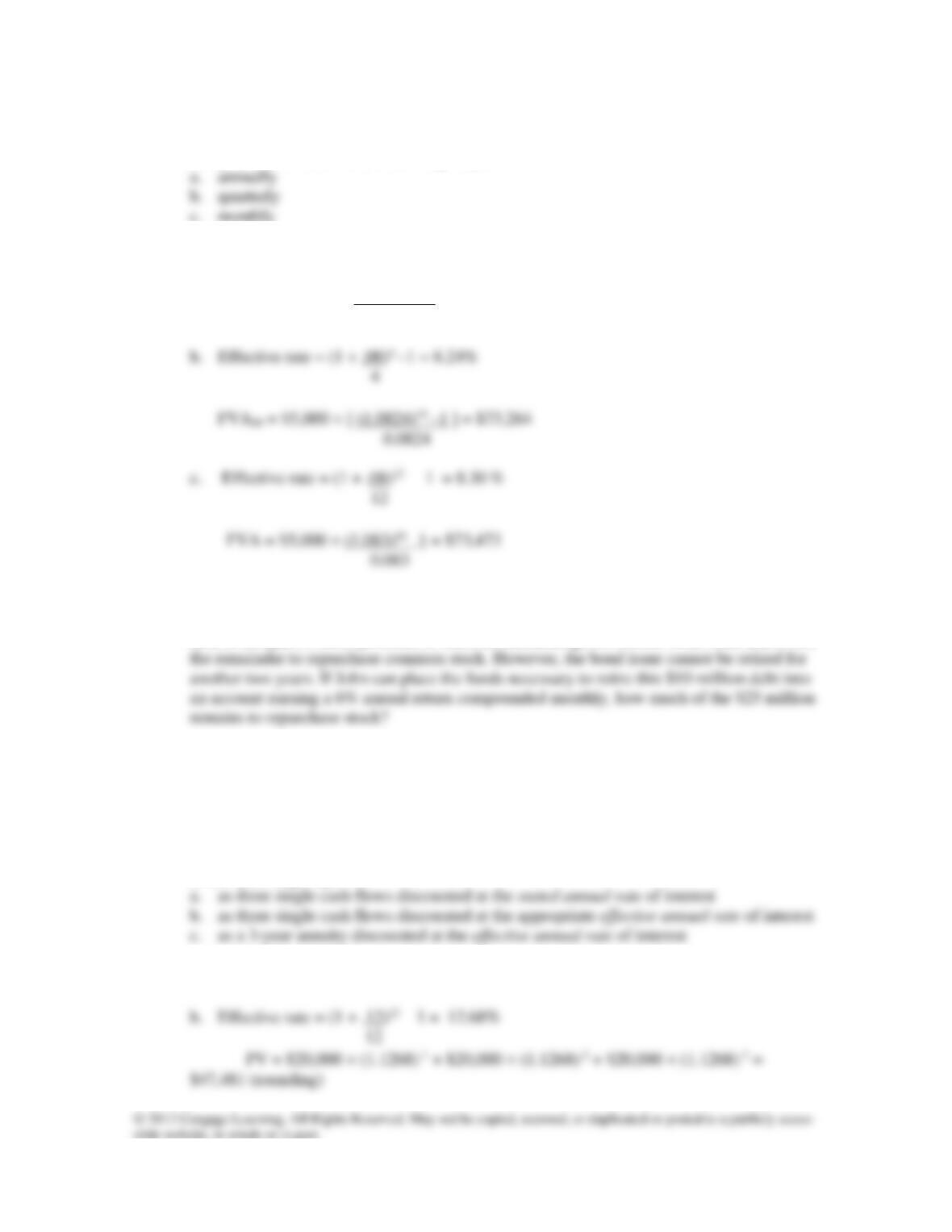
A3-32. a. Effective rate = nominal rate = 8%
FVA10 = $5,000 [ (1.08)10 –1 ] = $72,433
0.08
P3-33. John Tye was hired as the new corporate finance analyst at I-Ell Enterprises and received
his first assignment. John is to take the $25 million in cash received from a recent divesti-
ture, to use part of these proceeds to retire an outstanding $10 million bond issue and to use
A3-33. PV of debt obligation = $10,000,000 (1.005)-24 = $8,871,857
Funds remaining for stock repurchase = $25,000,000 – $8,871,857 = $16,128,143.
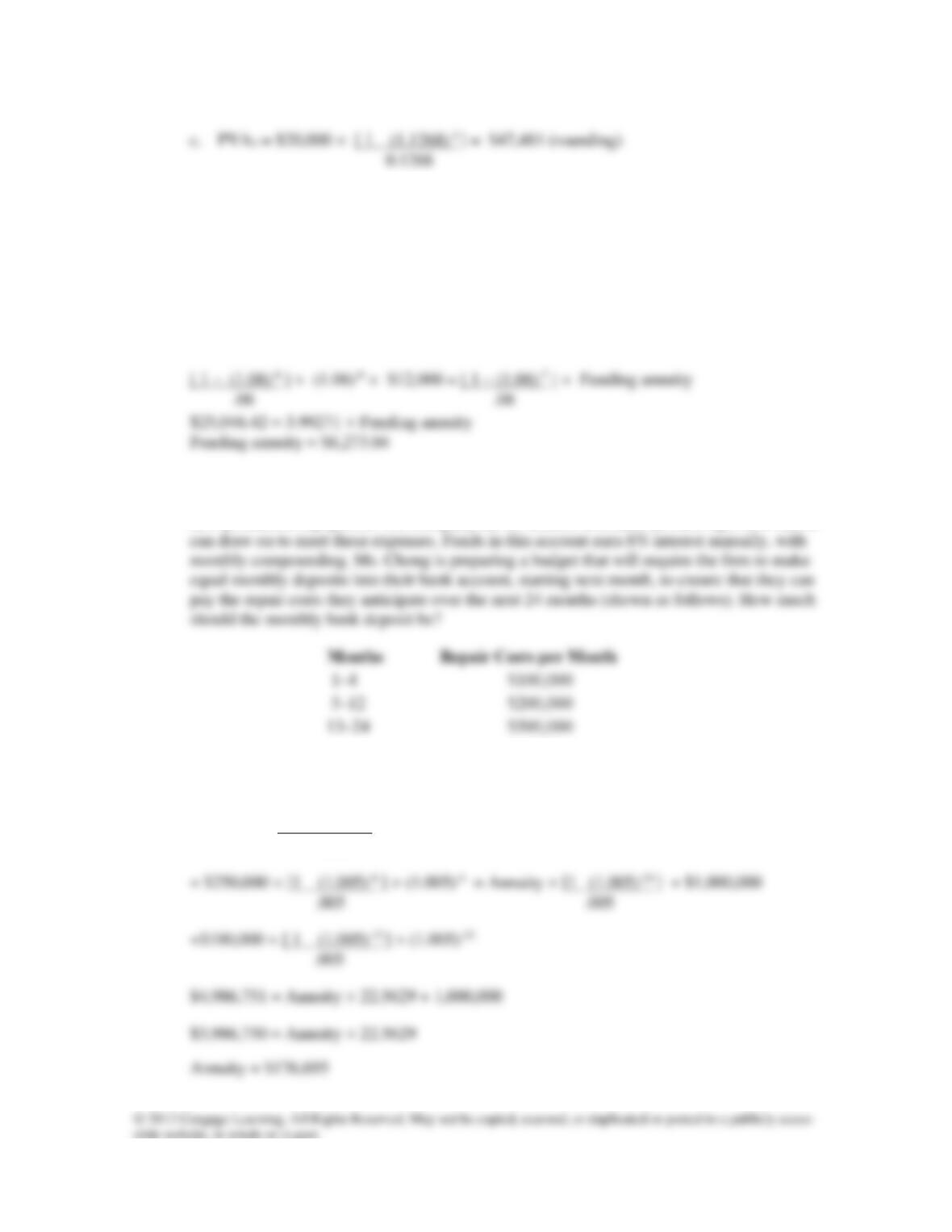
P3-34. Find the present value of a 3-year, $20,000 ordinary annuity deposited into an account that
pays 12% annual interest, compounded monthly. Solve for the present value of the annuity
in the following ways:
A3-34. a. PV = $20,000 (1.01)-12 + $20,000 (1.01)-24 + $20,000 (1.01)-36 = $47,479
Chapter 3 The Time Value of Money 105
P3-35. Determine the annual payment required to fund a future annual annuity of $12,000 per
year. You will fund this future liability over the next five years, with the first payment to
occur one year from today. The future $12,000 liability will last for four years, with the
first payment to occur seven years from today. If you can earn 8% on this account, how
much will you have to deposit each year over the next five years to fund the future liabil-
ity?
A3-35. Present Value of Future Liability = Present Value of Funding Annuity
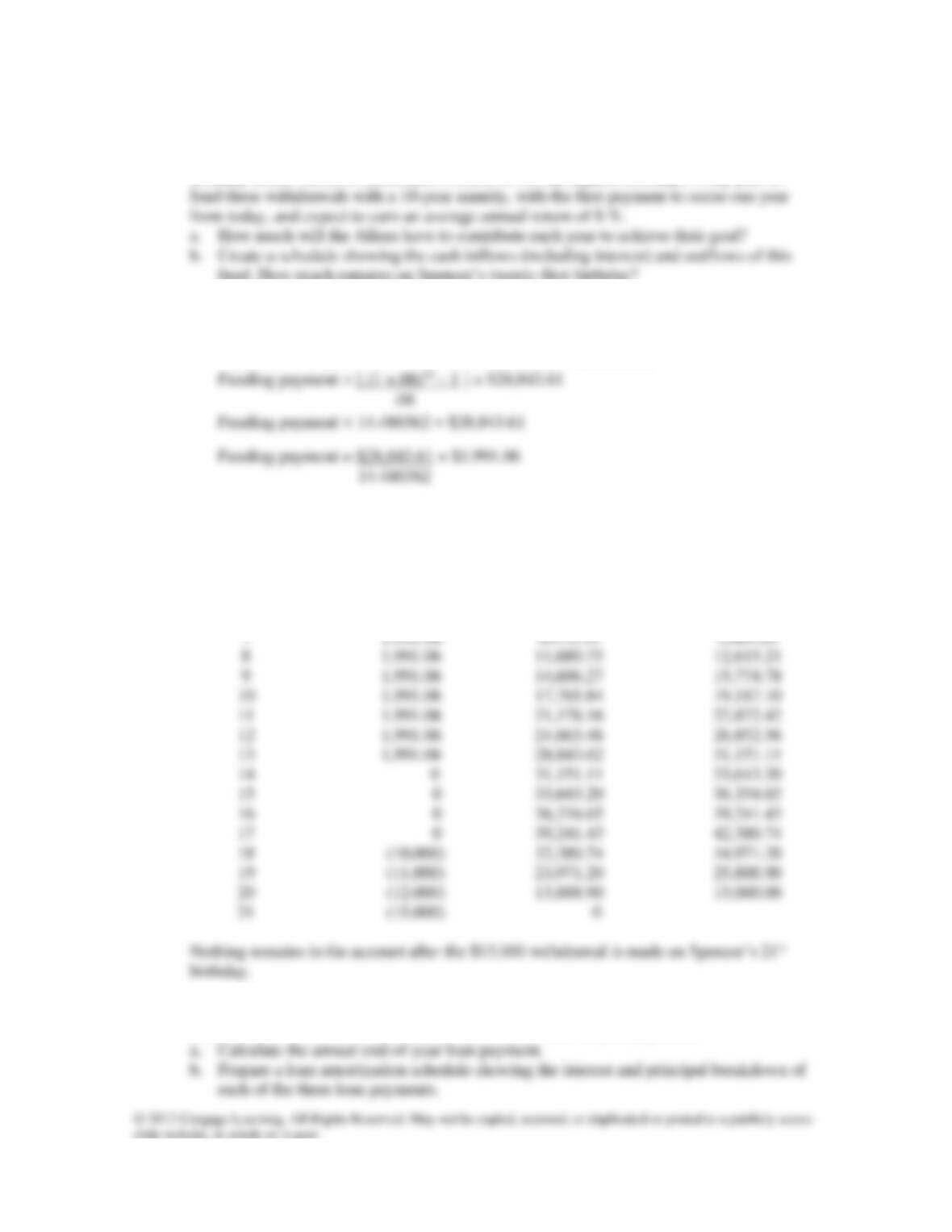
P3-36. Mary Chong, capital expenditure manager for PDA Manufacturing, knows that her compa-
ny is facing a series of monthly expenses associated with installation and calibration of
new production equipment. The company has $1 million in a bank account right now that it
A3-36. Present Value of Future Liabilities = Present Value of Required Funding Annuity
(rate = .06/12 = .005; # periods = 12 n)
$500,000 [ 1 – (1.005)-4 ]
.005
106 Instructor’s Manual
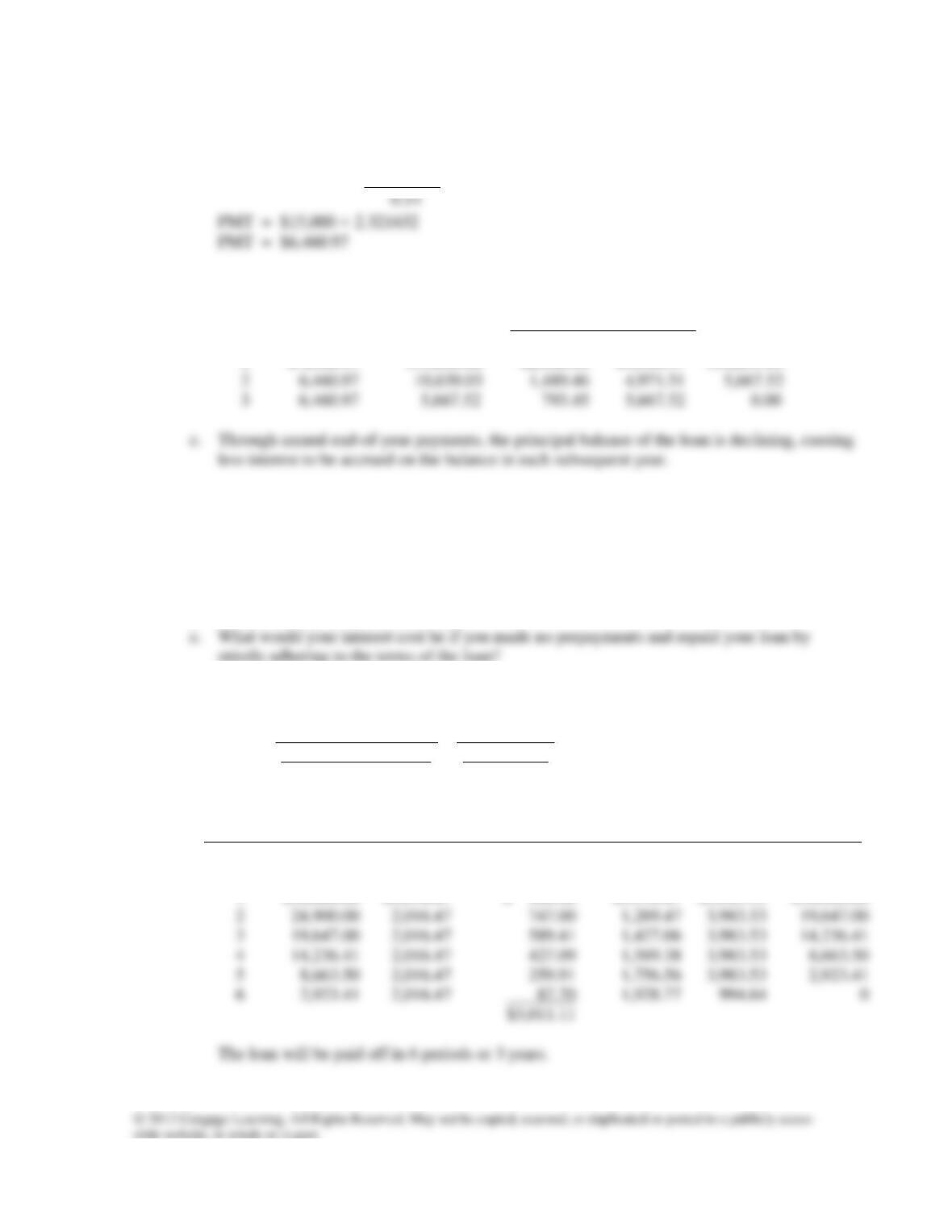
P3-37. Craig and LaDonna Allen are trying to establish a college fund for their son Spencer, who
just turned three today. They plan for Spencer to withdraw $10,000 on his eighteenth
birthday and $11,000, $12,000, and $15,000 on his subsequent birthdays. They plan to
fund. How much remains on Spencer’s twenty-first birthday?
A3-37. a. Amount needed at Spencer’s 13th birthday (in 10 years):
= $10,000 (1.08)-5 + $11,000 (1.08)-6 + $12,000 (1.08)-7 + $15,000 (1.08)-8
= $6,805.83 + $6,931.87 + $7,001.88 + $8,104.03 = $28,843.61
b.
End of Spencer’s
Birthday Year
Deposit
(Withdrawal)
Beginning
Balance
Ending Balance
(Begin Balance 1.08)
4
$ 1,991.06
$ 1,991.06
$ 2,150.34
5
1,991.06
4,141.40
4,472.72
6
1,991.06
6,463.78
6,980.88
8
1,991.06
9
1,991.06
1,991.06
1,991.06
1,991.06
1,991.06
0
0
0
(10,000)
(11,000)
(12,000)
(15,000)
0
P3-38. Joan Messineo borrowed $15,000 at a 14 % annual interest rate to be repaid over three
years. The loan is amortized into three equal annual end-of-year payments.
Chapter 3 The Time Value of Money 107
c. Explain why the interest portion of each payment declines with the passage of time.
A3-38. a. PMT = $15,000 [ 1 – (1.14)-3 ]
b.
End of
Loan
Beginning of
Payment
End of Year
Year
Payment
Year Principal
Interest
Principal
Principal
1
$ 6,460.97
$15,000.00
$2,100.00
$4,360.97
$10,639.03
3
793.45
5,667.52
0.00
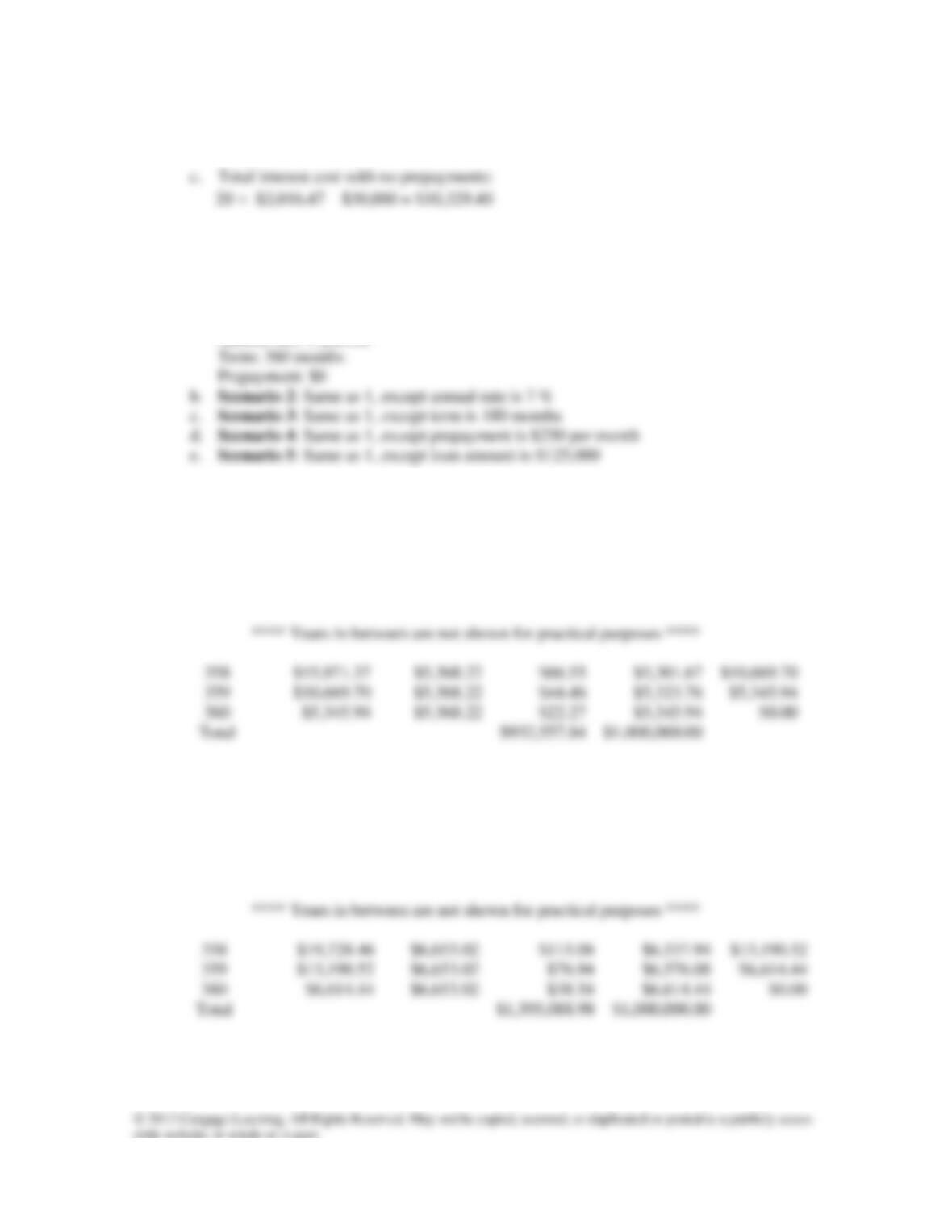
P3-39. You are planning to purchase a building for $40,000, and you have $10,000 to apply as a
down payment. You may borrow the remainder under the following terms: a 10-year loan
with semiannual repayments and a stated interest rate of 6 %. You intend to make $6,000
payments, applying the excess over your required payment to the reduction of the principal
balance.
a. Given these terms, how long (in years) will it take you to fully repay your loan?
b. What will be your total interest cost?
A3-39. a. Required Payment:
PMT = $30,000 = $30,000 = $2,016.47
[ 1 – (1 + {.06/2}-2 x 10 ] 1 – (1.03) -20
.06 /2 .03
Amortization Schedule
Period
Beginning
Balance
Payment
Interest
(.03 Principal)
Principal
Prepay
Ending
Balance
1
$30,000.00
$2,016.47
$ 900.00
$1,116.47
$3,983.53
$24,900.00
24,900.00
2,016.47
1,269.47
3,983.53
14,236.41
2,016.47
1,589.38
3,983.53
2,016.47
1,756.56
3,983.53
108 Instructor’s Manual
b. Total interest cost = $3,011.11
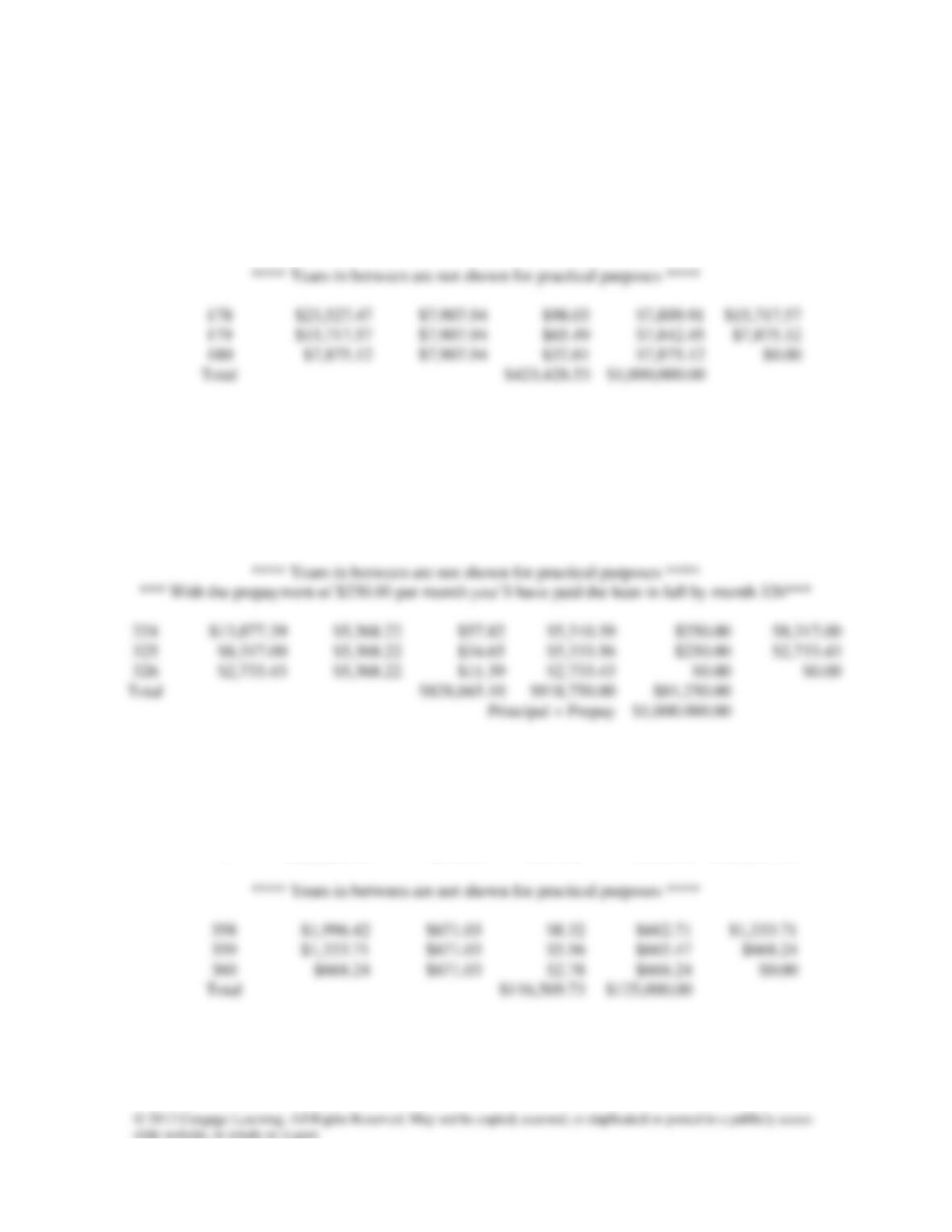
P3-40. Use a spreadsheet to create amortization schedules for the following five scenarios. What
happens to the total interest paid under each scenario?
a. Scenario 1:
Loan amount: $1 million
Annual rate: 5 percent
A3-40. a.
Beginning
Ending
Period
Balance
Payment
Interest
Principal
Balance
1
$1,000,000.00
$5,368.22
$4,166.67
$1,201.55
$998,798.45
2
$998,798.45
$5,368.22
$4,161.66
$1,206.56
$997,591.89
3
$997,591.89
$5,368.22
$4,156.63
$1,211.58
$996,380.31
$15,971.37
$66.55
$10,669.70
$10,669.70
$44.46
$5,345.94
$22.27
$0.00
$932,557.84
$1,000,000.00
b.
Beginning
Ending
Period
Balance
Payment
Interest
Principal
Balance
1
$1,000,000.00
$6,653.02
$5,833.33
$819.69
$999,180.31
2
$999,180.31
$6,653.02
$5,828.55
$824.47
$998,355.84
3
$998,355.84
$6,653.02
$5,823.74
$829.28
$997,526.55
$6,614.44
$1,395,088.98
$1,000,000.00
Chapter 3 The Time Value of Money 109
c.
Beginning
Ending
Period
Balance
Payment
Interest
Principal
Balance
1
$1,000,000.00
$7,907.94
$4,166.67
$3,741.27
$996,258.73
2
$996,258.73
$7,907.94
$4,151.08
$3,756.86
$992,501.87
3
$992,501.87
$7,907.94
$4,135.42
$3,772.51
$988,729.36
$7,907.94
$98.03
$7,809.91
$7,907.94
$65.49
$7,842.45
$7,875.12
$7,875.12
$7,907.94
$32.81
$7,875.12
d.
Beginning
Ending
Period
Balance
Payment
Interest
Principal
Prepay
Balance
1
$1,000,000.00
$5,368.22
$4,166.67
$1,201.55
$250.00
$998,548.45
2
$998,548.45
$5,368.22
$4,160.62
$1,207.60
$250.00
$997,090.85
3
$997,090.85
$5,368.22
$4,154.55
$1,213.67
$250.00
$995,627.18
$5,368.22
$5,310.39
$250.00
$8,317.00
$8,317.00
$5,368.22
$5,333.56
$250.00
$2,733.43
$2,733.43
$5,368.22
$2,733.43
Total
$828,665.10
$918,750.00
$1,000.000.00
e.
Beginning
Ending
Period
Balance
Payment
Interest
Principal
Balance
1
$125,000.00
$671.03
$520.83
$150.19
$124,849.81
2
$124,849.81
$671.03
$520.21
$150.82
$124,698.99
3
$124,698.99
$671.03
$519.58
$151.45
$124,547.54
Total
$116,569.73
P3-41. You are the pension fund manager for Tanju’s Toffees, and your CFO has just made a re-
quest of you. The CFO wants to know the minimum annual return required on the pension
110 Instructor’s Manual
fund in order to make all required payments over the next five years and not diminish the
existing asset base. The fund currently has assets of $500 million.
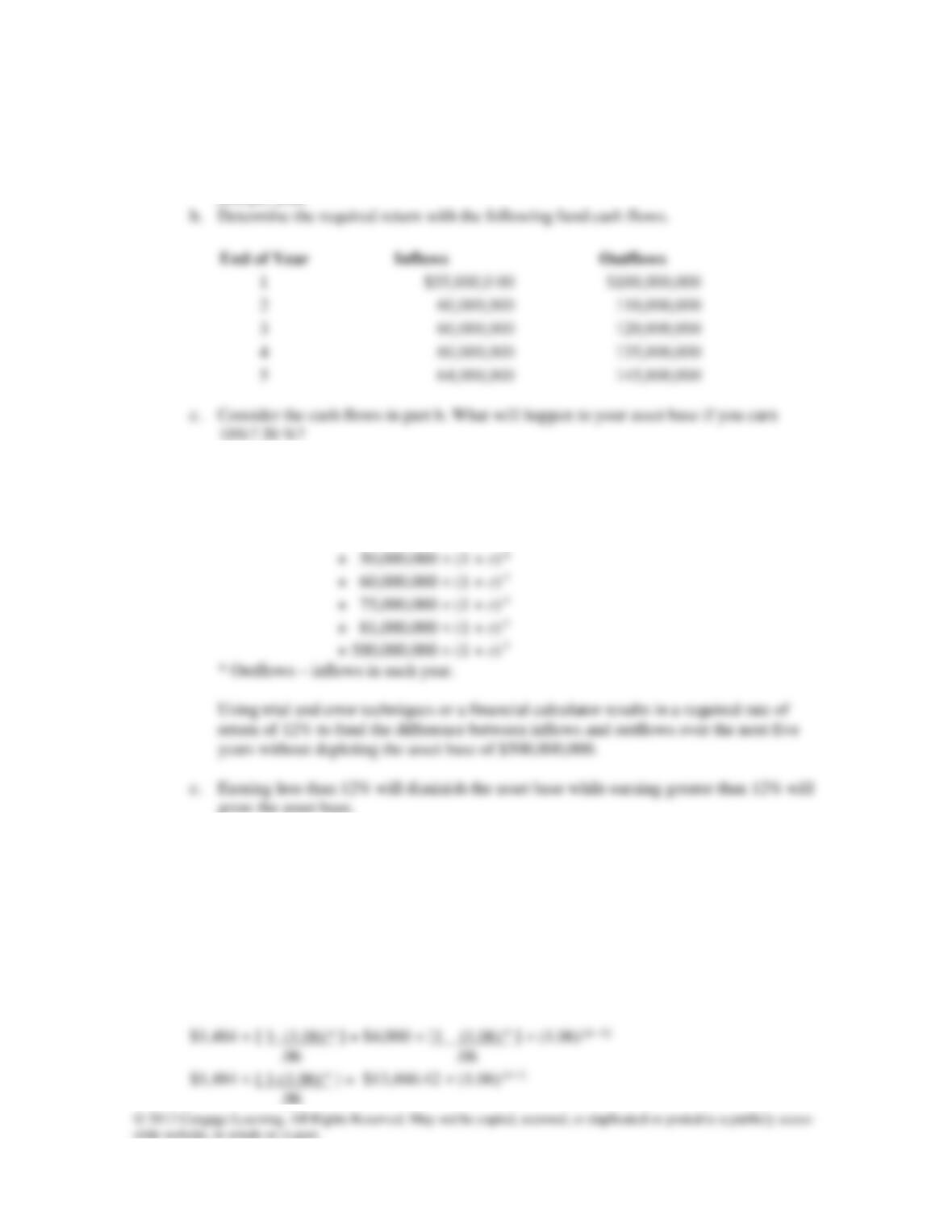
a. Determine the required return if outflows are expected to exceed inflows by $50 mil-
lion per year.
A3-41. a. $50,000,000 = 10%
$500,000,000
Net Outflows*
b. $500,000,000 = $ 45,000,000 ( 1+ r)-1
P3-42. You plan to start saving for your son’s college education. He will begin college when he
turns 18 years old and will need $4,000 then and in each of the following three years. You
will make a deposit at the end of this year in an account that pays 6 % compounded annual-
ly, and an identical deposit at the end of each year, with the last deposit occurring when he
turns 18. If an annual deposit of $1,484 will allow you to reach your goal, how old is your
son now?
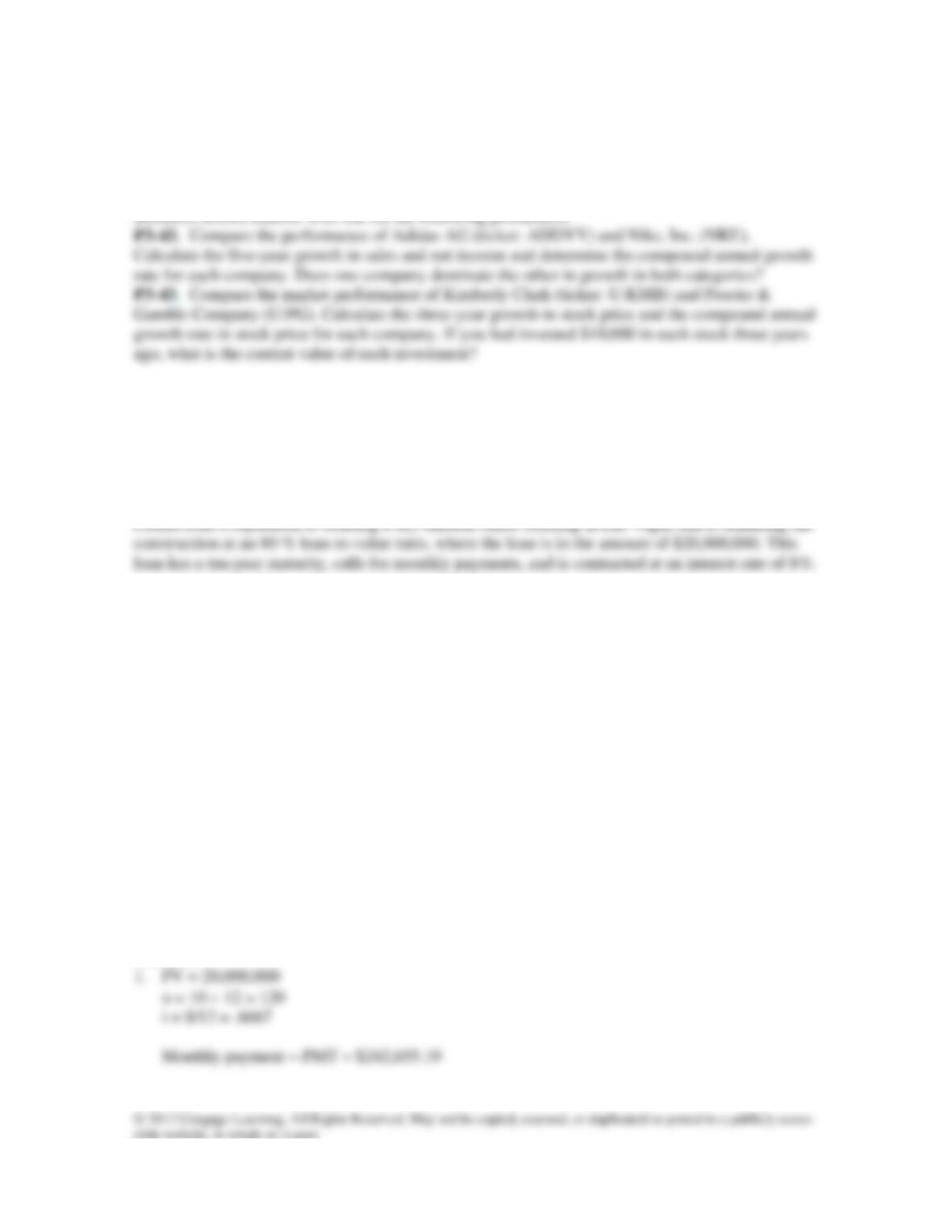
A3-42. PV of funding annuity = PV of college expense annuity
Chapter 3 The Time Value of Money 111
Via trial and error or a financial calculator, solve for n = 8.
Thus, your son will turn 18 eight years from today and is 10 years old now.
THOMSON ONE Business School Edition: Access financial information from the Thomson ONE –
A. Because these exercises depend upon real-time data, your answers will change continuously
depending upon when you access the Internet to download your data.
Answer to MiniCase
Present Value
Assignment
Using the above information, answer the following questions.
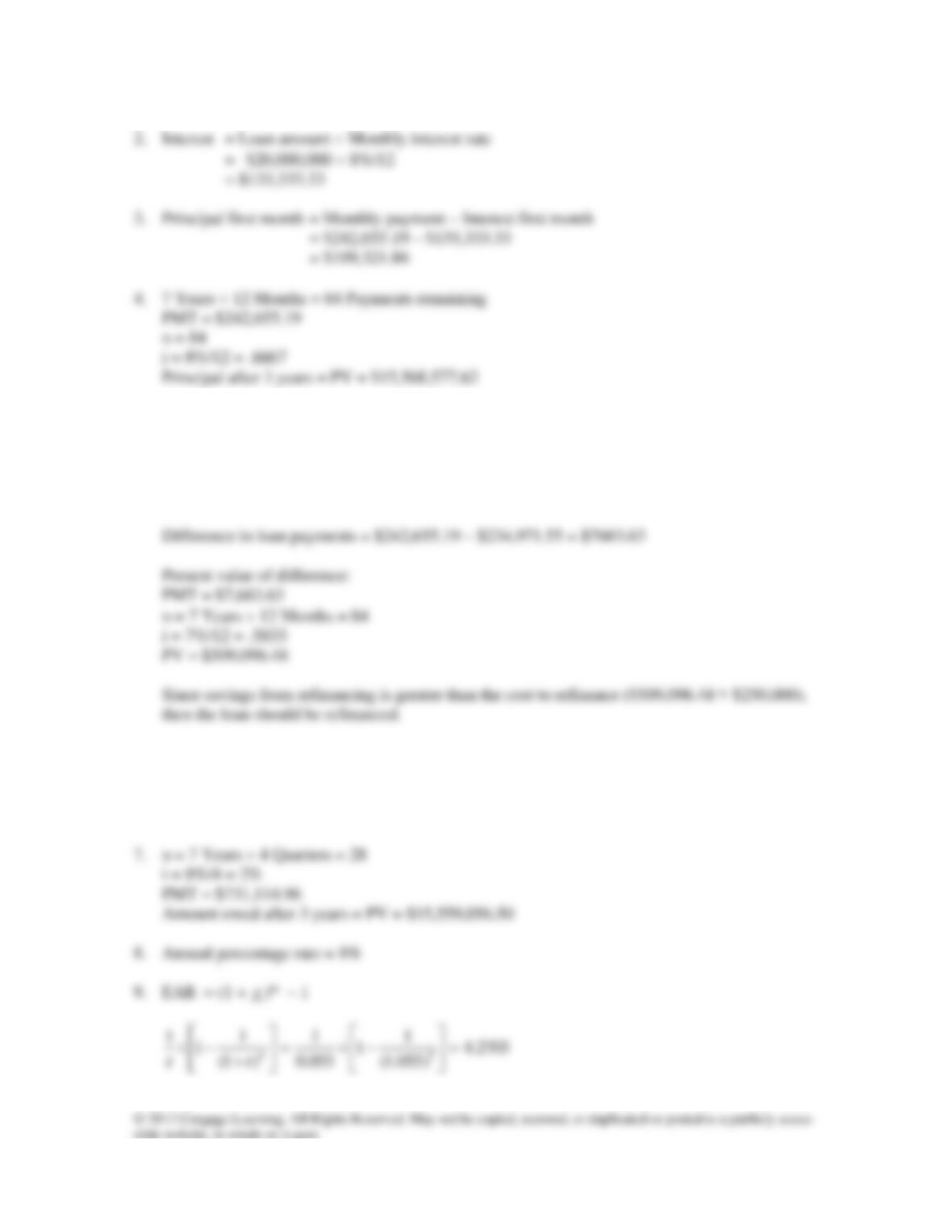
1. What is the monthly payment?
2. How much of the first payment is interest?
3. How much of the first payment is principal?
4. How much will Casino.com Corporation owe on this loan after making monthly payments for
three years (the amount owed immediately after the thirty-sixth payment)?
5. Should this loan be refinanced after three years with a new seven-year 7 percent loan, if the
cost to refinance is $250,000? To make this decision, calculate the new loan payments and then
the present value of the difference in the loan payments.
6. Returning to the original ten-year 8 percent loan, how much is the loan payment if these pay-
ments are scheduled for quarterly rather than monthly payments?
7. For this loan with quarterly payments, how much will Casino.com Corporation owe on this
loan after making quarterly payments for three years (the amount owed immediately after the
twelfth payment)?
8. What is the annual percentage rate on the original ten-year 8 % loan?
9. What is the effective annual rate (EAR) on the original ten-year 8 % loan?
Answers
112 Instructor’s Manual
5. New loan payments:
PV = $15,568,577.62
n = 7 Years 12 Months = 84 Months
i = 7%/12 = .5833
PMT = $234,971.55
6. PV = $20,000,000
n = 10 Years 4 Quarters = 40 Quarters
i = 8%/4 = 2%
Quarterly payments = PMT = $731,114.96