20
Chapter 3
Financial Decision Making and the Law of
One Price
3-1. Honda Motor Company is considering offering a $2000 rebate on its minivan, lowering the
vehicle’s price from $30,000 to $28,000. The marketing group estimates that this rebate will
increase sales over the next year from 40,000 to 55,000 vehicles. Suppose Honda’s profit margin
with the rebate is $6000 per vehicle. If the change in sales is the only consequence of this decision,
what are its costs and benefits? Is it a good idea?
The benefit of the rebate is that Honda will sell more vehicles and earn a profit on each additional
vehicle sold:
3-2. You are an international shrimp trader. A food producer in the Czech Republic offers to pay you
2 million Czech koruna today in exchange for a year’s supply of frozen shrimp. Your Thai
supplier will provide you with the same supply for 3 million Thai baht today. If the current
competitive market exchange rates are 25.50 koruna per dollar and 41.25 baht per dollar, what
is the value of this deal?
3-3. Suppose the current market price of corn is $3.75 per bushel. Your firm has a technology that
can convert 1 bushel of corn to 3 gallons of ethanol. If the cost of conversion is $1.60 per bushel,
at what market price of ethanol does conversion become attractive?
3-4. Suppose your employer offers you a choice between a $5000 bonus and 100 shares of the
company stock. Whichever one you choose will be awarded today. The stock is currently trading
for $63 per share.
a. Suppose that if you receive the stock bonus, you are free to trade it. Which form of the bonus
should you choose? What is its value?
b. Suppose that if you receive the stock bonus, you are required to hold it for at least one year.
What can you say about the value of the stock bonus now? What will your decision depend
on?
3-5. You have decided to take your daughter skiing in Utah. The best price you have been able to find
for a roundtrip air ticket is $359. You notice that you have 20,000 frequent flier miles that are
about to expire, but you need 25,000 miles to get her a free ticket. The airline offers to sell you
5000 additional miles for $0.03 per mile.
a. Suppose that if you don’t use the miles for your daughter’s ticket they will become
worthless. What should you do?
b. What additional information would your decision depend on if the miles were not expiring?
Why?
3-6. Suppose the risk-free interest rate is 4%.
a. Having $200 today is equivalent to having what amount in one year?
b. Having $200 in one year is equivalent to having what amount today?
c. Which would you prefer, $200 today or $200 in one year? Does your answer depend on when
you need the money? Why or why not?
3-7. You have an investment opportunity in Japan. It requires an investment of $1 million today and
will produce a cash flow of ¥ 114 million in one year with no risk. Suppose the risk–free interest
rate in the United States is 4%, the risk-free interest rate in Japan is 2%, and the current
competitive exchange rate is ¥ 110 per $1. What is the NPV of this investment? Is it a good
opportunity?
Cost = $1 million today
3-8. Your firm has a risk-free investment opportunity where it can invest $160,000 today and receive
$170,000 in one year. For what level of interest rates is this project attractive?
3-9. You run a construction firm. You have just won a contract to construct a government office
building. Constructing it will take one year and require an investment of $10 million today and
$5 million in one year. The government will pay you $20 million upon the building’s completion.
Suppose the cash flows and their times of payment are certain, and the risk-free interest rate is
10%.
a. What is the NPV of this opportunity?
b. How can your firm turn this NPV into cash today?
a.
Benefits Costs
NPV PV PV=−
b. The firm can borrow $18.18 million today, and pay it back with 10% interest using the $20 million
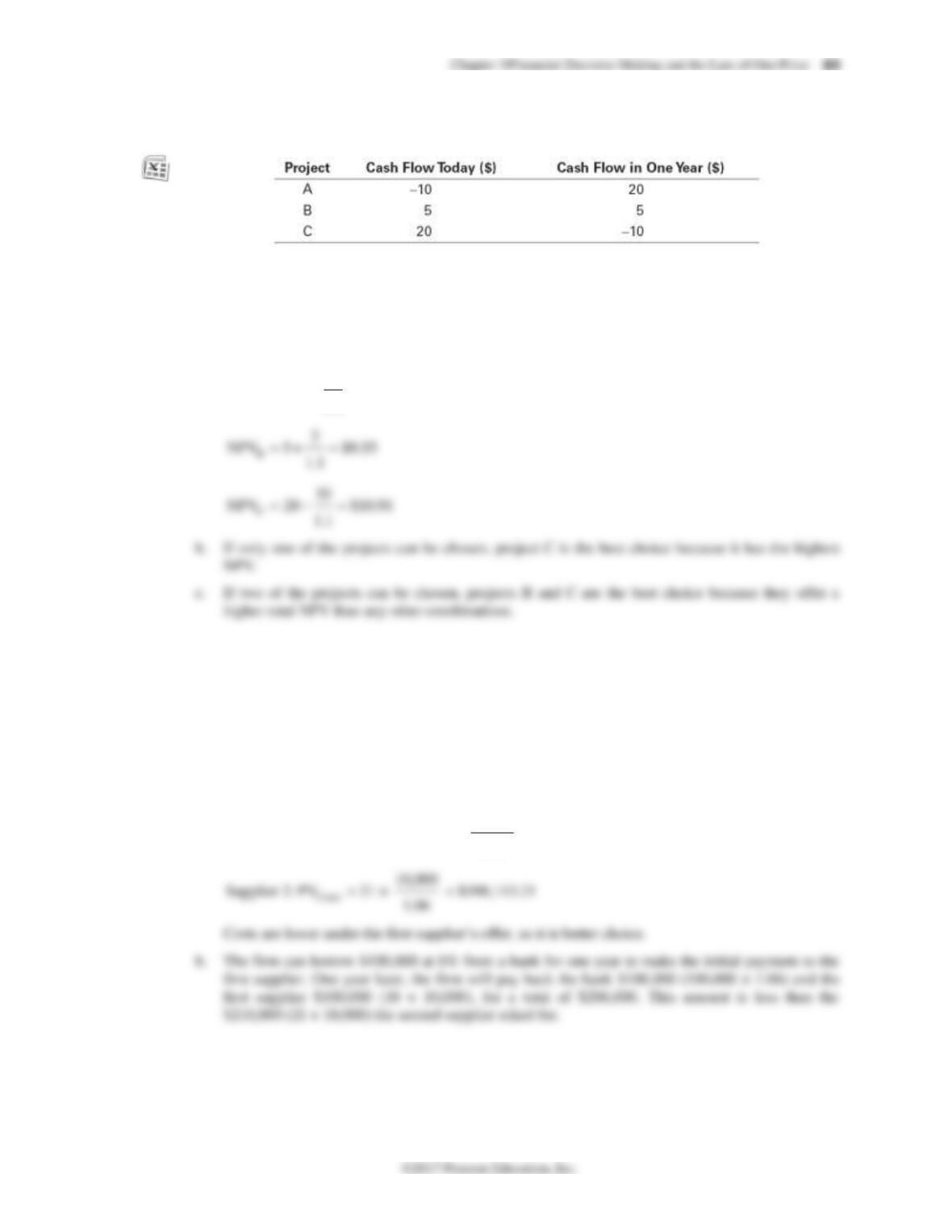
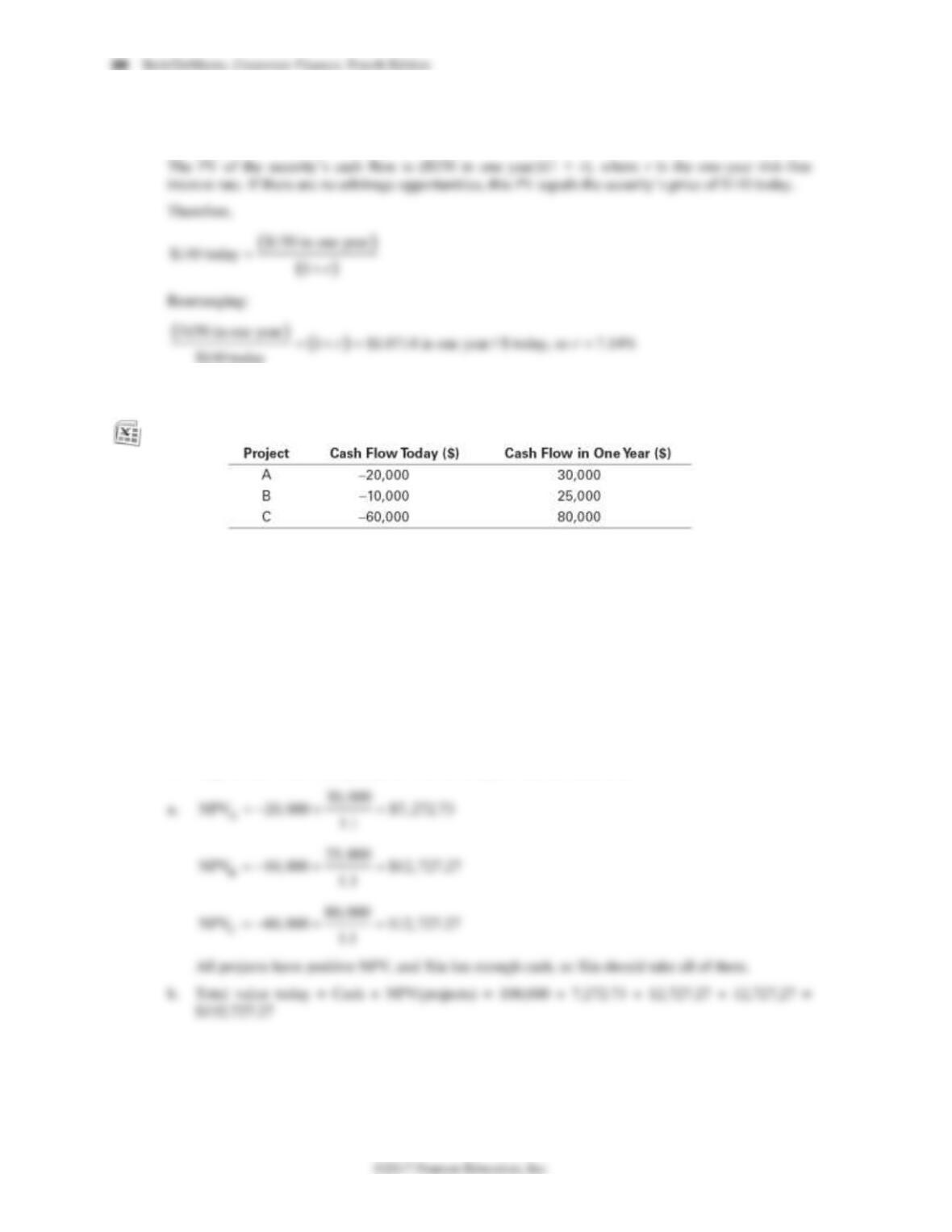
3-10. Your firm has identified three potential investment projects. The projects and their cash flows
are shown here:
Suppose all cash flows are certain and the risk-free interest rate is 10%.
a. What is the NPV of each project?
b. If the firm can choose only one of these projects, which should it choose?
c. If the firm can choose any two of these projects, which should it choose?
a.
A
20
NPV 10 $8.18
1.1
= − + =
3-11. Your computer manufacturing firm must purchase 10,000 keyboards from a supplier. One
supplier demands a payment of $100,000 today plus $10 per keyboard payable in one year.
Another supplier will charge $21 per keyboard, also payable in one year. The risk-free interest
rate is 6%.
a. What is the difference in their offers in terms of dollars today? Which offer should your firm
take?
b. Suppose your firm does not want to spend cash today. How can it take the first offer and not
spend $100,000 of its own cash today?
a.
Costs
10,000
Supplier 1: PV = 100,000 + $10 × = $194,339.62
1.06
3-12. Suppose Bank One offers a risk-free interest rate of 5.5% on both savings and loans, and Bank
Enn offers a risk-free interest rate of 6% on both savings and loans.
a. What arbitrage opportunity is available?
b. Which bank would experience a surge in the demand for loans? Which bank would receive a
surge in deposits?
c. What would you expect to happen to the interest rates the two banks are offering?
3-13. Throughout the 1990s, interest rates in Japan were lower than interest rates in the United States.
As a result, many Japanese investors were tempted to borrow in Japan and invest the proceeds
in the United States. Explain why this strategy does not represent an arbitrage opportunity.
3-14. An American Depositary Receipt (ADR) is security issued by a U.S. bank and traded on a U.S.
stock exchange that represents a specific number of shares of a foreign stock. For example,
Nokia Corporation trades as an ADR with symbol NOK on the NYSE. Each ADR represents one
share of Nokia Corporation stock, which trades with symbol NOK1V on the Helsinki stock
exchange. If the U.S. ADR for Nokia is trading for $6.74 per share, and Nokia stock is trading on
the Helsinki exchange for 6.20 € per share, use the Law of One Price to determine the current $/€
exchange rate.
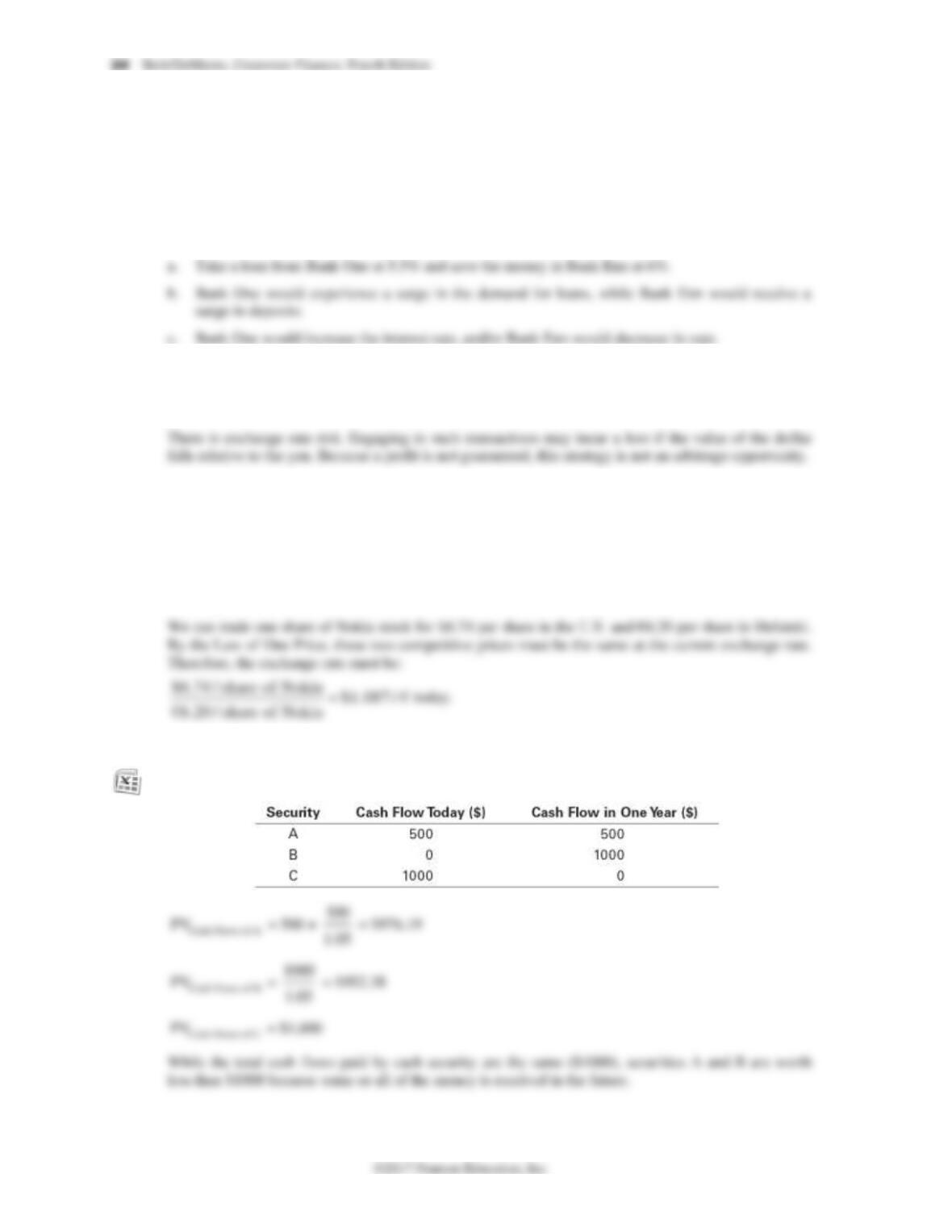
3-15. The promised cash flows of three securities are listed here. If the cash flows are risk-free, and the
risk-free interest rate is 5%, determine the no-arbitrage price of each security before the first
cash flow is paid.
3-16. An Exchange-Traded Fund (ETF) is a security that represents a portfolio of individual stocks.
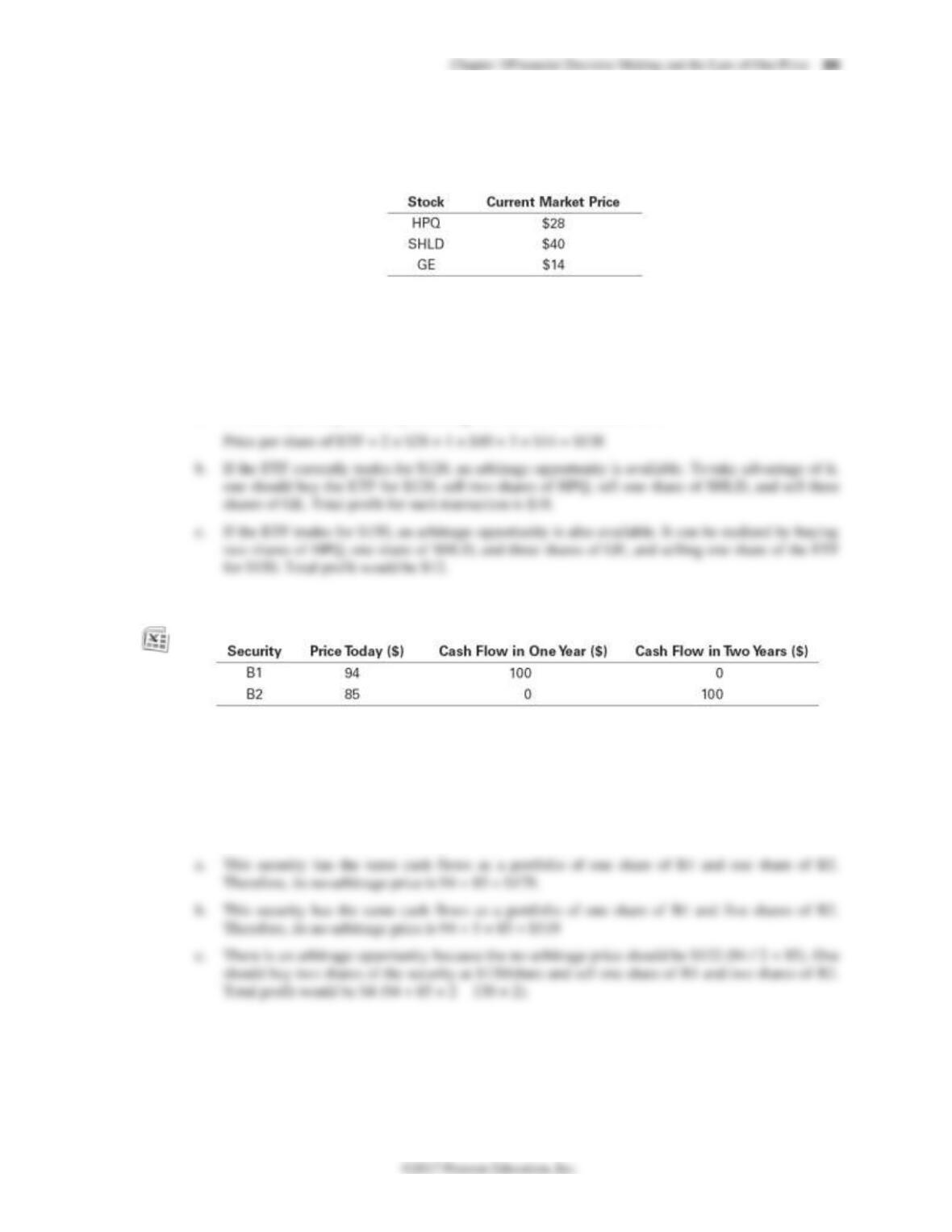
Consider an ETF for which each share represents a portfolio of two shares of Hewlett-Packard
(HPQ), one share of Sears (SHLD), and three shares of General Electric (GE). Suppose the
current stock prices of each individual stock are as shown here:
a. What is the price per share of the ETF in a normal market?
b. If the ETF currently trades for $120, what arbitrage opportunity is available? What trades
would you make?
c. If the ETF currently trades for $150, what arbitrage opportunity is available? What trades
would you make?
a. We can value the portfolio by summing the value of the securities in it:
3-17. Consider two securities that pay risk–free cash flows over the next two years and that have the
current market prices shown here:
a. What is the no-arbitrage price of a security that pays cash flows of $100 in one year and
$100 in two years?
b. What is the no-arbitrage price of a security that pays cash flows of $100 in one year and
$500 in two years?
c. Suppose a security with cash flows of $50 in one year and $100 in two years is trading for a
price of $130. What arbitrage opportunity is available?
3-18. Suppose a security with a risk-free cash flow of $150 in one year trades for $140 today. If there
are no arbitrage opportunities, what is the current risk-free interest rate?
3-19. Xia Corporation is a company whose sole assets are $100,000 in cash and three projects that it
will undertake. The projects are risk free and have the following cash flows:
Xia plans to invest any unused cash today at the risk-free interest rate of 10%. In one year, all
cash will be paid to investors and the company will be shut down.
a. What is the NPV of each project? Which projects should Xia undertake and how much cash
should it retain?
b. What is the total value of Xia’s assets (projects and cash) today?
c. What cash flows will the investors in Xia receive? Based on these cash flows, what is the
value of Xia today?
d. Suppose Xia pays any unused cash to investors today, rather than investing it. What are the
cash flows to the investors in this case? What is the value of Xia now?
e. Explain the relationship in your answers to parts (b), (c), and (d).
Chapter 3/Financial Decision Making and the Law of One Price 27
d. Unused cash = 100,000 – 20,000 – 30,000 – 60,000 = $10,000
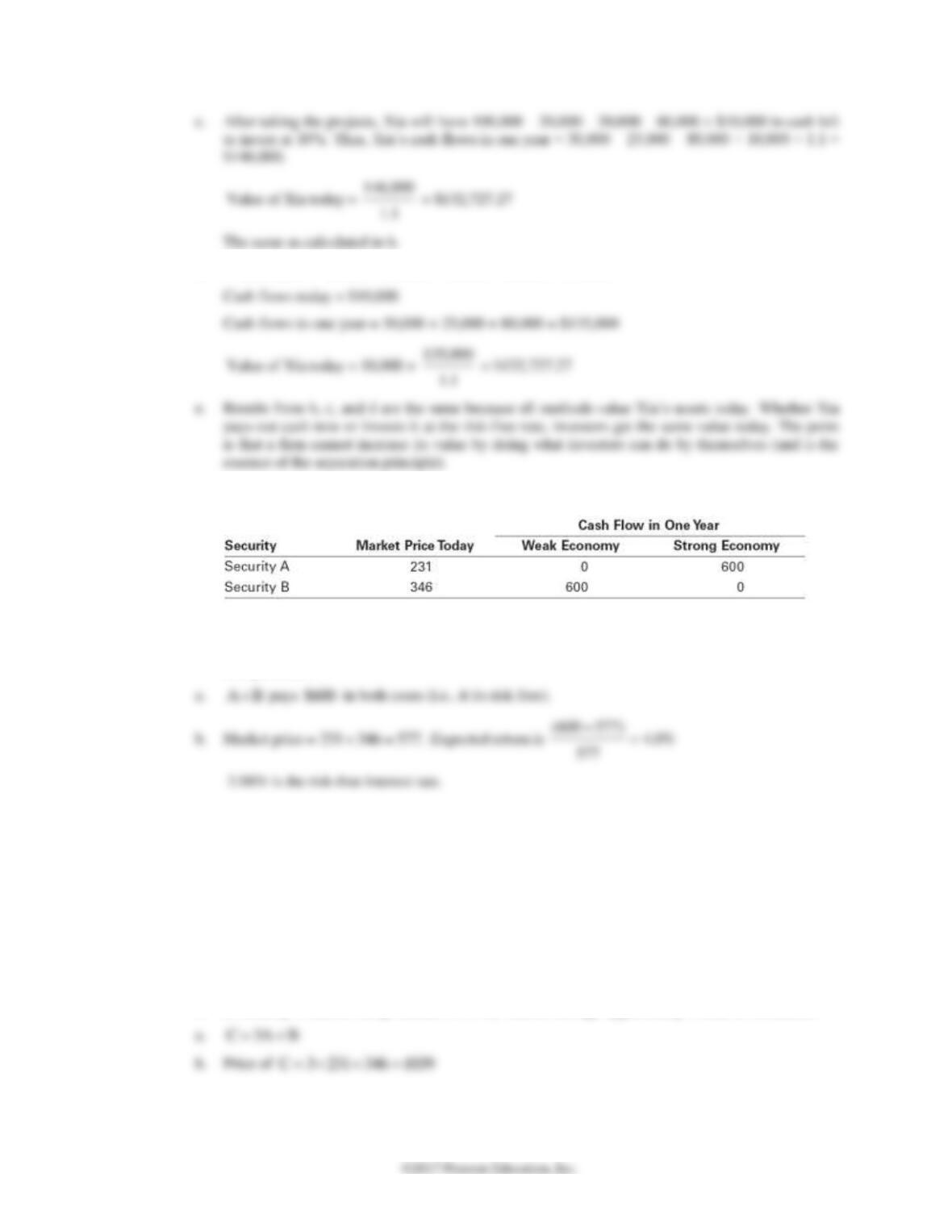
3-A.1. The table here shows the no-arbitrage prices of securities A and B that we calculated.
a. What are the payoffs of a portfolio of one share of security A and one share of security B?
b. What is the market price of this portfolio? What expected return will you earn from holding
this portfolio?
3-A.2. Suppose security C has a payoff of $600 when the economy is weak and $1800 when the economy
is strong. The risk-free interest rate is 4%.
a. Security C has the same payoffs as which portfolio of the securities A and B in problem A–1?
b. What is the no-arbitrage price of security C?
c. What is the expected return of security C if both states are equally likely? What is its risk
premium?
d. What is the difference between the return of security C when the economy is strong and
when it is weak?
e. If security C had a risk premium of 10%, what arbitrage opportunity would be available?
28 Berk/DeMarzo, Corporate Finance, Fourth Edition
3-A.3. You work for Innovation Partners and are considering creating a new security. This security
would pay out $1000 in one year if the last digit in the closing value of the Dow Jones Industrial
index in one year is an even number and zero if it is odd. The one-year risk-free interest rate is
5%. Assume that all investors are averse to risk.
a. What can you say about the price of this security if it were traded today?
b. Say the security paid out $1000 if the last digit of the Dow is odd and zero otherwise. Would
your answer to part (a) change?
c. Assume both securities (the one that paid out on even digits and the one that paid out on odd
digits) trade in the market today. Would that affect your answers?
a. Whether the last digit in the Dow is odd or even has no correlation with the Dow index itself or
3-A.4. Suppose a risky security pays an expected cash flow of $80 in one year. The risk-free rate is 4%,
and the expected return on the market index is 10%.
a. If the returns of this security are high when the economy is strong and low when the
economy is weak, but the returns vary by only half as much as the market index, what risk
premium is appropriate for this security?
b. What is the security’s market price?
Chapter 3/Financial Decision Making and the Law of One Price 29
3-A.5. Suppose Hewlett-Packard (HPQ) stock is currently trading on the NYSE with a bid price of
$28.00 and an ask price of $28.10. At the same time, a NASDAQ dealer posts a bid price for HPQ
of $27.85 and an ask price of $27.95.
a. Is there an arbitrage opportunity in this case? If so, how would you exploit it?
b. Suppose the NASDAQ dealer revises his quotes to a bid price of $27.95 and an ask price of
$28.05. Is there an arbitrage opportunity now? If so, how would you exploit it?
c. What must be true of the highest bid price and the lowest ask price for no arbitrage
opportunity to exist?
3-A.6. Consider a portfolio of two securities: one share of Johnson and Johnson (JNJ) stock and a bond
that pays $100 in one year. Suppose this portfolio is currently trading with a bid price of $141.65
and an ask price of $142.25, and the bond is trading with a bid price of $91.75 and an ask price
of $91.95. In this case, what is the no-arbitrage price range for JNJ stock?
According to the Law of One Price, the price that portfolio of securities is trading at is equal to the sum