CHAPTER 3: THE INTERNATIONAL MONETARY SYSTEM
1
CHAPTER 3
THE INTERNATIONAL MONETARY SYSTEM
This chapter helps students understand the international monetary system and how the choice of system
affects currency values. It also provides a historical background of the international monetary system.
This enables students to gain perspective when trying to interpret the likely consequences of new policies
in the area of international finance.
This chapter describes how exchange rates are determined under four different mechanisms – free
float, managed float, fixed-rate system, and target-zone system. Under the latter three systems,
governments intervene in the currency markets in one form or another to affect the exchange rate.
KEY POINTS
1. Under the latter three systems, which involve varying degrees of central bank intervention, the real
exchange rate is liable to change, with important implications for exchange risk management
(discussed in Chapters 9 and 10).
2. Regardless of the form of intervention, neither fixed nor floating rates remain fixed for long,
governments subordinate exchange rate considerations to domestic political considerations.
3. The gold standard is a specific type of fixed exchange rate system that required participating countries
4. Intervention to maintain a disequilibrium rate is usually either ineffective or injurious when pursued
over lengthy periods. Seldom, if ever, have policymakers been able to outsmart for any extended
5. Examining U.S. experience since the abandonment of fixed rates, we find that free-market forces did
indeed correctly reflect economic realities. The dollar’s value dropped sharply from 1973 to 1980
INSTRUCTORS MANUAL: FOUNDATIONS OF MULTINATIONAL FINANCIAL MANAGEMENT, 6TH ED.
2
SUGGESTED ANSWERS TO “THE EURO REACTS TO NEW INFORMATION”
1. Explain the differing initial and subsequent reactions of the euro to news about the European
Central Bank’s monetary policy.
ANSWER. The initial reaction is based on the expectation of no tightening in the money supply. The result
2. How does a strong pound reduce the threat of imported inflation and work against higher
interest rates?
3. Which U.K. manufacturers are likely to be pressured by a strong pound?
4. Why might higher pound interest rates send sterling even higher? Give two possible reasons.
ANSWER. Higher British interest rates occasioned by a tightening of monetary policy will lead to lower
5. What tools are available to the European Central Bank and the Bank of England to manage
their monetary policies?
ANSWER. Both central banks can use open market operations – which involve buying and selling bonds
CHAPTER 3: THE INTERNATIONAL MONETARY SYSTEM
3
SUGGESTED ANSWERS TO “BRITAIN–IN OR OUT FOR THE EURO”
1. Discuss the pros and cons for Britain of joining EMU.
ANSWER. By joining the EMU, Britain would lock itself into a new European monetary policy. Provided
this monetary policy is dominated by Germany, it is likely to be a low-inflation policy. At the same time,
2. Commentators pointed to the fact that many people in Britain have variable rate mortgages as
opposed to the fixed-rate mortgages more common in Europe. Britain also has the most flexible
labor markets in Europe. How would these factors likely affect Britain’s economic costs and
benefits of joining the euro?
ANSWER. To the extent the EMU is viewed as a serious inflation fighter, Britain’s entry would be viewed
3. What types of British companies would most likely benefit from joining the EMU?
4. Some large MNCs warned that they only chose to invest in Britain on the assumption it would
ultimately adopt the euro. Why would MNCs be interested in Britain joining the euro?
INSTRUCTORS MANUAL: FOUNDATIONS OF MULTINATIONAL FINANCIAL MANAGEMENT, 6TH ED.
4
SUGGESTED ANSWERS TO CHAPTER 3 QUESTIONS
1. a. What are the five basic mechanisms for establishing exchange rates?
1.b. How does each work?
ANSWER. In a free float, exchange rates are determined by the interaction of currency supplies and
1.c. What costs and benefits are associated with each mechanism?
ANSWER.
Benefits of a Floating Rate System. When floating rates were adopted in 1973, proponents said the new
system would reduce economic volatility and facilitate free trade. In particular, floating exchange rates
would offset international differences in inflation rates so that trade, wages, employment, and output
would not have to adjust. High-inflation countries would see their currencies depreciate, allowing their
firms to stay competitive without having to cut wages or employment. At the same time, currency
1.d. Have exchange rate movements under the current system of managed floating been excessive?
Explain.
ANSWER. Excessive movements would indicate that there are profits to be earned by betting against the
2. Find a recent example of a nation’s foreign exchange market intervention and note what the
government’s justification was. Does this justification make economic sense?
3. Gold has been called “the ultimate burglar alarm.” Explain what this expression means.
ANSWER. Governments “burgle” holders of their currencies by printing more money and subjecting
4. Suppose nations attempt to pursue independent monetary and fiscal policies. How will
exchange rates behave?
5. The experiences of fixed exchange-rate systems and target-zone arrangements have not been
entirely satisfactory.
5.a. What lessons can economists draw from the breakdown of the Bretton Woods system?
ANSWER. Adjusting monetary growth rates is the principal way to stabilize exchange rates. For example,
raising the value of the dollar relative to the yen requires tightening U.S. monetary policy relative to
5.b. What lessons can economists draw from the exchange rate experiences of the European
Monetary System?
ANSWER. Exchange rate stability requires that monetary policies be coordinated and geared toward
maintaining exchange rate parities. The slow progress of the European community with respect to the
EMS and policy coordination exemplifies the difficulties of achieving agreements on the many facets of
6. How did the European Monetary System limit the economic ability of each member nation to
set its interest rate to be different from Germany’s?
7. Historically, Spain has had high inflation and has seen its peseta continuously depreciate. In
1989, though, Spain joined the EMS and pegged the peseta to the DM. According to a Spanish
banker, EMS membership means that “the government has less capability to manage the
currency but, on the other hand, the people are more trusting of the currency for that reason.”
7.a. What underlies the peseta’s historical weakness?
7.b. Comment on the banker’s statement.
ANSWER. Countries that seek to participate in the EMS are effectively forced to pursue a monetary policy
7.c. What are the likely consequences of EMS membership on the Spanish public’s willingness to
save and invest?
8. In discussing EMU, a recent government report stressed a need to make the central bank
accountable to the “democratic process.” What are the likely consequences for price stability
and exchange rate stability in the EMS if the “Eurofed” becomes accountable to the
“democratic process?”
9. In 1996, Chancellor Kenneth Clarke called for a national debate on whether Britain should join
the EMU. Discuss the pros and cons for Britain of joining EMU.
ANSWER. By joining the EMU, Britain would lock itself into a new European monetary policy. Provided
this monetary policy is dominated by Germany, it is likely to be a low-inflation policy. At the same time,
CHAPTER 3: THE INTERNATIONAL MONETARY SYSTEM
9
ADDITIONAL CHAPTER 3 QUESTIONS AND ANSWERS
1. Why has speculation failed to smooth exchange rate movements?
2. Is a floating-rate system more inflationary than a fixed-rate system? Explain.
3. Since 1979, the price of gold has fallen by more than 60%. What could explain such a steep
price decline? Consider the roles of inflation and new financial instruments such as swaps and
options that can provide lower-cost inflation hedges.
ANSWER. Gold has traditionally provided a safe haven when economic and political conditions are
uncertain and currencies are volatile because of the belief that it was a sounder store of value than paper
4. Comment on the following statement: “A system of floating exchange rate fails when
governments ignore the verdict of the exchange markets on their policies and resort to direct
controls over trade and capital flows.”
5. Will coordination of economic policies make exchange rates more or less stable? Explain.
6. Despite official parity between the DM and the Ostmark, the black market rate in early 1990
was about ten Ostmarks for one DM. What problems might setting the exchange rate at one
Ostmark for each DM create for Germany?
ANSWER. The basic problem is that, at a one-for-one exchange rate, the Ostmark will be overvalued
relative to the DM. Unless East German wages fall, East German industry will find its cost of doing
7. When Britain announced its entry into the exchange-rate mechanism of the EMS on October 5,
1990, the price of British gilts (long-term government bonds) soared and sterling rose in value.
7.a. What might account for these price jumps?
ANSWER. By entering the exchange-rate mechanism, Britain has effectively foresworn devaluation of the
7.b. Sterling entered the ERM at a central rate against the DM of DM 2.95, and it is allowed to
move within a band of +/– 6% of this rate. What are sterling’s upper and lower rates against
the DM?
8. What potential costs might be associated with the decision to widen the margins within which
some currencies in the ERM can float?
9. Comment on the following headline in The Wall Street Journal (January 11, 1993): “Germany’s
Rate Cut Takes Pressure Off French Franc, and the Rest of the EMS.”
ANSWER. The origin of the September 1992 currency crisis was the Bundesbank’s decision to maintain
10. The French franc was the main target of speculators during the August 1993 assault on the
EMS despite the fact that France was running a 2% inflation rate while Germany had a 4.3%
inflation rate. Why might this be?
11. In early 1996, in response to growing doubts about the ability of EC nations to meet the
Maestricht criteria and move toward monetary union by the 1999 deadline, yields on
European bonds jumped. What is the likely link between the doubts on Maestricht and the EC
bond yield increases?
12. “For a fixed exchange rate system to work, the government must be able to make tight budget
and monetary policies stick from the outset.” Comment.
13. On taking office in October 1993, the Bundesbank’s new president, Hans Tietmeyer, said,
“Forced reductions in central bank interest rates which are contrary to stability policies can
neither solve economic or structural problems. But they would undermine trust in currency
values, drive long-term interest rates higher and delay necessary corrections in the real
economy.” Explain the context in which Mr. Tietmeyer made these comments. Do you agree or
disagree with his comments? Explain.
14. Comment on the following statement: “Wage flexibility is a substitute, albeit an imperfect one,
for exchange rate flexibility.”
ANSWER. If an economic shock leads to domestic imbalances between supply and demand, a change in
CHAPTER 3: THE INTERNATIONAL MONETARY SYSTEM
13
SUGGESTED SOLUTIONS TO CHAPTER 3 PROBLEMS
1. During the currency crisis of September 1992, the Bank of England borrowed DM33 billion
from the Bundesbank when a pound was worth DM2.78, or $1.912. It sold these DM in the
foreign exchange market for pounds in a futile attempt to prevent a devaluation of the pound. It
repaid these DM at the post-crisis rate of DM2.50:£1. By then, the dollar:pound exchange rate
was $1.782:£1.
1.a. By what percentage had the pound sterling devalued in the interim against the DM? Against
the dollar?
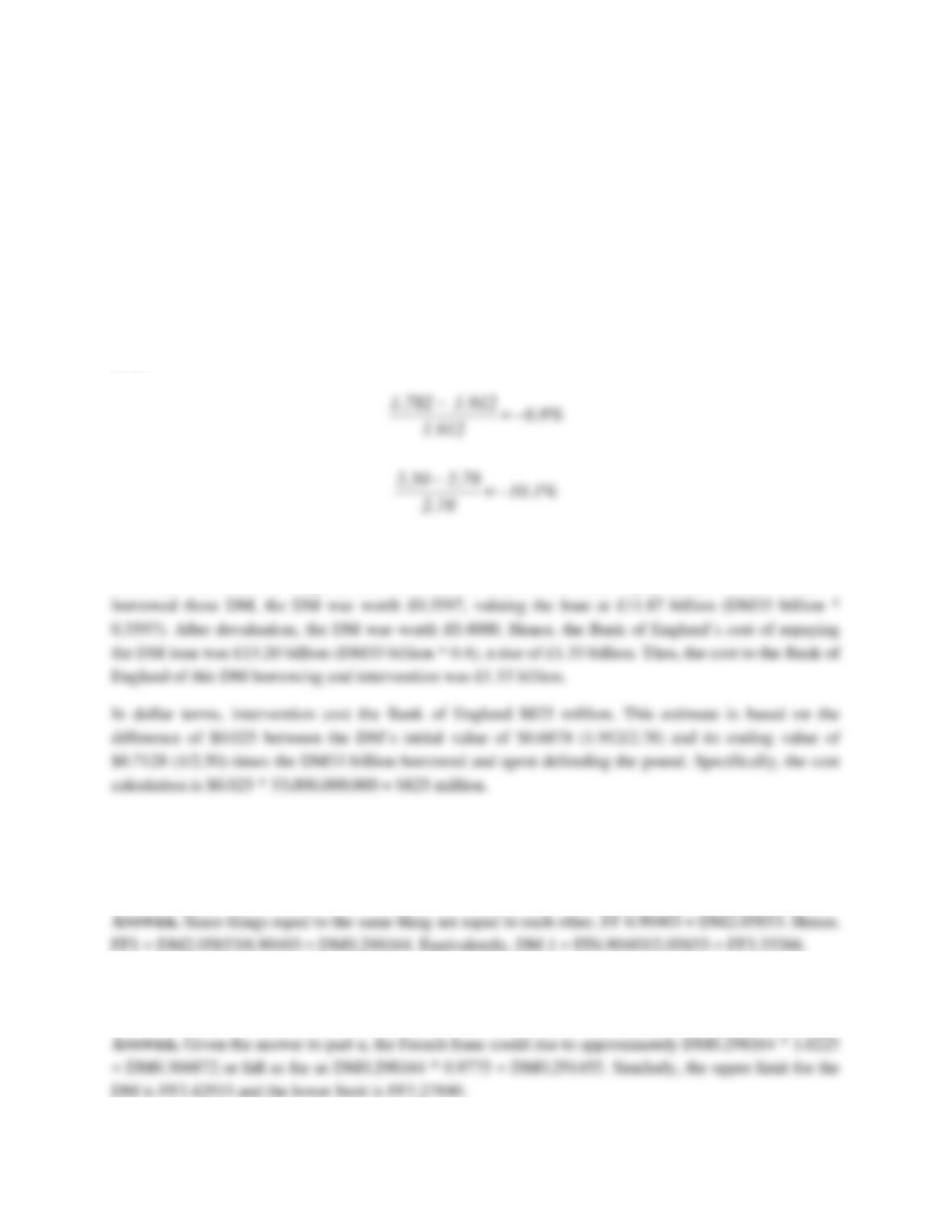
ANSWER. During this period, the pound depreciated by 10.1% against the pound and by 6.8% against the
dollar.
1.b. What was the cost of intervention to the Bank of England in pounds? In dollars?
ANSWER. The Bank of England borrowed DM 33 billion and must repay DM33 billion. When it
2. Suppose the central rates within the ERM for the French franc and DM are FF 6.90403:ECU 1
and DM 2.05853:ECU 1, respectively.
2.a. What is the cross-exchange rate between the franc and the DM?
2.b. Under the original 2.25% margin on either side of the central rate, what were the
approximate upper and lower intervention limits for France and Germany?
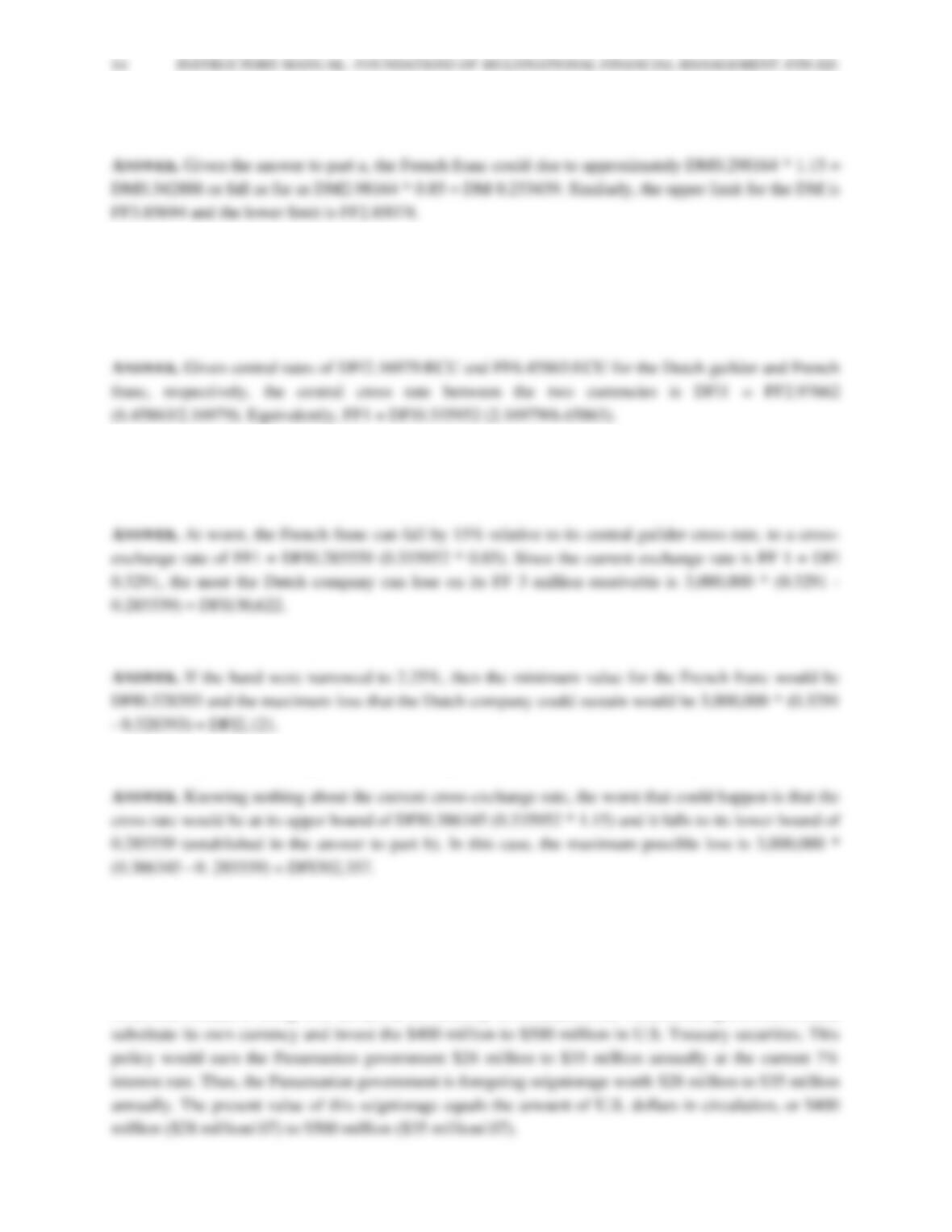
2.c. Under the revised 15% margin on either side of the central rate, what are the current
approximate upper and lower intervention limits for France and Germany?
3. A Dutch company exporting to France has FF3 million due in 90 days. Suppose that the current
exchange rate is FF1 = Dfl0.3291.
3.a. Under the exchange rate mechanism, and assuming central rates of FF6.45863/ECU and
DFl2.16979/ECU, what is the central cross-exchange rate between the two currencies?
3.b. Based on the answer to part a, what is the most the Dutch company could lose on its French
franc receivable, assuming that France and the Netherlands stick to the ERM with a 15%
band on either side of their central cross rate?
3.c. Redo part b, assuming the band was narrowed to 2.25%.
3.d. Redo part b, assuming you know nothing about the current cross-exchange rate.
4. Panama adopted the U.S. dollar as its official paper money in 1904. Currently, about $400
million to $500 million in U.S. dollars is circulating in Panama. If interest rates on U.S.
Treasury securities are 7%, what is the value of the seigniorage that Panama is forgoing by
using the U.S. dollar instead of its own-issue money?
ANSWER. Instead of using U.S. dollars as its currency in circulation, the Panamanian government could
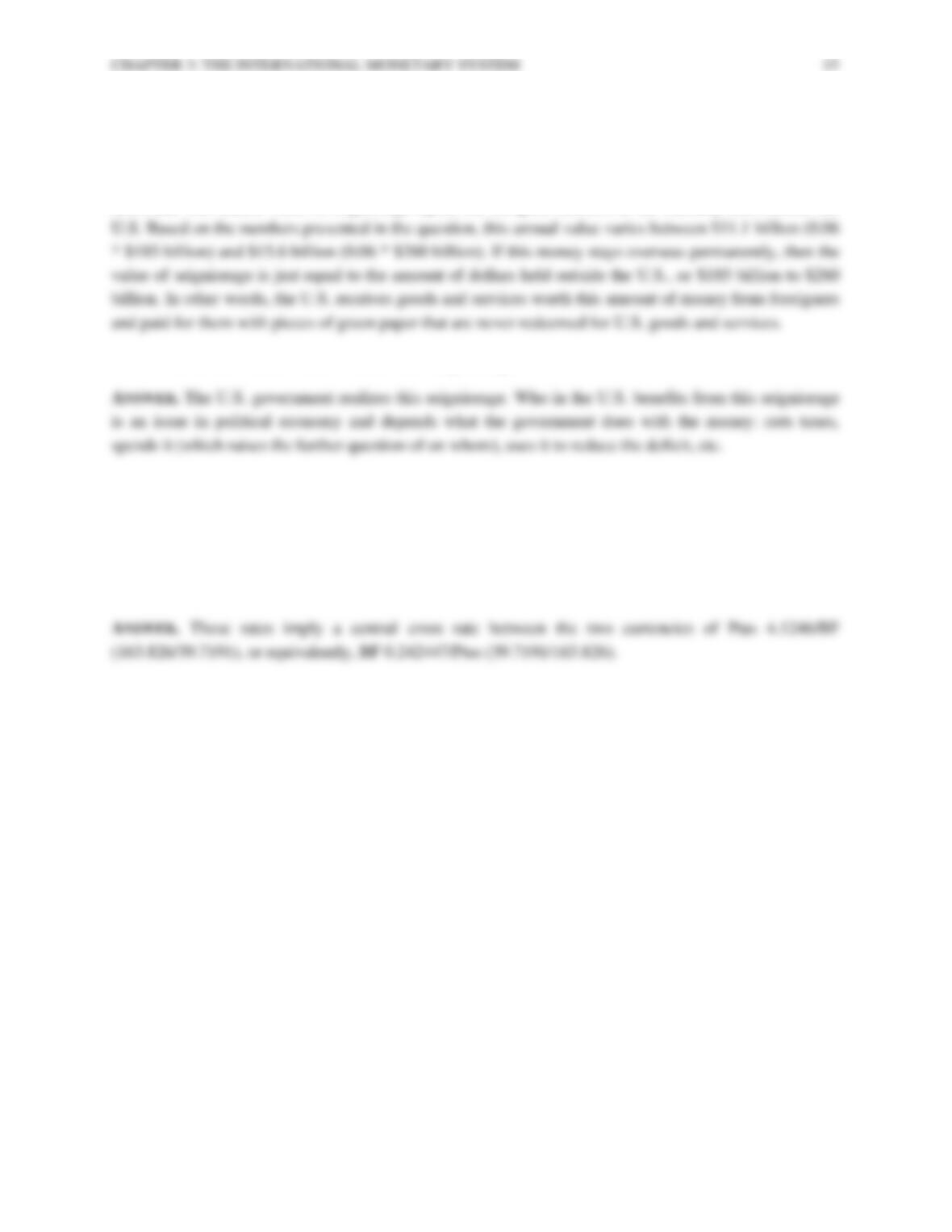
5. By some estimates, $185 billion to $260 billion in currency is held outside the U.S.
5.a. What is the value to the U.S. of the seigniorage associated with these overseas dollars?
Assume that dollar interest rates are about 6%.
ANSWER. The annual value of seigniorage equals the foregone interest on the currency held outside the
5.b. Who in the United States realizes this seigniorage?
ADDITIONAL CHAPTER 3 PROBLEM AND SOLUTION
1. The central rates for the Spanish and Belgian currencies on March 20, 1997, were Ptas
163.826/ECU and BF 39.7191/ECU. What central cross rate between these two currencies did
these central rates imply?