Preparing Your Taxes
Chapter 3
How Will This Affect Me?
There is an old joke that people who complain about taxes can be divided into two groups: men
and women. This chapter helps you pursue the tax-planning goal of maximizing the money that
you get to keep by legally minimizing the taxes you have to pay. Income, various adjustments to
income, deductions, and credits are considered in computing taxes. The chapter walks through
the steps in completing representative tax returns. The impact of Social Security taxes and tax
shelters are considered. Care is taken to distinguish between complying with tax laws and
regulations and understanding how to plan so as to minimize your tax burden. And a framework
for choosing a professional tax preparer or tax preparation software is provided. After reading
this chapter you should be able to prepare your own taxes or to better understand and evaluate
how your taxes are prepared by software or a tax professional.
LEARNING GOALS
LG1 Discuss the basic principles of income taxes and determine your filing status.
All taxes have a tax base and a tax rate, thus tax = base * rate. The name of the tax indicates the
tax base, thus, the tax base for the income tax is income; for the sales tax, the base is sales; and
so on. Income in general is similar for accounting purposes and for tax purposes, with several
differences designed to achieve some public policy goal. The concept of standard deduction and

There are four sets of rates – Single, Joint, Married filing separately, and Head of households.
The 2018 rates are in the textbook. The 2019 and 2020 rates for single and for joint returns are
below. The chapter has several examples of computing the tax. You can build the tax by
computing the tax on each bracket of income or use the rate schedule that computes the tax on
income up to the first number in the bracket and then you add the additional tax using the
appropriate marginal tax rate. Using the 2018 single tax rate, the tax on $36,900 is $4,238
computed as
Worksheet 3.0 computes the tax using either single or joint rates for adjusted gross income less
either itemized deductions or standard deduction for the years 2018,2019, and 2020.

2018 Tax Rates
Taxpayers using the Single rates
Taxable Income is Between
Tax Due is
0 – $9,525
10% of taxable income
$9,526 – $38,700
$952.50 + 12% of the amount over $9,525
$38,701 – $82,500
$4,453.50 + 22% of the amount over $38,700
$82,501 – $157,500
$14,089.50 + 24% of the amount over $82,500
$200,001 – $500,000
$45,689.50 + 35% of the amount over $200,000
$500,001 or more
$159,689.50 + 37% of the amount over $500,000
Taxpayers using the Married filing Joint Returns and
Surviving Spouses rates
Taxable Income is Between
Tax Due is
0 – $19,050
10% of taxable income
$19,051 – $77,400
$1,905 + 12% of the amount over $19,050
$77,401 – $165,000
$8,907 + 22% of the amount over $77,400
$165,001 – $315,000
$28,179 + 24% of the amount over $165,000
$315,001 – $400,000
$64,179 + 32% of the amount over $315,000
$400,001 – $600,000
$91,379 + 35% of the amount over $400,000
$600,001 or more
$161,379 + 37% of the amount over $600,000

2018 Tax Rates
Taxpayers using the Head of Household Rates
Taxable Income is Between
Tax Due is
Taxpayers using the Married filing Separately Rates
Taxable Income is Between
Tax Due is
0 – $9,525
10% of taxable income
$9,526 – $38,700
$952.50 + 12% of the amount over $9,525
$38,701 – $82,500
$4,453.50 + 22% of the amount over $38,700
$82,501 – $157,500
$14,089.50 + 24% of the amount over $82,500
$157,501 – $200,000
$32,089.50 + 32% of the amount over $157,500
$200,001 – $300,000
$45,689.50 + 35% of the amount over $200,000
$300,001 or more
$80,689.50 + 37% of the amount over $300,000

2019 Tax Rates
Taxpayers using the Single rates
Taxable Income is Between
Tax Due is
0 – $9,700
10% of taxable income
$9,701 – $39,475
$970 + 12% of the amount over $9,700
$39,476 – $84,200
$4,543 + 22% of the amount over $39,475
$84,201 – $160,725
$14,383 + 24% of the amount over $84,200
$204,101 – $510,300
$46,629 + 35% of the amount over $204,100
$510,301 or more
$153,799 + 37% of the amount over $510,300
Taxpayers using the Married filing Joint Returns and
Surviving Spouses rates
Taxable Income is Between
Tax Due is
0 – $19,400
10% of taxable income
$19,401 – $78,950
$1,940 + 12% of the amount over $19,400
$78,951 – $168,400
$9,086 + 22% of the amount over $78,950
$168,401 – $321,450
$30,554 + 24% of the amount over $168,400
$321,451 – $408,200
$79,530 + 32% of the amount over $321,450
$408,201 – $612,350
$109,893 + 35% of the amount over $408,200
$612,351 or more
$185,428 + 37% of the amount over $612,350

2020 Tax Rates
Taxpayers using the Single rates
Taxable Income is Between
Tax Due is
0 – $9,875
10% of taxable income
$9,876 – $40,125
$987.50 + 12% of the amount over $9,875
$40,126 – $85,525
$4,617.50 + 22% of the amount over $40,125
$85,526 – $163,300
$14,605.50 + 24% of the amount over $85,525
$207,351 – $518,400
$47,367.50 + 35% of the amount over $207,350
$518,401 or more
$156,235.00 + 37% of the amount over $518,400
Taxpayers using the Married filing Joint Returns and
Surviving Spouses rates
Taxable Income is Between
Tax Due is
0 – $19,750
10% of taxable income
$19,751 – $80,250
$1,975 + 12% of the amount over $19,750
$80,251 – $171,050
$9,235 + 22% of the amount over $80,250
$171,051 – $326,600
$29,211 + 24% of the amount over $171,050
$326,601 – $414,700
$66,543 + 32% of the amount over $326,600
$414,701 – $622,050
$94,735 + 35% of the amount over $414,700
$622,051 or more
$167,307.50 + 37% of the amount over $622,050

LG2 Describe the sources of gross income and adjustments to income, differentiate between
standard and itemized deductions, and calculate taxable income.
Exhibit 3.1 gives the steps to compute taxable income and the related tax liability. It will be
good to go over these steps.
The standard deduction varies by taxpayer’s age and filing status. Most common are the single
status which has a standard deduction of $12,000 in 2018, and the married filing joint status
which has a standard deduction of $24,000 in 2018. They change every year as the Consumer
Price Index changes. If the taxpayer’s itemized deductions are greater, the Schedule A is filed
and the itemized deductions deducted. The itemized deductions tend to be greater if the taxpayer
has state income taxes and mortgage interest on up to two personal residences. Below is a very
good summary of itemized deductions that is included in the chapter. It is reproduced here for
your information.
Itemized Deductions
Itemized deductions allow taxpayers to reduce their AGI by the amount of their allowable
personal expenditures. The Internal Revenue Code defines the types of nonbusiness items that
can be deducted from AGI. Here are some of the more common ones:

LG3 Prepare a basic tax return using the appropriate tax forms and rate schedules.
All taxpayers may file a form 1040, age 1 and page 2. In addition, there are six Schedules that
report more detail which is then reported on Form 1040. Supporting the Schedules are additional
forms. For example, Schedule A reports itemized deductions that is then transferred to form
1040.
Worksheet 3.1 is an example of a form 1040 for the year 2018. All forms are available on the
IRS website, irs.gov/forms and publications.
LG4 Explain who needs to pay estimated taxes, when to file or amend your return, and how to
handle an audit.
People frequently will say that they did not pay taxes because they got a refund. A refund only
means that you have overpaid the taxes you owe. In effect you have loaned money to the federal
government at zero interest. Better to have a small balance due, an amount that you can easily

LG5 Know where to get help with your taxes and how software can make tax return preparation
easier.
Most taxpayers can prepared their own tax returns as well as change the oil in their car.
LG6 Implement an effective tax planning strategy.
There are two strategies to tax planning:
Income shifting – Shift income to a taxpayer in a lower tax bracket or between years, from a high
tax year to a low tax year. Perhaps you can bunch your itemized deductions. For example make
Financial Facts or Fantasies?
These may be used as “teasers” to get the students on the right page with you. Also, they may be
used as quizzes after you covered the material or as “pre–test questions” to get their attention.
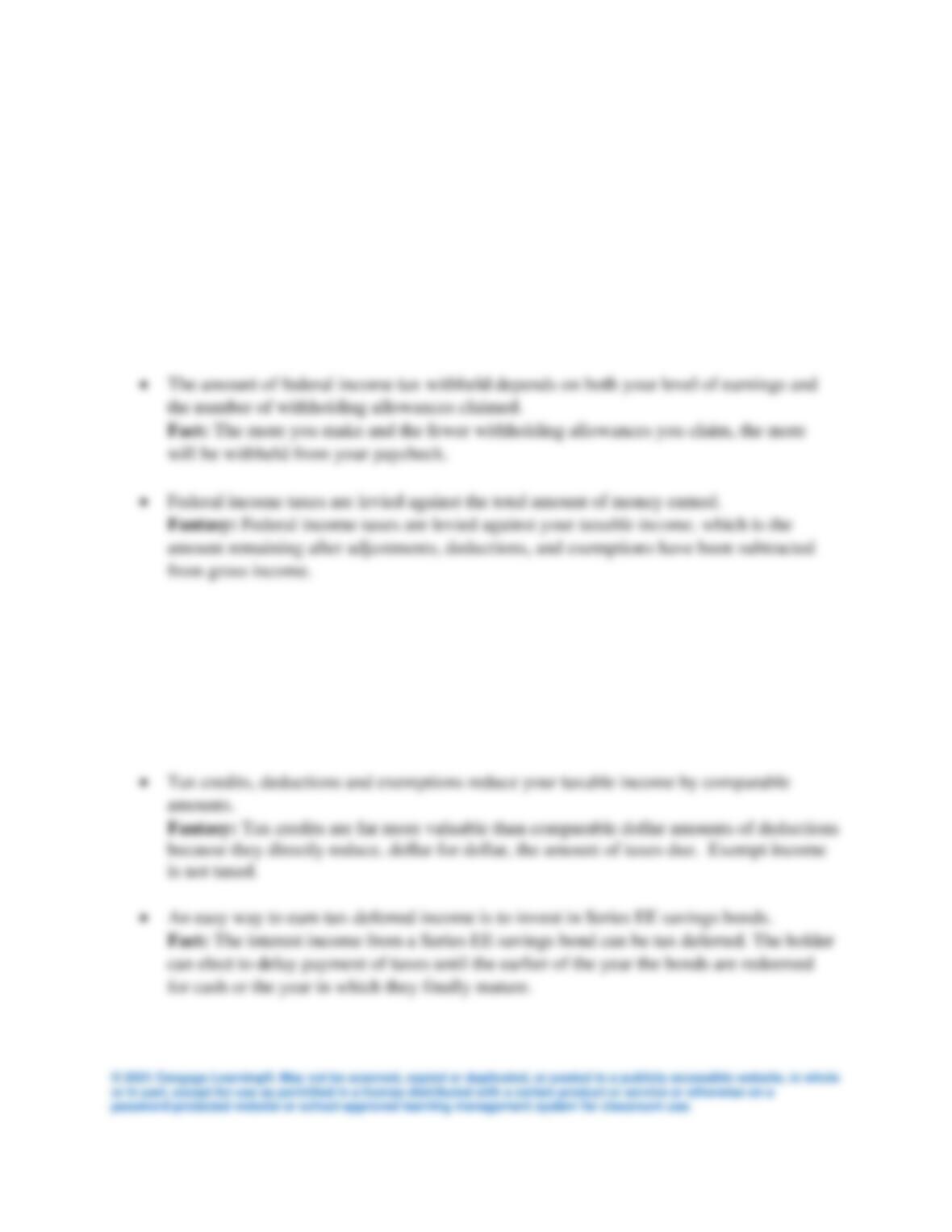
Are the following statements Financial Facts (true) or Fantasies (false)? Consider the answers to
the questions below as you read through this chapter.
• Every individual or married couple is required to file a federal income tax return
regardless of the amount of income earned.
Fantasy: Only those individuals or married couples who earn a specified minimum level
of income or wish to receive a refund or withheld taxes are required to file a tax return.
• Gains on the sale of investments such as stocks, bonds, and real estate are taxed at the
lower capital gains tax rate.
Fantasy: Only capital gains on investments held for longer than 12 months (long-term)
qualify for tax rates lower than those on ordinary income. Short-term capital gains are
taxed at ordinary income rates. Thus, all gains on the sale of investments do not qualify
for the lower capital gains tax rate.

Financial Facts or Fantasies?
These may be used as a quiz or as a pre-test to get the students interested.
1. True False Every individual or married couple is required to file a federal income tax
return regardless of the amount of income earned.
2. True False The amount of federal income tax withheld depends on both your level of
earnings and the number of withholding allowances claimed.
3. True False Federal income taxes are levied against the total amount of money earned.
4. True False Gains on the sale of investments such as stocks, bonds, and real estate are
taxed at the lower capital gains tax rate.
5. True False Tax credits, deductions and exemptions reduce your taxable income by
comparable amounts.
6. True False An easy way to earn tax-deferred income is to invest in Series EE savings
bonds.

YOU CAN DO IT NOW
The “You Can Do It Now” cases may be assigned to the students as short cases or problems.
They will help make the topic more real or relevant to the students. In most cases, it will only
take about ten minutes to do, that is, until the student starts looking around at the web site. But
they will learn by doing so.
Tax Planning
Consider whether you expect your tax rate to be lower, the same, or higher next year. Then do
some simple but effective tax planning:
Solutions to Financial Planning Exercises
1. Calculating Marginal Tax Rates. Amelia Hall is single and received the following items
and amounts of income during 2018. Determine the marginal tax rate applicable to each
item. Note that if the item is not taxable, the marginal rate is 0.
Salary $30,000
Qualified dividends 800
Gift from mother 500
Item
Amount
Marginal
Rate
Discussion
Salary
$30,000
12%
Taxable income over $9,525 and under
$38,700 is taxed at 12%.
Qualified dividends
800
0%
Dividends are taxed at the alternative
capital gains rate, which is 0 if the
ordinary income tax rate is 10 or 12%.
Gift from mother
500
0%
Gifts are excluded from gross income,
0%
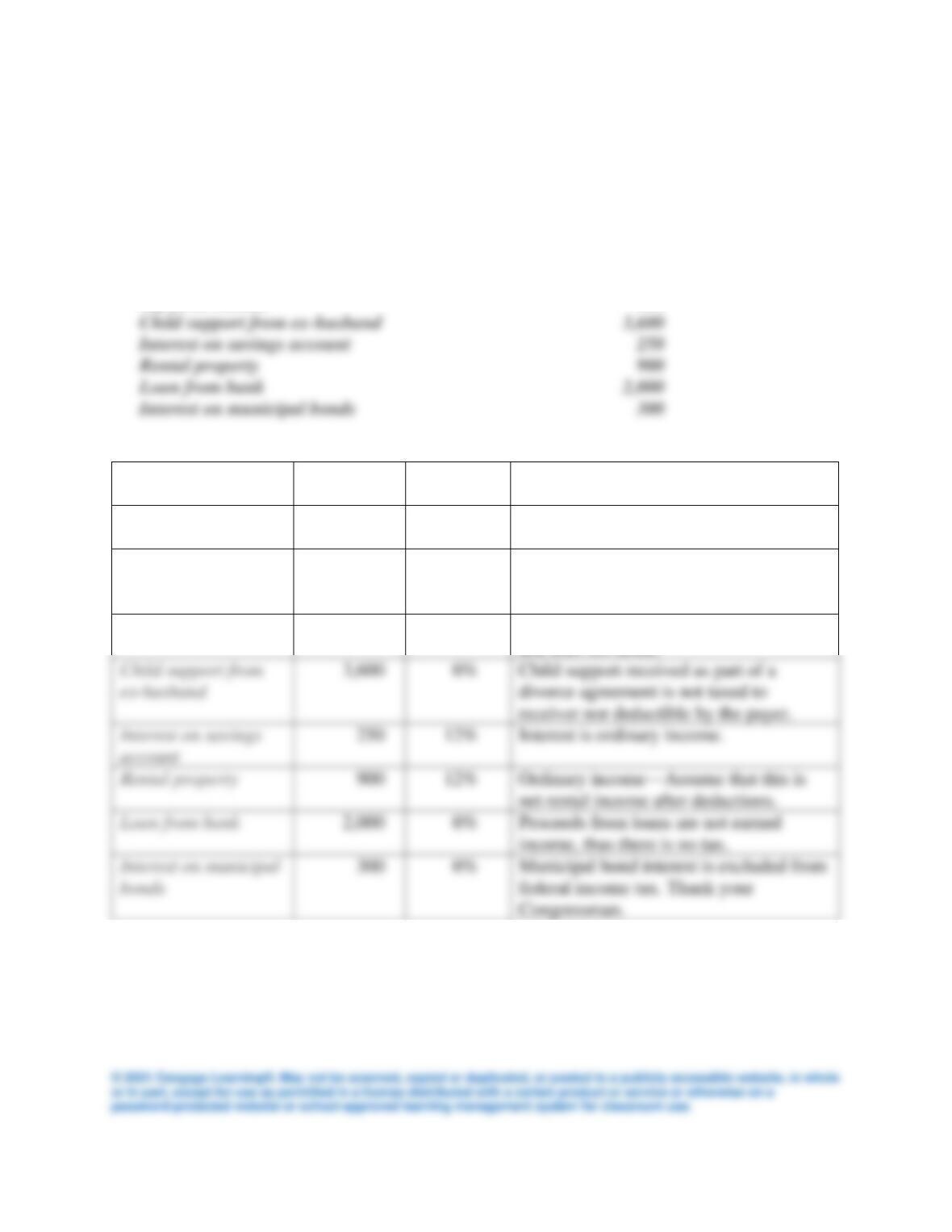
Child support received as part of a
divorce agreement is not taxed to
receiver nor deductible by the payer.
12%
Interest is ordinary income.
Rental property
12%
Ordinary income—Assume that this is
net rental income after deductions.
Proceeds from loans are not earned
income, thus there is no tax.

2. Estimating Taxable Income, Tax Liability, and Potential Refund. Charlotte Taylor is 24
years old and single, lives in an apartment, and has no dependents. Last year, she
Adjusted gross income = $55,000 + $142 = $55,142
3. Calculating Taxes on Security Transactions. If Isabella Rodriguez is single and in the 24
percent tax bracket, calculate the tax associated with each of the following transactions.
(Use the IRS regulations for capital gains in effect in 2018.)
a. She sold stock for $1,200 that she purchased for $1,000 5 months earlier.
She has a capital gain of $1,200 – $1,000 = $200. It is a short-term (held less than 12
months) capital gain and will be taxed at 24 percent.
b. She sold bonds for $4,000 that she purchased for $3,000 3 years earlier.
She has a capital gain of $4,000 – $3,000 = $1,000. It is a long-term (held more than 12
c. She sold stock for $1,000 that she purchased for $1,500 15 months earlier.
She has a capital loss of $1,000 – $1,500 = $500. It is a long-term capital loss and
4. Effect of Tax Credit versus Tax Exemption. Explain and calculate the differences
resulting from a $2,000 tax credit versus a $2,000 tax deduction for a single taxpayer
with $40,000 of pre-tax income.
Pre-tax income of $40,000 less the $12,000 standard deduction results in taxable income of
$28,000 for a single taxpayer. The marginal tax rate for $28,000 taxable income is 12

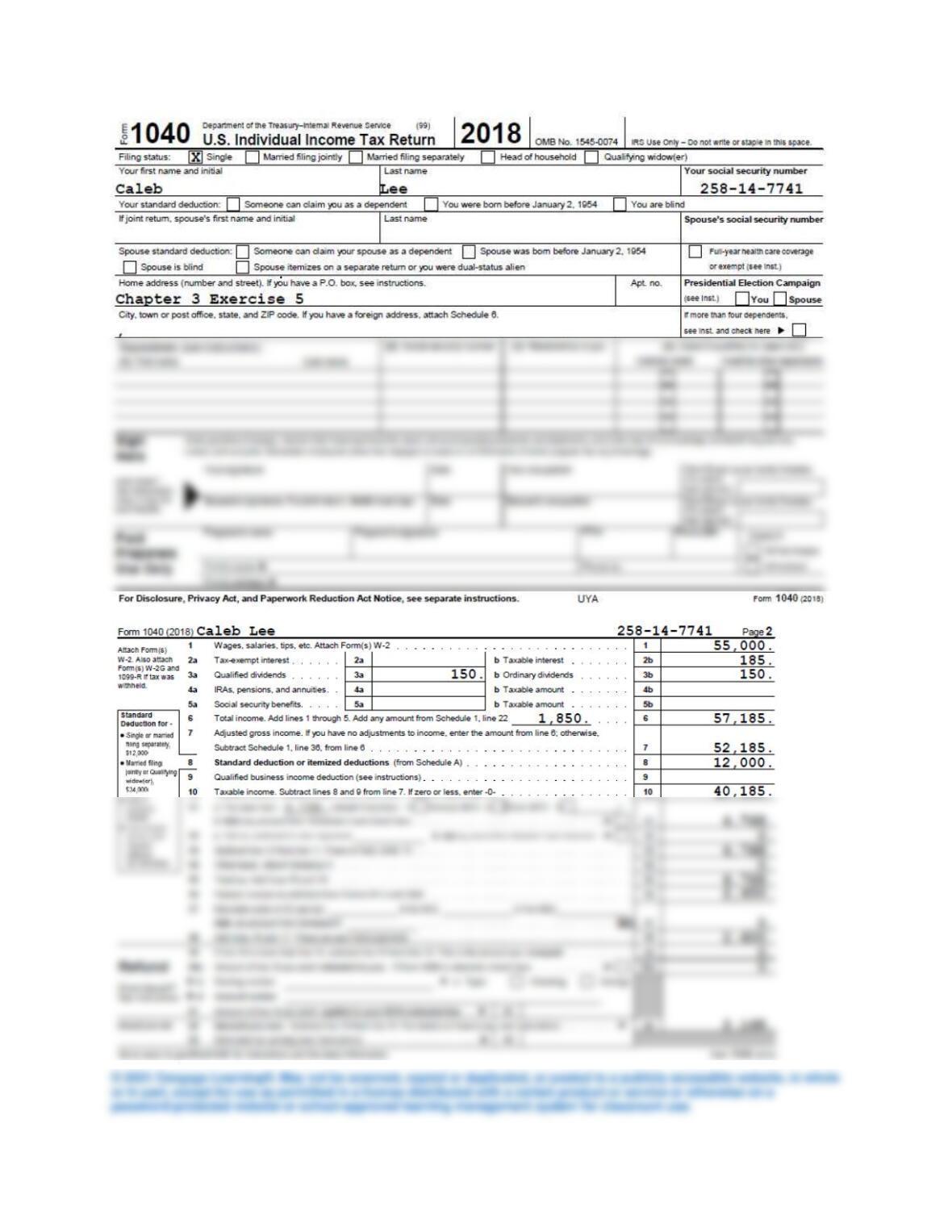
5. Preparing an Individual’s Tax Form. Caleb Lee graduated from college in 2018 and
began work as a systems analyst in July of that year. He is preparing to file his income
tax return for 2018, and has collected the following financial information for calendar
year 2018. A blank Form 1040 and Schedule 1 may be obtained at www.IRS.gov.
Tuition scholarships and grants $ 5,750
a. Prepare Caleb’s tax return, using a $12,000 standard deduction and the tax rates
given in Exhibit 3.3. Assume Caleb is single and his tuition scholarships and grants
are nontaxable (do not exceed tuition), but his room and board scholarship is
taxable.
Adjusted gross income is $1,850 + $55,000 + 185 = $57,035

b. Prepare Caleb’s tax return using the data in part a, along with the following
information:
IRA contribution $5,000
Qualified cash dividends received from U.S. corporation 150
Completed Form 1040, page 1 and page 2, is provided on the following page for part b.
Note that the tax return was prepared using Tax Act software. The software apparently
rounds some numbers so that the tax due is $2,168, which is $1.70 different than the
manual computations provided. Rounding is acceptable per IRS and here.