
6. Calculating Taxable Income for a Married Couple Filing Jointly. Emily and Luke
Robinson are married and have one child. Luke is putting together some figures so that he
can prepare the Robinsons’ joint 2018 tax return. So far, he’s been able to determine the
following concerning income and possible deductions:
Total unreimbursed medical expenses incurred $ 1,155
Gross wages and commissions earned 50,770
IRA contribution 5,000
Mortgage interest paid 5,200
Capital gains realized on assets held less than 12 months 1,450
Income from limited partnership 200
Interest paid on credit cards 380
Assume that Luke is not covered by a pension plan where he works, his child qualifies
for the child tax credit, and the standard deduction of $24,000 for married filing jointly
applies. How much taxable income will the Robinsons have for 2018?
Gross income:
Gross wages
$50,770
Income from limited partnership
200
Capital gains―short term
$1,450
Capital losses
(3,475)
Net capital loss
(2,025)
Qualified dividends
350
Bond interest
220
Gross income
$49,515
IRA contribution
Adjusted gross income
$44,515
Less: Standard deduction
24,000
Taxable income
$20,515
Less: Qualified dividends
Ordinary taxable income
$20,165
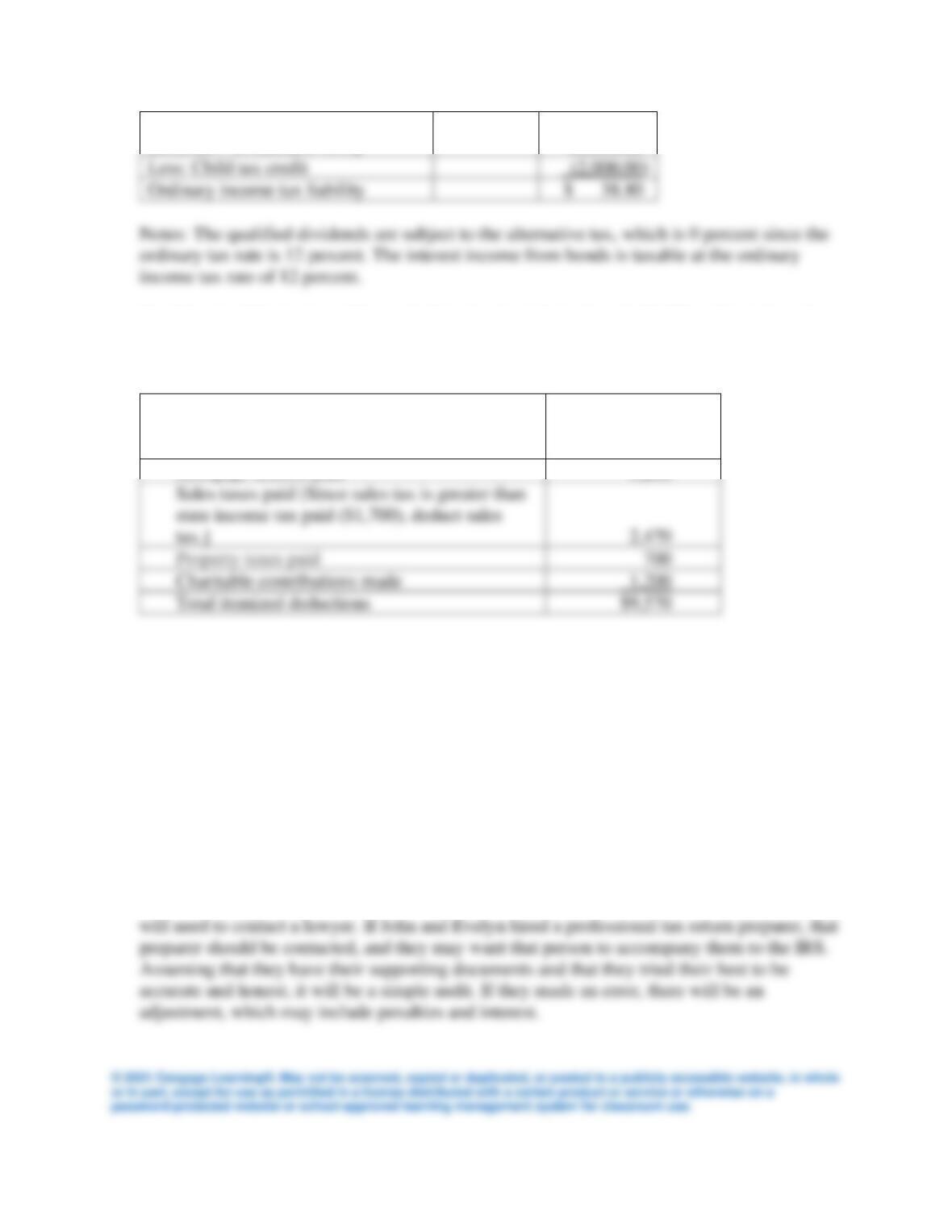
Ordinary income tax [$1,905 +
Total Itemized Deductions: The total of the itemized deductions is $9,570, which is less than
the standard deduction of $24,000. Thus, the standard deduction is used. The itemized
deductions are:
Total unreimbursed medical expenses incurred
($1,155 is less than 10% of AGI, thus $0 is
deductible.)
$ 0
Nondeductible Items: Interest paid on credit cards, interest paid on a car loan, and Social
Security taxes paid are personal items and are not deductible.
Earned Income Credit: The Robinsons would qualify for an earned income credit of about
$300 since their investment income is under $3,350. However, the credit is not discussed in
the text and thus is not included here.
7. Preparing for a Tax Audit. John and Evelyn Harris have been notified that they are
being audited. What should they do to prepare for the audit?
John and Evelyn should keep calm, because it is only an audit. They should gather their
records and supporting documents. If the notice is from the criminal division of the IRS, they

Critical Thinking Cases
3.1 The Clarks Tackle Their Tax Return
Lillian and Jackson Clark are a married couple in their early 20s living in Los Angeles.
Jackson Clark earned $93,000 in 2018 from his job as a sales assistant. During the year, his
employer withheld $11,685 for income tax purposes. In addition, the Clarks received
Medical and dental expenses (unreimbursed) $ 200
State and local property taxes 831
Interest paid on home mortgage 4,148
Charitable contributions 1,360
Total $6,539
In addition, Jackson incurred some unreimbursed travel costs for an out-of-town business
trip:
Airline ticket $250
Critical Thinking Questions
1. Using the Clarks’ information, determine the total amount of their itemized deductions.
Assume that they’ll use the filing status of married filing jointly, the standard deduction for
that status is $24,000. Should they itemize or take the standard deduction?
Medical and dental expenses (unreimbursed)
$200 less 10% of AGI, thus 0 deductible
State and local property taxes
831
Interest paid on home mortgage
4,148
Charitable contributions
1,360
deductible
Total Itemized Deductions
$6,539 – Standard is higher
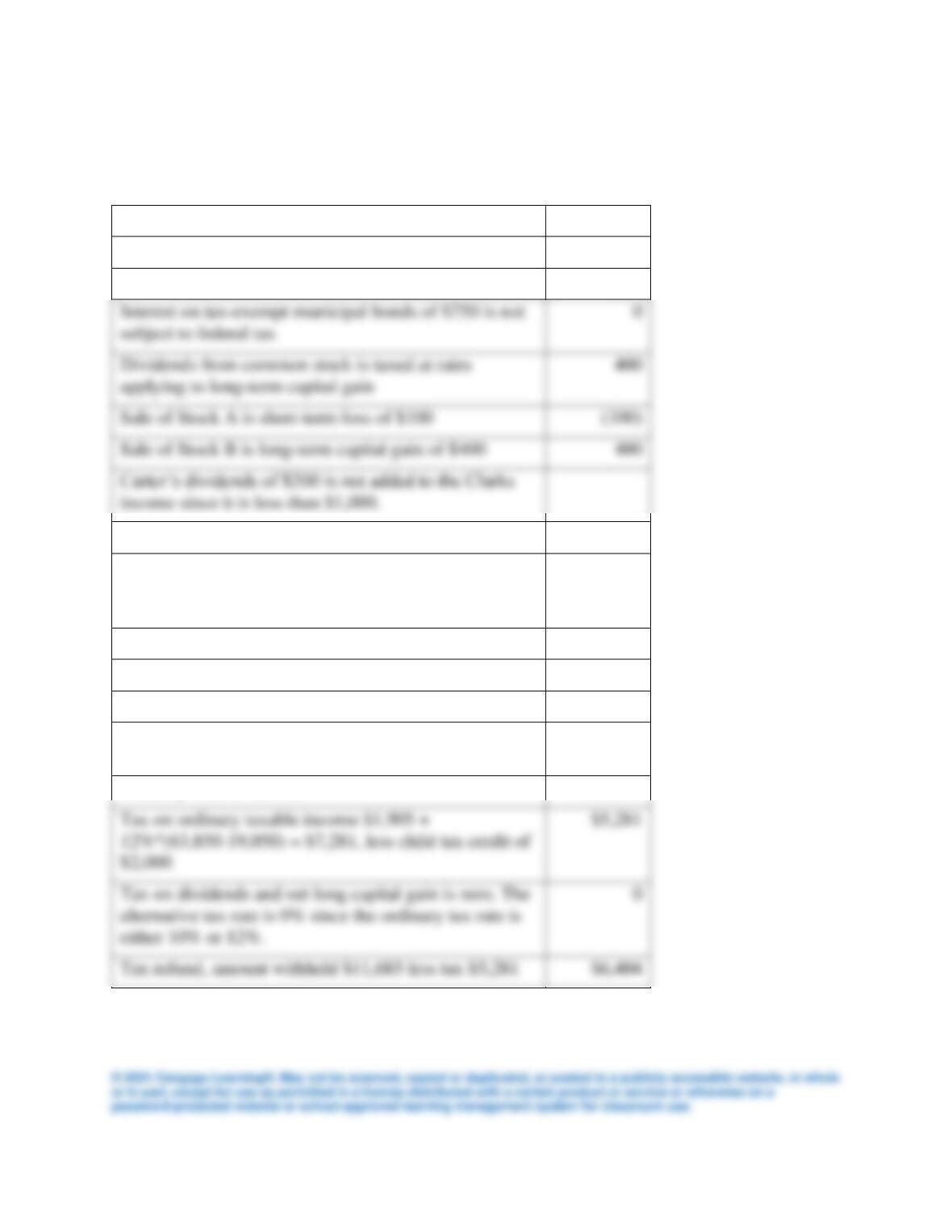
Prepare a schedule computing the tax on a joint return for Jackson and Lillian Clark for
the year ended December 31, 2018, that gives them the smallest tax liability. Use the
appropriate tax rate schedule provided in Exhibit 3.3 to calculate their taxes owed.
Items of income or deduction
Jackson’s salary
$93,000
Joint saving account interest
350
Interest on tax-exempt municipal bonds of $750 is not
subject to federal tax
Sale of Stock A is short-term loss of $100
Sale of Stock B is long-term capital gain of $400
400
income since it is less than $1,000.
Contribution to an IRA account
(5,500)
Unreimbursed employee expenses, the travel costs, are
not deductible. If he was self-employed, they would be
deductible.
Total Adjusted Gross Income
$88,550
Less the standard deduction
(24,000)
Taxable Income, total
$64,550
Income subject to alternative tax rate, net long-term
capital gains plus dividends (400 -100) + 400 = $700
($700)
Ordinary taxable income
$63,850
Tax on ordinary taxable income $1,905 +
12%*(63,850-19,050) = $7,281, less child tax credit of
$2,000
Tax refund, amount withheld $11,685 less tax $5,281

2. How much have you saved the Clarks through your treatment of their deductions?
If they itemized, the deductions would be $6,339
Standard deduction for married couple is 24,000
3. Discuss whether the Clarks need to file a tax return for their son.
A taxpayer claimed as a dependent on another’s tax return and receiving unearned income is not
4. Suggest some tax strategies that the Clarks might use to reduce their tax liability for next
year.
1. They can increase the amount of their retirement deduction if the employer will establish a
401(k) plan. The limit for 401(k) plans in 2018 is $18,500. In addition, Lillian may make a
contribution to a spousal IRA of $5,500.
2. They have a large refund. They should invest part, at least half, in a taxable mutual fund or
3.2 Julian Thomas: Waiter or Tax Expert?
Julian Thomas, who is single, goes to graduate school part-time and works as a waiter at
the Bay Grill in San Francisco. During 2018, his gross income was $20,700 in wages and

Gross income:
Wages $12,500
Tips 8,200
Adjusted gross income (AGI) $20,700
Less: Itemized deductions −2,300
Critical Thinking Questions
1. Calculate Julian Thomas’s taxable income. Assume that the standard deduction for a
single taxpayer is $12,000,
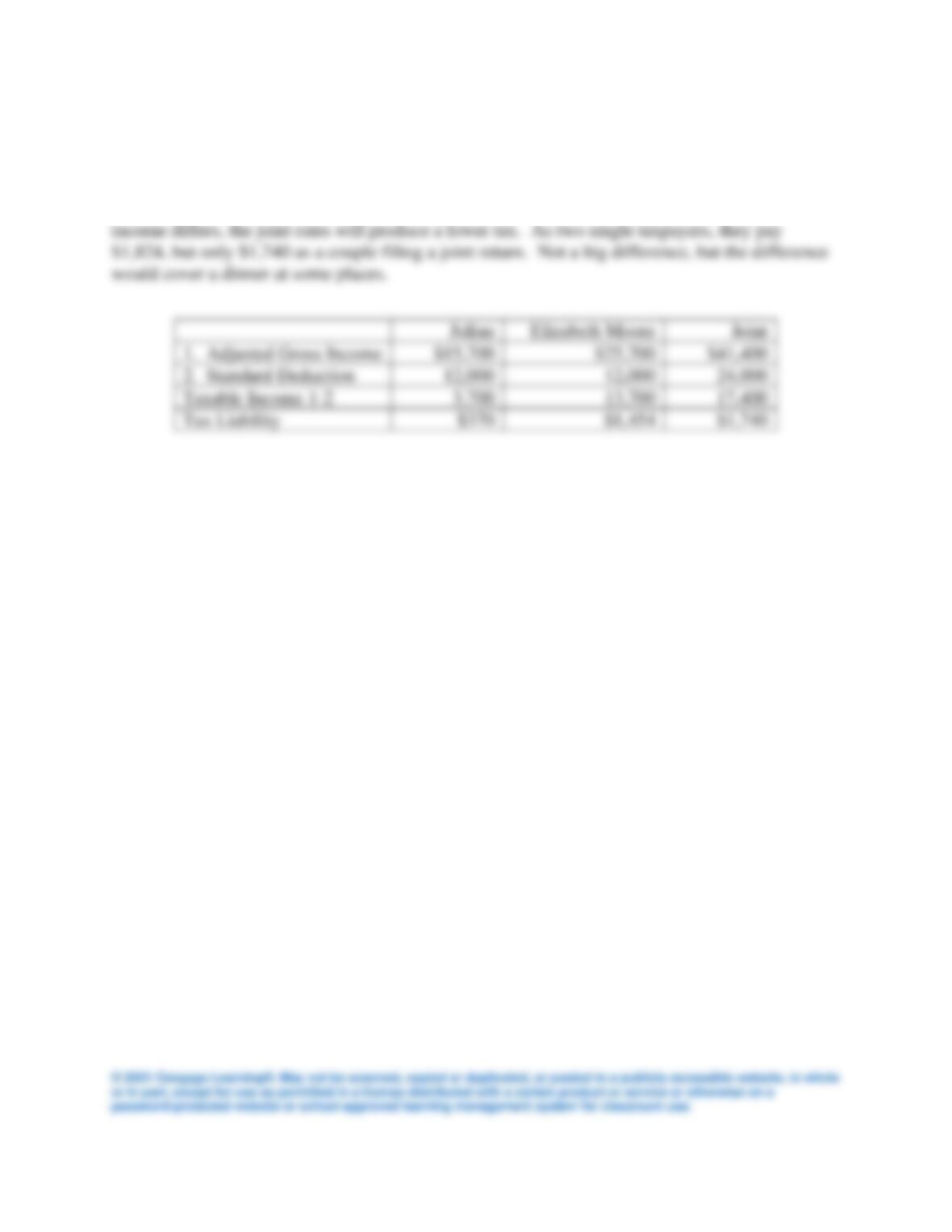
Use for part 1 and 3
Julian
Elizabeth Moore
Joint
1. Adjusted Gross Income
$20,700
$20,700
$41,400
2. Standard Deduction
Taxable Income 1-2
Tax Liability
2. Discuss Julian’s errors in interpreting the tax laws, and explain the difference between
itemized deductions and the standard deduction.
We all wish the tax law say something it does not. Taxpayer may deduct either standard
deduction or itemized deductions, not both. A point could be made to remind all that if the tips
3. Julian has been dating Elizabeth Moore for nearly four years, and they are seriously
thinking about getting married. Elizabeth has income and itemized deductions that are
identical to Julian’s. How much tax would they pay as a married couple (using the filing
status of married filing jointly and a standard deduction of $24,000) versus the total
amount the two would pay as single persons (each using the filing status of single)? Strictly
from a tax perspective, does it make any difference whether Julian and Elizabeth stay
single or get married? Explain.
When the income level is the same, the total tax is the same whether single or joint. If the

Test Yourself Questions
3-1 What is a progressive tax structure and the economic rationale for it?
The progressive tax structure uses a progressive tax rate where the rate increases [ from 10% to
37% as taxable income increases. The economic concepts supporting the progressive tax are
3-2 Briefly define the five filing categories available to taxpayers. When might married
taxpayers choose to file separately?
The five filing statuses are:
Single taxpayer is not married on last day of year
Married filing jointly—both parties to the marriage agree and take responsibility for the tax
3-3 Distinguish between gross earnings and take-home pay. What does the employer do with
the difference?
Take-home pay is the gross earnings less required income tax withholding, FICA taxes [Social
Security and Medicare taxes], and less any fringe benefits paid for by taxpayer such as group life

3-4 What two factors determine the amount of federal withholding.
Tax withholding will vary by filing status, number of withholding exemptions claimed, and
3-5 Define and differentiate between gross income and AGI. Name several types of tax-
exempt income. What is passive income?
Goss income is income from whatever source derived unless excluded by Congress. Examples
of excluded income are interest on state and local bonds, proceeds from various insurances, and
3-6 What is a capital gain, and how is it treated for tax purposes?
Capital gain is gain from the sale of capital assets. Capital assets is defined in the negative, that
is, it is anything except receivables, inventory, real property used in a trade or business, personal
property used in a trade or business, and so on. What is not not a capital asset? Investments in
stocks, bonds, raw land, real estate [not used in a business], personal assets, and so on.

3-7 If you itemize your deductions, you may include certain expenses as part of your
itemized deductions. Discuss five types of itemized deductions and the general rules that
apply to them.
Medical expenses—deductible if they exceed 7,5% [in 2018, 10% in 2019 and thereafter] of
adjusted gross income
3-8 Define and differentiate between the average tax rate and the marginal tax rate.
How does a tax credit differ from an itemized deduction?
Average tax rate is the tax due divided by the taxable income. The marginal tax rate is the rate
3-9 Explain how the following are used in filing a tax return: (a) Form 1040, and (b) tax
rate schedules.
a. Form 1040 is the main form used in filing federal income taxes. All individuals filing
may use Form 1040 accompanied by appropriate schedules as needed to file their tax
return. The form’s two pages summarize all items of income, the deductions detailed on

3-10 Define estimated taxes and explain under what conditions such tax payments are
required.
Taxpayers who do not work for an employer, must pay their own taxes four times a year: April
3-11 What is the purpose of a tax audit? Describe some things you can do to be prepared if
your return is audited.
A tax audit is a review of a tax return to prove its accuracy with regard to the proper reporting of
income and deductions. Some taxpayers are chosen randomly for audits, while others are audited
3-12 What types of assistance and tax preparation services does the IRS provide?
The IRS attempts to provide tax assistance on a walk-in basis at its various offices in the larger
decline in service from the IRS.
3-13 What are the advantages of using tax preparation software?
Tax software provides guidance, computation, and form preparation based upon taxpayer inputs.

3-14 Differentiate between tax evasion and tax avoidance.
Tax avoidance is the practice of using various legal strategies to reduce one‘s tax liability. Tax
3-15 Explain each of the following strategies for reducing current taxes: (a) maximizing
deductions, (b) income shifting, (c) tax-free income, and (d) tax-deferred income.
a. Taxpayers can maximize deductions by accelerating or bunching their deductions into
one tax year. Examples include paying next year’s property taxes early in order to be able
to count both, this year’s and next year’s taxes on this year’s return and bunching non-
c. Tax-free income is income which is free from federal income taxation. For example,
qualified municipal bonds pay interest income which is free from federal income taxes.
However, if you live where there is a state and/or local income tax, qualified municipal
bonds from other states will be subject to your state and local income taxes. Be aware
that not all municipal bonds qualify for the tax-exempt status and that capital gains on the
sale of municipal bonds are not tax free!

Key Terms
adjusted gross
adjustments to
(gross) income
Allowable deductions from gross income, including certain
employee, personal retirement, insurance, and support expenses.
amended return
A tax return filed to adjust for information received after the
average tax rate
The rate at which each dollar of taxable income is taxed on
average; calculated by dividing the tax liability by taxable
The amount of income remaining after subtracting all allowable
income.
estimated taxes
Tax payments required on income not subject to withholding
that are paid in four installments.
exemptions
Deductions from AGI based on the number of persons supported
by the taxpayer’s income. Exemptions are not allowed from
2018-2025 unless the law is changed.
Contributions Act
(FICA), or Social
Security tax
Disability, and Hospital Insurance tax levied on both employer
and employee.
federal withholding
taxes
withholding allowances claimed—that an employer deducts
deductions, or exemptions) subject to federal taxes; it includes
active, portfolio, and passive income. Defined in Section 61 as
income shifting
A technique used to reduce taxes in which a taxpayer shifts a
portion of income to relatives in lower tax brackets.
income taxes
A type of tax levied on taxable income by the federal
government and by many state and local governments.
itemized deductions
determining taxable income
marginal tax rate
The tax rate that you pay on the next dollar of taxable income.
progressive tax
structure
A tax structure in which the larger the amount of taxable
income, the higher the rate at which it is taxed.
standard deduction
age, and vision and can be taken by a taxpayer whose total
itemized deductions are too small.
Personal expenditures that can be deducted from AGI when

taxable income
The amount of income subject to taxes; it is calculated by
subtracting adjustments, the larger of itemized or standard
deductions, and exemptions from gross income.
taxes
The dues paid for membership in our society; the cost of living
in this country.
tax audit
An examination by the IRS to validate the accuracy of a given
tax return.
tax avoidance
The act of reducing taxes in ways that are legal and compatible
with the intent of Congress.
tax credits
or her taxes due rather than taxable income.
tax evasion
The illegal act of failing to report income or deductions
accurately and, in extreme cases, failing to pay taxes altogether.

Chapter Outline
Learning Goals
I. Understanding Federal Income Tax Principles
A. The Economics of Income Taxes
B. Your Filing Status
II. It’s Taxable Income That Matters
A. Gross Income
1. Three Kinds of Income
2. Capital Gains
D. Exemptions
*Test Yourself*
III. Calculating and Filing Your Taxes
A. Tax Rates
B. Tax Credits
C. Tax Forms and Schedules

c. Adjusted Gross Income (AGI)
E. Issues for High Income Taxpayers
*Test Yourself*
IV. Other Filing Considerations
A. Estimates, Extensions, and Amendments
B. Audited Returns
C. Tax Preparation Services: Getting Help on Your Returns
1. Help from the IRS
2. Private Tax Preparers
D. Computer-Based Tax Returns
*Test Yourself*
V. Effective Tax Planning
A. Key Objectives of Tax Planning
B. Some Popular Tax Strategies
C. The Tax Return and the Financial Planning Process
*Test Yourself*
Planning Over a Lifetime
Summary

3.1 The Clarks Tackle Their Tax Return