Chapter 3 CFIN6
Chapter 3 Solutions
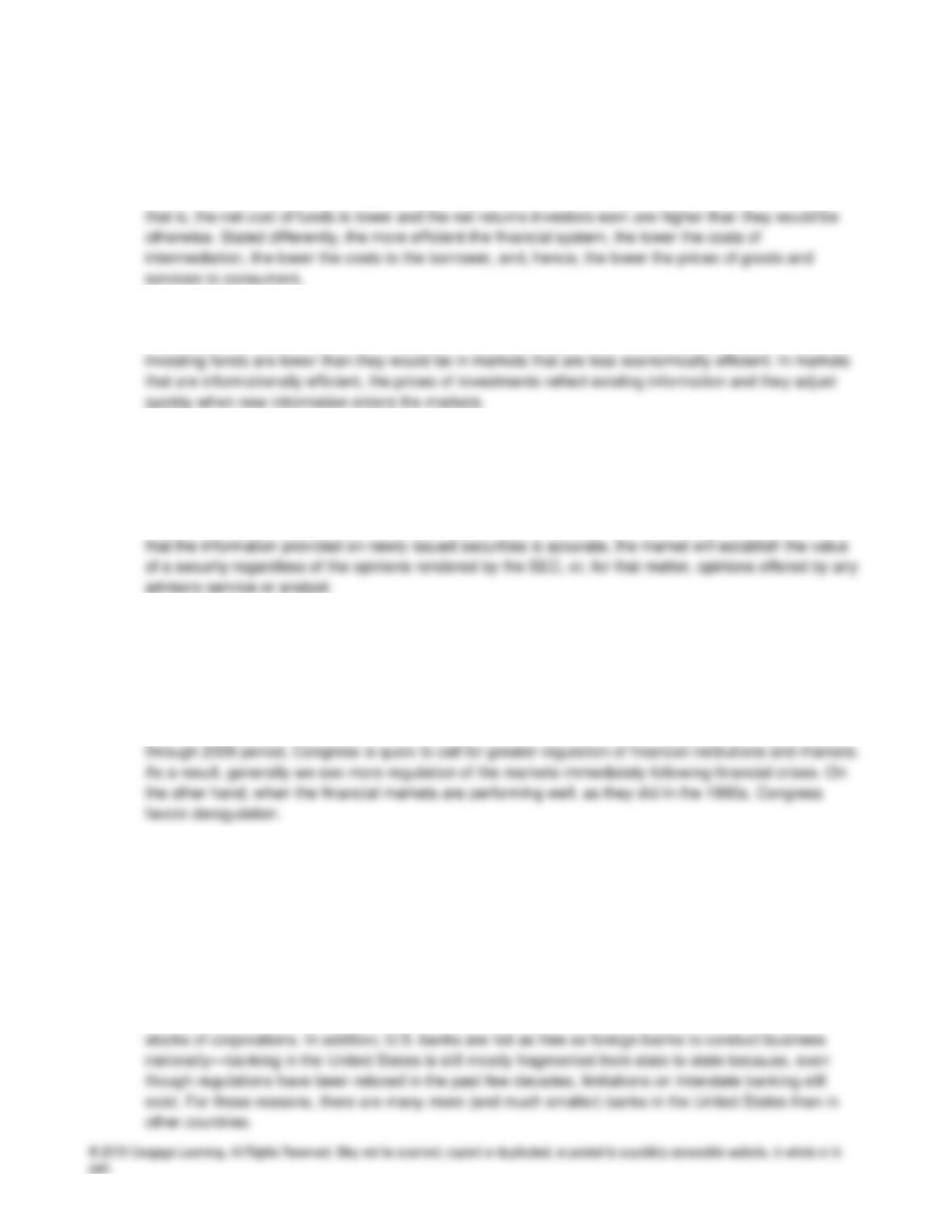
3-1 Free and efficient financial markets allocate funds more efficiently than would occur without free
financial markets. As a result, the real output of the economy is increased with such financial markets;
3-2 In economically efficient markets, funds are allocated to their optimal use at the lowest costs, which
means that funds are invested in the assets that yield the highest returns and the costs associated with
3-3 Even when financial markets are informationally efficient, investors can earn abnormal returns. But,
such opportunities should be random, which means trading rules that permit investors to earn abnormal
returns on a consistent basis do not exist.
3-4 No, the real value of a security is determined by the equilibrium forces of an efficient market. Assuming
3-5 Financial intermediaries are business organizations that receive funds in one form and repackage them
for use by those who need funds. For example, a financial intermediary might bundle the savings of
many depositors to create mortgages for borrowers. Through financial intermediation, resources are
allocated more effectively, and the real output of the economy is thereby increased.
3-6 When financial catastrophes occur, such as the near collapse of the financial markets during the 2007
3-7 The primary change that is evident from the deregulation of the financial services industry is that the
differences that previously existed among the various financial institutions are disappearing. Now
commercial banks offer mortgage loans and thrift institutions offer commercial loans. In addition,
intermediaries now are allowed to venture into areas of business that were previously “off limits” to
them, and they can conduct business nationally rather than just in their native state. If this trend
continues, there will be fewer, but larger financial intermediaries in the United States in the future.
3-8 Even with recent deregulation, the banking industry in the United States is very heavily regulated. U.S.
banks are prohibited from many activities that banks in other countries are not, such as owning the
Chapter 3 CFIN6
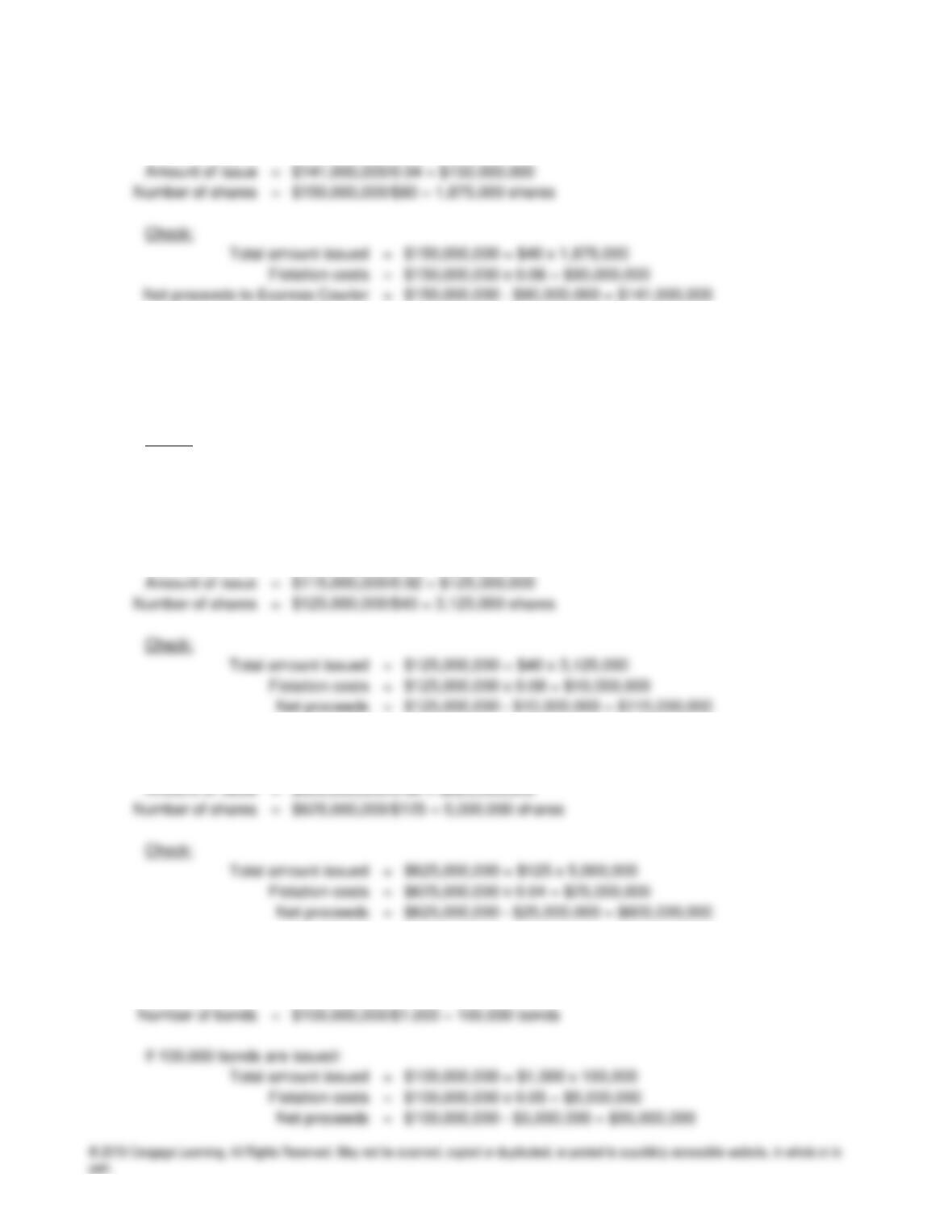
3-9 Net proceeds = Amount of issue x (1 – Flotation costs)
$141,000,000 = Amount of issue x (1 – 0.06)
3-10 Net proceeds = Amount of issue x (1 – Flotation costs)
$240,000,000 = Amount of issue x (1 – 0.04)
Amount of issue = $240,000,000/0.96 = $250,000,000
Number of bonds = $150,000,000/$1,000 = 250,000 bonds
Check:
Total amount issued = $250,000,000 = $1,000 x 250,000
Flotation costs = $250,000,000 x 0.04 = $10,000,000
Net proceeds = $250,000,000 – $10,000,000 = $240,000,000
3-11 Net proceeds = Amount of issue x (1 – Flotation costs)
$115,000,000 = Amount of issue x (1 – 0.08)
3-12 Net proceeds = Amount of issue x (1 – Flotation costs)
$600,000,000 = Amount of issue x (1 – 0.04)
3-13 Net proceeds = Amount of issue x (1 – Flotation costs)
$95,000,000 = Amount of issue x (1 – 0.05)
Amount of issue = $95,000,000/0.95 = $100,000,000
Chapter 3 CFIN6
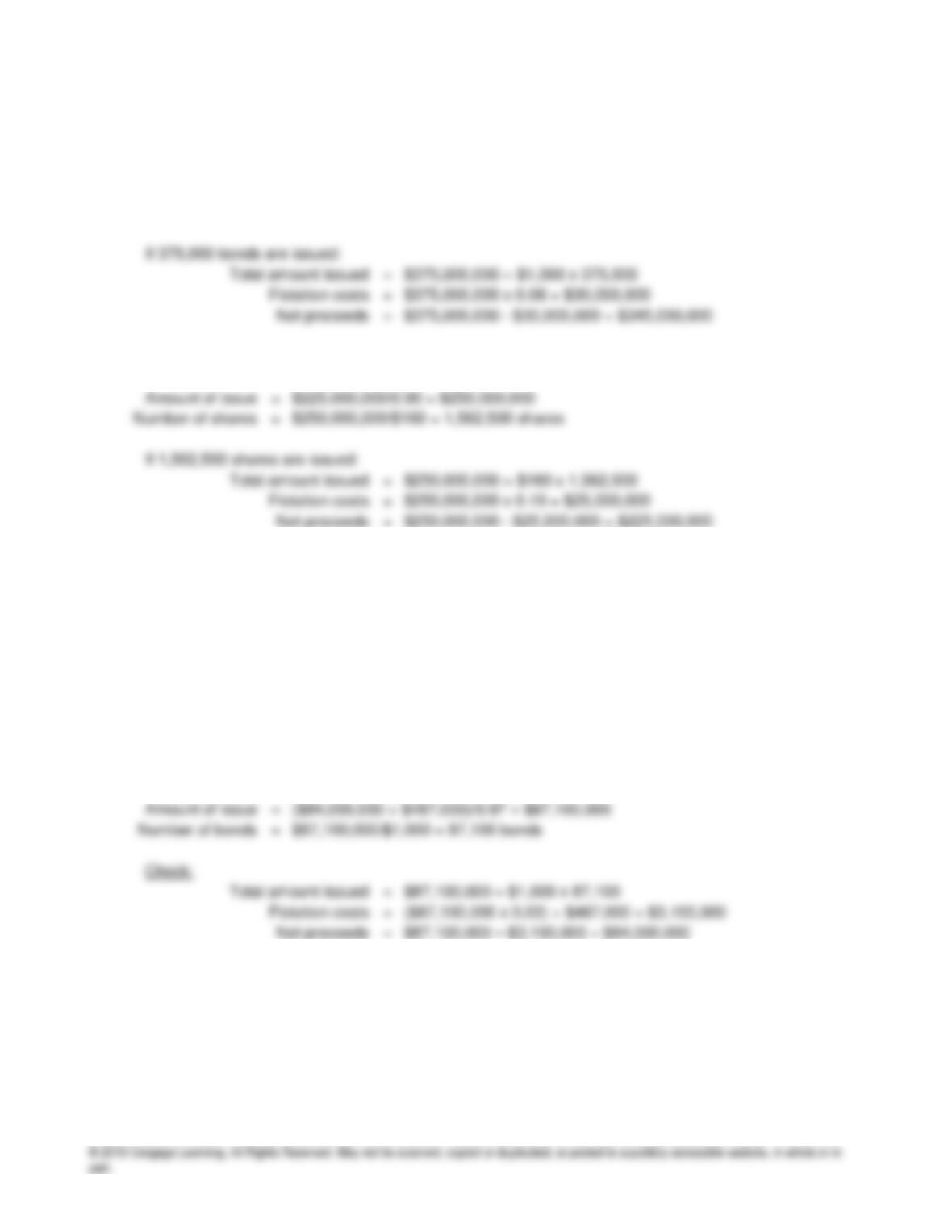
3-14 Net proceeds = Amount of issue x (1 – Flotation costs)
$345,000,000 = Amount of issue x (1 – 0.08)
Amount of issue = $345,000,000/0.92 = $375,000,000
Number of bonds = $375,000,000/$1,000 = 375,000 bonds
3-15 Net proceeds = Amount of issue x (1 – Flotation costs)
$225,000,000 = Amount of issue x (1 – 0.10)
3-16 Net proceeds = Amount of issue – Flotation costs
$345,000,000 = Amount of issue x (1 – 0.065) – $576,000
Amount of issue = ($345,000,000 + $576,000)/0.935 = $369,600,000
Number of shares = $369,600,000/$55 = 6,720,000
If 6,720,000 shares are issued:
Total amount issued = $369,600,000 = $55 x 6,720,000
Flotation costs = ($369,600,000 x 0.065) + $576,000 = $24,600,000
Net proceeds = $369,600,000 – $24,600,000 = $345,000,000
3-17 Net proceeds = Amount of issue – Flotation costs
$84,000,000 = Amount of issue x (1 – 0.03) – $487,000
3-18 Net proceeds = Amount of issue – Flotation costs)
$360,000,000 = Amount of issue x (1 – 0.04) – $288,000
Amount of issue = ($360,000,000 + $288,000)/0.96 = $375,300,000
Number of shares = $375,300,000/$60 = 6,255,000 shares
Chapter 3 CFIN6
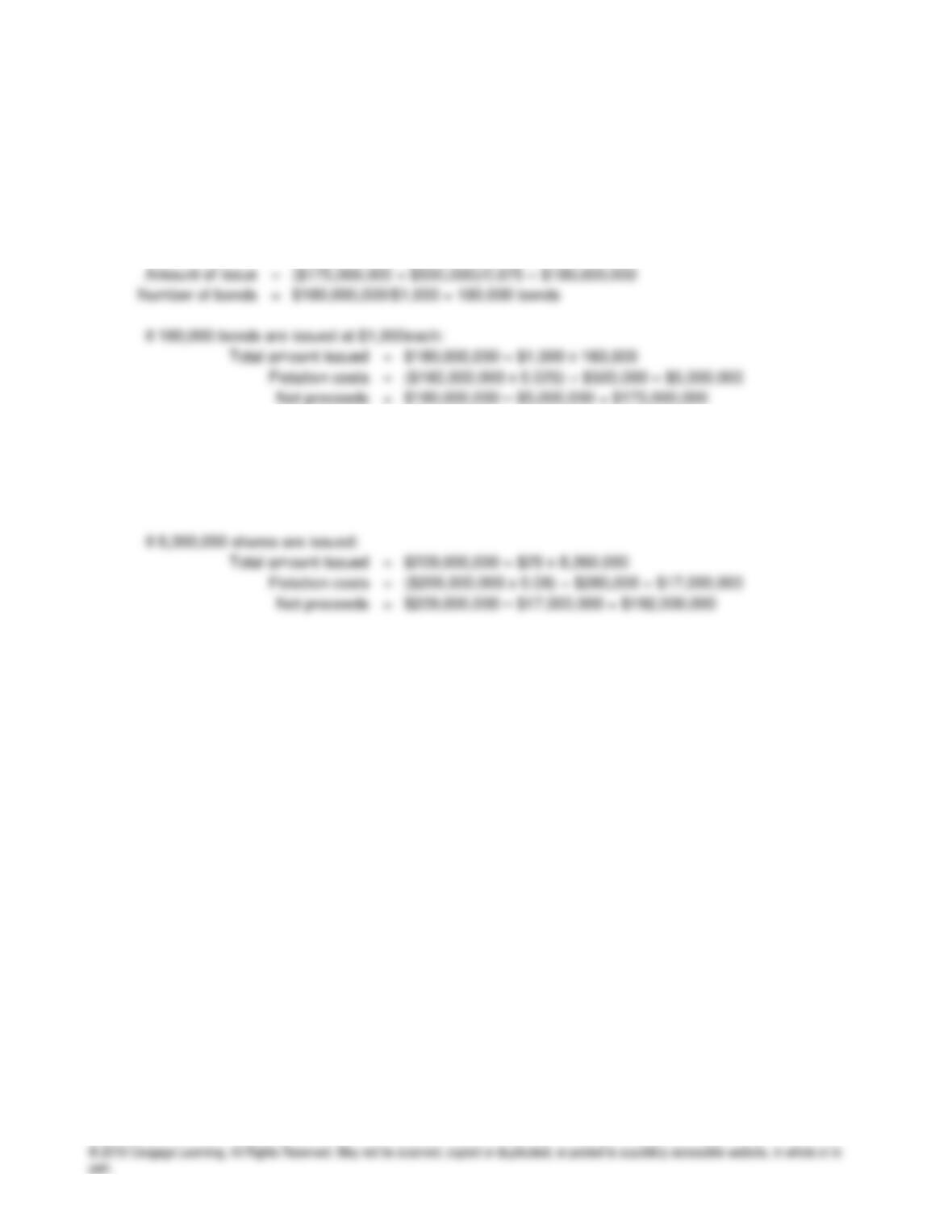
If 6,255,000 shares are issued:
Total amount issued = $375,300,000 = $60 x 6,255,000
Flotation costs = $375,300,000 x 0.04 = $15,012,000
Other costs = $288,000
Net proceeds = $375,300,000 – ($15,012,000 + $288,000) = $360,000,000
3-19 Net proceeds = Amount of issue – Flotation costs
$175,000,000 = Amount of issue x (1 – 0.025) – $500,000
3-20 Net proceeds = Amount of issue – Flotation costs
$192,000,000 = Amount of issue x (1 – 0.08) – $280,000
Amount of issue = ($192,000,000 + $280,000)/0.92 = $209,000,000
Number of shares = $209,000,000/$25 = 8,360,000