
Chapter 3
Structure of Interest Rates
Outline
Why Security Debt Yields Vary
Modeling the Yield to be Offered on a Debt Security
A Closer Look at the Term Structure
Pure Expectations Theory
Chapter 3: Structure of Interest Rates ❖ 2
Key Concepts
1. Use a current Wall Street Journal or other newspaper to show how yields vary among securities. The
chapter helps to explain the disparity in yields.
2. Provide logic behind how default risk, liquidity, tax status, and maturity can affect yields.
POINT/COUNTER-POINT:
Should a Yield Curve Influence a Borrower’s Preferred Maturity of a Loan?
POINT: Yes. If there is an upward-sloping yield curve, then a borrower should pursue a short-term loan
to capitalize on the lower annualized rate charged for a short-term period. The borrower can obtain a
series of short-term loans rather than a single loan to match the desired maturity.
COUNTER-POINT: No. The borrower will face uncertainty regarding the interest rate charged on
WHO IS CORRECT? Use the Internet to learn more about this issue and then formulate your own
opinion.
Questions
1. Characteristics That Affect Security Yields. Identify the relevant characteristics of any security that
can affect the security’s yield.
ANSWER: The relevant characteristics are:
2. Impact of Credit Risk on Yield. How does high credit risk affect the yield on securities?
ANSWER: Investors require a higher risk premium on securities with a high default risk.
3. Impact of Liquidity on Yield. Discuss the relationship between the yield and the liquidity of
securities.
Chapter 3: Structure of Interest Rates ❖ 3
4. Tax Effects on Yields. Do investors in high tax brackets or those in low tax brackets benefit more
from tax-exempt securities? Why? Do municipal bonds or corporate bonds offer a higher before-tax
yield at a given point in time? Why? Which has the higher after-tax yield? If taxes did not exist,
would Treasury bonds offer a higher or lower yield than municipal bonds with the same maturity?
Why?
ANSWER: High-tax bracket investors benefit more from tax-exempt securities because their tax
savings from avoiding taxes is greater.
5. Pure Expectations Theory. Explain how a yield curve would shift in response to a sudden
expectation of rising interest rates, according to the pure expectations theory.
ANSWER: The demand for short-term securities would increase, placing upward (downward)
6. Forward Rate. What is the meaning of the forward rate in the context of the term structure of interest
rates? Why might forward rates consistently overestimate future interest rates? How could such a bias
be avoided?
ANSWER: The forward rate is the expected interest rate at a future point in time.
7. Pure Expectations Theory. Assume an expectation of lower interest rates in the future arises quite
suddenly. What would be the effect on the shape of the yield curve? Explain.
ANSWER: The demand for short-term securities would decrease, placing downward (upward)
8. Liquidity Premium Theory. Explain the liquidity premium theory.
ANSWER: If investors believe that securities with larger maturities are less liquid, they will require a

Chapter 3: Structure of Interest Rates ❖ 4
9. Impact of Liquidity Premium on Forward Rate. Explain how consideration of a liquidity premium
affects the estimate of a forward interest rate.
10. Segmented Markets Theory. If a downward-sloping yield curve is mainly attributed to segmented
markets theory, what does that suggest about the demand for and supply of funds in the short-term
and long-term maturity markets?
ANSWER: A downward-sloped yield curve suggests that the demand for short-term funds is high
11. Segmented Markets Theory. If the segmented markets theory causes an upward-sloping yield curve,
what does this imply? If markets are not completely segmented, should we dismiss the segmented
markets theory as even a partial explanation for the term structure of interest rates? Explain.
ANSWER: An upward-sloped yield curve caused by segmented markets implies that the demand for
12. Preferred Habitat Theory. Explain the preferred habitat theory.
ANSWER: The preferred habitat theory suggests that while investors and borrowers may prefer a
13. Yield Curve. What factors influence the shape of the yield curve? Describe how financial market
participants use the yield curve.
ANSWER: The yield curve’s shape is affected by the demand and supply conditions for securities in
Advanced Questions
14. Segmented Markets Theory. Suppose that the U.S. Treasury decided to finance its deficit with
mostly long-term funds. How could this decision affect the term structure of interest rates? If short-
term and long-term markets are segmented, would the Treasury’s decision have a more or less
pronounced impact on the term structure? Explain.

Chapter 3: Structure of Interest Rates ❖ 5
ANSWER: If the Treasury borrowed heavily in the long-term markets, it could place upward pressure
15. Yield Curve. If liquidity and interest rate expectations are both important for explaining the shape of
a yield curve, what does a flat yield curve indicate about the market’s perception of future interest
rates?
ANSWER: A flat yield curve without consideration of a liquidity premium would represent no
16. Global Interaction among Yield Curves. Assume that the yield curves in the United States, France,
and Japan are flat. If the U.S. yield curve suddenly becomes so positively sloped, do you think the
yield curves in France and Japan would be affected? If so, how?
ANSWER: The yield curves in other countries would also be affected if the event precipitating the
17. Multiple Effects on the Yield Curve. Assume that (1) investors and borrowers expect that the
economy will weaken and that inflation will decline, (2) investors require a small liquidity premium,
and (3) markets are partially segmented and the Treasury currently has a preference for borrowing in
short-term markets. Explain how each of these forces would affect the term structure, holding other
factors constant. Then explain the effect on the term structure overall.
ANSWER: The weak economy creates the expectation of a decline in interest rates, so according to
expectations theory, there would be a downward-sloping yield curve.
18. Effect of Crises on the Yield Curve. During some crises, investors shift their funds out of the stock
market and into money market securities for safety, even if they do not fear that interest rates will
rise. Explain how and why these actions by investors affect the yield curve. Is the shift due to the
expectations theory, liquidity premium theory, or segmented markets theory?
ANSWER: The movement into money market securities results in a larger supply of short-term funds

Chapter 3: Structure of Interest Rates ❖ 6
19. How the Yield Curve May Respond to Prevailing Conditions. Consider how economic conditions
affect the credit risk premium. Do you think the credit risk premium will likely increase or decrease
during this semester? How do you think the yield curve will change during this semester? Offer some
logic to support your answers.
ANSWER: This question is open-ended. It requires students to apply the concepts that were presented
20. Assessing Interest Rate Differentials among Countries. In some countries where there is high
inflation, the annual interest rate is more than 50 percent, while in other countries such as the U.S.
and many European countries, the annual interest rates are typically less than 10 percent. Do you
think such a large interest rate differential is primarily attributed to country-specific differences in the
risk-free rates or in the credit risk premiums? Explain.
ANSWER: The risk-free foreign interest rates are determined by supply and demand for funds in their
local currency. Inflationary expectations affect the risk-free interest rate. Thus, the difference in
21. Applying the Yield Curve to Risky Debt Securities. Assume that the yield curve for Treasury
bonds has a slight upward slope, starting at 6% for a 10-year maturity and slowly rising to 8% for a
30-year maturity. Create a yield curve that you believe would exist for A-rated bonds, and a
corresponding yield curve for B-rated bonds.
ANSWER: The yield curve for A-rated bonds would likely have a similar slope as the yield curve for
22. Changes to Credit Rating Process. Explain how credit rating agencies have changed their rating
processes following criticism of their ratings during the credit crisis.
ANSWER: In response to the criticism, credit rating agencies made some changes to improve their
rating process and their transparency. They now disclose more information about how they derived
CRITICAL THINKING QUESTION
How a Credit Crisis Can Paralyze Credit Markets. The key components of a market interest rate
are the risk-free rate and the credit risk premium. During a credit crisis, these two components
may change substantially, but in different ways. Write a short essay that describes how the risk-
free rate and the risk premium may change during a credit crisis. Explain why the financial
Chapter 3: Structure of Interest Rates ❖ 7
markets can become paralyzed during a crisis. Is it because of changes in the risk-free rate or
changes in the risk premium?
ANSWER
During a credit crisis, the Fed can ensure availability of funds in the financial system, by using monetary
policy to expand money supply. This results in a large increase in the supply of funds available, and when
Interpreting Financial News
Interpret the following comments made by Wall Street analysts and portfolio managers.
a. “An upward-sloping yield curve persists because many investors stand ready to jump into the
stock market.”
Investors are holding short-term Treasury securities, and are unwilling to hold long-term
Treasury securities, because they may liquidate these securities soon, and prefer liquid securities
that are less susceptible to interest rate risk.
Managing in Financial Markets

Chapter 3: Structure of Interest Rates ❖ 8
As an analyst at a bond rating agency, you have been asked to interpret the implications of the recent shift
in the yield curve. Six months ago, the yield curve exhibited a slight downward slope. Over the last six
months, the long-term yields declined, while short-term yields remained the same. Analysts stated that the
shift was due to revised expectations of interest rates.
a. Given the shift in the yield curve, does it appear that firms increased or decreased their demand
for long-term funds over the last six months?
The lower long-term yields may be attributed to a reduced demand for long-term funds. That is,
b. Interpret what the shift in the yield curve suggests about the market’s changing expectations of
future interest rates.
The yield curve six months ago implied the expectation of a slight decline in interest rates. The
c. Recently, an analyst argued that the underlying reason for the yield curve shift was that many of
the large U.S. firms anticipate a recession. Explain why an anticipated recession could force the
yield curve to shift as it has.
When the economic conditions are expected to deteriorate, the demand for loanable funds by
d. What could the specific shift in the yield curve signal about the ratings of existing corporate
bonds? Which types of corporations would be most likely to experience a change in their bond
ratings as a result of the specific shift in the yield curve?
To the extent that the downward shift in the yield curve signals an anticipated recession (or at
Problems
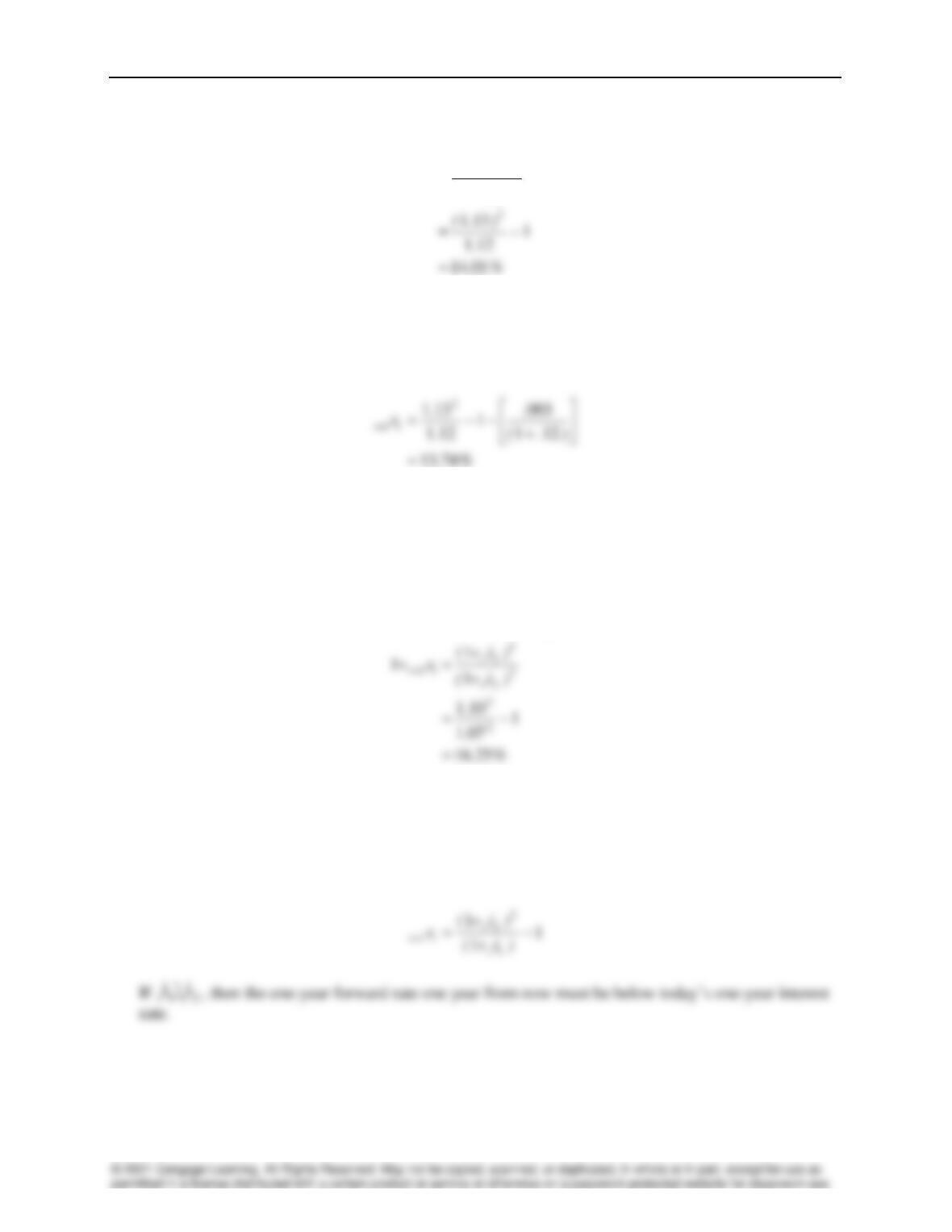
1. Forward Rate. a. Assume that as of today, the annualized two-year interest rate is 13 percent, while
the one-year interest rate is 12 percent. Use this information to estimate the one-year forward rate.
Chapter 3: Structure of Interest Rates ❖ 9
ANSWER:
)i(
)i(
r
t
t
t
1
1
1
1
2
2
11
−
+
+
=
+
b. Assume that the liquidity premium on a two-year security is 0.3 percent. Use this information to
estimate the one-year forward rate.
ANSWER:
2. Forward Rate. Assume that as of today, the annualized interest rate on a three-year security is 10
percent, while the annualized interest rate on a two-year security is 7 percent. Use this information to
estimate the one-year forward rate two years from now.
ANSWER:
)r()i()i(
ttt
111
12
2
2
3
3
++=+
+
3. Forward Rate. If
t 1 t 2
i i
, what is the market consensus forecast about the one-year forward rate one
year from now? Is this rate above or below today’s one-year interest rate? Explain.
ANSWER:
The one-year forward rate one year from now is:
t 1 t 2
i i
4. After-tax Yield. You need to choose between investing in a one-year municipal bond with a 7
percent yield and a one-year corporate bond with an 11 percent yield. If your marginal federal income
tax rate is 30 percent and no other differences exist between these two securities, which would you
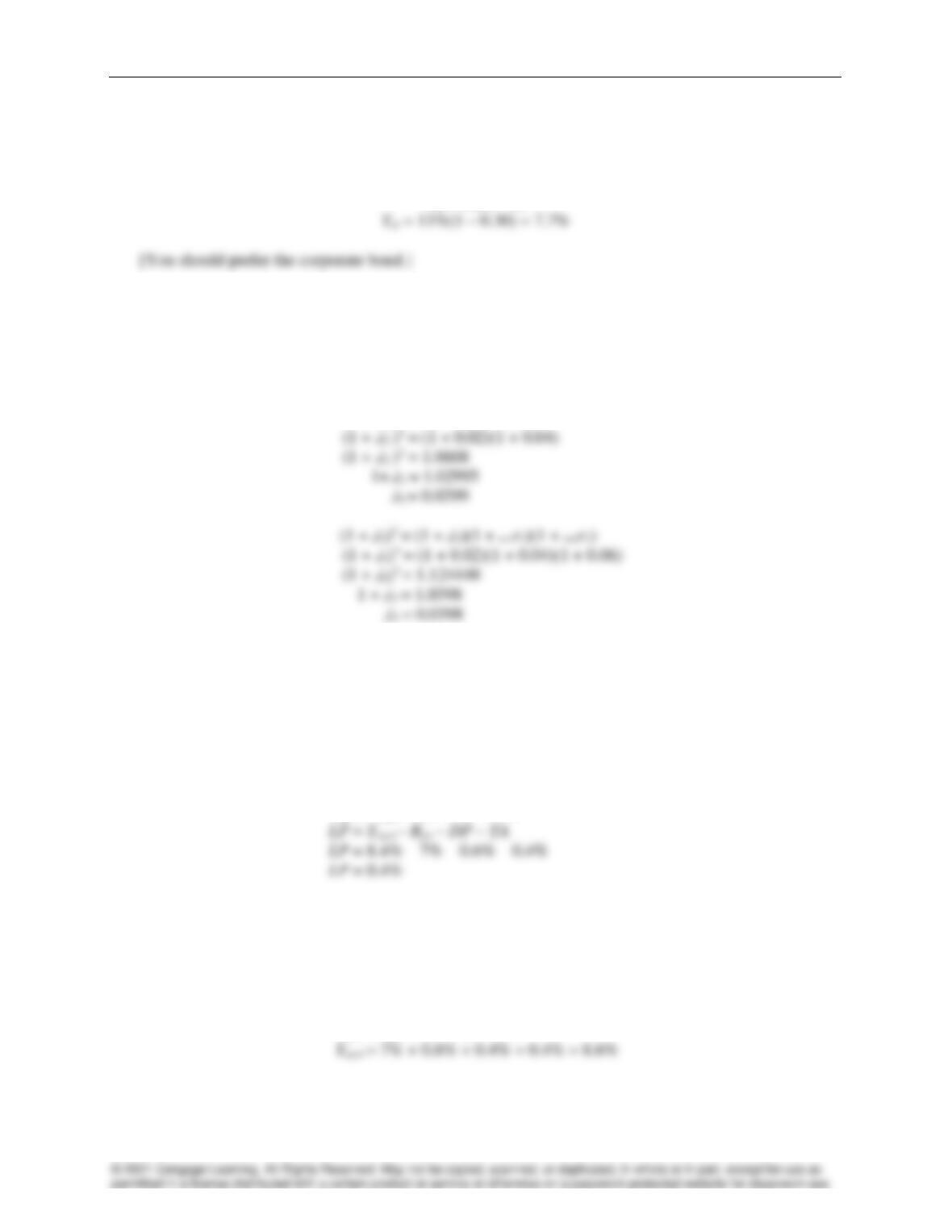
Chapter 3: Structure of Interest Rates ❖ 10
invest in?
ANSWER:
Yat = Ybt(1 – T)
5. Deriving Current Interest Rates. Assume that interest rates for one-year securities are expected to
be 2 percent today, 4 percent one year from now and 6 percent two years from now. Using only the
pure expectations theory, what are the current interest rates on two-year and three-year securities?
ANSWER:
(1 + ti2 )2 = (1 + ti1)(1 + t+1r1)
6. Commercial Paper Yield.
a. A corporation is planning to sell its 90-day commercial paper to investors offering an 8.4 percent
yield. If the three-month Treasury bill’s annualized rate is 7 percent, the credit risk premium is
estimated to be 0.6 percent and there is a 0.4 percent tax adjustment, what is the liquidity
premium on the commercial paper?
ANSWER:
Ycp, n = Rf,n + DP + LP + TA
b. If due to unexpected changes in the economy the credit risk premium increases to 0.8 percent,
what is the appropriate yield to be offered on the commercial paper (assuming no other changes
occur)?
ANSWER:
Ycp,n = Rf,n + DP + LP + TA

Chapter 3: Structure of Interest Rates ❖ 11
7. Forward Rate.
a. Determine the forward rate for various one-year interest rate scenarios if the two-year interest rate
is 8 percent, assuming no liquidity premium. Explain the relationship between the one-year
interest rate and the one-year forward rate, holding the two-year interest rate constant.
ANSWER: As the one-year interest rate rises, the forward rate declines. The one-year forward rate is zero
once the one-year interest rate is equal to the two-year interest rate, and it becomes negative if the one-year
b. Determine the one-year forward rate for the same one-year interest rate scenarios in question (a),
assuming a liquidity premium of 0.4 percent. Does the relationship between the one-year interest
rate and the forward rate change when the liquidity premium is considered??
c. Determine how the one-year forward rate would be affected if the quoted two-year interest rate
rises, while both the quoted one-year interest rate and the liquidity premium are held constant.
Explain the logic of this relationship.
ANSWER: The forward rate increases for higher levels of a two-year interest rate. The greater the
d. Determine how the one-year forward rate would be affected if the liquidity premium rises,
holding the quoted one-year interest rates constant. Also, hold the two-year interest rate constant.
Explain the logic of this relationship.
ANSWER: The forward rate is reduced for higher levels of the liquidity premium, holding the one-
8. After-tax Yield. Determine how the after-tax yield from investing in a corporate bond is affected by
higher tax rates, holding the before-tax yield constant. Explain the logic of this relationship.
ANSWER: The after-tax yield is reduced for higher levels of the tax rate, holding the before-tax yield
9. Debt Security Yield.
a. Determine how the appropriate yield to be offered on a security is affected by a higher risk-free
rate. Explain the logic of this relationship.
ANSWER: The appropriate yield to be offered on a security would need to be increased if the risk-

Chapter 3: Structure of Interest Rates ❖ 12
b. Determine how the appropriate yield to be offered on a security is affected by a higher default
risk premium. Explain the logic of this relationship.
ANSWER: The appropriate yield to be offered on a security would need to be increased if the default
Flow of Funds Exercise
Influence of the Structure of Interest Rates
Recall that Carson Company has obtained substantial loans from finance companies and commercial
banks. The interest rate on these loans are tied to the six-month Treasury bill rate (and includes a risk
premium) and are adjusted every six months. Thus, Carson’s cost of obtaining funds is sensitive to
a. Assume that the market’s expectations for the economy are similar to those of Carson. Also
assume that the yield curve is primarily influenced by interest rate expectations. Would the yield
curve be upward sloping or downward sloping? Why?
b. If Carson could obtain more debt financing for its10-year projects, would it prefer to obtain credit
at a long-term fixed interest rate, or at a floating rate. Why?
The prevailing interest rate would be lower on loans than on the bonds, but the interest rate on
c. If Carson attempts to obtain funds by issuing 10-year bonds, explain what information would help
the company to estimate the yield it would have to pay on 10-year bonds. That is, which key
factors would influence the rate it has pay on the 10-year bonds?
The key factors are the risk-free rate on 10–year bonds, the risk premium, and any special
d. If Carson attempts to obtain funds by issuing loans with floating interest rates every six months,
explain what information would help the company estimate the yield it would have to pay over the
next ten years. That is, what are the key factors that would influence the rate it would pay over the 10-
year period?
The key factors are the risk-free rate on six-month T-bills, and the risk premium. The cost of debt
Chapter 3: Structure of Interest Rates ❖ 13
e. An upward-sloping yield curve suggests that the initial rate that financial institutions could charge
on a long-term loan to Carson would be higher than the initial rate that they could charge on a
loan that floats in accordance with short-term interest rates. Does this imply that creditors should
prefer to provide a fixed-rate loan rather than a floating-rate loan to Carson? Explain why
Carson’s expectations of future interest rates are not necessarily the same as those of some
financial institutions.
Creditors may prefer to provide fixed-rate loans if they expect interest rates to decline (so that
Solution to Integrative Problem for Part 1
Interest Rate Forecasts and Investment Decisions
1. The appropriate recommendation requires a rational forecast of U.S. interest rates based on the
information provided. A rational forecast can be created by recognizing what factors will or will not
influence future interest rates and weighing the potential influence of any relevant factors. Each of the
nine pieces of information provided to the student is addressed below:
1. Movements in interest rates over the year surely affected bond prices, but this information does
not help forecast future interest rates.
4. No impact anticipated.
5. A stronger U.S. economy should place upward pressure on U.S. interest rates, regardless of the
economy two years ago. What is important is the change in the future U.S. economy relative to
present conditions, because U.S. bond prices today reflect present U.S. interest rates. Any change
in the U.S. demand for loanable funds will change the U.S. interest rates, forcing investors to
revalue U.S. bonds.
reduce their investing in the United States, causing a net decline in the supply of funds in the

Chapter 3: Structure of Interest Rates ❖ 14
United States provided by foreign investors. Consequently, there is upward pressure on U.S.
Overall, Numbers 1, 2, 4, and 9 should have no influence on your forecast of U.S. interest rates.
Number 3 suggests a slight decline in U.S. interest rates, while Numbers 5, 6, 7, and 8 suggest an
increase in U.S. interest rates. The net effect is an expected increase in U.S. interest rates.
2. Following the same procedure as stated in Question 1, you can develop a rational forecast of
Canadian interest rates. The assessment of Canadian bonds must be separated from the assessment of
U.S. bonds since Canadian Treasury bond values will not always move in tandem with U.S. Treasury
bond values.
Most of the information is either irrelevant for forecasting future interest rates in Canada or suggests
no change. The only factors that influence Canadian interest rates and are expected to change are
3. The yield on newly issued U.S. corporate bonds should rise to a greater degree than newly issued U.S.