Answers and Solutions: 3 – 1
Chapter 3
Analysis of Financial Statements
ANSWERS TO END-OF-CHAPTER QUESTIONS
3-1 a. A liquidity ratio is a ratio that shows the relationship of a firm’s cash and other current
assets to its current liabilities. The current ratio is found by dividing current assets by
current liabilities. It indicates the extent to which current liabilities are covered by those
assets expected to be converted to cash in the near future. The quick, or acid test, ratio
is found by taking current assets less inventories and then dividing by current liabilities.
assets, it measures the percentage of assets financed by debtholders. The debt-to-equity
ratio is the total debt divided by the total common equity. The times-interest-earned
ratio is determined by dividing earnings before interest and taxes by the interest
charges. This ratio measures the extent to which operating income can decline before
the firm is unable to meet its annual interest costs. The EBITDA coverage ratio is
similar to the times-interest-earned ratio, but it recognizes that many firms lease assets
and also must make sinking fund payments. It is found by adding EBITDA and lease
payments then dividing this total by interest charges, lease payments, and sinking fund
payments over one minus the tax rate.
Answers and Solutions: 3 – 2
e. Market value ratios relate the firm’s stock price to its earnings and book value per share.
The price/earnings ratio is calculated by dividing price per share by earnings per share–
-this shows how much investors are willing to pay per dollar of reported profits. The
price/free cash flow is calculated by dividing price per share by free cash flow per
share. This shows how much investors are willing to pay per dollar of free cash flow.
Market-to-book ratio is simply the market price per share divided by the book value
per share. Book value per share is common equity divided by the number of shares
outstanding.
3-2 The emphasis of the various types of analysts is by no means uniform nor should it be.
Management is interested in all types of ratios for two reasons. First, the ratios point out
weaknesses that should be strengthened; second, management recognizes that the other
parties are interested in all the ratios and that financial appearances must be kept up if the
firm is to be regarded highly by creditors and equity investors. Equity investors are
interested primarily in profitability, but they examine the other ratios to get information on
the riskiness of equity commitments. Long-term creditors are more interested in the debt
ratio, TIE, and fixed-charge coverage ratios, as well as the profitability ratios. Short-term
creditors emphasize liquidity and look most carefully at the liquidity ratios.
Answers and Solutions: 3 – 3
3-4 Differences in the amounts of assets necessary to generate a dollar of sales cause asset
turnover ratios to vary among industries. For example, a steel company needs a greater
3-5 a. Cash, receivables, and inventories, as well as current liabilities, vary over the year for
firms with seasonal sales patterns. Therefore, those ratios that examine balance sheet
figures will vary unless averages (monthly ones are best) are used.
3-6 Firms within the same industry may employ different accounting techniques, which make
it difficult to compare financial ratios. More fundamentally, comparisons may be
misleading if firms in the same industry differ in their other investments. For example,
comparing PepsiCo and Coca-Cola may be misleading because apart from their soft drink
business, Pepsi also owns other businesses such as Frito-Lay, Pizza Hut, Taco Bell, and
KFC.
Answers and Solutions: 3 – 4
SOLUTIONS TO END-OF-CHAPTER PROBLEMS
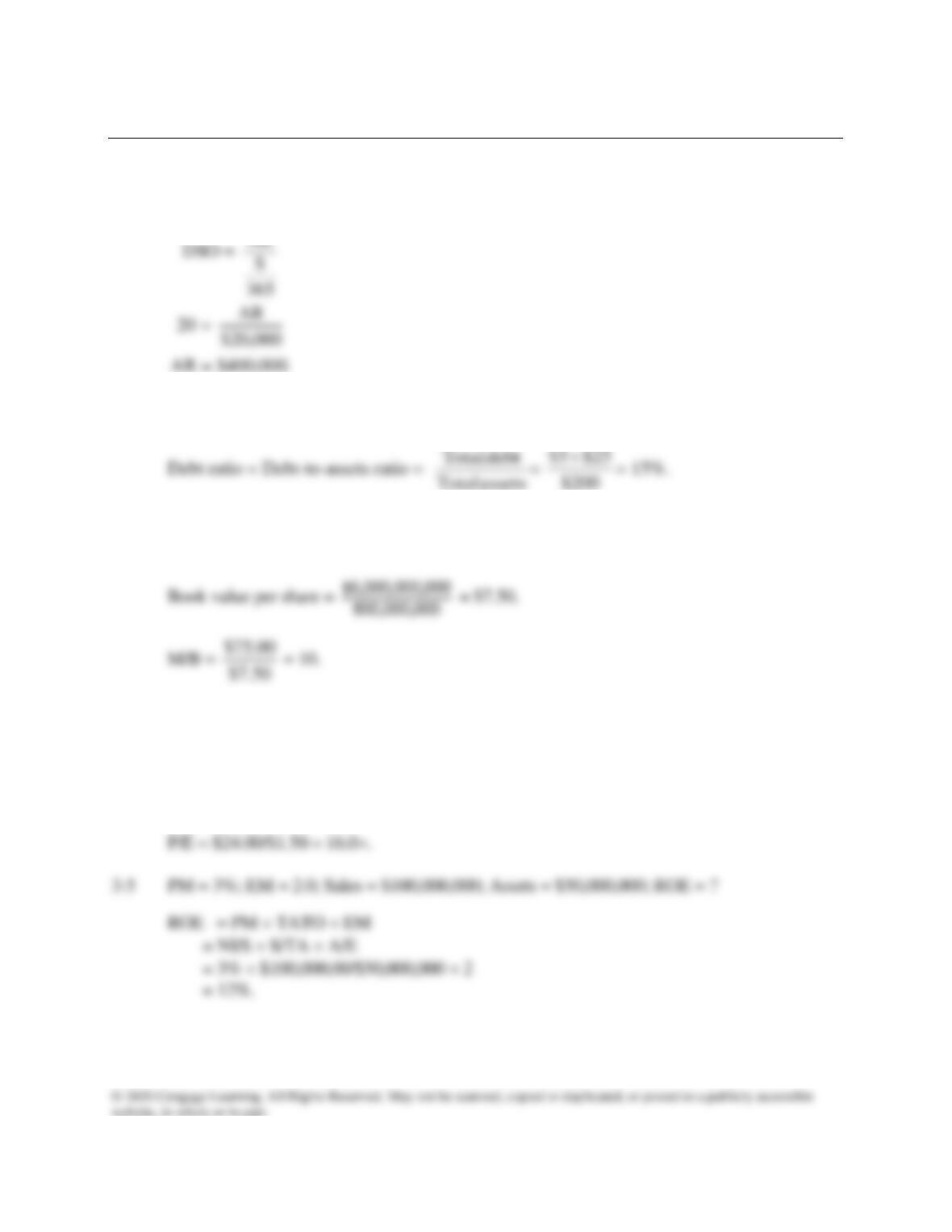
3-1 DSO = 20 days; ADS = $20,000; AR = ?
3-2 TA = $200 million, notes payable =$5 million, and LT debt = $25 million.
3-3 TA = $10,000,000,000; CL = $1,000,000,000; LT debt = $3,000,000,000; CE =
$6,000,000,000; Shares outstanding = 800,000,000; P0 = $75; M/B = ?
3-4 Earnings per share = $1.50; FCF per share = $3.00; P/FCF = 8.0; P/E = ?
P/FCF = 8.0
P/$3.00 = 8.0
P = $24.00.
Answers and Solutions: 3 – 5
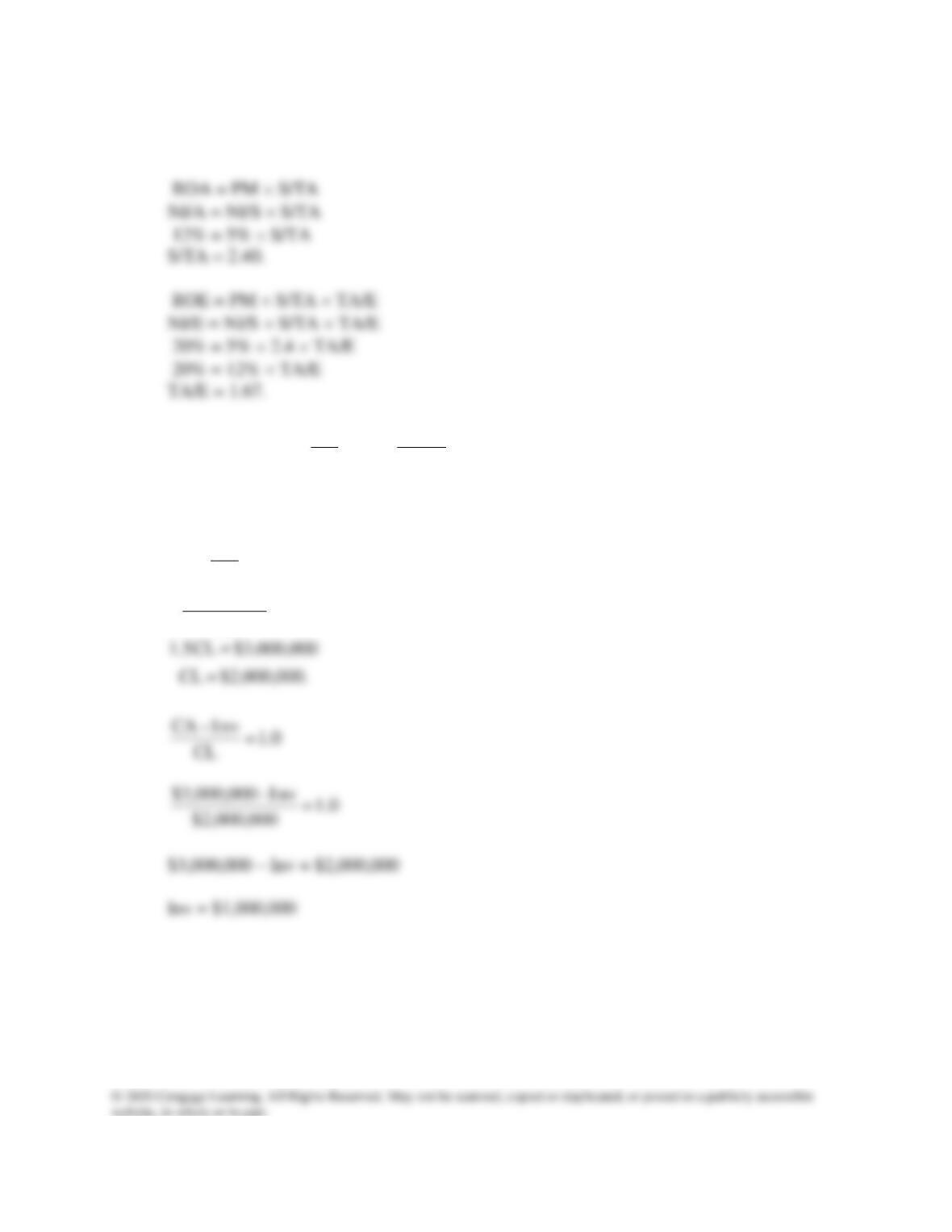
3-6 ROA = 12%; PM = 5%; ROE = 20%; S/TA = ?; A/E = ?
ROA = NI/A; PM = NI/S; ROE = NI/E
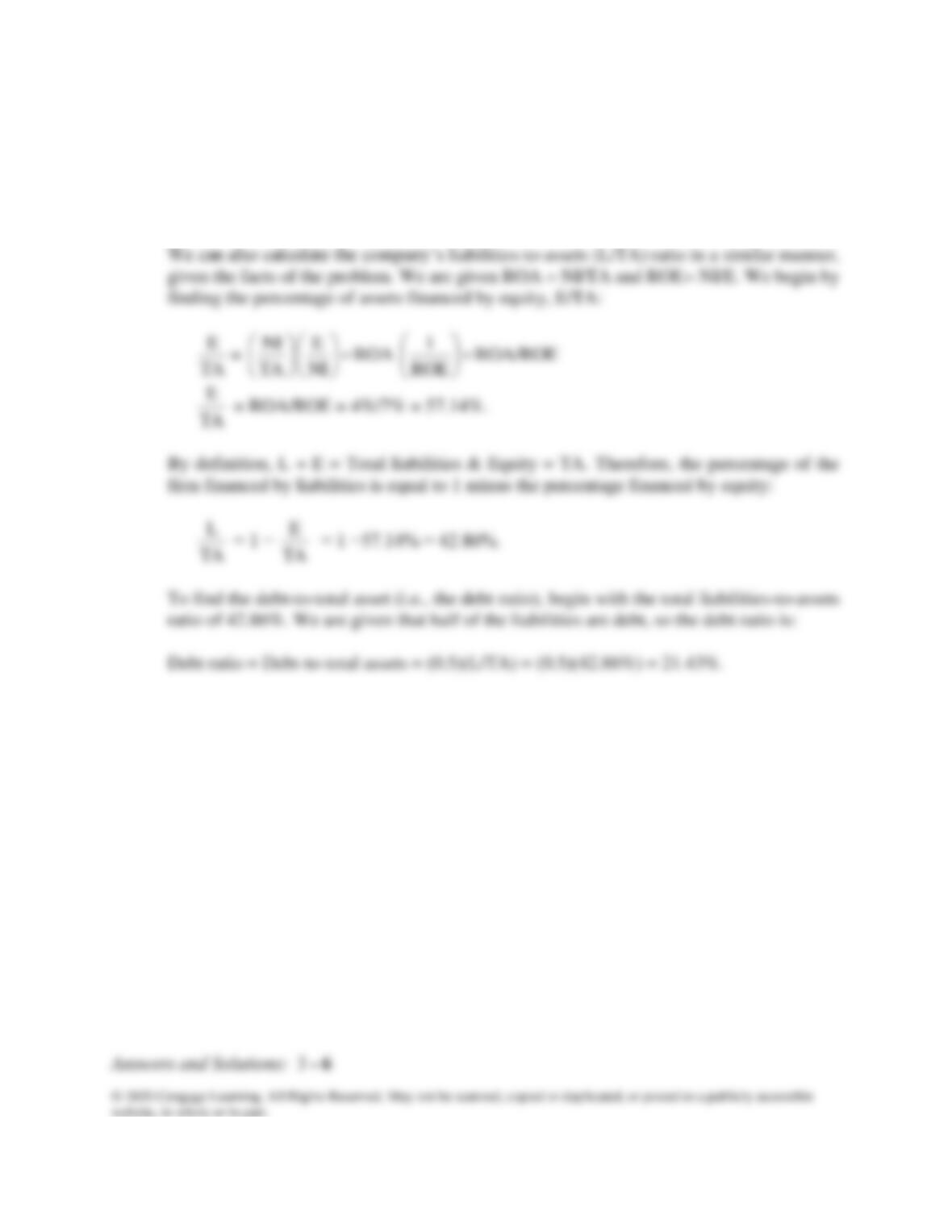
3-7 CA = $3,000,000;
CL
CA
= 1.5;
CL
I – CA
= 1.0;
CL = ?; I = ?
1.5 =
CL
$3,000,000
1.5 =
CL
CA
3-8 We are given ROA = 4%, ROE = 7%, and TAT = Sales/Total assets = 1.2.
From DuPont equation: ROA = Profit margin Total assets turnover
4% = Profit margin (1.2)
Profit margin = 4%/1.2 = 3.33%.
Answers and Solutions: 3 – 7
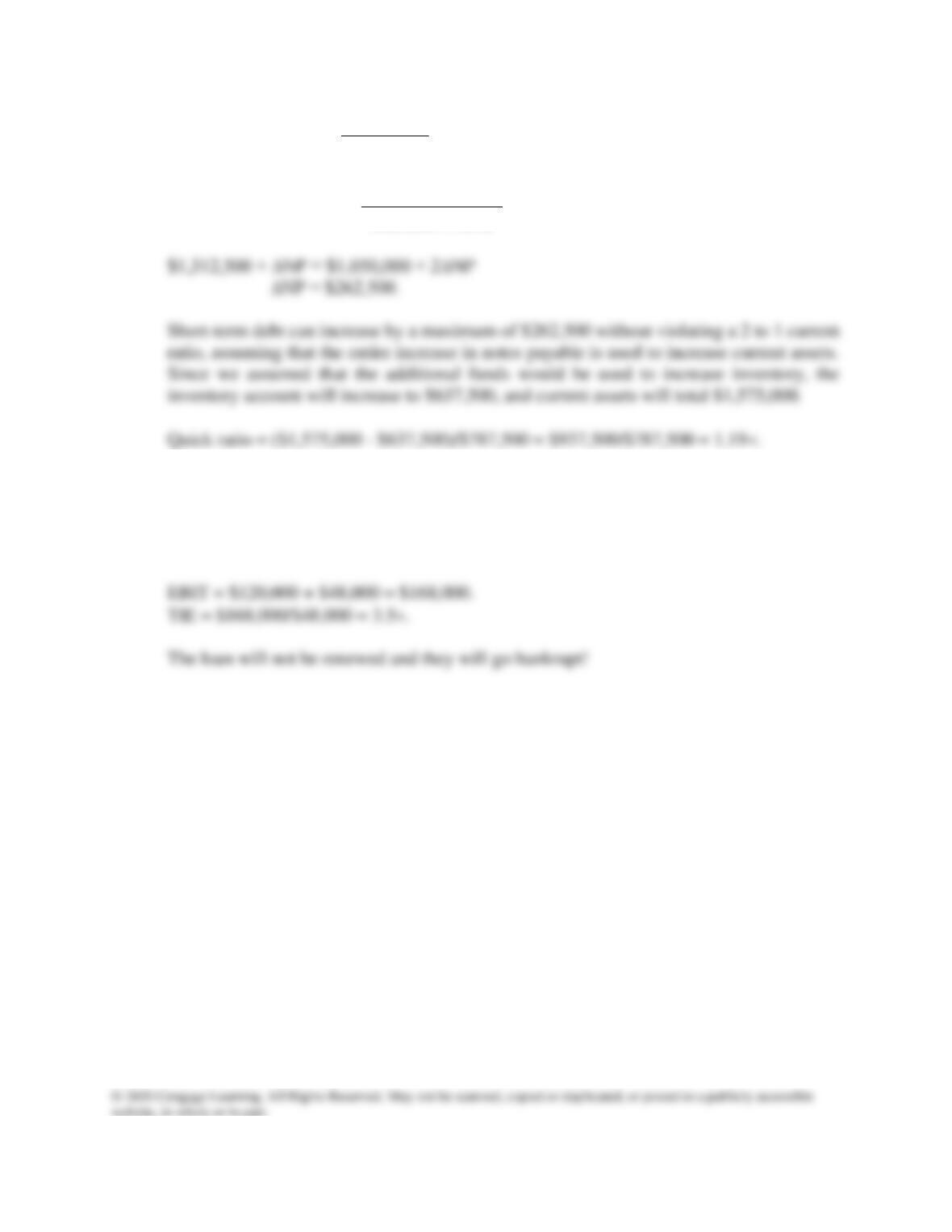
3-9 Present current ratio =
$525,000
$1,312,500
= 2.5.
Minimum current ratio =
NP + $525,000
NP + $1,312,500
= 2.0.
3-10 TIE = EBIT/Interest expense, so find EBIT and Interest expense.
Interest = $600,000 0.08 = $48,000.
Net income = $3,000,000 0.03 = $90,000.
Pre-tax income = $90,000/(1 – T) = $90,000/0.75 = $120,000.
Answers and Solutions: 3 – 8
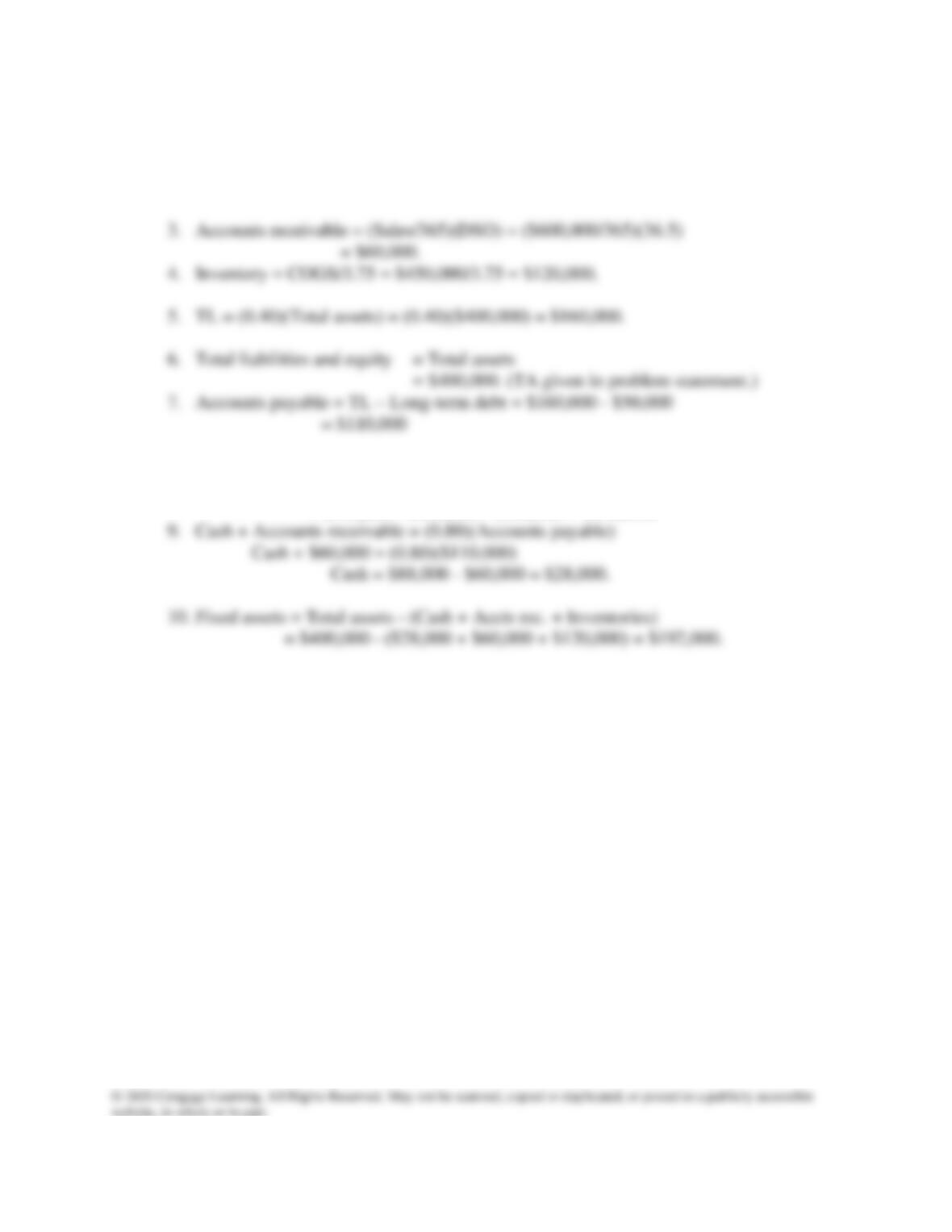
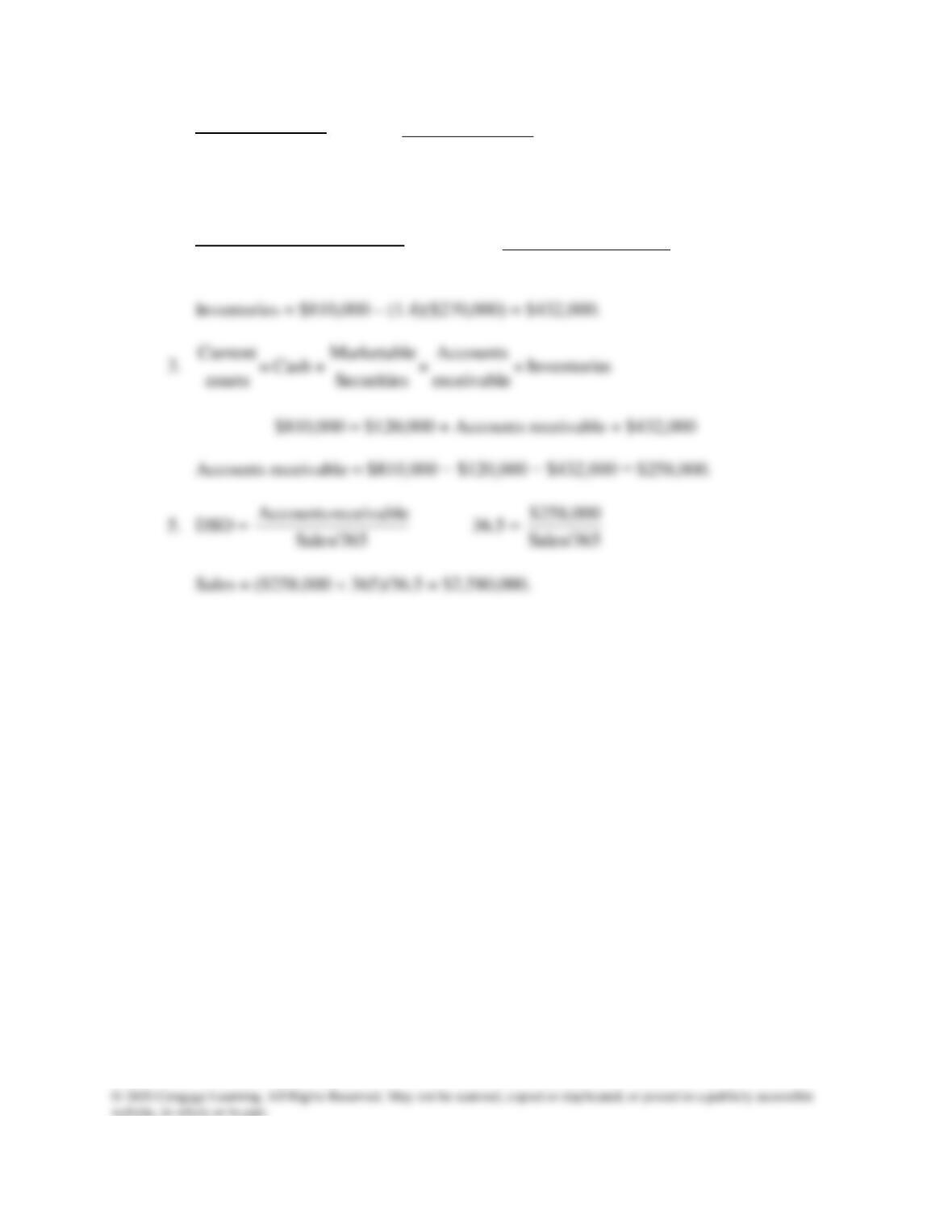
3-11 1. Sales = (1.5)(Total assets) = (1.5)($400,000) = $600,000.
2. Cost of goods sold = (Sales)(1 – 0.25) = ($600,000)(0.75)
= $450,000.
8. Common stock =Total liabilities
and equity – TL – Retained earnings
= $400,000 – $160,000 – $100,000 = $140,000.
Answers and Solutions: 3 – 9
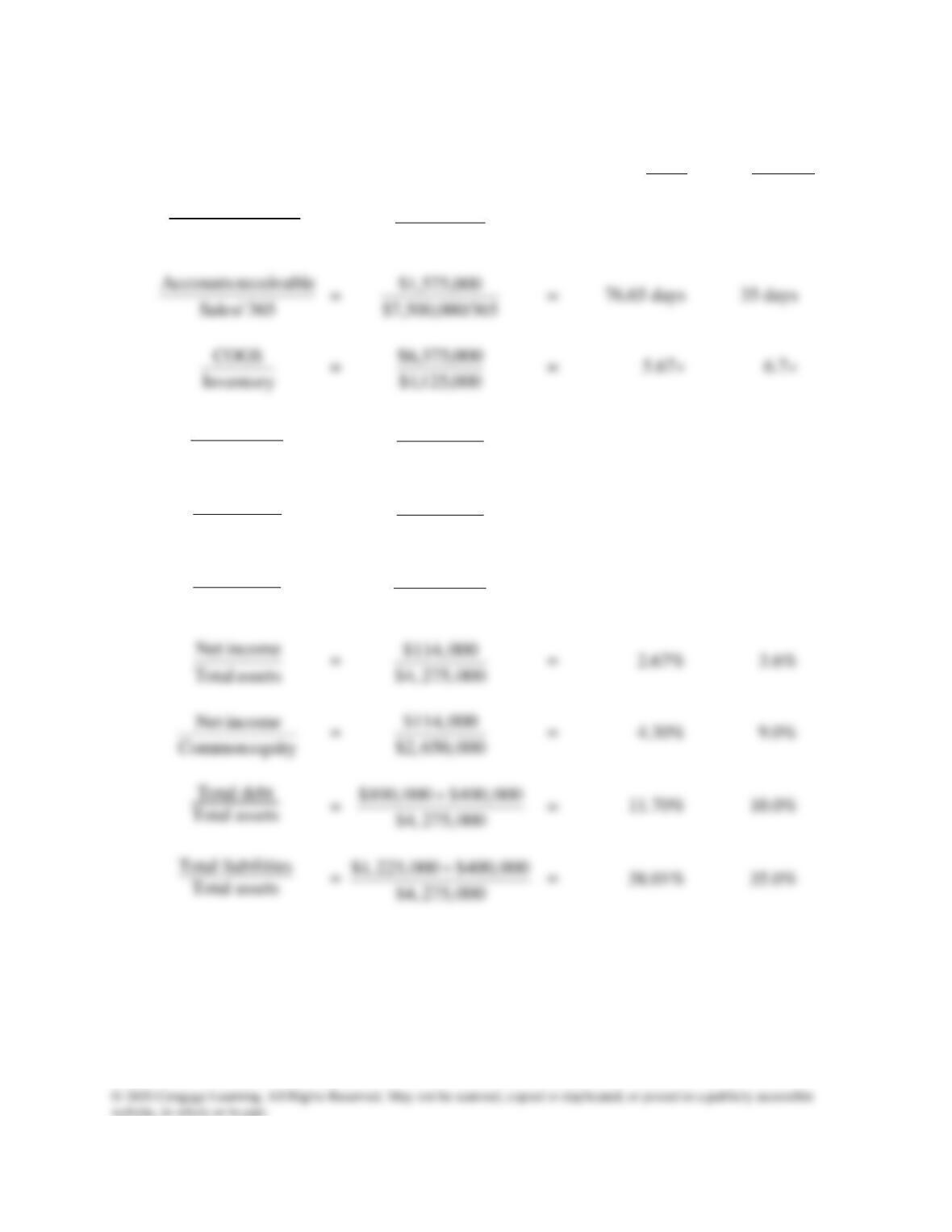
3-12 1. Current assets
Current liabilities = 3.0
sliabilitieCurrent
$810,000
= 3.0
Current liabilities = $810,000/3 = $270,000.
2. Current assets − Inventories
Current liabilities = 1.4
$270,000
sInventorie – $810,000
= 1.4
Answers and Solutions: 3 – 10
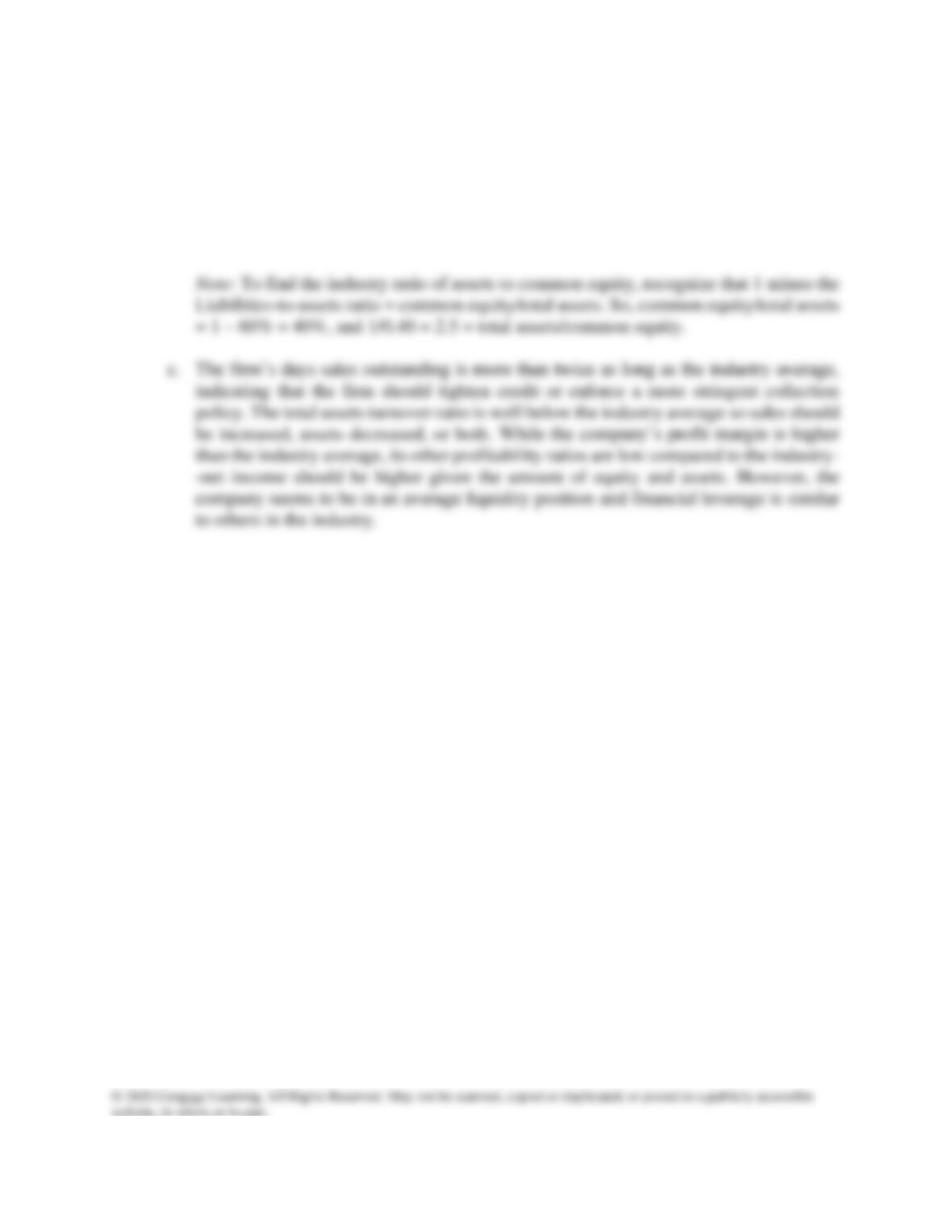
3-13 a. (Dollar amounts in thousands.)
Industry
Firm Average
Current assets
Current liabilities =
$2,925,000
$1, 225, 000
= 2.39 2.0
000,375,6$
Sales
Fixed assets
=
000,350,1$
000,500,7$
= 5.56 12.1
Sales
Total assets
=
000,275,4$
000,500,7$
= 1.754 3.0
Sales
incomeNet
=
$114,000
$7,500,000
= 1.52% 1.2%
incomeNet
Answers and Solutions: 3 – 11
b. For the firm,
Equity multiplier (EM) =
$4, 275, 000
$2,650,000
= 1.61%.
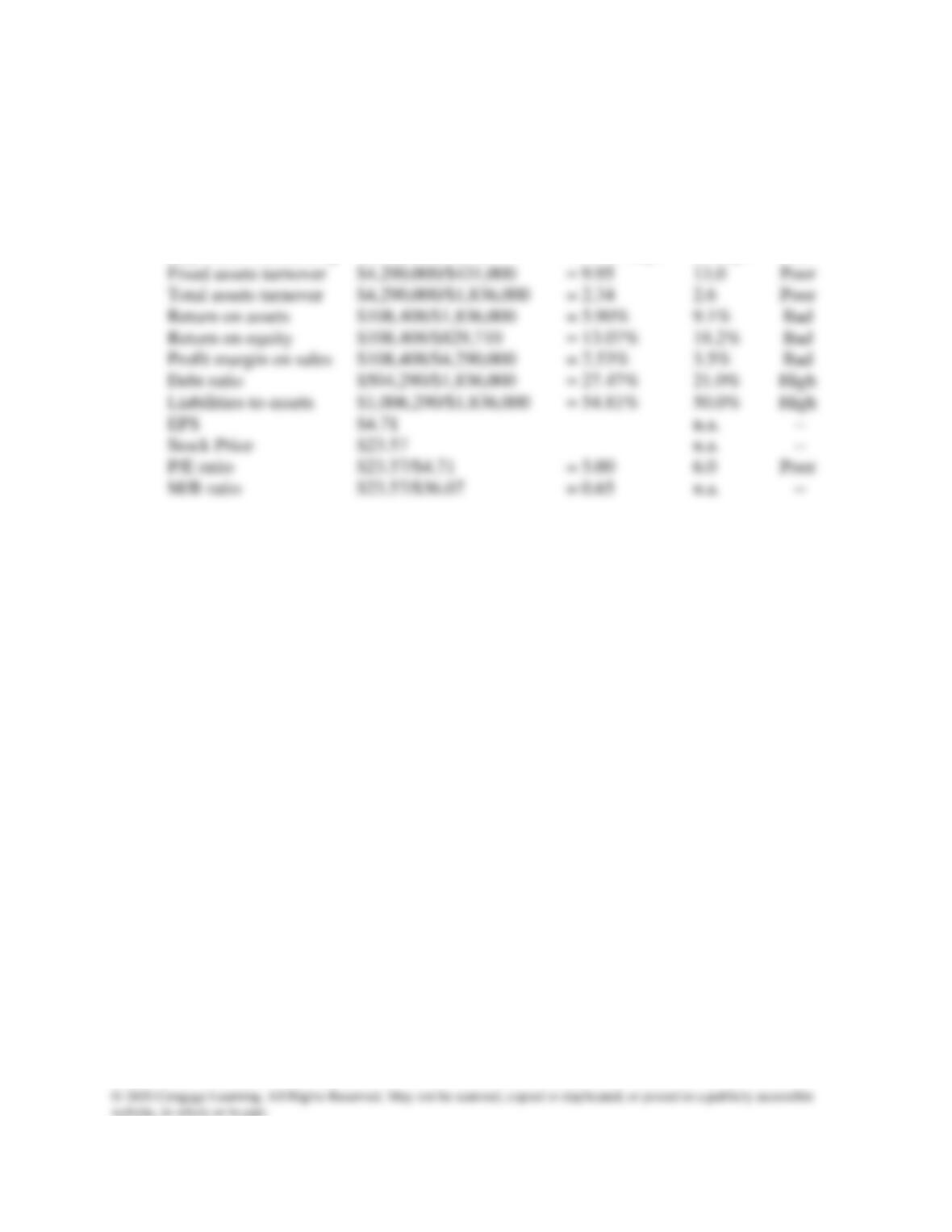
ROE = PM T.A. turnover EM = 1.52% 1.754 1.61 = 4.3%.
For the industry, ROE = 1.2% 3 2.5 = 9%.
Answers and Solutions: 3 – 12
3-14 Here are the firm’s base case ratios and other data as compared to the industry:
Firm Industry Comment
Quick $511,000/$602,000 = 0.85 1.0 Weak
Current $1,405,000/$602,000 = 2.33 2.7 Weak
Inventory turnover $3,580,000/$894,000 = 4.00 7.0 Poor
Days sales outstanding $439,000/$11,753 = 37.35 days 32 days Poor
The firm appears to be badly managed—all of its ratios are worse than the industry averages,
and the result is low earnings, a low P/E, P/CF ratio, a low stock price, and a low M/B
ratio. The company needs to do something to improve.

Answers and Solutions: 3 – 13
SOLUTION TO SPREADSHEET PROBLEM
3-15 The detailed solution for the problem is available is in the file Ch03 P15 Build a Model
Solution.xlsx and is available at the textbook’s web site.
Mini Case: 3 – 14
MINI CASE
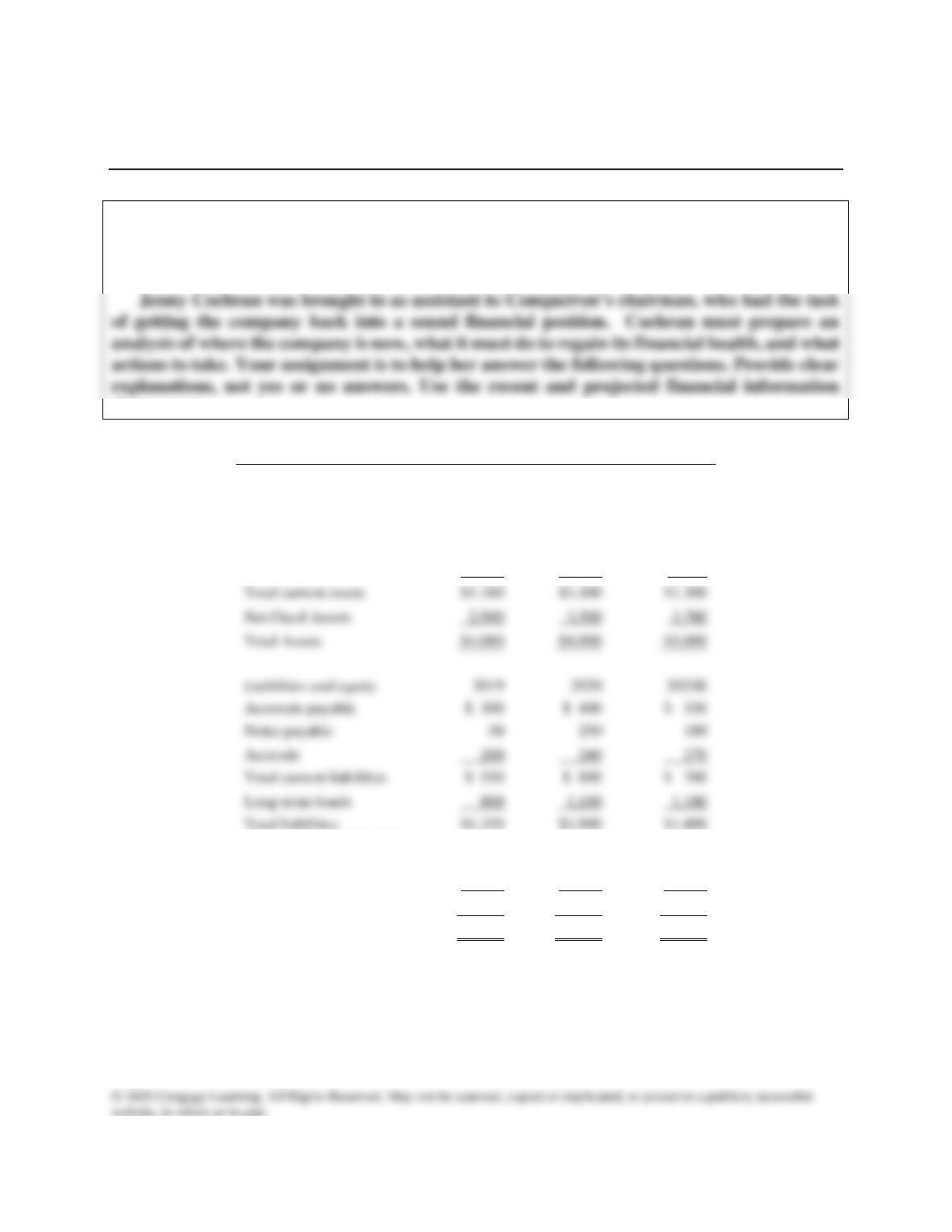
The first part of the case, presented in Chapter 2, discussed the situation of Computron
Industries after an expansion program. A large loss occurred in 2019, rather than the
expected profit. As a result, its managers, directors, and investors are concerned about the
firm’s survival.
shown next.
Balance Sheets
2018
2019
2020E
Assets
Cash and equivalents
$ 60
$ 50
$ 60
Short-term investments
100
10
50
Accounts receivable
400
520
530
Inventories
620
820
660
Total current assets
$1,180
$1,400
$1,300
Net Fixed Assets
2,900
3,500
3,700
Total Assets
$4,080
$4,900
$5,000
Liabilities and equity
Accounts payable
$ 300
$ 400
$ 330
Notes payable
50
250
100
Accruals
200
240
270
Total current liabilities
$ 550
$ 890
$ 700
Long-term bonds
800
1,100
1,100
Total liabilities
$1,350
$1,990
$1,800
Common stock (100,000
shares)
1,000
1,000
1,000
Retained earnings
1,730
1,910
2,200
Total common equity
$2,730
$2,910
$3,200
Total liabilities and equity
$4,080
$4,900
$5,000
Note: “E” denotes the “estimated forecast.”