CFIN6 – CHAPTER 3
INTEGRATIVE PROBLEMS SOLUTIONS
Integrative Problem 3-1
a. A financial market is one in which financial assets are bought and sold. There are many different types of
financial markets, each one deals with a different type of financial asset, serves a different set of
customers, or operates in a different part of the country. Financial markets differ from physical asset
markets in that real, or tangible assets such as machinery, real estate, and agricultural products are
traded in the physical asset markets, but financial securities representing claims on assets are traded in
the financial markets.
d. Transfers of capital can be made (1) by direct transfer of money and securities, (2) through an
investment banker, or (3) through a financial intermediary. In a direct transfer, a business sells its stocks
or bonds directly to investors (savers), without going through any type of institution. The business
borrower receives dollars from the savers, and the savers receive securities (bonds or stock) in return.
e. The physical, or organized security exchanges are formal organizations that have tangible, physical
locations and trade in designated securities. There are exchanges for stocks, bonds, commodities,
futures, and options. Two well-known exchanges in the United States are the New York Stock Exchange
and the American Stock Exchange. The physical exchanges are conducted as auction markets with
securities going to the highest bidder. Buyers and sellers place orders with their brokers who then
The over-the-counter (OTC) market is made up of hundreds of brokers and dealers around the country
who are connected electronically by telephones and computers. The OTC market facilitates trading of
securities that are not listed with an organized, physical exchange. This market consists of (1) the
f. The basic process is essentially the same as for established firms that are publicly traded. Stage I
decisions include those that the firms make concerning the size of the issue, the type of securities to be
issued, and the selection of an investment banker. Stage II decisions include those made with the advice
of the investment banker—that is, reevaluating the Stage I decisions, determining how the issue will be
handled by the investment banker (underwritten or best efforts), negotiating the issuance costs, and
determining the issuing price. When a firm is going public for the first time, however, there is no
Once the stock is issued, the investment banker generally remains active in the market to help ensure
that the stock price remains close to its equilibrium.
g. Following is the equation used to determine the net amount that Kampfire will receive from the stock
issue:
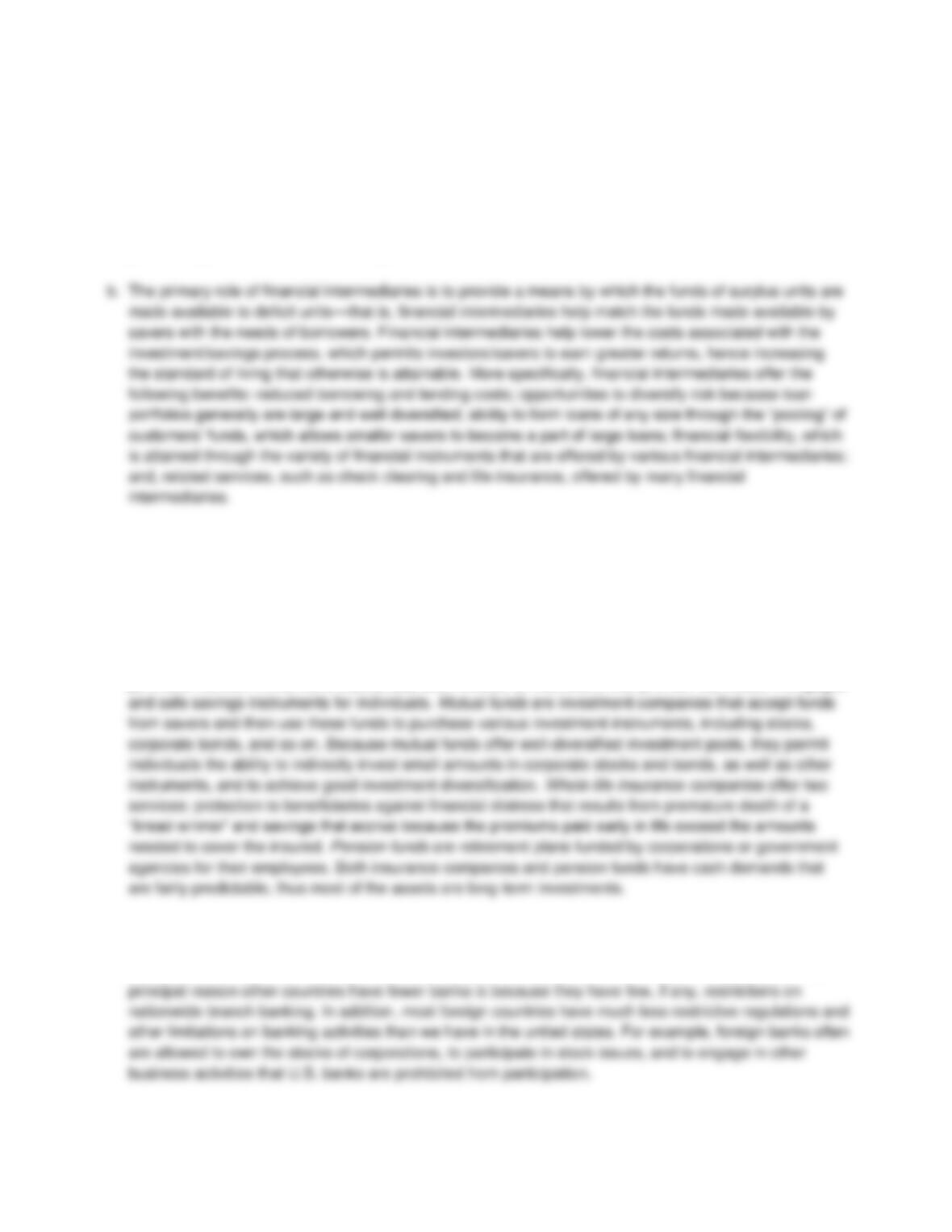
Net amount received by Kampfire = (Amount of issue)(1 – F) – Other expenses
Here F represents the issue (flotation) costs stated in decimal form. Rearranging this equation, we can
determine the amount that must be issued to net Kampfire $25 million as follows:
Integrative Problem 3-2
a. A financial intermediary is an organization that facilitates the indirect transfer of funds from savers to
borrowers by issuing liabilities to savers in the form of savings accounts, mutual funds, and pension
plans, and by offering credit to borrowers in the form of credit cards, mortgages, commercial loans, and
so forth. Financial intermediation refers to the process by which financial intermediaries transform funds
provided by savers into funds used by borrowers.
c. Commercial banks are the traditional “department stores” of finance because they offer a variety of
products and services to a variety of customers. Even though their customers traditionally have been
businesses, commercial banks offer checking and savings instruments and loans to both businesses and
individuals. Credit unions are owned by the depositors, who generally have a common bond, such as
religion, occupation, and so on. Credit unions primarily service individuals by offering consumer loans
used for automobile purchases, home equity improvements, and so forth. Thrift institutions are
organizations that cater to individuals who have relatively small amounts of savings or who wish to
purchase homes. Thrifts have traditionally been viewed as institutions that provide real estate mortgages
d. Financial intermediaries in other countries are characterized by significantly fewer independent
organizations than exist in the United States. For example, most other countries have fewer than 100
independent banks, whereas there are more than 7,000 independent banks in the United States. The
e. The U.S. financial system has experienced significant deregulation during the past couple of decades.
Much of the deregulation has been aimed toward “evening the playing field” for U.S. banks and
intermediaries in the international markets. For example, branch banking restrictions have been
substantially relaxed, banking organization have been allowed to participate in more, and a wider variety
of, financial-related business activities. In the future, we should see many more changes that will help
U.S. banks and financial intermediaries better compete worldwide. As the financial services industry