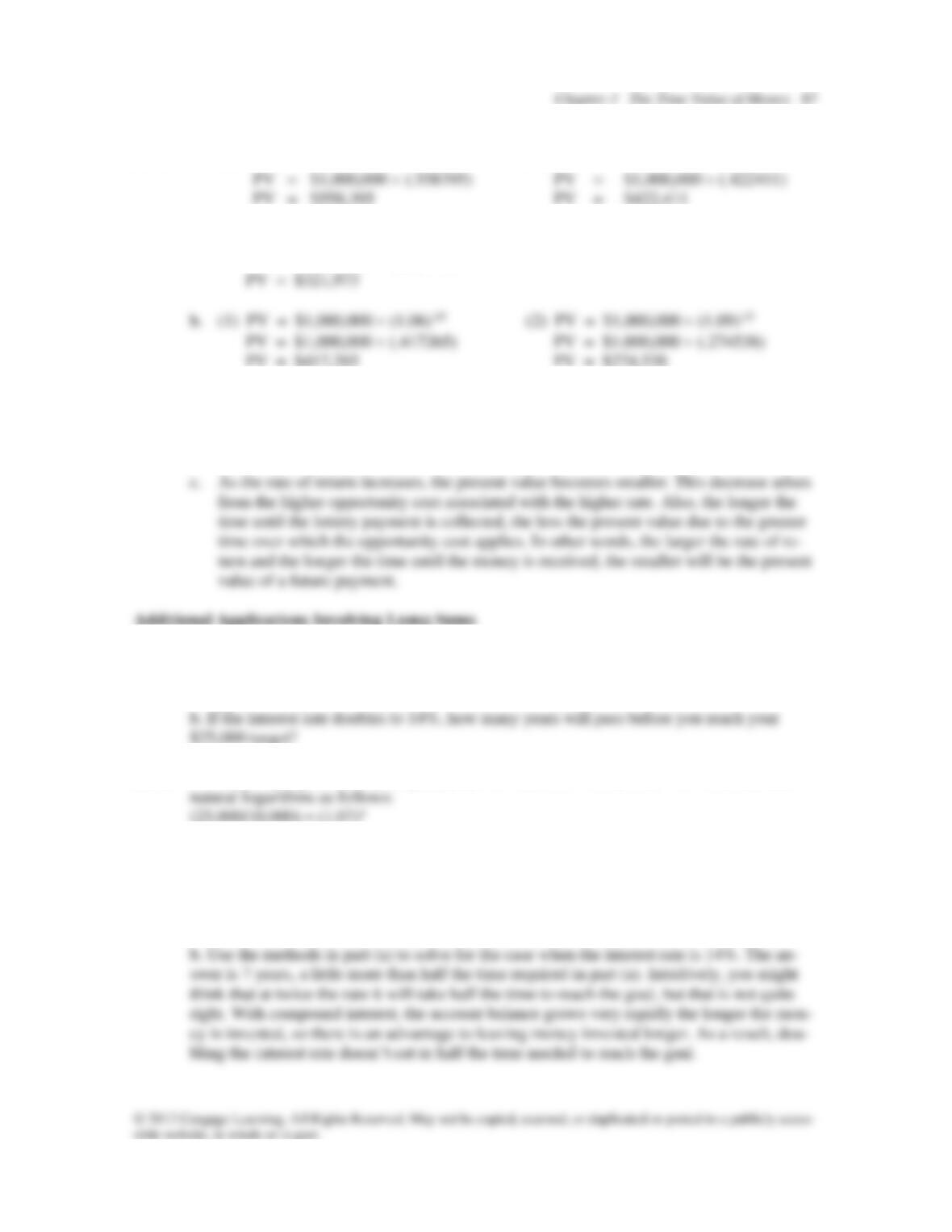
A3-4. a. (1) PV = $1,000,000 (1.06)-10 (2) PV = $1,000,000 (1.09)-10
(3) PV = $1,000,000 (1.12)-10
PV = $1,000,000 (.321973)
(3) PV = $1,000,000 (1.12)-15
PV = $1,000,000 (.182696)
PV = $182,696
P3-5. You have saved $10,000 toward a down payment on a home. The money is invested in an
account earning 7% interest. You will be ready to purchase the new home once your
savings account grows to $25,000.
a. Approximately how many years will it take for the account to reach $25,000?
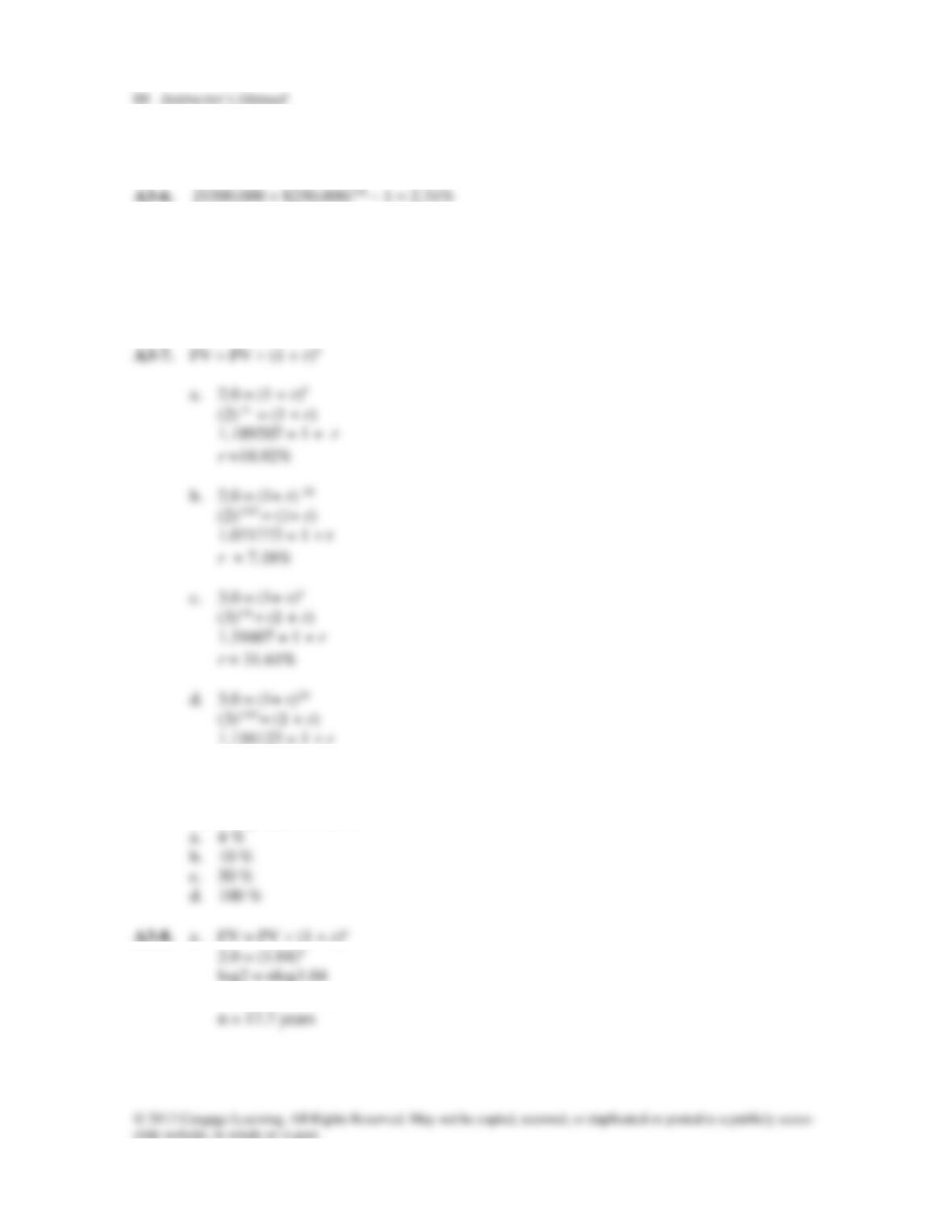
A3-5. a. You are trying to solve this equation for “n”: $25,000 = $10,000(1.07)n . You can use
Ln(2.5) = nLn(1.07)
n=13.5 years.
You could find the same answer by entering the following formula in Excel:
=nper(0.07,0,10000,-25000,0) = 13.5 years.
P3-6. You purchased a home for $250,000 eight years ago, and now the home is worth $300,000.
What annual rate of return did you earn on your home?
P3-7. Find the rates of return required to do the following:
a. Double an investment in 4 years
b. Double an investment in 10 years
c. Triple an investment in 4 years
d. Triple an investment in 10 years
r = 11.61%
P3-8. Determine the length of time required to double the value of an investment, given the
following rates of return.
0.301 = n 0.017
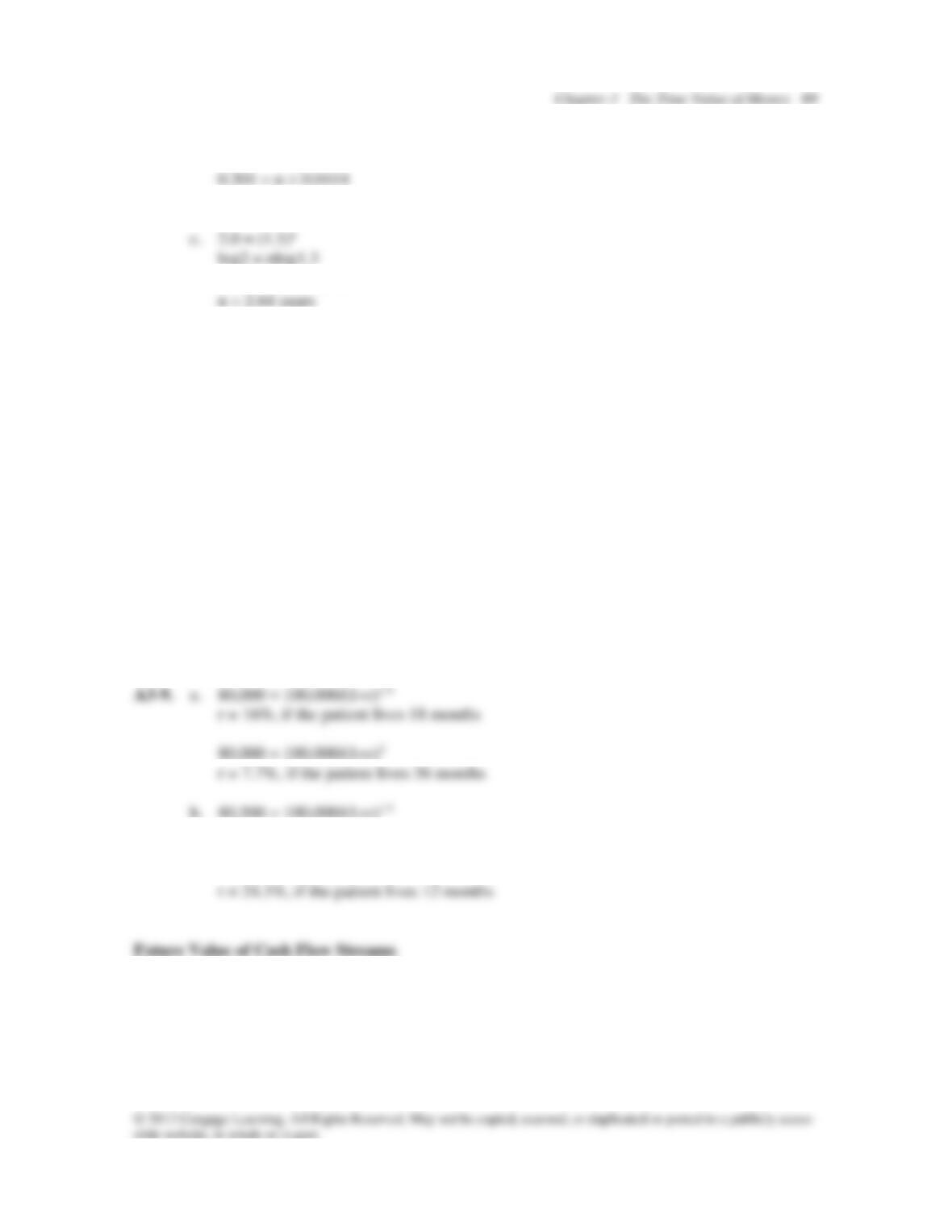
b. 2.0 = (1.1) n
log2 = nlog1.1
n = 7.27 years
0.301 = n 0.1139
d. 2.0 = (2)n
n = 1 year
P3-9. The viatical industry offers a rather grim example of present value concepts. A firm in this
business, called a viator, purchases the rights to the benefits from a life insurance contract
from a terminally ill client. The viator may then sell claims on the insurance payout to oth-
er investors. The industry began in the early 1990s as a way to help AIDS patients capture
some of the proceeds from their life insurance policies for living expenses.
Suppose a patient has a life expectancy of 18 months and a life insurance policy with a
death benefit of $100,000. A viator pays $80,000 for the right to the benefit, and then sells
that claim to another investor for $80,500.
a. From the point of view of the patient, this contract is like taking out a loan. What is the
compound annual interest rate on the loan if the patient lives exactly 18 months? What
if the patient lives 36 months?
b. From the point of view of the investor, this transaction is like lending money. What is
the compound annual interest rate earned on the loan if the patient lives 18 months?
What if the patient lives just 12 months?
r = 15.75%, if the patient lives 18 months
80,500 = 100,000/(1+r)
P3-10. Liliana Alvarez’s employer offers its workers a two-month paid sabbatical every seven
years. Liliana, who just started working for the firm, plans to spend her sabbatical touring
Europe at an estimated cost of $25,000. To finance her trip, Liliana plans to make six an-
nual end-of-year deposits of $2,500 each, starting this year, into an investment account
earning 8% interest.
90 Instructor’s Manual
a. Will Liliana’s account balance at the end of seven years be enough to pay for her trip?
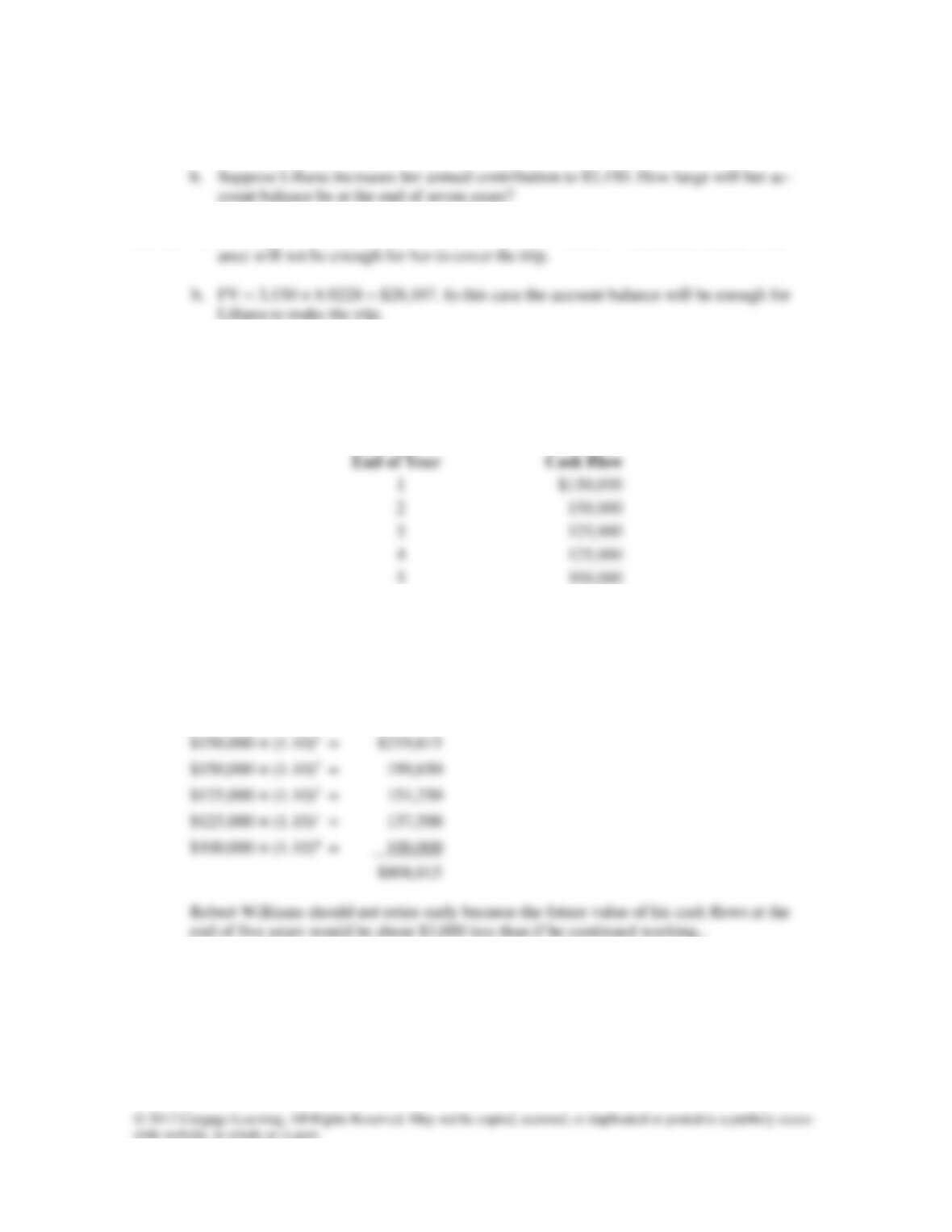
A3-10. a. FV = 2,500 × FVAF (7, 8%) = $2,500 × 8.9228 = $22,307. Therefore, Liliana’s bal-
P3-11. Robert Williams is considering an offer to sell his medical practice, allowing him to retire
five years early. He has been offered $500,000 for his practice and can invest this amount
in an account earning 10 % per year. If the practice is expected to generate the following
cash flows, should Robert accept this offer and retire now?
A3-11. FV on original retirement date if early retirement is chosen:
$500,000 (1.10)5 = $805,255
FV on retirement date if early retirement is not chosen:
P3-12. Gina Coulson has just contracted to sell a small parcel of land that she inherited a few
years ago. The buyer is willing to pay $24,000 now. Alternatively, the buyer will make the
series of payments shown in the following table, with each payment made at the beginning
of the year. Because Gina doesn’t really need the money today, she plans to let it accumu-
late in an account that earns 7% annual interest.
Chapter 3 The Time Value of Money 91
Mixed Stream
Beginning of Year (t)
Cash Flow (CFt)
1
$ 2,000
2
4,000
3
6,000
4
8,000
5
10,000
a. What is the future value of the lump sum at the end of year 5?
b. What is the future value of the mixed stream at the end of year 5?
c. Based on your findings in parts (a) and (b), which alternative should Gina take?
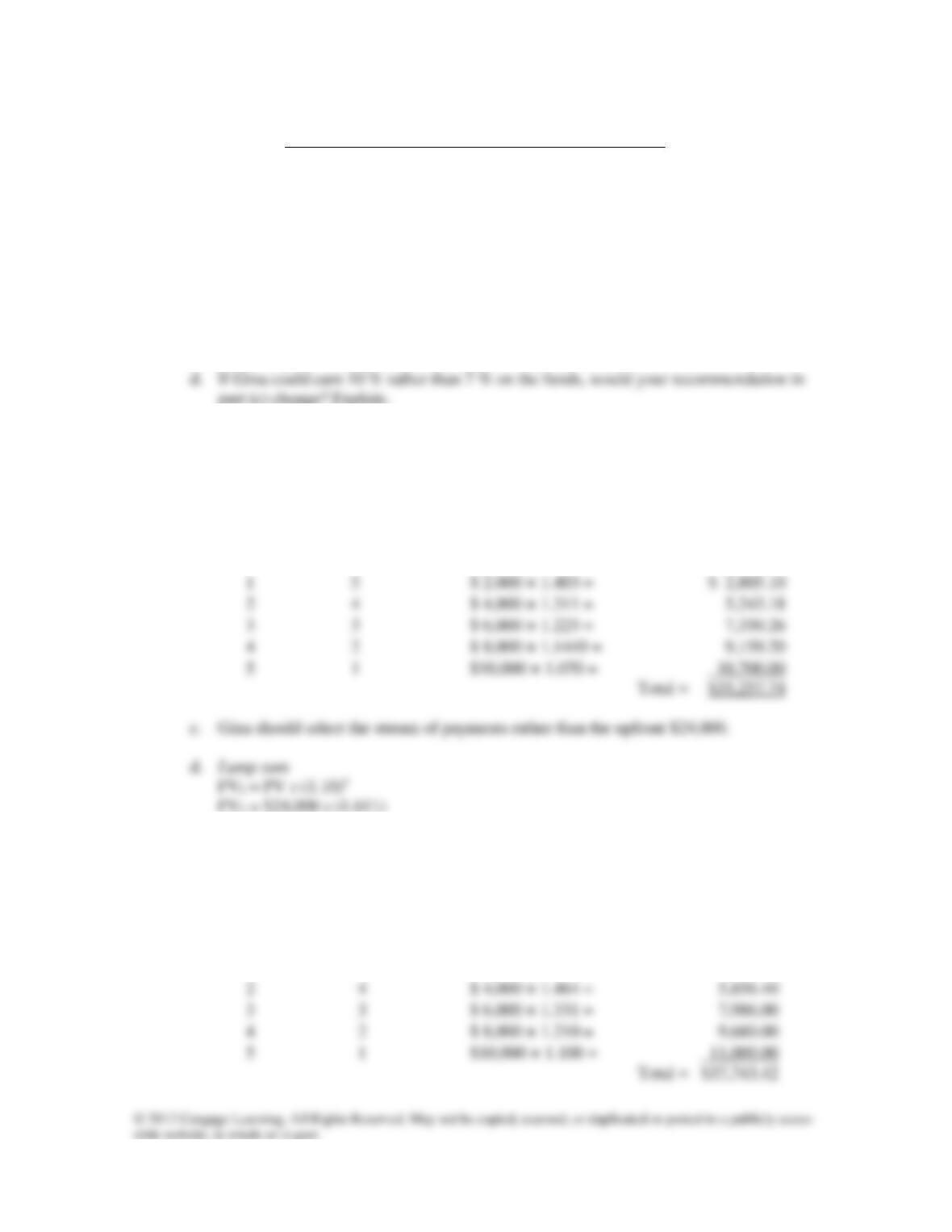
A3-12. a. FV5 = PV × (1.07)5
FV5 = $24,000 × (1.403)
FV5 = $33,661
b. Beginning of Number of
Year Years (t) FV = CFt × (1 + .07)t
Future Value
FV5 = $38,652.24
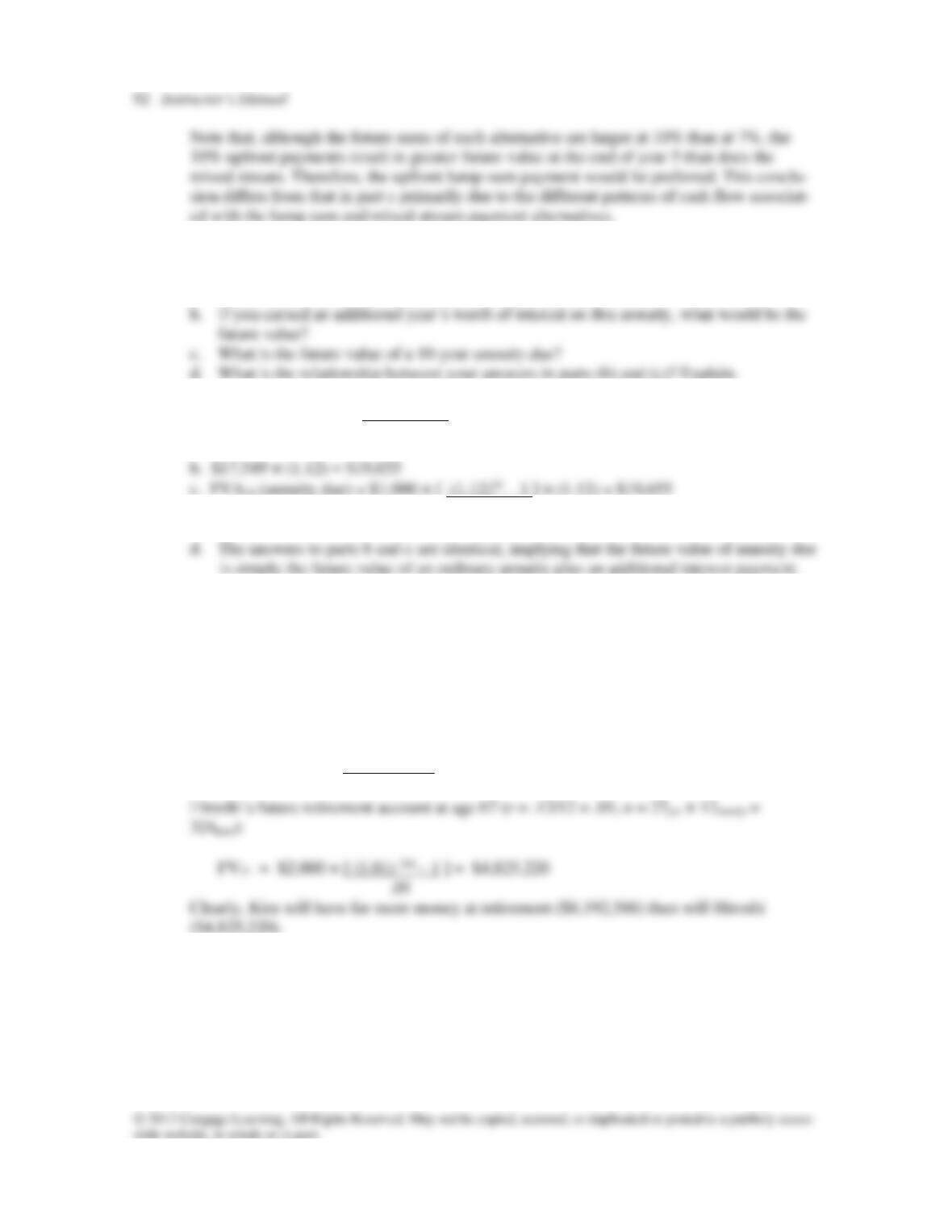
Mixed stream
Beginning of Number of
Year Years (t) FV = CFt × (1 + .10)t
Future Value
1 5 $ 2,000 × 1.611 = $ 3,221.02
P3-13. For the following questions, assume an annual annuity of $1,000 and a required return of
12%.
a. What is the future value of a ten-year ordinary annuity?
A3-13. a. FVA10 = $1,000 × [ (1.12)10 – 1 ] = $17,549
0.12
0.12
P3-14. Kim Edwards and Hiroshi Suzuki are both newly minted 30-year-old MBAs. Kim plans to
invest $1,000 per month into her 401(k) beginning next month. Hiroshi intends to invest
$2,000 per month, but he does not plan to begin investing until 10 years after Kim begins
investing. Both Kim and Hiroshi will retire at age 67, and the 401(k) plan averages a 12 %
annual return. Who will have more 401(k) money at retirement?
A3-14. Kim’s future retirement account at age 67 (r = .12/12 = .01; n = 37yrs × 12mos/yr = 444 mos):
FV37 = $1,000 [ (1.01)444 – 1] = $8,192,586
.01
P3-15. To supplement your planned retirement, you estimate that you need to accumulate
$220,000 in 42 years. You plan to make equal annual end-of-year deposits into an account
paying 8 % annual interest.
a. How large must the annual deposits be to create the $220,000 fund in 42 years?
b. If you can afford to deposit only $600 per year into the account, how much will you
have accumulated by the end of the forty-second year?
P3-16. Given the mixed streams of cash flows shown in the following table, answer parts (a) and
(b):
Cash Flow Stream
Year
A
B
$
A3-16.
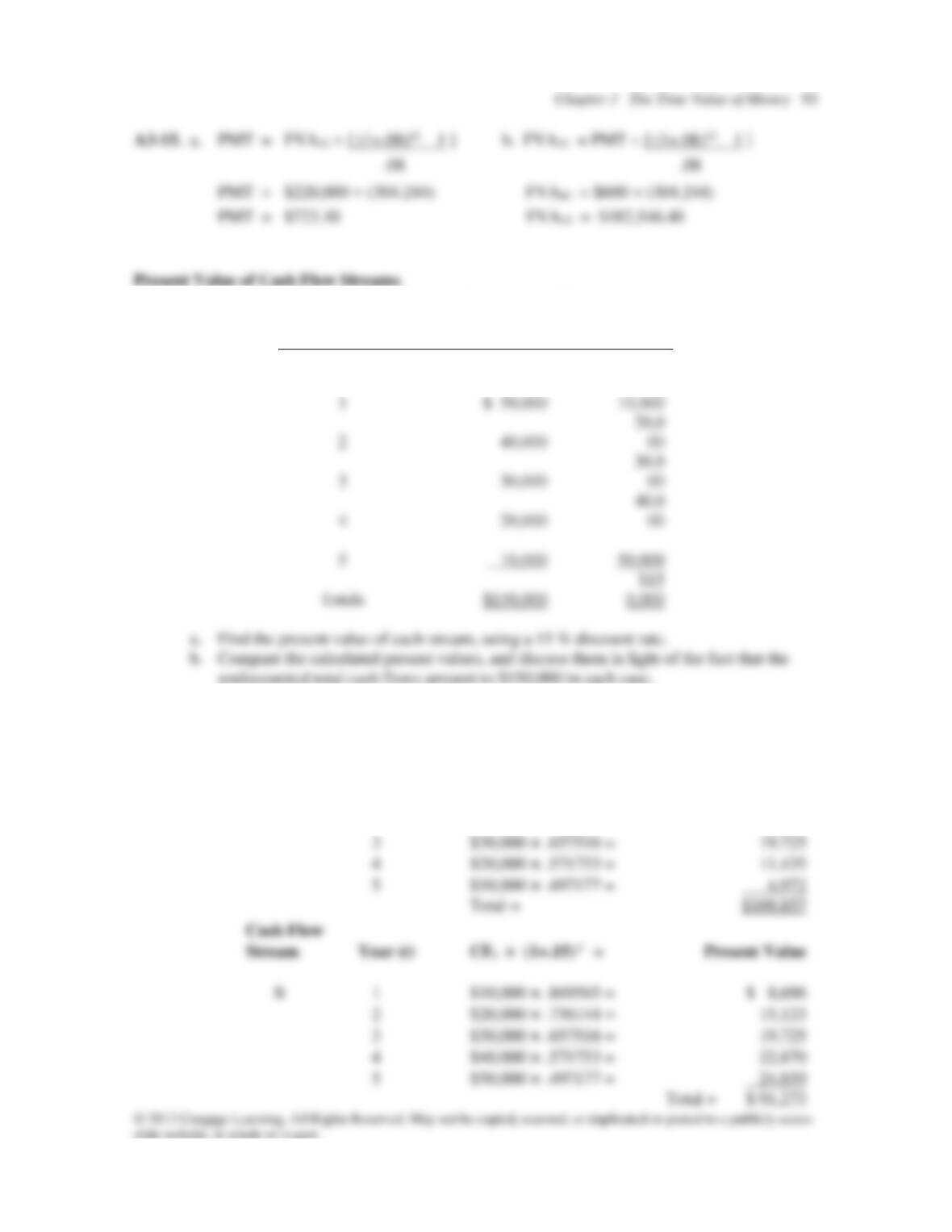
a. Cash Flow
Stream Year (t) CFt × (1+.15)-t = Present Value
A 1 $50,000 × .869565 = $ 43,479
2 $40,000 × .756144 = 30,246
P3-17. As part of your personal budgeting process, you have determined that at the end of each of
the next five years you will incur significant maintenance expenses on your home. You’d
like to cover these expenses by depositing a lump sum in an account today that earns 8%.
You will gradually draw down this account each year as maintenance bills come due.
End of Year Budget Shortfall
1 $ 5,000
2 4,000
3 6,000
4 10,000
5 3,000
a. How much money must you deposit today to cover all of the expenses?
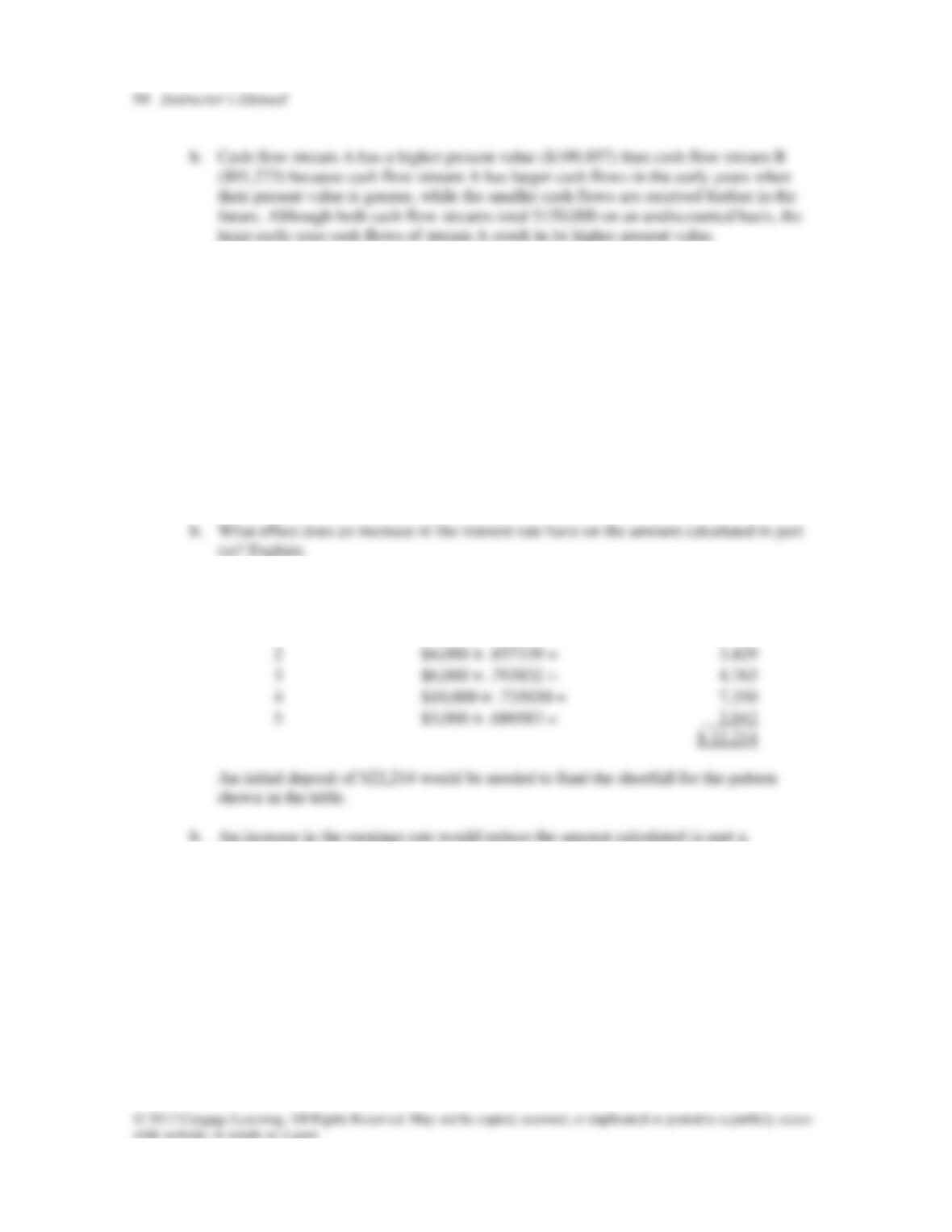
A3-17. a. End of Budget
Year (t) Shortfall × (1 + .08)-t = Present Value
1 $5,000 × .925926 = $ 4,630
P3-18. Ruth Nail receives two offers for her seaside home. The first offer is for $1 million today.
The second offer is for an owner-financed sale with annual payments as follows:
End of Year
Payment
0 (Today)
$200,000
1
200,000
2
200,000
3
200,000
4
200,000
5
300,000
Chapter 3 The Time Value of Money 95
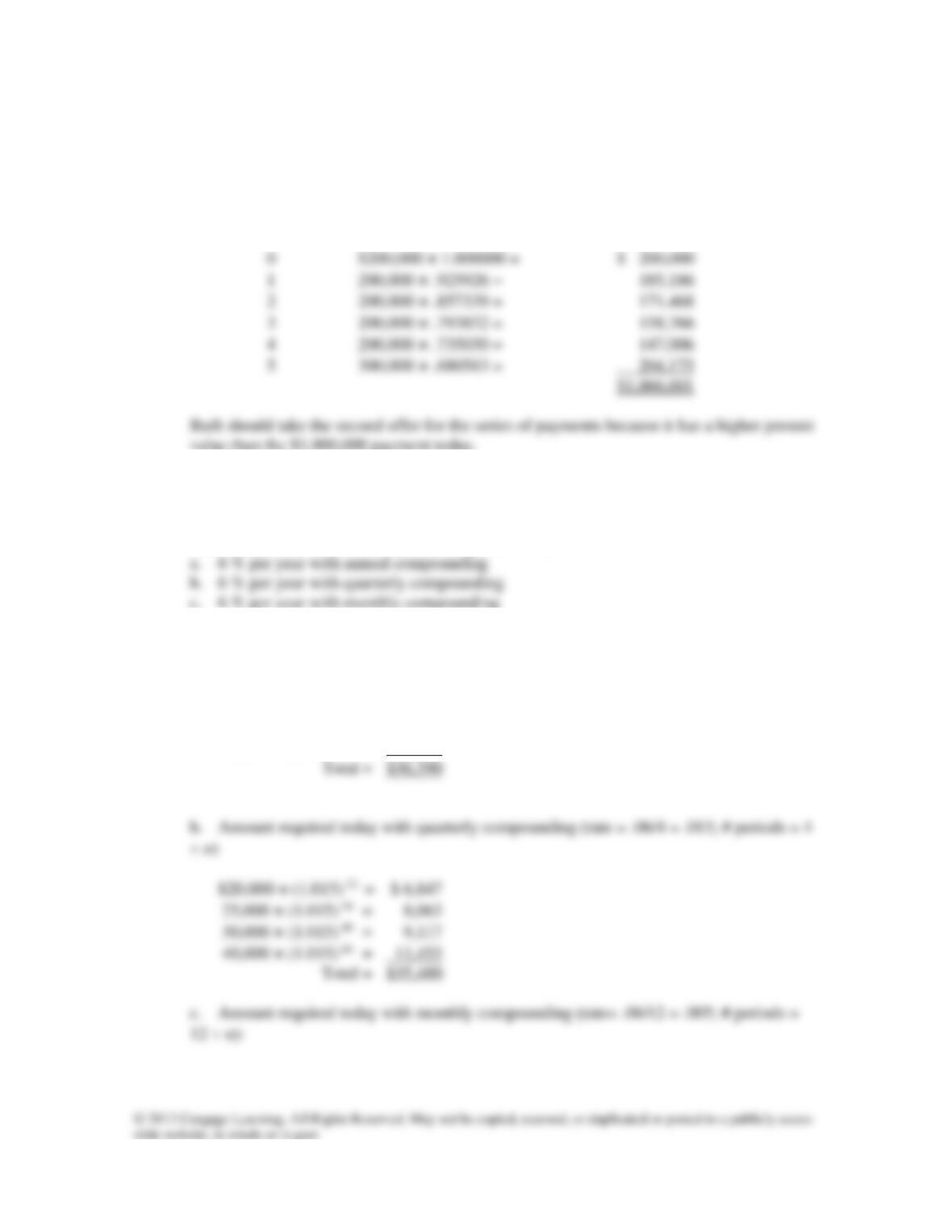
Assuming that Ruth earns a rate of 8 % on her investments, which offer should she take?
A3-18. PV of owner-financed sale:
End of
Year (t) Cash Flow × (1+.08)-t = Present Value
P3-19. Melissa Gould wants to invest today in order to assure adequate funds for her son’s college
education. She estimates that her son will need $20,000 in 18 years; $25,000 in 19 years;
$30,000 in 20 years; and $40,000 in 21 years. How much does Melissa have to invest in a
fund today if the fund earns the following interest rate?
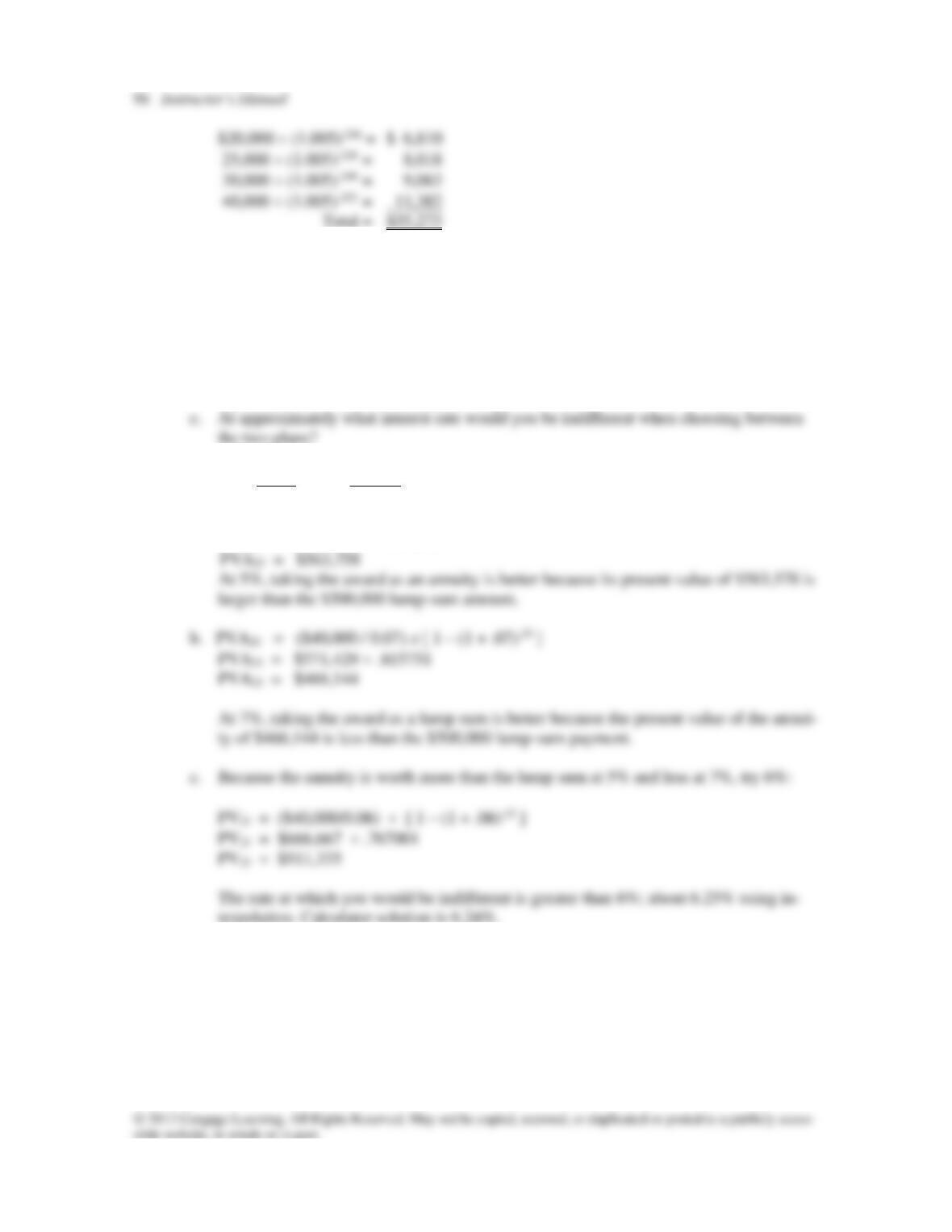
A3-19. a. Amount required today with annual compounding (rate = .06; # periods = 1 n)
$20,000 × (1.06)-18 = $ 7,007
25,000 × (1.06)-19 = 8,263
30,000 × (1.06)-20 = 9,354
40,000 × (1.06)-21 = 11,766
P3-20. Assume that you just won the state lottery. Your prize can be taken either in the form of
$40,000 at the end of each of the next 25 years (i.e., $1 million over 25 years) or as a lump
sum of $500,000 paid immediately.
a. If you expect to be able to earn 5% annually on your investments over the next 25
years, which alternative should you take? Why?
b. Would your decision in part (a) be altered if you could earn 7% rather than5 % on your
investments over the next 25 years? Why?
A3-20. PVAn = PMT [1 – 1 ]
r (1 + r) n
a. PVA25 = ($40,000 / 0.05) [1 – (1 + .05)-25 ]
PVA25 = $800,000 .704697
P3-21. For the following questions, assume an end-of-year cash flow of $250 and a 10% discount
rate.
a. What is the present value of a single cash flow?
b. What is the present value of a 5-year annuity?
c. What is the present value of a 10-year annuity?
d. What is the present value of a 100-year annuity?
e. What is the present value of a $250 perpetuity?
0.10
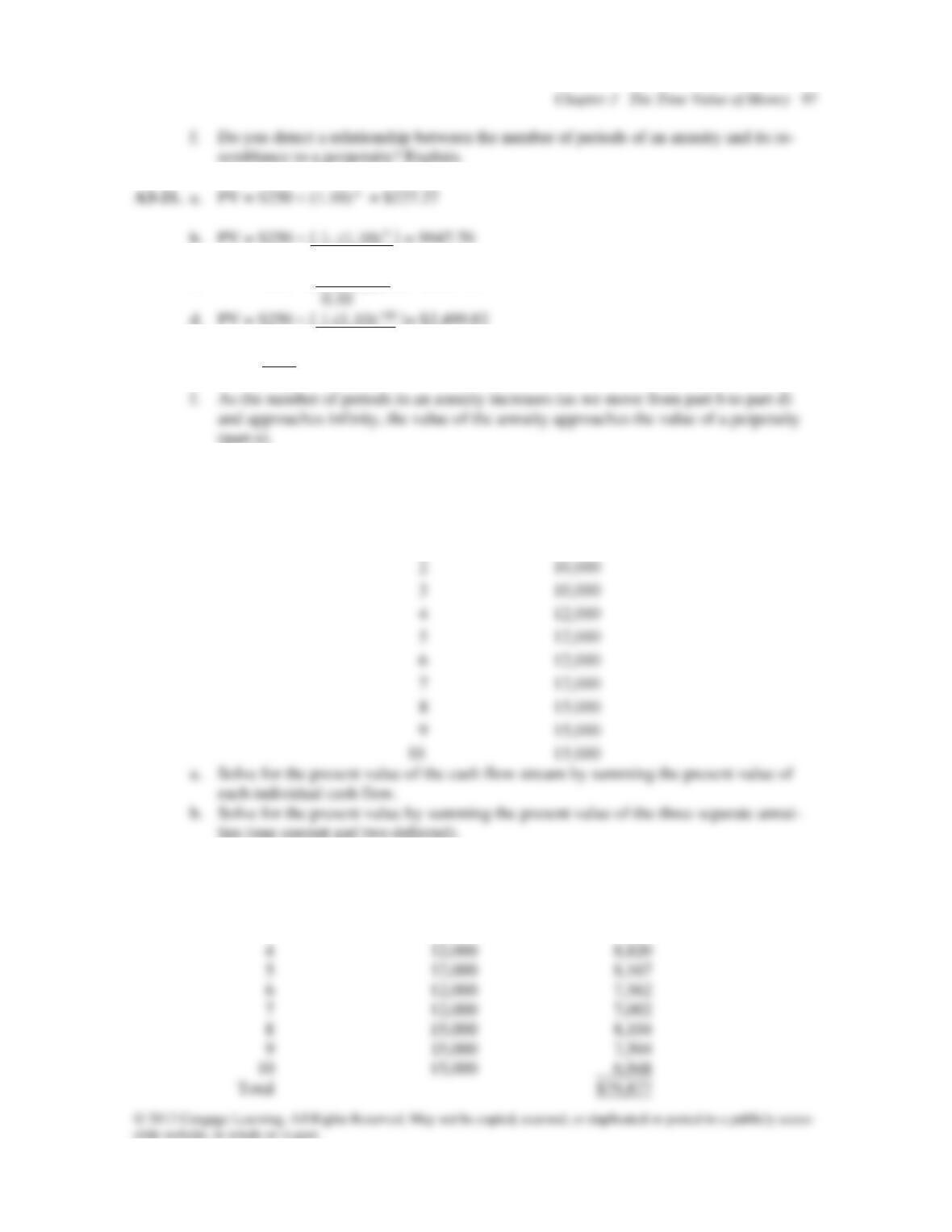
c. PV = $250 [1- (1.10)-10 ] = $1,536.14
0.10
e. PV = $250 = $2,500.00
0.10
P3-22. Use the following table of cash flows to answer parts (a) and (b). Assume an 8% discount
rate.
End of Year
Cash Flow
1
$10,000
2
3
4
5
6
7
8
9
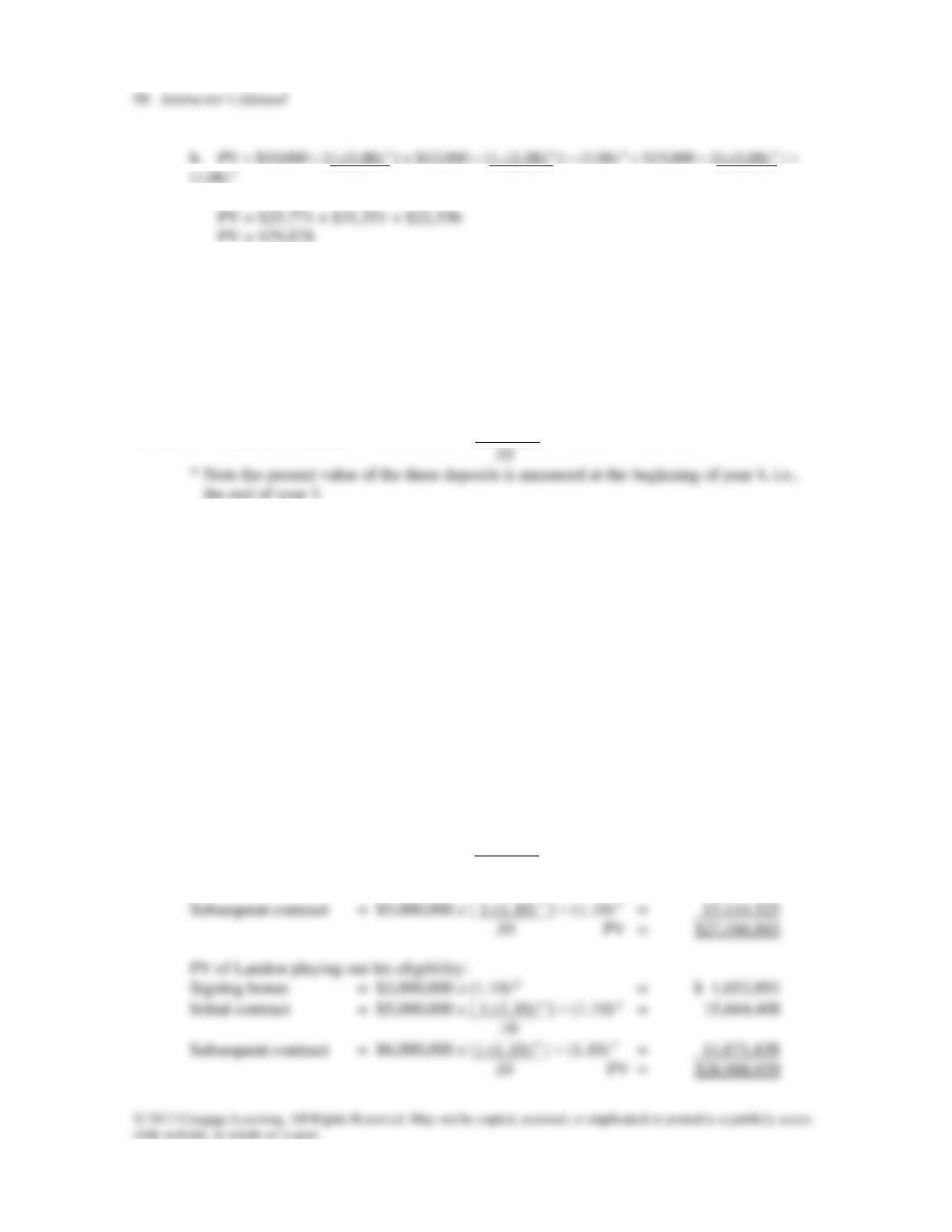
A3-22. a. Year Cash Flow Present Value
1 $10,000 $ 9,259
2 10,000 8,573
3 10,000 7,938
0.08 0.08 0.08
P3-23. Consumer Insurance, Inc. sells extended warranties on appliances that provide coverage
after the manufacturers’ warranties expire. An analyst for the company forecasts that the
company will have to pay warranty claims of $5 million per year for three years, with the
first costs expected to occur four years from today. The company wants to set aside a lump
sum today to cover these costs, and money invested today will earn 10%. How much does
the firm need to invest now?
A3-23. PV of deferred annuity* = $5,000,000 [1-(1.10)-3 ] (1.10)-3 = $9,342,044
P3–24. Landon Lowman, the 20-year-old star quarterback of the university football team, is
approached about skipping his last two years of college and entering the professional football
draft. Landon expects that his football career will be over by the time he is 32 years old.
Talent scouts estimate that Landon could receive a signing bonus of $1 million today, along
with a five-year contract for $3 million per year (payable at the end of each year). They
further estimate that he could negotiate a contract for $5 million per year for the remaining
seven years of his career. The scouts believe, however, that Landon will be a much higher
draft pick if he improves by playing two more years of college football. If he stays at the
university, he is expected to receive a $2 million signing bonus in two years, along with a
five-year contract for $5 million per year. After that, the scouts expect Landon to obtain a
five-year contract for $6 million per year to take him into retirement. Assume that Landon
can earn a 10% return over this time. Should Landon stay or go?
A3-24. PV of Landon entering the draft:
Signing bonus = $ 1,000,000
Initial contract = $3,000,000 x [ 1-(1.10)-5 ] = 11,372,360
.10
P3-25. Matt Sedgwick, facilities and operations manager for the Birmingham Buffalo professional
football team, has come up with an idea for generating income. Matt wants to expand the
stadium by building skyboxes sold with lifetime (perpetual) season tickets. Each skybox
will be guaranteed 10 season tickets at a cost of $200 per ticket per year for life. If each
skybox costs $100,000 to build, what is the minimum selling price that Matt will have to
charge for the skyboxes to break even, if the required return is 10 %?
A3-25. PV of ticket sales = ($200 10) = $20,000
P3-26. Jill Chu wants to choose the best of four immediate retirement annuities available to her. In
each case, in exchange for paying a single premium today, she will receive equal annual
end-of-year cash benefits for a specified number of years. She considers the annuities to be
equally risky and is not concerned about their differing lives. Her decision will be based
solely on the rate of return she will earn on each annuity. The key terms of each of the four
annuities are shown in the following table.
Annuity
Premium
Paid Today
Annual
Benefit
Life (years)
A
$30,000
$3,100
20
B
25,000
3,900
10
C
40,000
4,200
15
D
35,000
4,000
12
a. Calculate to the nearest 1 % the rate of return on each of the four annuities Jill is con-
sidering.
b. Given Jill’s stated decision criterion, which annuity would you recommend?
A3-26. a. Loan A Loan B
$30,000 = $3,100 (PVFA,r, 20 yrs.) $25,000 = $3,900 (PVFAr%,10 yrs.)
9.677 = PVFA r%, 20 yrs.) 6.410 = PVIFA r%, 10 yrs.
r = 8% r = 9%
9.524 = PVFAr%, 15 yrs. 8.75 = PVIFAr%, 12 yrs.
r = 6% r = 5%
P3-27. Evaluate each of the following three investments, each costing $1,000 today and providing
the returns noted below, over the next five years.
Investment 1: $2,000 lump sum to be received in five years
Investment 2: $300 at the end of each of the next five years
Investment 3: $250 at the beginning of each of the next five years
a. Which investment offers the highest return?
$500)?
c. What causes the big change in the returns on the annuities?
A3-27. a. Return on Investment # 1:
$2,000 = $1,000 (1 + r)5
r = 14.87%
Return on Investment # 2:
$1,000 = $300 1 [ 1 – 1 ]
r (1+r) n
Via trial and error or a financial calculator: r
15.24%