Chapter 29
Basic Financial Tools: A Review
ANSWERS TO END–OF–CHAPTER QUESTIONS
29-1 a. PV (present value) is the value today of a future payment, or stream of payments,
discounted at the appropriate rate of interest. PV is also the beginning amount that will
b. FVIFi,n is the future value interest factor for a lump sum left in an account for n periods
paying i percent interest per period. PVIFi,n is the present value interest factor for a lump
c. The equivalent (effective) annual rate (EAR) is the rate that, under annual compounding,
would have produced the same future value at the end of 1 year as was produced by more
d. An amortization schedule is a table that breaks down the periodic fixed payment of an
Answers and Solutions: 29 – 1
e. The par value is the nominal or face value of a stock or bond. The par value of a bond
generally represents the amount of money that the firm borrows and promises to repay at
some future date. The par value of a bond is often $1,000, but can be $5,000 or more.
f. Bond prices and interest rates are inversely related; that is, they tend to move in the
opposite direction from one another. A fixed-rate bond will sell at par when its coupon
g. Stand–alone risk is only a part of total risk and pertains to the risk an investor takes by
holding only one asset. Risk is the chance that some unfavorable event will occur. For
h. The expected rate of return (^
r) is the expected value of a probability distribution of
expected returns.
i. A risk premium is the difference between the rate of return on a risk–free asset and the
expected return on Stock i which has higher risk. The market risk premium is the
Answers and Solutions: 29 – 2
k. Market risk is that part of a security’s total risk that cannot be eliminated by
diversification. It is measured by the beta coefficient. Diversifiable risk is also known as
l. The beta coefficient is a measure of a stock’s market risk, or the extent to which the
returns on a given stock move with the stock market.
o. The Capital Market Line (CML) specifies the efficient set of portfolios an investor can
attain by combining a risk–free asset and the risky market portfolio M. The CML reflects
the assumption that the expected return on any efficient portfolio is equal to the riskless
rate plus a risk premium, and thus describes a linear relationship between expected return
and risk.
q. Intrinsic value (P
^0) is the present value of the expected future cash flows. The market
price (P0) is the price at which an asset can be sold.
Answers and Solutions: 29 – 3
r. The required rate of return on common stock, denoted by rs, is the minimum acceptable
rate of return considering both its riskiness and the returns available on other
s. Normal, or constant, growth occurs when a firm’s earnings and dividends grow at some
constant rate forever. One category of nonconstant growth stock is a “supernormal”
29-2 For the same stated rate, daily compounding is best. You would earn more “interest on
interest.”
29-3 The yield to maturity is generally the same as the market rate of interest, rd. The price of the
bond will rise and its YTM will fall if interest rates fall. If the bond still has a long term to
29-4 Security X is less risky if held in a diversified portfolio because of its lower beta and negative
29-5 According to the Security Market Line (SML) equation, a decrease in beta will decrease a
company’s expected return by an amount equal to the market risk premium times the change
29-6 The Security Market Line (SML) represents in a graphical form, the relationship between the
risk of an asset as measured by its beta and the required rates of return for individual
29-7 Yes. The value of a share of stock is the PV of its expected future dividends. If the two
investors expect the same future dividend stream, and they agree on the stock’s riskiness,
SOLUTIONS TO END–OF–CHAPTER PROBLEMS
29-1 The general formula is FVAn = PMT(FVIFAi,n).
a. 0 1 2 3 4 5 6 7 8
| | | | | | | | |
b. 0 1 2 3 4 5 6
| | | | | | | ($300)6.6330 = $1,989.90.
300 300 300 300 300 300
FV = ?
With a financial calculator, enter N = 6, I = 4, PV = 0, and PMT = –300. Then press the
FV key to find FV = $1,989.89.
0%
9%
4%
Answers and Solutions: 29 – 6
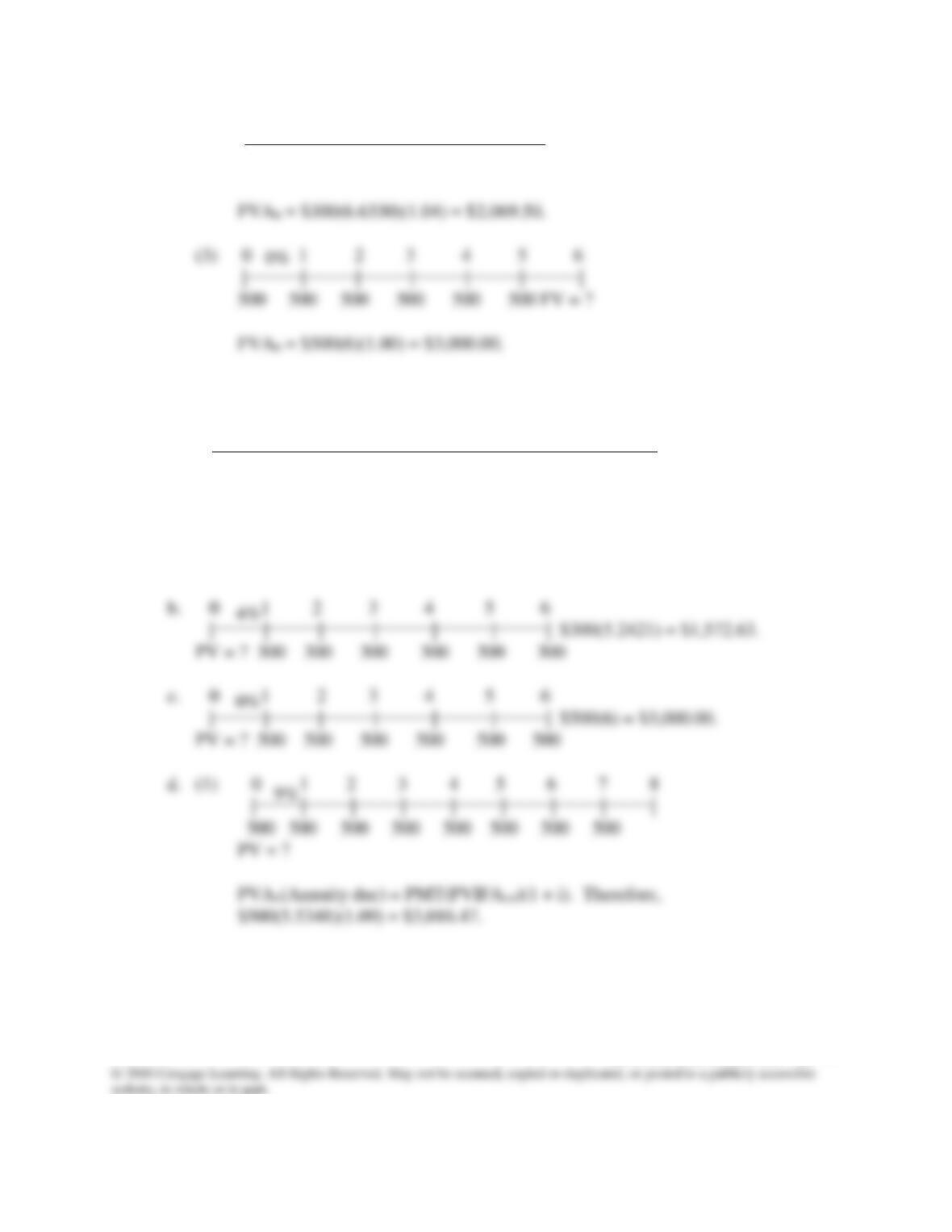
(2) 0 1 2 3 4 5 6
| | | | | | |
300 300 300 300 300 300 FV = ?
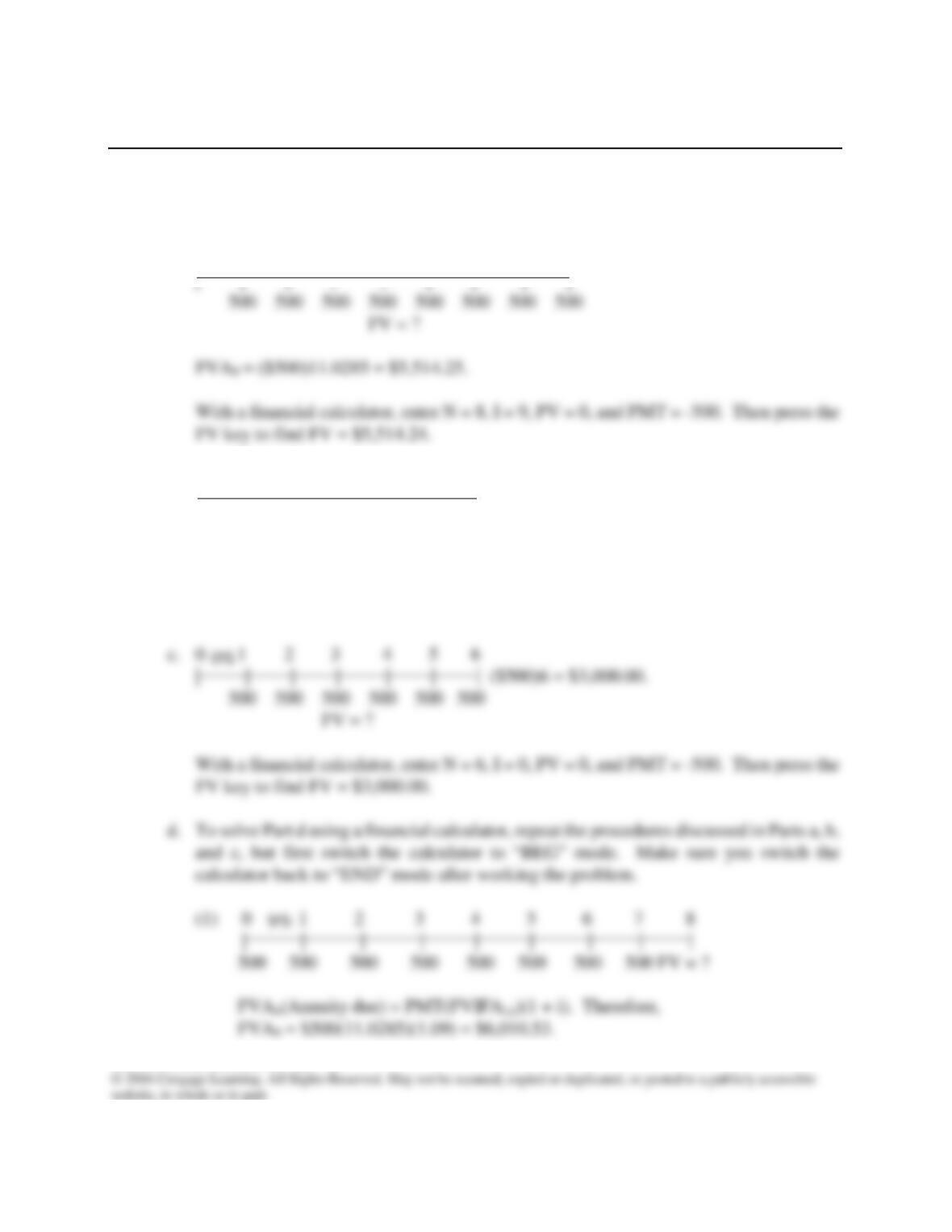
29-2 The general formula is PVAn = PMT(PVIFAi,n).
a. 0 1 2 3 4 5 6 7 8
| | | | | | | | |
PV = ? 500 500 500 500 500 500 500 500
With a financial calculator, simply enter the known values and then press the key for the
unknowns. Except for rounding errors, the answers are as given below. With the tables,
proceed as described below: PVA8 = $500(5.5348) = $2,767.40.
0%
4%
9%
Answers and Solutions: 29 – 7
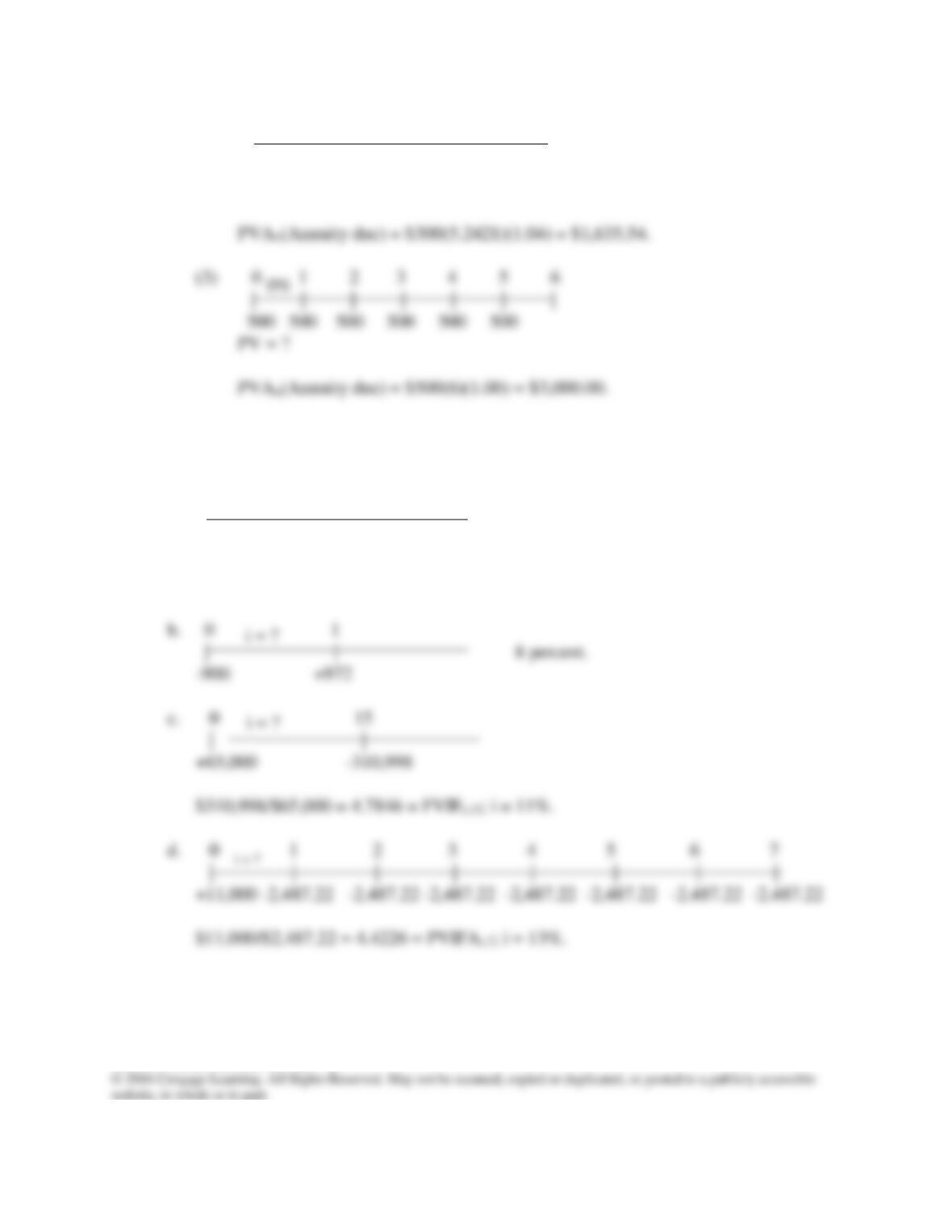
(2) 0 1 2 3 4 5 6
| | | | | | |
300 300 300 300 300 300
PV = ?
29-3 These problems can all be solved using a financial calculator by entering the known values
shown on the time lines and then pressing the I button, or by using the interest factor tables.
a. 0 1
| |
+900 -972
8 percent: $900 = $972(PVIFi,1); PVIFi,1 = 0.9259.
i = ?
4%
i = ?
Answers and Solutions: 29 – 8
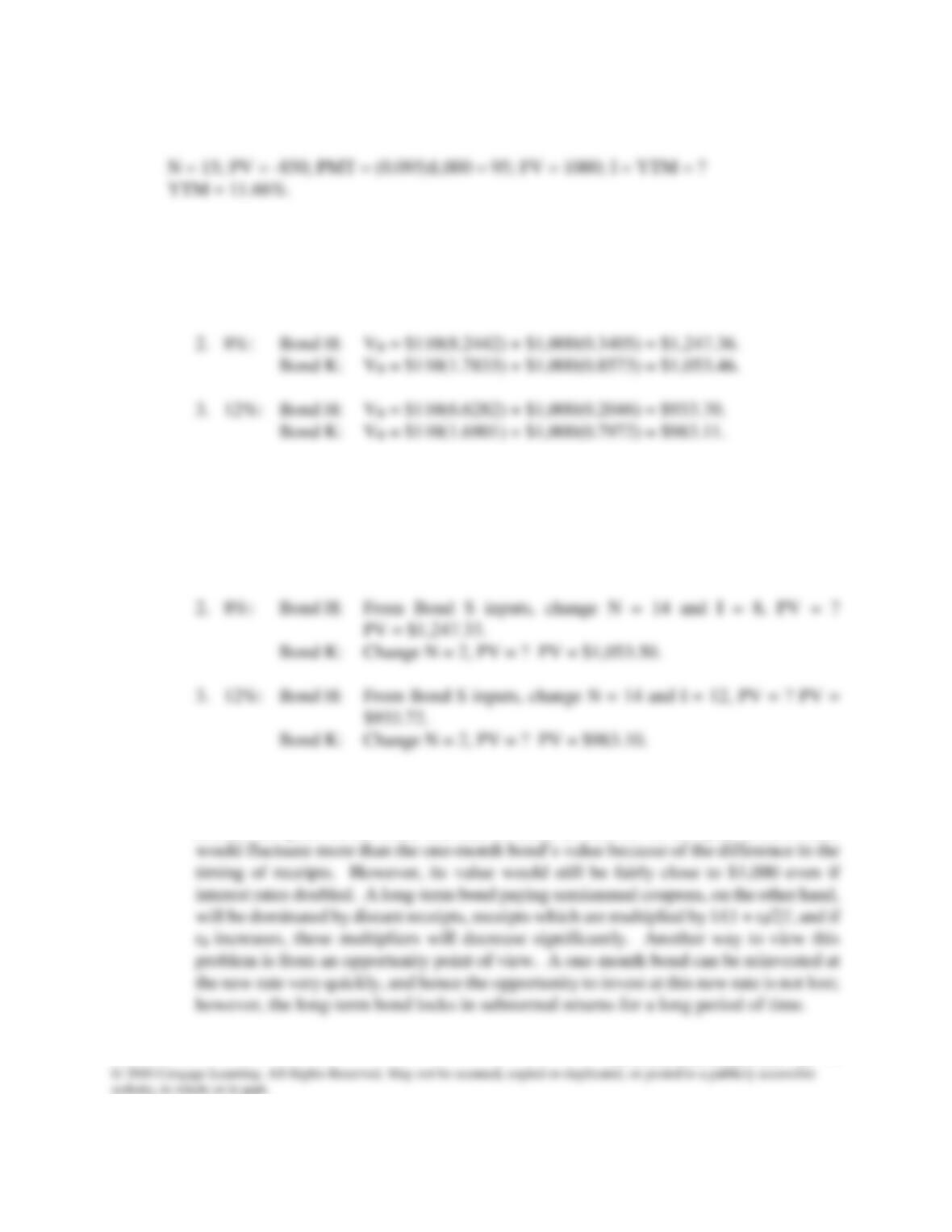
29-4 With your financial calculator, enter the following:
29-5 a. VB = PMT(PVIFAi,n) + FV(PVIFi,n)
1. 5%: Bond H: VB = $110(9.8986) + $1,000(0.5051) = $1,593.95.
Bond K: VB = $110(1.8594) + $1,000(0.9070) = $1,111.53.
Calculator solutions:
1. 5%: Bond H: Input N = 14, I = 5, PMT = 110, FV = 1000, PV = ?
PV = $1,593.92.
Bond K: Change N = 2, PV = ? PV = $1,111.56.
b. Think about a bond that matures in one month. Its present value is influenced primarily
by the maturity value, which will be received in only one month. Even if interest rates
double, the price of the bond will still be close to $1,000. A two-year bond’s value
Answers and Solutions: 29 – 9
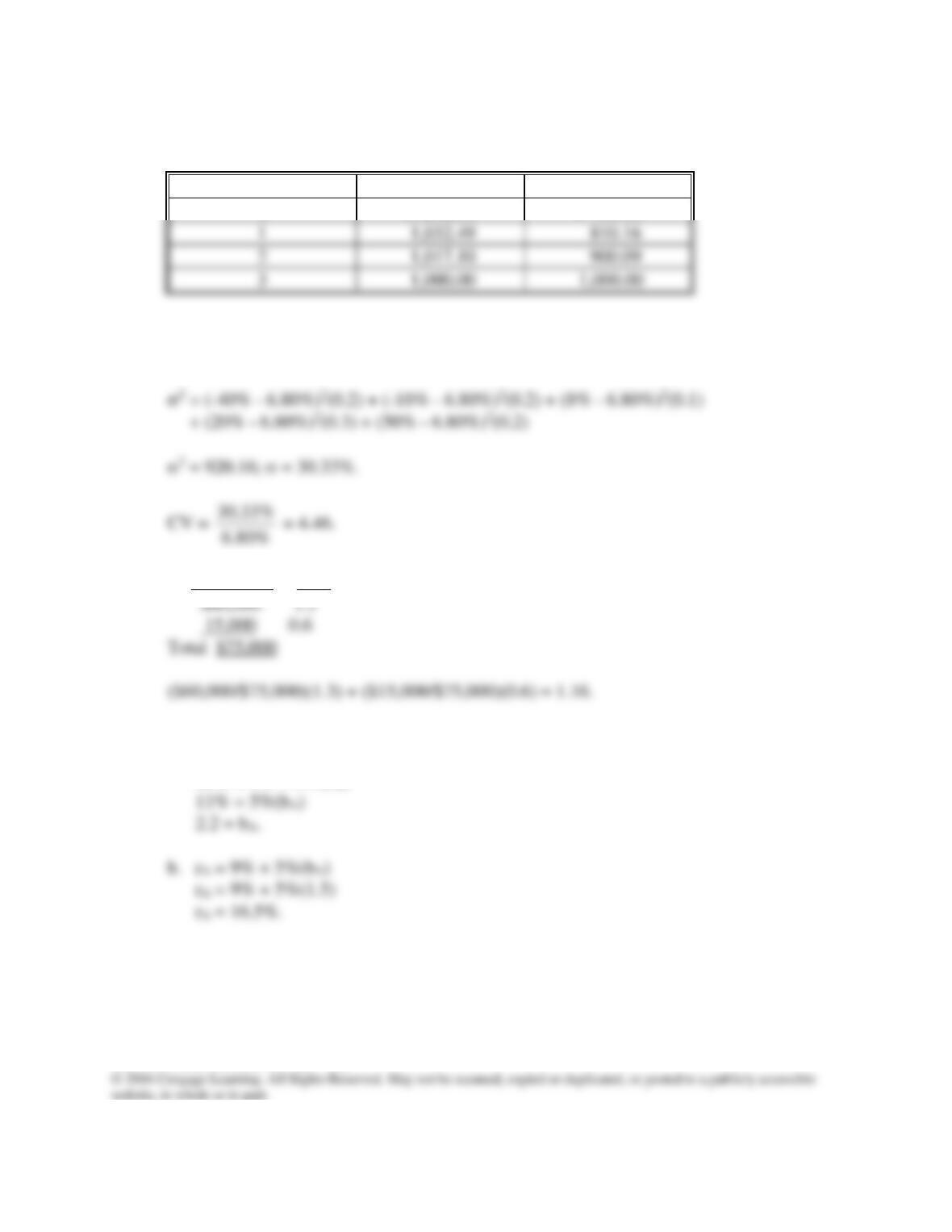
29-6
t
Price of Bond A
Price of Bond Z
0
$1,046.35
$ 729.22
29-7 ^
r = (0.2)(-40%) + (0.2)(-10%) + (0.1)(8%) + (0.3)(20%) + (0.2)(50%)
= 6.80%.
29-8 Investment Beta
29-9 a. rA = rRF + (rM – rRF)bA
20% = 9% + (14% – 9%)bA
20% = 9% + 5%(bA)
Answers and Solutions: 29 – 10
1
1,032.49
2
1,017.10
3
1,000.00
1,000.00
29-10 D1 = $0.75; g = 7%; rs = 15%; P
^0 = ?
.375.9$
07.015.0
75.0$
gr
D
P
ˆ
s
1
0=
−
=
−
=
29-12 0 1 2 3 4
| | | | |
PV = ? 50 50 50 1,050
Discount rate: Effective rate on bank deposit:
8.24%
Answers and Solutions: 29 – 11
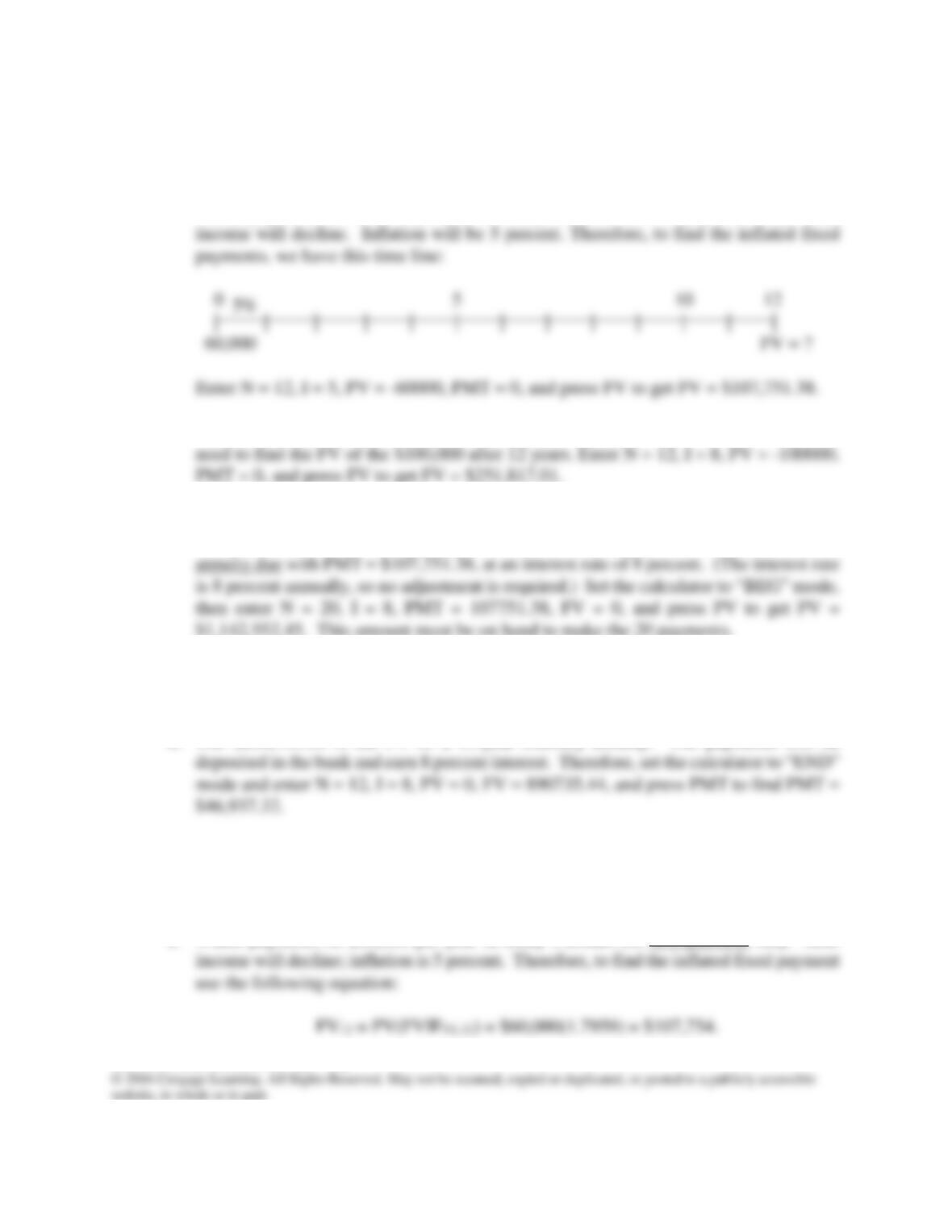
29-13 Information given:
1. Will save for 12 years, then receive payments for 20 years.
2. Wants payments of $60,000 per year in today’s dollars for first payment only. Real
3. He now has $100,000 in an account which pays 8 percent, annual compounding. We
4. He wants to withdraw, or have payments of, $107,751.38 per year for 20 years, with the
first payment made at the beginning of the first retirement year. So, we have a 20–year
5. Since the original $100,000, which grows to $251,817.01, will be available, we must
save enough to accumulate $1,142,552.45 – $251,817.01 = $890,735.44.
6. The $890,735.44 is the FV of a 12-year ordinary annuity. The payments will be
Using a tabular method: Information given:
1. Will save for 12 years, then receive payments for 20 years.
2. Wants payments of $60,000 per year in today’s dollars for first payment only. Real
Answers and Solutions: 29 – 12
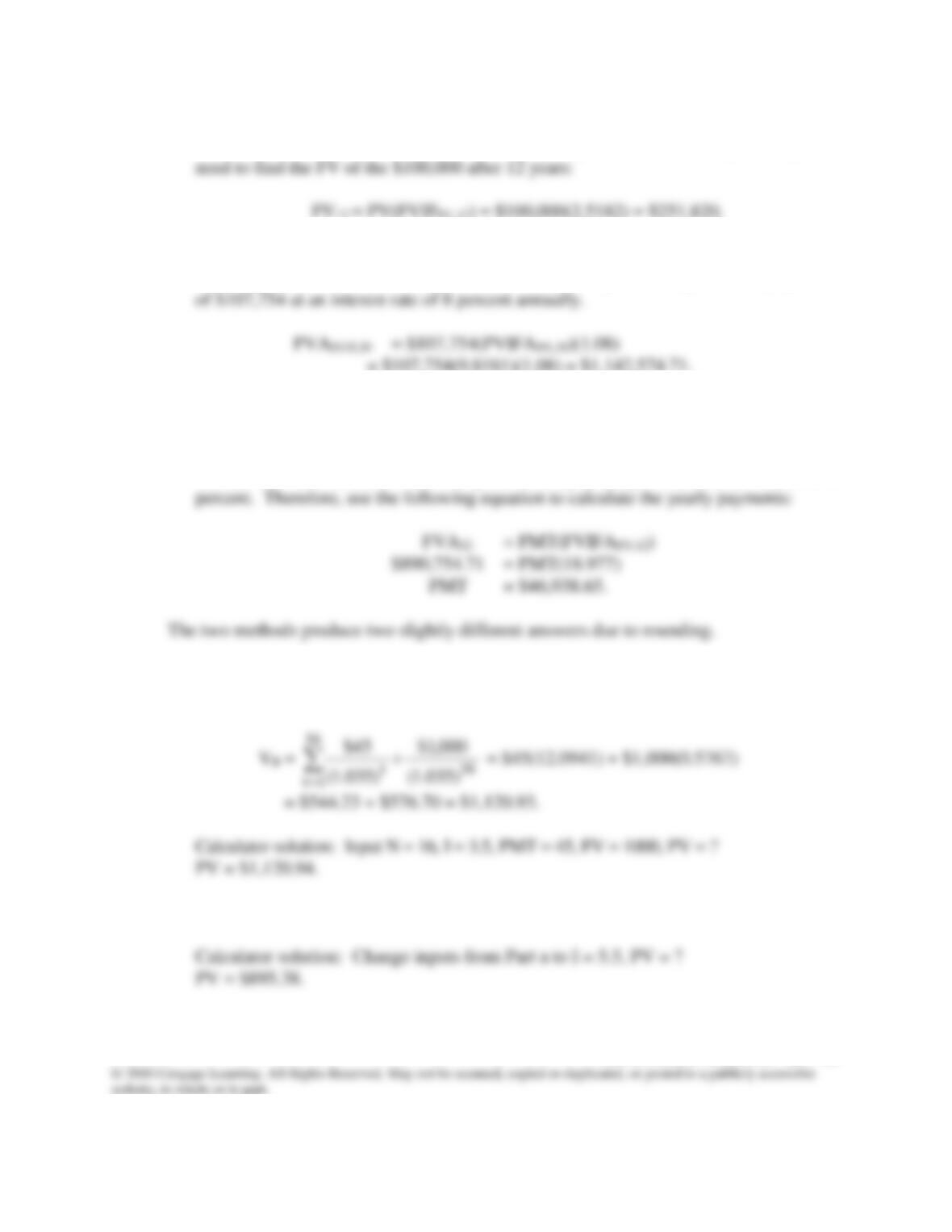
3. He now has $100,000 in an account which pays 8 percent, annual compounding. We
4. He wants to withdraw $107,754 per year for 20 years, with the first payment made at the
beginning of the first retirement year. So we have a 20-year annuity due with payments
5. Since the original $100,000 which grows to $251,820 will be available, he must save
enough to accumulate $1,142,574.71 – $251,820 = $890,754.71.
6. The $890,754.71 is the FV of a 12-year ordinary annuity. The interest earned is 8
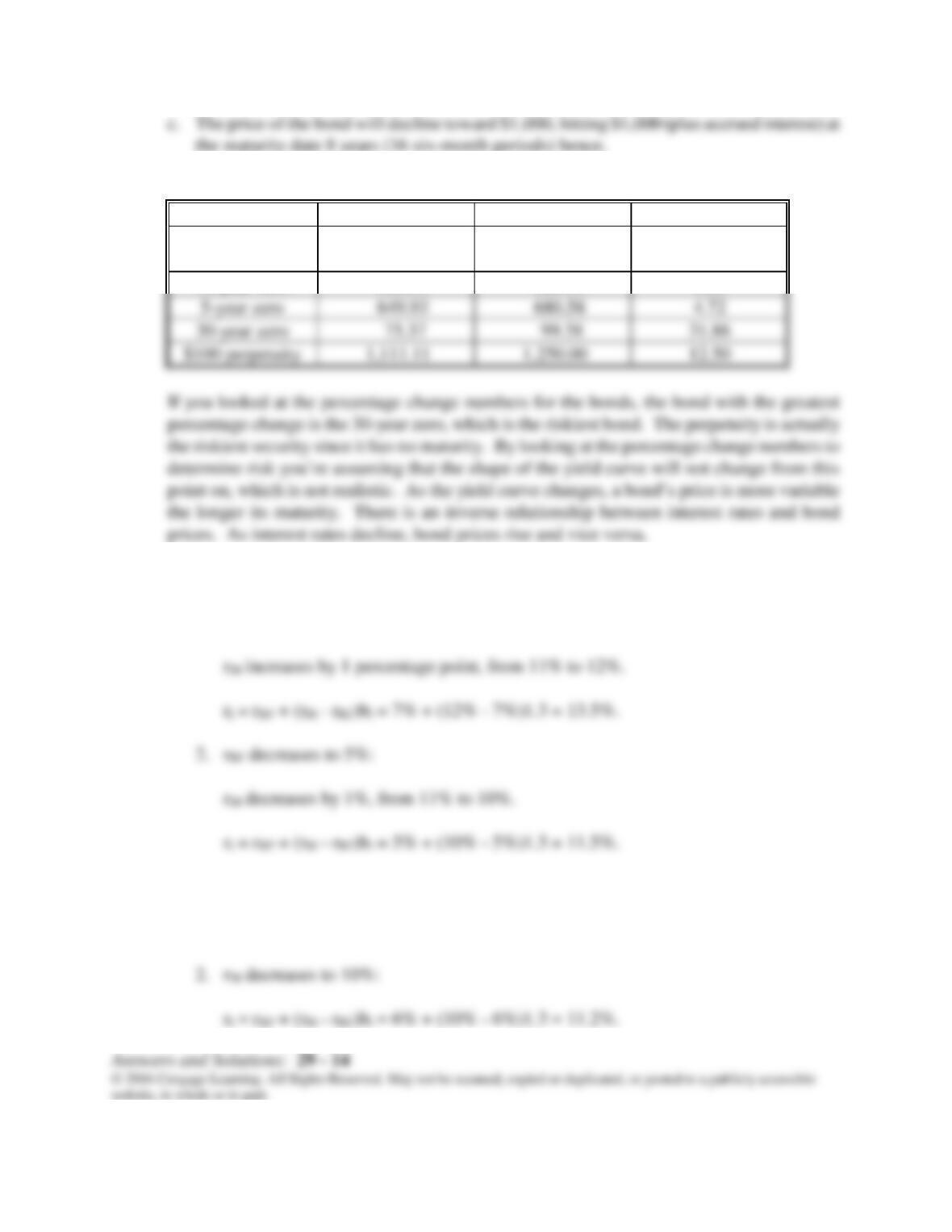
29-14 a. The bonds now have an 8-year, or a 16-semiannual period, maturity, and their value is
calculated as follows:
b. VB = $45(10.4622) + $1,000(0.4246) = $470.80 + $424.60 = $895.40.
Answers and Solutions: 29 – 13
29-15
Price at 9%
Price at 8%
Pctge. change
10-year, 10%
annual coupon
$1,064.18
$1,134.20
6.58%
10-year zero
422.41
463.19
9.65
649.93
680.58
4.72
30-year zero
29-16 a. ri = rRF + (rM – rRF)bi = 6% + (11% – 6%)1.3 = 12.5%.
b. 1. rRF increases to 7%:
c. 1. rM increases to 13%:
ri = rRF + (rM – rRF)bi = 6% + (13% – 6%)1.3 = 15.1%.
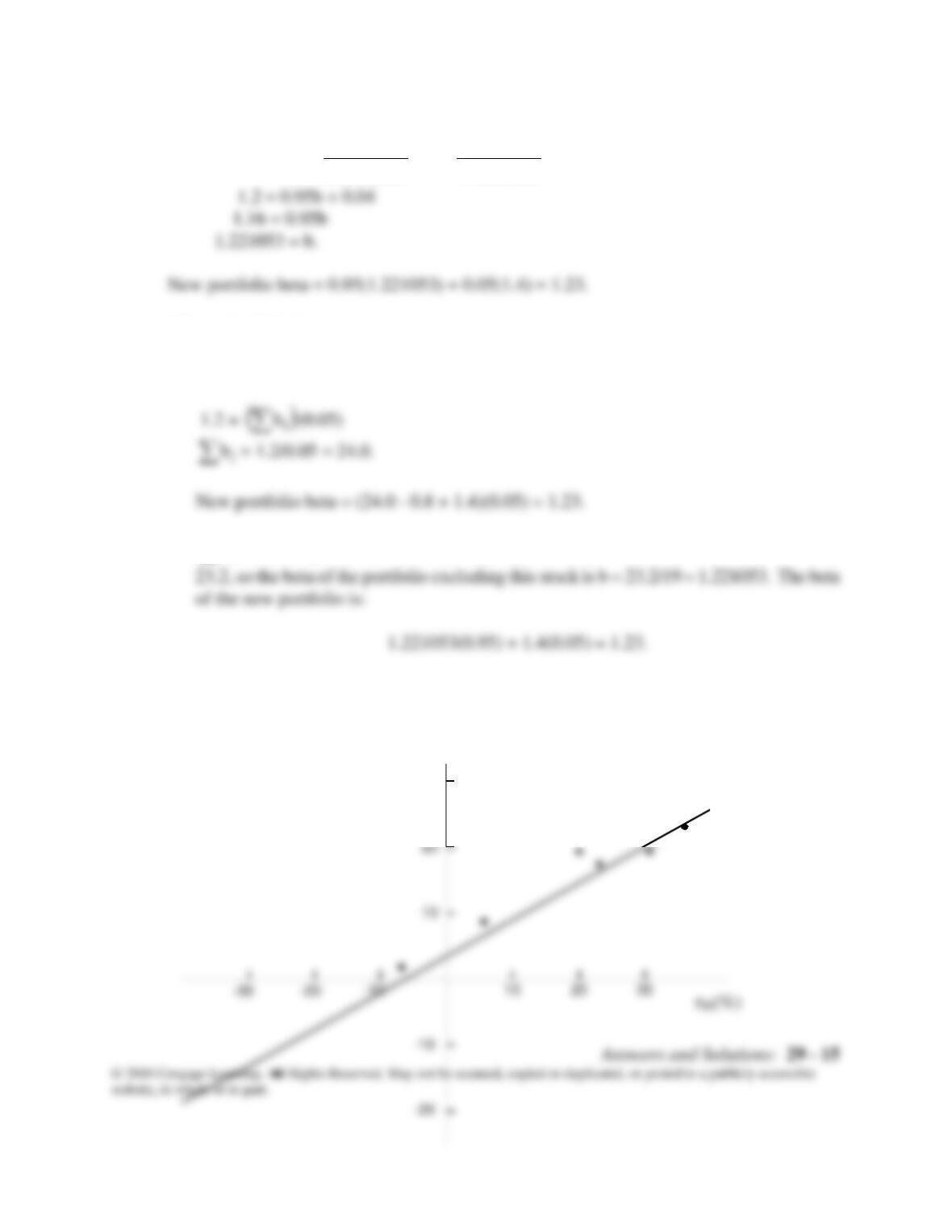
29-17 Old portfolio beta =
000,000,3$
000,850,2$
(b) +
000,000,3$
000,150$
(0.8)
Alternative Solutions:
1. Old portfolio beta = 1.2 = (0.05)b1 + (0.05)b2 + … + (0.05)b20
∑
i
b
2.
∑
i
b
excluding the stock with the beta equal to 0.8 is 24.0 – 0.8 =
29-18 a. A plot of the approximate regression line is shown in the following figure:
r
30
k
ABC
(%)
r
ABC
(%)
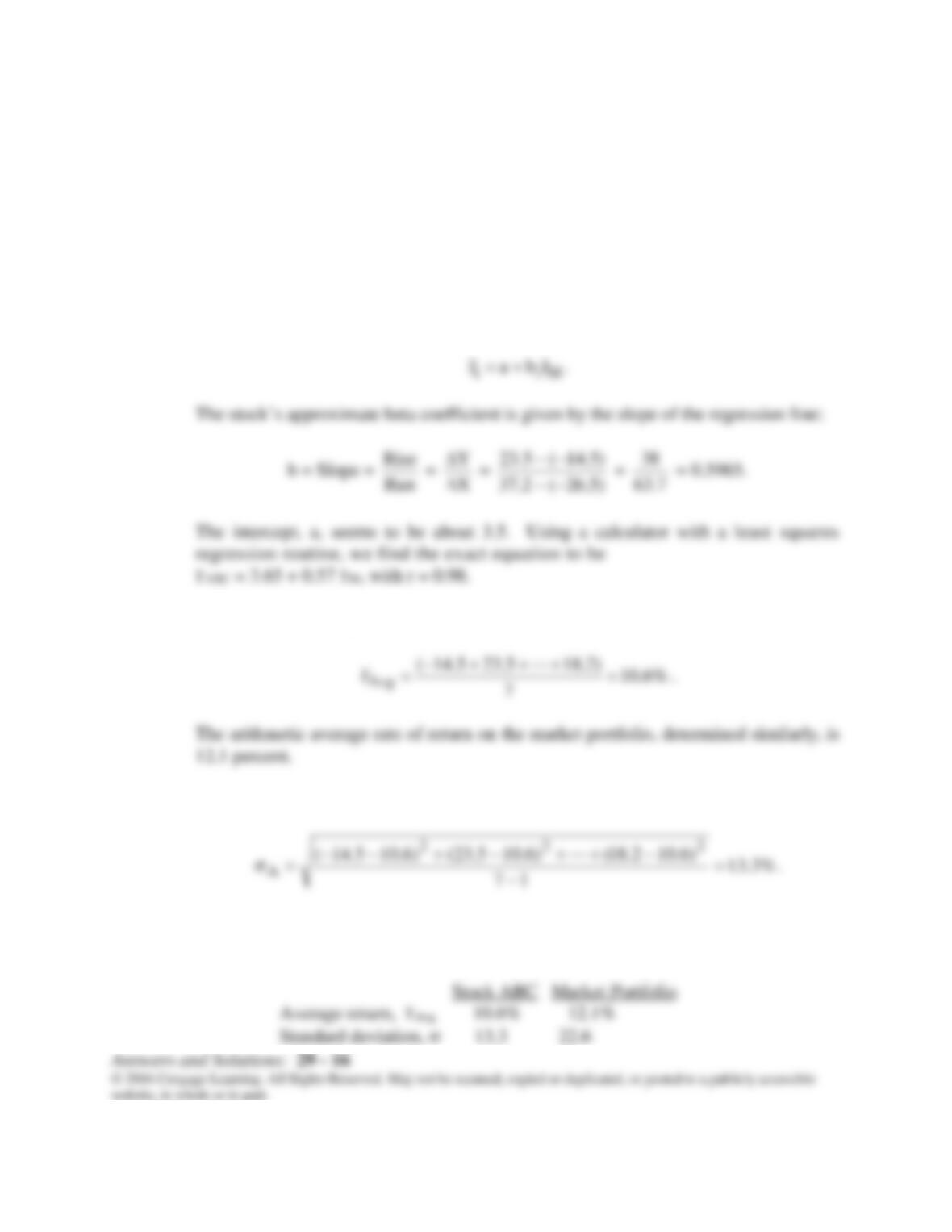
The equation of the regression line is
b. The arithmetic average return for Stock ABC is calculated as follows:
For Stock ABC, the estimated standard deviation is 13.3 percent:
The standard deviation of returns for the market portfolio is similarly determined to be
22.6 percent. The results are summarized below:
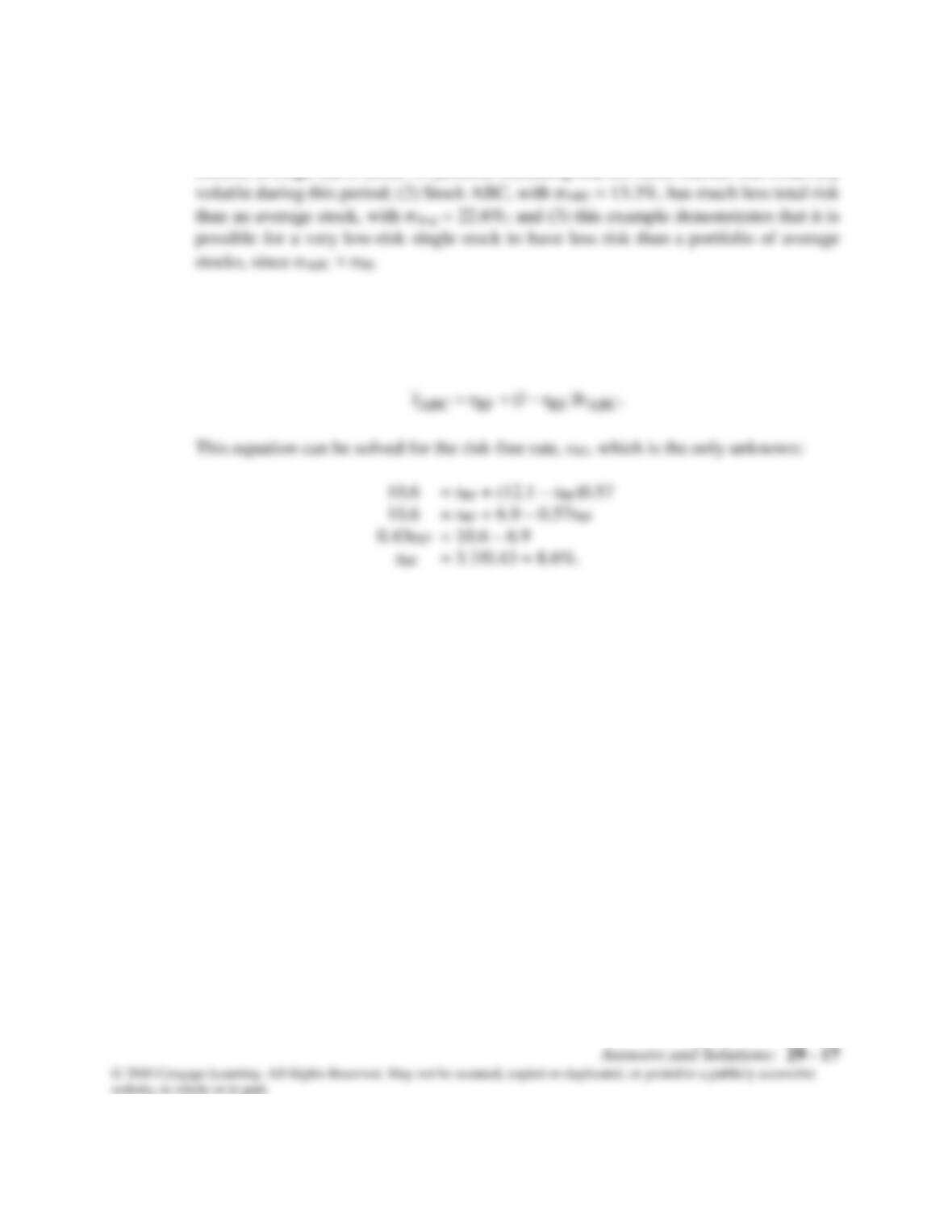
Several points should be noted: (1) σM over this particular period is higher than the
historic average σM of about 15 percent, indicating that the stock market was relatively
c. Since Stock ABC is in equilibrium and plots on the Security Market Line (SML), and
given the further assumption that ^
rABC = C
¯rAB and ^
rM = M
¯r (note: this assumption often
does not hold) then this equation must hold:
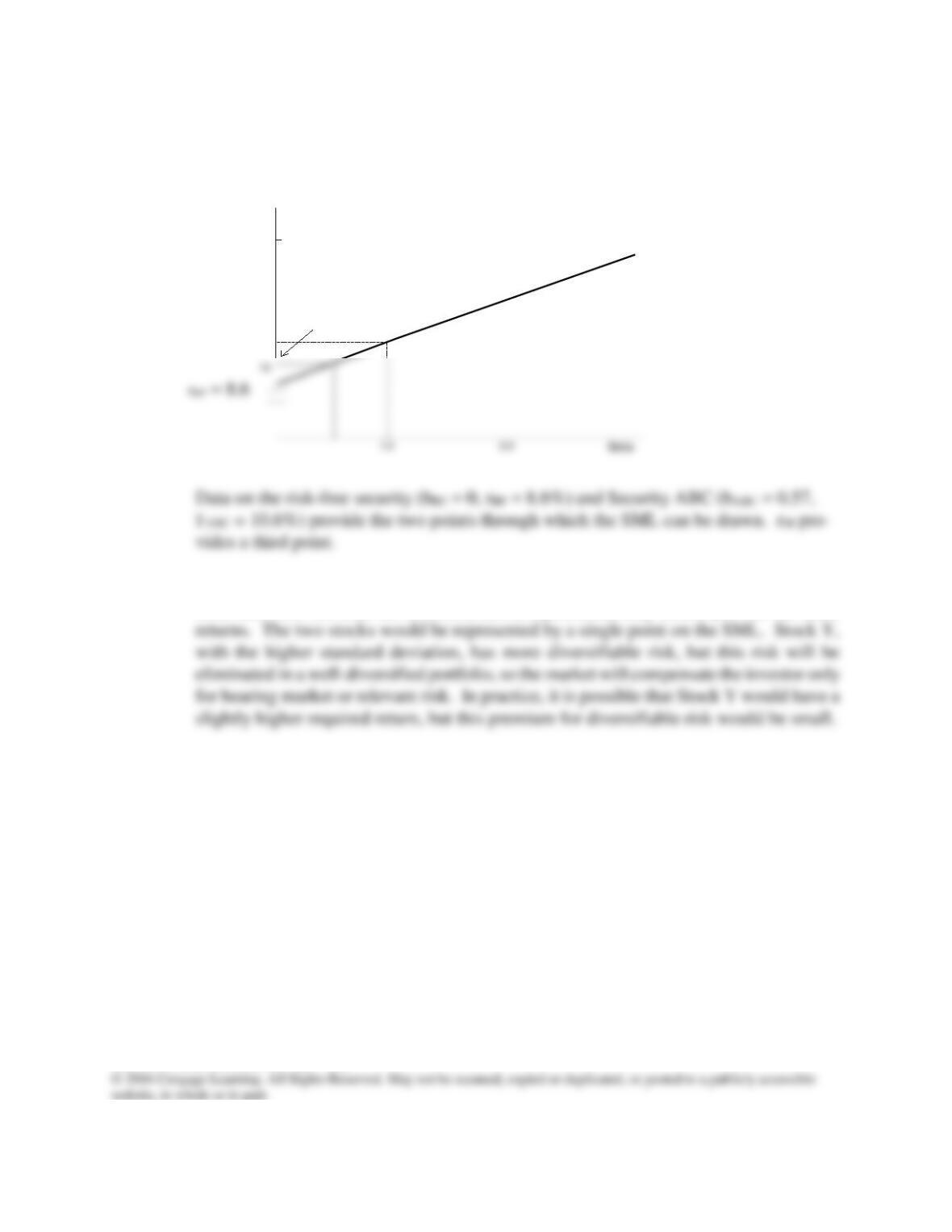
d. The SML is plotted below.
e. In theory, you would be indifferent between the two stocks. Since they have the same
beta, their relevant risks are identical, and in equilibrium they should provide the same
k(%)
20
k
ABC
= 10.6%
k
M
= 12.1
r(%)
rM = 12.1
rABC = 10%
Answers and Solutions: 29 – 18
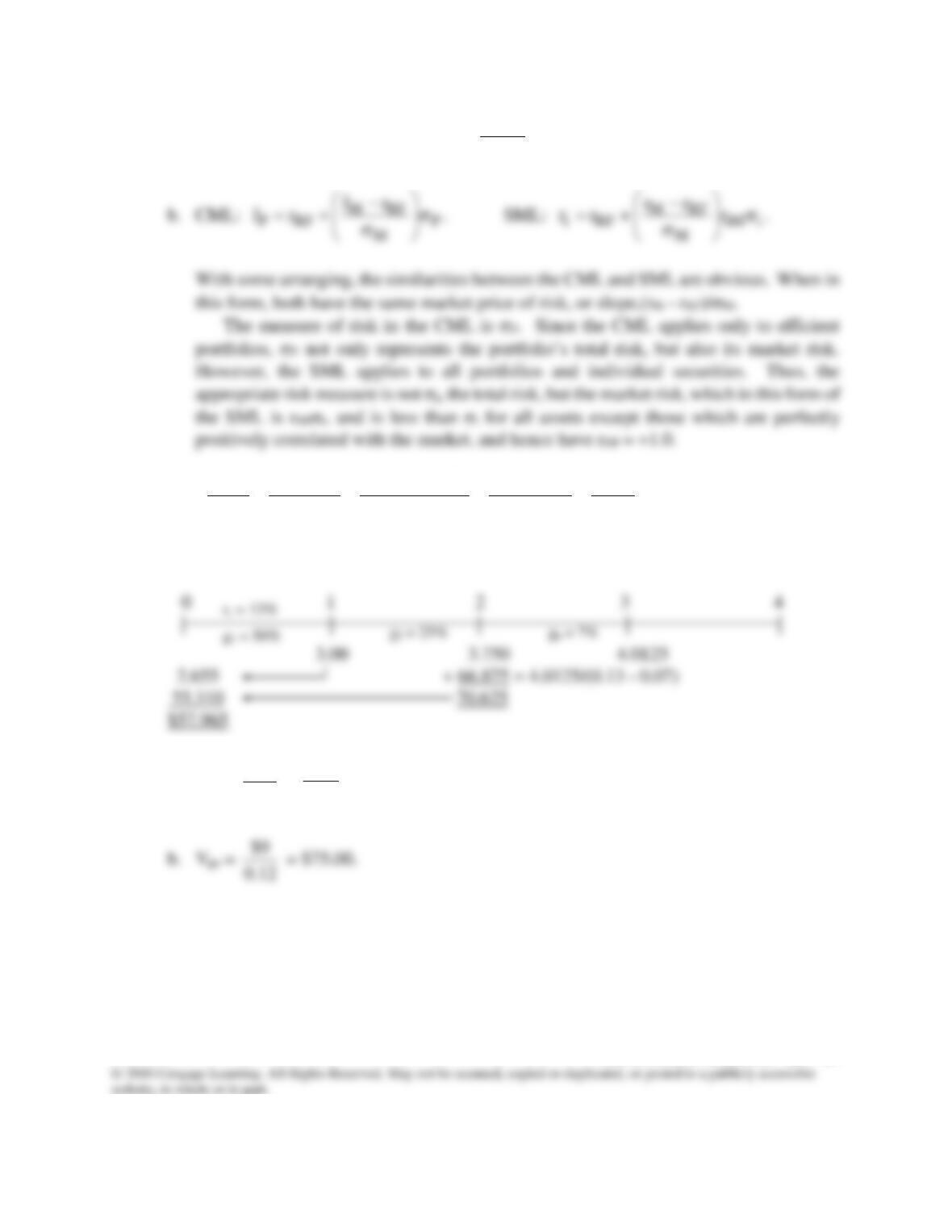
29-19 a. ri = rRF + (rM – rRF)bi = rRF + (rM – rRF)
m
Iim
r
σ
σ
.
29-20
.50.28$
20.0
70.5$
05.015.0
)95.0(6$
)05.0(15.0
)]05.0(1[6$
gr
)g1(D
gr
D
P
ˆ
s
0
s
1
0
==
+
=
−−
−+
=
−
+
=
−
=
29-21 D0 = $2, rS = 6% + 7% = 13%, g1 = 50%, g2 = 25%, gn = 7%.
29-22 a. Vps =
ps
ps
r
D
=
07.0
9$
= $128.57.
Answers and Solutions: 29 – 19