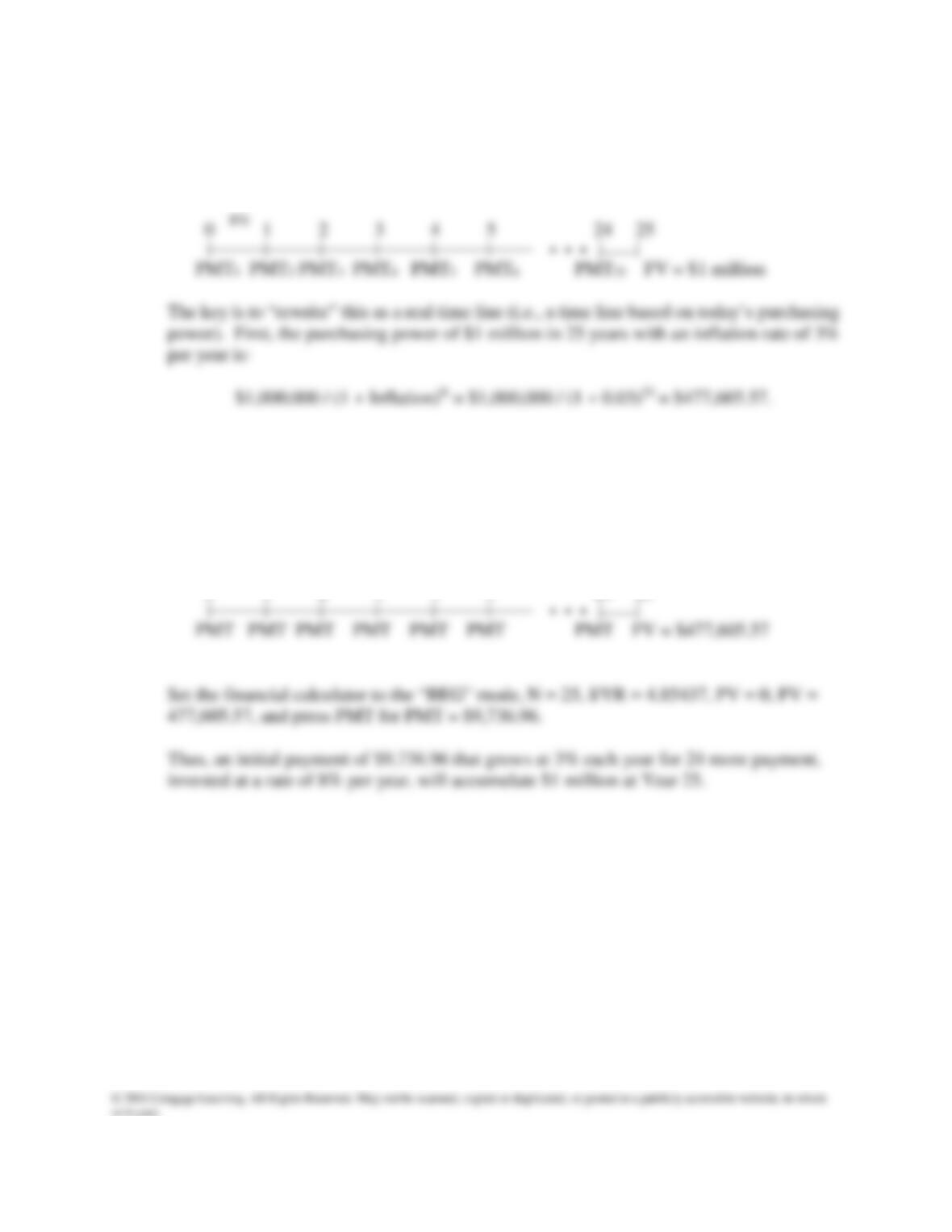
28-34 Information given:
The nominal time line is shown below, with a different payment each period and a FV of
a nominal $1 millon:
This is a growing annuity, with a nominal rate of 8% and an inflation rate of 3%. You
should use the real rate in the calculator: rr = [(1 + rNOM)/(1 + Inflation)] – 1.0 =
[1.08/1.03] – 1.0 = .0485437 = 4.85437%.
So the “real” time line in expressed in today’s purchasing power is:
0 1 2 3 4 5 24 25
4.85437%
Answers and Solutions: 28 -21
8%

SOLUTION TO SPREADSHEET PROBLEM
28-35 The detailed solution for the spreadsheet problem, Ch28 P35 Build a Model Solution.xls,
is available on the textbook’s Web site.
Answers and Solutions: 28 – 22
MINI CASE
Assume that you are nearing graduation and have applied for a job with a local bank. As
part of the bank’s evaluation process, you have been asked to take an examination that covers
several financial analysis techniques. The first section of the test addresses discounted cash
flow analysis. See how you would do by answering the following questions.
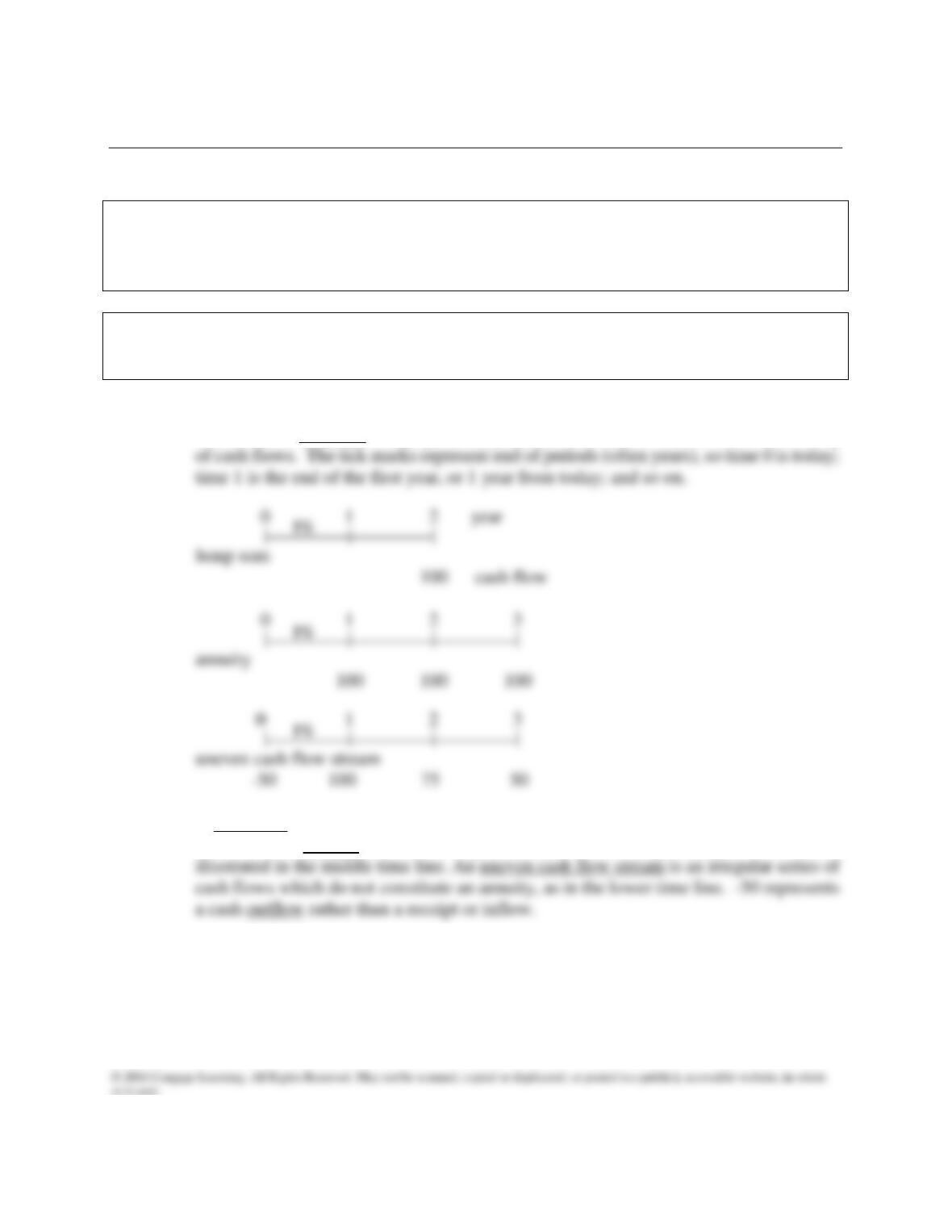
a. Draw time lines for (a) a $100 lump sum cash flow at the end of year 2, (b) an
ordinary annuity of $100 per year for 3 years, and (c) an uneven cash flow stream
of -$50, $100, $75, and $50 at the end of years 0 through 3.
Answer: (Begin by discussing basic discounted cash flow concepts, terminology, and solution
methods.) A time line is a graphical representation which is used to show the timing
A lump sum is a single flow; for example, a $100 inflow in year 2, as shown in the top
time line. An annuity is a series of equal cash flows occurring over equal intervals, as
Mini Case: 28 -23
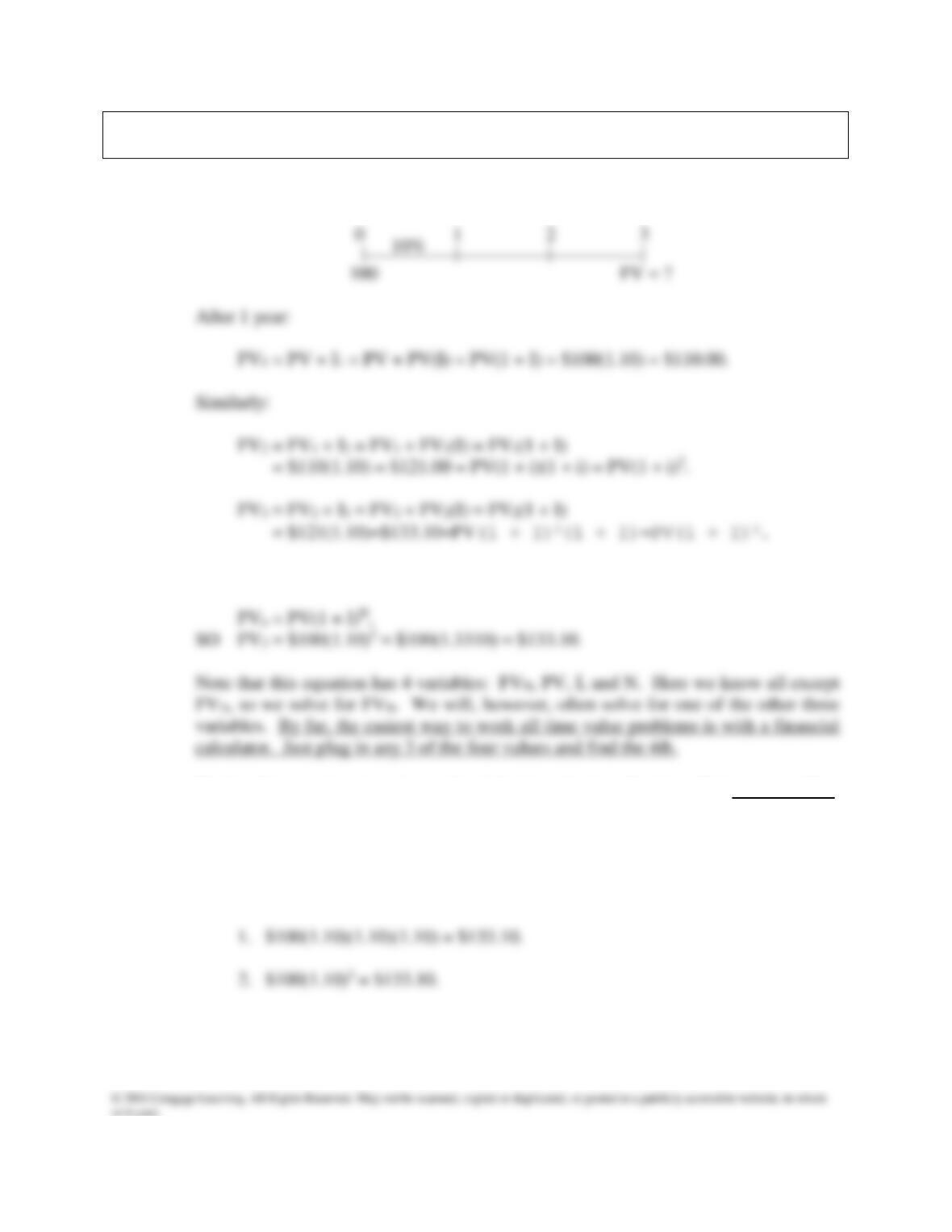
b. 1. What is the future value of an initial $100 after 3 years if it is invested in an
account paying 10% annual interest?
Answer: Show dollars corresponding to question mark, calculated as follows:
In general, we see that:
Finding future values (moving to the right along the time line) is called compounding.
Note that there are 3 ways of finding FV3: using a regular calculator, financial
calculator, or spreadsheets. For simple problems, we show only the regular calculator
and financial calculator methods.
(1) regular calculator:
Mini Case: 28 – 24
(2) financial calculator:
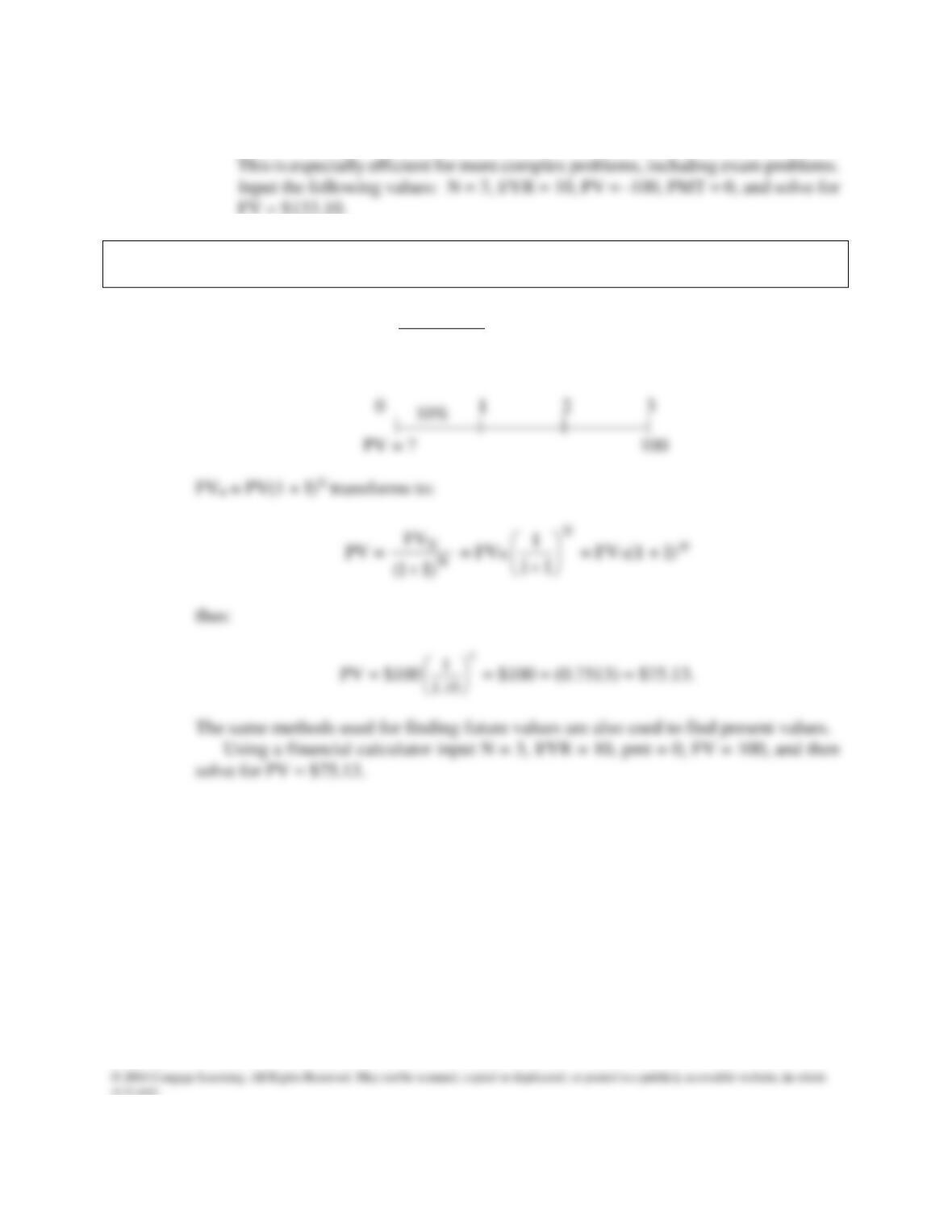
b. 2. What is the present value of $100 to be received in 3 years if the appropriate
interest rate is 10%?
Answer: Finding present values, or discounting (moving to the left along the time line), is the
reverse of compounding, and the basic present value equation is the reciprocal of the
compounding equation:
Mini Case: 28 -25
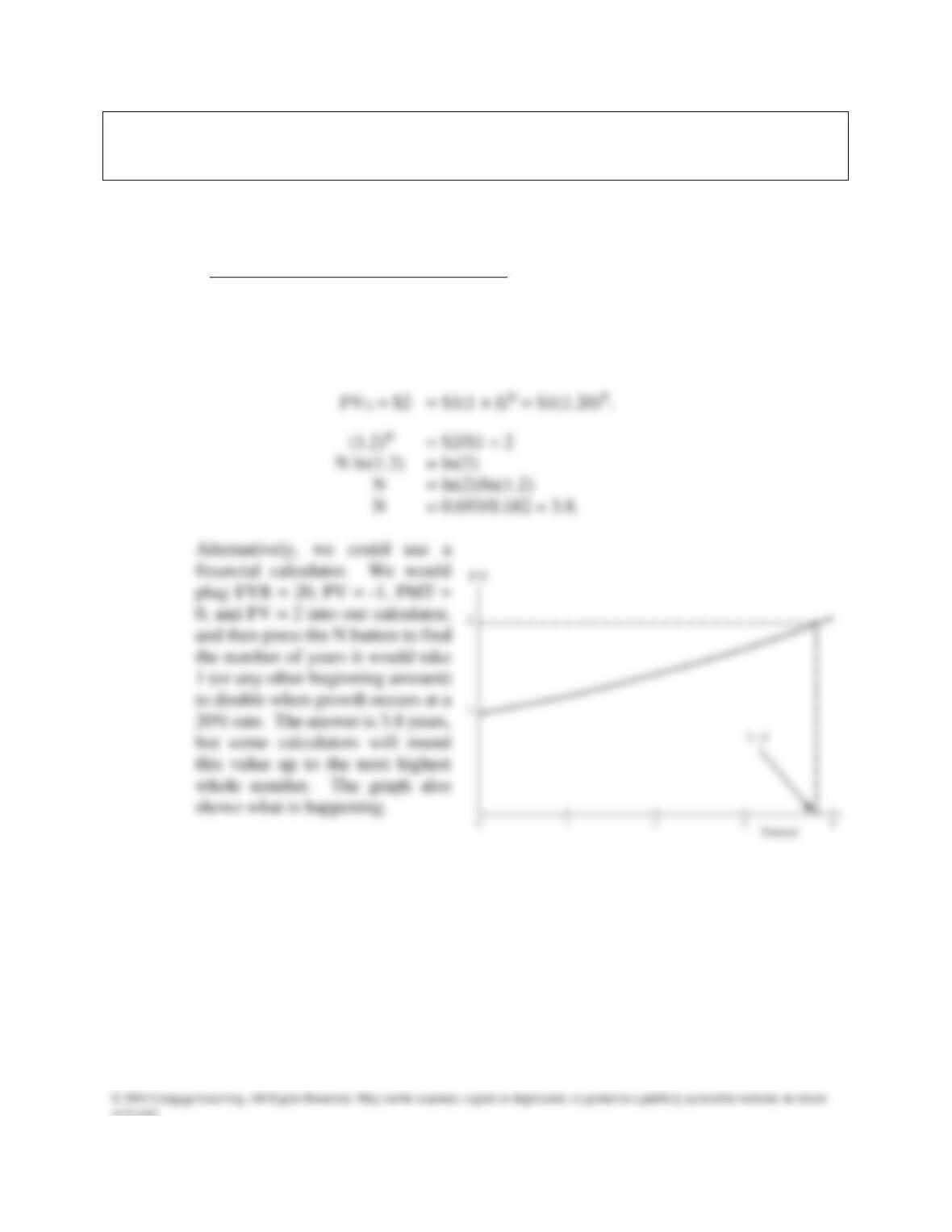
c. We sometimes need to find out how long it will take a sum of money (or anything
else) to grow to some specified amount. For example, if a company’s sales are
growing at a rate of 20% per year, how long will it take sales to double?
Answer: We have this situation in time line format:
0 1 2 3 3.8 4
| | | | | |
-1 2
Say we want to find out how long it will take us to double our money at an interest rate
of 20%. We can use any numbers, say $1 and $2, with this equation:
20%
Mini Case: 28 – 26
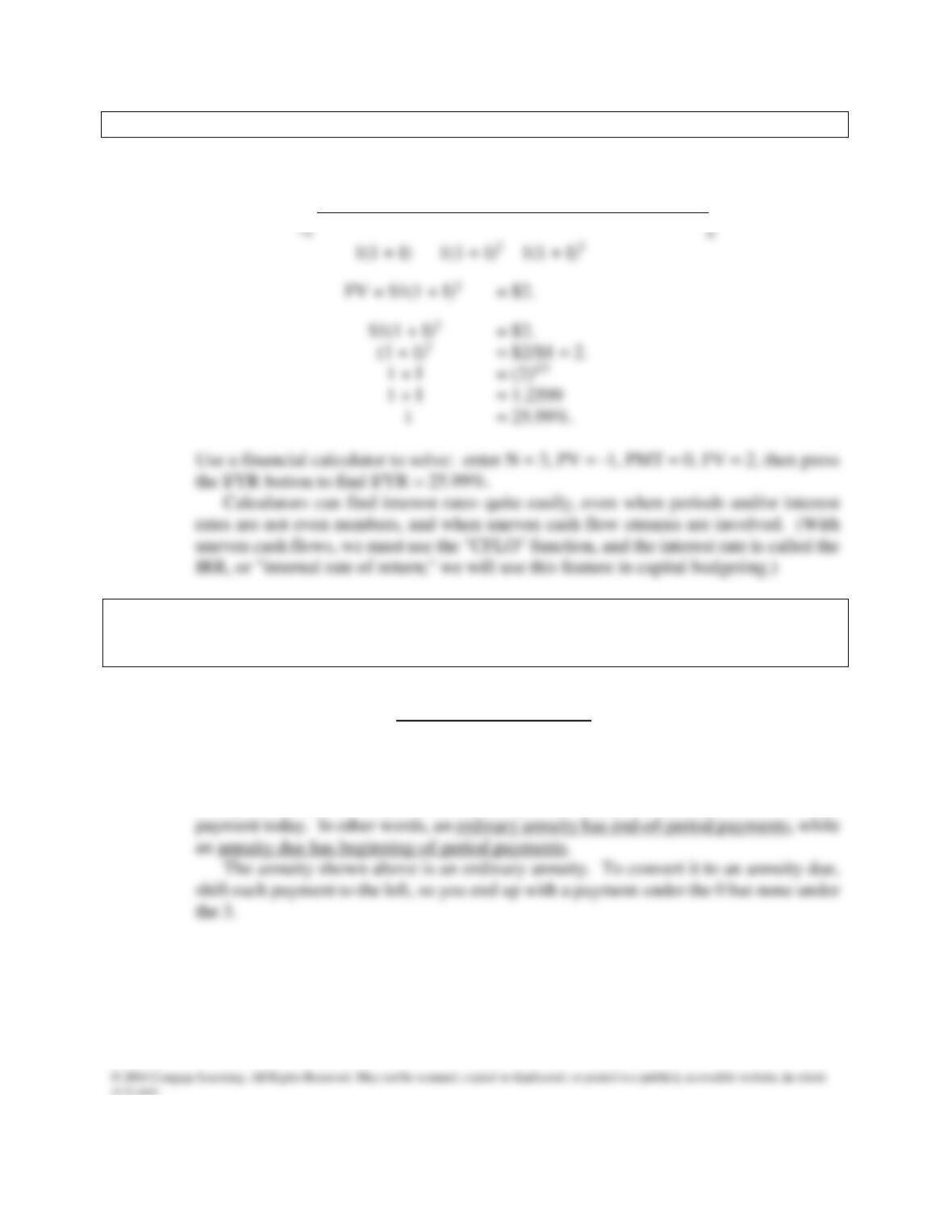
d. If you want an investment to double in 3 years, what interest rate must it earn?
Answer: 0 1 2 3
| | | |
e. What is the difference between an ordinary annuity and an annuity due? What
type of annuity is shown below? How would you change it to the other type of
annuity?
0 1 2 3
| | | |
100 100 100
Answer: This is an ordinary annuity—it has its payments at the end of each period; that is, the
first payment is made 1 period from today. Conversely, an annuity due has its first
Mini Case: 28 -27
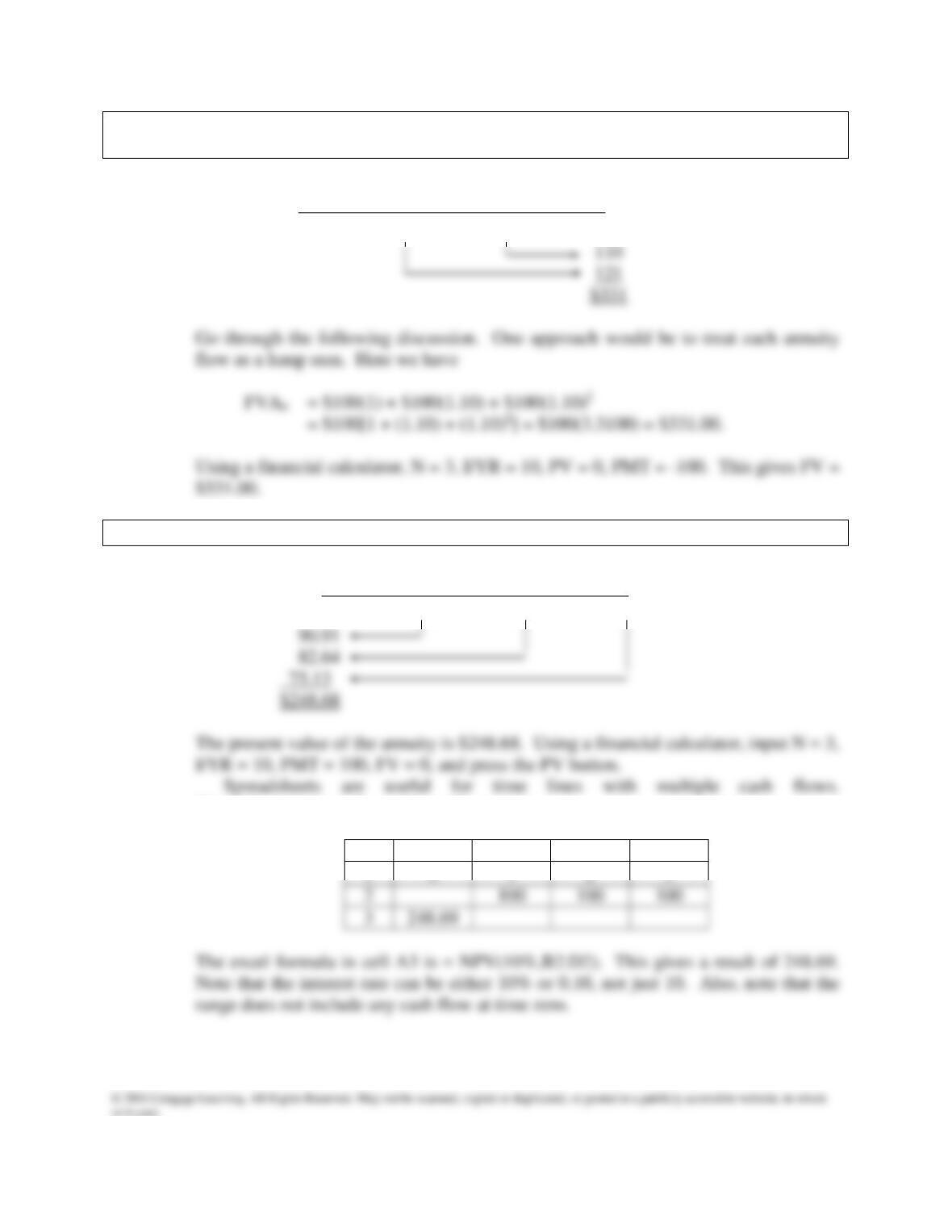
f. 1. What is the future value of a 3-year ordinary annuity of $100 if the appropriate
interest rate is 10%?
Answer: 0 1 2 3
| | | |
100 100 100
f. 2. What is the present value of the annuity?
Answer: 0 1 2 3
| | | |
100 100 100
The following spreadsheet shows this problem:
A
B
C
D
1
0
1
2
3
2
3
10%
10%
Mini Case: 28 – 28
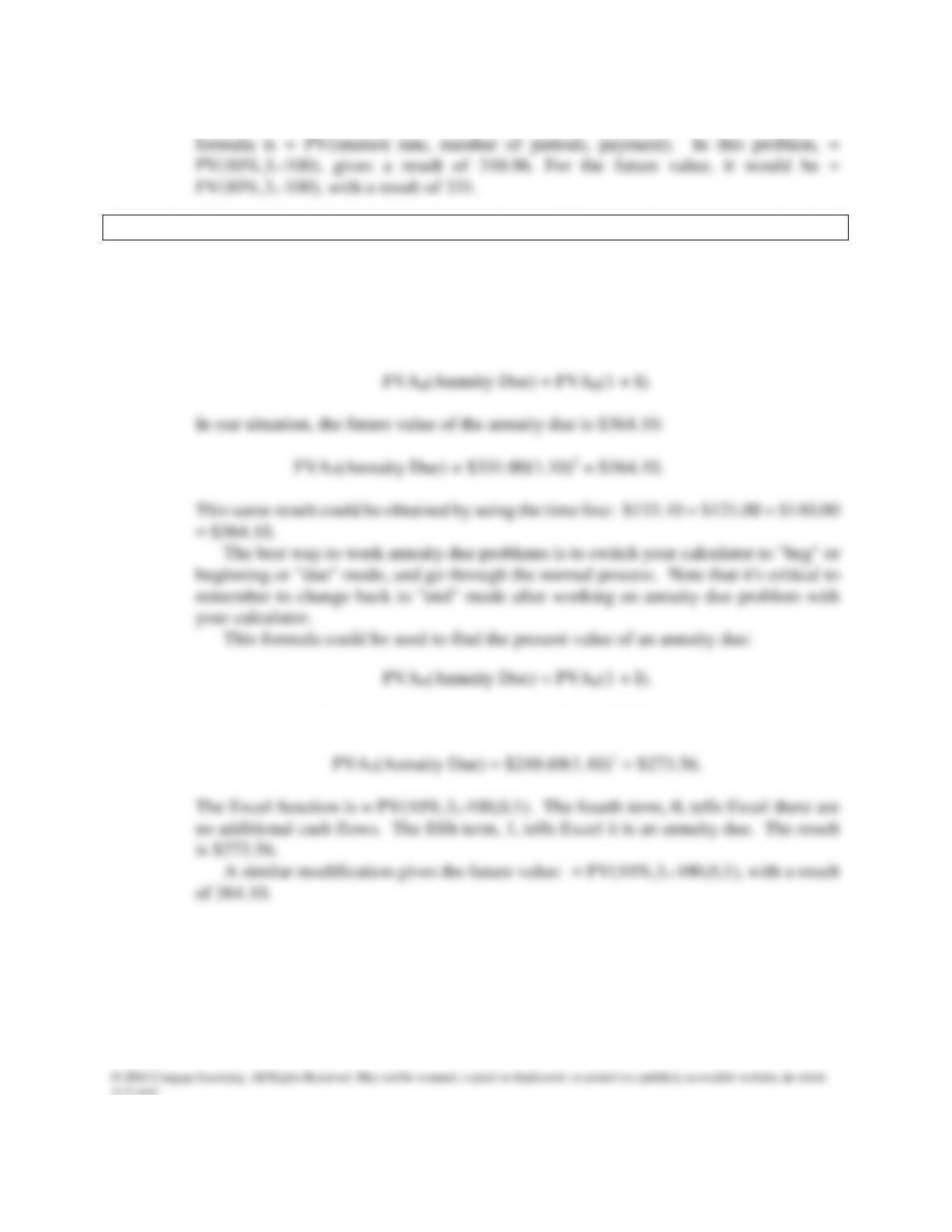
Excel also has special functions for annuities. For ordinary annuities, the excel
f. 3. What would the future and present values be if the annuity were an annuity due?
Answer: If the annuity were an annuity due, each payment would be shifted to the left, so each
payment is compounded over an additional period or discounted back over one less
period.
To find the future value of an annuity due use the following formula:
In our situation, the present value of the annuity due is $273.56:
Mini Case: 28 -29
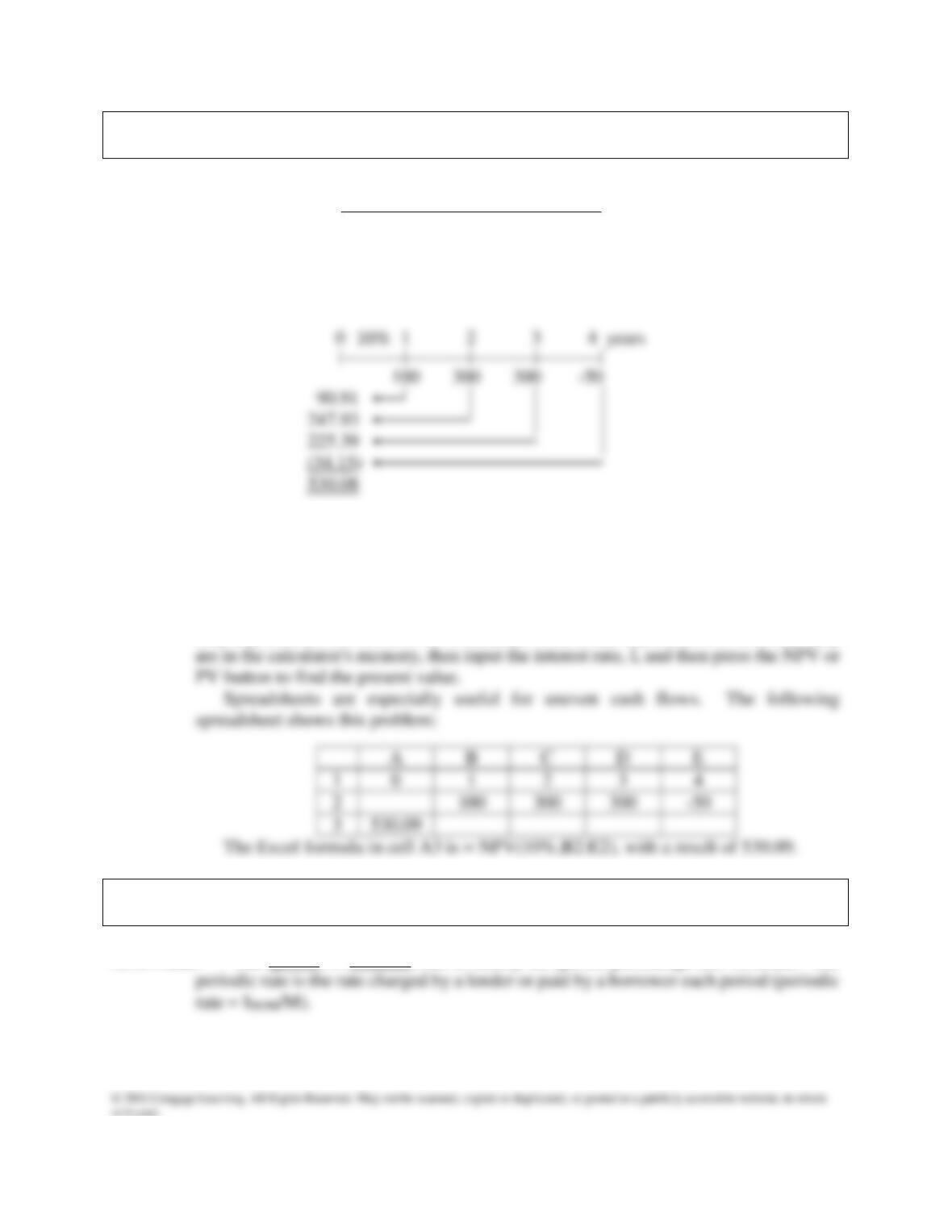
g. What is the present value of the following uneven cash flow stream? The
appropriate interest rate is 10%, compounded annually.
0 1 2 3 4 years
| | | | |
0 100 300 300 -50
Answer: Here we have an uneven cash flow stream. The most straightforward approach is to
find the PVs of each cash flow and then sum them as shown below:
Note (1) that the $50 year 4 outflow remains an outflow even when discounted. There
are numerous ways of finding the present value of an uneven cash flow stream. But by
far the easiest way to deal with uneven cash flow streams is with a financial calculator
or a spreadsheet. Calculators have a function which on the HP 17B is called “CFLO,”
for “cash flow.” Other calculators could use other designations such as cf0 and CFi, but
they explain how to use them in the manual. You would input the cash flows, so they
h. 1. Define (a) the stated, or quoted, or nominal rate, (iNom), and (b) the periodic rate
(iPer).
ANSWER: The quoted, or nominal, rate is merely the quoted percentage rate of return. The
Mini Case: 28 – 30
h. 2. Will the future value be larger or smaller if we compound an initial amount more
often than annually, for example, every 6 months, or semiannually, holding the
stated interest rate constant? Why?
Answer: Accounts that pay interest more frequently than once a year, for example, semiannually,
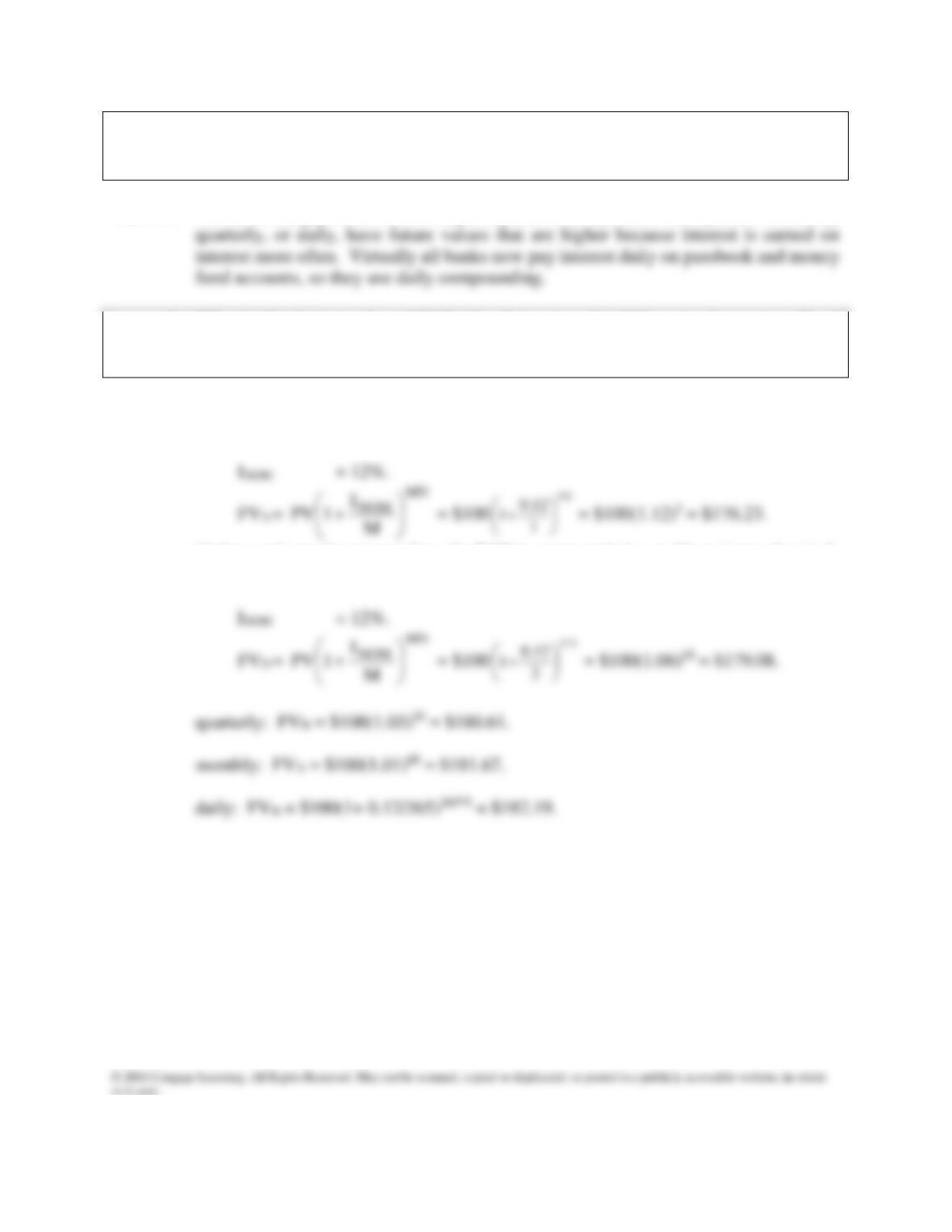
h. 3. What is the future value of $100 after 5 years under 12% annual compounding?
Semiannual compounding? Quarterly compounding? Monthly compounding?
Daily compounding
Answer: Under annual compounding, the $100 is compounded over 5 annual periods at a 12.0
percent periodic rate:
Under semiannual compounding, the $100 is compounded over 10 semiannual periods
at a 6.0 percent periodic rate:
Mini Case: 28 -31