1
2
3
4
5
6
7
8
9
10
11
12
13
14
15
16
32
33
34
35
36
37
47
48
49
50
51
52
A B C D E F G H I J K L M N O P Q R S
1/15/2015
Situation
FUTURE VALUE
$100 lump sum at the end of year 2.
Interest rate 0.1 These are the basic inputs, in blue.
Cash flow 100
Chapter 28. Mini Case
b. (1.) What’s the future value of an initial $100 after 3 years if it is invested in an account paying 10%
annual interest?
Assume that you are nearing graduation and have applied for a job with a local bank. As part of the
bank’s evaluation process, you have been asked to take an examination that covers several financial
analysis techniques. The first section of the test addresses discounted cash flow analysis. See how
you would do by answering the following questions.
a. Draw time lines for (1) a $100 lump sum cash flow at the end of Year 2, (2) an ordinary annuity of
$100 per year for 3 years, and (3) an uneven cash flow stream of -$50, $100, $75, and $50 at the end of
Years 0 through 3.
Functions, as shown below.
1 of 11
57
58
69
70
71
72
73
74
75
76
77
78
79
94
95
96
97
98
99
100
101
116
117
118
119
120
121
122
123
124
125
126
127
128
129
130
131
132
133
A B C D E F G H I J K L M N O P Q R S
Period (N) 0% 5% 10% 15%
01.0000 1.0000 1.0000 1.0000
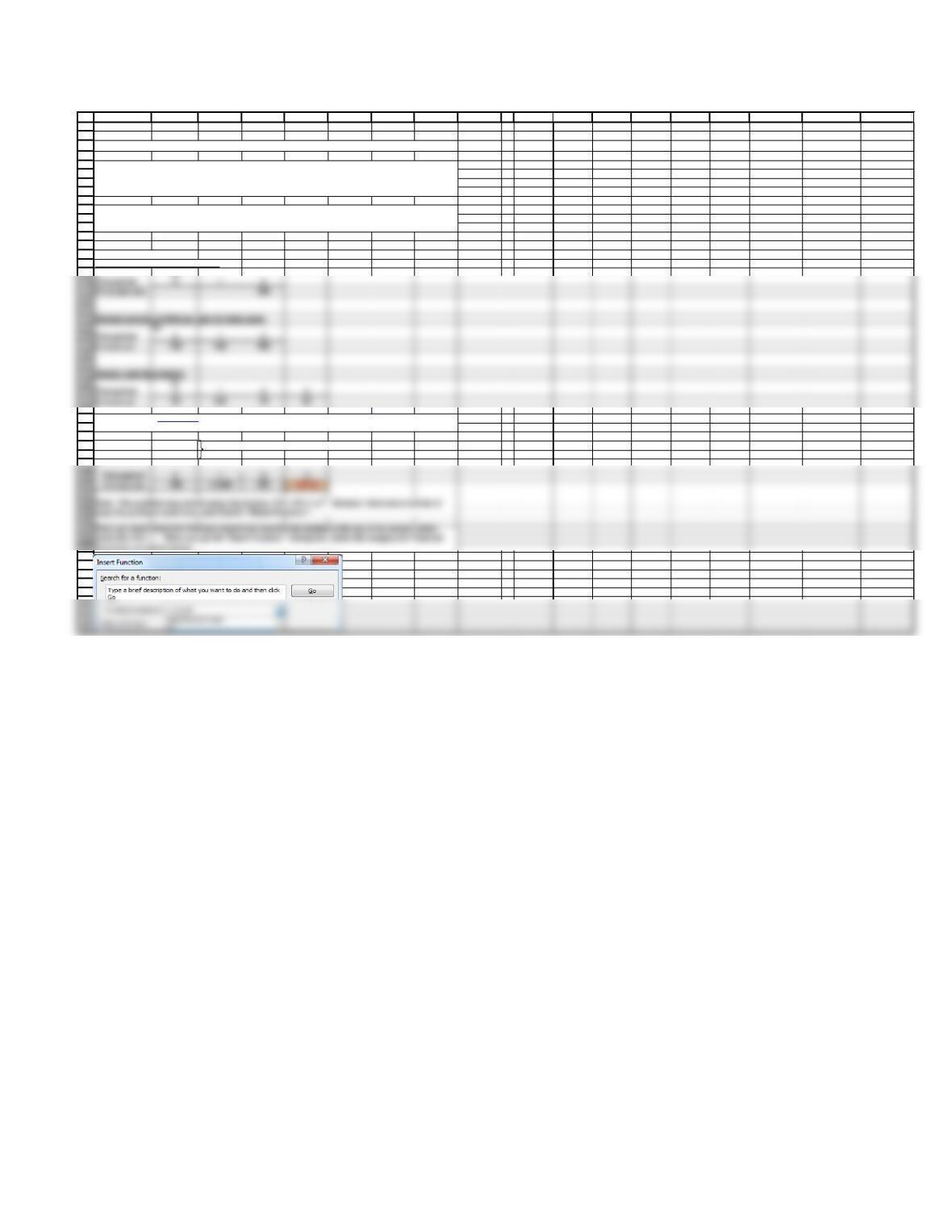
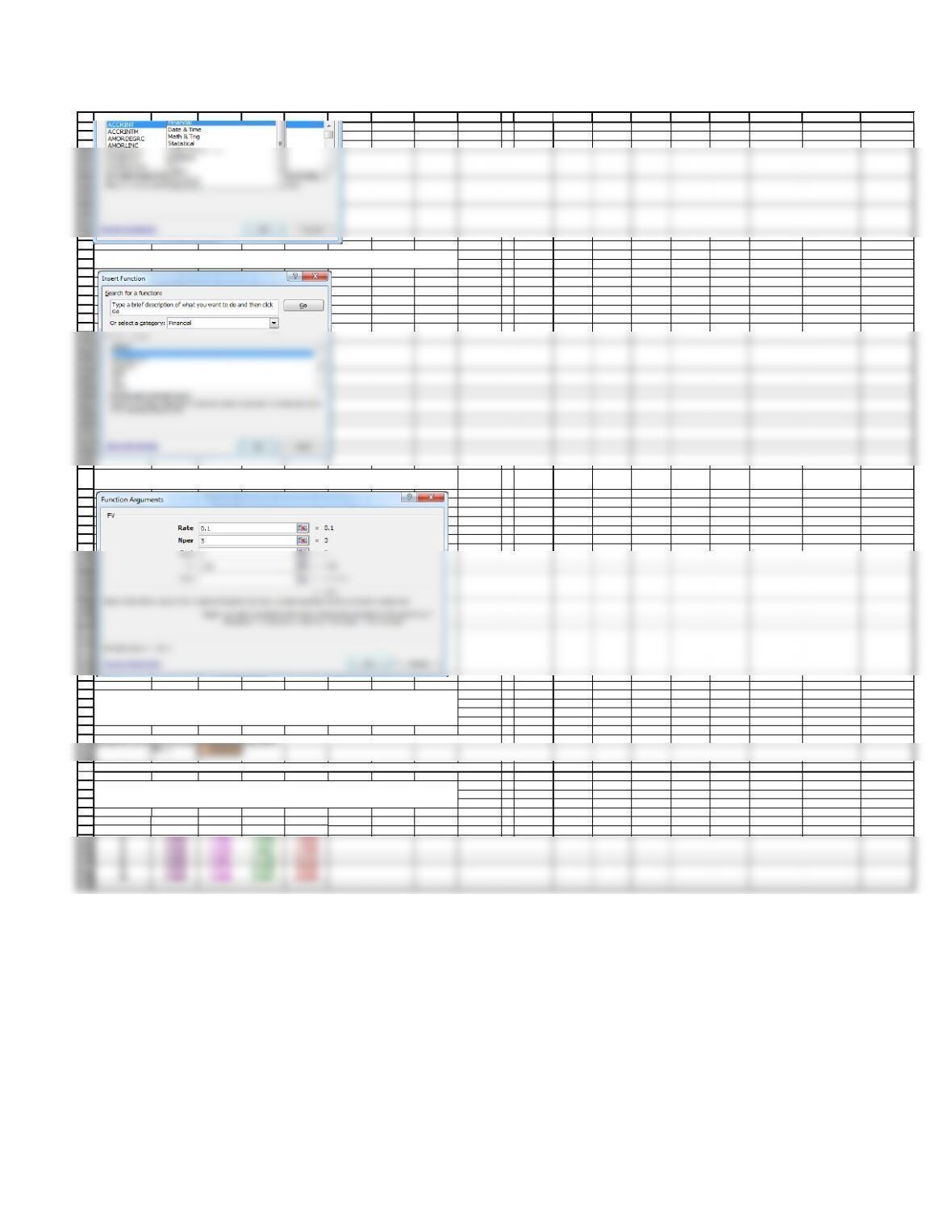
After selecting the “FV” function from the “Financial” category, we will be using the following dialog
box to input our data.
After selecting the category for Financial functions, scroll down until you can selet the FV function, as
show below. Alternatively, select the menu Formulas, then then select Financial, then pick FV.
Notice that we entered a value instead of a cell reference as the input for the problem for instructional
purposes. It’s really better to enter cell values so that your spreadsheet can automatically reflect any
changes to the input data. This is one of the features that makes the spreadsheet such a valuable tool.
With a spreadsheet, calculating FVIF’s is a simple operation, and we can use it to graph the
relationship between future value, growth, interest rates, and time. A similar table can be found in the
textbook, along with a corresponding graph.
Future Value Interest Factors
Using the function wizard yields the following result:
2 of 11
Time period 0 1 2 3
140
141
142
143
144
145
146
147
148
161
162
163
164
165
166
167
168
169
170
176
177
178
179
180
181
182
183
184
185
186
A B C D E F G H I J K L M N O P Q R S
PRESENT VALUE (PV)
PROBLEM
b. (2) What is the present value of $100 to be received in 3 years if the appropriate interest rate is
10%?
Simply put, the present value (PV) is the value today of some future cash flow (or series of cash flows).
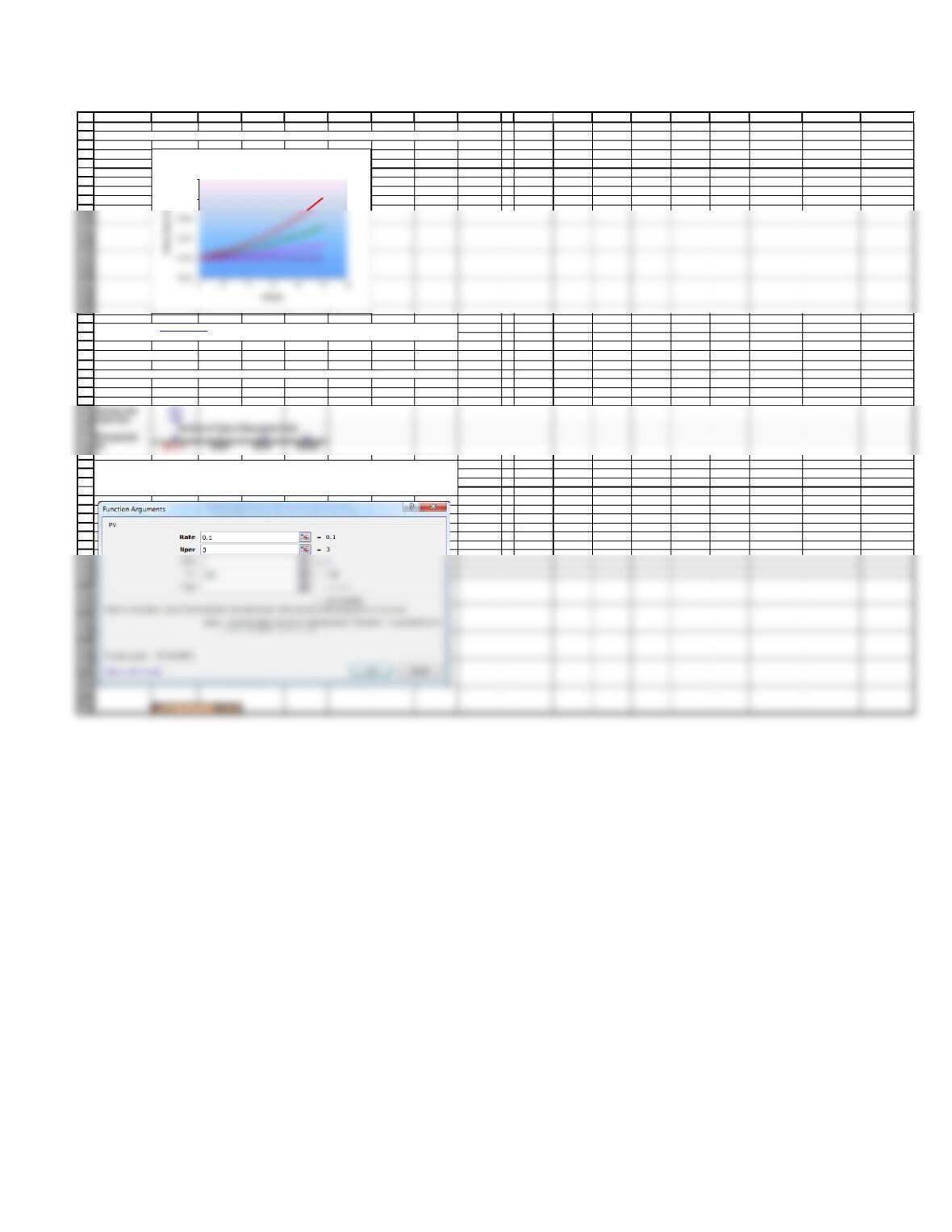
This problem can also be solved using the function wizard using a procedure similar to that for the FV
function. Begin by putting the pointer on the cell in which you want to display the result. Then, after
selecting the “PV” function from the “Paste Function” box, the input data for the problem must be
entered. Then click OK to get the result, $75.13.
Relationships among Future Value, Growth, Interest Rates, and Time
$4.00
$5.00
Relationships among Future Value, Growth, Interest
Rate, and Time
3 of 11
205
206
207
208
209
210
211
212
218
219
220
221
222
223
224
240
241
A B C D E F G H I J K L M N O P Q R S
Finding Time to Double
I = 0.2
periods
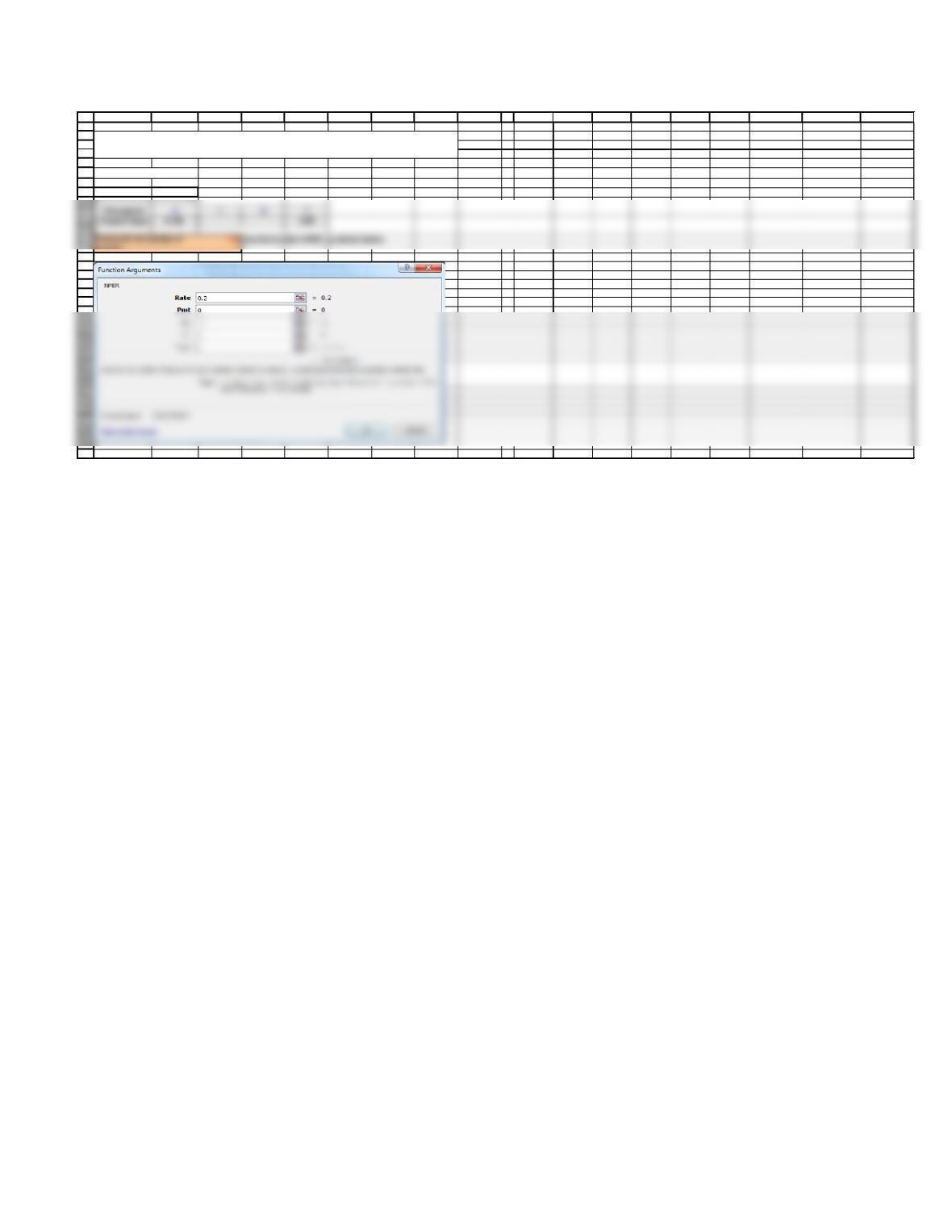
c. We sometimes need to find how long it will take a sum of money (or anything else) to grow to some
specified amount. For example, if a company’s sales are growing at a rate of 20% per year, how long
will it take sales to double?
4 of 11
214
216
242
243
244
249
250
251
252
253
254
255
256
257
258
259
260
261
278
279
280
281
282
283
284
285
286
287
288
289
294
A B C D E F G H I J K L M N O P Q R S
SOLVING FOR I
PROBLEM
I = 25.99%
N3
We noted above the difficulty of solving this problem mathematically. This is because it involves
taking the Nth root of a value (an operation which generally requires either a calculator or a computer).
However, if you would like to know how to solve the problem mathematically, the formula is
(FVn/PV)(1/N) – 1, which is derived from the FV formula.
Once again, Excel has a special function for this calculation. We suggest using either a financial
calculator or the function wizard to solve this type of problem, because of its complexity. The
procedure can be carried out using the function wizard, by selecting the “Rate” function from the list of
financial functions in the “Paste Function” dialog box. Upon entering the time, present value, and
future value, the interest rate can be found. Note that you can either type the data in or else activate
the menu slot and then click on the appropriate cell.
d. If you want an investment to double in three years, what interest rate must it earn?
5 of 11
245
248
295
296
297
298
299
300
301
338
339
308
309
310
311
312
313
314
315
316
317
318
319
320
321
322
341
342
343
344
347
349
345
A B C D E F G H I J K L M N O P Q R S
FUTURE VALUE OF AN ANNUITY
N3
PRESENT VALUE OF AN ANNUITY
N3
As explained below, one way to solve this problem is to find the future value of each of the annuity
f. (1.) What is the future value of a 3-year ordinary annuity of $100 if the appropriate interest rate is
10%?
An easier procedure is to solving for the future value of an annuity with the function wizard. This
procedure is similar to that of a lump sum future value. Whereas before we left the “Pmt” field blank,
now we insert the annuity payment ($100 in this case). First, we access the “FV” function box from the
list of financial functions. Then, we input our new data. A key thing to watch is the “Type” input box.
Previously, we left this box alone. An “0″ or no entry in the box indicates an ordinary annuity, and a “1”
indicates an annuity due. Though we can leave the box blank, it is a good habit to enter a “0” in the
field.
f. (2.) What is the present value of the annuity?
6 of 11
303
353
354
355
356
357
358
359
375
376
377
378
379
380
381
382
383
384
387
389
Time period 0 1 2 3
417
418
FV = $364.10
392
393
394
395
396
397
398
399
400
401
A B C D E F G H I J K L M N O P Q R S
PV = $248.69
Additionally, using the function wizard for this problem is exactly like above, but we enter a “1” instead of a “0” into
the “Type” field.
The procedure for solving this problems follows the previous example with one notable exception. Since, the
payments occur at the beginning of each year, the first annuity payment occurs in time period 0, and the last
occurs in time period 2.
Or, you could use the function wizard for this ordinary annuity.
f. (3.) What would the future and present values be if the annuity were an annuity due?
7 of 11
420
421
422
423
455
456
430
431
432
433
434
435
436
437
438
457
458
459
460
461
462
468
469
470
471
472
473
474
475
476
477
478
484
485
486
479
516
517
487
488
489
490
491
492
493
494
495
496
497
498
499
519
520
521
522
523
524
A B C D E F G H I J K L M N O P Q R S
N3
I = 10%
Time period
0 1 2 3 4
NPV = = Σ of PVs = $530.09
I0.1
N
CFNPV0
Or
As we show above, the first way to solve for the present value of this uneven cash flow stream is to
use the time line to find the present value of each of the cash flows in the periods in which they occur,
then sum all the present values. This procedure will yield the correct present value.
To find the present value of the annuity due, this problem is solved just like the previous problem,
except that the payments occur in periods 0 through 2.
With, the financial calculator, we could enter each of these cash flows and the discount rate, and
simply press NPV for the present value of the cash flow stream. In Excel, we can perform a similar
calculation by using the “NPV” function. While this function is very similar, there is a key distinction.
In the cash flow register of your calculator, the first entry you make would be the cash flow to occur in
time period zero. However, the “NPV” function interprets the first data entry as being the cash flow in
time period one. Therefore, the initial cash flow must be added seperately. In this particular example,
the initial cash flow is zero.
g. What is the present value of the following uneven cash flow stream? The appropriate interest rate is 10%,
h. (1.) Identify (a) the stated, or quoted, or nominal rate (iNom) and (b) the periodic rate (iPER).
Using the function wizard, we follow the same procedure as above, except remember to enter a “1” to
tell Excel that in this problem the payments occur at the beginning of the periods.
This problem could also be set up in a column format; it is a matter of personal preference as to which
8 of 11
425
427
Time period 0 1 2 3
534
535
536
542
545
546
537
538
539
540
548
549
550
551
552
553
554
555
556
557
558
559
560
561
562
N (years x 2) 6
I (I per year/2) 0.06 FV = $141.85
564
565
566
570
571
572
573
577
578
579
580
581
587
588
589
590
591
592
593
594
595
596
597
598
599
600
601
604
605
606
607
608
609
622
623
624
625
626
627
628
630
632
634
635
A B C D E F G H I J K L M N O P Q R S
SEMIANNUAL AND OTHER COMPOUNDING PERIODS
h. (3.) What is the future value of $100 after 5 years under 12% annual compounding?
N 3
What is the FV with semiannual compounding?
What is the FV with quarterly compounding?
What is the FV with monthly compounding?
What is the FV with daily compounding?
SETUP FOR A 30 YEAR MORTGAGE. GRAPH BELOW. THE LONGER THE
PV 1000 PV 1000
NBeg. Amt. Payment Interest Principal End. Amt.
1 $1,000.00 $106.08 $100.00 $6.08 $993.92
2 $993.92 $106.08 $99.39 $6.69 $987.23
3 $987.23 $106.08 $98.72 $7.36 $979.88
NBeg. Amt. Payment Interest Principal End. Amt. 4 $979.88 $106.08 $97.99 $8.09 $971.79
8 $942.33 $106.08 $94.23 $11.85 $930.48
9 $930.48 $106.08 $93.05 $13.03 $917.45
10 $917.45 $106.08 $91.74 $14.33 $903.11
Note: See Columns M 11 $903.11 $106.08 $90.31 $15.77 $887.34
through R for a 30 year 12 $887.34 $106.08 $88.73 $17.34 $870.00
25 $462.00 $106.08 $46.20 $59.88 $402.12
26 $402.12 $106.08 $40.21 $65.87 $336.26
27 $336.26 $106.08 $33.63 $72.45 $263.80
28 $263.80 $106.08 $26.38 $79.70 $184.10
29 $184.10 $106.08 $18.41 $87.67 $96.44
30 $96.44 $106.08 $9.64 $96.44 $0.00
$3,182.38 $2,182.38 $1,000.00
j. (2.) What is the annual interest expense for the borrower, and the annual interest income for the lender, during
Year 2?
The effective annual rate is the annual rate that causes the PV to grow to the same FV as under multiple
compounding periods.
k. On January 1, you deposit $100 in an account that pays a nominal (or quoted) interest rate of 11.33463%, with
interest added (compounded) daily. How much will you have in your account on October 1, or 9 months later? (273
days)
j. (1.) What would the required payment be on a $1,000 loan that is to be repaid in three equal installments at the
end of each of the next three years if the interest rate is 10%?
Larger, because interest is earned on interest.
to 1 year.
h. (2.) Will the future value be larger or smaller if we compound an initial amount more often than annually, for
example, every 6 months (semiannually ), holding the stated interest rate constant? Why?
Now, construct an amortization table for the loan described above.
$400.00
$450.00
Payment
Payment Distribution
9 of 11
529
636
637
638
639
640
641
642
643
651
652
653
654
655
656
657
658
663
664
A B C D E F G H I J K L M N O P Q R S
N273
FV $108.85
Annual rate = 10%
Periods 0 1.0 2 3.0 4 5.0 6
FV of CF $121.55 $110.25 $100.00
There are two approaches. First, you could simply find the future value of each cash flow using the
period rate and compounded for the appropriate number of periods, as shown below.
l. (1.) What is the value at the end of Year 3 of the following cash flow stream if the quoted interest rate is 10%,
compounded semiannually?
$0
$75
$100
Principal
Interest
10 of 11
648
Years 0 0.5 1 1.5 2 2.5 3
666
667
668
669
670
671
672
675
676
677
678
PV = $247.59
l. (3.) Is the stream an annuity? No, because we don’t have a payment for each compounding period.
681
682
683
684
685
687
688
694
695
696
697
698
699
700
701
703
704
705
N456
See which has the greater present value
712
713
714
715
716
717
724
725
726
727
728
729
N456
See which has the higher effective rate of return, EFF%
731
732
733
A B C D E F G H I J K L M N O P Q R S
Periods 0 1 2 3.0 4 5.0 6
PV of CF $90.70 $82.27 $74.62
In the second approach, we use the annual effective rate to find the present value of a 3-year annuity.
See which provides the greater future wealth
0 1 2 3 4 5456
850
1000
I0.00018538
N456
PV of the note: PV $918.95 > $859 cost, so buy the note.
l. (4.) An important rule is that you should never show a nominal rate on a time line or use it in calculations unless
what condition holds? (Hint: Think of annual compounding, when iNOM = EAR = iPER.) What would be wrong with
your answer to questions l(1) and l(2) if you used the nominal rate (10%) rather than the periodic rate (iNOM/2 = 10%/2
l. (2.) What is the PV of the same stream?
m. Suppose someone offered to sell you a note calling for the payment of $1,000 in 15 months (or 456 days). They
offer to sell it to you for $850. You have $850 in a bank time deposit that pays a 6.76649% nominal rate with daily
note versus that of the bank account.
Using the first approach, we find the present value of each individual cash flow using the periodic rate
and the number of periods.
7
11 of 11
673
674
Total FV = $247.59