Chapter 27
Multinational Financial Management
ANSWERS TO BEGINNING-OF–CHAPTER QUESTIONS
Most of the questions are illustrated in the BOC spreadsheet model.
27-1 A purely domestic firm does not have to deal with exchange rates, different laws in
different countries, transferring funds between subsidiaries in different countries, having
to communicate in different languages, and so forth. All of these factors create
complications and challenges for multinational firms.
27-2 (See the BOC model for data and examples of exchange rates.) From a U.S. perspective,
an exchange rate tells us:
a. Direct quotation: Number of dollars required to buy one unit of a foreign currency.
c. Cross rates deal with exchange rates between countries other than the U.S., although
Answers and Solutions: 27 – 1
Number of pairs with N = 250 currencies:
Ni
N
1i
−
∑
=
=
5i
5
1i
−
∑
=
= 15 – 5 = 10.
Now note that if there were 250 countries, each with its own currency, there
27-3 (See the BOC model for data and examples of spot and forward rates.) Spot rates are
rates for immediate exchange, whereas forward rates are rates at some future date.
Forward rates can be used for hedging purposes. For example, Backroads Inc., a
Berkeley–based tour company, contracts for meals, rooms, etc. with European inns and
27-4 (See the BOC model for examples of interest rate parity.) Interest rate parity is the
situation that exists when the real expected rate of return on riskless securities is the same
in all countries. If the real risk free rate were higher in one country than another, money
would flow to the country with the higher real risk free rate. That process would increase
rates in the low–rate country and lower rates in the high rate country, and the process
Within a given country, returns come in the form of interest and capital gains, but for
short-term debt, within–country returns come almost entirely as interest. However, in the
world economy, returns on short-term investments come not only from interest but also
from gains or losses due to changes in exchange rates. If a U.S. investor converts U.S. to
Canadian dollars and invests in Canadian bonds, he or she will at a later date receive
of (878.22/856.90 -1) x 2 = 4.98% in U.S. dollars. Thus, the investor earns 4% on his or
her Canadian investment and then gains 0.98% due to the appreciation of the Canadian
dollar, leaving a net return of 4.98%.
27-5 Purchasing power parity is also discussed and illustrated in the BOC model. In essence,
it posits that (aside from such frictions as transportation costs) goods must sell at the
27-6 IBM would want to take advantage of the “free trade credit,” so it would want to delay
payment. However, it will have to pay in euros, and if the dollar depreciates against the
euro, then it will take more dollars in the future to buy the 10 million euros than it would
27-7 The introduction of the euro has made commerce more efficient in Europe. European
companies can more easily merge with companies in other countries and thus gain
economies of scale. It has become easier for a company based in say Germany to
conduct business all across Europe. It is also easier for non-European companies to do
business in Europe because they have to deal only with the euro rather than with the
companies to expand into countries where firms are less efficient.
There is, of course, a downside to the euro. First, it was expensive to make the
conversion. ATMs and other machines had to be changed to accommodate the new coins
and bills. Companies had to convert their books and records from their old currencies to
euros. There was also a fear that retailers would round up the converted prices and thus
ANSWERS TO END-OF-CHAPTER QUESTIONS
27-1 a. A multinational corporation is one that operates in two or more countries.
b. The exchange rate specifies the number of units of a given currency that can be
purchased for one unit of another currency. The fixed exchange rate system was in
c. A country has a deficit trade balance when it imports more goods from abroad than it
exports. Devaluation is the lowering, by governmental action, of the price of its
d. Exchange rate risk refers to the fluctuation in exchange rates between currencies over
time. A convertible currency is one which can be traded in the currency markets and
can be redeemed at current market rates. When an exchange rate is pegged, the rate is
fixed against a major currency such as the U. S. dollar. Consequently, the values of
the pegged currencies move together over time.
e. Interest rate parity holds that investors should expect to earn the same return in all
Answers and Solutions: 27 – 5
g. Repatriation of earnings is the cash flow, usually in the form of dividends or royalties,
from the foreign branch or subsidiary to the parent company. These cash flows must
h. A Eurodollar is a U. S. dollar on deposit in a foreign bank, or a foreign branch of a U.
S. bank. Eurodollars are used to conduct transactions throughout Europe and the rest
i. The Euro is a currency used by the nations in the European Monetary Union who
signed the Treaty of Maastricht.
27-2 The U. S. dollar. The primary reason for using the dollar was that it provided a relatively
stable benchmark, and it was accepted universally for transaction purposes.
27-6 Taking into account differential labor costs abroad, transportation, tax advantages, and so
forth, U. S. corporations can maximize long-run profits. There are also nonprofit
Answers and Solutions: 27 – 6
27-7 The foreign project’s cash flows have to be converted to U. S. dollars, since the
shareholders of the U. S. corporation (assuming they are mainly U. S. residents) are
27-8 A Eurodollar is a dollar deposit in a foreign bank, normally a European bank. The
foreign bank need not be owned by foreigners—it only has to be located in a foreign
country. For example, a Citibank subsidiary in Paris accepts Eurodollar deposits. The
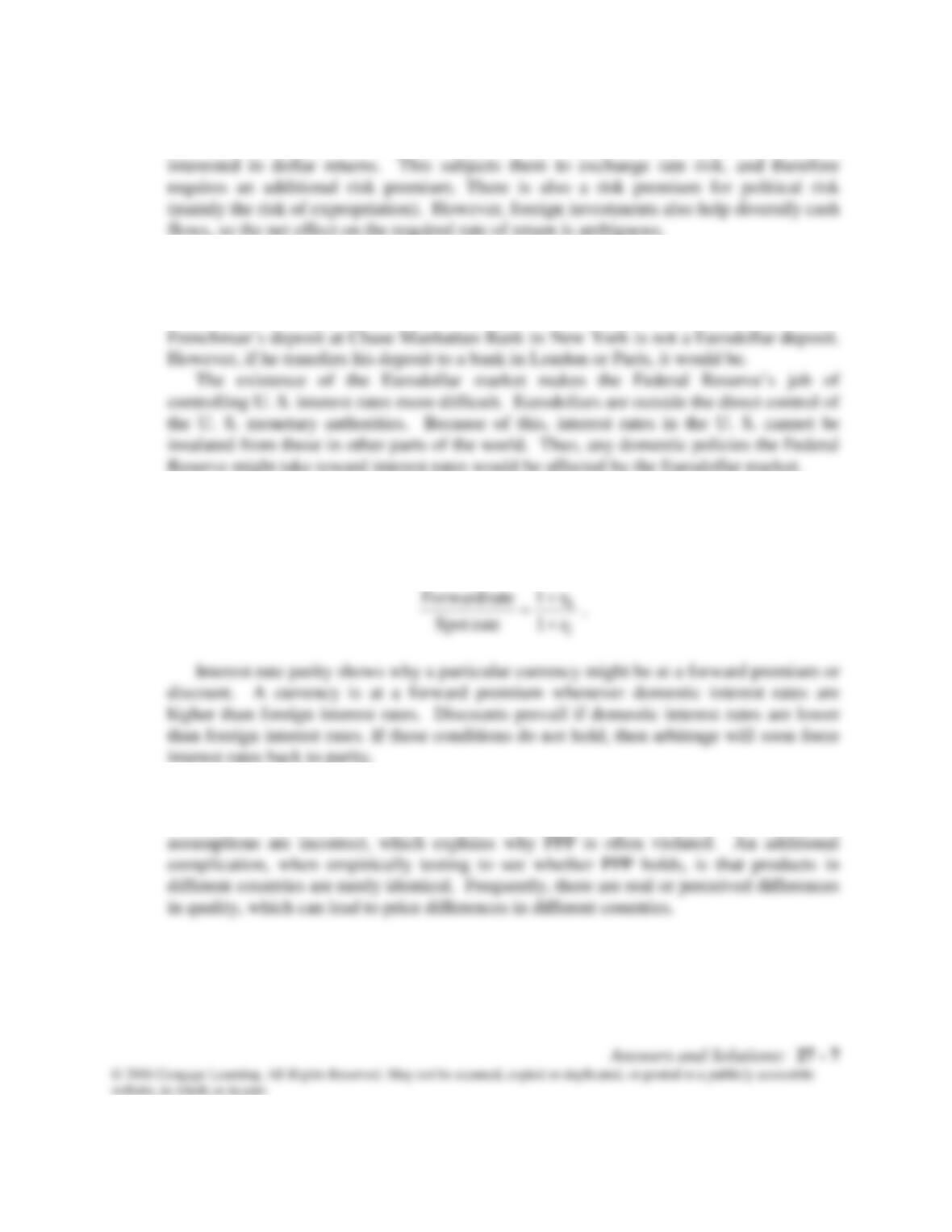
27-9 No, interest rate parity implies that an investment in the U. S. with the same risk as a
similar investment in a foreign country should have the same return. Interest rate parity
is expressed as:
27-10 Purchasing power parity assumes there are neither transaction costs nor regulations which
limit the ability to buy and sell goods across different countries. In many cases, these
SOLUTIONS TO END-OF-CHAPTER PROBLEMS
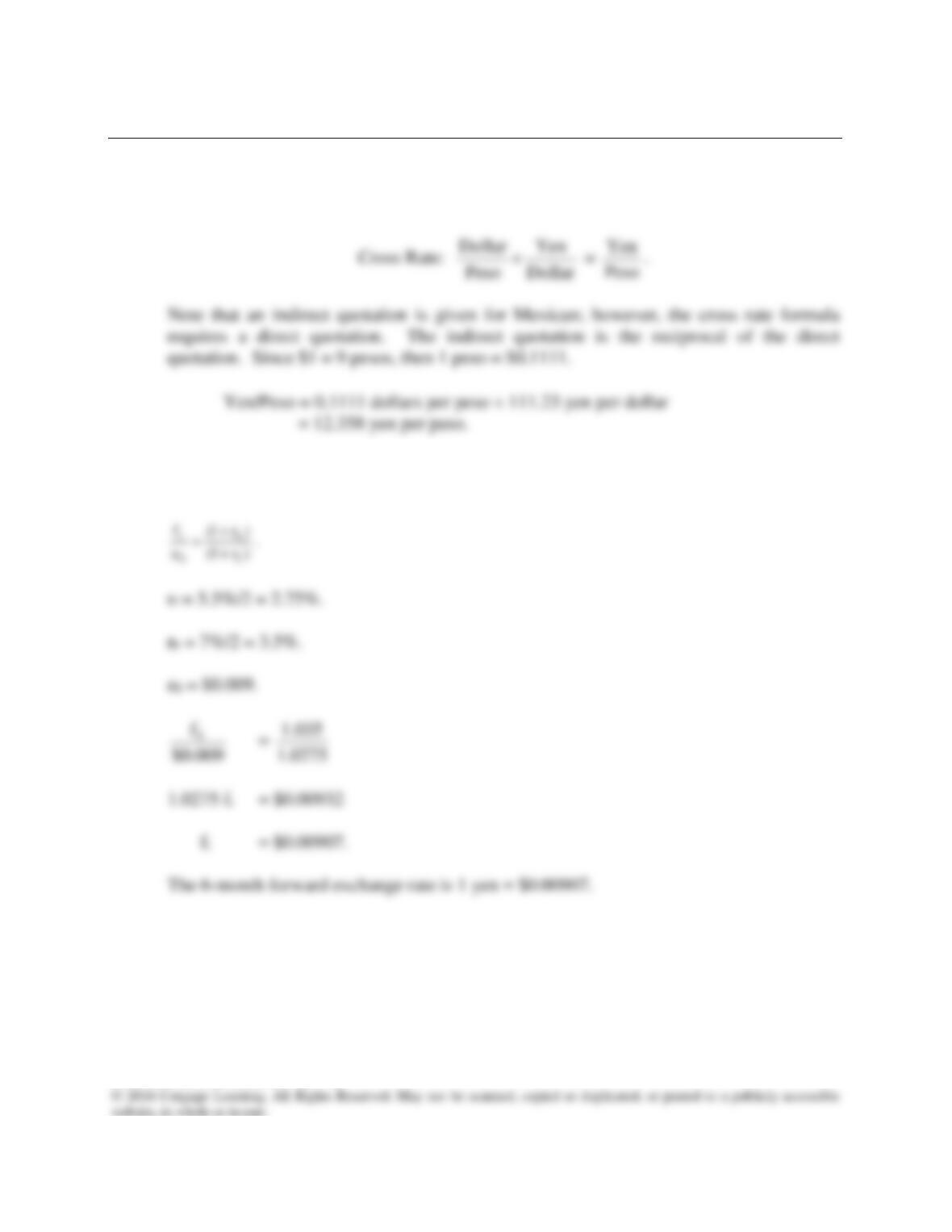
27-1 $1 = 9 Mexican pesos; $1 = 111.23 Japanese yen; Cross exchange rate, yen/peso = ?
27-2 rNom, 6-month T-bills = 7%; rNom of similar default–free 6–month Japanese bonds = 5.5%;
Spot exchange rate, e0: 1 Yen = $0.009; 6-month forward exchange rate = ft = ?
Answers and Solutions: 27 – 8
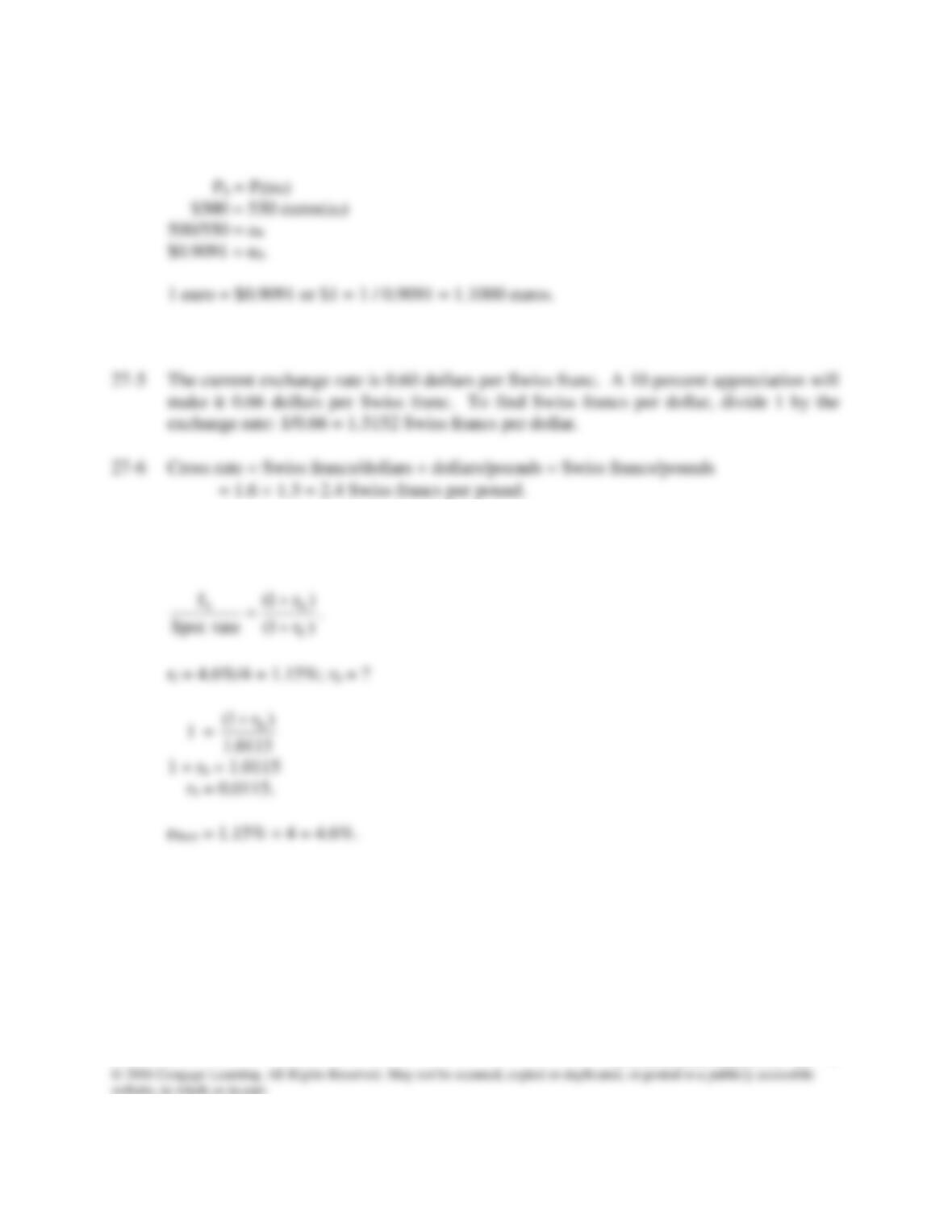
27-3 U. S. Computer = $500; French Computer = 550 euros; Spot rate between euro and
dollar = ?
27-4 Dollars should sell for 1/1.50, or 0.6667 euros per dollar.
27-7 Spot rate = 1 yen = $0.0086; ft = 1 yen = $0.0086; rNom of 90-day Japanese risk–free
securities = 4.6%; rNom of 90-day U. S. risk-free securities = ?
Answers and Solutions: 27 – 9
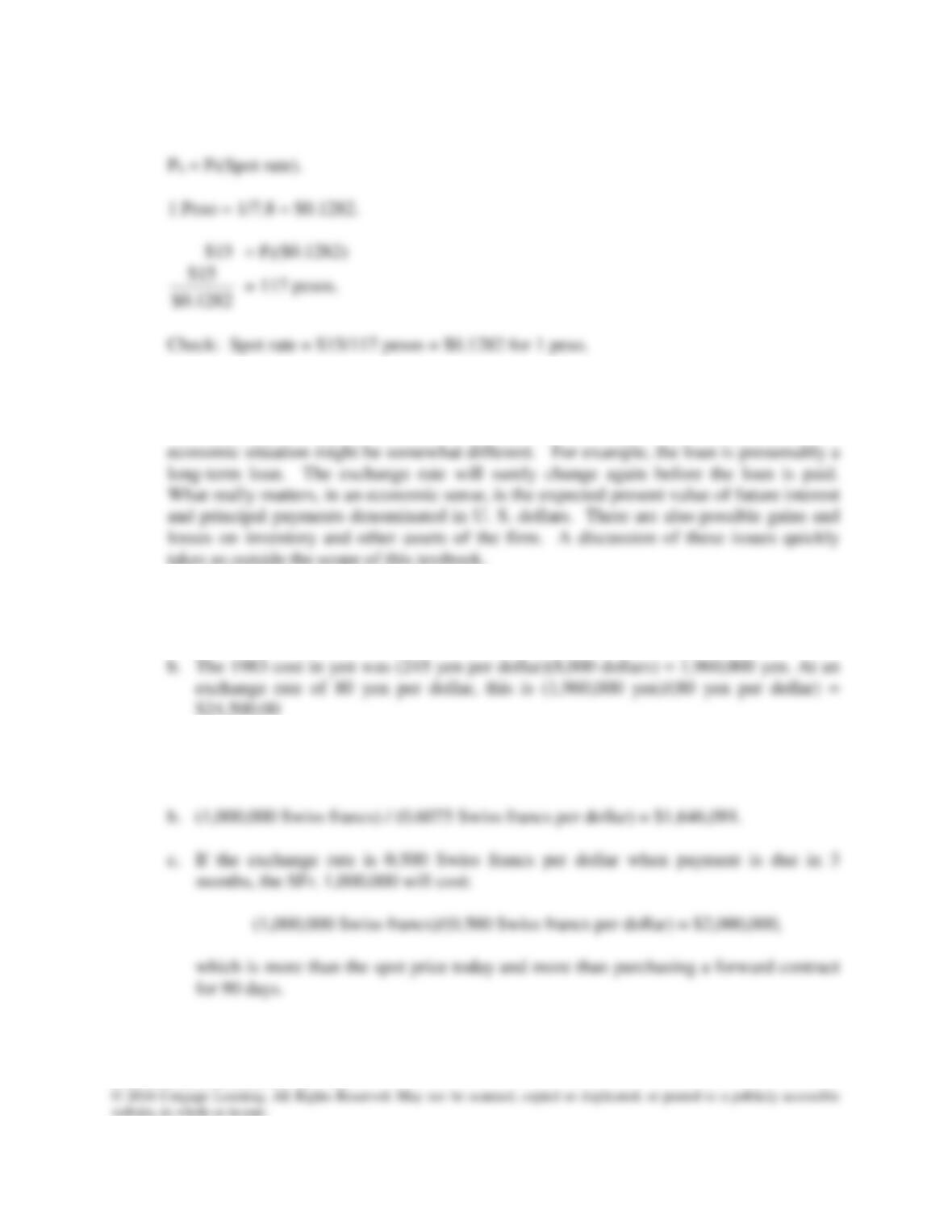
27-8 $1 = 7.8 pesos; headphones = $15.00; Price of headphones in Mexico = ?
27-9 The U. S. dollar liability of the corporation falls from (0.10 dollars per peso)(50,000,000
pesos) = $5,000,000 to (0.09 dollars per peso)(50,000,000 pesos) = $4,500,000,
corresponding to a gain of 500,000 U. S. dollars for the corporation. However, the real
27-10 a. The automobile’s value has increased because the dollar has declined in value relative
to the yen.
27-11 a. (1,000,000 Swiss francs) / (0.6028 Swiss francs per dollar) = $1,658,925.
Answers and Solutions: 27 – 10
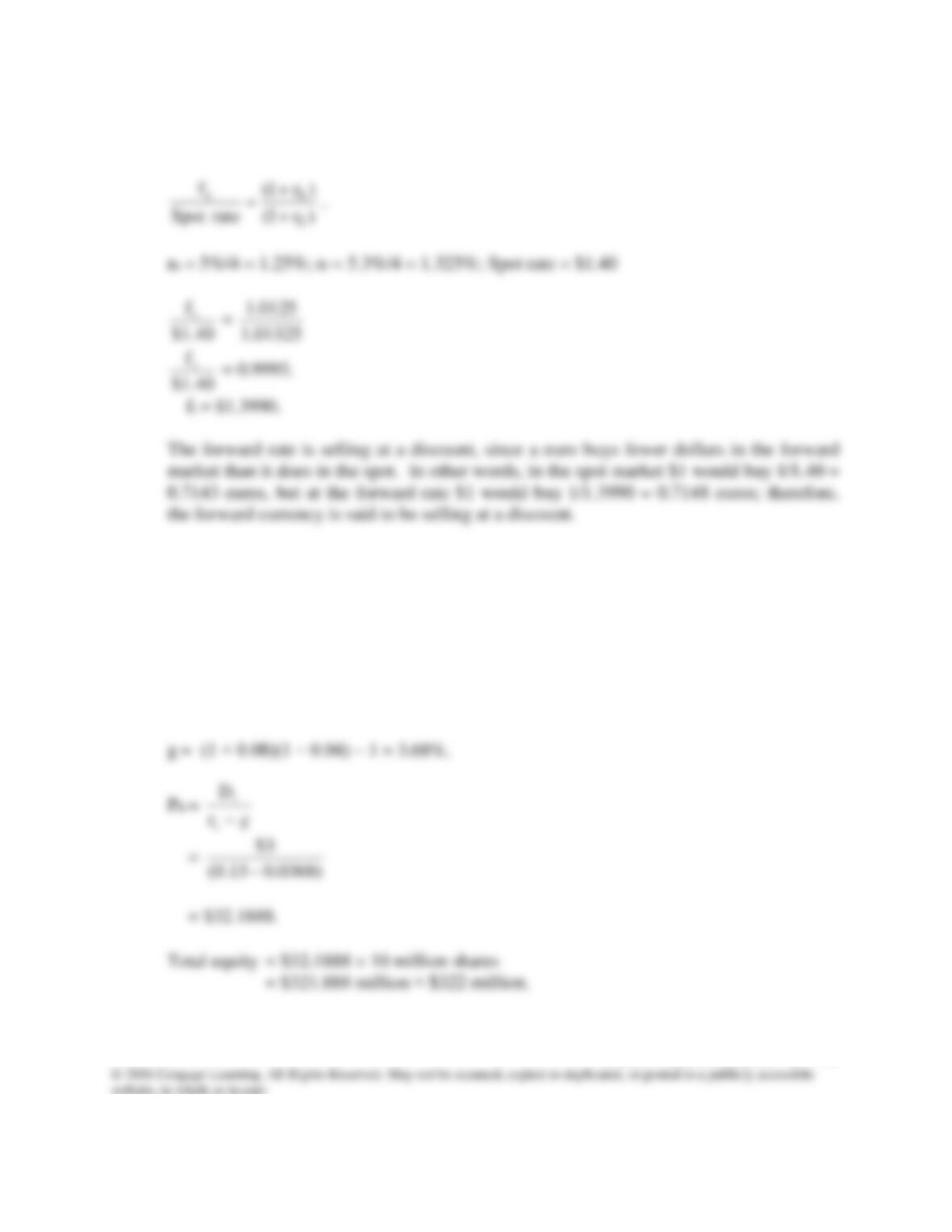
27-12 rNom of 90-day U. S. risk-free securities = 5%; of 90–day German risk–free securities =
5.3%; Spot rate = 1 euro = $0.80; ft selling at premium or discount = ?
27-13 First, convert the pesos to dollars: D1 = (30 pesos)(0.10 dollars per peso) = 3 pesos.
Second, find the growth rate in dollar denominated pesos. If the peso is depreciating 4% a
year with respect to the dollar, then the exchange rate at t=2 will be (0.10 dollars per
peso)(1 – 0.04) = 0.096 dollars per peso. This is a growth rate of (0.096 – 0.10)/0.10 =
−0.04 = −4%. In other words, the exchange rate is “growing” at the rate it is depreciating.
Therefore, the total growth rate in dollar denominated dividends is:
Answers and Solutions: 27 – 11
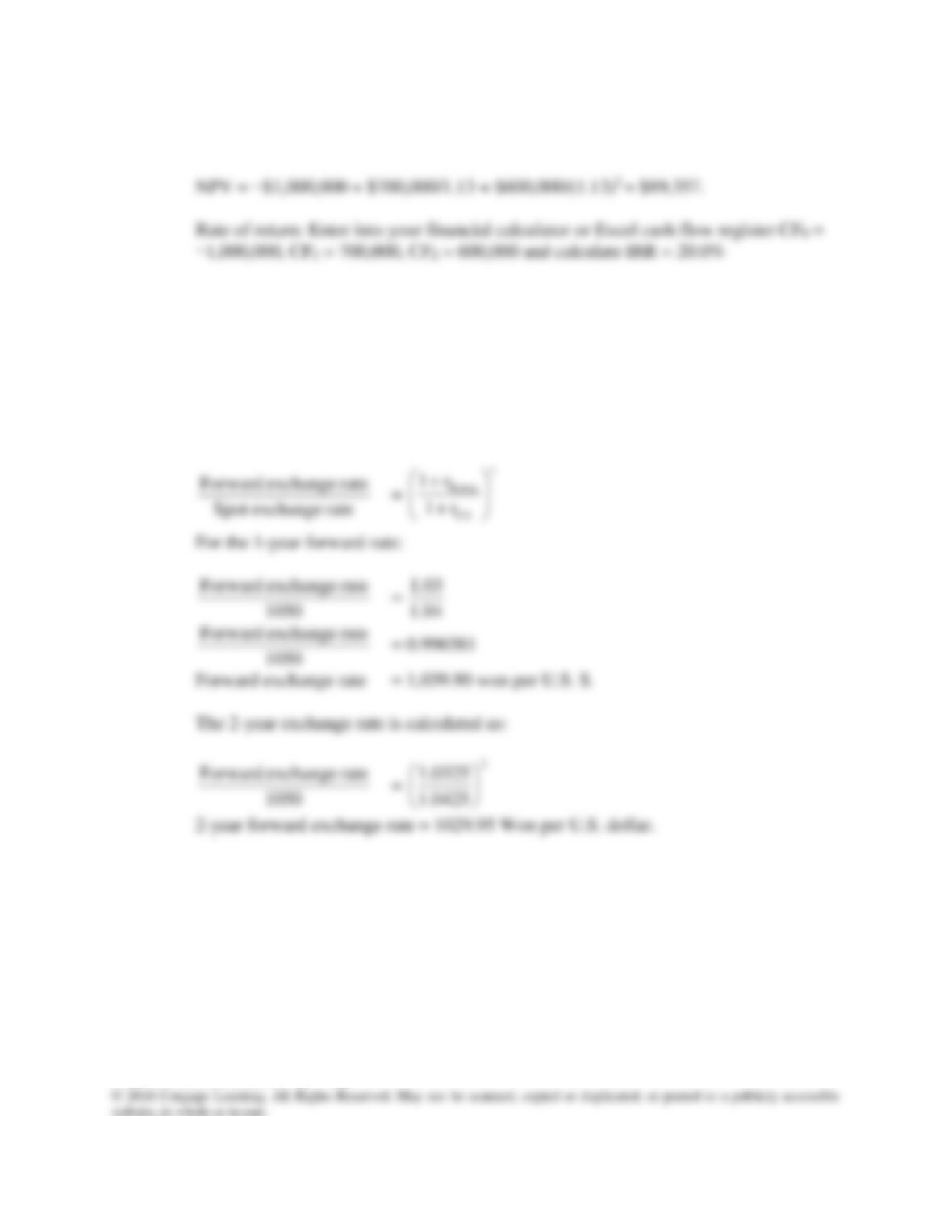
27-14 a. If a U.S. based company undertakes the project, the rate of return for the project is a
simple calculation, as is the net present value.
b. This analysis is from the perspective of a Korean investor, so Korea is the home
country and the U.S is the foreign country. The interest rate parity relationship uses
direct quotes for exchange rates; direct quotes are number of units of home currency
per unit of foreign currency. Therefore, a direct quote from a Korean perspective is
the number of won per dollar.
According to interest rate parity, the following condition holds:
Answers and Solutions: 27 – 12
c. First, we must adjust the cash flows to reflect Nam Sung’s home currency.
The expected Won cash flows are
Year 0: (−1,000,000 dollars)(1,050 won per dollar) = −1,050.00 million won.
Answers and Solutions: 27 – 13

SOLUTION TO SPREADSHEET PROBLEM
27-15 The detailed solution for the spreadsheet problem, Ch 27 P15 Build a Model
Solution.xls, is available on the textbook’s Web site.
Answers and Solutions: 27 – 14