1
2
3
4
5
6
7
8
9
10
11
12
13
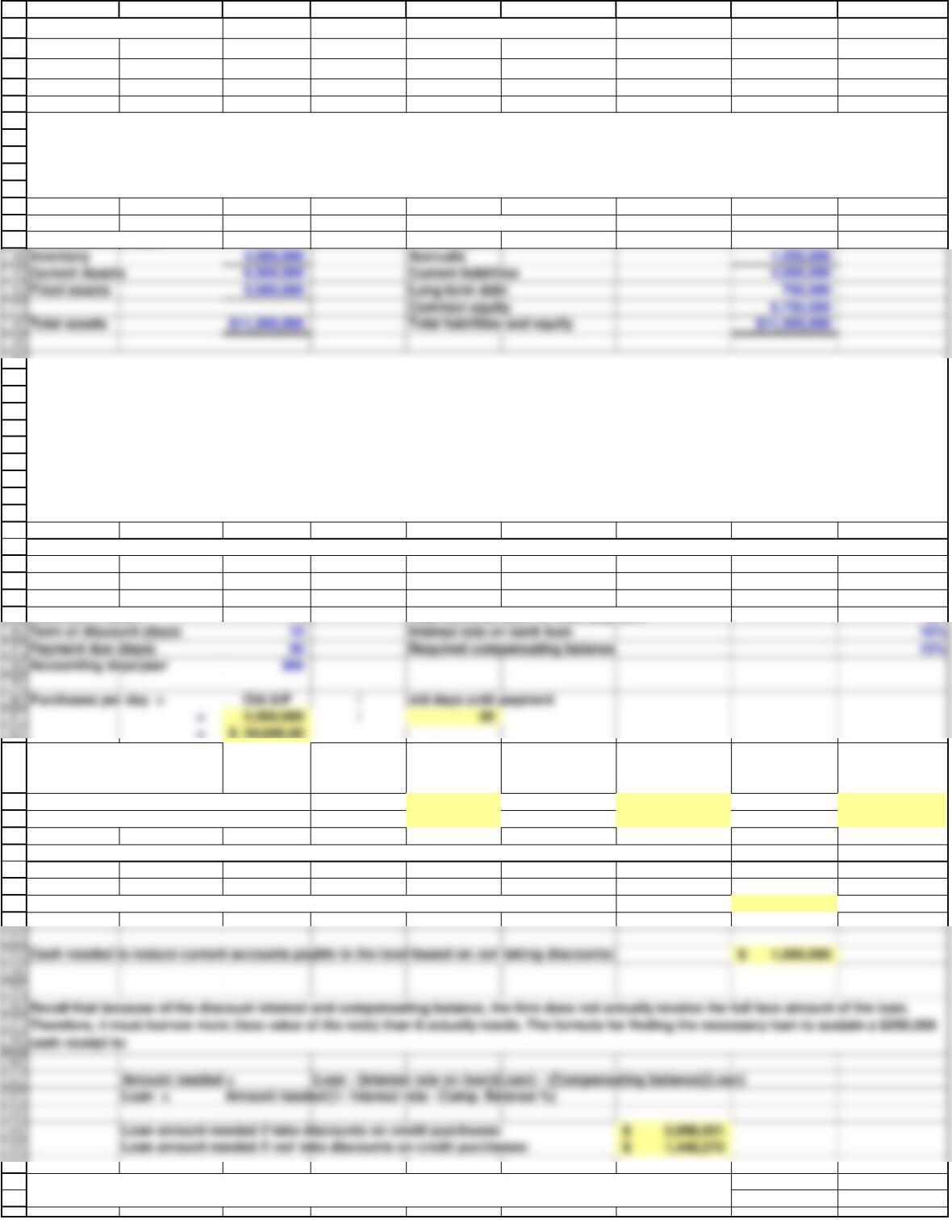
Payment due (days) 30 Required compensating balance 15%
Accounting days/year 360
59
20
21
22
23
24
25
26
27
28
29
30
31
32
33
34
35
43
44
45
46
47
48
49
50
51
66
67
68
69
A B C D E F G H I
Build-a-Model Solution 11/26/2018
Chapter: 27
Problem: 11
Cash $250,000 Accounts payable $2,500,000
Accounts Receivable 2,250,000 Notes payable 250,000
a. How large would the accounts payable balance be if Stewart takes discounts? If it does not take discounts and pays in 30 days?
Input Data
Discount, if taken 1% Days actually taken to make payment 50
Accounts payables =
Term of
discount
(days)
x
Purchases per
day =
Accounts payables if take discounts = 10 x50,000$ = 500,000$
Accounts payables if don’t take discounts = 30 x50,000$ = 1,500,000$
b. How large must the bank loan be if Stewart takes discounts? If Stewart doesn’t take discounts?
Cash needed to reduce current accounts payble to the level based on taking discounts: 2,000,000$
Stewart Manufacturing buys on terms of 2/10, net 30, but it has not been paying on time–it is a “slower payer,” and its suppliers are getting
upset. Stewart does not take discounts, and it has been paying in 50 rather than the required 30 days. Assume that the accounts payable are
recorded at full cost, not net of discounts. Stewart’s balance sheet follows:
Stewart’s suppliers are fed up and will not continue selling to Stewart unless Stewart begins making prompt payments (that is, paying in 30
days or less). The firm is going to have to reduce its level of accounts payable, either to an amount that is equal to 30 days purchases (if it
does not take discounts) or to 10 days purchases (if it decides to take discounts). Management has decided to obtain the needed funds by
borrowing on an additional 1-year note payable (call this a current liability) from its bank at a rate of 16%, discount interest, with a 15%
compensating balance required. The cash currently held by Stewart is needed for transactions, so it cannot be used as part of the
compensating balance. So, the issue now facing the company is this: How much trade credit should it use, and how large a loan should it
obtain from its bank?
c. What are the nominal and effective costs of nonfree trade credit? What is the effective cost of the bank
loan? Based on these costs, what should Stewart do?
1 of 3
Current Assets 6,500,000 Current liabilities 4,000,000
70
71
72
A B C D E F G H I
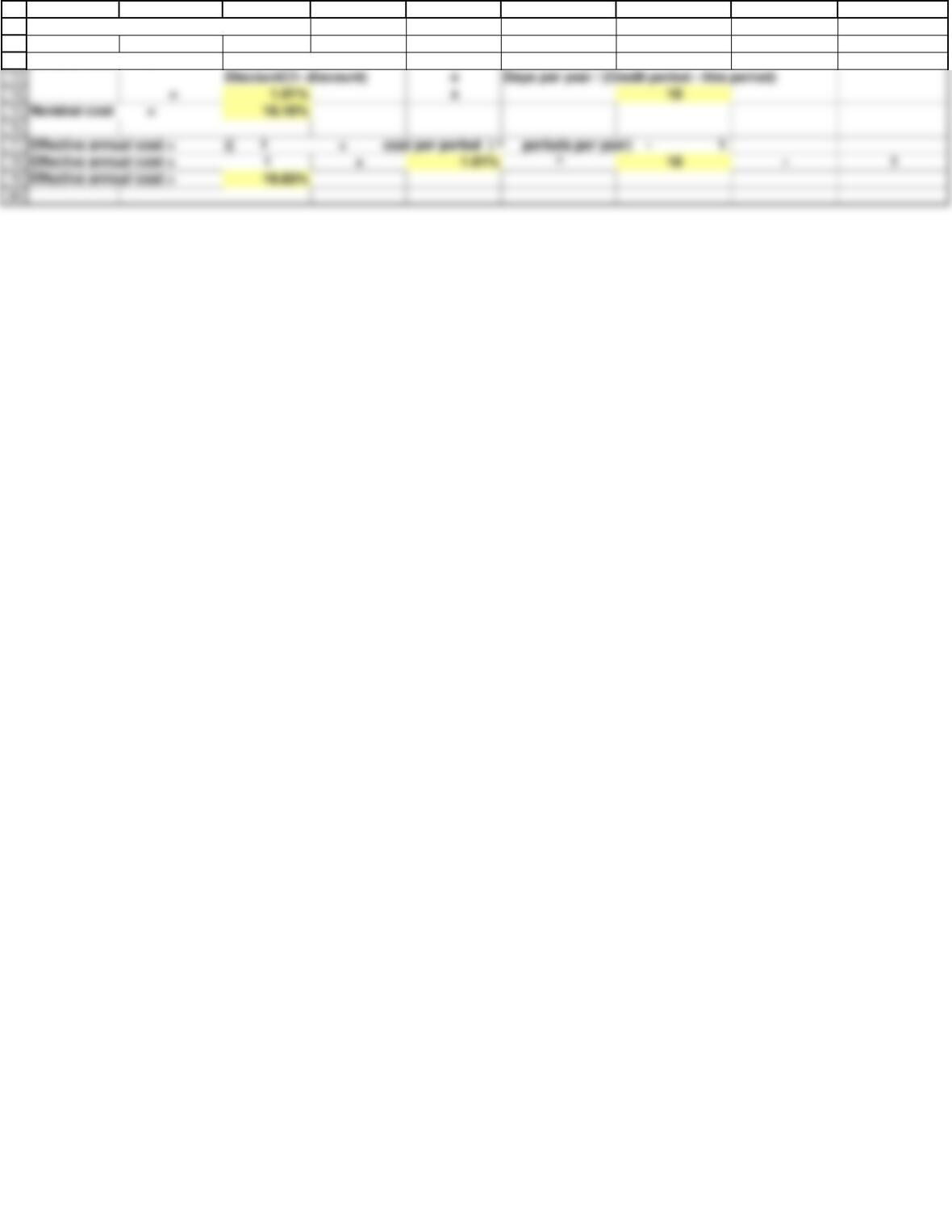
(1) Cost of nonfree trade credit
Nominal cost = cost per period xPeriods per year
2 of 3
Nominal cost = 18.18%
81
82
83
84
85
86
87
88
89
120
Prepaid interest $231,884 Current liabilities $4,449,275
102
103
104
105
106
107
108
109
121
122
123
124
125
126
127
128
129
130
134
131
151
A B C D E F G H I
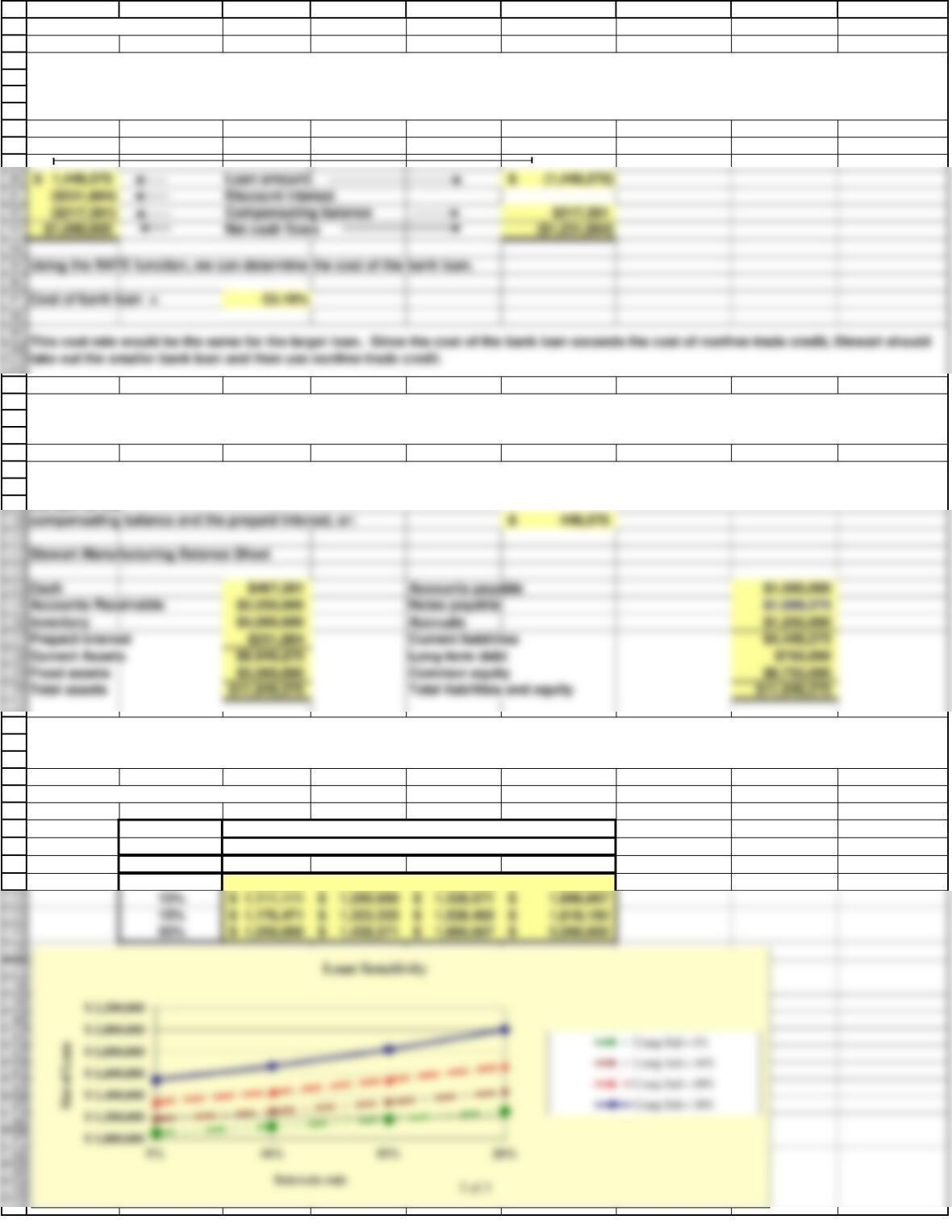
(2) Cost of the bank loan
0 (1 Year) 1
Set up a data table as shown below:
Interest
Rate
1,449,275$ 0% 10% 20% 30%
5% 1,052,632$ 1,176,471$ 1,333,333$ 1,538,462$
Required Loan
Compensating Balance Percentage
Terms of the bank loan are a 16% discount interest rate, and a 15% compensating balance. This terms (and the effective rate on the loan) are
the same regardless of how much the firm borrows. Assume an amount equal to the amount needed if Stewart does not take discounts on its
purchases. We will set up a one-year timeline to analyze the cash flow relevant to this situation.
d. Assume that Stewart foregoes the discount and borrows the amount needed to become current on its payables. Construct a pro forma
balance sheet based on this decision. (Hint: you will need to include an account called “prepaid interest” under current assets.)
The operating assets will remain unchanged, but a new current asset, “Prepaid interest,” will be created. Also, cash will increase by the amount
of the compensating balance. On the liability side, accounts payable will decline, and notes payable will increase. Total assets will increase by
the sum of the
e. Using interest rates in the range of 5% to 25% and compensating balances in the range of 0% to 30%, perform a sensitivity analysis that
shows how the size of the bank loan would vary with changes in the interest rate and the compensating balance percentage.