CHAPTER 27
LEASING
Answers to Concepts Review and Critical Thinking Questions
1. Some key differences are: (a) Lease payments are fully tax-deductible, but only the interest portion of
5. A lease must be disclosed on the balance sheet if one of the following criteria is met:
6. The lease must meet the following IRS standards for the lease payments to be tax deductible:
7. As the term implies, off-balance-sheet financing involves financing arrangements that are not required
Solutions to Questions and Problems
NOTE: All end of chapter problems were solved using a spreadsheet. Many problems require multiple
steps. Due to space and readability constraints, when these intermediate steps are included in this solutions
manual, rounding may appear to have occurred. However, the final answer for each problem is found
without rounding during any step in the problem.
Basic
So, the total cash flows from leasing are:
2. If we assume the lessor has the same tax rate, the NAL to the lessor is the negative of our company’s
NAL, so:
3. To find the maximum lease payment that would satisfy both the lessor and the lessee, we need to find
the payment that makes the NAL equal to zero. Using the NAL equation and solving for the OCF, we
find:
4. If the tax rate is zero, there is no depreciation tax shield forgone. Also, the aftertax lease payment is
the same as the pretax payment, and the aftertax cost of debt is the same as the pretax cost. So:
5. We already calculated the break-even lease payment for the lessor in Problem 3. Since the
6. The appropriate depreciation percentages for a three-year MACRS class asset can be found in Chapter
Intermediate
7. The pretax cost savings are not relevant to the lease versus buy decision, since the firm will definitely
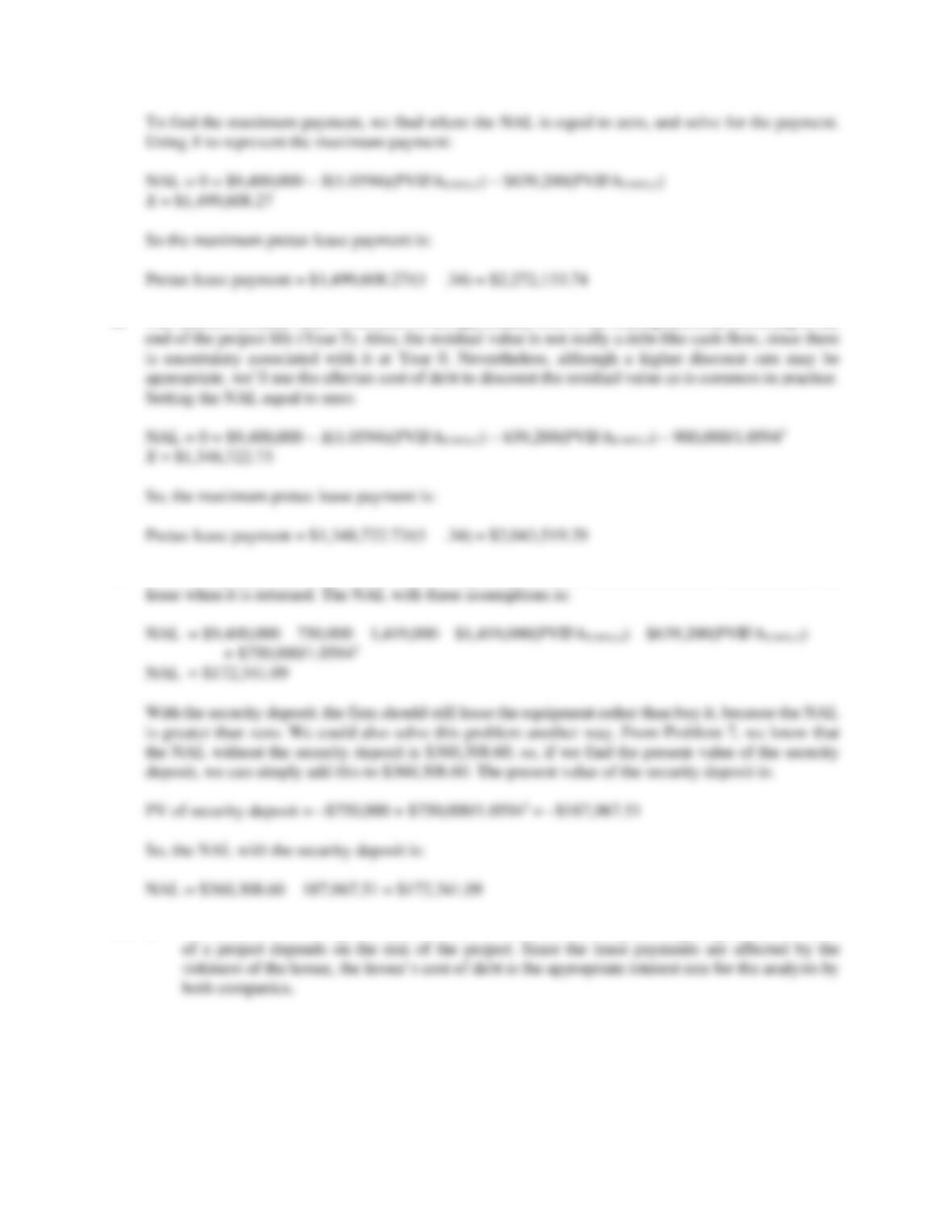
8. The aftertax residual value of the asset is an opportunity cost to the leasing decision, occurring at the
9. The security deposit is a cash outflow at the beginning of the lease and a cash inflow at the end of the
10. a. The different borrowing rates are irrelevant. A basic tenant of capital budgeting is that the return
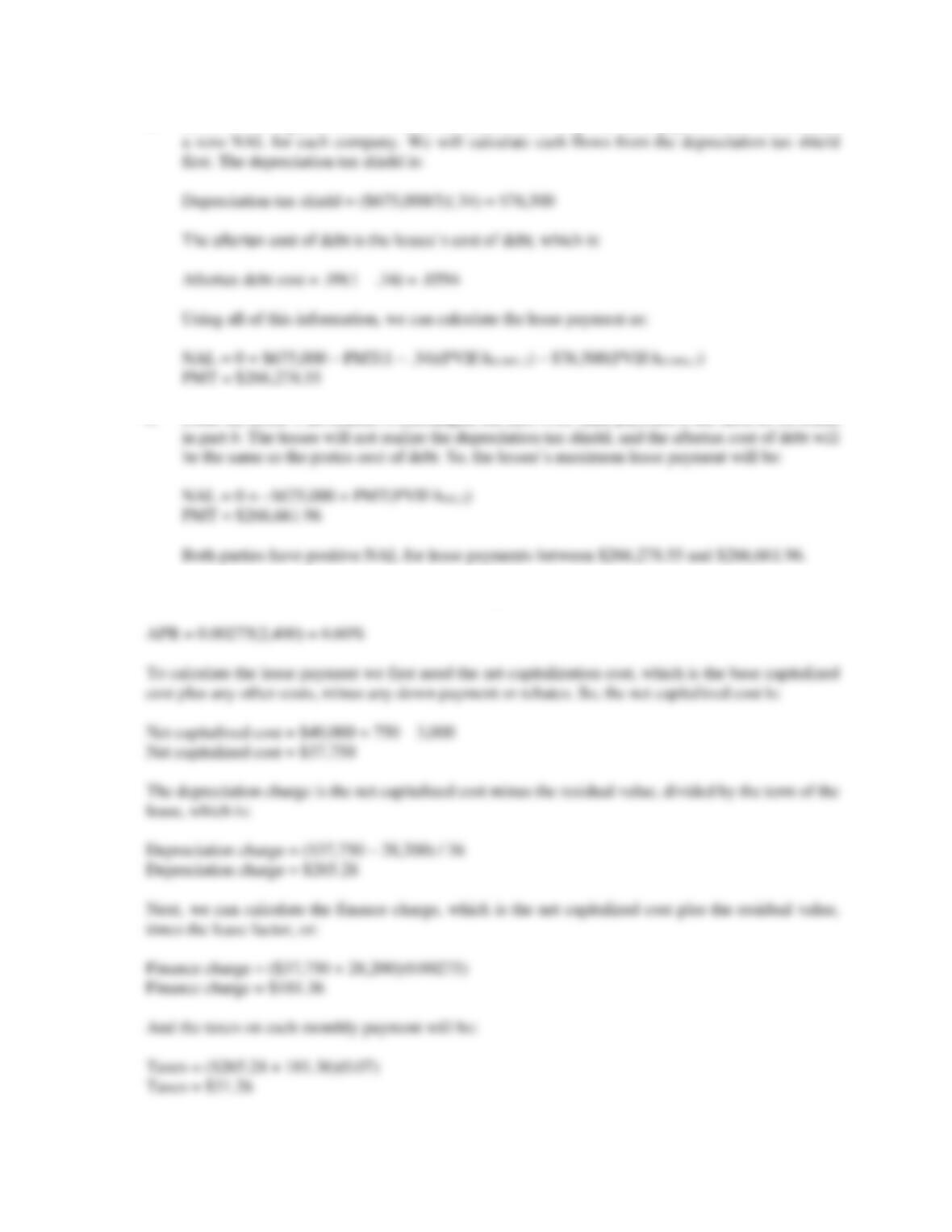
b. Since both companies have the same tax rate, there is only one lease payment that will result in
c. Since the lessor’s tax bracket is unchanged, the zero NAL lease payment is the same as we found
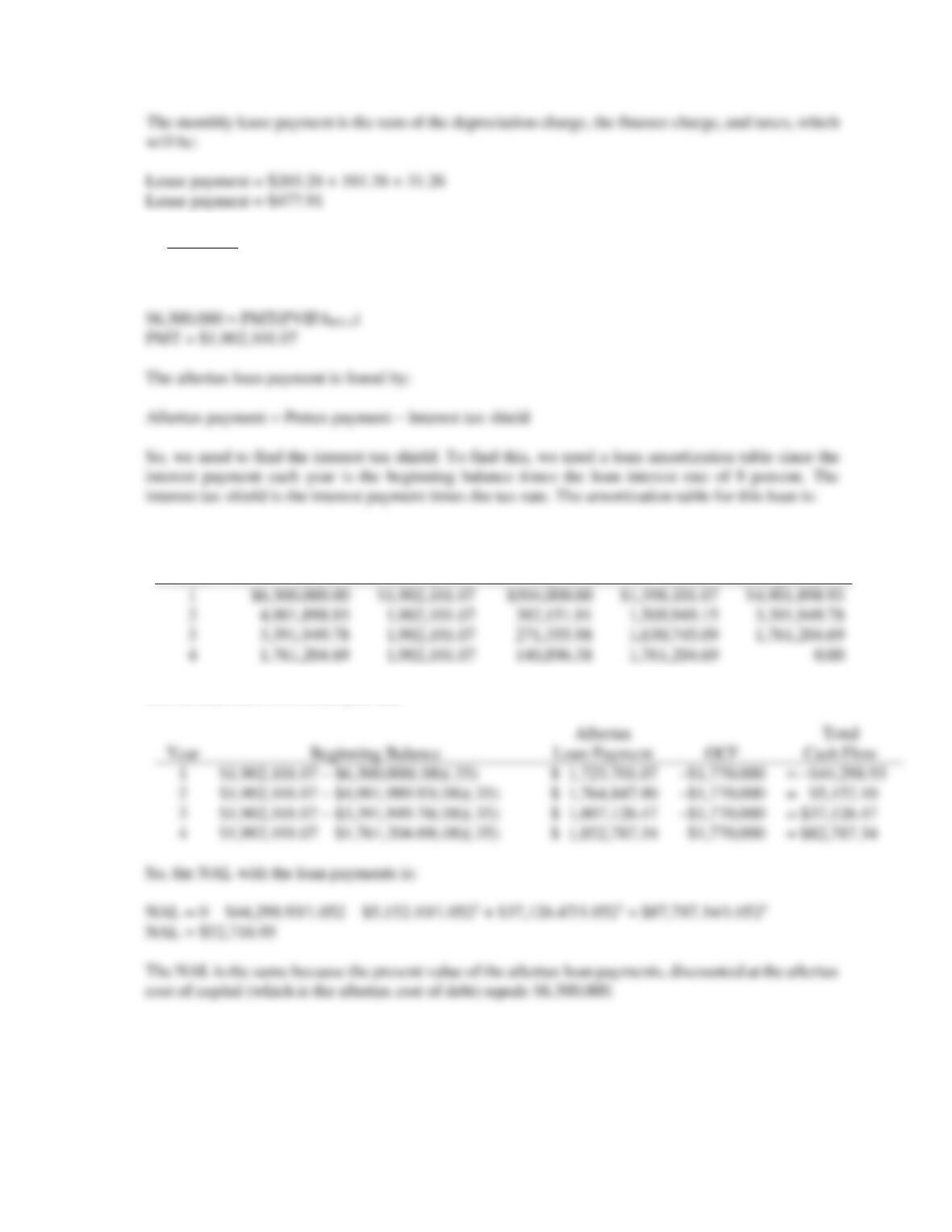
11. The APR of the loan is the lease factor times 2,400, so:
Challenge
12. With a four-year loan, the annual loan payment will be
Year
Beginning
Balance
Total Payment
Interest
Payment
Principal
Payment
Ending Balance
$1,902,101.07 – $3,391,949.78(.08)(.35)
$1,902,101.07 – $1,761,204.69(.08)(.35)
So, the total cash flows each year are: