Chapter 26
Mergers and Corporate Control
ANSWERS TO BEGINNING-OF–CHAPTER QUESTIONS
The BOC questions lead us through a verbal discussion of mergers and merger analysis. This is
a useful exercise, but it does not explain the type of quantitative analysis that a financial analyst
would need to go through to evaluate a potential merger. For a quantitative analysis, we
recommend going through the BOC model.
26-1 Horizontal: In the same business. Example: Exxon merging with Mobil Oil. Vertical: One
is a supplier to the other. Example: DuPont buying Conoco to get a supply of oil.
26-2 Synergy is the situation where two firms merge and the merged firm has higher cash flows
than the sum of the cash flows from the two merger partners. Synergy generally results
Answers and Solutions: 26 – 1
26-3 The most important factor leading to successful mergers is the existence of good synergies,
for without synergistic gains the acquirer cannot afford to pay much of a premium for the
26-4 Under the multiples approach, metrics like industry average P/E ratios, Price/Book ratios,
and Price/EBITDA ratios would be multiplied by the relevant factor for the target
26-5 These are three versions of the DCF method. The corporate valuation method finds the
value of the entire corporation and then deducts the value of the debt to find the value of
the stock. Here the free cash flows are discounted at the WACC, non-operating assets are
added, and then the market value of the debt is subtracted to get the value of the equity.
Under the adjusted present value (APV) method, the free cash flows and the interest tax
It is, of course, difficult to estimate the values required for the DCF methods. Neither
the WACC for use in the corporate valuation model nor the unlevered cost of equity for
26-6 The DCF methods are conceptually better and would normally be given more weight in the
valuation process. The market multiples approach is based on the assumption that the
target firm is quite similar to the average firm in its industry, and, indeed, that all firms in
the industry are relatively similar. That may be incorrect. Also, the multiples approach
26-7 Note: Everything said in this answer to Question 7 pertains to financial accounting only.
The tax accounting treatment is totally separate and quite different. See the answer to
Question 8 for a discussion of tax implications of mergers.
With purchase accounting, the target’s assets are appraised and are then put on the
acquirer’s books at their appraised value. Often, the actual price paid exceeds the appraised
value of the target’s assets, in which case there is apparently some intangible asset called
Answers and Solutions: 26 – 3
acquiring firm, regardless of how much was actually paid for the target. In a pooling, the
$400 million premium paid over book would simply be disregarded.
When companies could choose between pooling and purchase, most choose pooling,
because under purchase accounting they were required to amortize (write off) the goodwill
26-8 Taxes in mergers are quite complicated, so we can only provide a rough outline of the tax
situation. Here are answers to the tax treatment under the 4 situations described in the
question. To answer these questions, we traced through the chart provided in ch26BOC–
model.xls.
a. Acquirer pays $100 million in cash for the target’s stock in a tender offer. Acquirer
records assets at their book value. (Note: This could be done on the company’s tax
• Target’s stockholders would receive the entire $100 million from the acquirer when
they surrendered their stock, and then each individual stockholder would pay taxes
depending on how long they had held the stock and their cost basis.
Answers and Solutions: 26 – 4
b. Same as a, but Acquirer records assets at their appraised value.
Now we go to the lower middle box. The target’s stockholders get the same $100
million and pay the same taxes as before. However, the target firm itself, which really
means the acquiring firm because it now owns the target, must immediately pay a tax
on the $50 million difference between the $50 million book value and the $100 million
c. Acquirer gives stock with a market value of $100 million in exchange for the target’s
stock.
Now in the chart move across the top to the right. We now have an exchange of
stock, which results in a non-taxable merger. The target’s stockholders would receive
d. Acquirer pays $100 million in cash to the target for its assets.
This takes us to the lower left section of the chart. We would have a taxable merger.
Assets would be written up to their appraised value ($80 million), and $20 million of
Answers and Solutions: 26 – 5
ANSWERS TO END-OF-CHAPTER QUESTIONS
26-1 a. Synergy occurs when the whole is greater than the sum of its parts. When applied to
mergers, a synergistic merger occurs when the postmerger free cash flows exceed the
sum of the separate companies’ premerger free cash flows. A merger is the joining of
two firms to form a single firm.
b. A horizontal merger is a merger between two companies in the same line of business.
c. A friendly merger occurs when the target company’s management agrees to the merger
and recommends that shareholders approve the deal. In a hostile merger, the
management of the target company resists the offer. A defensive merger occurs when
d. An operating merger occurs when the operations of two companies are integrated with
e. The free cash flow to equity model, or also called the residual dividend model, first
calculates FCFE, which is the free cash flow payable to shareholders. FCFE is free
Answers and Solutions: 26 – 6
f. Under purchase accounting, the acquiring firm is assumed to have “bought” the
acquired company in much the same way it would buy any capital asset. Any excess
of the purchase price over the book value of assets is added to goodwill, which may be
expensed for Federal income tax purposes, but may not be expensed for shareholder
reporting.
i. A divestiture is the opposite of an acquisition. That is, a company sells a portion of its
assets, often a whole division, to another firm or individual. In a spin-off, a holding
company distributes the stock of one of the operating companies to its shareholders.
Thus, control passes from the holding company to the shareholders directly.
j. A holding company is a corporation formed for the sole purpose of owning stocks in
other companies. A holding company differs from a stock mutual fund in that holding
companies own sufficient stock in their operating companies to exercise effective
26-2 Horizontal and vertical mergers are most likely to result in governmental intervention, but
26-3 A tender offer might be used. Although many tender offers are made by surprise and over
the opposition of the target firm’s management, tender offers can and often are made on a
26-4 An operating merger involves integrating the company’s operations in hopes of obtaining
26-5 The three models—APV, FCFE and corporate valuation (CV) all do the same thing. They
value a firm’s operations and its equity. When implemented under a scenario that is
consistent with the assumptions of all three models, they will all give the same answer.
The CV model discounts free cash flows at the WACC to obtain the value of operations.
SOLUTIONS TO END-OF-CHAPTER PROBLEMS
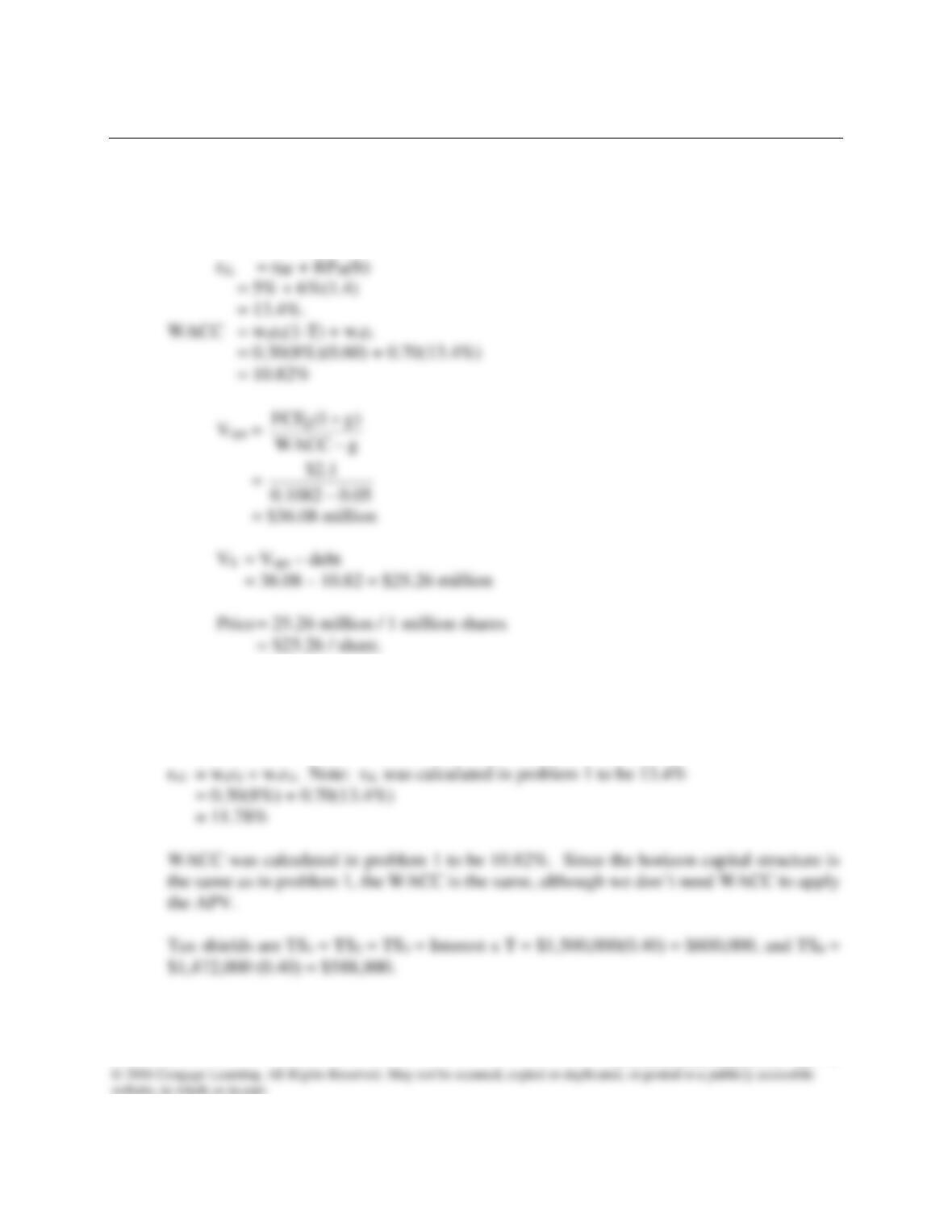
26-1 FCF1 = 2.00(1.05) = $2.1 million; g = 5%; b = 1.4; rRF = 5%; RPM = 6%; wd = 30%; T =
40%; rd = 8% Vops = ? P0 = ?
26-2 FCF1 = $2.5 million, FCF2 = $2.9 million, FCF3 = $3.4 million, and FCF4 = 3.57 million;
Interest in the 4th year = $1.472 million. g = 5%; b = 1.4; rRF = 5%; RPM = 6%; wd = 30%;
T = 40%; rd = 8% Vops = ? P0 = ?
Answers and Solutions: 26 – 9
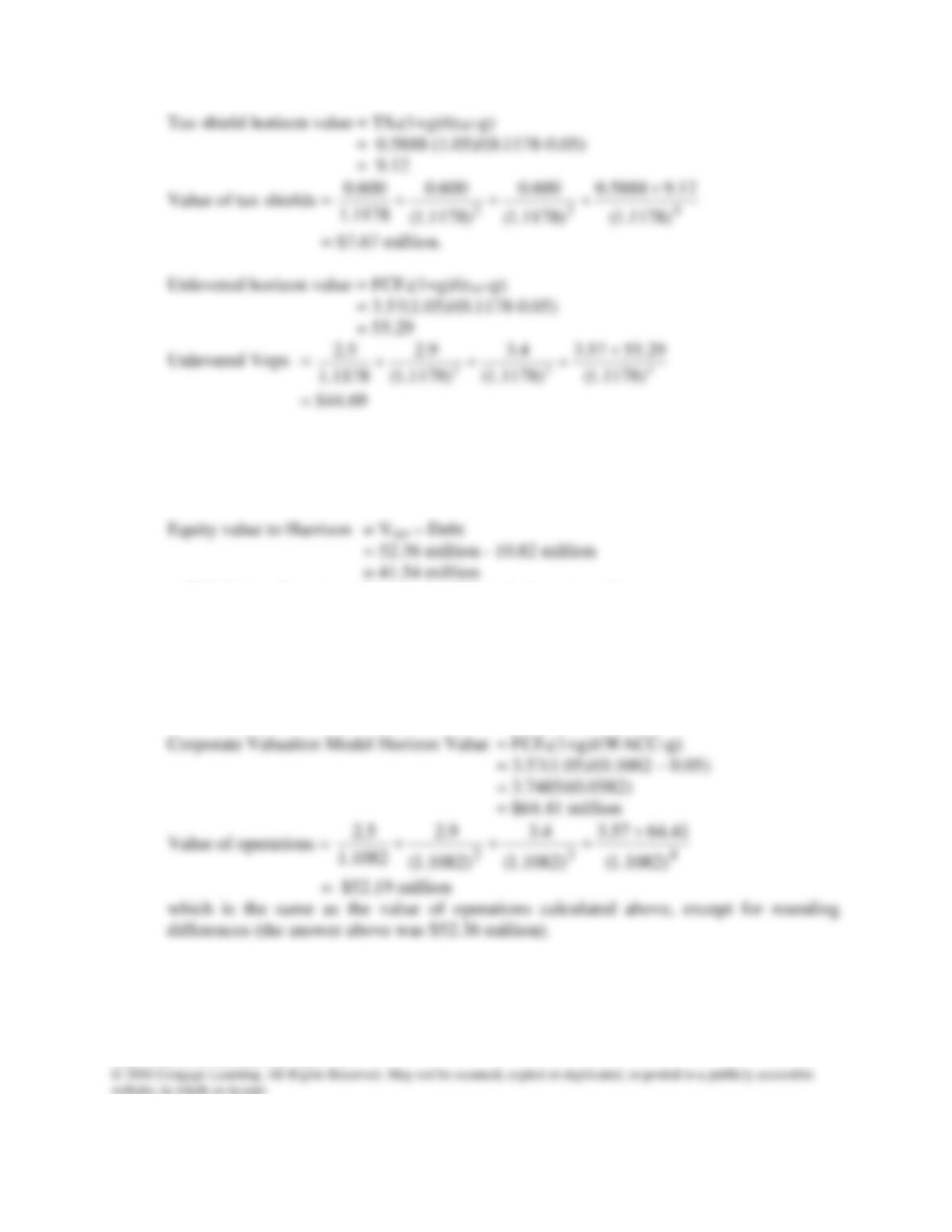
Value of operations = unlevered Vops + value of tax shields
= 44.69 + 7.67
= 52.36 million
or $41.54 per share since there are 1 million shares outstanding.
Note: Since the capital structure isn’t changing and the company has reached its target
capital structure by the horizon, you could have just used the corporate valuation model to
calculate the value of operations. In the corporate valuation model you discount the FCFs
at the WACC to get the value of operations:
26-3 On the basis of the answers in Problems 1 and 2, the bid for each share should range
between $25.26 and $41.54.
Answers and Solutions: 26 – 10
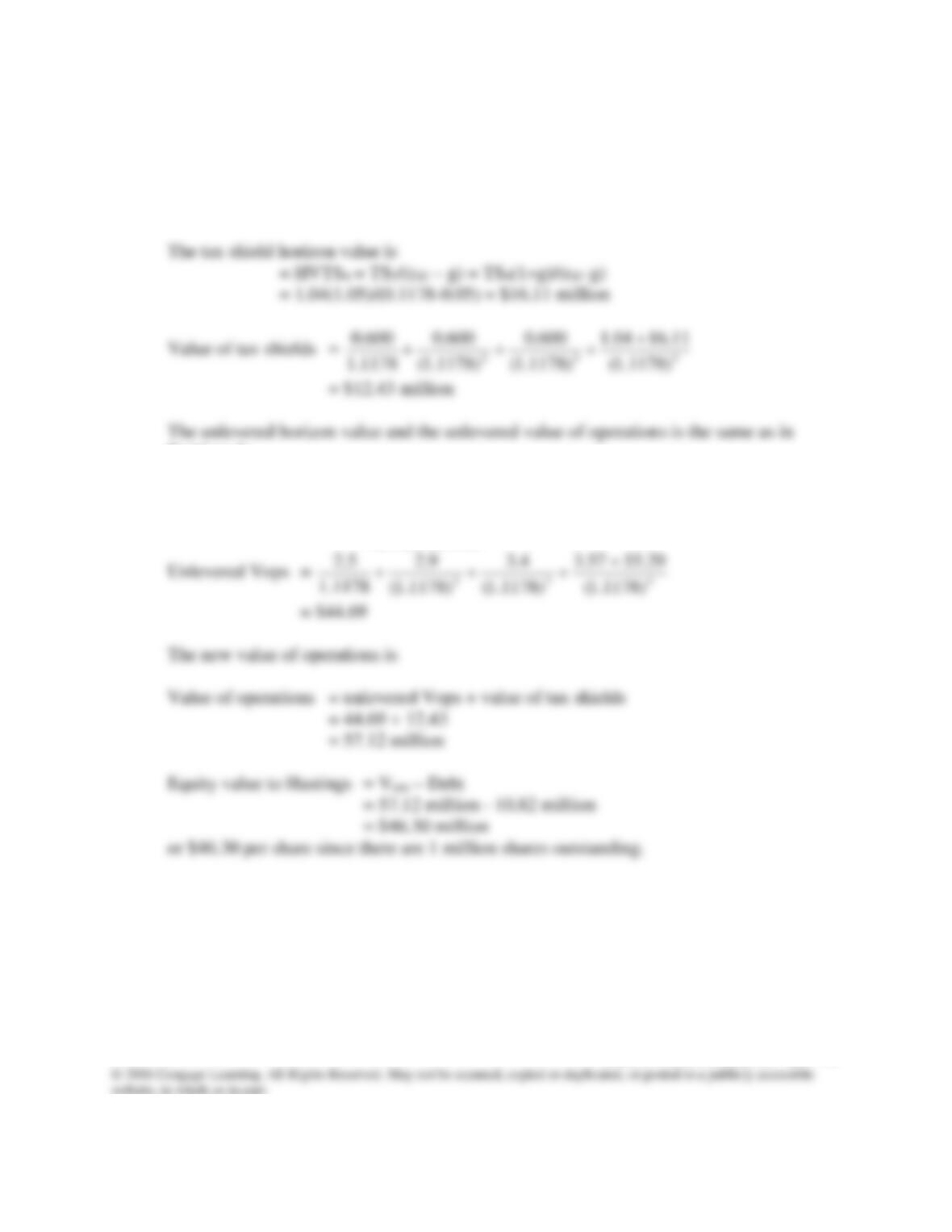
26-4 The difference between this problem and Problem 2 is the tax shield in year 4, which
reflects the 45% debt capital structure. TS4 = (new debt level)(interest rate on debt)(tax
rate) = 30.6(0.085)(0.40) = $1.04 million. rsU = 11.78% was calculated in the earlier
problems.
Problem 3:
Unlevered horizon value = FCF4(1+g)/(rsU-g)
= 3.57(1.05)/(0.1178-0.05)
= $55.29 million
Answers and Solutions: 26 – 11
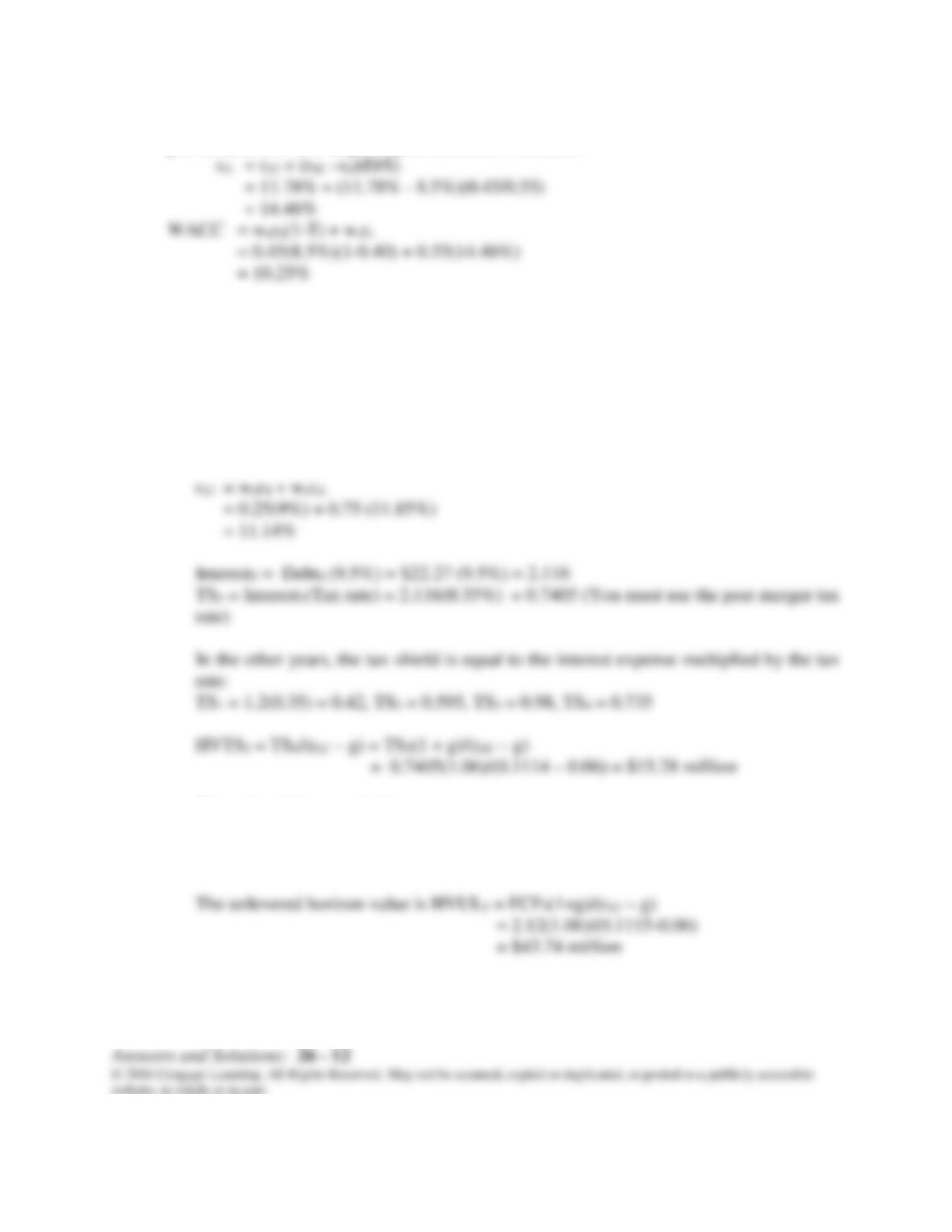
Although not necessary for the problem, you could calculate the new WACC that will
prevail after the 45% target capital structure is reached.
26-5 a. The appropriate discount rate reflects the risk of the cash flows. Thus, it is Conroy’s
unlevered cost of equity that should be used to discount the free cash flows and tax
shields in years 1-5 and at the horizon. The horizon value should be calculated using
Conroy’s tax shields at the stable target capital structure, which are provided for Year
5. Since Conroy’s beta = 1.3, its current cost of equity, rsL = 6% + 1.3(4.5%) = 11.85%.
Since its percentage of debt is 25% and the rate on its debt is 9%, its unlevered cost of
equity is
The value of the tax shields =
5432 )1114.1(
28.15741.0
)1114.1(
735.0
)1114.1(
980.0
)1114.1(
595.0
1114.1
42.0 +
++++
= $11.50 million
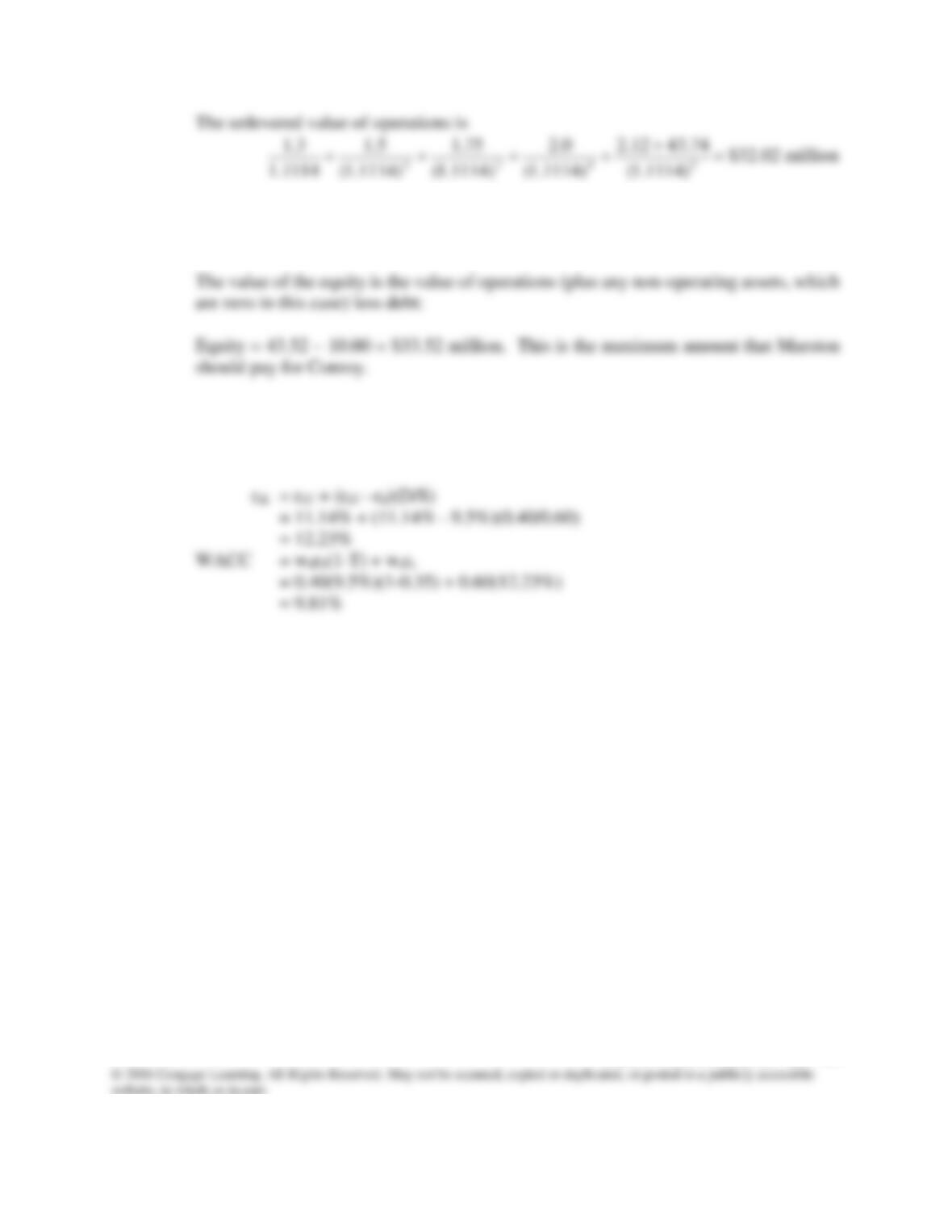
b. The value of operations is the sum of the interest tax shields and the unlevered value =
11.50 + 32.02 = $43.52 million.
Although not required for the value calculation, the WACC at the new capital
structure can be calculated. At the new capital structure of 40 percent debt with a rate
of 9.5 percent, the new levered cost of equity and WACC will be:
Answers and Solutions: 26 – 13
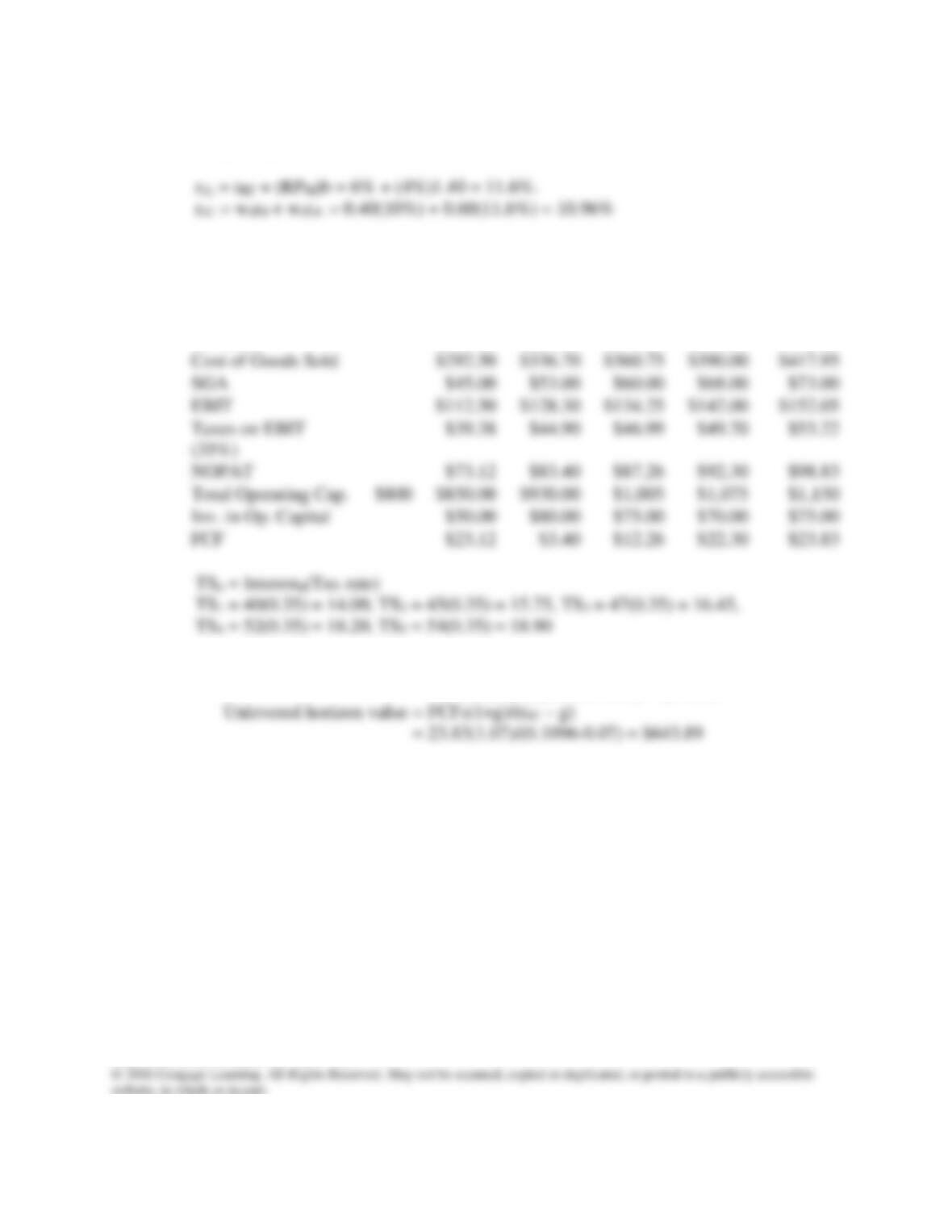
26-6 a. BCC’s unlevered cost of equity depends on its pre-merger cost of equity and its pre-
merger capital structure:
b. The free cash flows are NOPAT – investment in net operating capital = (Sales – CGS
– selling expenses)(1–T) – investment in net operating capital. CGS is 65% of sales:
2015
2016
2017
2018
2019
2020
Net sales
$450.00
$518.00
$555.00
$600.00
$643.00
$112.50
$128.30
$134.25
$142.00
$152.05
Total Operating Cap.
$800
$850.00
$930.00
Inv. in Op. Capital
c. Horizon value of tax shields = TS5(1+g)/(rsU – g)
= 18.9(1.07)/(0.1096-0.07) = $510.68
Answers and Solutions: 26 – 14
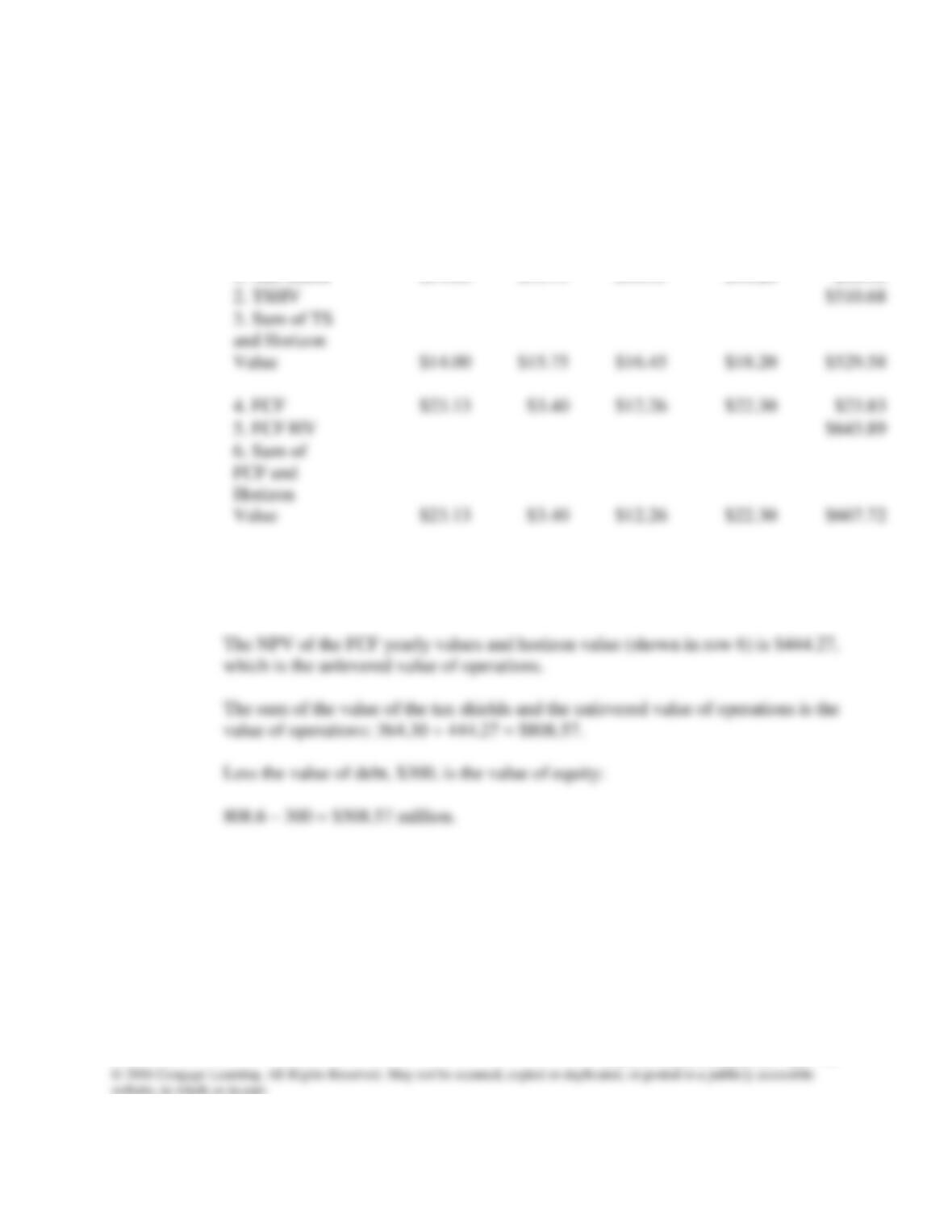
d. Value of tax shields = PV of tax shields and the PV of the horizon value of the tax
shields at rsU.
The unlevered value of operations = PV of the FCFs and the PV of the unlevered
horizon value at rsU. The cash flows for both are summarized below:
2016
2017
2018
2019
2020
1. Tax shield
$14.00
$15.75
$16.45
$18.20
$18.90
The NPV of the TS yearly values and horizon value (shown in row 3) when
discounted at 10.96% is $364.30, which is the value of the tax shields.
Answers and Solutions: 26 – 15
4. FCF
$23.13
$12.26
$22.30
$23.83
5. FCF HV