Build a Model Solution 11/26/2018
Chapter: 26
Problem: 9
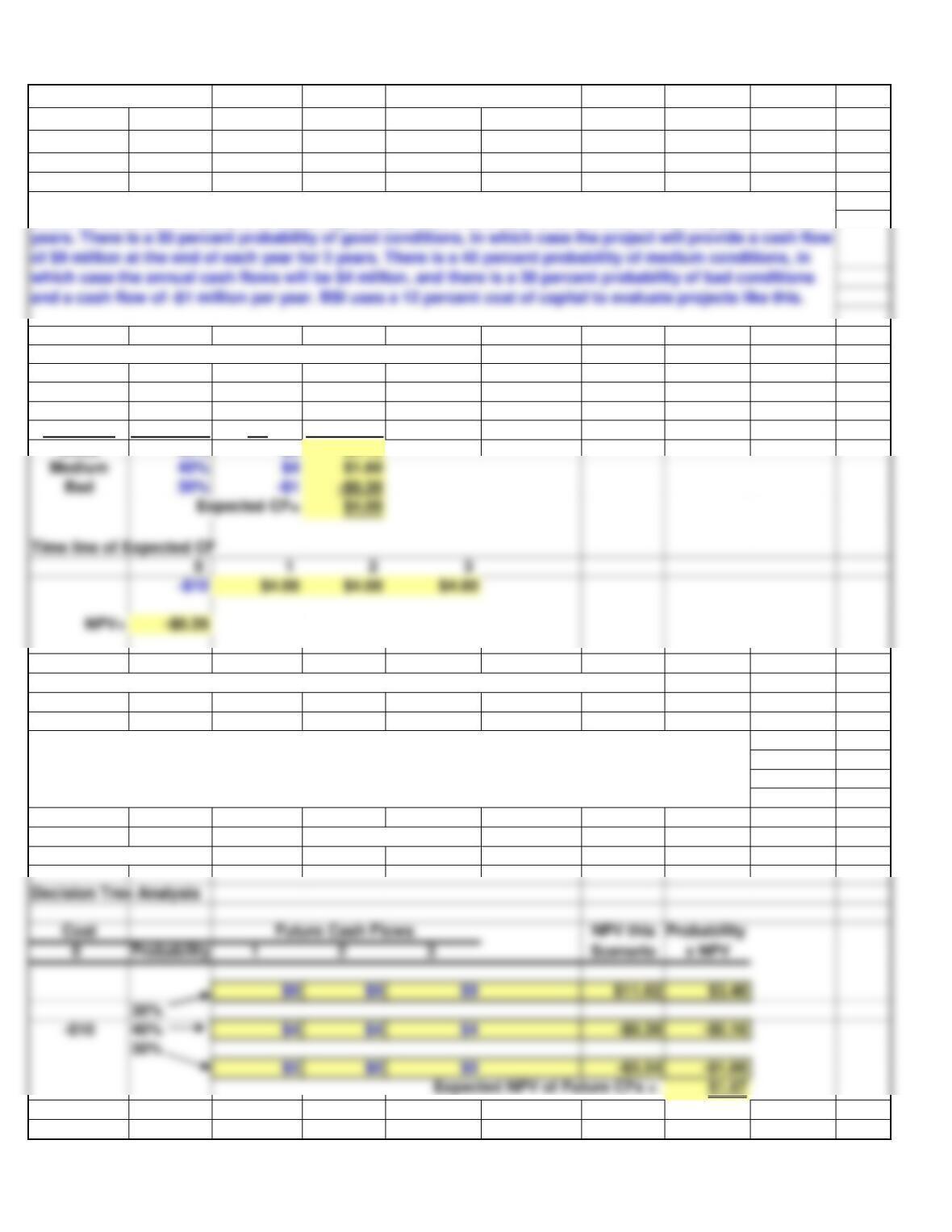
a. Find the project’s expected cash flows and NPV.
WACC= 12%
Condition
Probability
CF CF x Prob.
Good 30% $9 $2.70
Without any real options, reject the project. It has a negative NPV and is quite risky.
WACC= 12% Salvage Value = $6
Risk-free rate = 6%
Decision Tree Analysis
Bradford Services Inc. (BSI) is considering a project that has a cost of $10 million and an expected life of 3
b. Now suppose the BSI can abandon the project at the end of the first year by selling it for $6
million. BSI will still receive the Year 1 cash flows, but will receive no cash flows in subsequent
years. Assume the salvage value is risky and should be discounted at the WACC.
Page 1
Time line of Expected CF
WACC= 12%
Risk-free rate = 6%
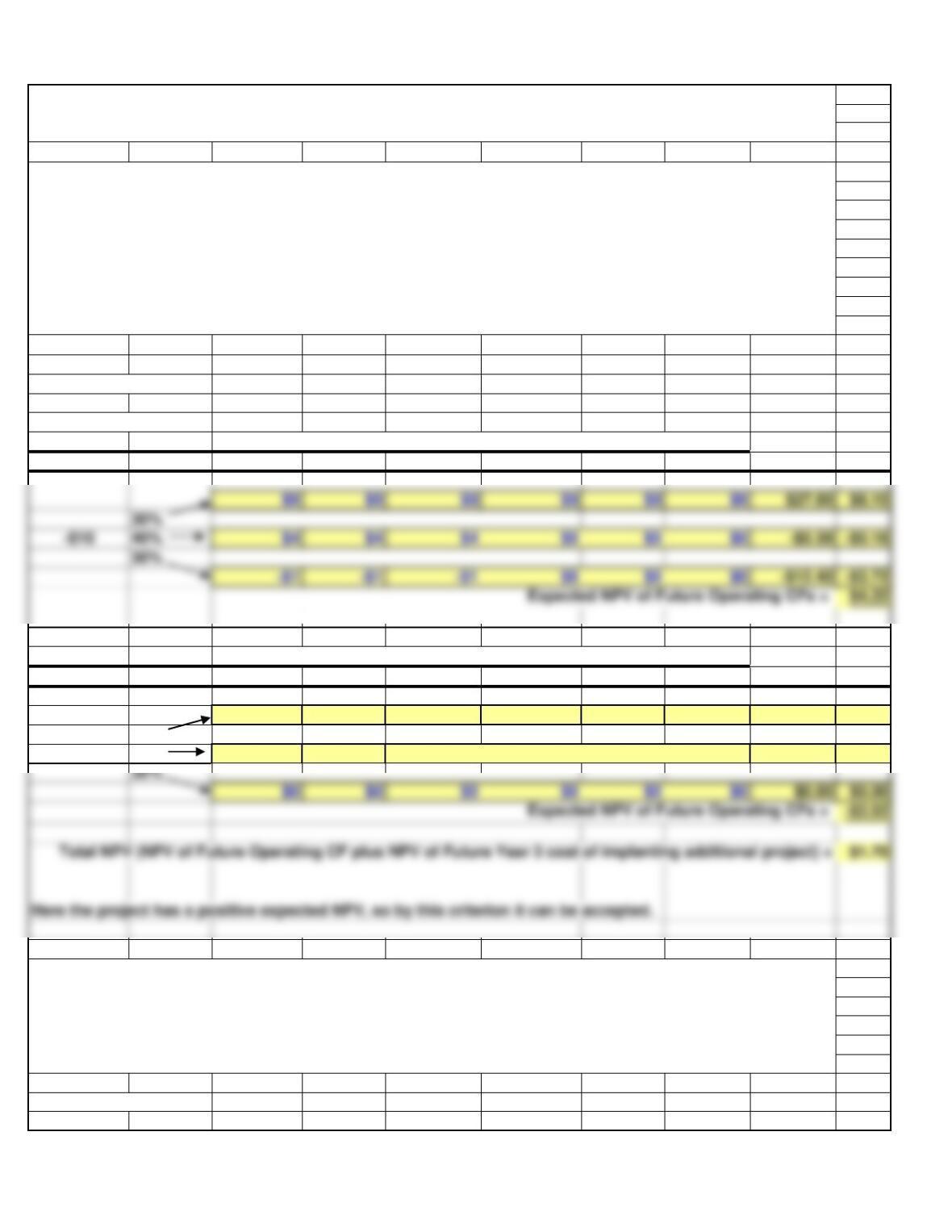
Decision Tree Analysis
Cost NPV this Prob.
0
Probability
1 2 3 4 5 6 Scenario x NPV
NPV this Prob.
0
Probability
1 2 3 4 5 6 Scenario x PV
$0 $0 -$10 $0 $0 $0 -$8.40 -$2.52
30%
40% $0 $0 $0 $0 $0 $0 $0.00 $0.00
30%
Here the project has a positive expected NPV, so by this criterion it can be accepted.
WACC= 12%
Risk-free rate = 6%
d. Now suppose the original (no abandonment and no additional growth) project could be delayed a year.
All the cash flows would remain unchanged, but information obtained during that year would tell the
company exactly which set of demand conditions existed. Use decision tree analysis to estimate the value of
the project if it is delayed by 1 year. Hint: Discount the $10 million cost at the risk-free rate since it is known
with certainty. Show two time lines, one for operating cash flows and one for the cost, then sum their NPVs.
Future Operating Cash Flows (Discount at WACC)
Future Cost of Implementing Additional Project (Discount at Risk-free rate)
When abandonment is factored in, the very large negative NPV under bad conditions is reduced, and the
expected NPV becomes positive. Note that even though the NPV of medium is still negative, it is higher than
it would be if the project was abandoned at year 1 if conditions are medium.
c. Now assume that the project cannot be shut down. However, expertise gained by taking it on will lead to
an opportunity at the end of Year 3 to undertake a venture that would have the same cost as the original
project, and the new project’s cash flows would follow whichever branch resulted for the original project. In
other words, there would be a second $10 million cost at the end of Year 3, and then cash flows of either $9
million, $4 million, or -$1million for the following 3 years. Use decision tree analysis to estimate the value of
the project, including the opportunity to implement the new project in Year 3. Assume the $10 million cost at
Year 3 is known with certainty and should be discounted at the risk-free rate of 6 percent. Hint: do one
decision tree for the operating cash flows and one for the cost of the project, then sum their NPVs.
Page 2
30%
30%

Page 3
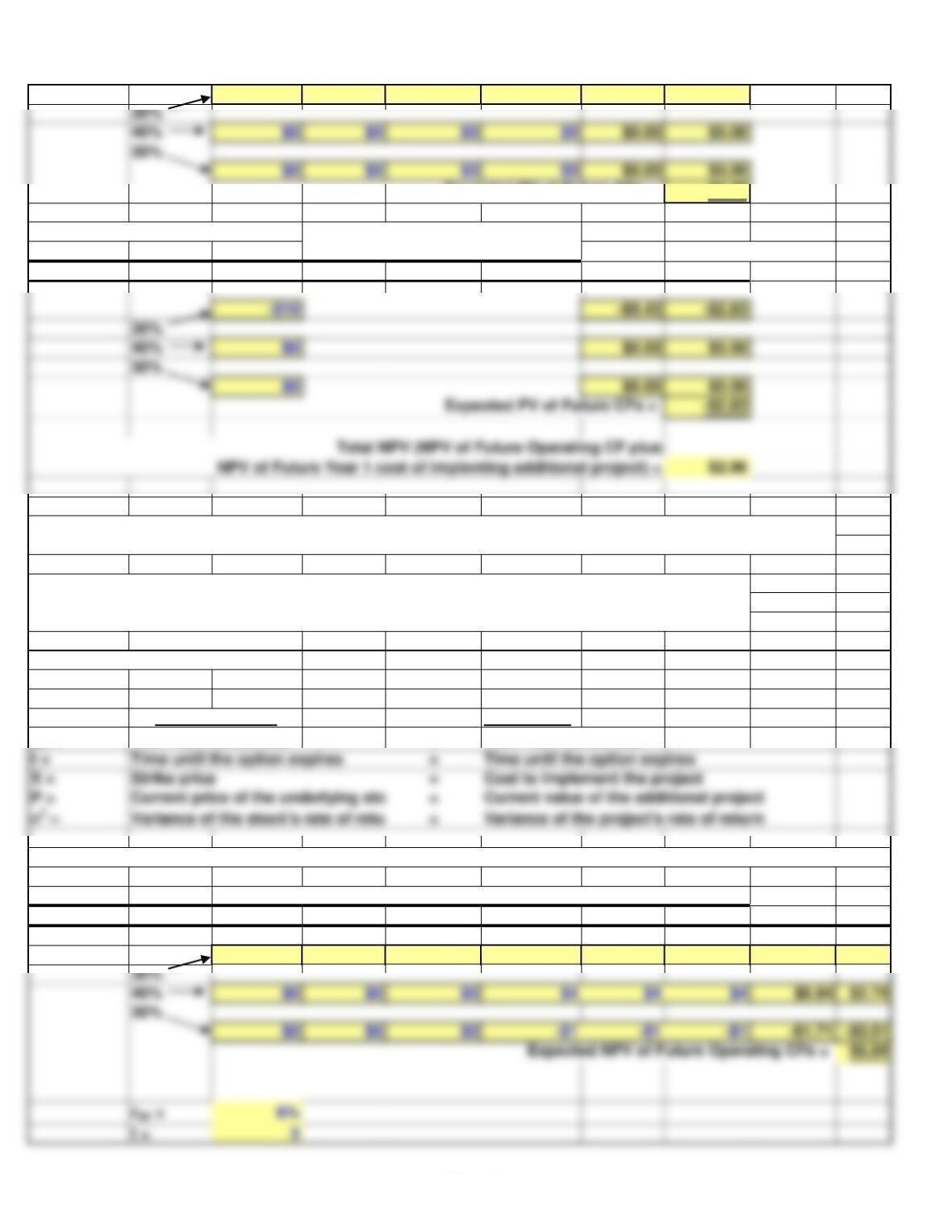
$0 $9 $9 $9 $19.30 $5.79
Expected PV of Future CFs = $5.79
Decision Tree Analysis: Costs
Cost NPV this Probability
0
Probability
1 2 3 4 Scenario x NPV
Expected PV of Future CFs = -$2.83
Risk-free rate= 6%
Variance of project’s rate of return= 22%
Real Option
rRF = Risk-free interest rate = Risk-free interest rate
t = Time until the option expires = Time until the option expires
X = Strike price = Cost to implement the project
P =
Current price of the underlying stock
Variance of the stock’s rate of return
Find current value of the additional project’s cash flows. This includes all cash flows except cost of implementation.
Cost NPV this Prob.
0
Probability
1 2 3 4 5 6 Scenario x NPV
$0 $0 $0 $9 $9 $9 $15.39 $4.62
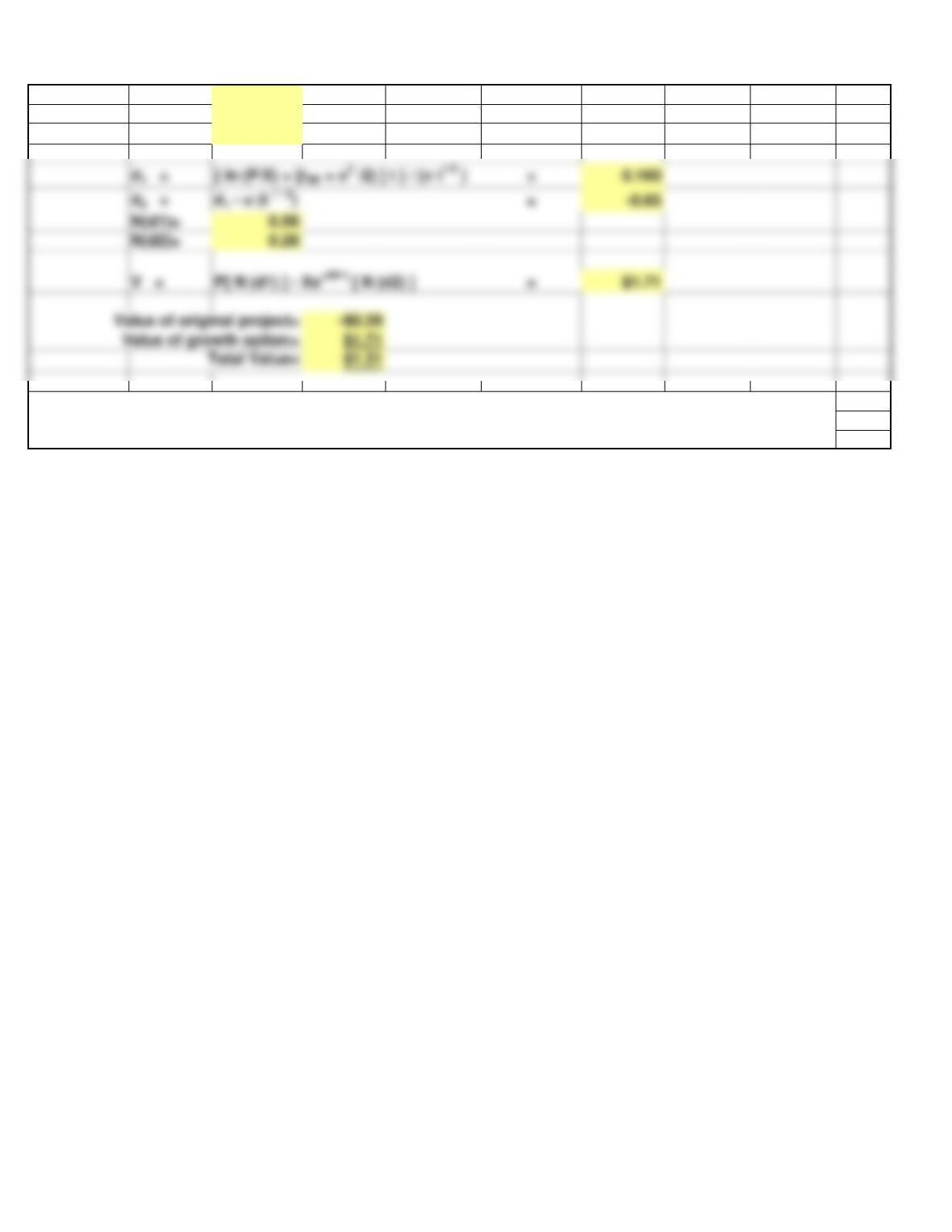
e. Go back to part c. Instead of using decision tree analysis, use the Black-Scholes model to
estimate the value of the growth option. The risk-free rate is 6 percent, and the variance of the
project’s rate of return is 22 percent.
Financial Option
Since the NPV from waiting is positive and the NPV from immediate implementation is negative, it makes
sense to delay the decision for a year.
Future Cost of Implementation
(Discount at Risk-Free Rate)
Future Operating Cash Flows of Additional Project (Discount at WACC)
Page 4
X = $10.00
P = $6.84
s2 = 22.0%
Even though the original project has a negative NPV, the value of the growth option is large enough so that
the combination of the original project and the growth option is greater than zero. Therefore, the project
should be accepted.
Page 5