
Although we don’t need this calculation for the valuation, after the merger, BCC will
have 50 percent of debt costing 10%, so its levered cost of equity and WACC will be:

SOLUTION TO SPREADSHEET PROBLEMS
26-7 The detailed solution for the spreadsheet problem, Ch26 P07 Build a Model Solution.xls,
is available on the textbook’s Web site.
Answers and Solutions: 26 – 17

MINI CASE
Hager’s Home Repair Company, a regional hardware chain that specializes in “do–it–
yourself” materials and equipment rentals, is cash rich because of several consecutive good
years. One of the alternative uses for the excess funds is an acquisition. Doug Zona, Hager’s
treasurer and your boss, has been asked to place a value on a potential target, Lyons’
Lighting (LL), a chain that operates in several adjacent states, and he has enlisted your
help.
The table below indicates Zona’s estimates of LL’s earnings potential if it came
under Hager’s management (in millions of dollars). The interest expense listed here
includes the interest (1) on LL’s existing debt, which is $55 million at a rate of 9 percent,
and (2) on new debt expected to be issued over time to help finance expansion within the
new “L division,” the code name given to the target firm. If acquired, LL will face a 40
percent tax rate.
Security analysts estimate LL’s beta to be 1.3. The acquisition would not change
Lyons’ capital structure, which is 20 percent debt. Zona realizes that Lyons’ Lighting’s
business plan also requires certain levels of operating capital and that the annual
investment could be significant. The required levels of total net operating capital are listed
below.
Zona estimates the risk–free rate to be 7 percent and the market risk premium to be
4 percent. He also estimates that free cash flows after 2020 will grow at a constant rate of 6
percent. Following are projections for sales and other items.
2015 2016 2017 2018 2019 2020
Net sales $60.00 $90.00 $112.50 $127.50 $139.70
Cost of goods sold (60%) 36.00 54.00 67.50 76.50 83.80
Selling/administrative expense 4.50 6.00 7.50 9.00 11.00
Interest expense 5.00 6.50 6.50 7.00 8.16
Total net operating capital 150.00 150.00 157.50 163.50 168.00 173.0
Hager’s management is new to the merger game, so Zona has been asked to answer some
basic questions about mergers as well as to perform the merger analysis. To structure the
task, Zona has developed the following questions, which you must answer and then defend
to Hager’s board.
Mini Case: 26- 18
a. Several reasons have been proposed to justify mergers. Among the more
prominent are (1) tax considerations, (2) risk reduction, (3) control, (4) purchase
of assets at below-replacement cost, (5) synergy, and (6) globalization. In general,
which of the reasons are economically justifiable? Which are not? Which fit the
situation at hand? Explain.
Answer: The economically justifiable rationales for mergers are synergy and tax
consequences. Synergy occurs when the value of the combined firm exceeds the sum
of the values of the firms taken separately. (if synergy exists, then the whole is greater
than the sum of the parts, and hence synergy is also called the “2 + 2 = 5” effect.)
Another valid rationale behind mergers is tax considerations. For example, a firm
which is highly profitable and consequently in the highest corporate tax bracket could
acquire a company with large accumulated tax losses, and immediately use those losses
to shelter its current and future income. Without the merger, the carry-forwards might
eventually be used, but their value would be higher if used now rather than in the future.
Mini Case: 26- 19
Sometimes a firm will be touted as a possible acquisition candidate because the
replacement value of its assets is considerably higher than its market value. For
example, in the early 1980s, oil companies could acquire reserves more cheaply by
buying out other oil companies than by exploratory drilling. However, the value of an
asset stems from its expected cash flows, not from its cost. Thus, paying $1 million for
a slide rule plant that would cost $2 million to build from scratch is not a good deal if
no one uses slide rules.
b. Briefly describe the differences between a hostile merger and a friendly merger.
Answer: In a friendly merger, the management of one firm (the acquirer) agrees to buy
another firm (the target). In most cases, the action is initiated by the acquiring firm,
but in some situations the target may initiate the merger. The managements of both
Mini Case: 26- 20
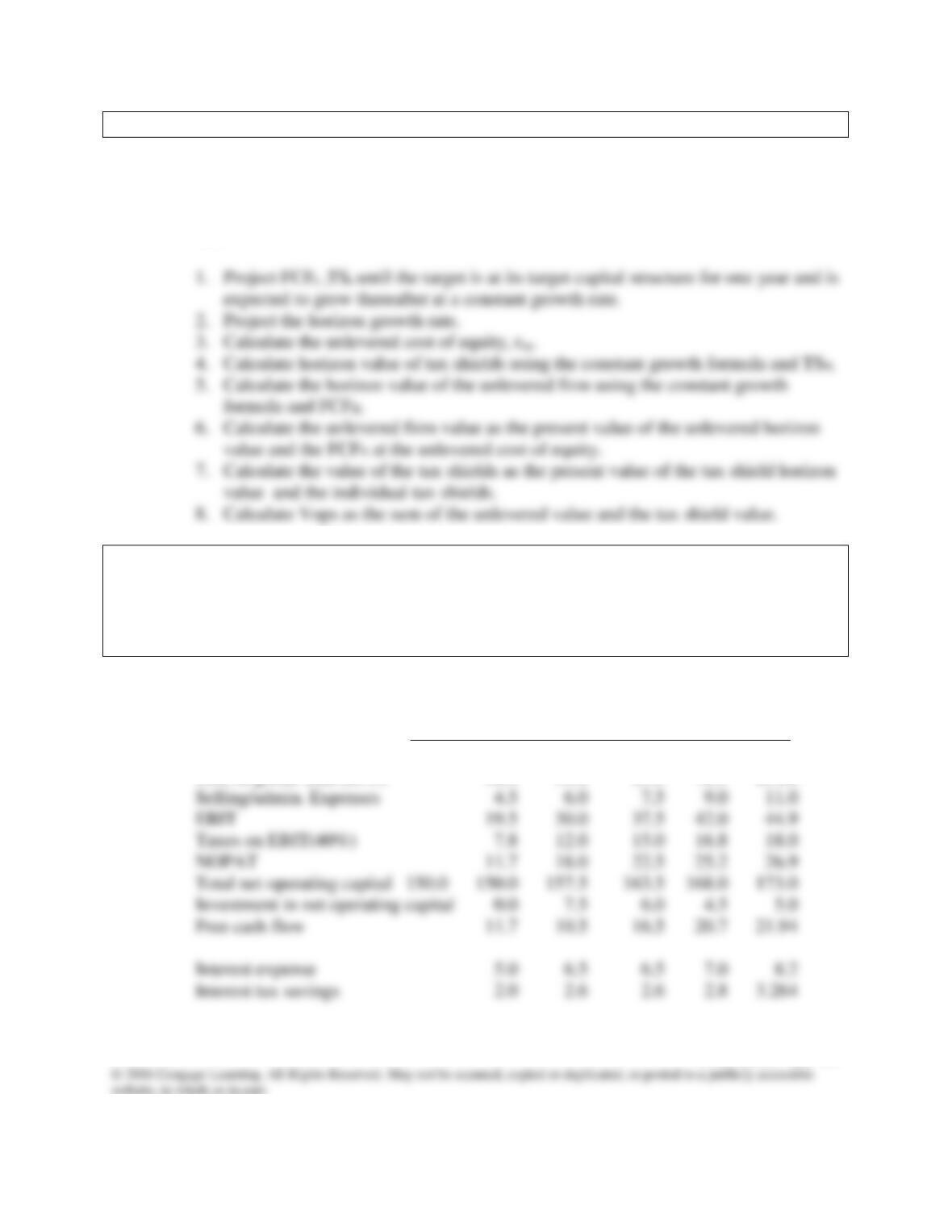
c. What are the steps in valuing a merger?
Answer: When the capital structure is changing rapidly, as in many mergers, the WACC changes
from year–to–year and it is difficult to apply the corporate valuation model in these
cases. The APV model works better when the capital structure is changing. The steps
are:
d. Use the data developed in the table to construct the L division’s free cash flows for
2016 through 2020. Why are we identifying interest expense separately since it is
not normally included in calculating free cash flow or in a capital budgeting cash
flow analysis? Why is investment in net operating capital included when
calculating free cash flow?
Answer: The easiest approach here is to calculate the free cash flows for the L division,
assuming that the acquisition is made (in millions of dollars).
2015 2016 2017 2018 2019 2020
Net sales $60.0 $90.0 $112.5 $127.5 $139.70
Cost of goods sold (60%) 36.0 54.0 67.5 76.5 83.80
Mini Case: 26- 21
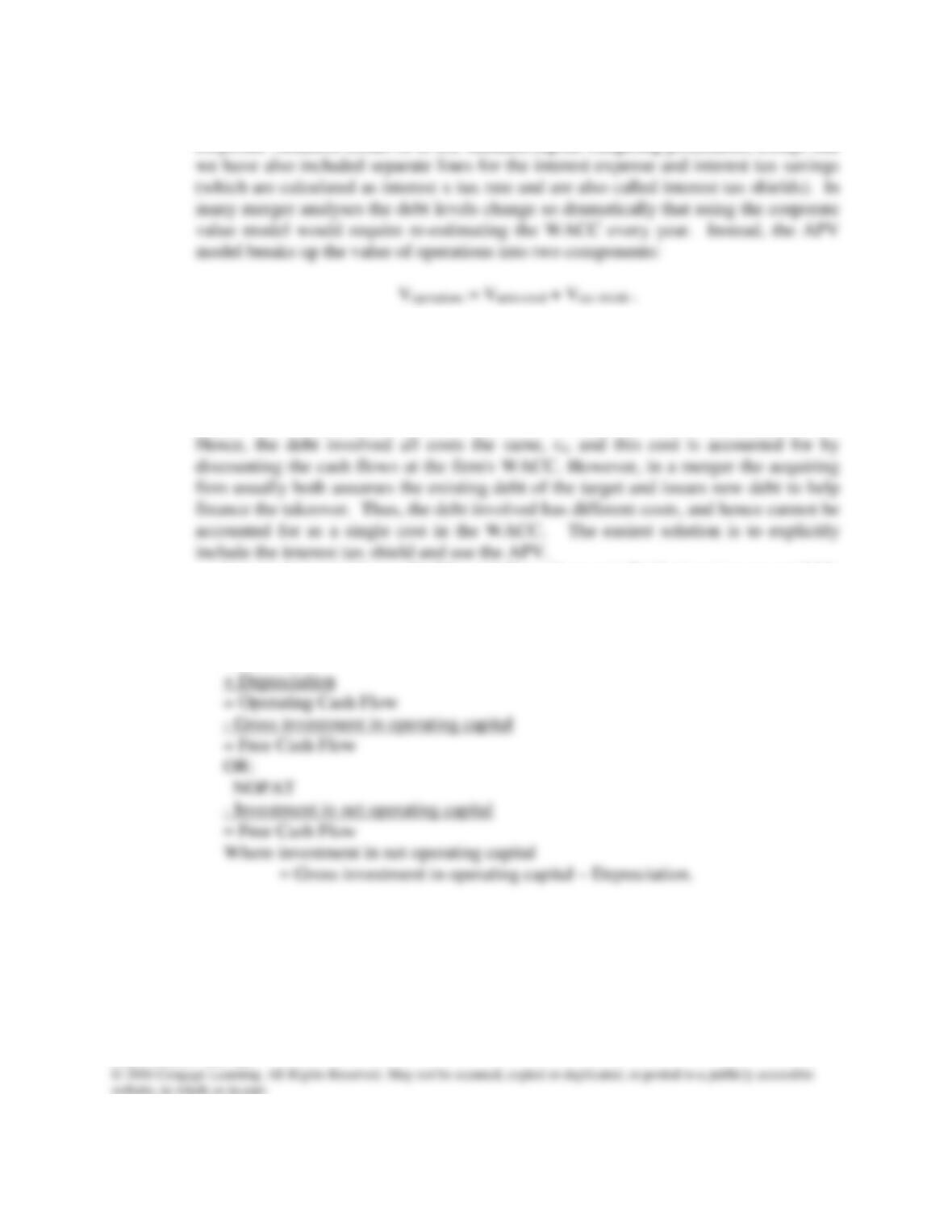
Note that these free cash flows are identical to what you would construct to use the
corporate valuation model or to use standard capital budgeting procedures, except that
The free cash flows and interest tax savings are discounted separately at the unlevered
cost of equity. This is more convenient to use than the corporate value model because
the unlevered cost of equity can be used even when the capital structure is changing.
Also, in straight capital budgeting and the simplest application of the corporate
value model all debt involved is new debt, which is issued to fund the asset additions.
In regards to retentions, all of the cash flows from an individual project are available
for use throughout the firm, since capital expenditures are explicitly accounted for.
Similarly, we account for capital expenditures within the acquired firm when we
calculate free cash flow. There are two equivalent ways to calculate free cash flow:
NOPAT
Mini Case: 26- 22
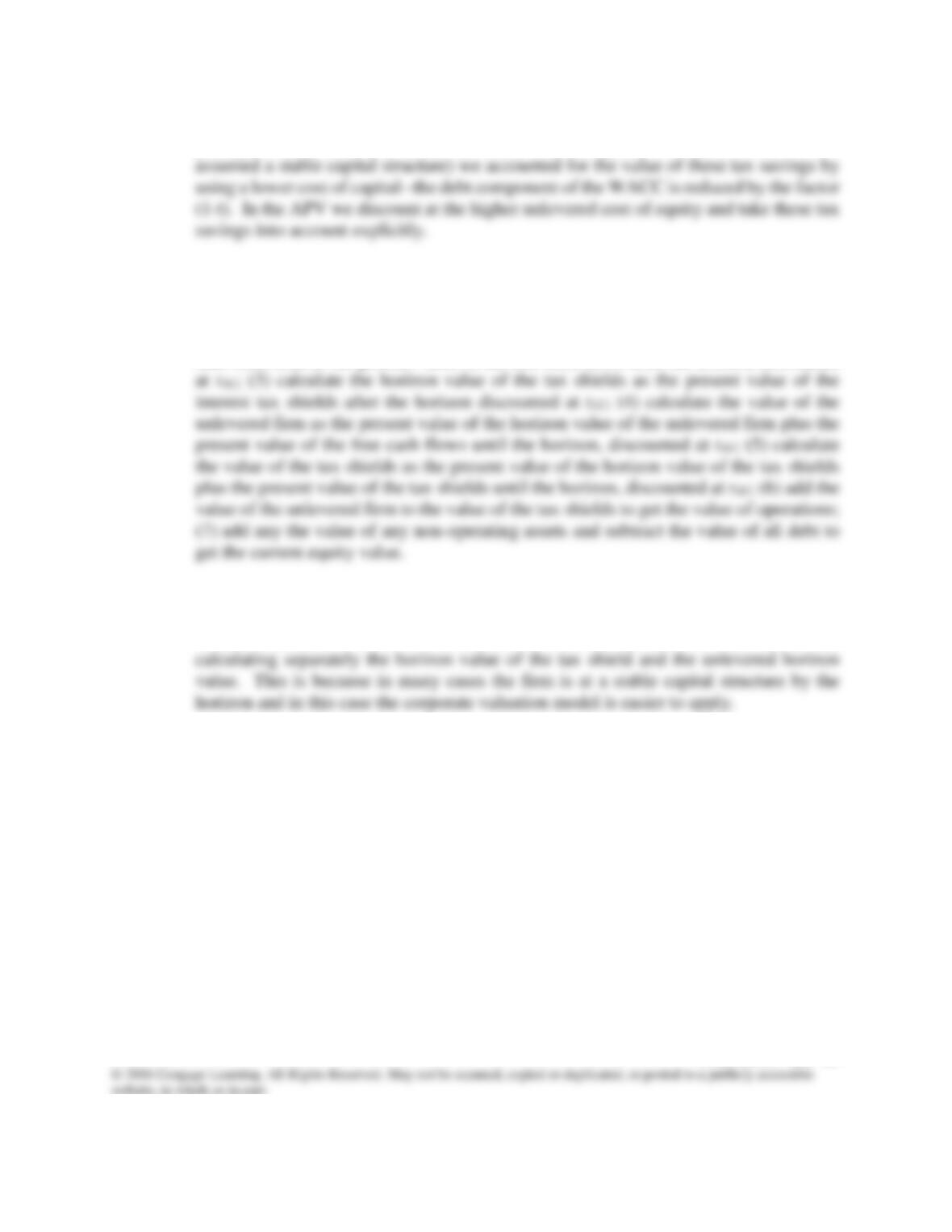
The interest tax savings are cash flows that are also available to pay interest,
principal, or for other use within the firm. In the corporate valuation model (which
The steps to apply the APV model are:
(1) Calculate the unlevered cost of equity, rsU, using the pre-merger levered cost of
equity and the pre–merger capital structure; (2) calculate the horizon value of the
unlevered firm as the present value of the free cash flows after the horizon discounted
Note that the Extension to this chapter discusses how the final interest expense
projections are made and shows that in many cases, and in this case, the corporate
valuation model can be used at the horizon to calculate the horizon value rather than
Mini Case: 26- 23

e. Conceptually, what is the appropriate discount rate to apply to the cash flows
developed in part c? What is your actual estimate of this discount rate?
Answer: As discussed above, the free cash flows, tax shields and horizon value should all be
discounted at the unlevered cost of equity. This cost should be calculated based on the
f. What is the estimated horizon, or continuing, value of the acquisition; that is, what
is the estimated value of the L division’s cash flows beyond 2020? What is Lyons’
value to Hager’s shareholders? Suppose another firm were evaluating Lyons’ as
an acquisition candidate. Would they obtain the same value? Explain.
Answer: The 2020 cash flow is $20.7 million, and it is expected to grow at a 6 percent constant
growth rate in 2020 and beyond. We will find the unlevered horizon value and the
horizon value of the tax shields:
Mini Case: 26- 24
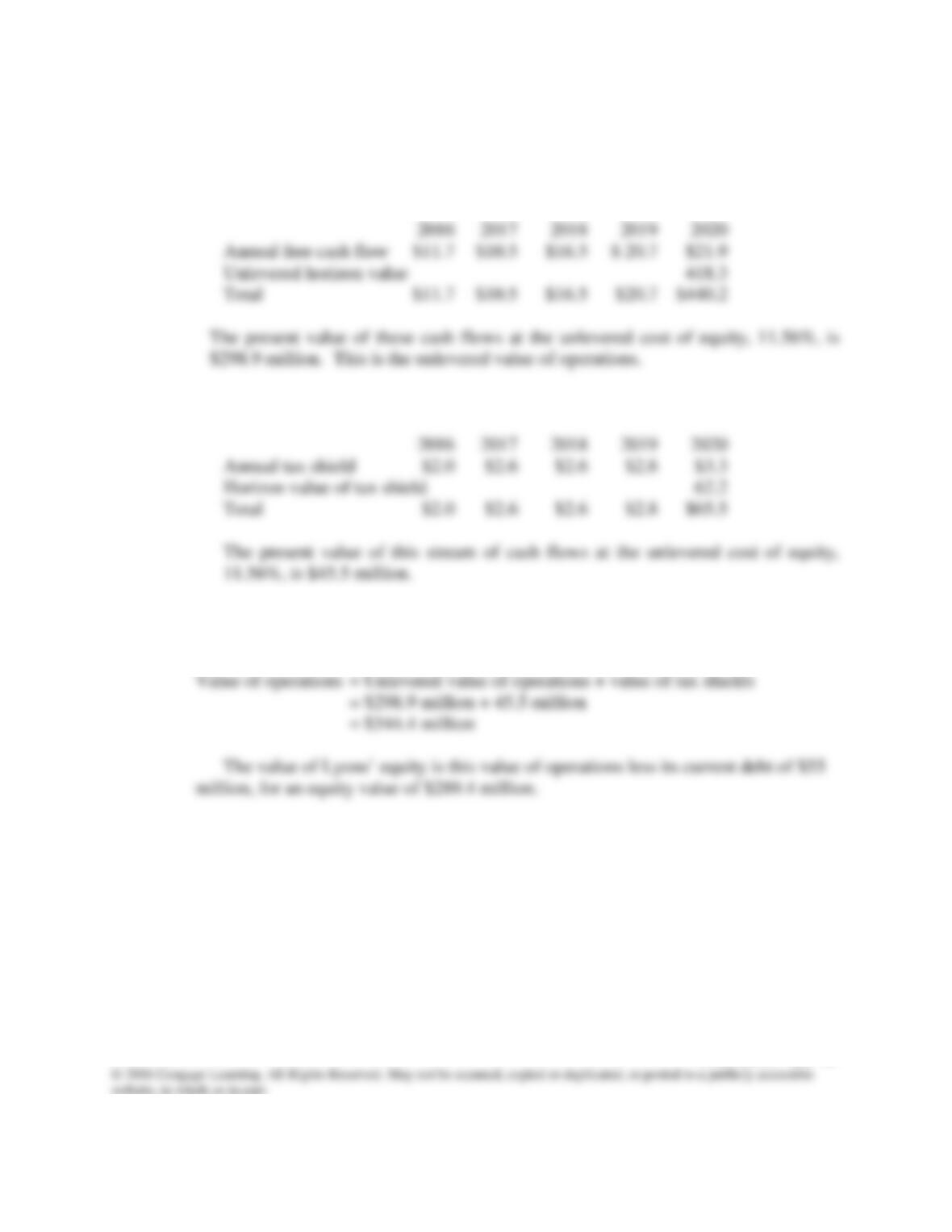
To calculate the unlevered value of the firm, find the present value of the unlevered
horizon value and the free cash flows at the unlevered cost of equity (in millions of
dollars):
The value of the interest tax shields is calculated similarly:
Now, the value of Lyons’ operations is the sum of the unlevered value and the value
of the tax shields:
If another firm were valuing Lyons’, they would probably obtain an estimate
different from $289.4 million. Most important, the synergies involved would likely be
different, and hence the cash flow estimates would differ. Also, another potential
acquirer might use different financing, or have a different tax rate, and hence estimate
a different discount rate at the horizon and have different interest tax shields.
Mini Case: 26- 25
g. Assume that Lyons’ has 20 million shares outstanding. These shares are traded
relatively infrequently, but the last trade, made several weeks ago, was at a price
of $11 per share. Should Hager’s make an offer for Lyons’? If so, how much
should it offer per share?
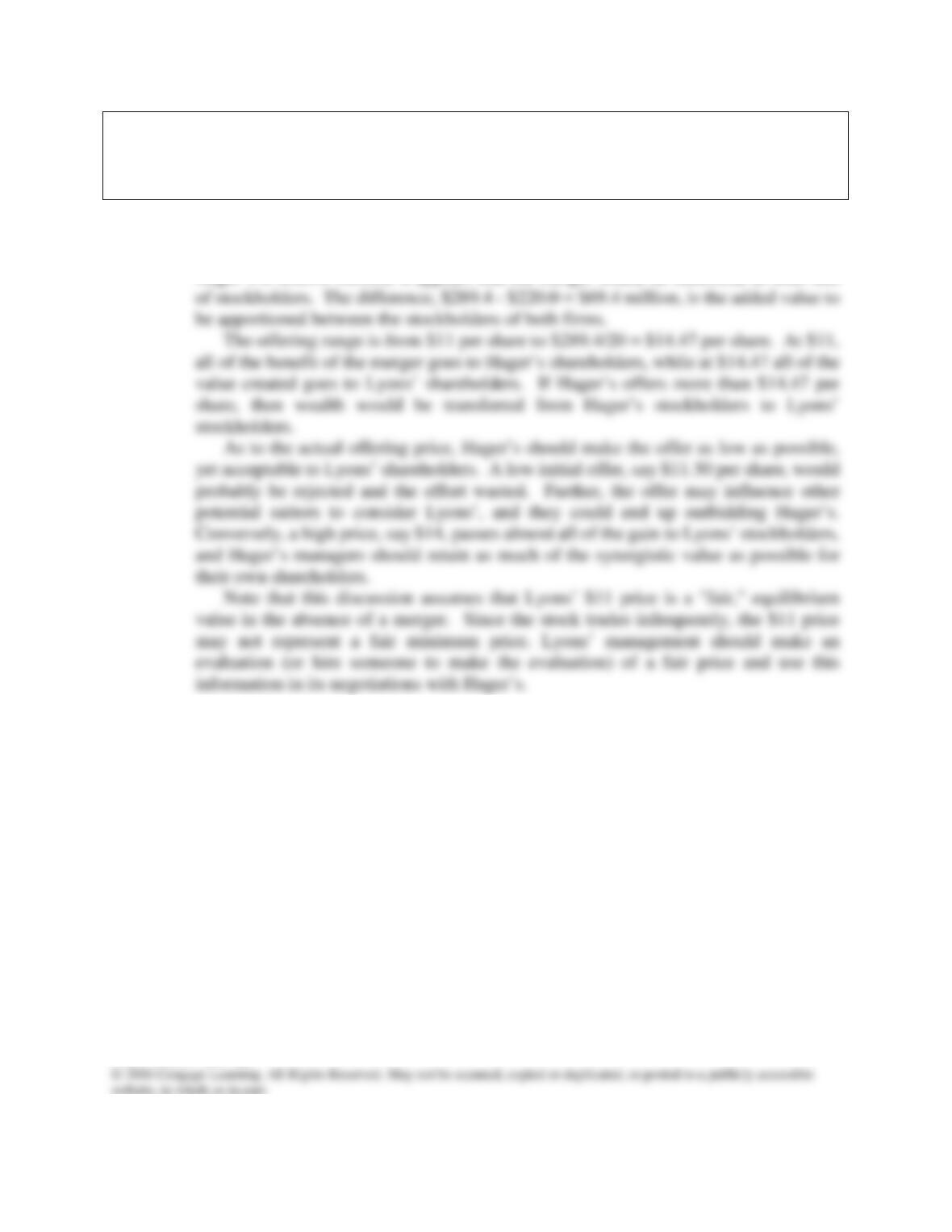
Answer: With a current price of $11 per share and 20 million shares outstanding, Lyons’
current market value is $11(20) = $220 million. Since Lyons’ expected value to
Hager’s is $289.4 million, it appears that the merger would be beneficial to both sets
Mini Case: 26- 26
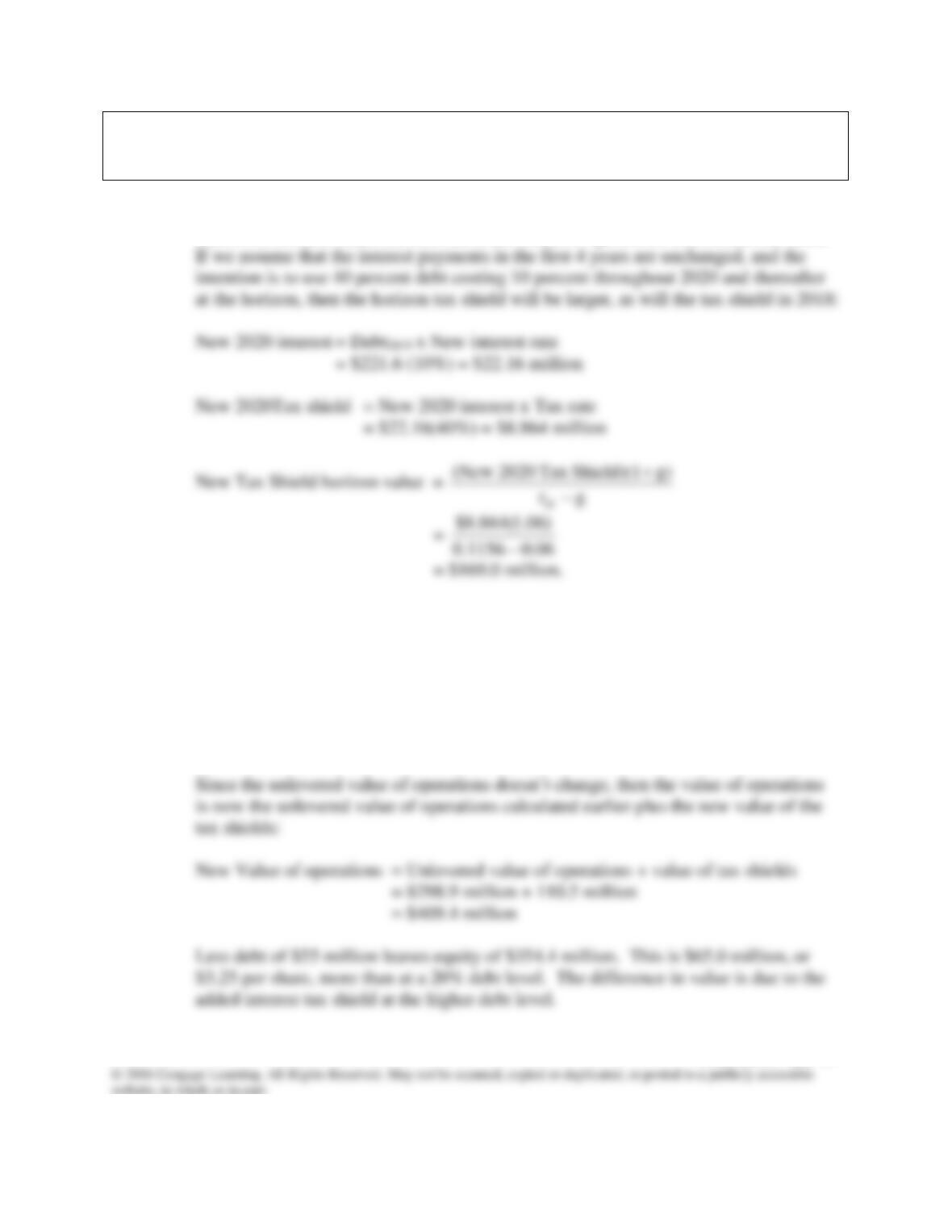
h. How would the analysis be different if Hager’s intended to recapitalize Lyons’
with 40% debt costing 10% at the end of four years? This amounts to $221.6
million in debt as of the end of 2019.
Answer: The free cash flows and the unlevered cost of equity would be unchanged. Thus the
unlevered horizon value and the unlevered value of operations will remain the same.
2016 2017 2018 2019 2020
Annual tax shield $2.0 $2.6 $2.6 $2.8 $3.3
Horizon value of tax shield 169.0
Total $2.0 $2.6 $2.6 $2.8 $177.9
The present value of this stream of cash flows at the unlevered cost of equity,
11.56%, is $110.5 million.
Mini Case: 26- 27
i. There has been considerable research undertaken to determine whether mergers
really create value and, if so, how this value is shared between the parties involved.
What are the results of this research?
Answer: Most researchers agree that takeovers increase the wealth of the shareholders of
target firms, for otherwise they would not agree to the offer. However, there is a debate
j. What method is used to account for mergers?
Answer: Mergers must be accounted for using purchase accounting, in which the acquired
k. What merger–related activities are undertaken by investment bankers?
Answer: The investment banking community is involved with mergers in a number of ways.
Mini Case: 26- 28
l. What are the major types of divestitures? What motivates firms to divest assets?
Answer: The three primary types of divestitures are (1) the sale of an operating unit to
another firm, (2) setting up the business to be divested as a separate corporation and
m. What are holding companies? What are their advantages and disadvantages?
Answer: Holding companies are corporations formed for the sole purpose of owning the
Mini Case: 26- 29