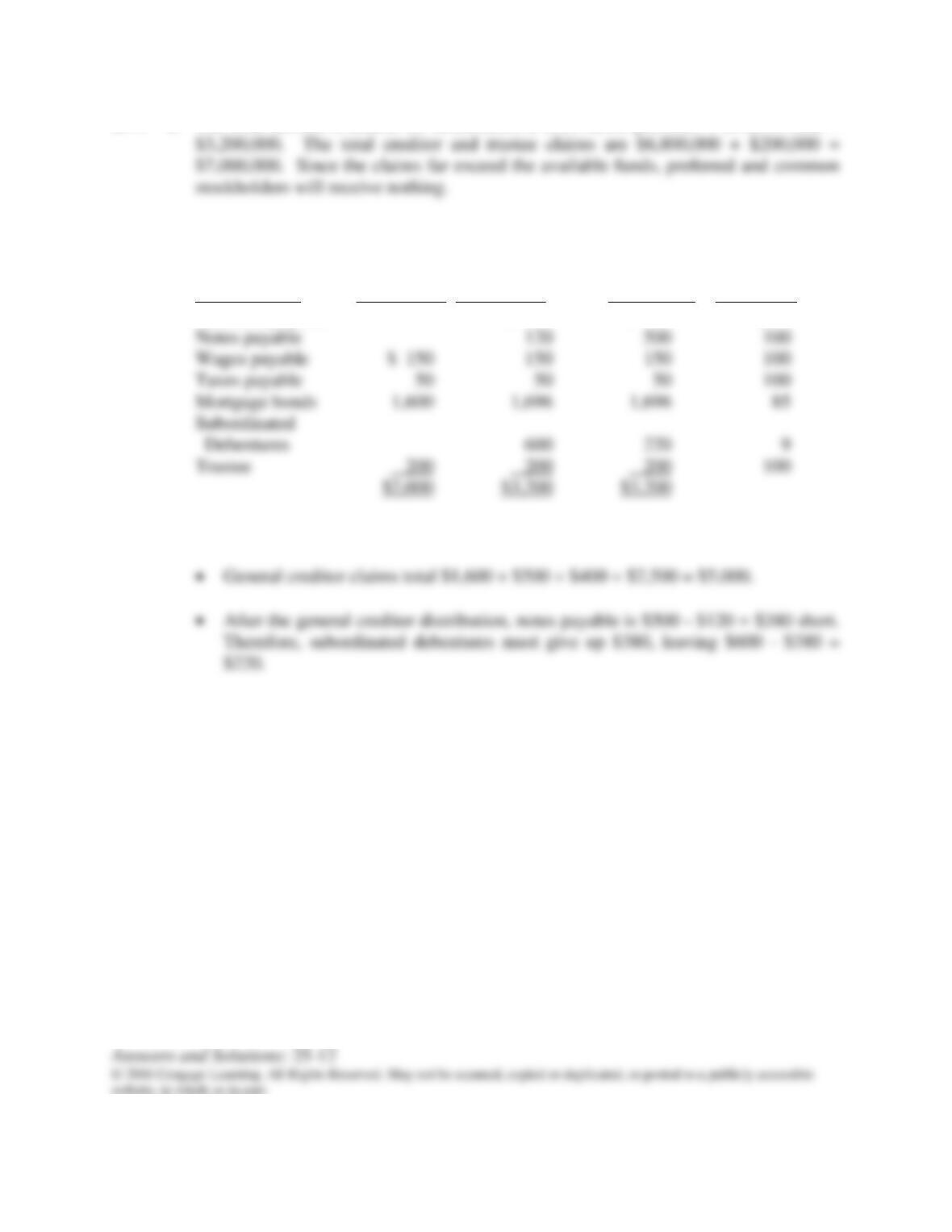
25-4 a. The total amount available for distribution is $3,190,000 proceeds + $10,000 cash =
b. The following table shows the liquidation distribution (in thousands of dollars):
Priority Creditor Subordination
Claimant Distribution Distribution Adjustment Percentage
Accounts payable $ 384 $ 384 24%
• Funds remaining after the priority distribution = $3,200 – $2,000 = $1,200.

SOLUTION TO SPREADSHEET PROBLEM
25-5 The detailed solution for the spreadsheet problem, Ch25 P05Build a Model Solution.xls,
is available on the textbook’s Web site.
Answers and Solutions: 25-13

MINI CASE
Kimberly MacKenzie, president of Kim’s Clothes Inc., a medium–sized manufacturer of
women’s casual clothing, is worried. Her firm has been selling clothes to Russ Brothers
department store for more than ten years, and she has never experienced any problems in
collecting payment for the merchandise sold. Currently, Russ Brothers owes Kim’s Clothes
$65,000 for spring sportswear that was delivered to the store just two weeks ago. Kim’s
concern was brought about by an article that appeared in yesterday’s Wall Street Journal
that indicated that Russ Brothers was having serious financial problems. Further, the
article stated that Russ Brothers‘ management was considering filing for reorganization, or
even liquidation, with a federal bankruptcy court.
Kim’s immediate concern was whether or not her firm would collect its receivables if
Russ Brothers went bankrupt. In pondering the situation, Kim also realized that she knew
nothing about the process that firms go through when they encounter severe financial
distress. To learn more about bankruptcy, reorganization, and liquidation, Kim asked Ron
Mitchell, the firm’s chief financial officer, to prepare a briefing on the subject for the entire
board of directors. In turn, Ron asked you, a newly hired financial analyst, to do the
groundwork for the briefing by answering the following questions:
a. 1. What are the major causes of business failure?
Answer: The major causes of business failure consist of economic factors, such as industry
a. 2. Do business failures occur evenly over time?
Answer: A fairly large number of businesses fail each year, but the number in any one year
a. 3. Which size of firm, large or small, is more prone to business failure? Why?
Answer: Bankruptcy is more frequent among smaller firms. While bankruptcy does occur in
Mini Case: 25 – 14
b. What key issues must managers face in the financial distress process?
Answer: As a manager begins to face financial distress, he or she must begin to consider the
following key issues:
c. What informal remedies are available to firms in financial distress? In
answering this question, define the following terms: (1) workout, (2)
restructuring, (3) extension, (4) composition, (5) assignment, and (6) assignee
(trustee).
Answer: When faced with financial distress, it is often desirable for firms to pursue informal
reorganizations or liquidations with creditors, given the costs associated with legal
bankruptcy. Creditors generally prefer informal reorganization plans when dealing
Mini Case: 24 – 15
d. Briefly describe U.S. Bankruptcy Law, including the following terms:
(1) chapter 11, (2) chapter 7, (3) trustee, (4) voluntary bankruptcy, and (5)
involuntary bankruptcy.
Answer: U. S. Bankruptcy laws were first enacted in 1898 to ensure that businesses worth
more as ongoing concerns were not shut down by individual creditors desiring
Mini Case: 25 – 16
e. What are the major differences between an informal reorganization and
reorganization in bankruptcy? In answering this question, be sure to discuss the
following items: (1) common pool problem, (2) holdout problem, (3) automatic
stay, (4) cramdown, and (5) fraudulent conveyance.
Answer: There are many differences between voluntary reorganizations and reorganizations in
bankruptcy. Voluntary reorganizations are far less costly and relatively simple to
While bankruptcy gives the firm a chance to work out its problems without the
threat of creditor foreclosure, it does not give the debtor free reign over the firm’s
assets. First, bankruptcy law gives creditors the right to petition the bankruptcy court
to block almost any action the firm might take while in bankruptcy. Second,
Mini Case: 24 – 17
f. What is a prepackaged bankruptcy? Why have prepackaged bankruptcies
become more popular in recent years?
Answer: Prepackaged bankruptcy is a relatively new type of reorganization which is a hybrid—
Mini Case: 25 – 18
g. Briefly describe the priority of claims in a Chapter 7 liquidation.
Answer: Chapter 7 of the federal bankruptcy reform act provides for an equitable distribution
of the debtor’s assets among the creditors. The distribution of assets is governed by
the following priority of claims:
• Secured creditors (who are entitled to the proceeds of the sale of specific property
pledged for a lien or a mortgage).
• Unsecured claims for customer deposits.
• Taxes due to federal, state, county, and any other government agency.
Mini Case: 24 – 19

h. Assume that Russ Brothers did indeed fail, and that it had the following balance
sheet when it was liquidated (in millions of dollars):
Current assets $40.0 Accounts payable $10.0
Net fixed assets 5.0 Notes payable (to banks) 5.0
Accrued wages 0.3
Federal taxes 0.5
State and local taxes 0.2
Current liabilities $16.0
First mortgage $ 3.0
Second mortgage 0.5
Subordinated debenturesa 4.0
Total long-term debt $ 7.5
Preferred stock 1.0
Common stock 13.0
Paid-in capital 2.0
Retained earnings 5.5
Total equity $21.5
Total assets $45.0 Total claims $45.0
Athe debentures are subordinated to the notes payable.
The liquidation sales resulted in the following proceeds:
From sale of current assets $14,000,000
From sale of fixed assets 2,500,000
Total receipts $16,500,000
For simplicity, assume that there were no trustee’s fees or any other claims
against the liquidation proceeds. Also, assume that the mortgage bonds are
secured by the entire amount of fixed assets. What would each claimant receive
from the liquidation distribution?
Mini Case: 25 – 20
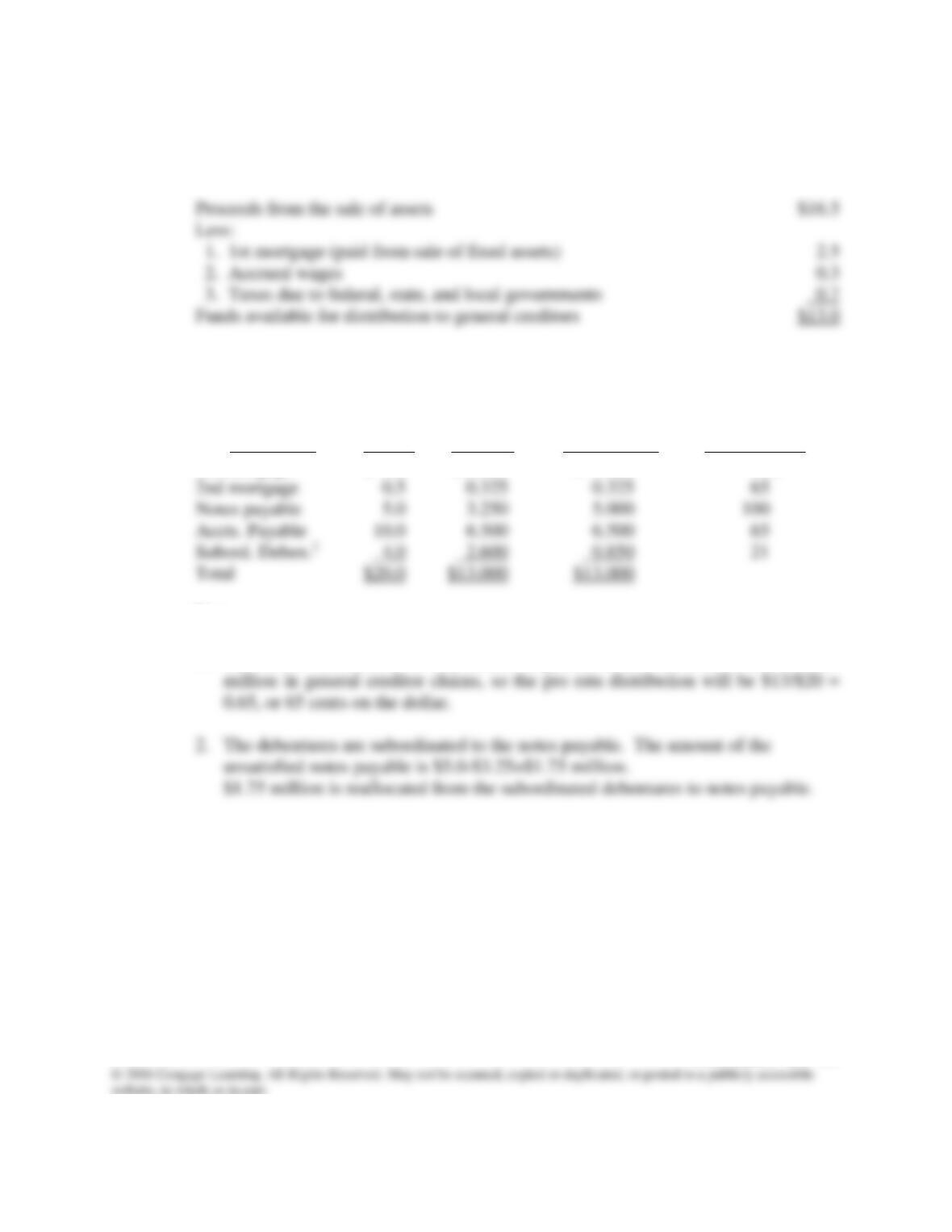
Answer: The following table shows the liquidation distribution (millions of dollars):
Distribution to Priority Claimants
(in millions)
Distribution to General Creditors
Distribution Percentage
Gen’l creditor Amt. Of pro rata after subord. Original claim
claims claim distrib.1 adjustment received
1st mortgage $ 0.5 $ 0.325 $ 0.325 94%
Notes:
1. $13 million is available for distribution to general creditors; however, there is $20
Mini Case: 24 – 21