Chapter 25
Bankruptcy, Reorganization, and Liquidation
ANSWERS TO BEGINNING-OF–CHAPTER QUESTIONS
25-1 Bankruptcies occur in firms of all sizes. Small firms, with fewer creditors, are often able
to work out informal settlements and thus avoid the time and expense of formal
bankruptcy. Ross Corporation, described in Question 3, is probably too large, and it has
25-2 The judge in a federal bankruptcy proceeding can abrogate all contracts, including labor
contracts. If a contract requires payments greater than the company’s cash flows can
25-3 a. As noted above, is probably too large, and it has too many creditors, to work out an
informal settlement. For a company this large and complex, the federal bankruptcy
system will almost certainly have to be used.
b. The two key chapters are Chapter 11, which spells out how a company can be
reorganized and thus allowed to continue in existence, and Chapter 7, which spells
out the procedures for liquidation.
c. Management generally initiates bankruptcy proceedings. One of its creditors whose
Answers and Solutions: 25-1
e. The “common pool problem” refers to a situation where creditors are owed more than
the value of the firm’s assets. Here each individual creditor might try to collect what
was owed to him or her quickly, knowing that there was not enough to satisfy all
creditors. It might be that the company would be worth more, hence creditors in total
would receive more, if the firm were reorganized, but if one creditor seized some vital
property, the company might be put out of business and forced to liquidate. In this
situation, all the creditors would, in self-defense if for no other reason, be quick to try
to get their money out, which would shut down the debtor firm. The Bankruptcy Act
g. A “pre–pack” is a pre-packaged bankruptcy reorganization plan. Here a plan is
worked out between management and the major creditors prior to filing for Chapter
11 protection. Pre-packs are most feasible under either of two conditions: (1) The
firm is fundamentally sound and is merely experiencing a temporary liquidity
problem, or (2) there are relatively few creditors, as that makes it easier to conduct
negotiations. In a pre-pack (and also in other reorganization plans), smaller claims are
generally paid off in full to avoid administrative hassles. The judge could, of course,
cram down a pre-pack.
h. The term “cramdown” refers to the situation where the bankruptcy judge forces
various claimants to accept terms that they do not like and vote against, i.e., the judge
crams the plan down the throats of the various parties. Bankruptcies are typically
Answers and Solutions: 25-2
stockholders) is based on assumptions about sales, costs, and so forth, and those
predictions are far from certain. Moreover, the reorganization plan probably requires
debtholders to accept securities in the reorganized firm, and perhaps some creditors
will be required to accept common stock rather than debt. In such a situation, some
i. The following is the specified priority ranking of claimants to a company’s assets in
the event of bankruptcy:
• Past due property tax liens
• Secured creditors up to the value of their collateral. Different secured creditors may
be secured by different assets.
In a liquidation, the assets are sold off and the available funds are then distributed. If
they are distributed in strict accordance with the above priority rankings, then this is
in accordance with absolute priority doctrine. The relative priority doctrine refers to
the situation where the bankruptcy judge determines that a company’s value would be
Answers and Solutions: 25-3
would occur more often.
j. If the assets were sold at auction and the company was liquidated, the proceeds would
in all likelihood be distributed in accordance with the absolute priority doctrine as
discussed above, using the previously indicated rankings. Well-secured debtholders
would perhaps be paid in full, and lower ranking claimants would get something only
With the projected FCF and the WACC, the value of the firm can be determined as
the PV of the FCFs. The estimated value must then be apportioned among the
claimants. Generally, each secured creditor would be left whole, provided the
appraised value of their specific collateral is equal to or greater than the face amount
of the secured debt. However, some or all secured creditors might have to take debt in
ANSWERS TO END-OF-CHAPTER QUESTIONS
25-1 a. Informal debt restructuring is the agreement between the creditors and troubled firm
to change the existing debt terms. An extension postpones the required payment date,
while a composition is a reduction in creditor claims. Extension provides payment in
b. Assignment is an informal procedure for liquidating debts which transfers title to a
debtor’s assets to a third person, known as an assignee or trustee. Assignment
normally yields creditors a larger amount than they would receive in a formal
bankruptcy. However, an assignment does not automatically result in a full and legal
discharge of all the debtor’s liabilities, nor does it protect the creditors against fraud.
c. The absolute priority doctrine states that claims must be paid in strict accordance with
the priority of each claim, regardless of the consequence to other claimants. The
Answers and Solutions: 25-5
d. The Bankruptcy Reform Act of 1978 was enacted to speed up and streamline
bankruptcy proceedings. This law represents a shift to a relative priority doctrine of
creditors’ claims. Chapter 11 of the Bankruptcy Act is the business reorganization
chapter. Under this chapter, a case is started when a firm‘s management or its
e. The priority of claims in liquidation is established in Chapter 7 of the Bankruptcy Act
to provide an equitable distribution of the debtor’s assets among the creditors.
f. Extension and composition are both characteristics of debt restructuring. In an
extension, creditors postpone the dates of required interest or principal payments, or
both. In a composition, creditors voluntarily reduce their fixed claims on the debtor
Answers and Solutions: 25-6
25-2 The rehabilitation plan may be accepted because of the following:
• Expenses of liquidation may consume a large proportion of the assets.
25-3 Not necessarily. The going-concern value of a firm is a function of its outlook—it might
25-4 Liquidations usually result in losses for the following reasons:
• Assets typically have characteristics which make their value in existing uses greater
than when resold.
25-5 Because public utilities and railroads often involve essential services, reorganizations and
mergers rather than liquidations are likely to take place. This is less true for industrial
SOLUTIONS TO END-OF-CHAPTER PROBLEMS
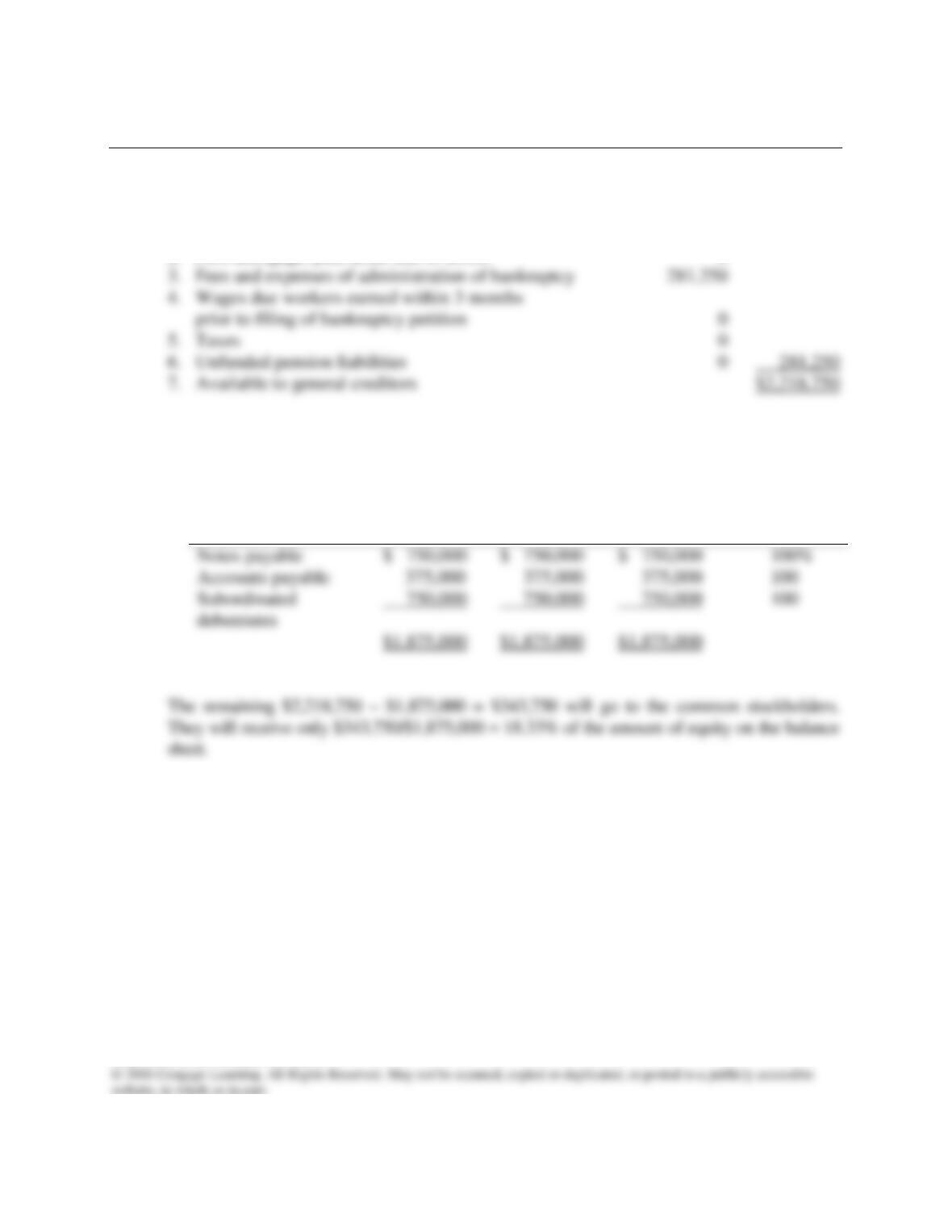
25-1 Distribution of proceeds on liquidation:
1. Proceeds from sale of assets $2,500,000
2. First mortgage, paid from sale of assets 0
Distribution to general creditors:
Claims of General
Creditors
Claim
(1)
Application
of 100%
Distribution
(2)
After
Subordination
Adjustment
(3)
Percentage
of Original
Claims
Received
(4)
Answers and Solutions: 25-8
25-2 a. The pro forma balance sheet follows (in millions of dollars):
Current assets $159a Current liabilities $ 42
Notes:
a$168 less $9 used to retire the $10.50 preferred stock.
b(1.2 million shares)($75 par value) = $90.
c(1.2 million shares)($37.50 par value) = $45.
b. The pro forma income statement (in millions of dollars) follows:
Net sales $540.0
Operating expense 516.0
Net operating income $ 24.0
Notes:
a0.08($90 million par value) = $7.2.
b$2.40(1.2 million shares) = $2.9.
Answers and Solutions: 25-9
c. The earnings required before the recapitalization is $7.8 million/(1 – 0.5) = $15.6
million. We divide the preferred dividends by (1 – T) since $15.6 million must be
d. The debt ratio before reorganization is $120 million/$336 million = 0.357 = 35.7%.
After reorganization the debt ratio is $210 million/$327 million = 0.642 = 64.2%.
25-3 a. Creditor claims total $1,100,000 while the trustee has an additional $50,000 in claims,
yet the liquidation produced only $600,000 in proceeds. Since the proceeds are
insufficient to satisfy the creditor and trustee claims, the shareholders receive nothing.
b. The mortgage bondholders have priority claim against the proceeds from the sale of
pledged property. Thus, the $400,000 from the fixed assets must first be distributed
c. The priority claimants are the mortgage bondholders, trustee, workers, and
government. The remaining claimants are general creditors. There is $200,000
d. Of the total $600,000 received from the liquidation, $520,000 has been distributed to
priority claimants. This leaves $80,000 to distribute to the general creditors. But the
general creditor claims total $630,000:
Account Claim
Accounts payable $ 50,000
Account Amount Received
Accounts payable $ 6,350
Notes payable 22,860
Answers and Solutions: 25-11