FM16 Ch25 Mini Case Mini Case
11/23/2018
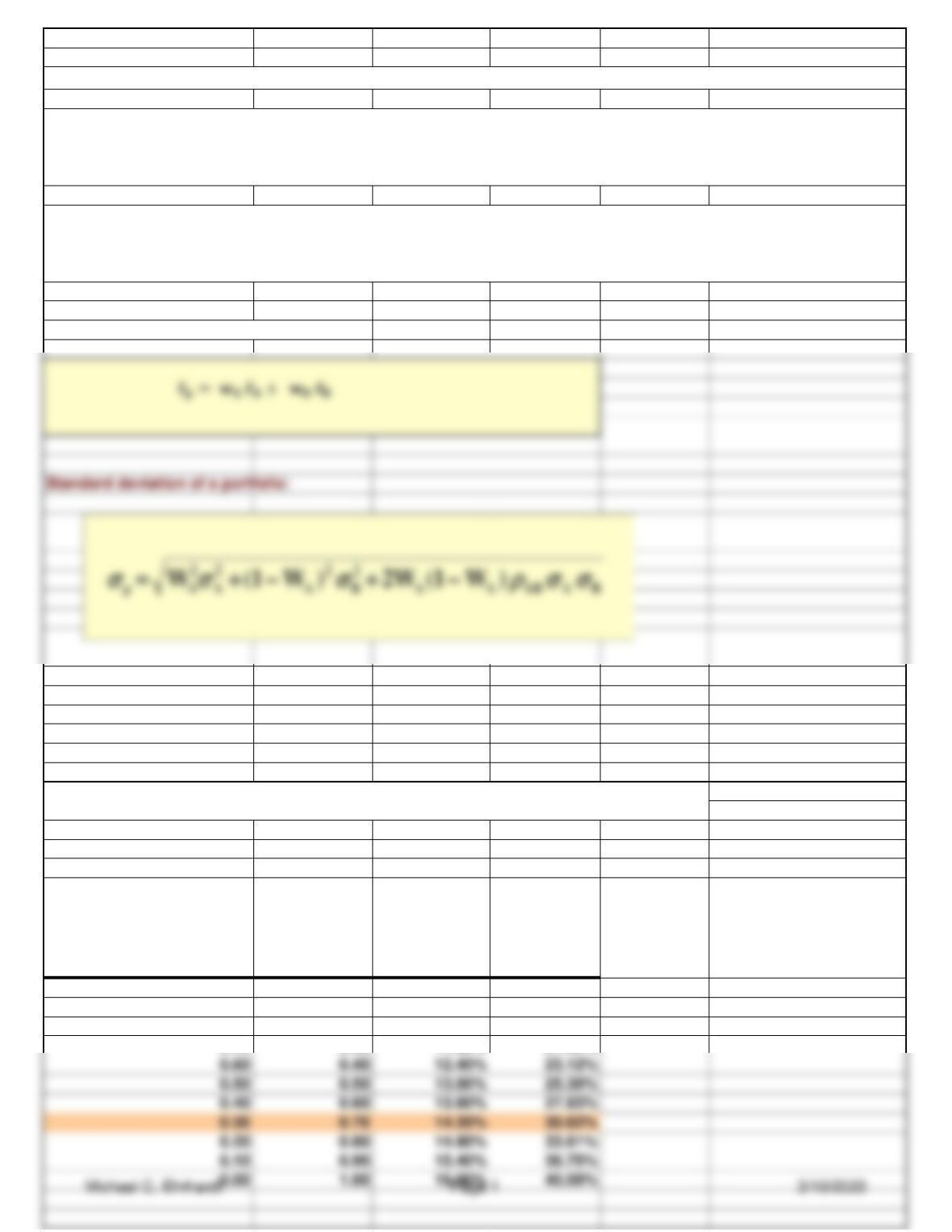
Expected return of a portfolio:
Asset A Asset B
Expected return, r hat 10% 16%
Standard deviation, s20% 40%
Correlation = 0.35
Proportion of Portfolio in
Security A
(Value of wA)
Proportion of
Portfolio in
Security B
(Value of 1-wA)
rpsp
1.00 0.00 10.00% 20.00%
0.90 0.10 10.60% 19.76%
0.80 0.20 11.20% 20.24%
0.70 0.30 11.80% 21.39%
0.60 0.40 12.40% 23.12%
0.50 0.50 13.00% 25.30%
0.40 0.60 13.60% 27.83%
0.30 0.70 14.20% 30.62%
0.20 0.80 14.80% 33.61%
0.10 0.90 15.40% 36.75%
0.00 1.00 16.00% 40.00%
Chapter 25. Mini Case
a. Suppose Asset A has an expected return of 10 percent and a standard deviation of 20 percent. Asset B has an
expected return of 16 percent and a standard deviation of 40 percent. If the correlation between A and B is 0.35,
what are the expected return and standard deviation for a portfolio comprised of 30 percent Asset A and 70 percent
Asset B?
Using the equations above, we can find the expected return and standard deviation of a
portfolio with different percentages invested in each asset.
You have been hired at the investment firm of Bowers & Noon. One of its clients doesn’t understand the value of
diversification or why stocks with the biggest standard deviations don’t always have the highest expected returns.
Your assignment is to address the client’s concerns by showing the client how to answer the following questions.
Standard deviation of a portfolio:
FM16 Ch25 Mini Case Mini Case
Correlation = 1
Proportion of Portfolio in
Security A
(Value of wA)
Proportion of
Portfolio in
Security B
(Value of 1-wA)
rpsp
1.00 0.00 10.00% 20.00%
0.90 0.10 10.60% 21.59%
0.80 0.20 11.20% 23.32%
Correlation = -1
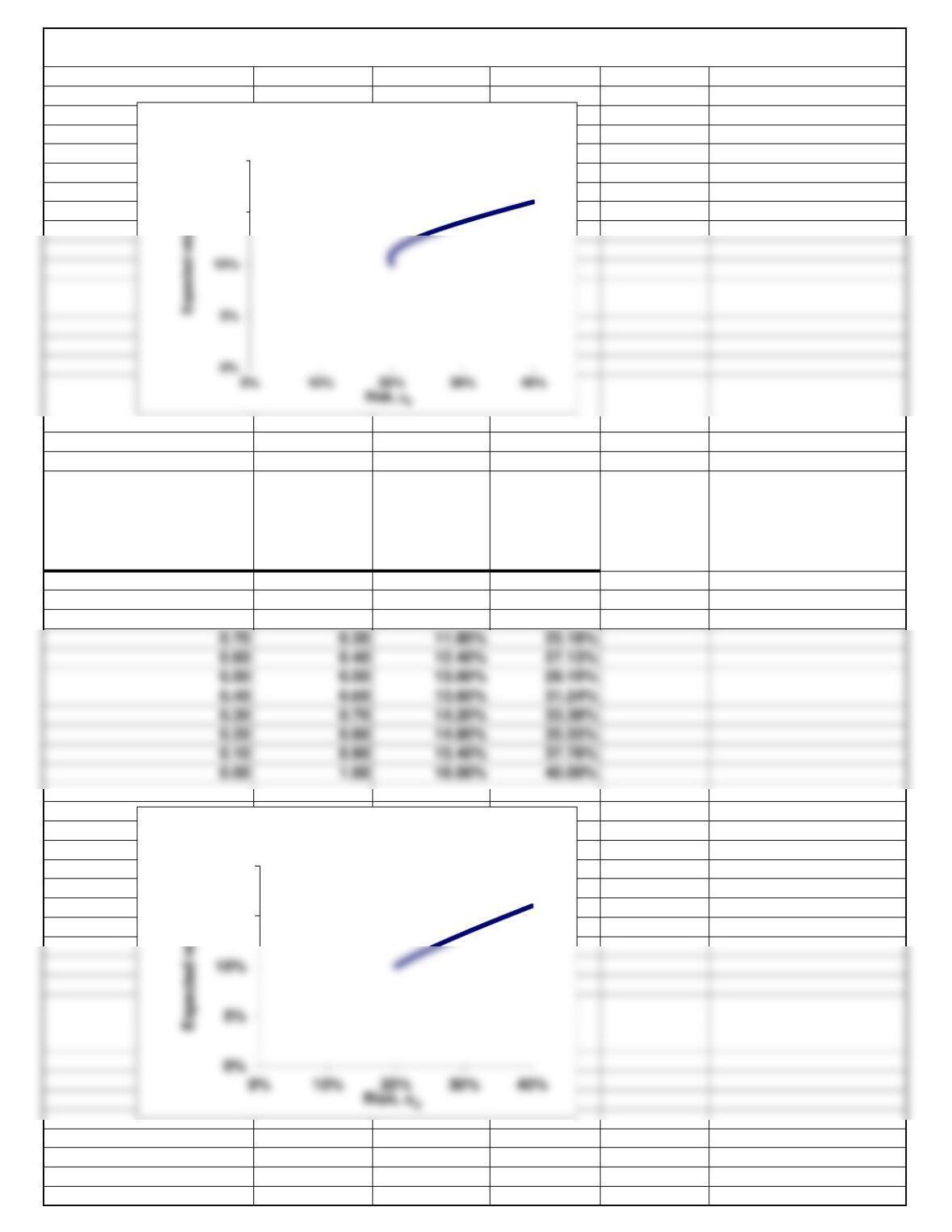
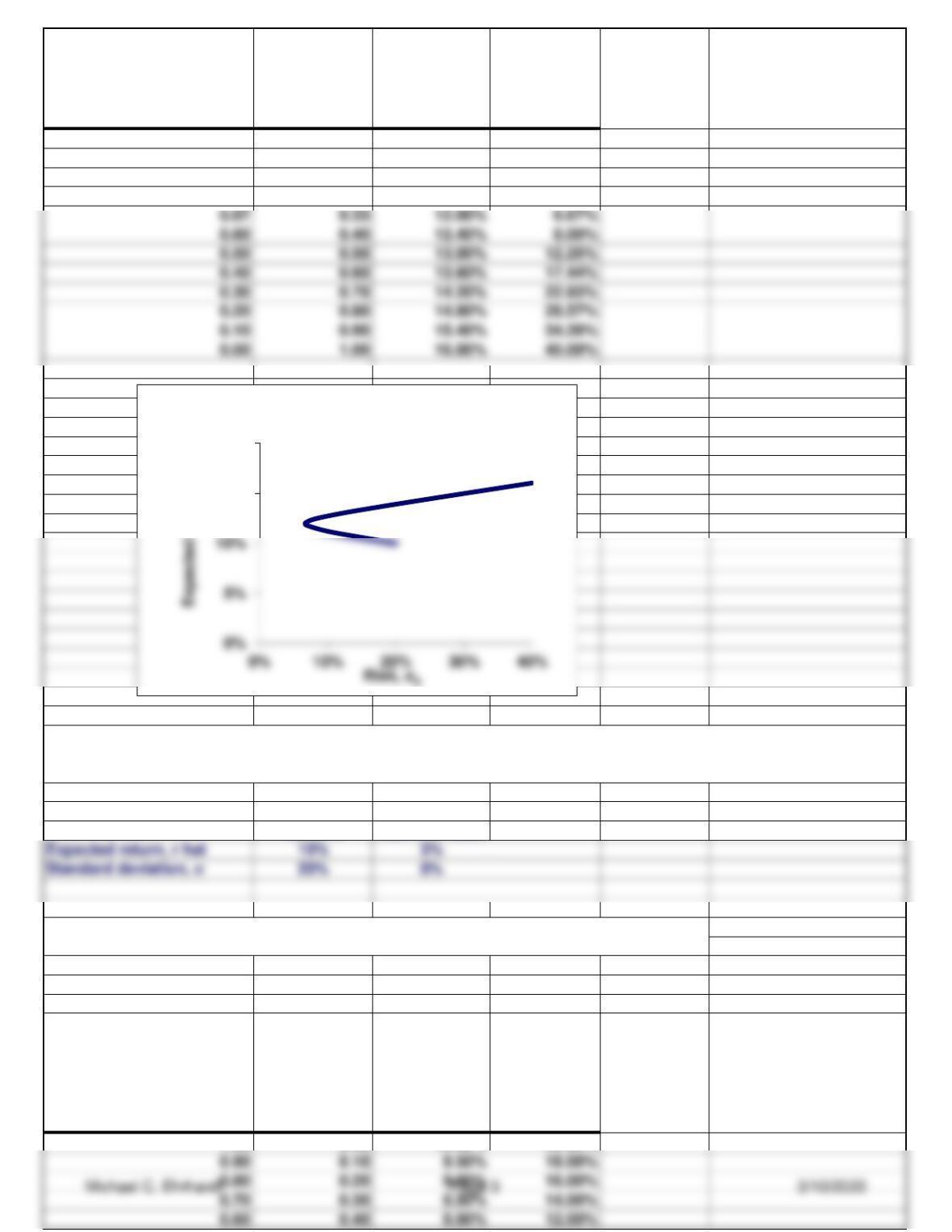
b. Plot the attainable portfolios for a correlation of 0.35. Now plot the attainable portfolios for correlations of +1.0
and -1.0.
15%
20%
AB = +0.35: Attainable Set of Risk/Return
Combinations
15%
20%
AB = +1.0: Attainable Set of Risk/Return
Combinations
Michael C. Ehrhardt Page 2 3/10/2022
0.70 0.30 11.80% 25.18%
0.60 0.40 12.40% 27.13%
0.50 0.50 13.00% 29.15%
0.40 0.60 13.60% 31.24%
0.30 0.70 14.20% 33.38%
0.20 0.80 14.80% 35.55%
0.10 0.90 15.40% 37.76%
0.00 1.00 16.00% 40.00%
FM16 Ch25 Mini Case Mini Case
Proportion of Portfolio in
Security A
(Value of wA)
Proportion of
Portfolio in
Security B
(Value of 1-wA)
rpsp
1.00 0.00 10.00% 20.00%
0.90 0.10 10.60% 14.63%
0.80 0.20 11.20% 9.80%
0.70 0.30 11.80% 6.78%
Asset A Risk-free Asset
Correlation = 0
Proportion of Portfolio in
Security A
(Value of wA)
Proportion of
Portfolio in
Risk-free Asset
(Value of 1-wA)
rpsp
1.00 0.00 10.00% 20.00%
Using the equations above, we can find the expected return and standard deviation of a
portfolio with different percentages invested in each asset.
c. Suppose a risk-free asset has an expected return of 5 percent. By definition, its standard deviation is zero, and
its correlation with any other asset is also zero. Using only Asset A and the risk-free asset, plot the attainable
portfolios.
15%
20%
AB = -1.0: Attainable Set of Risk/Return
Combinations
0.67 0.33 12.00% 6.67%
0.60 0.40 12.40% 8.00%
0.50 0.50 13.00% 12.25%
0.40 0.60 13.60% 17.44%
0.30 0.70 14.20% 22.93%
0.20 0.80 14.80% 28.57%
0.10 0.90 15.40% 34.26%
0.00 1.00 16.00% 40.00%
FEASIBLE AND EFFICIENT PORTFOLIOS
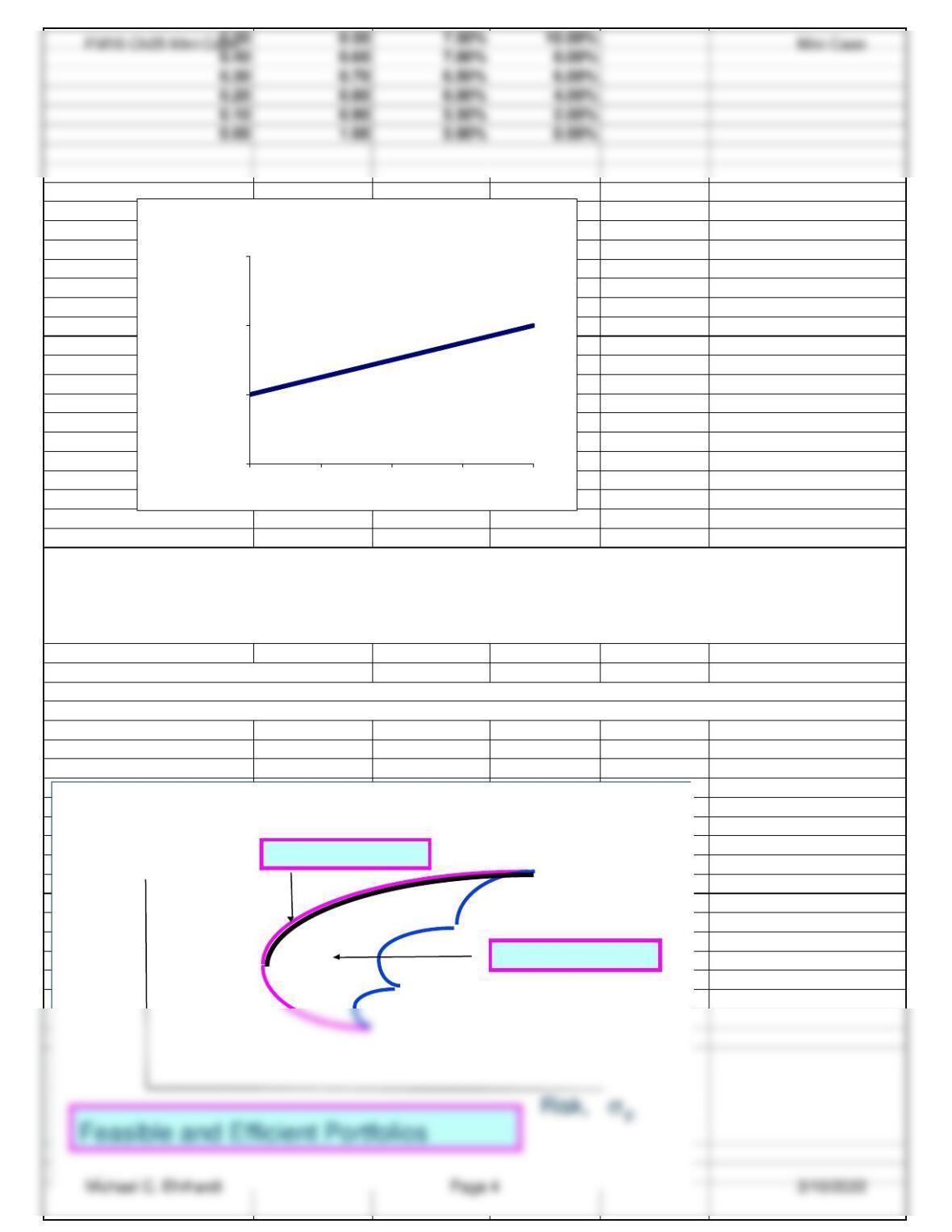
The feasible set of portfolios represent all portfolios that can be constructed from a given set of stocks.
An efficient portfolio is one that offers: the most return for a given amount of risk or the least risk for a
given amount of return.
d. Construct a reasonable, but hypothetical, graph that shows risk, as measured by portfolio standard deviation, on
the X axis and expected rate of return on the Y axis. Now add an illustrative feasible (or attainable) set of portfolios,
and show what portion of the feasible set is efficient. What makes a particular portfolio efficient? Don’t worry about
specific values when constructing the graph-merely illustrate how things look with “reasonable” data.
Expected
Portfolio
Return, r p
Efficient Set
Feasible Set
0%
5%
10%
15%
0% 5% 10% 15% 20%
Expected return
Risk, sp
Attainable Set of Risk/Return Combinations
with Risk-Free Asset
FM16 Ch25 Mini Case Mini Case
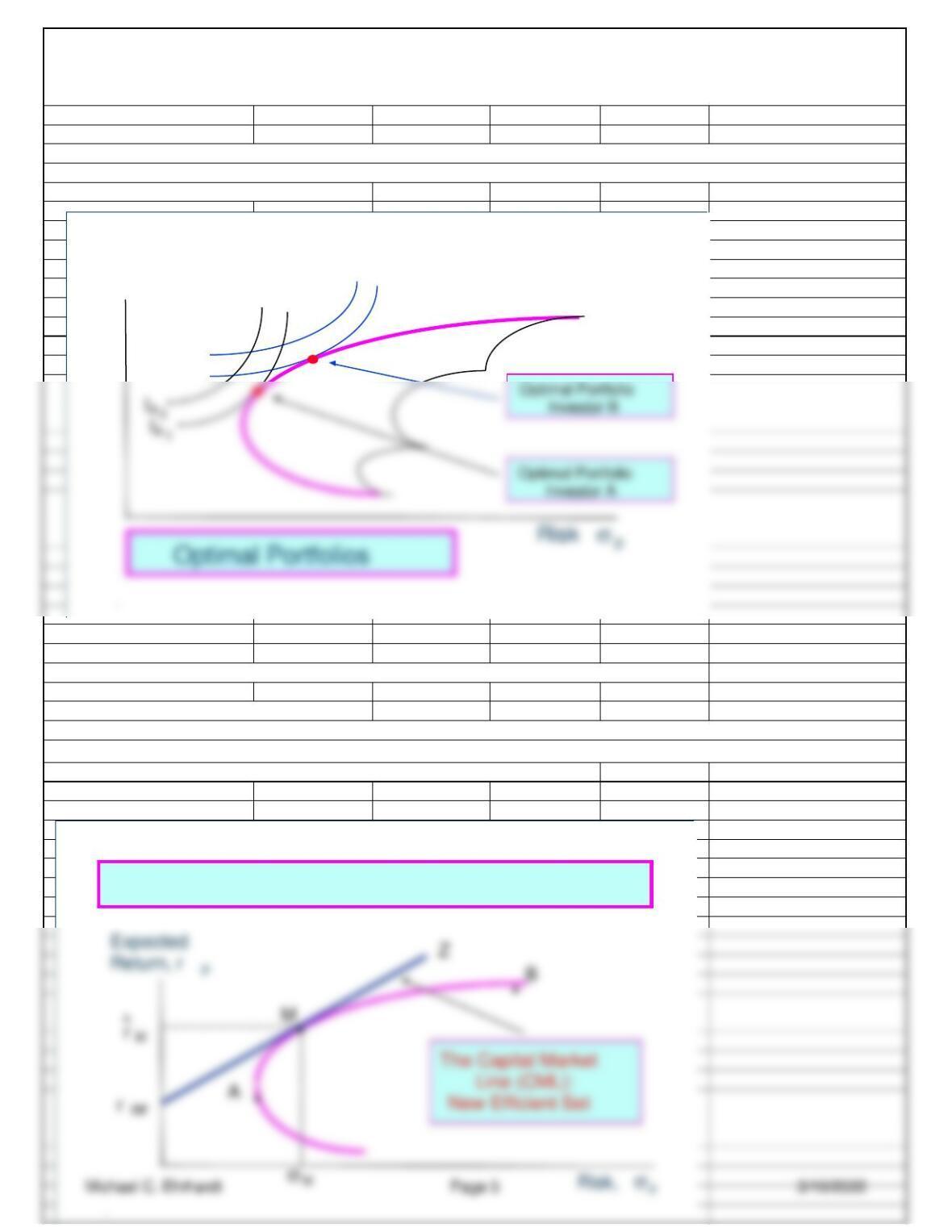
OPTIMAL PORTFOLIOS
An investor’s optimal portfolio is defined by the tangency point between the efficient set and the investor’s
indifference curve. The indifference curve reflect an investor’s attitude toward risk as reflected in his or
her risk/return trade off function.
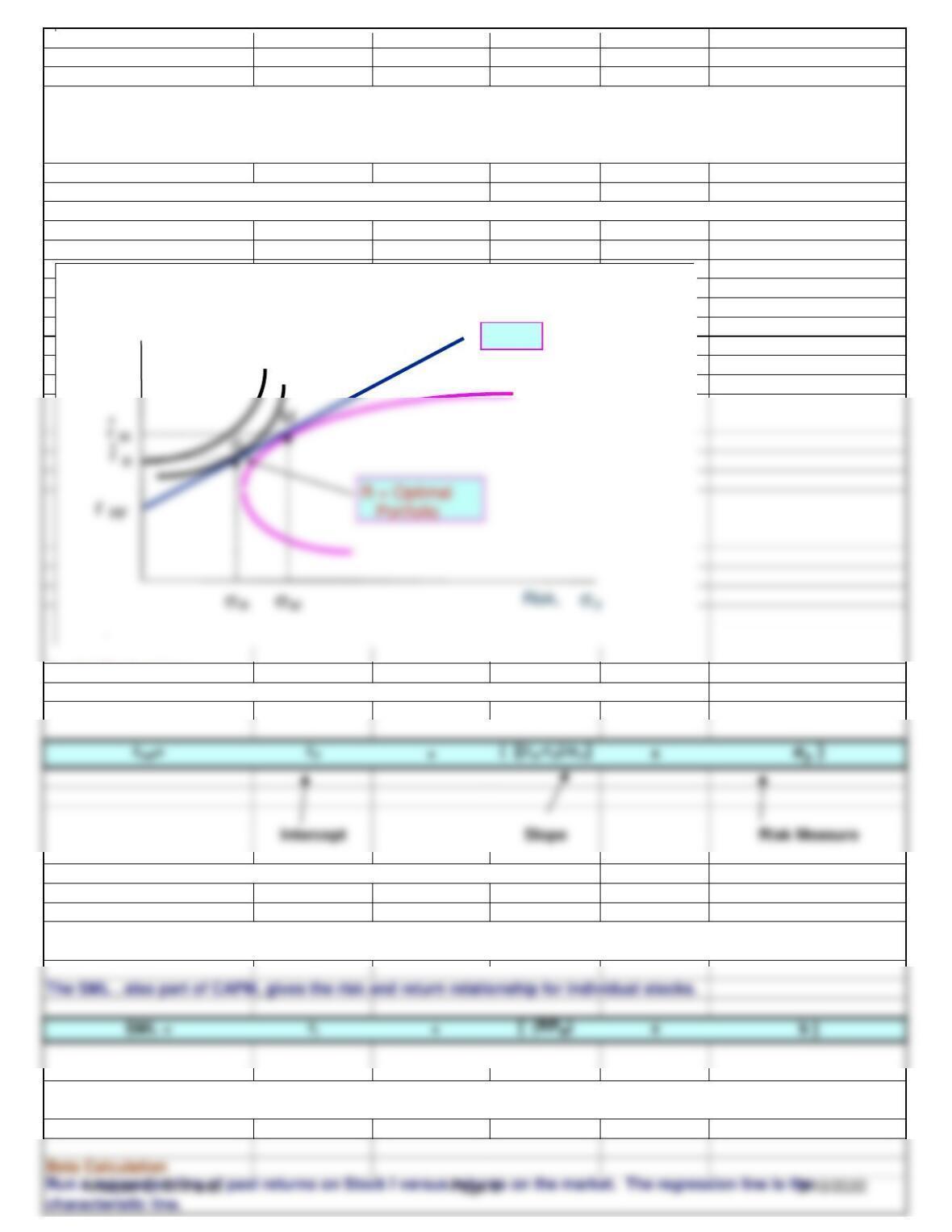
f. Now add the risk-free asset. What impact does this have on the efficient frontier?
EFFICIENT SET WITH A RISK-FREE ASSET
When a risk free asset is added to the feasible set, investors can create portfolios that combine this asset
with a portfolio of risky asset. The straight line connecting rrf with M, the tangency point between the line
and the old efficiency set, becomes the new efficient frontier.
e. Now add a set of indifference curves to the graph created for part b. What do these curves represent? What is the
optimal portfolio for this investor? Finally, add a second set of indifference curves which leads to the selection of a
different optimal portfolio. Why do the two investors choose different portfolios?
IB2IB1
Expected
Return, r p
Efficient Set with a Risk-Free Asset
FM16 Ch25 Mini Case Mini Case
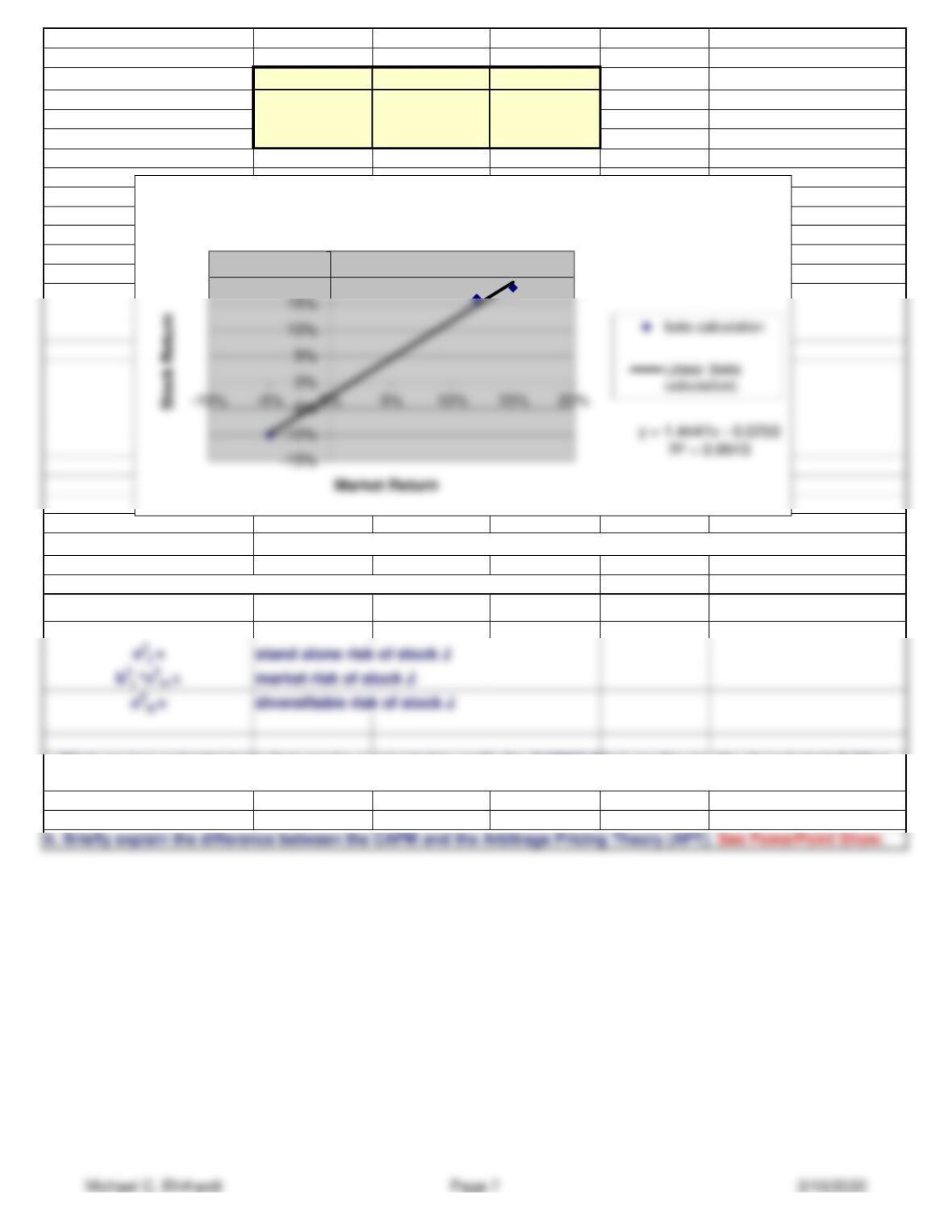
OPTIMAL PORTFOLIO WITH A RISK-FREE ASSET
The optimal portfolio for any investor is the point of tangency between the CML and the investors indifference
curve.
Capital Market Line
The capital market line is all linear combinations of the risk free asset and portfolio M.
The CML gives the risk and return relationship for efficient portfolios
The SML , also part of CAPM, gives the risk and return relationship for individual stocks.
Beta Calculation
characteristic line.
g. Write out the equation for the Capital Market Line (CML) and draw it on the graph. Interpret the CML. Now add a
set of indifference curves, and illustrate how an investor’s optimal portfolio is some combination of the risky
portfolio and the risk-free asset. What is the composition of the risky portfolio?
i. What is a characteristic line? How is this line used to estimate a stock’s beta coefficient? Write out and explain
the formula that relates total risk, market risk, and diversifiable risk.
h. What is the Capital Asset Pricing Model (CAPM)? What are the assumptions that underlie the model? What is the
Security Market Line? See PowerPoint Show.
.
I1
I2
CML
Expected
Return, r p
FM16 Ch25 Mini Case Mini Case
Year
rMri
115% 18%
2-5% -10%
312% 16%
R2 measures the percent of a stock’s variance as explained by the market.
Relationship between stand alone, market, and diversifiable risk
s2j = b2j *s2m + s2ej
j. What are two potential tests that can be conducted to verify the CAPM? What are the results of such tests? What
is Roll’s critique of CAPM tests? See PowerPoint Show.
20%
25%
Beta Calculation