Chapter 25
Question 16
Input Area:
Output Area:
Face value of debt 20,000$
Maturity (months) 12
Market value 21,600$
Standard deviation 34%
Risk-free rate 6%
Chapter 25
Question 17
Input Area:
Output Area:
a. Project A:
b. Although the NPV of project B is higher,
Project A:
Project B:
c.
Yes. If the same group of investors have
since it increases the value of the firm to
Chapter 25
Question 18
Input Area:
Output Area:
Face value of debt 30,000$
Maturity (months) 12
Market value 33,400$
Standard deviation 38%
Risk-free rate 6%
Chapter 25
Question 19
Input Area:
Output Area:
Face value 50,000$
Market value 55,000$
Maturity (years) 12
Standard deviation 21%
Risk-free rate 6%
Equity (#17) 4,327.50$
Equity (#18) 7,655.59$
Debt (#17) 17,272.50$
Debt (#18 ) 25,744.41$
Chapter 25
Question 20
Input Area:
Output Area:
Maturity (years) 5
Face value 25,000,000$
Market value 18,000,000$
Standard deviation 41%
Risk-free rate 6%
Chapter 25
Question 21
Input Area:
Output Area:
situation, it is not likely the company will
Under the new plan where the company
operates for five more years, the
probability of increasing the value of
assets to meet or exceed the face value
operates for two more years.
Maturity (years) 2
Face value 30,000$
Market value 17,000$
Standard deviation 60%
Risk-free rate 5%
Chapter 25
Question 22
Input Area:
Output Area:
Maturity (years) 5
Face value 75,000$
Market value 71,000$
Standard deviation 34%
Risk-free rate 7%
Chapter 25
Question 23
Input Area:
Output Area:
Going back to chapter on dividends, the
price of the stock will decline by the amount
of the dividend (less any tax effects).
Therefore, we would expect the price of the
stock to drop when a dividend is paid,
reducing the upside potential of the call by the
amount of the dividend. The price of a call
option will decrease when the dividend yield
Current stock price 89$
Standard deviation 50%
Risk-free rate 4%
Strike price 85$
Expiration (months) 6
Dividend yield 2%
Chapter 25
Question 24
Input Area:
Output Area:
Going back to the chapter on dividends, the
price of the stock will decline by the amount
of the dividend (less any tax effects).
Therefore, we would expect the price of the
stock to drop when a dividend is paid,
reducing the decreasing the stock price. The
price of a put option will increase when the
dividend yield increases.
Current stock price 89$
Strike price 85$
Expiration (months) 6
Dividend yield 2%
Standard deviation 50%
Risk-free rate 4%
Chapter 25
Question 25
Output Area:
Chapter 25
Question 26
Output Area:
Chapter 25
Question 27
Input Area:
Output Area:
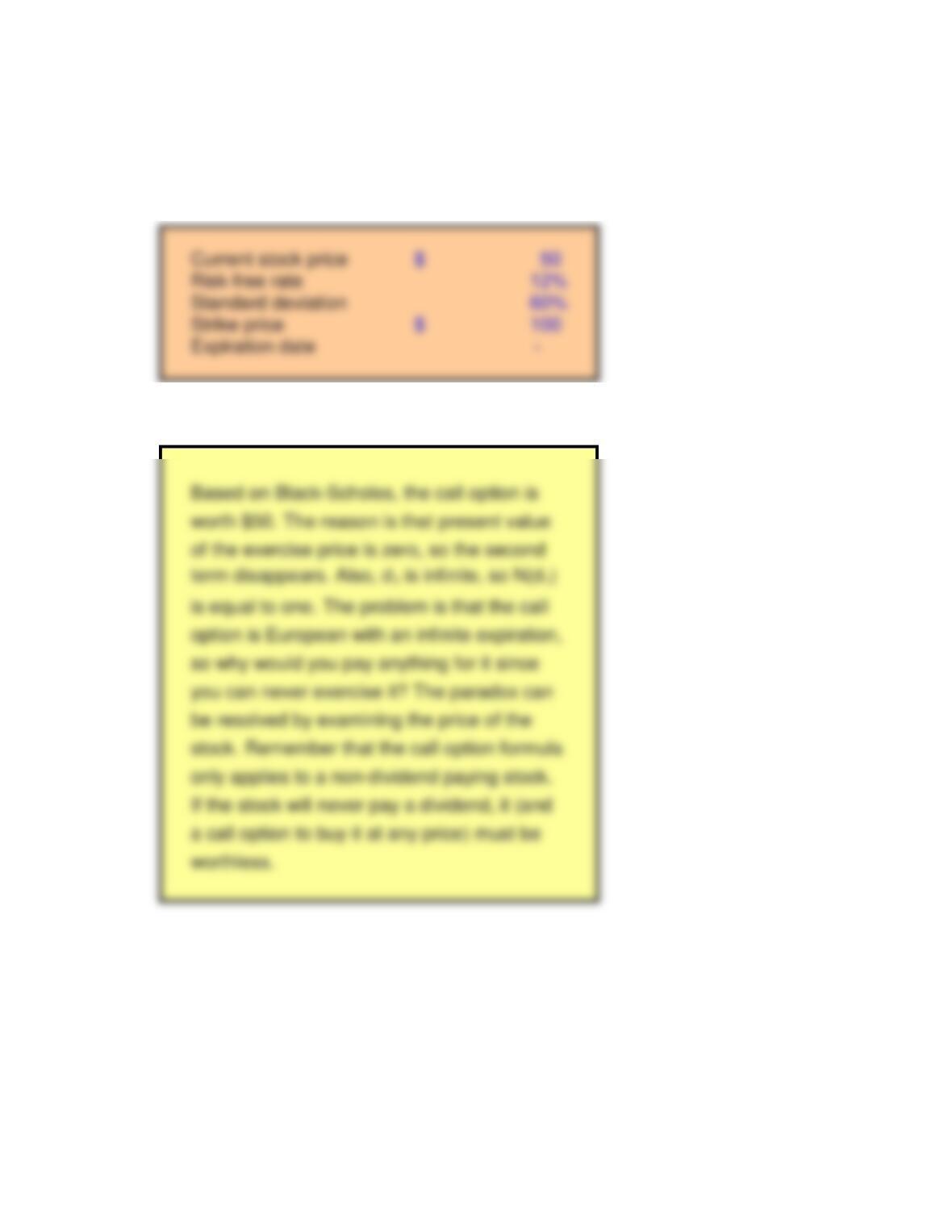
Current stock price 50$
Risk-free rate 12%
Standard deviation 60%
Strike price 100$
Expiration date –
Chapter 25
Question 28
Output Area: