Chapter 24
Enterprise Risk Management
ANSWERS TO BEGINNING-OF–CHAPTER QUESTIONS
24-1 “Managing Risks” means taking steps to mitigate the effects of adverse events. Buying
fire insurance is an attempt to mitigate the adverse consequences of a fire. Risk managers
attempt to identify all the risks a firm faces, and then consider what steps might be taken
to mitigate them. Buying insurance is one form of mitigation for certain risks.
The most prevalent risk most firms face is that customers will not want to buy enough
24-2 Swaps are transactions where two parties swap payment streams. For example, one firm
might have to make floating rate payments and another firm have to make fixed rate
payments. The firms can use a swap under which each agrees to make the other’s
payments. Similarly, firms with debt denominated in different currencies can arrange
24-3 See the Excel model for an answer to Question 3. Here we show that both companies get
24-4 Futures contracts are deals where one party agrees to buy, and the other agrees to sell,
something a specified future date. For example, a T–bond futures contract is a contract to
buy (or to sell) $100,000 of a hypothetical 20 year, 6%, Treasury bond at some specified
24-5 See the BOC Excel model for the answer to Question 5. Here we show the number of T-
bond futures contracts that would be used in the hedge (500 contract, with a nominal
ANSWERS TO END-OF-CHAPTER QUESTIONS
24-1 a. A derivative is an indirect claim security that derives its value, in whole or in part, by
the market price (or interest rate) of some other security (or market). Derivatives
include options, interest rate futures, exchange rate futures, commodity futures, and
swaps.
b. According to COSO, enterprise risk management “is a process, effected by an entity’s
c. Financial futures provide for the purchase or sale of a financial asset at some time in
d. A hedge is a transaction that lowers a firm’s risk of damage due to fluctuating stock
prices, interest rates, and exchange rates. A natural hedge is a transaction between
two counterparties where both parties’ risks are reduced. The two basic types of
hedges are long hedges, in which futures contracts are bought in anticipation of (or to
e. A swap is an exchange of cash payment obligations, which usually occurs because the
parties involved prefer someone else’s payment pattern or type. A structured note is a
debt obligation derived from another debt obligation, and permits a partitioning of
risks to give investors what they want.
f. Commodity futures are futures contracts which involve the sale or purchase of
Answers and Solutions: 23 – 4
24-2 If the elimination of volatile cash flows through risk management techniques does not
significantly change a firm’s expected future cash flows and WACC, investors will be
24-3 The six reasons why risk management might increase the value of a firm is that it allows
24-4 There are several ways to reduce a firm‘s risk exposure. First, a firm can transfer its risk
to an insurance company, which requires periodic premium payments established by the
insurance company based on its perception of the firm’s risk exposure. Second, the firm
24-5 The futures market can be used to guard against interest rate and input price risk through
the use of hedging. If the firm were concerned that interest rates will rise, it would use a
short hedge, or sell financial futures contracts. If interest rates do rise, losses on the issue
24-6 Swaps allow firms to reduce their financial risk by exchanging their debt for another
party’s debt, usually because the parties prefer the other’s debt contract terms. There are
several ways in which swaps reduce risk. Currency swaps, where firms exchange debt
Answers and Solutions: 23 – 6
SOLUTIONS TO END-OF-CHAPTER PROBLEMS
24-1 If Zhao issues fixed rate debt and then swaps, its net cash flows will be: −7% + 6.8% −
LIBOR = −(LIBOR + 0.2%).
24-3 Futures contract settled at 100 16/32% of $100,000 contract value, so PV = 1.005 ×
$1,000 = $1,005 × 100 bonds = $100,500. Using a financial calculator, we can solve for
rd as follows:
N = 40; PV = –1005; PMT = 30; FV = 1000; solve for I = rd = 2.9784% × 2 = 5.9569% ≈
24-4 If Carter issues floating rate debt and then swaps, its net cash flows will be: –(LIBOR +
2%) – 7.95% + LIBOR = –9.95%. This is less than the 10% rate at which it could
directly issue fixed rate debt, so the swap is good for Carter.
24-5 a. In this situation, the firm would be hurt if interest rates were to rise by June, so it
would use a short hedge, or sell futures contracts. Since futures maturing in June are
selling for 95 17/32 of par, and futures contracts are for $100,000 in Treasury bonds,
Answers and Solutions: 23 – 7
b. The firm would now pay 13 percent on the bonds. With an 11 percent coupon rate,
the bond issue would bring in only $8,585,447.31:
The value of all of the futures contracts will drop to $76,945.56(105) =
$8,079,283.80.
However, the value of the short futures position began at $95,531.25(105) =
c. In a perfect hedge, the gains on futures contracts exactly offset losses due to rising
interest rates. For a perfect hedge to exist, the underlying asset must be identical to
Answers and Solutions: 23 – 8

SOLUTION TO SPREADSHEET PROBLEM
24-6 The detailed solution for the spreadsheet problem, Ch24 P06 Build a Model Solution.xls,
is available on the textbook’s Web site.
Answers and Solutions: 23 – 9
MINI CASE
Assume that you have just been hired as a financial analyst by Tennessee Sunshine Inc., a
mid–sized Tennessee company that specializes in creating exotic sauces from imported
fruits and vegetables. The firm’s CEO, Bill Stooksbury, recently returned from an
industry corporate executive conference in San Francisco, and one of the sessions he
attended was on the pressing need for smaller companies to institute corporate risk
management programs. Since no one at Tennessee Sunshine is familiar with the basics of
derivatives and corporate risk management, Stooksbury has asked you to prepare a brief
report that the firm’s executives could use to gain at least a cursory understanding of the
topics.
To begin, you gathered some outside materials on derivatives and corporate risk
management and used these materials to draft a list of pertinent questions that need to be
answered. In fact, one possible approach to the paper is to use a question-and-answer
format. Now that the questions have been drafted, you have to develop the answers.
a. Why might stockholders be indifferent whether or not a firm reduces the
volatility of its cash flows?
Answer: If volatility in cash flows is not caused by systematic risk, then stockholders can
b. What are six reasons risk management might increase the value of a
corporation?
Answer: There are no studies proving that risk management either does or does not add value.
However, there are six reasons why risk management might increase the value of a
Mini Case: 23 – 10
c. What is COSO? How does COSO define enterprise risk management?
Answer: The Committee of Sponsoring Organizations of the Treadway Commission, is a
group of private accounting firms that put together a framework for internal control
systems to prevent accounting fraud. They extended this framework to include
d. Describe the eight components of the COSO ERM framework.
Answer: The COSO ERM framework has eight components.
1. Internal environment. This includes the company’s mission, culture, and risk
appetite.
.
Mini Case: 23 – 11
e. Describe some of the risks events within the following major categories of risk:
Answer: 1. Strategy and reputation. A company’s strategic choices simultaneously influence
and respond to its competitors’ actions, corporate social responsibilities, the
public’s perception of its activities, and its reputation among suppliers, peers, and
customers.
f. What are some actions that companies can take to minimize or reduce risk
exposures?
Answer: There are several actions that companies can take to minimize or reduce their risk
exposure. First, companies can transfer risk to an insurance company by paying
Mini Case: 23 – 12
g. What are forward contracts? How can they be used to manage foreign exchange
risk?
Answer: A forward contract is an agreement between two parties. One party agrees to sell a
specified item at a specified price on a specified date, and the other party agrees to
h. Describe how commodity futures markets can be used to reduce input price risk.
Answer: Futures markets involve contracts that call for the purchase or sale of a financial (or
real) asset at some future date, but at a price which is fixed today.
i. It is January and Tennessee Sunshine is considering issuing $5 million in bonds
in June to raise capital for an expansion. Currently, TS can issue 20-year bonds
at 7 percent, but interest rates are on the rise and Stooksbury is concerned that
long-term interest rates might rise by as much as 1 percent before June. You
looked online and found that June T–bond futures are trading at 111’25. What
are the risks of not hedging and how might TS hedge this exposure? In your
analysis, consider what would happen if interest rates all increased by 1 percent.
Mini Case: 23 – 13
Answer: If TS waits until June to issue its bonds, and if interest rates rise, then TS will have to
pay a higher interest rate on its debt. How much does that cost TS? One way to
calculate the cost is to see how much the 20–year 7 percent semi–annual bonds that it
T-bond futures contracts are priced off of a hypothetical 20–year, 6 percent coupon,
semiannual payment bond, and the 111’25 futures price translates to a $1,117.81 for
each $1000 face value bond. The implied yield can be caluclated with a financial
calculator to be (N = 40; Pmt = 30; FV = 1000; PV = –1117.81; calculate I/Y =
2.5284% semi-annually, which is an annual rate of about 5.057%. If interest rates
Mini Case: 23 – 14
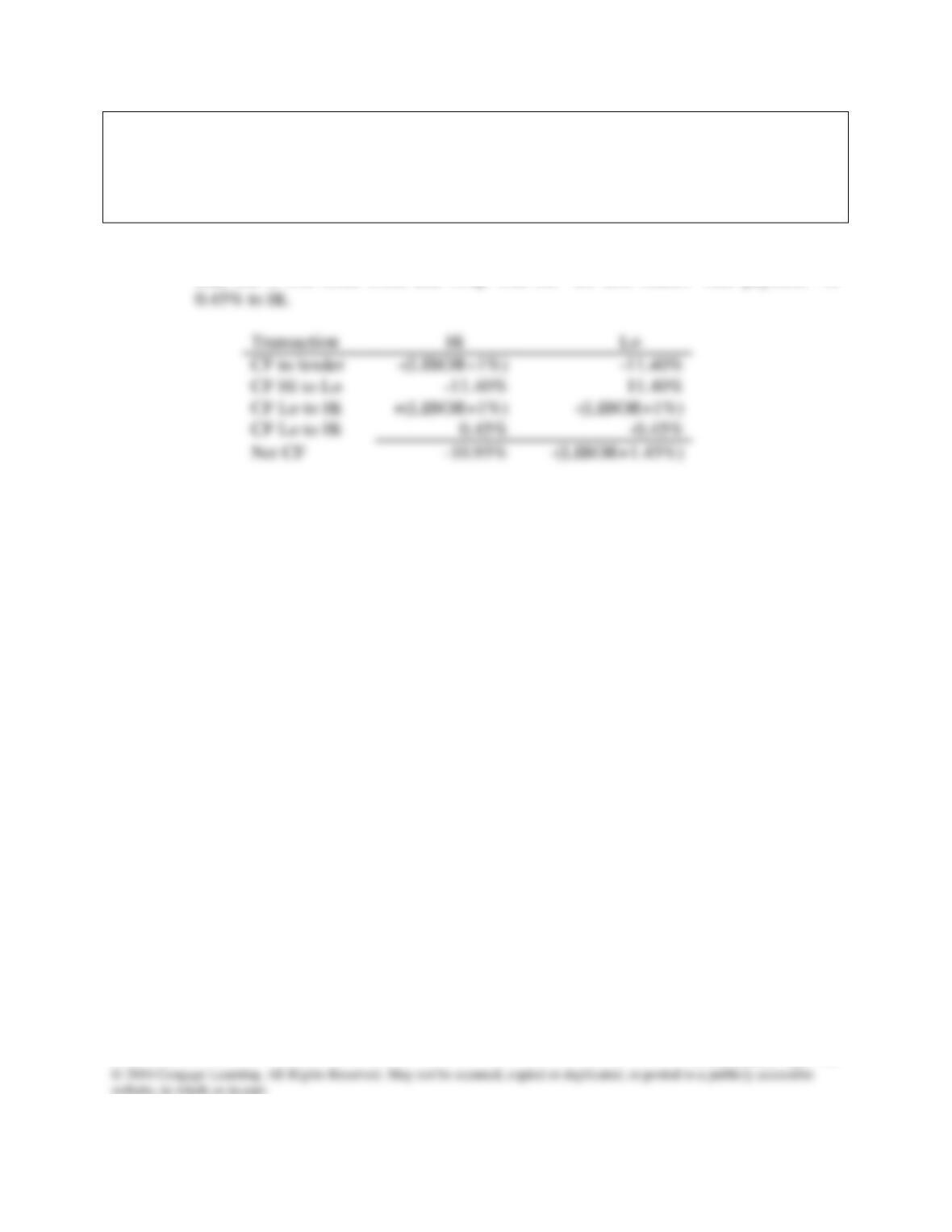
j. What is a swap? Suppose two firms have different credit ratings. Firm Hi can
borrow fixed at 11% and floating at LIBOR + 1%. Firm Lo can borrow fixed at
11.4% and floating at LIBOR + 1.5%. Describe a floating versus fixed interest
rate swap between firms Hi and Lo in which Lo also makes a “side payment” of
45 basis points to Firm L.
Answer: Hi wants fixed rate, but it will issue floating and “swap” with Lo. Lo wants floating
rate, but it will issue fixed and swap with Hi. Lo also makes “side payment” of
Mini Case: 23 – 15