Answers and Solutions: 24-1
Chapter 24
Bankruptcy, Reorganization, and Liquidation
ANSWERS TO END-OF-CHAPTER QUESTIONS
24-1 a. Informal debt restructuring is the agreement between the creditors and troubled firm to
change the existing debt terms. An extension postpones the required payment date,
while a composition is a reduction in creditor claims. Extension provides payment in
full, though delayed. Conversely, composition involves a reduced cash settlement.
Restructuring often involves both extension and composition. A reorganization in
bankruptcy is a court-approved attempt to keep a company alive by changing its capital
structure. A reorganization must adhere to the standards of fairness and feasibility.
c. The absolute priority doctrine states that claims must be paid in strict accordance with
the priority of each claim, regardless of the consequence to other claimants. The
relative priority doctrine is more flexible and gives a more balanced consideration to
all claimants than does the absolute priority doctrine.
Answers and Solutions: 24-2
d. The Bankruptcy Reform Act of 1978 was enacted to speed up and streamline
bankruptcy proceedings. This law represents a shift to a relative priority doctrine of
creditors’ claims. Chapter 11 of the Bankruptcy Act is the business reorganization
e. The priority of claims in liquidation is established in Chapter 7 of the Bankruptcy Act
to provide an equitable distribution of the debtor’s assets among the creditors.
f. Extension and composition are both characteristics of debt restructuring. In an
extension, creditors postpone the dates of required interest or principal payments, or
both. In a composition, creditors voluntarily reduce their fixed claims on the debtor by
Answers and Solutions: 24-3
24-2 The rehabilitation plan may be accepted because of the following:
• Expenses of liquidation may consume a large proportion of the assets.
24-3 Not necessarily. The going-concern value of a firm is a function of its outlook—it might
be improved by changing the management or otherwise improving operations. The firm
may be temporarily distressed.
24-4 Liquidations usually result in losses for the following reasons:
• Assets typically have characteristics which make their value in existing uses greater
than when resold.
24-5 Because public utilities and railroads often involve essential services, reorganizations and
mergers rather than liquidations are likely to take place. This is less true for industrial
companies.
Answers and Solutions: 24-4
SOLUTIONS TO END-OF-CHAPTER PROBLEMS
24-1 Distribution of proceeds on liquidation:
1.
Proceeds from sale of assets
$2,500,000
2.
First mortgage, paid from sale of assets
0
3.
Fees and expenses of administration of
bankruptcy
4.
Wages due workers earned within 3 months
prior to filing of bankruptcy petition
5.
Taxes
6.
Unfunded pension liabilities
7.
Available to general creditors
$2,218,750
Distribution to general creditors:
Claims of General
Creditors
Claim
(1)
Application
of 100%
Distribution
(2)
After
Subordination
Adjustment
(3)
Percentage
of Original
Claims
Received
(4)
Accounts payable
375,000
375,000
375,000
100
Notes payable
$ 750,000
$ 750,000
$ 750,000
100%
Subordinated
debentures
750,000
750,000
750,000
100
$1,875,000
$1,875,000
$1,875,000
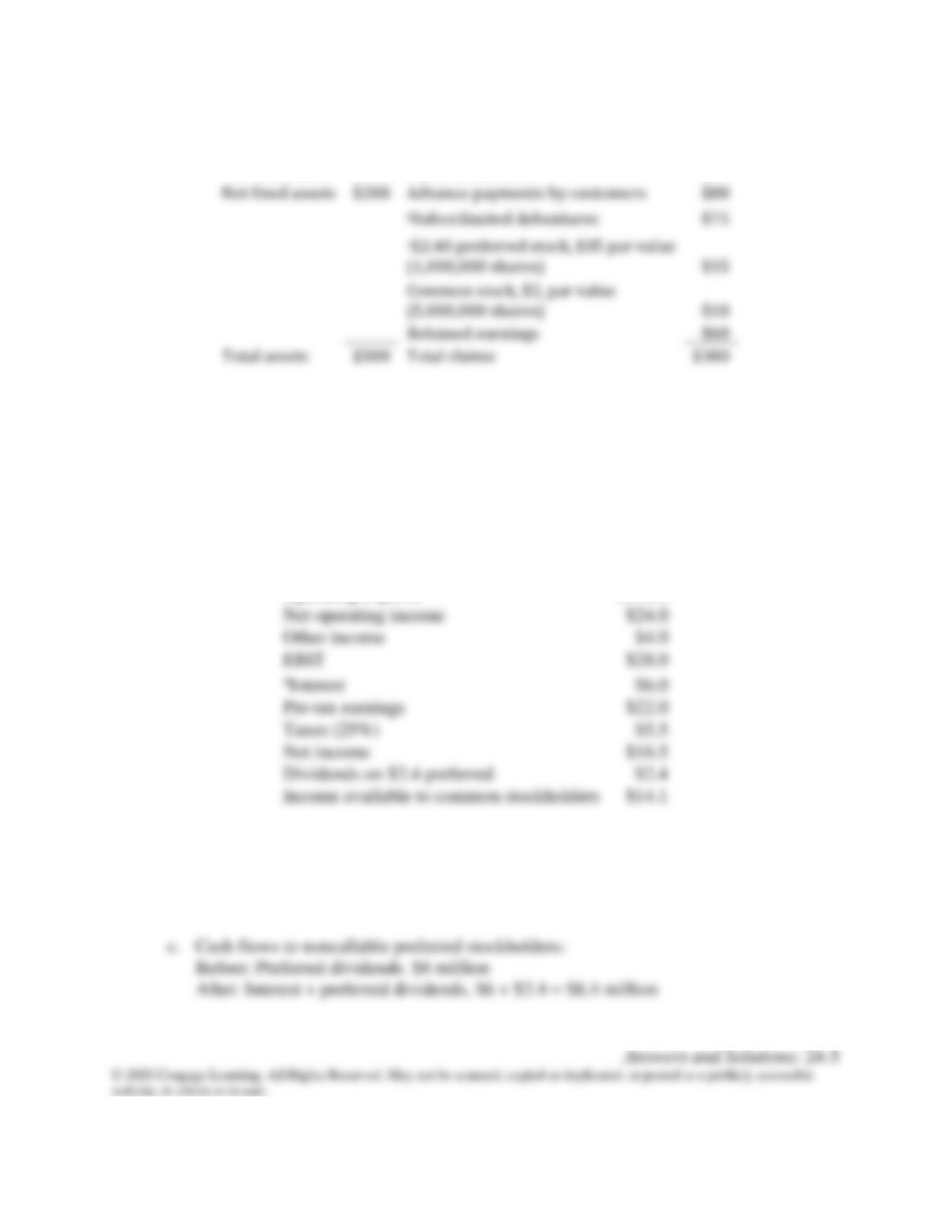
24-2 a. The pro forma balance sheet follows (in millions of dollars):
aCurrent assets
$100
Current liabilities
$40
Net fixed assets
$200
Advance payments by customers
$80
(1,000,000 shares)
$35
(5,000,000 shares)
$10
Retained earnings
$60
Total assets
$300
Total claims
$300
Notes:
a$300 less $200 used to retire the callable preferred stock.
b(1 million bonds)($75 par value) = $75.
c(1 million shares)($35 par value) = $35.
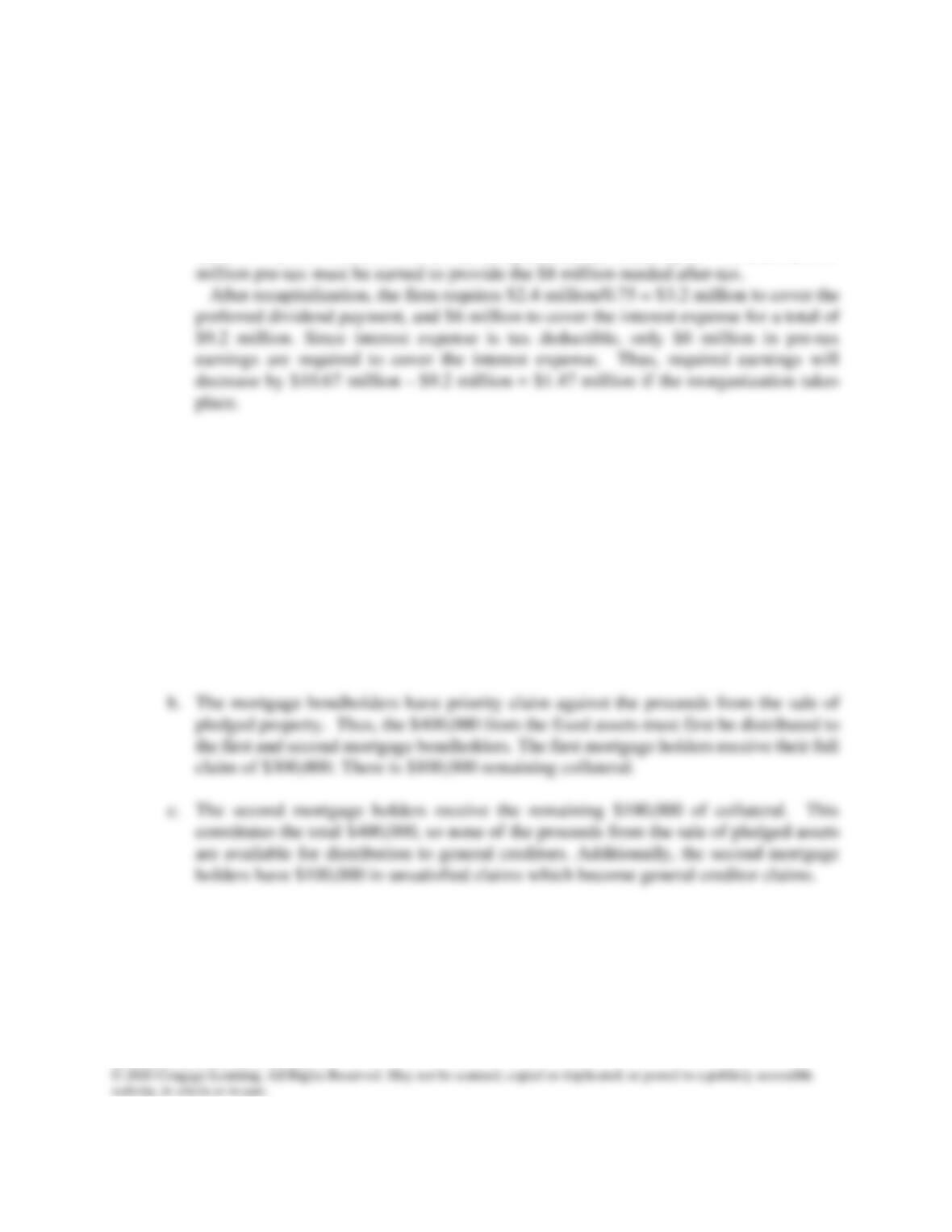
b. The pro forma income statement (in millions of dollars) follows:
Net sales
$540.0
Operating expense
$516.0
Net operating income
Other income
EBIT
Pre-tax earnings
Taxes (25%)
Net income
Dividends on $2.4 preferred
Income available to common stockholders
Notes:
a0.08($75 million par value) = $6.
b$2.40(1 million shares) = $240.
Answers and Solutions: 24-6
Net income to common stockholders:
Before: $13 million
After: $14.1 million
d. The pre-tax earnings required before the recapitalization are ($6 + $2)/(1 – 0.25) =
$8/0.75 = $10.67 million. We divide the preferred dividends by (1 – T) since $10.67
e. The debt ratio before reorganization is: (Current liabilities + Advanced payments)/(TA)
= ($40 + $80) million/$500 million = 0.24 = 24%. After reorganization the debt ratio
is ($40 + $80 + $75)/$300 = 0.65 = 65%.
If preferred stock is treated as debt, the ratio was (Current liabilities + Advanced
payments + All dividends)/(TA) = ($40 + $80 + $110 + $200)/$500= 0.86 = 86%. After
reorganization the debt ratio is ($40 + $80 + $75 + $35)/$300 = 0.7667 = 76.67%. This
ratio actually declines.
24-3 a. Creditor claims total $1,100,000 while the trustee has an additional $50,000 in claims,
yet the liquidation produced only $600,000 in proceeds. Since the proceeds are
insufficient to satisfy the creditor and trustee claims, the shareholders receive nothing.
Answers and Solutions: 24-7
d. The priority claimants are the mortgage bondholders, trustee, workers, and
government. The remaining claimants are general creditors. There is $200,000
available after the $400,000 distribution to the mortgage bondholders. This is
e. Of the total $600,000 received from the liquidation, $520,000 has been distributed to
priority claimants. This leaves $80,000 to distribute to the general creditors. But the
general creditor claims total $630,000:
Account Amount Received
Accounts payable $ 6,350
Notes payable 22,860
Second mortgage bonds 12,700 (plus $100,000)
Debentures 25,400
Subordinated debentures 12,700
Total $ 80,010 ≈ $80,000
Answers and Solutions: 24-8
the notes payable holders and nothing (of the general creditor portion) for the
subordinate debenture holders.
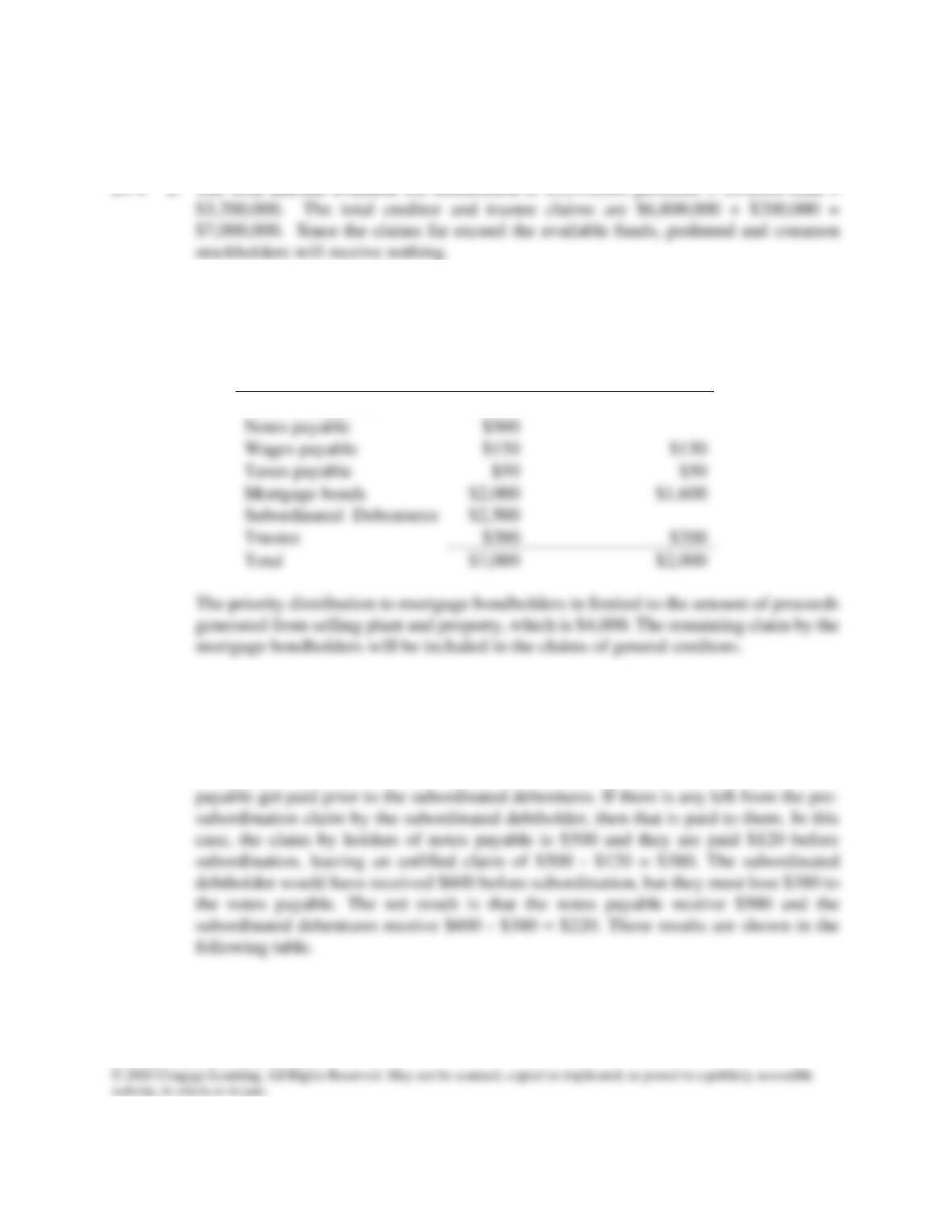
b. The following tables shows the steps to determine the percentage of each creditor’s
claim that is paid. First, identify all claims and all priority distributions (in thousands
of dollars):
Claimant
Claim
Priority Distribution
Accounts payable
$1,600
Notes payable
Wages payable
Taxes payable
Mortgage bonds
$2,000
Subordinated Debentures
$2,500
Trustee
Total
$7,000
Second, determine the ratio of remaining claims to remaining proceeds. Priority
distributions were $2,000, so that leaves $3,200 – $2,000 = $1,200 for general
claimants. The percentage of claims satisfied (before subordination) is $1,200/$5,000
= 0.24 = 24%. Apply this percentage to the remaining general claims to determine the
remaining creditor distributions before subordination. Third, the holders of notes
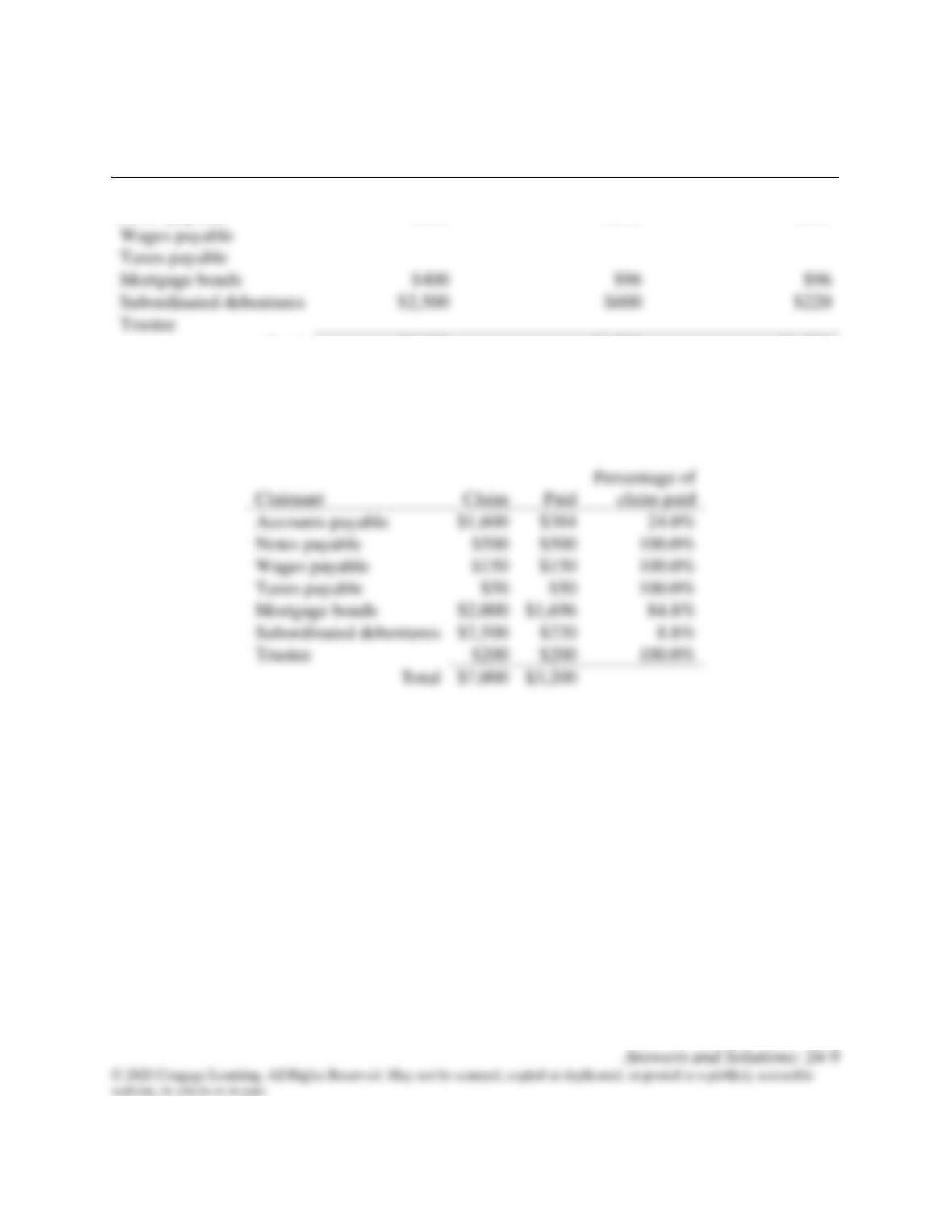
Claimant
Remaining
general claims
Remaining creditor
distribution before
subordination
Remaining creditor
distribution after
subordination
Accounts payable
$1,600
$384
$384
Notes payable
$500
$120
$500
Wages payable
Taxes payable
Mortgage bonds
$400
Subordinated debentures
$2,500
$600
$220
Trustee
Total
$5,000
$1,200
$1,200
Claimant
claim paid
Accounts payable
$1,600
Notes payable
Wages payable
Taxes payable
Mortgage bonds
$2,000
$1,696
Subordinated debentures
$2,500
Trustee
Total
$7,000
$3,200
The following table sums the priority distributions and the remaining general creditor
distributions after subordination to determine total distributions and the percentage of
the each claimants claim that is paid.
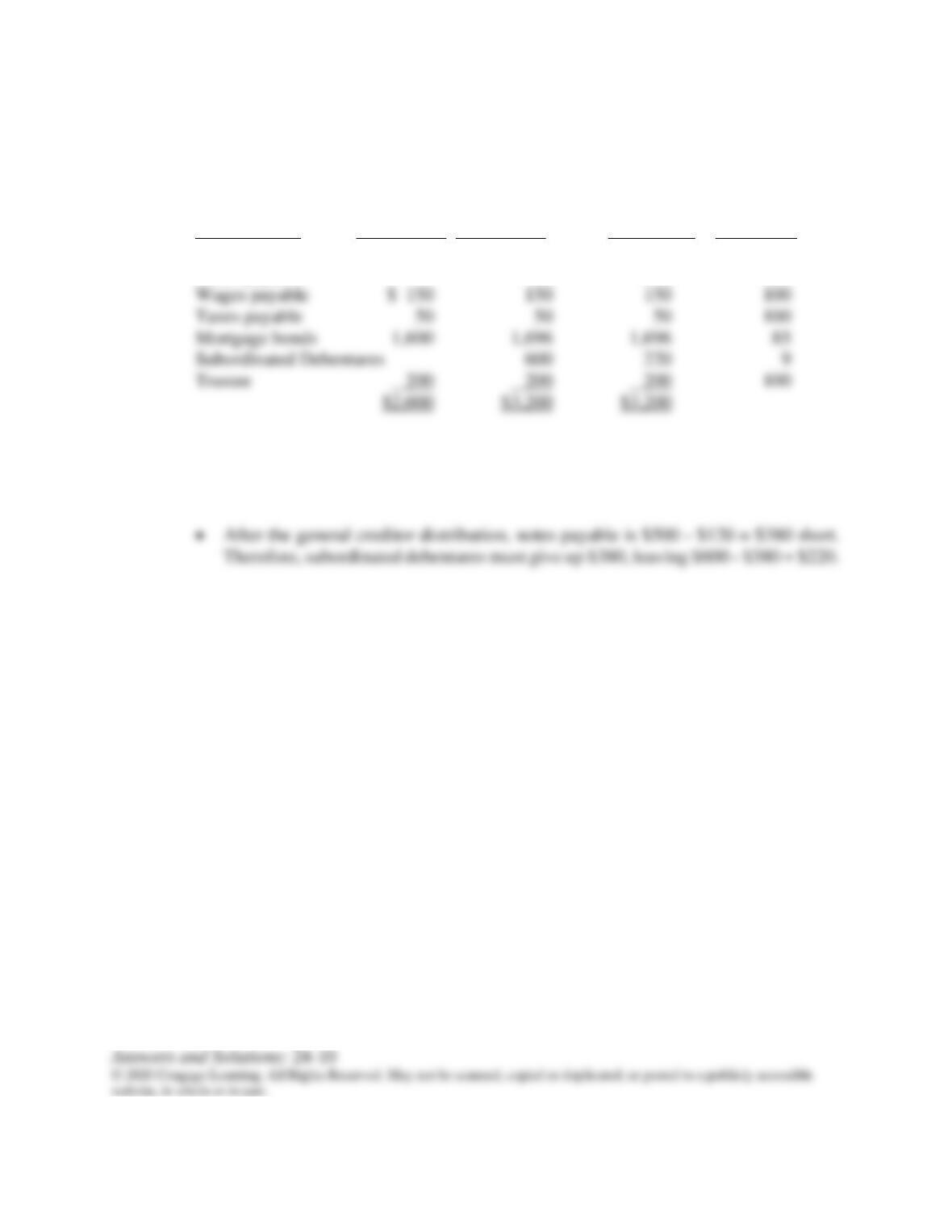
Priority Creditor Subordination
Claimant Distribution Distribution Adjustment Percentage
Accounts payable $ 384 $ 384 24%
Notes payable 120 500 100
• Funds remaining after the priority distribution = $3,200 – $2,000 = $1,200.
• General creditor claims total $1,600 + $500 + $400 + $2,500 = $5,000.

Answers and Solutions: 24-11
SOLUTION TO SPREADSHEET PROBLEM
24-5 The detailed solution for the spreadsheet problem, Ch24 P05Build a Model Solution.xlsx,
is available on the textbook’s Web site.

Mini Case: 24 – 12
MINI CASE
Kimberly MacKenzie, president of Kim‘s Clothes Inc., a medium-sized manufacturer of
women’s casual clothing, is worried. Her firm has been selling clothes to Russ Brothers
department store for more than ten years, and she has never experienced any problems in
collecting payment for the merchandise sold. Currently, Russ Brothers owes Kim‘s Clothes
$65,000 for spring sportswear that was delivered to the store just two weeks ago. Kim’s
concern was brought about by an article that appeared in yesterday’s Wall Street Journal
that indicated that Russ Brothers was having serious financial problems. Further, the article
stated that Russ Brothers’ management was considering filing for reorganization, or even
liquidation, with a federal bankruptcy court.
Kim‘s immediate concern was whether or not her firm would collect its receivables if
Russ Brothers went bankrupt. In pondering the situation, Kim also realized that she knew
nothing about the process that firms go through when they encounter severe financial
distress. To learn more about bankruptcy, reorganization, and liquidation, Kim asked Ron
Mitchell, the firm’s chief financial officer, to prepare a briefing on the subject for the entire
board of directors. In turn, Ron asked you, a newly hired financial analyst, to do the
groundwork for the briefing by answering the following questions:
a. 1. What are the major causes of business failure?
Answer: The major causes of business failure consist of economic factors, such as industry
a. 2. Do business failures occur evenly over time?
Answer: A fairly large number of businesses fail each year, but the number in any one year
a. 3. Which size of firm, large or small, is more prone to business failure? Why?
Answer: Bankruptcy is more frequent among smaller firms. While bankruptcy does occur in
Mini Case: 24 – 13
b. What key issues must managers face in the financial distress process?
Answer: As a manager begins to face financial distress, he or she must begin to consider the
following key issues:
c. What informal remedies are available to firms in financial distress? In answering
this question, define the following terms: (1) workout, (2) restructuring, (3)
extension, (4) composition, (5) assignment, and (6) assignee (trustee).
Answer: When faced with financial distress, it is often desirable for firms to pursue informal
reorganizations or liquidations with creditors, given the costs associated with legal
bankruptcy. Creditors generally prefer informal reorganization plans when dealing
Mini Case: 24 – 14
d. Briefly describe U.S. Bankruptcy Law, including the following terms:
(1) chapter 11, (2) chapter 7, (3) trustee, (4) voluntary bankruptcy, and (5)
involuntary bankruptcy.
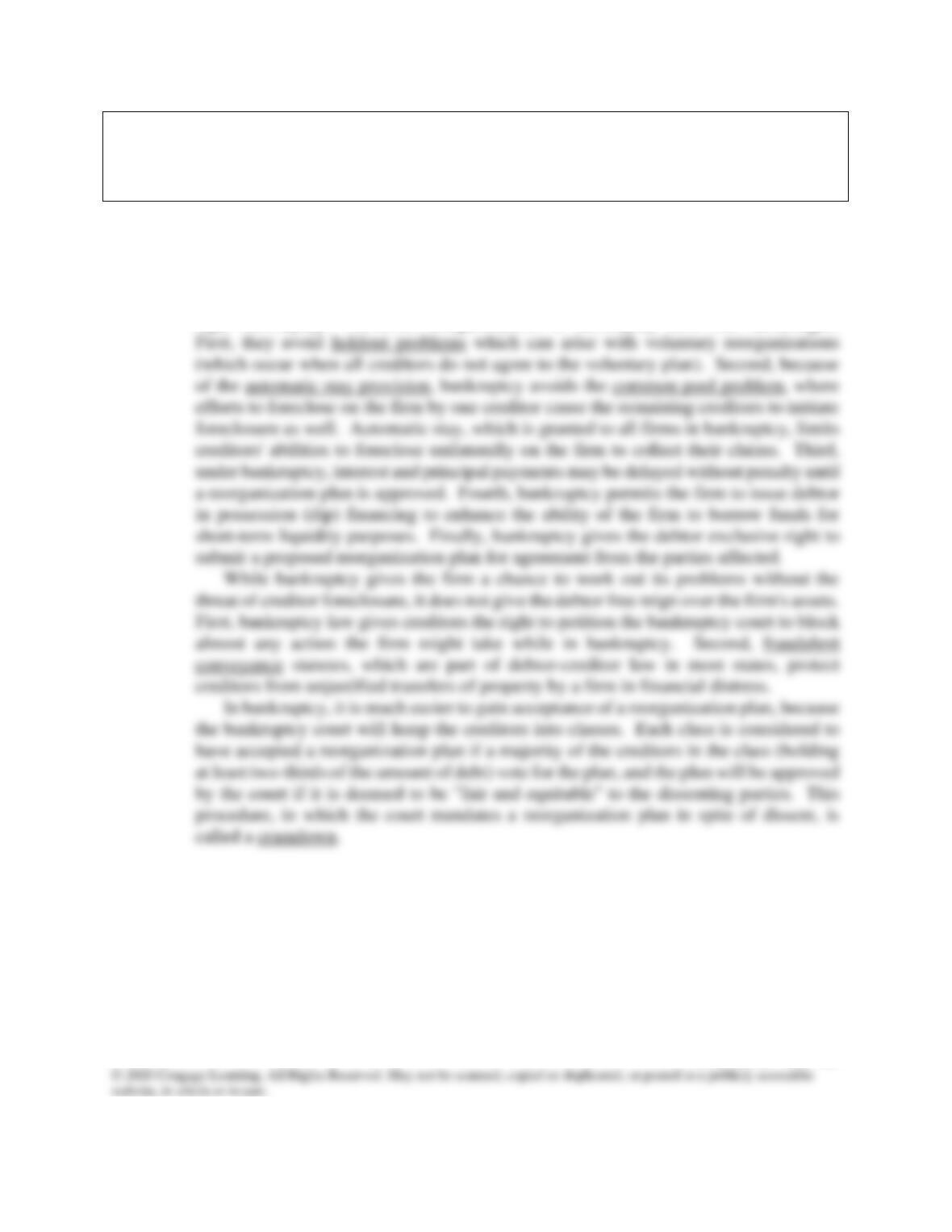
Answer: U. S. Bankruptcy laws were first enacted in 1898 to ensure that businesses worth more
as ongoing concerns were not shut down by individual creditors desiring liquidation
Mini Case: 24 – 15
e. What are the major differences between an informal reorganization and
reorganization in bankruptcy? In answering this question, be sure to discuss the
following items: (1) common pool problem, (2) holdout problem, (3) automatic
stay, (4) cramdown, and (5) fraudulent conveyance.
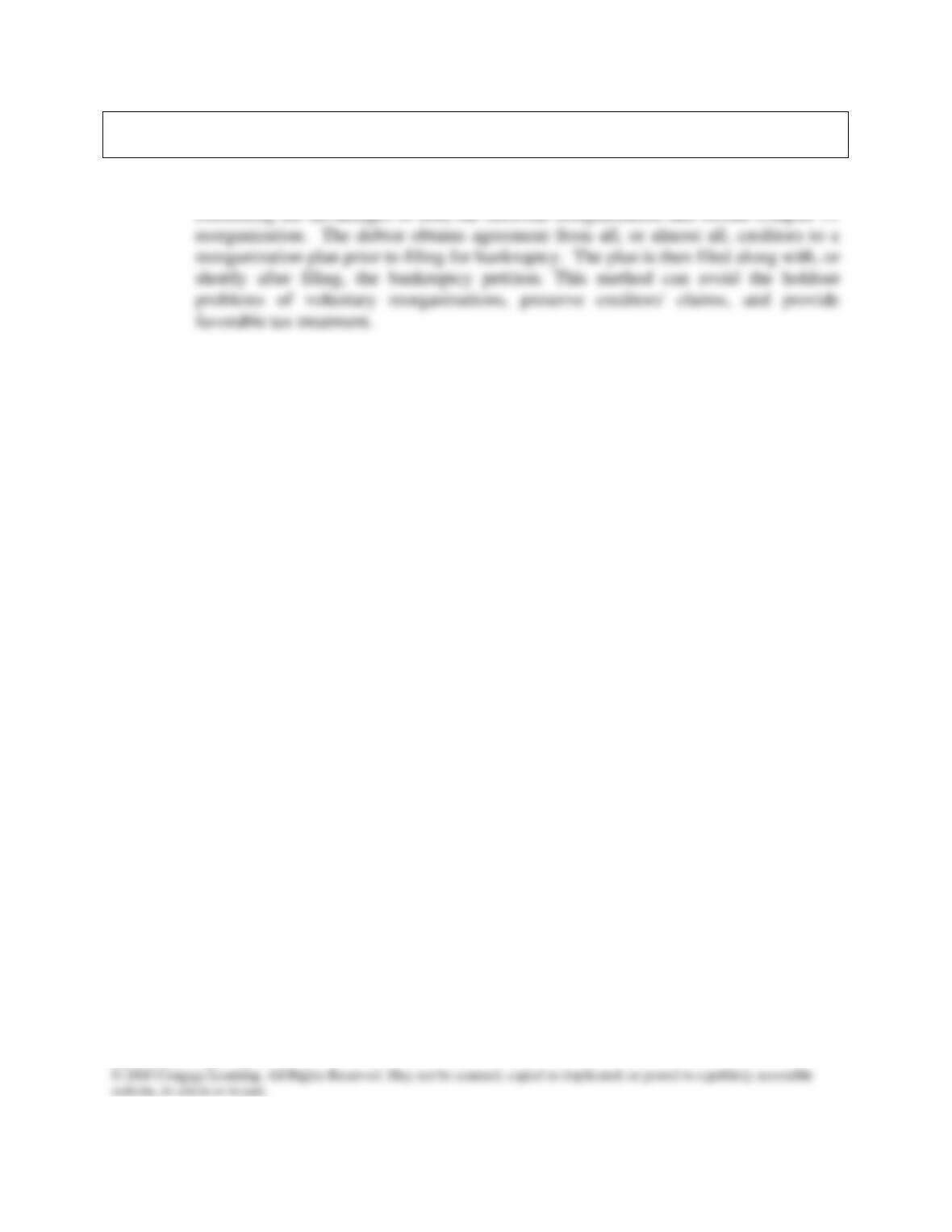
Answer: There are many differences between voluntary reorganizations and reorganizations in
bankruptcy. Voluntary reorganizations are far less costly and relatively simple to create
as compared to reorganizations in bankruptcy. As a result, voluntary reorganizations
typically allow creditors to recover more money, and sooner, than they would under
legal bankruptcy. However, reorganizations in bankruptcy have their advantages.
Mini Case: 24 – 16
f. What is a prepackaged bankruptcy? Why have prepackaged bankruptcies
become more popular in recent years?
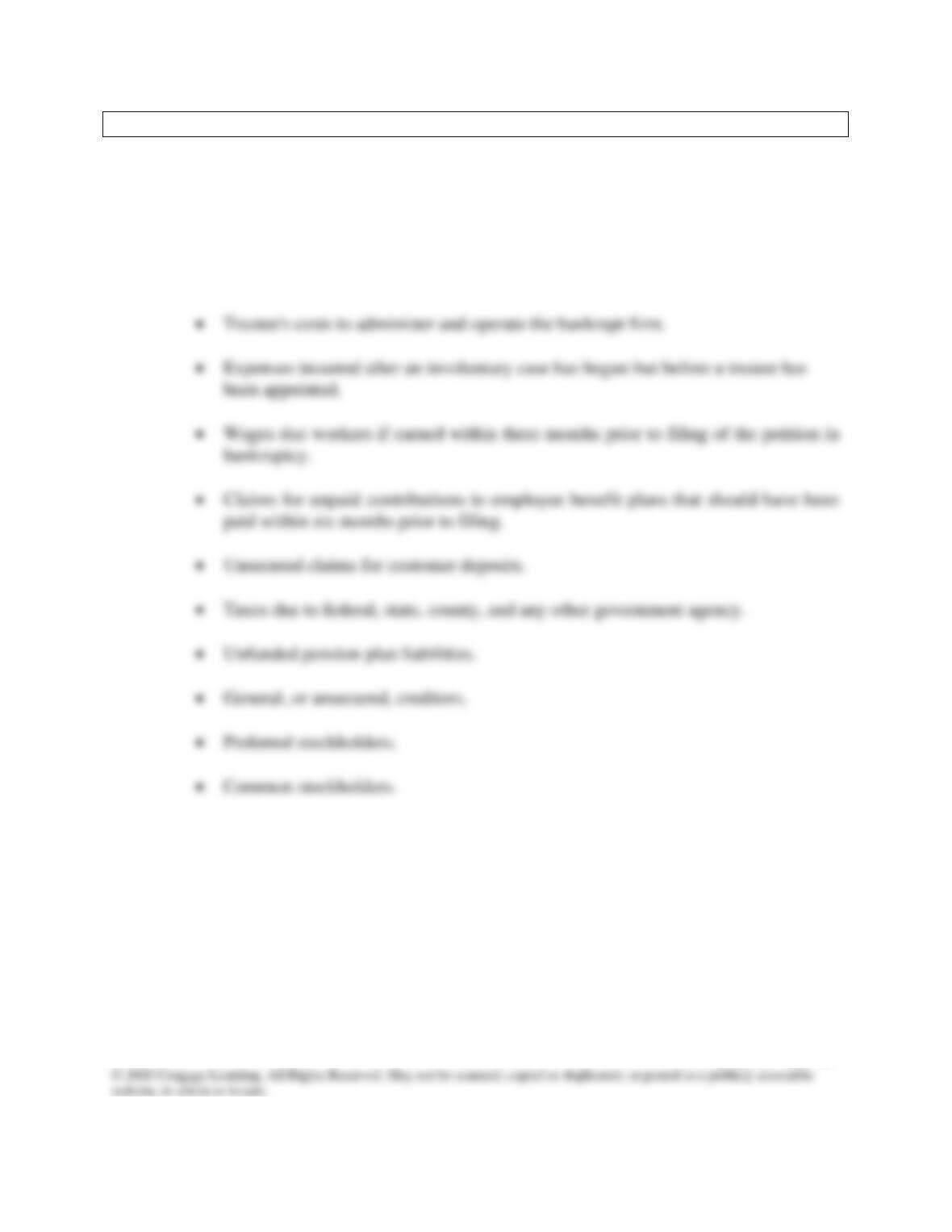
Answer: Prepackaged bankruptcy is a relatively new type of reorganization which is a hybrid—
Mini Case: 24 – 17
g. Briefly describe the priority of claims in a Chapter 7 liquidation.
Answer: Chapter 7 of the federal bankruptcy reform act provides for an equitable distribution of
the debtor’s assets among the creditors. The distribution of assets is governed by the
following priority of claims:
• Secured creditors (who are entitled to the proceeds of the sale of specific property
pledged for a lien or a mortgage).

Mini Case: 24 – 18
h. Assume that Russ Brothers did indeed fail, and that it had the following balance
sheet when it was liquidated (in millions of dollars):
Current assets $40.0 Accounts payable $10.0
Net fixed assets 5.0 Notes payable (to banks) 5.0
Accrued wages 0.3
Federal taxes 0.5
State and local taxes 0.2
Current liabilities $16.0
First mortgage $ 3.0
Second mortgage 0.5
Subordinated debenturesa 4.0
Total long-term debt $ 7.5
Preferred stock 1.0
Common stock 13.0
Paid-in capital 2.0
Retained earnings 5.5
Total equity $21.5
Total assets $45.0 Total claims $45.0
Athe debentures are subordinated to the notes payable.
The liquidation sales resulted in the following proceeds:
From sale of current assets $14,000,000
From sale of fixed assets 2,500,000
Total receipts $16,500,000
For simplicity, assume that there were no trustee’s fees or any other claims against
the liquidation proceeds. Also, assume that the mortgage bonds are secured by
the entire amount of fixed assets. What would each claimant receive from the
liquidation distribution?
Mini Case: 24 – 19
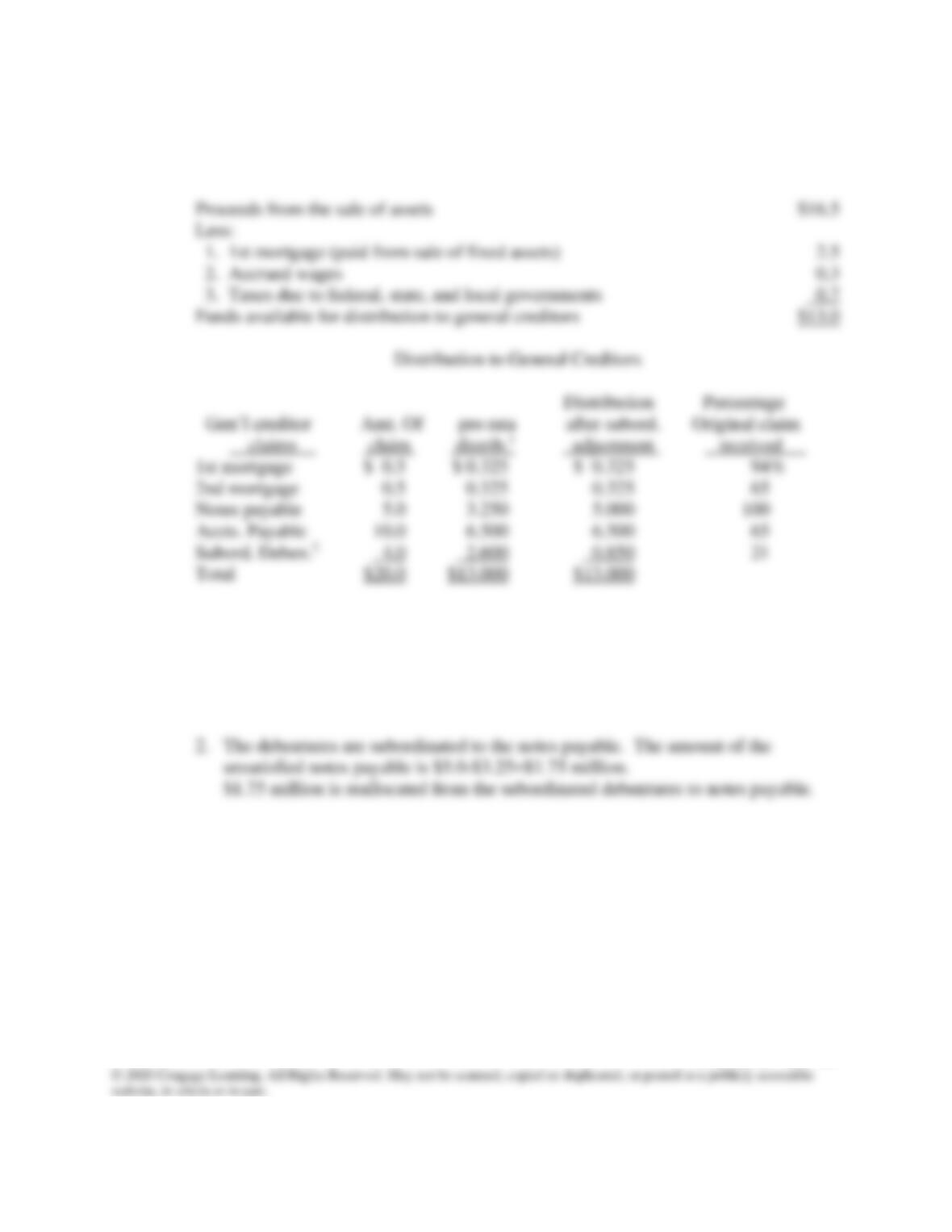
Answer: The following table shows the liquidation distribution (millions of dollars):
Distribution to Priority Claimants
(in millions)
Notes:
1. $13 million is available for distribution to general creditors; however, there is $20
million in general creditor claims, so the pro rata distribution will be $13/$20 =
0.65, or 65 cents on the dollar.