1
2
3
4
5
6
7
8
9
10
11
12
20
21
22
23
24
25
26
27
28
30
33
b. What key issues must managers face in the financial distress process?
following terms: (1) Workout; (2) Restructuring; (3) Extension; (4) Composition; (5) Assignment; and (6) Assignee
36
37
38
39
40
41
f. What is a prepackaged bankruptcy? Why have prepackaged bankruptcies become more popular in recent years?
47
48
49
50
51
52
53
54
A B C D E F G H I
11/24/2018
(2) Do business failures occur evenly over time? Answer: See Chapter 24 Mini Case Show
Chapter 24. Mini Case for Bankruptcy, Reorganization, and Liquidation
Kimberly MacKenzie, president of Kim’s Clothes Inc., a medium-sized manufacturer of women‘s casual clothing, is
worried. Her firm has been selling clothes to Russ Brothers Department Store for more than ten years, and she has
never experienced any problems in collecting payment for the merchandise sold. Currently, Russ Brothers owes
Kim’s Clothes $65,000 for spring sportswear that was delivered to the store just two weeks ago. Kim’s concern was
brought about by an article that appeared in yesterday‘s Wall Street Journal that indicated that Russ Brothers was
having serious financial problems. Further, the article stated that Russ Brothers’ management was considering
filing for reorganization, or even liquidation, with a federal bankruptcy court.
(3) Which size of firm, large or small, is more prone to business failure?
Why? Answer: See Chapter 24 Mini Case Show
g. Briefly describe the priority of claims in a Chapter 7 liquidation. Answer: See Chapter 24 Mini Case Show
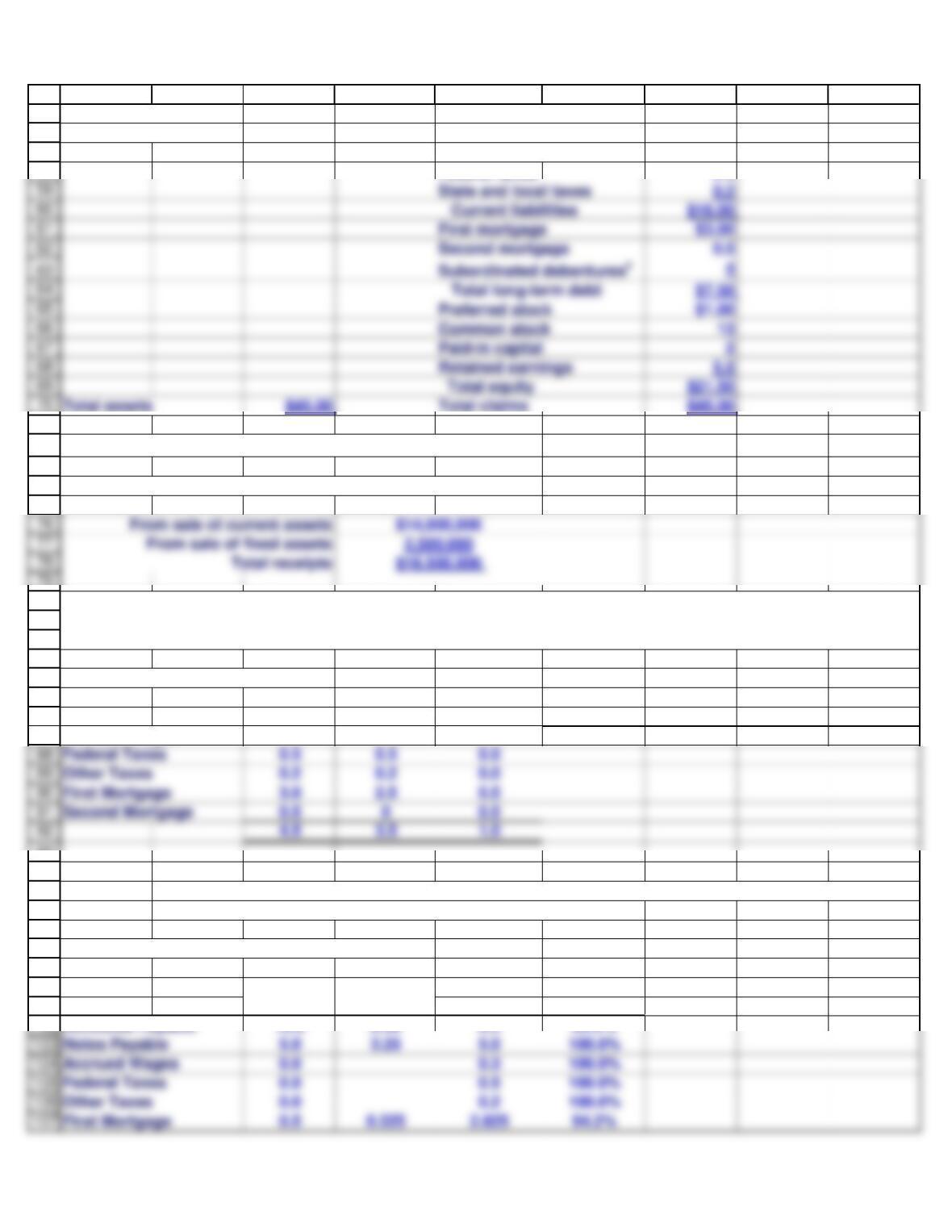
h. Assume that Russ Brothers did indeed fail, and that it had the following balance sheet when it was liquidated (in
millions of dollars):
d. Briefly describe U.S. bankruptcy law, including the following terms: (1) Chapter 11; (2) Chapter 7; (3) Trustee; (4)
Voluntary bankruptcy; and (5) Involuntary bankruptcy. Answer: See Chapter 24 Mini Case Show
Answer: See Chapter 24 Mini Case Show
a. (1.) What are the major causes of business failure? Answer: See Chapter 24 Mini Case Show
Federal Taxes 0.5 0.5 0.0
Other Taxes 0.2 0.2 0.0
First Mortgage 3.0 2.5 0.5
Second Mortgage 0.5 00.5
55
56
57
58
71
72
73
74
75
79
80
81
82
83
84
85
86
87
Notes Payable 5.0 3.25 5.0 100.0%
Accrued Wages 0.0 0.3 100.0%
Federal Taxes 0.0 0.5 100.0%
Other Taxes 0.0 0.2 100.0%
First Mortgage 0.5 0.325 2.825 94.2%
93
94
95
96
97
98
99
100
101
102
A B C D E F G H I
Current assets $40.00 Accounts payable $10.00
Net fixed assets 5.0 Notes payable (to banks) 5
Accrued wages 0.3
Federal taxes 0.5
aThe debentures are subordinated to the notes payable.
The liquidation sale resulted in the following proceeds:
Priority Distribution (millions of $)
Creditor Claim Distribution Unsatisfied
Accrued Wages 0.3 0.3 0.0
Notes:
(1) First mortgage receives entire proceeds from sale of fixed assets, leaving $0 for the second mortgage.
(2) $16.5 – $3.5 = $13.0 remains for distribution to general creditors.
General Creditor Distribution (millions of $)
Creditor Final Amount % Received
Accounts Payable 10.0 6.50 6.5 65.0%
For simplicity, assume that there were no trustee’s fees or any other claims against the liquidation proceeds. Also,
assume that the mortgage bonds are secured by the entire amount of fixed assets. What would each claimant
receive from the liquidation distribution?
Remaining
Claim
Initial
Distributiona
State and local taxes 0.2
Current liabilities $16.00
First mortgage $3.00
Second mortgage 0.5
Total long-term debt $7.50
Preferred stock $1.00
Common stock 13
Paid-in capital 2
Retained earnings 5.5
Total equity $21.50
Total assets $45.00 Total claims $45.00

108
109
110
111
A B C D E F G H I
Second Mortgage 0.5 0.325 0.325 65.0%
Sub. Debt 4.0 2.6 0.85 21.3%
20.0 13.0 16.5
a Pro rata amount = $13/$20 = 0.65.
b Includes priority distribution and $1.75 transfer from subordinated debentures.