Chapter 23 Risk Management
Chapter Overview
The Opening Focus talks about Google large international business segment. The story
starts at its second quarter 2011 earnings call when it was announced that Google had earned a
Opening Focus Discussion Questions:
1. What are the advantages and disadvantages of using hedging policies to prevent cash flow fluc-
tuations?
2. What is interest rate exposure? How can a company reduce its interest rate exposure?
This chapter covers:
23-1. Overview of Risk Management
Technology
1. Smart Practices Video. David Childress, asset liability manager for Ford Motor Co. discusses
interest rate risk and its impact on the firm’s balance sheet.
3. Smart Ideas Video. John Graham of Duke University discusses the costs and benefits of
hedging.
5. Smart Ideas Video. Betty Simkins of Oklahoma State University talks about interest rate
swaps.
6. Smart Solutions provide a step-by-step solution to Problem 23-2, calculating the forward price
of a 7-month forward contract.
Lecture Guide
Probably the only perfect hedge is in a Japanese garden. Risk management can’t be per-
Chapter 23 Risk Management 591
nized commodity exchanges were set up in Chicago and New York in the middle of the 19th centu-
ry.
Figure 23.1 Risk Managers Report Increases in Common Risks Facing Their Terms
23-1 Overview of Risk Management
There have been a number of innovations in the area of risk management in the past few
decades. In the early 1970s, for example, the abandonment of the gold standard and the move to
23-1a Risk Factors
Risk management means managing a company’s exposure to changes in factors like com-
modity prices, interest rates and exchange rates. Risk itself refers to a condition where there is a
23-1b The Hedging Decision
Hedging itself is a zero net present value project, but it can increase value for some firms. For
hedging to do so, then either cash flows must increase or the discount rate decrease. To impact
cash flows, risk management decisions must either lower the company’s transaction costs or im-
prove its investment decisions.
• Motivations for Hedging:
o Risk management can reduce the firm’s transactions cost by reducing the probabil-
ity of financial distress. A manager should ask what is the probability – high or
592 Instructor’s Manual
Figure 23.2 Probability Distribution of Possible Cash Flows for a Corporation
Table 23.1 The Tax Incentive to Hedge
Figure 23.3 Why Do Firms Hedge?
23-2 Forward Contracts
Forward contracts are obligations to buy or sell specified amounts of a currency, commodi-
23-2a Forward Prices
In efficient markets there are no arbitrage opportunities. In other words, forward price ac-
Table 23.2 Spot and Forward Exchange Rates
23-2b Currency Forward Contracts
It is important to understand the relationship between spot and forward currency prices.
Figure 23.4 Payoff Diagram for the Buyer of a 6-Month Forward Contract on the British
Pound
Figure 23.5 Payoff Diagram for the Seller of a 6-Month Forward Contract on the British
Pound
23-2c Interest Rate Forward Contracts
Many companies use interest rate forward contracts, or forward rate agreements, in which cash
flows based on a particular interest rate and principal amount are exchanged. Note that the nota-
Chapter 23 Risk Management 593
23-3 Futures Contracts
This section begins with some basic definitions of the key terminology. Futures contracts are very
Table 23.3 Gold Futures Prices, July 15, 2011
Table 23.4 Examples of Exchange-Traded Futures Contracts
23-3a Hedging with Futures Contracts
Most futures contracts do not end in delivery of the commodity. Traders are more likely to
“unwind” a futures contract by taking an offsetting position – buying when they had previously
sold or selling when they had previously bought. Studies have shown that there is a variety of firm
hedging policies. In general, large firms are more likely to hedge (perhaps because of greater so-
23-3b Concerns When Using Futures Contracts
This section discusses the major concerns when using futures contracts:
594 Instructor’s Manual
23-4 Options and Swaps
23-4a Options
Options can also be used to hedge successfully. One advantage of options is that they can
23-4b Swaps
Swaps are also a series of forward contracts, but they have periodic settlements, say quar-
terly, monthly or annually, rather than only at the expiration of the contract. The still have default
risk, but it lies in between the risk of a forward and a future. There may not be an actual exchange
of cash flows – often only the net cash flow is actually exchanged. Often in case of default, the
Figure 23.6 Typical Structure of a Fixed-for-Floating Swap
Figure 23.7 Semiannual Net Cash Flow for the Fixed-Rate Payer in a Fixed-for-Floating
Swap with a Notional Principal of $10,000,000
Figure 23.8 Semiannual Net Cash Flow for the Floating-Rate Payer in a Fixed-for-Floating
Swap with a Notional Principal of $10,000,000
• Currency Swaps: Today it is difficult not to deal with foreign currencies – firms may have
customers or suppliers in a foreign country. A firm may wish to hedge to reduce its for-
Chapter 23 Risk Management 595
23-5 Financial Engineering
Note that regulation has not kept pace with derivative development. The current joke is
that derivatives regulation is like blowing a whistle to keep away tigers. So far, it’s working –
Risk Management Summary
Risk management is an area that firms must play close attention to. A variety of specialized
instruments have been developed to help firms manage their risk.
Ch. 23 Resource Articles
“Where the Risk Went,” Business Week, October 28, 2002. This article looks at new financial
tools that shift some of the risk burden from banks to other institutions. It mentions securitization,
derivatives, credit default swaps, syndicated loans, surety bonds and computerized risk gauges.
Enrichment Exercises
Show the class a 60-minute PBS special, “The Trillion Dollar Bet.” This program talks about the
development of the Black-Scholes model, including interviews with Myron Scholes and Robert
Merton (who added to the model) who earned Nobel prizes for their work. It discusses the rise and
fall of Long Term Capital Management (LTCM), a hedge fund sponsored in part by the option
596 Instructor’s Manual
Answers to Concept Review Questions
2. Derivative securities may have acquired a questionable reputation because of a few well-
publicized misuses of derivatives. For example, Orange County in California had financial
3. If Equation 23.2 does not hold, an arbitrageur could earn a riskless profit by selling the forward
contract if the contract price is too high based on the model or buying the forward contract if it
5. A futures contract is settled daily. This means that if the asset moves in the wrong direction for
investors, they may be required to put up additional money to satisfy their broker’s margin ac-
6. The daily settlement feature tends to reduce default risk – the investor who is at the losing end
7. An interest rate swap is just a portfolio of FRAs because it is just a sequence of payments
through time where the payments depend on the difference between a fixed and a floating in-
8. A corporation may choose to hedge with forwards, futures, or swaps even if it can keep its up-
side potential by hedging with options. Hedging with options does preserve some upside poten-
9. A firm might prefer an engineered solution when the off-the-shelf solutions do not precisely
Chapter 23 Risk Management 597
Answers to Self-Test Problems
ST23-1. A certain commodity sells for $150 today. The present value of the cost of storing this
commodity for one year is $10. The risk-free rate is 4%. What is a fair price for a one-
year forward contract on this asset?
ST23-2. The spot exchange rate is $1.6666/£. The risk-free rate is 4% in the U.S. and 6 percent in
the United Kingdom. What is the forward exchange rate (assume a 1-year contract)?
A: Use equation 23.3 here, but remember that we need to express the exchange rates in
Answers to End-of-Chapter Questions
Q23-1. Historically, what types of risk were the focus of most firms’ risk-management practices?
A23-1. In the past, firms tended to focus on minimizing firm-specific risks dealing with their own
operations. These risks included worker’s compensation claims, product recalls, product li-
Q23-2. Distinguish between the motivations for purchasing insurance and the motivations for
hedging market-wide sources of risk.
A23-1. The motivations for purchasing insurance are the benefits gained by transferring certain
types of risk exposures to an insurance company, which is better able to evaluate and price
Q23-3. Distinguish between transaction exposure and economic exposure.
A23-3. Transaction exposure is the risk associated with potential changes in prices that affect the
Q23-4. In what way can hedging reduce the risk of financial distress? How might reducing the risk
of financial distress increase firm value?
A23-4. Hedging can reduce the risk of financial distress by decreasing the probability that the
firm’s cash flows will decline to the point of financial distress. By reducing this risk, the
598 Instructor’s Manual
Q23-5. Explain how hedging can reduce a firm’s tax liability.
A23-5. Hedging can reduce a firm’s tax liability if the firm’s tax function is convex, meaning that
Q23-6. Why do closely held firms tend to hedge more than firms with diffuse ownership?
A23-6. Closely-held firms are more likely to hedge because their owners have invested a greater
Q23-7. How can hedging make it easier to evaluate a manager’s performance?
Q23-8. What are the advantages of using exchange-traded derivatives to hedge a risk exposure?
What are the advantages of over-the-counter derivatives?
A23-8. Exchange traded derivatives offer the advantage of having low transaction costs and high
Q23-9. Conceptually, how do we determine the fair forward price for an asset? What are the nec-
essary assumptions to arrive at a fair forward price?
A23-9. The forward price for an asset can be determined by comparing the forward contract with
Q23-10. Conceptually, what are the differences between Equations 23.1, 23.2, and 23.3? Which
equation would you use to determine the fair forward price for an asset that does not earn
any income but is costly to store, such as gold or silver? How would you modify the
equation?
A23-10. Equations 23-1, 23-2 and 23-3 differ in that each is used to determine the fair forward
Q23-11. Describe the features of a futures contract that make it more liquid than a forward con-
tract.
A23-11. Futures contracts are standardized and have high trading volume, which makes them
Q23-12. Explain the features of a futures contract that make it have less credit risk than a forward
contract.
A23-12. Futures contracts are exchange-traded, which makes them have less credit risk than for-
ward contracts, as the exchange is the counter-party in all transactions and is highly cred-
Q23-13. Why is fungibility an important feature of futures contracts?
A23-13. Given that futures contracts are fungible, the buyer or seller of a futures contract can
Q23-14. Describe the delivery process for futures contracts. Why does delivery rarely take place
in futures contracts?
A23-14. Futures contracts generally allow delivery to take place any time during the month in
which the settlement date falls. At some point during this month, if delivery is to take
Q23-15. Why is a call option on an interest rate called an interest rate cap and a put option called
an interest rate floor?
A23-15. A call option on an interest rate is an interest rate cap because it effectively limits the
600 Instructor’s Manual
Q23-16. Explain how a fixed-for-floating swap can be considered a portfolio of forward contracts
on 6-month discount bonds.
A23-16. When two parties enter into a fixed-for-floating swap, they are agreeing today to ex-
Q23-17. Go to the CBOT website (www.cmegroup.com/company/cbot.html), and determine the
contract specifications for soybean meal futures and 10-year U.S. Treasury note futures.
Apart from the difference in the type of asset, what is the difference between the two
contracts in terms of what qualifies as deliverable grades?
A23-17. Soybean meal futures do not have a variety of deliverable grades. In fact, there is only
one grade of soybean meal with minimum protein of 48% that is suitable for delivery. On
Q23-18. Go to the CME Group website (www.cmegroup.com/company/cbot.html), and determine
the minimum initial margin requirements for speculators in the contracts traded on that
exchange. Which contracts have the smallest margin requirements? Which contracts
have the largest requirements? Why do you suppose these contracts have such different
margin requirements?
A23-18. In general, the margin requirement will depend on the volatility of the underlying asset.
Answers to End-of-Chapter Problems
Forward Contracts
P23-1. Suppose that an investor has agreed to pay $94,339.62 for a one-year discount bond in one
year. Two years from now, the investor will receive the bond’s face value of $100,000. The
current effective annual risk-free rate of interest is 5.8%, and the current spot price for a
two-year discount bond is $88,999.64. Has the investor agreed to pay too much or too lit-
tle? How might an arbitrageur capitalize on this opportunity?
A23-1. Fair forward price = $88,999.64 × (1 + .058) = $94,161.62.
Chapter 23 Risk Management 601
P23-2. Company A’s stock will pay a dividend of $5 in three months and $6 in six months. The
current stock price is $200, and the risk-free rate of interest is 7% per year with monthly
compounding for all maturities. What is the fair forward price for a seven-month forward
contract?
A23-2. The fair forward price is:
P23-3. The current price of gold is $288 per troy ounce. The cost of storing gold is $0.03/oz per
month. Assuming an annual risk-free rate of interest of 12% compounded monthly, what is
the approximate futures price of gold for delivery in four months?
A23-3. The fair forward price is
P23-4. Following is the current yield to maturity on Treasury bills of various maturities:
Time to Maturity Yield
Months %
1 5.0
3 5.2
6 5.4
9 5.8
Assuming monthly compounding, what should the forward interest rate of a three-month
T-bill be if it is to be delivered at the end of three months? What if it is to be delivered at
the end of six months?
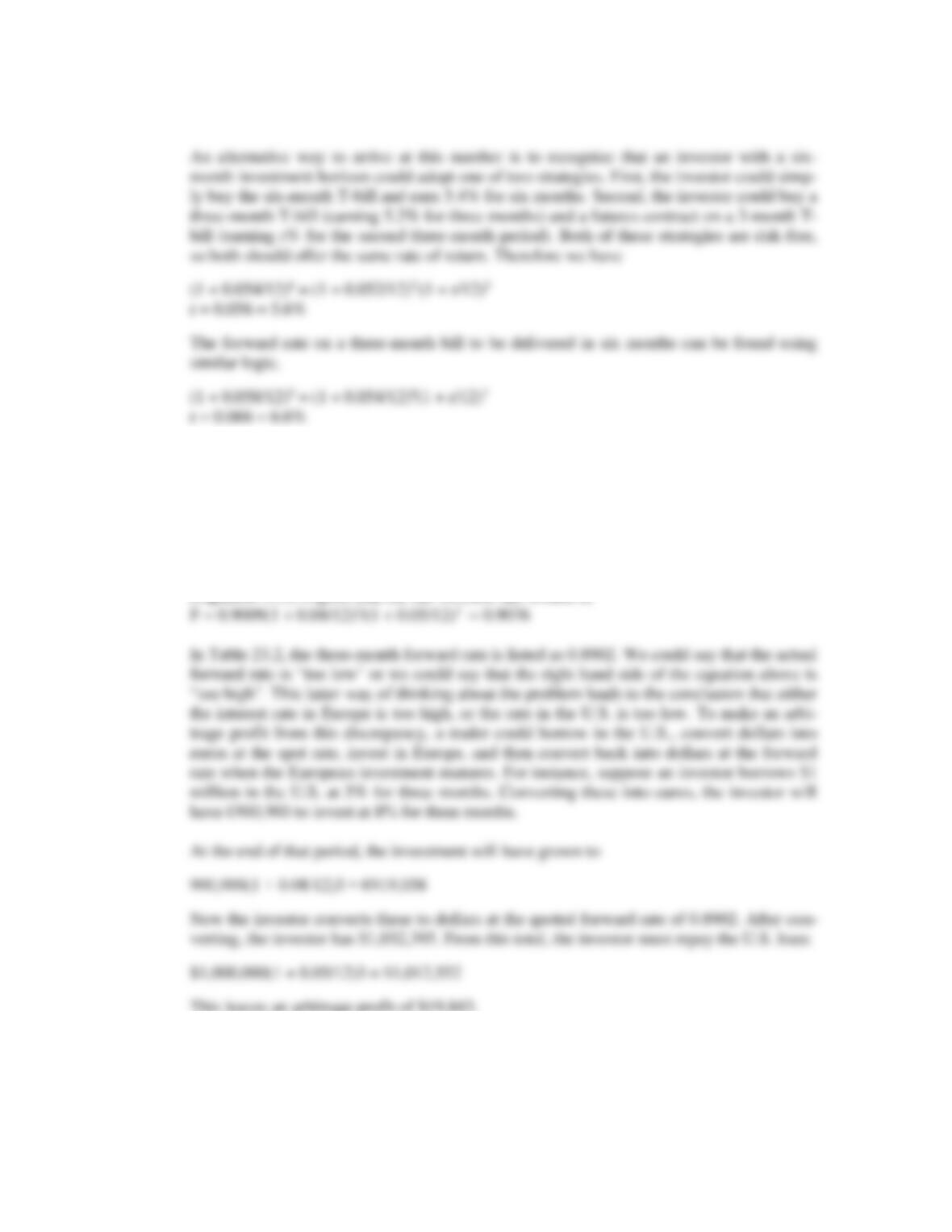
A23-4. We want to determine the forward interest rate on a three-month bond that will be deliv-
602 Instructor’s Manual
P23-5. Using the information in Table 23.2, determine whether the three–month forward rate on euros
is fair if the annualized yield for risk-free borrowing over the next three months is 8% in Eu-
rope and 5% in the United States. If the price is not fair, how could you capitalize on the arbi-
trage opportunity? What is the potential profit? Assume monthly compounding for borrowing
and lending.
A23-5. The spot rate of exchange between euros and dollars is € 0.9009 / $. Interest rate parity
(Equation 23.3) implies that the fair forward rate should be
This leaves an arbitrage profit of $19,843.
P23-6. A U.S. automobile importer is expecting a shipment of custom-made cars from Britain in
six months. Upon delivery, the importer will pay for the cars in pounds. Using the infor-
mation in Table 23.2, suggest a hedging strategy for the importer. Explain the consequenc-
es for the spot market transaction and the forward market transaction if the $/£ spot
exchange rate increases over the next six months.
Chapter 23 Risk Management 603
A23-6. The importer can hedge this exposure by buying Pounds forward at $1.6845 per Pound. If
P23-7. Suppose that KF Exports enters into a FRA with Interfirst Bank with a notional principal of
$50 million and the following terms: In six months, if LIBOR is above 6%, KF will pay In-
terfirst according to the standard FRA formula. On the other hand, if LIBOR is less than
6%, Interfirst will pay KF. If LIBOR is 5.5% in six months, who pays and how much will
the company pay? What if LIBOR is 6.5%?
A23-7. The cash flow for an FRA is the notional principal × (rs – rF) × D/360, all divided by 1 + (rs
Futures Contracts
P23-8. An investor purchases one gold futures contract for delivery in August 2011. Using the
information in Table 23.3, determine the settle price for the contract on July 15, 2011.
What is the total futures price for the contract? If the settle price on the next trading day is
$1,592/oz, will the investor have money deposited into his margin account or withdrawn?
How much? Suppose that the investor eventually closes out the position by selling at a
price of $1,594/oz. How much is his profit or loss?
P23-9. Consider the following scenarios, determine how to hedge each scenario using bond fu-
tures, and comment on whether it would be appropriate to hedge the exposure.
a. A bond portfolio manager will be paid a large bonus if her $10 million portfolio earns
6% in the current fiscal year. She has done very well through the first nine months.
However, she is concerned that interest rates might increase over the next few months.
b. The manager of a company is selling one of its warehouses. The deal will close in two
months. The manager plans to buy six-month Treasury bills when the company re-
ceives payment for the warehouse space, but the manager is worried that interest rates
might decline in the next two months.
604 Instructor’s Manual
c. Sam Blackwell plans to retire in a year. Upon retirement, he will be paid a lump sum
based on the value of the securities in his defined-contribution retirement plan. Sam’s
portfolio consists largely of Treasury bonds, and he is worried that interest rates will be
increasing in the coming year.
A23-9. a. The portfolio manager could sell bond futures to protect herself from a decline in the
Options and Swaps
P23-10. Chipman Products Company will suffer an increase in borrowing costs if the 13-week
Treasury bill rate increases in the next six months. Chipman Products is willing to accept
the risk of small changes in the 13-week T-bill rate but wishes to avoid the potential
losses associated with large changes. The company plans to hedge its risk exposure using
an interest rate collar. If the company buys a call option on the 13-week T-bill rate with a
strike price of 60 and sells a put option with a strike price of 50, describe how this strate-
gy will limit the company’s exposure to changes in the T-bill rate. The premium on the
call is 0.75, and the premium on the put is 0.85. What is the company’s profit (or loss) in
the option market if the T-bill rate is 4.5% in five months? If the T-bill rate is 5.5%? If
the T-bill rate is 6.5%?
A23-10. By buying a call option on the 13-week T-bill rate, the company is protected from in-
creases in its borrowing costs above a T-bill rate of 6.0%. By selling a floor, the compa-
P23-11. Go to the CBOT website (www.cmegroup.com/company/cbot.html),and determine the
contract specifications for Dow Jones Industrial Average futures. Determine the current
futures price for the next available contract month. What would your profit or loss be if
you bought one contract today and the Dow Jones Industrial Average increased by 100
points before the last settlement date?
P23-12. Company A, based in Switzerland, would like to borrow $10 million at a fixed rate of
interest. Because the company is not well known, however, it has not been able to find a
willing U.S. lender. However, the company can borrow SF17,825,000 at 11% per year
for five years. Company B, based in the United States, would like to borrow
SF17,825,000 for five years at a fixed rate of interest. It has not been able to find a Swiss
lender. However, it has been offered a loan of $10 million at 9% per year. Five-year gov-
ernment bonds are yielding 9.5% and 8.5% in Switzerland and the United States, respec-
tively. Suggest a currency swap that would net the financial intermediary 0.5% per year.
Chapter 23 Risk Management 605
A23-12. One possible arrangement is
Annual payment by Company A to FI: 10.25% of $10,000,000
P23-13. Citibank and ABM Company enter into a five-year interest rate swap with a notional
principal of $100 million and the following terms: Every year for the next five years,
ABM agrees to pay Citibank 6% and receive from Citibank LIBOR. Using the following
information about LIBOR at the end of each of the next five years, determine the cash
flows in the swap.
Year LIBOR (%)
1 5.0
2 5.5
3 6.2
4 6.0
5 6.4
A23-13. The cash flows would be
Year 1: Net payment to Citibank of $1,000,000
P23-14. Based on the type of swap ABM entered into in the previous problem, what type of lia-
bilities do you think ABM has? Long-term or short-term?
THOMSON ONE Business School Edition: Answers will vary from moment to moment.
Answer to MiniCase
Risk Management
Basic International Group Incorporated has been involved in international trade for the past 4 years.
Recently the CEO has come to the realization that Basic needs better risk management and he asks
you to investigate ways to manage risk through hedging. You remember that derivative securities,
including forwards, futures, options, and swaps, are the financial instruments commonly used for
hedging and risk management. However, to gain more insight into risk management you decide to
answer the following questions.
Assignment
1. What are the types of risk factors that a company faces?
2. If risk aversion cannot explain why firms choose to hedge, then what are the motivations?
606 Instructor’s Manual
3. Explain how a firm’s management can limit risk exposure through using a forward contract.
What types of forward contracts are available?
4. What are the differences between forwards and futures contracts?
5. How do managers use futures contracts to limit risk exposure?
6. How do managers use options to limit risk exposure?
7. How do managers use swaps to limit risk exposure?
Answers
1. The chapter discusses three types of risk factors; interest rate risk, transaction exposure, and
economic exposure. A firm is exposed to interest rate risk if a change in the level of interest
2. According to modern hedging theory, value-maximizing firms hedge because hedging can in-
crease firm value in several different ways. For most firms, however, the principal reason for
hedging is to reduce the likelihood of financial distress. Reducing the likelihood of financial
distress benefits the firm by also reducing the likelihood it will experience the costs associated
3. Managers can use forward contracts to lock in prices today for a future contract. Forward con-
4. Like a forward contract, a futures contract involves two parties agreeing today on a price at
which the purchaser will buy a given amount of a commodity or financial instrument from the
5. Futures contracts, like forward contracts, are also used for hedging. There are futures markets
6. A key feature of an option as a hedging tool is that it provides protection against adverse price
risk (an investor has the right to exercise the option if price changes make it optimal to do so)
Chapter 23 Risk Management 607
7. In a swap contract, two parties agree to exchange payment obligations on two underlying fi-
nancial liabilities that are equal in principal amount but differ in payment patterns. Investors
use swaps to change the characteristics of cash flows, most often to change the characteristics