Chapter 23
Other Topics in Working Capital Management
ANSWERS TO BEGINNING-OF-CHAPTER QUESTIONS
23-1 The Economic Ordering Quantity (EOQ) model combines the annual costs associated
with ordering different quantities with the annual costs of carrying different average
inventory balances. Ordering costs decline with larger orders, but larger orders mean
larger average inventory balances, which mean larger carrying costs. The EOQ model
finds the optimal order size, defined as the order size that minimizes the total annual costs
23-2 William Baumol modified the EOQ inventory model and applied it to cash management.
He treated the transactions cost of either selling marketable securities or borrowing to
replenish the cash balance as ordering costs in an EOQ sense, and in his model the
23-3 Inventories used must be charged to cost of goods sold, which is subtracted from sales to
produce gross operating profit. The four primary methods used to value inventory are
these: (1) Specific identification, where each item’s cost is recorded and used as the cost
of goods sold when the item is sold. Autos on a dealer’s lot are an example. (2) First in,
first out (FIFO). (3) Last in, last out (LIFO). (4) and weighted average cost. If prices
ANSWERS TO END-OF-CHAPTER QUESTIONS
23-1 a. The Baumol model is a model for establishing the firm’s target cash balance that
closely resembles the EOQ model used for inventory. The model assumes (1) that the
b. Carrying costs are the costs of carrying inventory. Ordering costs are the costs of
ordering inventory. Total inventory costs are the sum of ordering and carrying costs.
c. The Economic Ordering Quantity (EOQ) is the order quantity that minimizes the
e. The red line method is a technique for inventory control, as is the two-bin method.
Computerized inventory control systems are just what the name implies. In the red
line method, a line is drawn around the inside of a bin at the level of the reorder point,
and the inventory clerk places an order when the red line shows. The two–bin method
Answers and Solutions: 28 – 3
23-2 a. Our suppliers switch from delivering –
by train to air freight. (a below)
b. We change from producing just in time to
e. Interest rates rise; other things –
are constant. (e below)
(a) Lower safety stock will be required because delivery time is shortened.
23-3 When money is tight, interest rates are generally high. This means that near–cash assets
have high returns; hence, it is expensive to hold idle cash balances. Firms tend to
economize on their cash balance holdings during tight-money periods.
Answers and Solutions: 28 – 4
23-4 a. Better synchronization of cash inflows and outflows would allow the firm to keep its
transactions balance at a minimum, and would therefore lower the target cash
balance.
d. An overdraft system will enable the firm to hold less cash.
e. If the amount borrowed equals the increase in check–writing, the target cash balance
Answers and Solutions: 28 – 5
SOLUTIONS TO END-OF-CHAPTER PROBLEMS
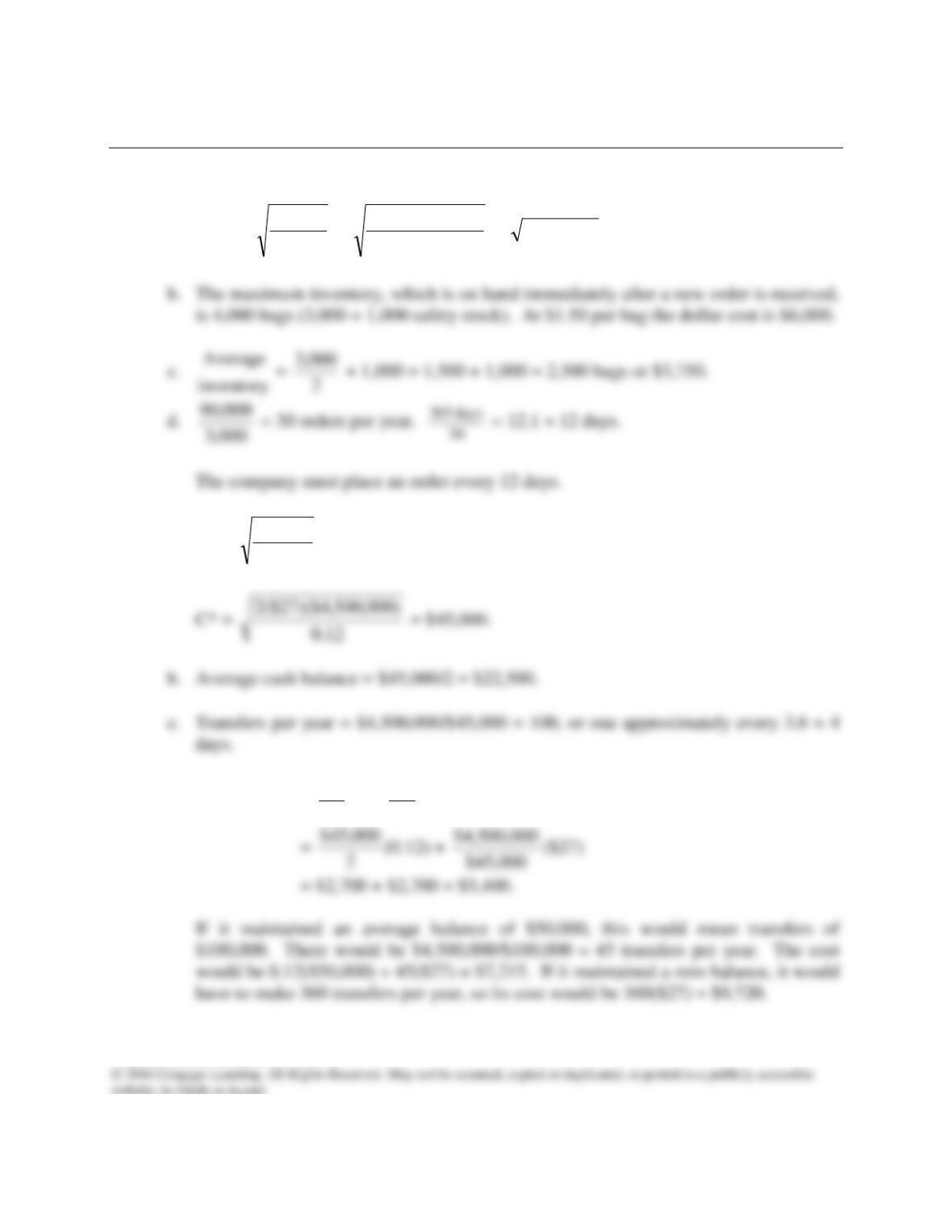
23-1 a. EOQ =
)P)(C(
)S)(F(2
=
)5.1)(2.0(
)000,90
)(15($2
=
000,000,9
= 3,000 bags per order.
23-2 a. C* =
r
)T)(F(2
=
sizen transactio
Optimal
. F = $27; T = $4,500,000; r = 12%.
d. Total cost =
2
*C
(r) +
*C
T
(F)
Answers and Solutions: 28 – 6

SOLUTIONS TO SPREADSHEET PROBLEMS
23-3 The detailed solution for the spreadsheet problem, Ch28 P03 Build a Model Solution.xls,
is available on the textbook’s Web site.
Answers and Solutions: 28 – 7
MINI CASE
Andria Mullins, financial manager of Webster Electronics, has been asked by the firm’s
CEO, Fred Weygandt, to evaluate the company’s inventory control techniques and to lead
a discussion of the subject with the senior executives. Andria plans to use as an example
one of Webster’s “big ticket” items, a customized computer microchip which the firm uses
in its laptop computer. Each chip costs Webster $200, and in addition it must pay its
supplier a $1,000 setup fee on each order. Further, the minimum order size is 250 units;
Webster’s annual usage forecast is 5,000 units; and the annual carrying cost of this item is
estimated to be 20 percent of the average inventory value.
Andria plans to begin her session with the senior executives by reviewing some basic
inventory concepts, after which she will apply the EOQ model to Webster’s microchip
inventory. As her assistant, you have been asked to help her by answering the following
questions:
a. Why is inventory management vital to the financial health of most firms?
Answer: Inventory management is critical to the financial success of most firms. If insufficient
b. What assumptions underlie the EOQ model?
Answer: the standard form of the EOQ model requires the following assumptions:
Mini Case: 23- 8
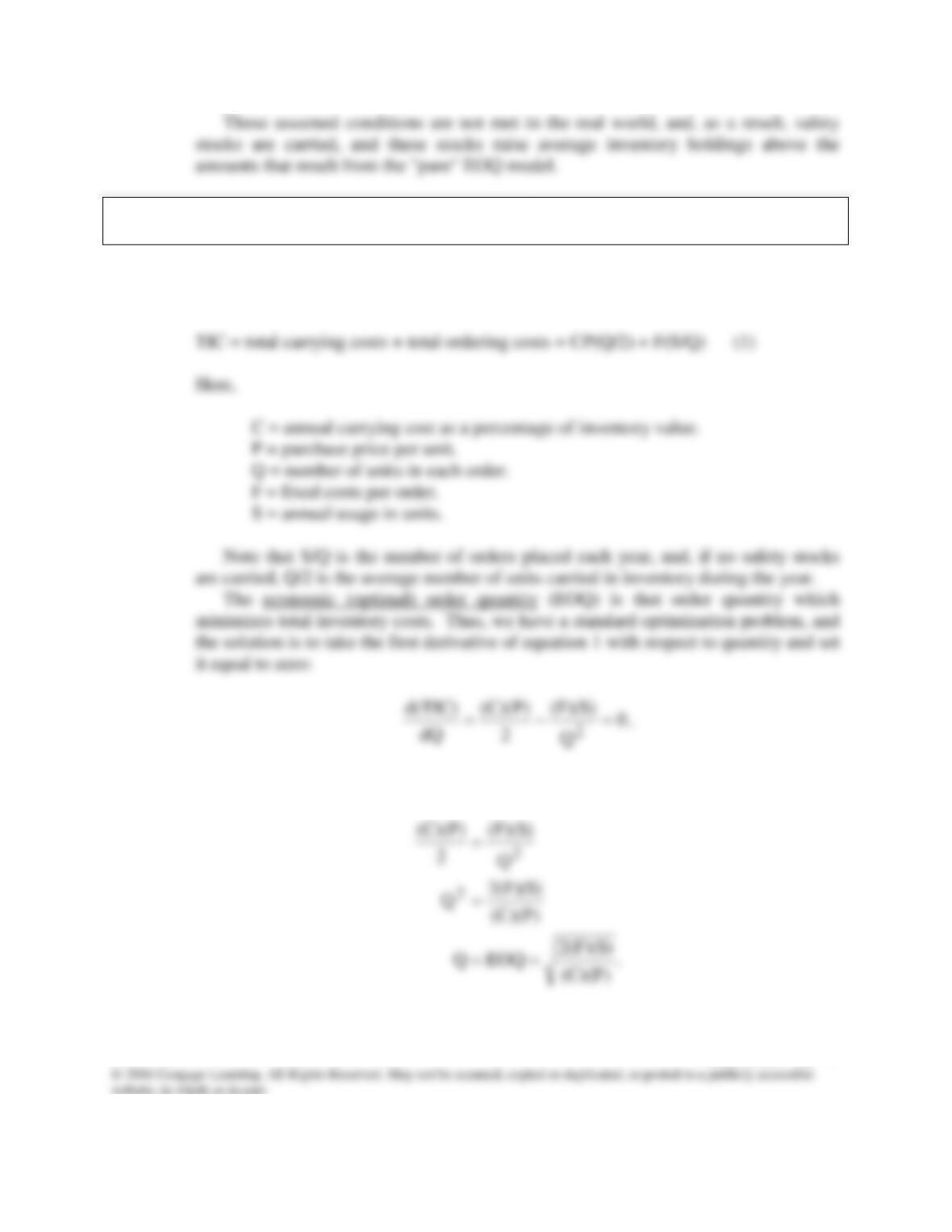
c. Write out the formula for the total costs of carrying and ordering inventory, and
then use the formula to derive the EOQ model.
Answer: Under the assumptions listed above, total inventory costs (TIC) can be expressed as
follows:
TIC = total carrying costs + total ordering costs = CP(Q/2) + F(S/Q) (1)
Now, solving for Q, we obtain:
Mini Case: 28 – 9
d. What is the EOQ for custom microchips? What are total inventory costs if the
EOQ is ordered?
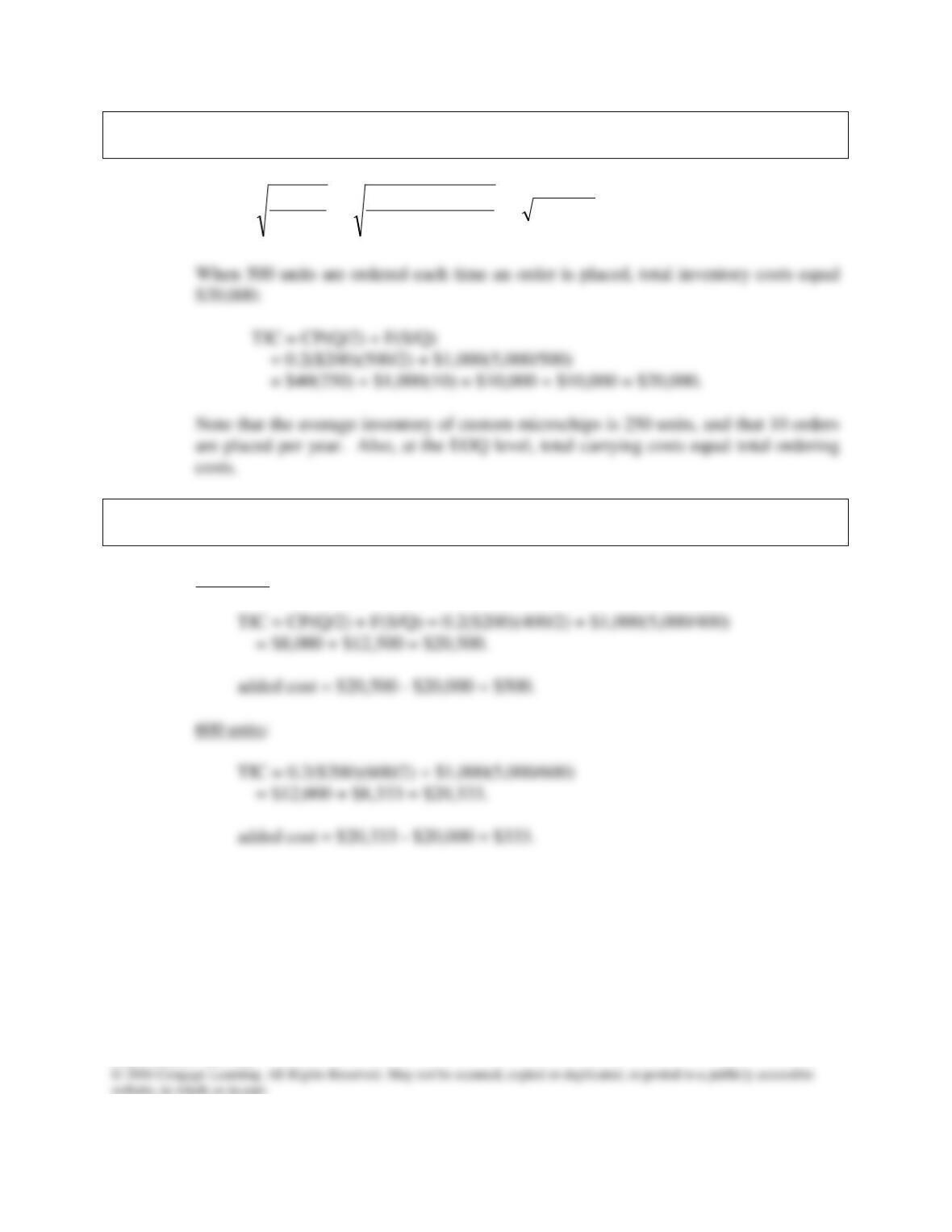
Answer: EOQ =
)P)(C(
)S)(F(2
=
)200($2.0
)000,5)(000,1($2
=
000,250
= 500 units.
e. What is Webster’s added cost if it orders 400 units at a time rather than the
EOQ quantity? What if it orders 600 per order?
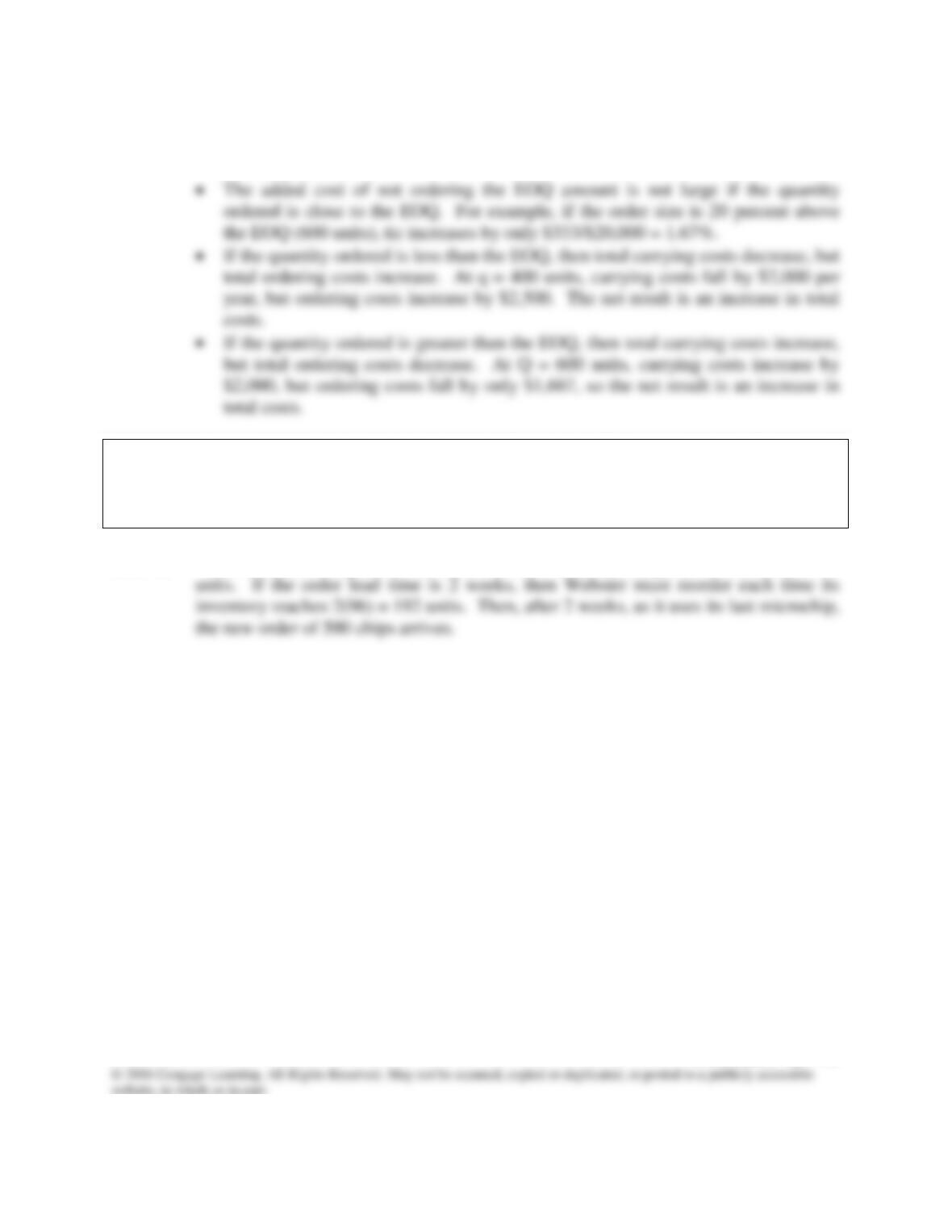
Answer: 400 units:
TIC = CP(Q/2) + F(S/Q) = 0.2($200)(400/2) + $1,000(5,000/400)
Mini Case: 23- 10
Note the following points:
• At any order quantity other than EOQ = 500 units, total inventory costs are higher
than they need be.
f. Suppose it takes 2 weeks for Webster’s supplier to set up production, make and
test the chips, and deliver them to Webster’s plant. Assuming certainty in
delivery times and usage, at what inventory level should Webster reorder?
(assume a 52-week year, and assume that Webster orders the EOQ amount.)
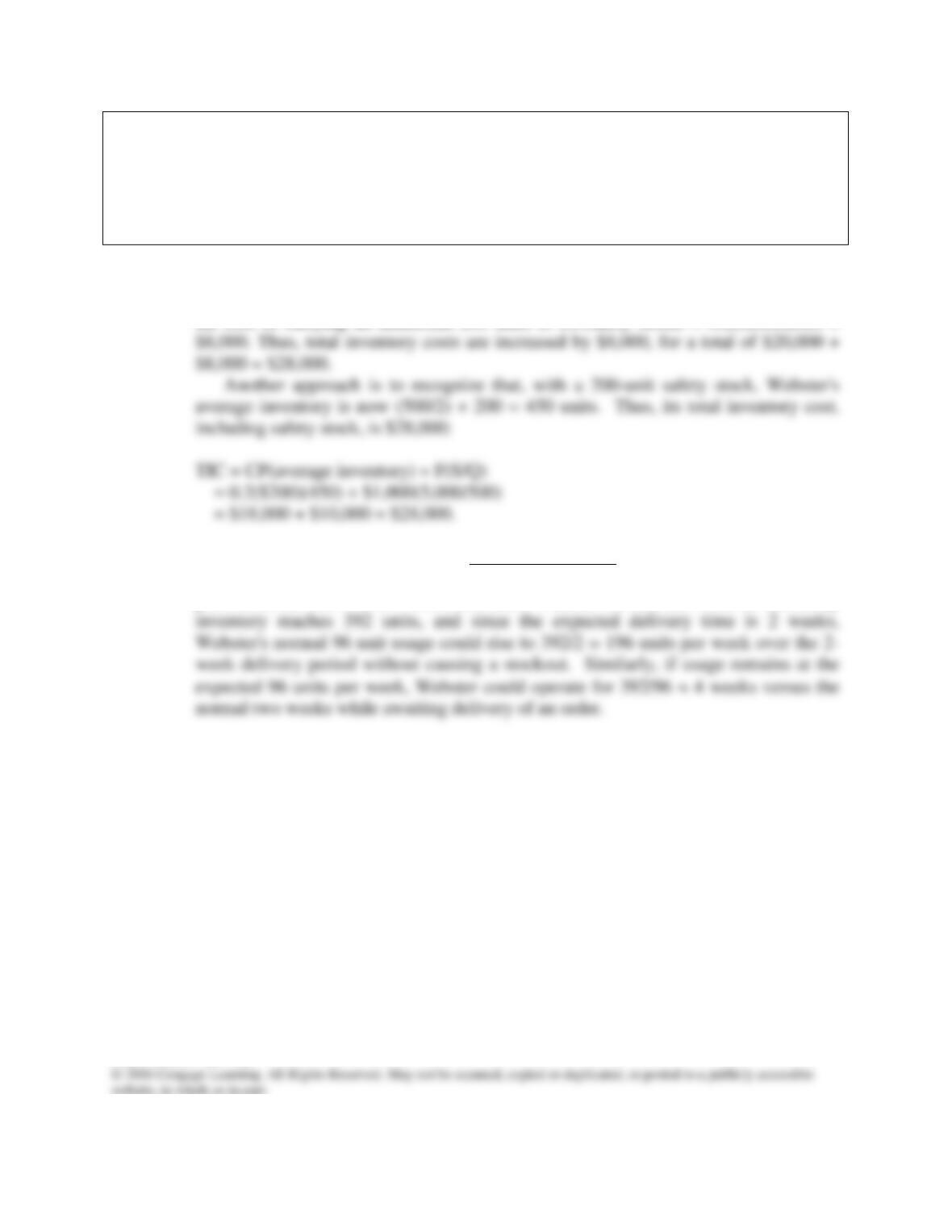
Answer: With an annual usage of 5,000 units, Webster’s weekly usage rate is 5,000/52 ≈ 96
Mini Case: 28 – 11
g. Of course, there is uncertainty in Webster’s usage rate as well as in delivery
times, so the company must carry a safety stock to avoid running out of chips
and having to halt production. If a 200–unit safety stock is carried, what effect
would this have on total inventory costs? What is the new reorder point? What
protection does the safety stock provide if usage increases, or if delivery is
delayed?
Answer: There are two ways to view the impact of safety stocks on total inventory costs.
Webster’s total cost of carrying the operating inventory is $20,000 (see part d). Now
the cost of carrying an additional 200 units is CP(safety stock) = 0.2($200)(200) =
Webster must still reorder when the operating inventory reaches 192 units. However,
with a safety stock of 200 units in addition to the operating inventory, the reorder
point becomes 200 + 192 = 392 units. Since Webster will reorder when its microchip
Mini Case: 23- 12
h. Now suppose Webster’s supplier offers a discount of 1 percent on orders of 1,000
or more. Should Webster take the discount? Why or why not?
Answer: First, note that since the discount will only affect the orders for the operating
inventory, the discount decision need not take account of the safety stock. Webster’s
i. For many firms, inventory usage is not uniform throughout the year, but, rather,
follows some seasonal pattern. Can the EOQ model be used in this situation? If
so, how?
Answer: The EOQ model can still be used if there are seasonal variations in usage, but it must
be applied to shorter periods during which usage is approximately constant. For
j. How would these factors affect an EOQ analysis?
1. The use of just–in–time procedures.
Answer: Just-in–time procedures are designed specifically to reduce inventories. If a just in
Mini Case: 28 – 13
j. 2. The use of air freight for deliveries.
Answer: Air freight would presumably shorten delivery times and reduce the need for safety
j. 3. The use of a computerized inventory control system, wherein as units were
removed from stock, an electronic system automatically reduced the inventory
account and, when the order point was hit, automatically sent an electronic
message to the supplier placing an order. The electronic system ensures that
inventory records are accurate, and that orders are placed promptly.
Answer: Computerized control systems would, generally, enable the company to keep better
j. 4. The manufacturing plant is redesigned and automated. Computerized process
equipment and state-of-the–art robotics are installed, making the plant highly
flexible in the sense that the company can switch from the production of one
item to another at a minimum cost and quite quickly. This makes short
production runs more feasible than under the old plant setup.
Answer: The trend in manufacturing is toward flexibly designed plants, which permit small
Mini Case: 23- 14
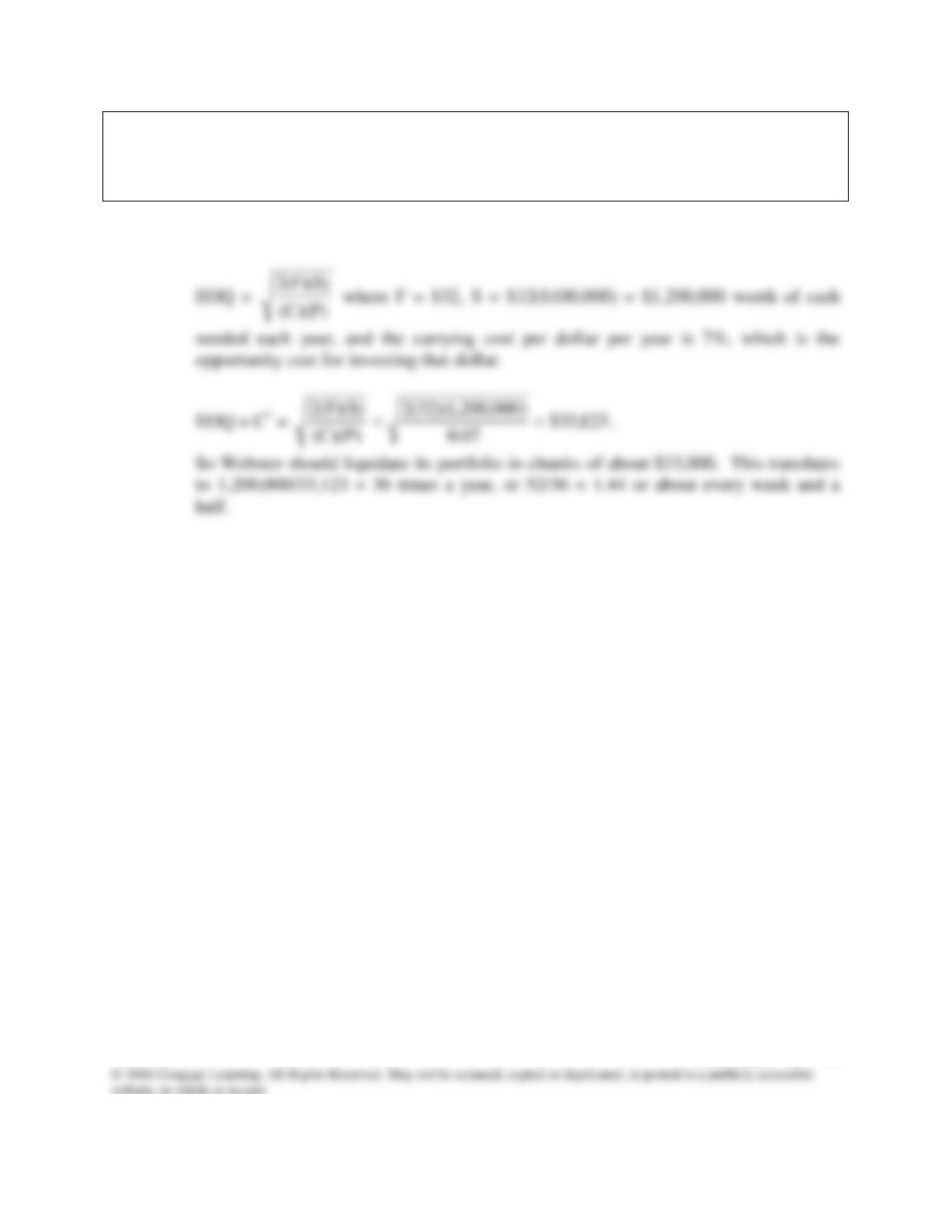
k. Webster runs a $100,000 cash deficit per month, requiring periodic transfers
from its marketable securities portfolio. Broker fees are $32 per transfer and
Webster earns 7% on its investment portfolio. Can Andrea use the EOQ model
to determine how frequently Webster should liquidate part of its portfolio?
Answer: The EOQ model can be applied directly to this problem.
Mini Case: 28 – 15