569
Chapter 22 Bankruptcy and Financial Distress
Chapter Overview
The Opening Focus concerns Chrysler’s Bankruptcy and the government’s intervention in
the fall of the automobile giant. Chrysler’s obligations to pension plans and healthcare plans and
other debt exceeded the value of its assets. The government had already loaned them $4 billion but
were still struggling. They had three options: liquidation, reorganization or sale. They were only
worth $800 million if liquidated but worth more if sold as an intact unit. Through an intervention
by the U.S. Government – allegedly to protect Big Labor (the UAW) – Fiat was given a large
percentage of shares in the New Chrysler. Will these actions work?
Opening Focus Discussion Questions:
1. What is the earnings impact when costs that should be attributed to operating expenses are
instead treated as capital expenditures?
This chapter discusses
22-1. Bankruptcy and Business Failure
22-2. The Bankruptcy Code and Chapter 11
Technology
1. Smart Ethics Video. Tom Cole of Deutsche Bank’s Leveraged Finance Group talks about
ethical issues in bankruptcy.
Lecture Guide
Three executives were arguing about who would pay for lunch that day. The first said,
“I’ll pay. I’ll use this as a tax write-off.” The second said, “No, I’ll take it. I’ll charge it to my
company expense account.” The third one said, “No, let me have it. I’m filing for bankruptcy
tomorrow.”
22-1 Bankruptcy and Business Failure
Financial Distress is defined as when a companies cash flows are insufficient to pay its
current obligations. There are many types of distress in addition to bankruptcy. This section
Instructor’s Manual
570
Figure 22.1 Outcomes of Financial Distress
Table 22.1 Largest Bankruptcies in U.S. History
For an up to date list of bankruptcies, go to bankruptcydata.com. This web site lists the
Table 22.2 Annual Business Bankruptcy Filings in the United States, 2000-2010
22-2 The Bankruptcy Code and Chapter 11
22-2a The Bankruptcy Code
Table 22.3 Summary of Bankruptcy Code Chapters
Table 22.3 and this section summarizes the bankruptcy code. There are fifteen chapters in
the code. While the most well known is Chapter 7 and 11, others are used nearly as often. Chapter
22-2b The Chapter 11 Process
The largest firms tend to file Chapter 11, rather than Chapter 7 bankruptcies. Firms filing
Chapter 11 are less likely to be insolvent. Their assets are more likely to be greater than their
liabilities and they are more likely to have an immediate cash flow problem. Larger firms are also
likely to be solvent, rather than insolvent, when filing Chapter 11 bankruptcy. Why is this?
• Student Involvement: Have student get into small groups and look at recent bankruptcies
Chapter 22 Bankruptcy and Financial Distress
571
22-2c Illiquidity
In the early stages of a bankruptcy case, a firm frequently faces the problem of being
22-2d Valuation
Valuation is tricky in bankruptcy because all parties have varying reasons to see the
22-2e Management
Under Chapter 11 the existing management usually stays in place. They become debtor-in–
Figure 22.2 The Players in a Corporate Bankruptcy
22-2f The Chapter 11 Plan of Organization
A distressed firm will usually try to work out its difficulties with its creditors first, before
formally filing for bankruptcy. Success depends in part on the number of creditors – the more
creditors, the more difficult working out a voluntary settlement will be. If a firm cannot
22-2g Attractive Features of Chapter 11
This section lists the most attractive features of the Chapter 11 Bankruptcy Code and
Instructor’s Manual
572
22-2h The Success of Chapter 11
22-3 Bankruptcy Act of 2005
This section gives a very brief summary of the changes to bankruptcy code that was written
22-4 Alternatives to Traditional Chapter 11
22-4a Out-of-Court Workouts
22-4b Prepackaged Bankruptcies
Some companies handle all of the details of bankruptcy before actually filing for Chapter
22-4c Chapter 7
Chapter 7 is actually the most chosen form of bankruptcy. Chapter 7 is a liquidation of
22-5 Priority of Claims
The priority of claims is listed and discussed in this section.
Table 22.4 Balance Sheet for Oxford Company
Table 22.5 Distribution of the Liquidation Proceeds of Oxford Company
22-6 Predicting Bankruptcy
Altman’s Z score is commonly used in predicting bankruptcy. It uses inputs including working
Chapter 22 Bankruptcy and Financial Distress
573
Table 22.7 Balance Sheet of Poff Industries
Table 22.8 Income Statement for Poff Industries
These sections provide a numerical example of calculating the Z score for a firm.
Bankruptcy and Financial Distress summary
Ch. 22 Resource Articles
“Why Chapter 11 Needs Rewriting,” Business Week, March 19, 2001. This article notes that a
number of companies have filed multiple Chapter 11 bankruptcy filings. “Round–tripping”
(jokingly referred to as Chapter 22s and 33s) is an ongoing trend, and has increased since 1997.
Enrichment Exercises
Darden has an excellent group negotiation bankruptcy case concerning Eastern Airlines. There are
four separate cases, each with its own set of spreadsheets and each with a different point of view.
Students can be divided into groups, with each group representing a different point of view. Then
Instructor’s Manual
574
Answers to Concept Review Questions
1. Financial distress occurs when a company’s cash flows are not enough to pay its current
3. Bankruptcy law allows time and provisions for a firm to continue operations and reorganize
into a more efficient firm. The automatic stay provision of Chapter 11 will prevent current
creditors from collecting immediately – which could send the firm into immediate Chapter 7
and no one would benefit. Normal contract law would not allow for these firm saving features.
4. Business failures help the overall economy by weeding out unsuccessful firms. The firms that
are left are stronger, have better business models and better management and make better use
5. It would make sense to reorganize rather than liquidate if the firm has the expectation of future
cash flows sufficient to bring the firm back to solvency. If its assets are worth less than its
6. Existing management generally stays in control because they have the most knowledge about
8. A cramdown procedure is necessary if a particular class of creditors refuses to agree to a
Chapter 22 Bankruptcy and Financial Distress
575
9. The Bankruptcy Act of 2005 gave more power to creditors and made it more difficult to
10. An out-of-court workout is an alternative to Chapter 11 bankruptcy where a company attempts
11. A prepackaged bankruptcy shortens and simplifies the bankruptcy process by preparing a
12. Chapter 7 actually provides for the liquidation of the debtor’s assets by a trustee. Chapter 7 is
13. The absolute priority rule allows creditors to know where they stand in their claim on the
14. Subordinating a claim means that claim has a lower priority. Secured creditors have a claim on
15. Paying the expenses of administering the bankruptcy proceeding is given the highest priority.
If this were not the case it would be difficult to find trustees to agree to administer
Solutions to Self-Test Problems
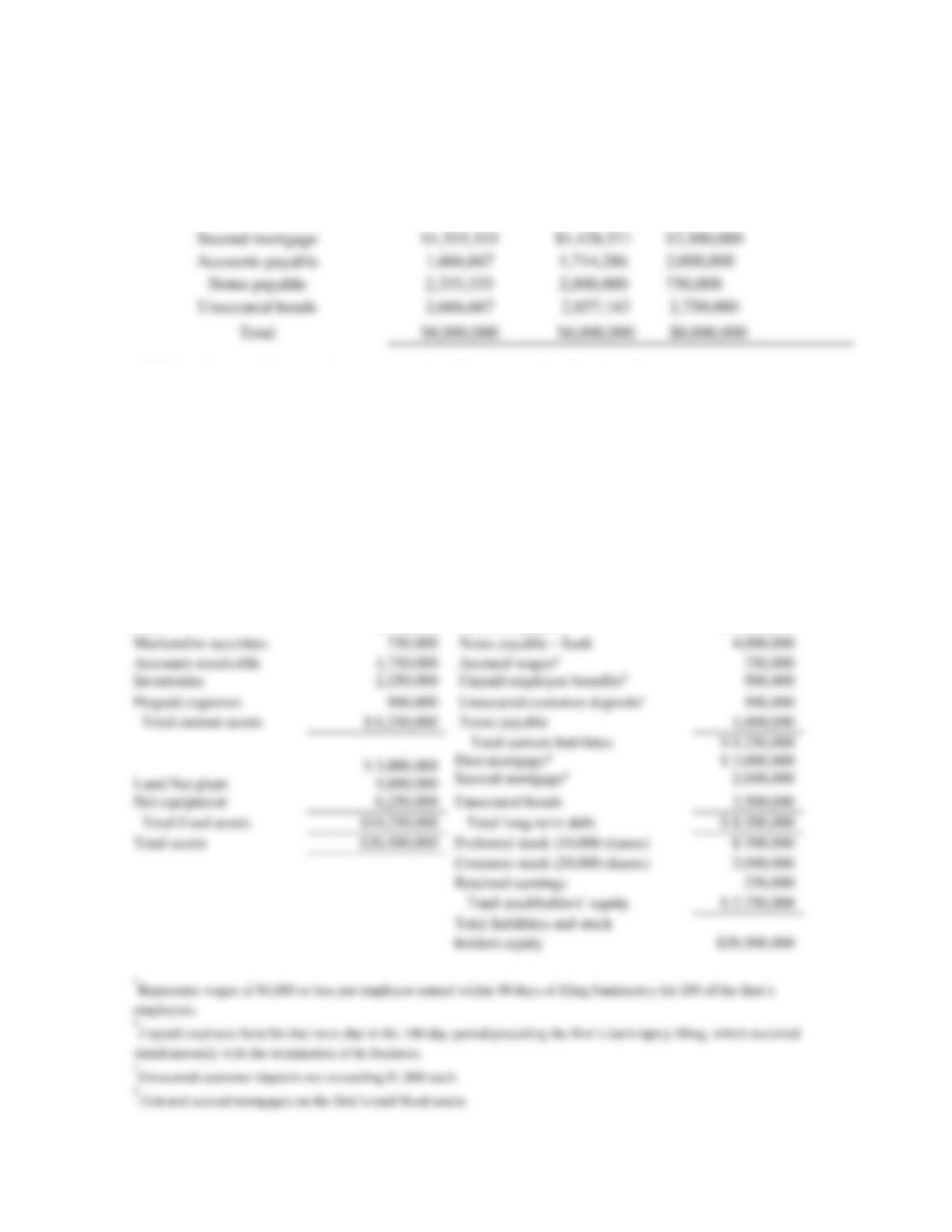
ST22-1. A firm has $8 million in funds to distribute to its unsecured creditors. Three possible sets
of unsecured creditor claims are presented. Calculate the settlement, if any, to be
received by each creditor in each case shown in the following table.
Unsecured Creditors’ Claims
Case I
Case II
Case III
Unpaid balance of second mortgage
$ 2,000,000
$ 2,500,000
$ 5,000,000
Instructor’s Manual
576
In Case II, each creditor will receive $8,000,000/$14,000,000 = $0.5714 on the dollar.
In Case III, each creditor will receive $8,000,000/$16,000,000 = $0.5000 on the dollar. The
actual amounts received are as follows:
Unsecured Creditor
Case I
Case II
Case III
ST22-2. Oxygen Filtration Systems recently failed and will be liquidated by a court-appointed
trustee who will charge $500,000 for his services. The pre-liquidation balance sheet
follows. Assume that the trustee liquidates the assets for $10.2 million, with $5.8 million
coming from the sale of current assets and $4.4 million coming from fixed assets. Also
assume that the unsecured bonds are subordinate to the notes payable. Prepare a table
indicating the amount to be distributed to each claimant. Do the firm’s owners receive
any funds?
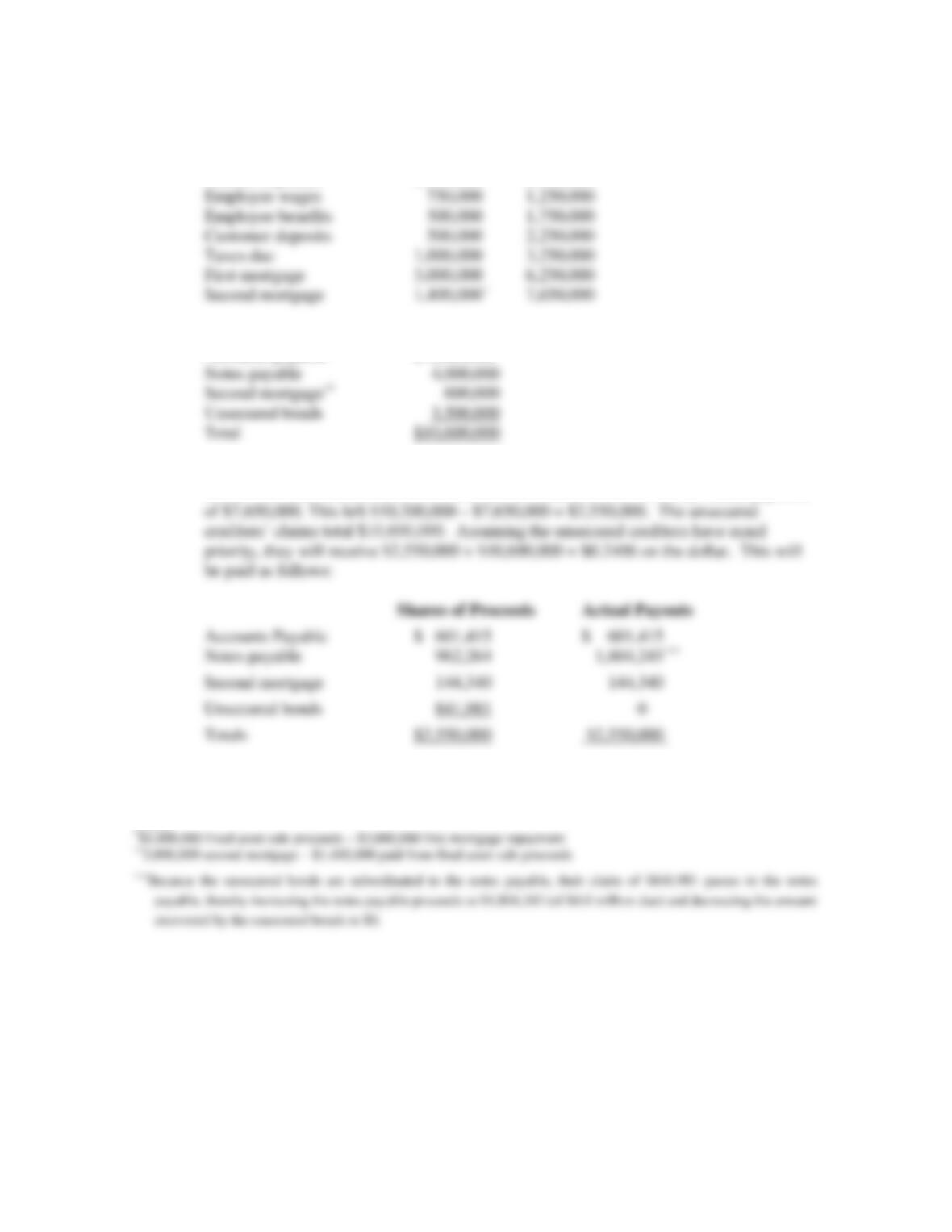
Oxygen Filtration Systems
Balance Sheet as of December 31, 2012
Assets Liabilities and Stockholder’s Equity
Cash
$ 600,000
Accounts payable
$ 2,500,000
Chapter 22 Bankruptcy and Financial Distress
577
A: Amount available for distribution: $10,200,000.
Distributions to Claimants Cumulative Total
Trustee expenses $ 500,000 $ 500,000
Unsecured Creditors
Accounts payable $ 2,500,000
Creditors through the first mortgage-holder will be paid in full, and the second mortgage-
holder will receive $1,400,000 from the sale of secured assets, for a total initial payment
Note that because the unsecured creditors’ claims are not fully repaid, no funds are available for
distribution to the firm’s owners—both the preferred and common stockholders.
____
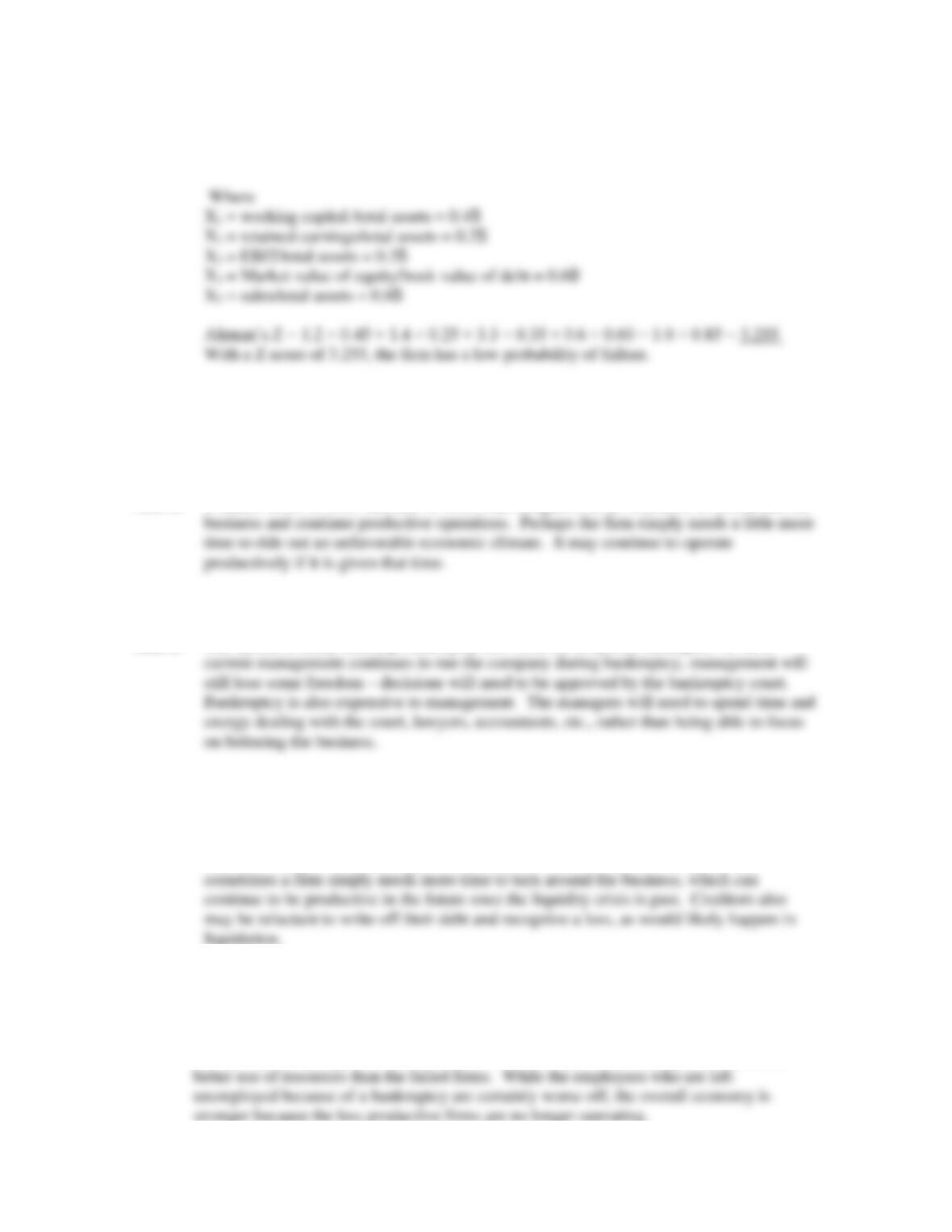
ST22-3. Express Trailers has a working capital/total assets ratio of 0.3, a retained earnings/total
assets ratio of 0.15, an earnings before interest and taxes/ total asset ratio of 0.20, a
market value of equity/book value of equity ratio of 0.5, and a sales/total assets ratio of
0.75. Calculate and interpret the company’s Z score.
Instructor’s Manual
578
A: Altman’s Z = 1.2 × X1 + 1.4 × X2 + 3.3 × X3 + 0.6 × X4 + 1.0 × X5
Answers to End-of-Chapter Questions
Q22-1. Discuss why it makes sense to offer subsidies to firms that reorganize rather than
liquidate.
A22-1. It makes sense to offer subsides to firms that reorganize as an incentive to restructure the
Q22-2. Explain why the option to delay entering bankruptcy has value for corporate managers.
A22-2. The option to delay entering bankruptcy has value for corporate managers. Even if
Q22-3. Why do creditors usually accept a plan for financial rehabilitation rather than demand
liquidation of a business?
A22-3. Creditors will accept a plan for financial rehabilitation is there is a possibility that they
will receive a greater percentage of what they are owed. Creditors recognize that
Q22-4. “A certain number of bankruptcies are good for the economy.” Discuss why you agree or
disagree with this statement.
A22-4. Business failures help the overall economy by weeding out unsuccessful firms. The firms
that are left are stronger, have better business models and better management and make
Chapter 22 Bankruptcy and Financial Distress
579
Q22-5. “A business should always be liquidated when the liquidation value exceeds the business’s
value as a going concern.” Discuss why you agree or disagree with this statement.
A22-5. In general, if liquidation provides more value than continuing the business, then the firm
Q22-6. What are the advantages and disadvantages of a voluntary workout to resolve financial
distress? What are the advantages and disadvantages of declaring bankruptcy to resolve
financial distress?
A22-6. The primary advantage of a voluntary workout is that it is less costly than going through
the courts. It avoids cost costs and legal fees. The disadvantages are that it may be
Q22-7. A business can be liquidated for $700,000, or it can be reorganized. Reorganization would
require an investment of $400,000. If the company is reorganized, earnings are projected
to be $150,000 per year, and the company would trade at a price/earnings ratio of 8.0
times. Should the company be liquidated or reorganized?
A22-7. At a price earnings ratio of 8 times, the earnings are worth 8 × $150,000 = $1,200,000.
Minus the investment of $400,000, this leaves a value of $800,000. This is greater than
Q22-8. Explain why the priorities for liquidation are determined as they are. Do you agree with
the order?
A22-8. The priorities are designed to give the claimants with the strongest claims the highest
priority. Expenses of the bankruptcy proceedings are first because it would be difficult to
get anyone to administer a bankruptcy if they were not assured of being paid for their