MINI CASE
Rich Jackson, a recent finance graduate, is planning to go into the wholesale building
supply business with his brother, Jim, who majored in building construction. The firm
would sell primarily to general contractors, and it would start operating next January.
Sales would be slow during the cold months, rise during the spring, and then fall off again
in the summer, when new construction in the area slows. Sales estimates for the first 6
months are as follows (in thousands of dollars):
Jan $100
Feb 200
Mar 300
Apr 300
May 200
Jun 100
The terms of sale are net 30, but because of special incentives, the brothers expect 30
percent of the customers (by dollar value) to pay on the 10th day following the sale, 50
percent to pay on the 40th day, and the remaining 20 percent to pay on the 70th day. No
bad debt losses are expected, because Jim, the building construction expert, knows which
contractors are having financial problems.
a. Discuss, in general, what it means for the brothers to set a credit and collections
policy.
Answer: When a firm sets its credit and collections policy it determines four things:
1. The credit period, which is the length of time buyers are given to pay for their
purchases
Mini Case: 22 – 21
b. Assume that, on average, the brothers expect annual sales of 18,000 items at an
average price of $100 per item. (use a 365-day year.)
1. What is the firm’s expected days sales outstanding (DSO)?
Answer: Days sales outstanding = DSO = 0.3(10) + 0.5(40) + 0.2(70) = 37 days, vs. 30-day
b. 2. What is its expected average daily sales (ADS)?
b. 3. What is its expected average accounts receivable (AR) level?
b. 4. Assume that the firm’s profit margin is 25 percent. How much of the receivables
balance must be financed? What would the firm’s balance sheet figures for
accounts receivable, notes payable, and retained earnings be at the end of one
year if notes payable are used to finance the investment in receivables? Assume
that the cost of carrying receivables had been deducted when the 25 percent
profit margin was calculated.
Answer: Although the firm has $182,466 in receivables, the entire amount does not have to be
Mini Case: 22- 22
b. 5. If bank loans have a cost of 12 percent, what is the annual dollar cost of carrying
the receivables?
Answer: Cost of carrying receivables = 0.12($136,849) = $16,422. In addition, there is an
c. What are some factors that influence (1) a firm’s receivables level
and (2) the dollar cost of carrying receivables?
Answer: 1. As shown in question B.3. Above, receivables are a function of the average daily
sales and the days sales outstanding. Exogenous economic factors such as the
Mini Case: 22 – 23

d. Assuming that the monthly sales forecasts given previously are accurate, and
that customers pay exactly as was predicted, what would the receivables level be
at the end of each month? To reduce calculations, assume that 30 percent of the
firm’s customers pay in the month of sale, 50 percent pay in the month following
the sale, and the remaining 20 percent pay in the second month following the sale.
Note that this is a different assumption than was made earlier. Use the following
format to answer parts c and d:
E.O.M. Quarterly DSO =
Month Sales AR Sales ADS (AR)/(ADS)
Jan $100 $ 70
Feb 200 160
Mar 300 250 $600 $6.59 37.9
Apr 300
May 200
Jun 100
Mini Case: 22- 24
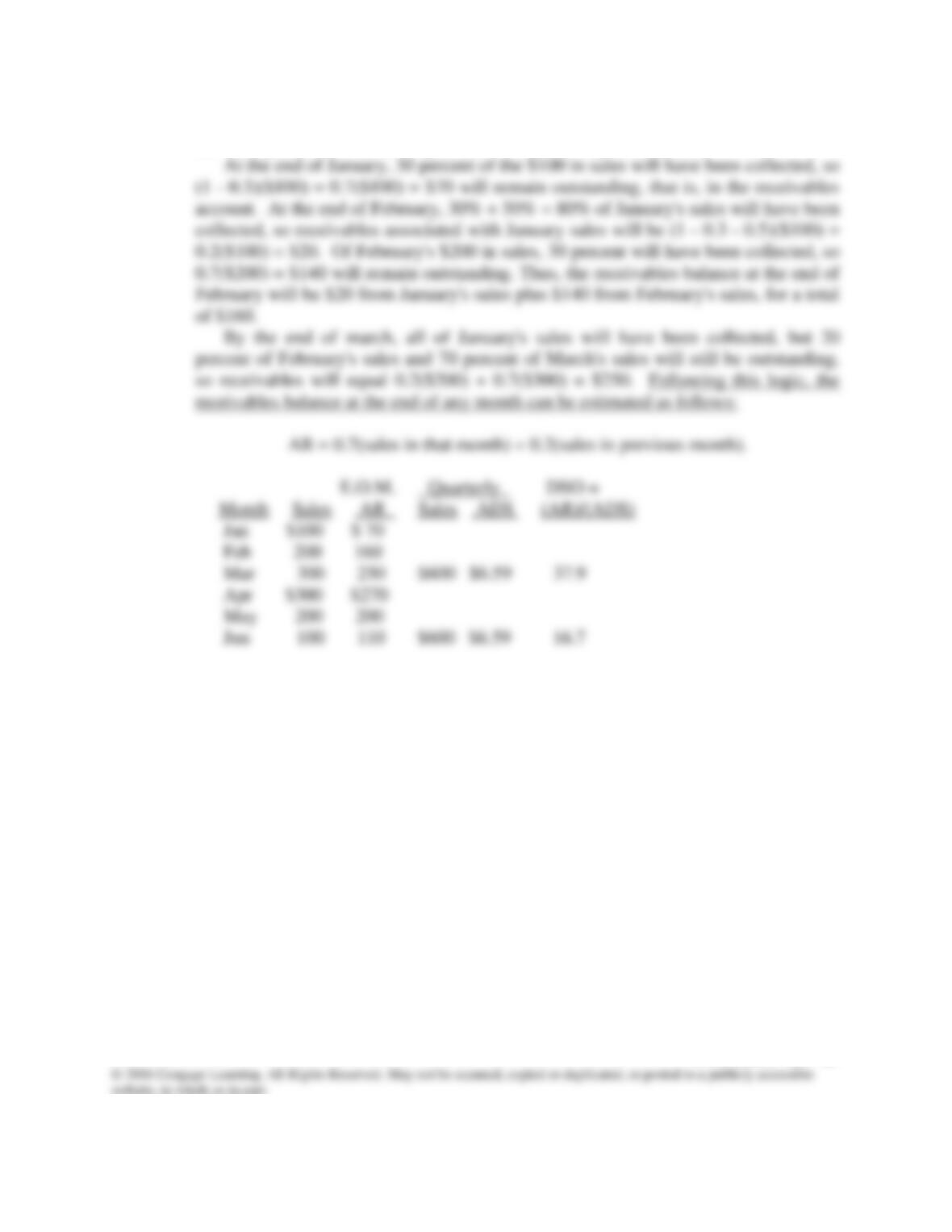
Answer: (Note: from this point on, the solutions are expressed in thousands of dollars. Also,
the table given below is developed in the solutions to parts D and E.)
Mini Case: 22 – 25
e. What is the firm’s forecasted average daily sales for the first 3 months? For the
entire half–year? The days sales outstanding is commonly used to measure
receivables performance. What DSO is expected at the end of March? At the
end of June? What does the DSO indicate about customers’ payments? Is DSO
a good management tool in this situation? If not, why not?
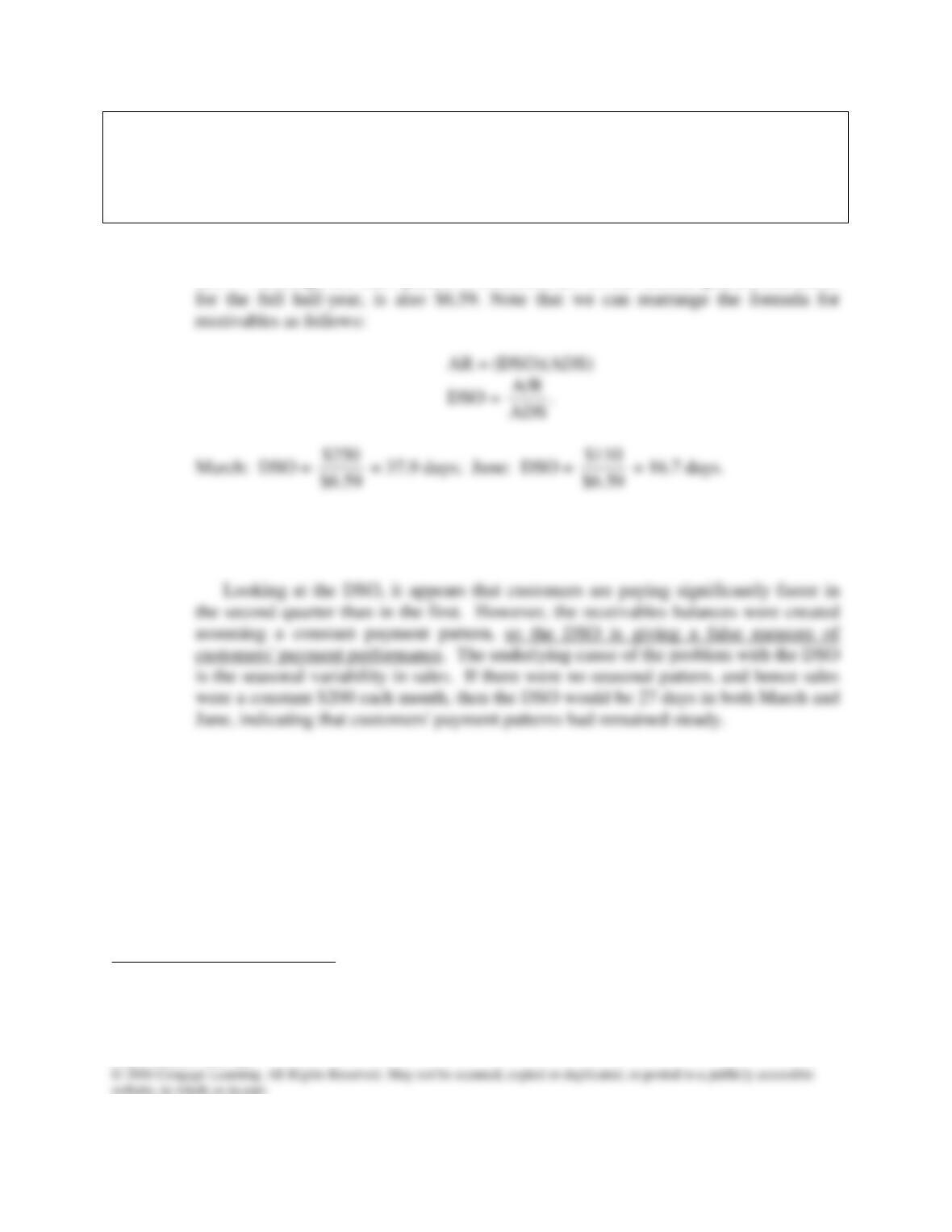
Answer: For the first quarter, sales totaled $100 + $200 + $300 = $600, so ads = $600/91 =
$6.59. Although the sales pattern is different, ads for the second quarter, and hence
Thus, at the end of March, DSO = 37.9 days, while at the end of June, DSO = 16.7
days.1
1Even if one confined ads to the months which contributed to receivables, Feb/Mar and May/Jun, first quarter ADS = $8.33 and
DSO = 30 days, while half–year ads = $5.00 and DSO = 22 days, differences would still appear.
Mini Case: 22- 26
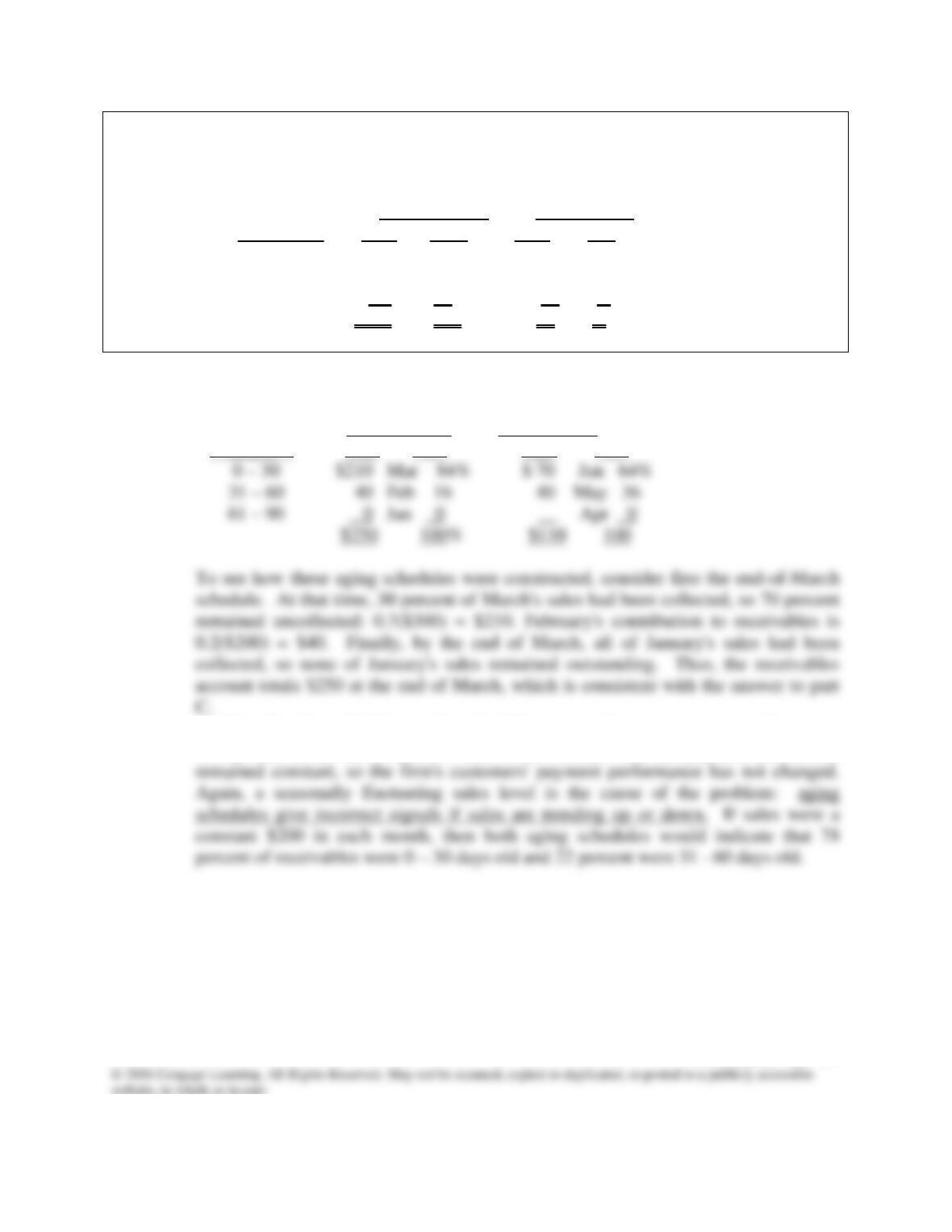
f. Construct aging schedules for the end of March and the end of June (use the
format given below). Do these schedules properly measure customers’ payment
patterns? If not, why not?
Age of account March June
(days) AR % AR %
0 – 30 $210 84%
31 – 60 40 16
61 – 90 0 0
$250 100%
Answer: Aging schedule:
Age of account March June
(days) AR % AR %
Note that the end-of-June aging schedule suggests that customers are paying more
slowly than in the earlier quarter. However, we know that the payment pattern has
Mini Case: 22 – 27
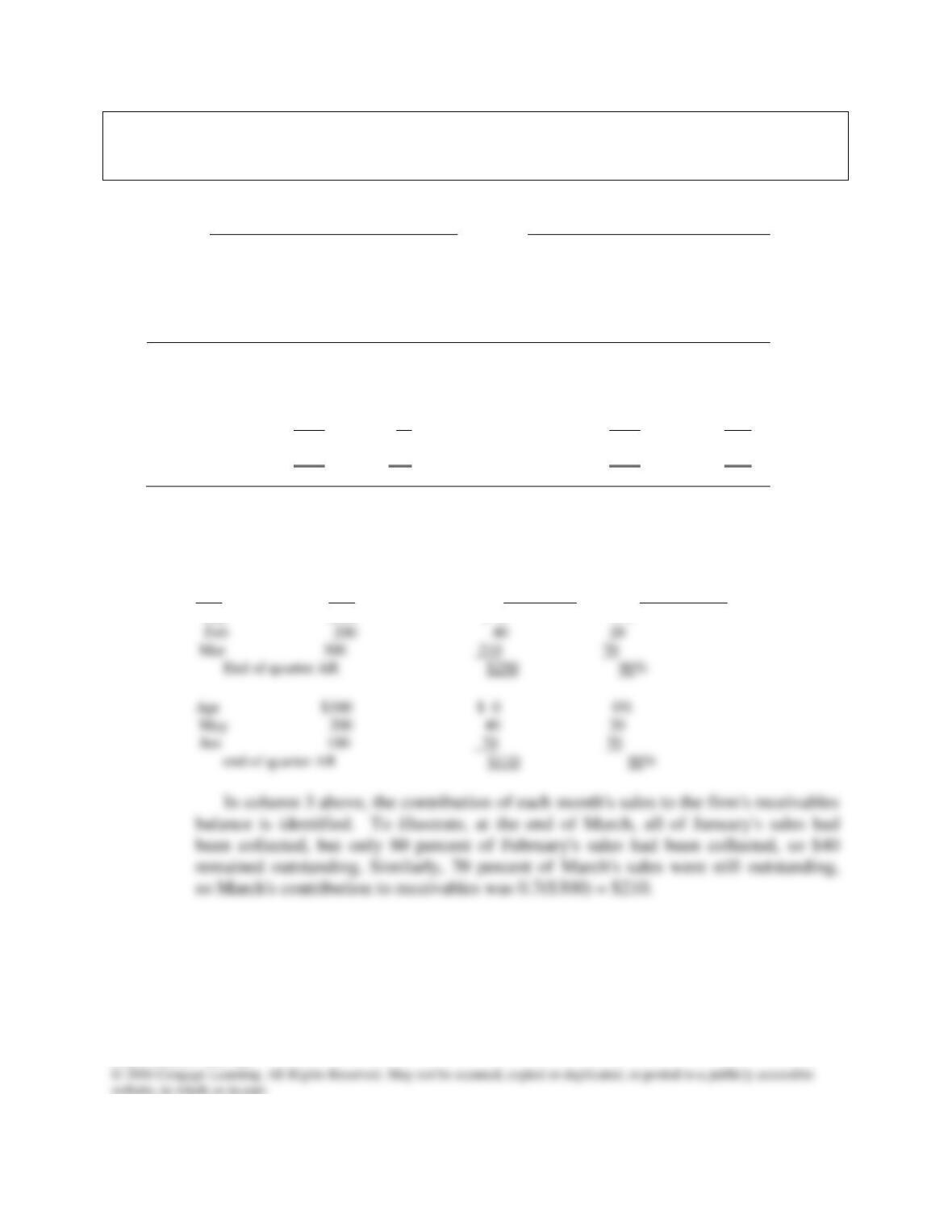
g. Construct the uncollected balances schedules for the end of March and the end
of June. Use the format given below. Do these schedules properly measure
customers’ payment patterns?
March
June
Month
Sales
Contribution
to AR
AR–to–
Sales Ratio
Month
Sales
Contribution
to A/R
AR–to–
Sales
Ratio
January
$100
$ 0
0%
April
February
200
40
20
May
March
300
210
70
June
Answer: Uncollected balances schedules:
Contribution to Ratio of month’s
Month Sales end–of–period AR AR to month’s sales
(1) (2) (3) (4)
Jan $100 $ 0 0%
Mini Case: 22- 28
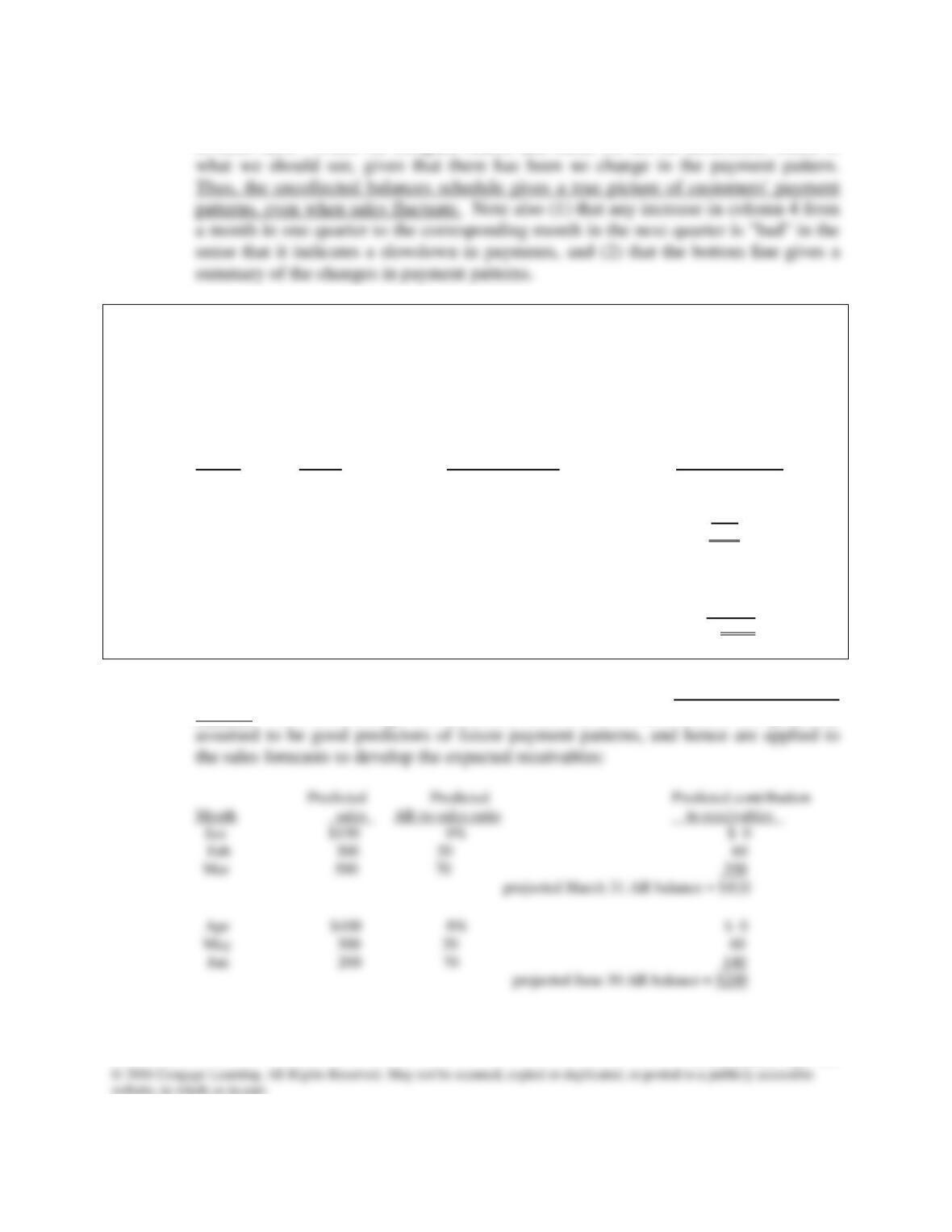
The focal point of the uncollected balances schedule is column 4, the receivables–
to–sales ratio. When we compare March and June, we see no difference, which is
h. Assume that it is now July of year 1, and the brothers are developing pro forma
financial statements for the following year. Further, assume that sales and
collections in the first half–year matched the predicted levels. Using the year 2
sales forecasts as shown next, what are next year’s pro forma receivables levels
for the end of March and for the end of June?
Predicted Predicted Predicted contribution
Month sales AR–to–sales ratio to receivables
Jan $150 0% $ 0
Feb 300 20 60
Mar 500 70 350
projected March 31 AR balance = $410
Apr $400
May 300
Jun 200
Projected June 30 AR balance =
Answer: The uncollected balances schedule can be used to forecast the pro forma receivables
balance. For forecasting, the historical receivables–to–sales ratios are generally
Mini Case: 22 – 29

i. Assume now that it is several years later. The brothers are concerned about the
firm’s current credit terms, which are now net 30, which means that contractors
buying building products from the firm are not offered a discount, and they are
supposed to pay the full amount in 30 days. Gross sales are now running
$1,000,000 a year, and 80 percent (by dollar volume) of the firm’s paying
customers generally pay the full amount on day 30, while the other 20 percent
pay, on average, on day 40. Two percent of the firm’s gross sales end up as bad
debt losses.
The brothers are now considering a change in the firm’s credit policy. The
change would entail (1) changing the credit terms to 2/10, net 20, (2) employing
stricter credit standards before granting credit, and (3) enforcing collections
with greater vigor than in the past. Thus, cash customers and those paying
within 10 days would receive a 2 percent discount, but all others would have to
pay the full amount after only 20 days. The brothers believe that the discount
would both attract additional customers and encourage some existing customers
to purchase more from the firm—after all, the discount amounts to a price
reduction. Of course, these customers would take the discount and, hence,
would pay in only 10 days.
The net expected result is for sales to increase to $1,100,000; for 60 percent of
the paying customers to take the discount and pay on the 10th day; for 30
percent to pay the full amount on day 20; for 10 percent to pay late on day 30;
and for bad debt losses to fall from 2 percent to 1 percent of gross sales. The
firm’s operating cost ratio will remain unchanged at 75 percent, and its cost of
carrying receivables will remain unchanged at 12 percent.
To begin the analysis, describe the four variables that make up a firm’s
credit policy, and explain how each of them affects sales and collections. Then
use the information given in part H to answer parts I through N.
Answer: The four variables which make up a firm’s credit policy are (1) the discount offered,
including the amount and period; (2) the credit period; (3) the credit standards used
Mini Case: 22 – 31
j. Under the current credit policy, what is the firm‘s days sales outstanding (DSO)?
What would the expected DSO be if the credit policy change were made?
k. What is the dollar amount of the firm’s current bad debt losses? What losses
would be expected under the new policy?
l. What would be the firm‘s expected dollar cost of granting discounts under the
new policy?
Answer: Current situation: under the current, no discount policy, the cost of discounts is $0.
Mini Case: 22- 32
m. What is the firm’s current dollar cost of carrying receivables? What would it be
after the proposed change?
Answer: Current situation: the firm’s average daily sales currently amount to $1,000,000/365
Mini Case: 22 – 33
n. What is the incremental after–tax profit associated with the change in credit
terms? Should the company make the change? (assume a tax rate of 40
percent.)
New Old Difference
Gross sales $1,000,000
Less discounts 0
Net sales $1,000,000
Production costs 750,000
Profit before credit
Costs and taxes $ 250,000
Credit–related costs:
Carrying costs 7,890
Bad debt losses 20,000
Profit before taxes $ 222,110
Taxes (40%) 88,844
Net income $ 133,266
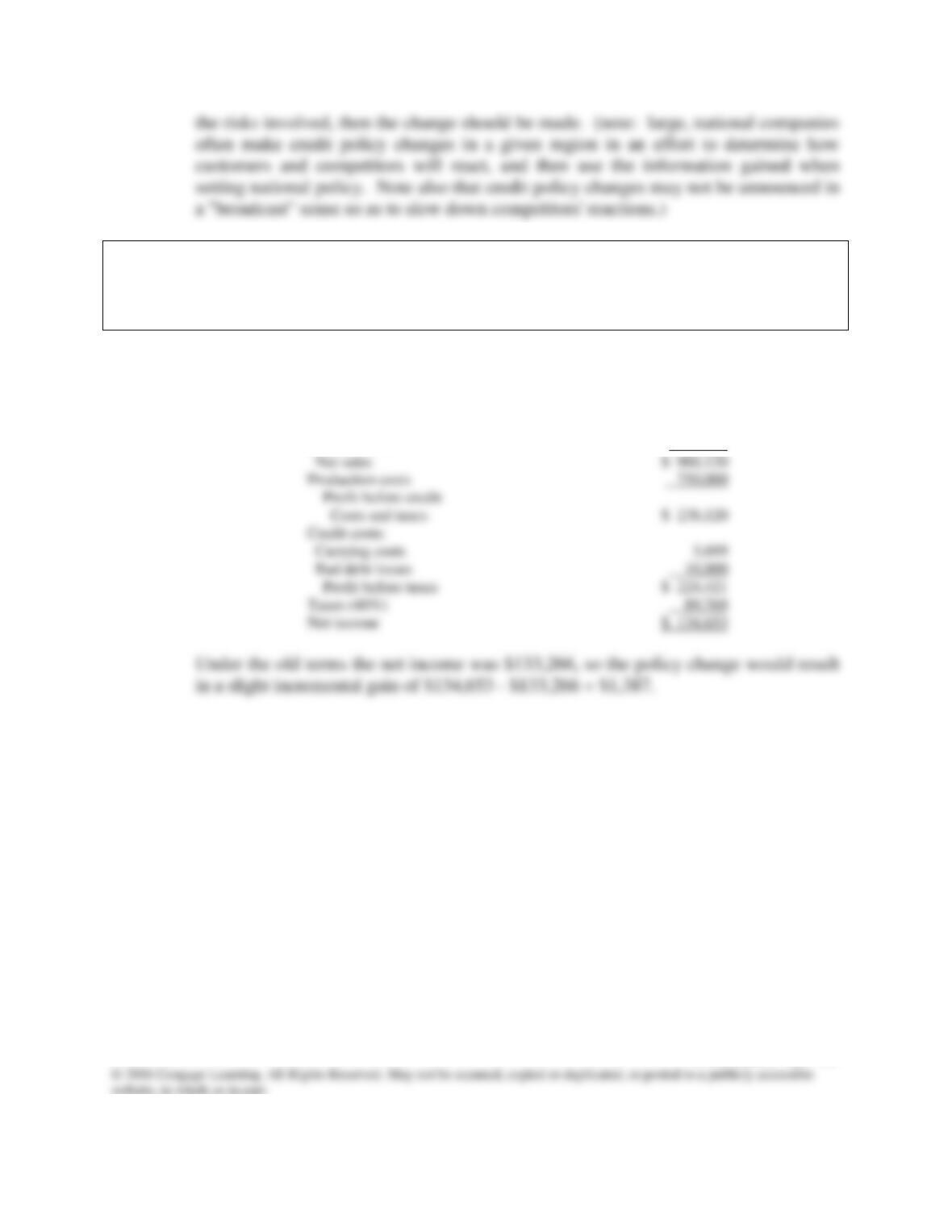
Answer: The income statements and differentials under the two credit policies are shown
below:
Thus, if expectations are met, the credit policy change would increase the firm’s
annual after–tax profit by $14,884. Since there are no non–cash expenses involved
here, the $14,884 is also the incremental cash flow expected under the new policy.
Mini Case: 22- 34
o. Suppose the firm makes the change, but its competitors react by making similar
changes to their own credit terms, with the net result being that gross sales
remain at the current $1,000,000 level. What would the impact be on the firm‘s
post-tax profitability?
Answer: If sales remain at $1,000,000 after the change is made, then the following situation
would exist:
Gross sales $1,000,000
Less discounts 11,880
Mini Case: 22 – 35
p. The brothers need $100,000 and are considering a 1-year bank loan with a
quoted annual rate of 8%. The bank is offering the following alternatives: (1)
simple interest, (2) discount interest, (3) discount interest with a 10%
compensating balance, and (4) add-on interest on a 12–month installment loan.
What is the effective annual cost rate for each alternative? For the first three of
these assumptions, what is the effective rate if the loan is for 90 days, but
renewable? How large must the face value of the loan amount actually be in each
of the 4 alternatives to provide $100,000 in usable funds at the time the loan is
originated?
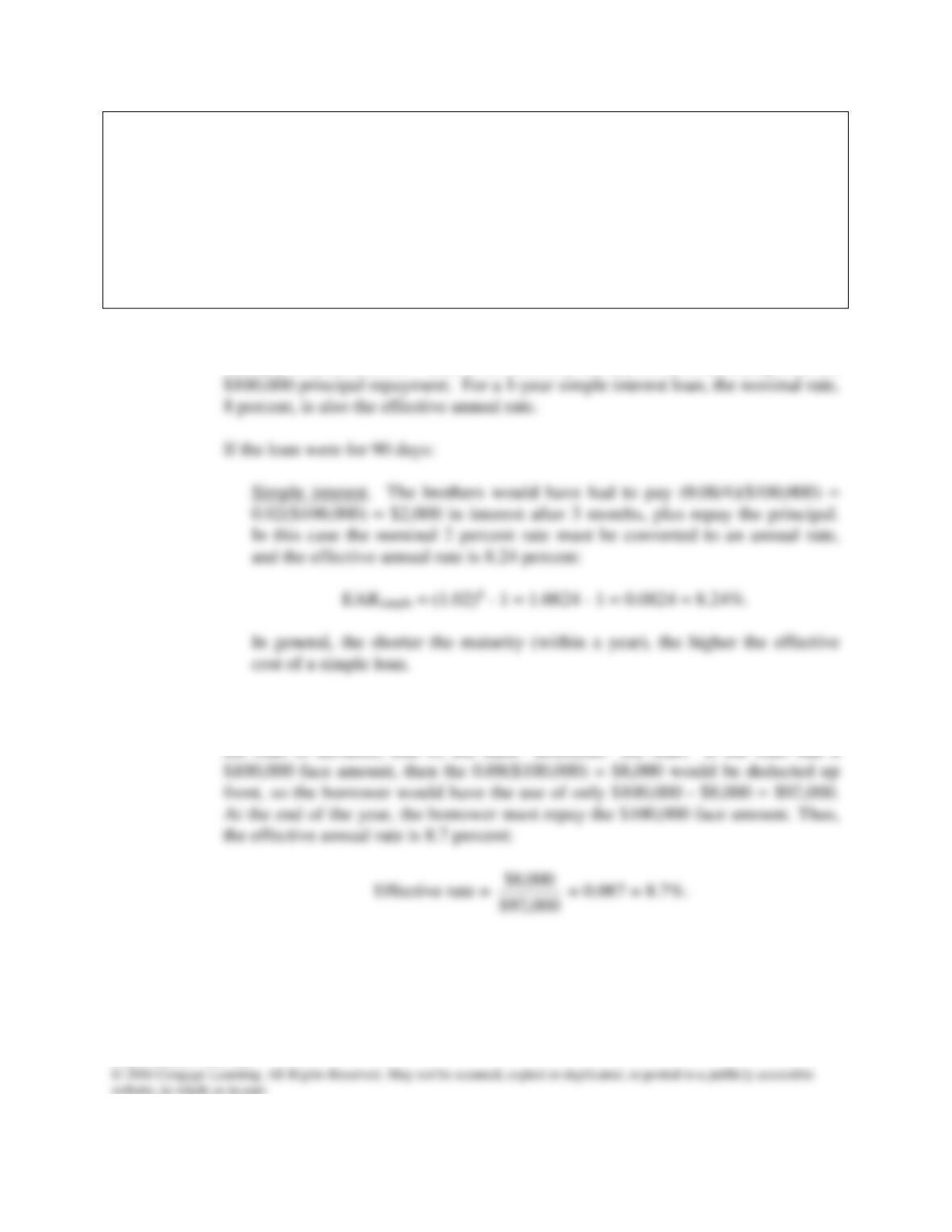
Answer: 1. With a simple interest loan, they gets the full use of the $100,000 for a year, and
then pay 0.08($100,000) = $8,000 in interest at the end of the term, along with the
2. On a discount interest loan, the bank deducts the interest from the face amount of
Mini Case: 22- 36
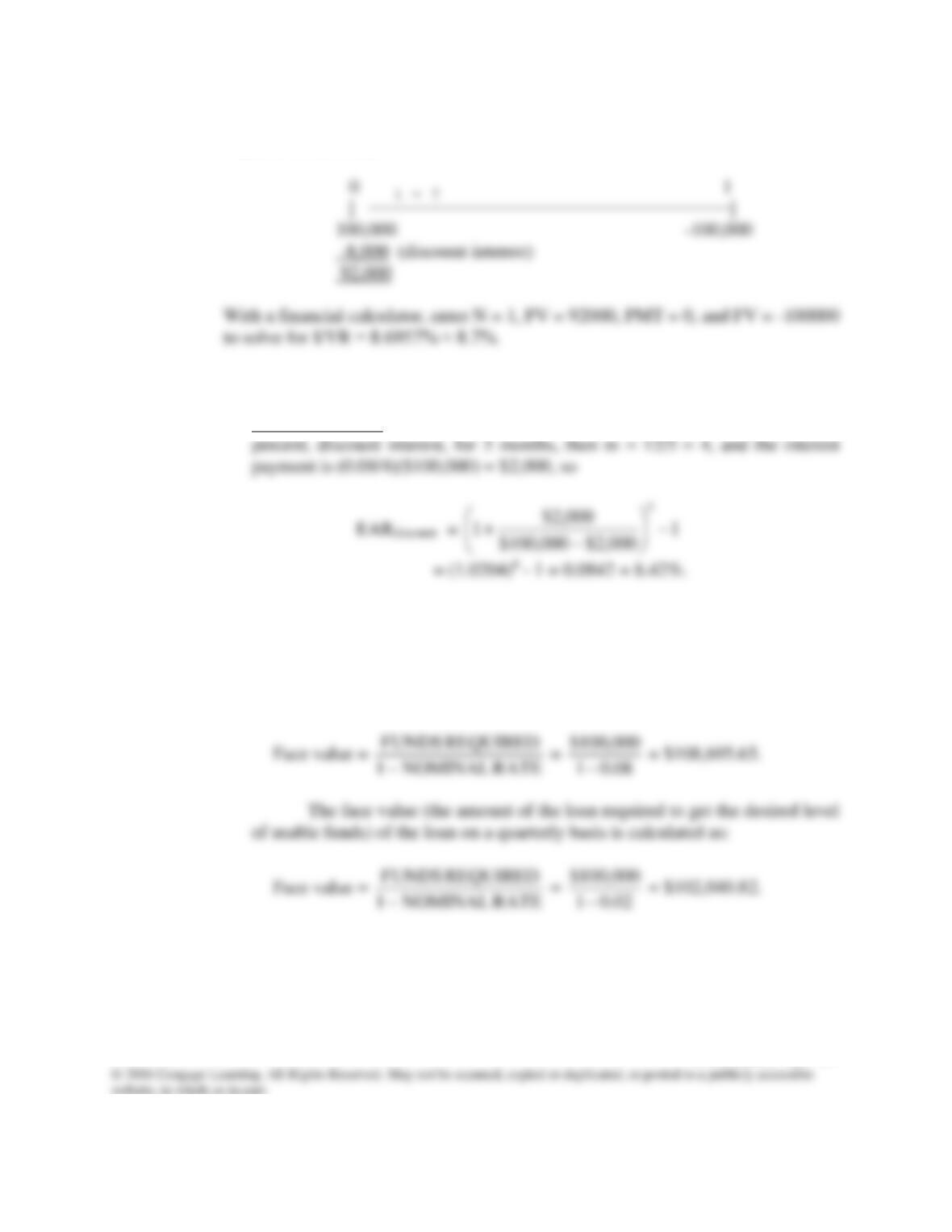
Note that a timeline can also be used to calculate the effective annual rate of the
1-year discount loan:
If the loan were for 90 days:
Discount interest. If borrow $100,000 face value at a nominal rate of 8
Discount interest imposes less of a penalty on shorter-term than on longer-
term loans.
The face value (the amount of the loan required to get the desired level
of usable funds) of the loan is calculated as:
Mini Case: 22 – 37
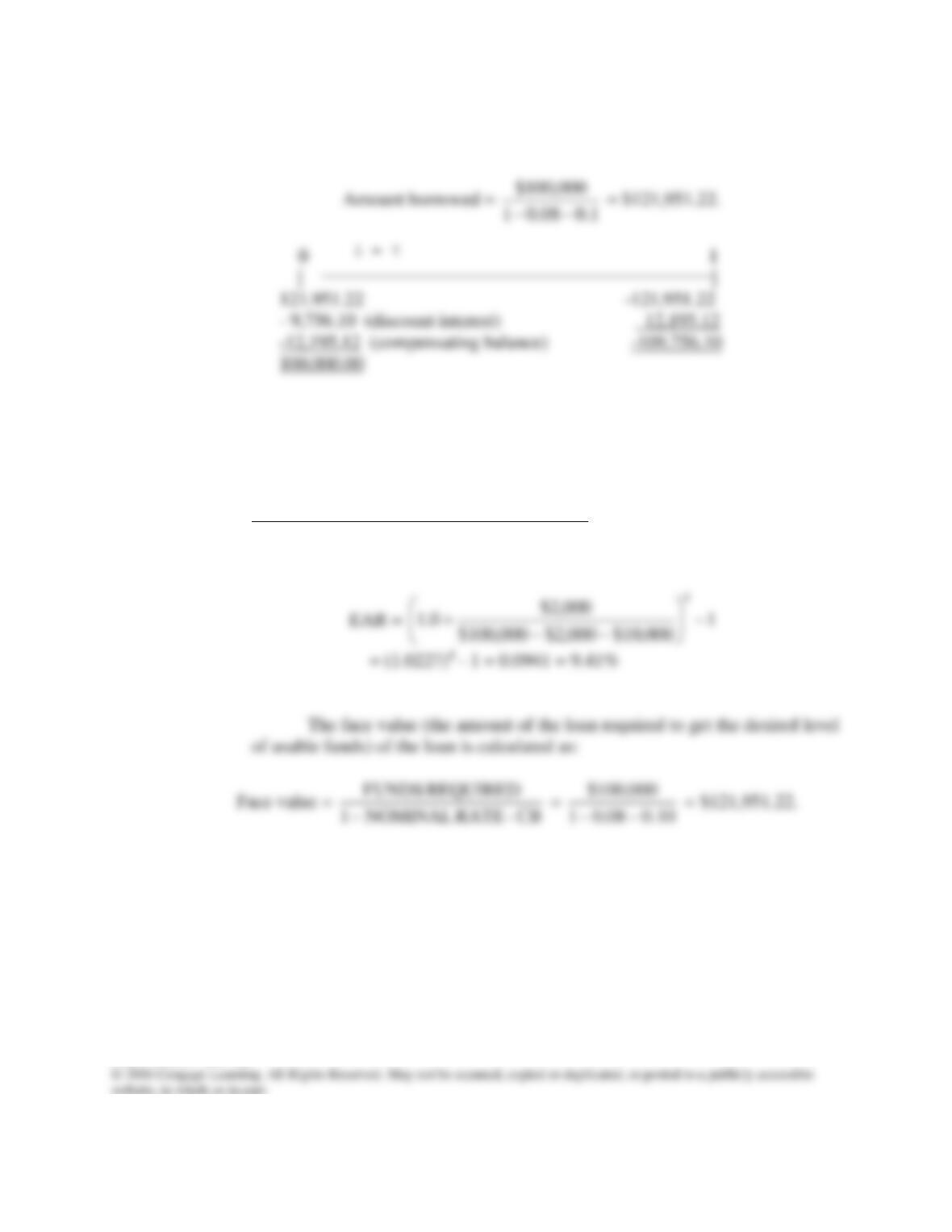
3. If the loan is a discount loan, and a compensating balance is also required, then
the effective rate is calculated as follows:
With a financial calculator, enter N = 1, PV = 100000, PMT = 0, and FV = –
109756.10 to solve for I/YR = 9.7561% 9.76%.
If the loan were for 90 days:
Discount interest with compensating balance. Everything is the same as in #2
above, except that we must add the compensating balance term to the
denominator.
Mini Case: 22- 38
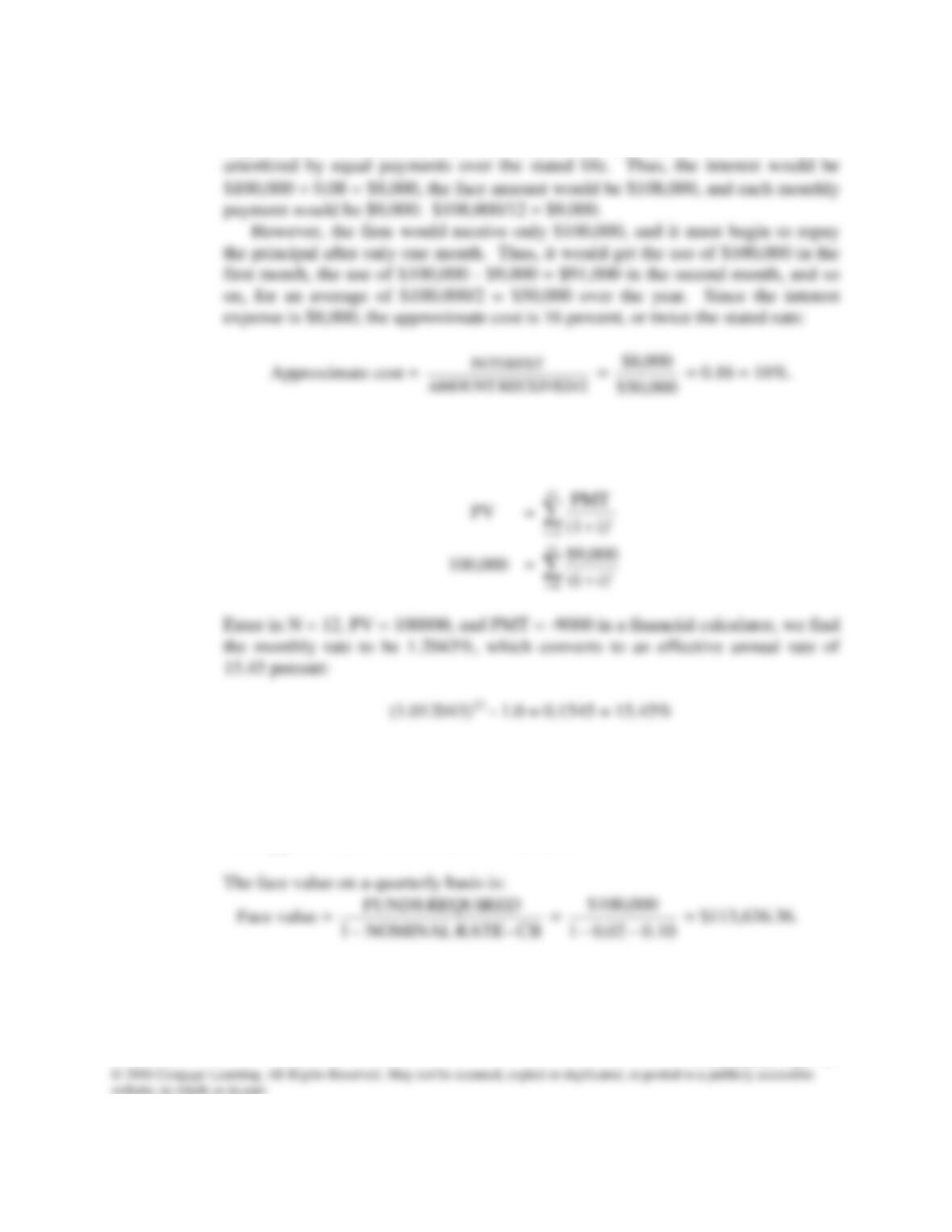
4. In an installment (add–on) loan, the interest is calculated and added on to the
required cash amount, and then this sum is the face amount of loan, and it is
To find the exact effective annual rate, recognize that the borrower has received
$100,000 and must make 12 monthly payments of $9,000:
The face value (the amount of the loan required to get the desired level of usable
funds) of the loan is $100,000. Note that the borrower would only have full use
of the $100,000 for the first month and, over the course of the year, it would only
have approximate use of $100,000/2 = $50,000.
Mini Case: 22 – 39