Chapter 22
Providing and Obtaining Credit
ANSWERS TO BEGINNING-OF–CHAPTER QUESTIONS
22-1 The term “credit policy” embraces four variables: (1) credit period, (2) discount offered,
including the discount percentage and when payment must be made to get the discount,
(3) credit standards, and (4) collection policy.
Customers like easy credit, so the easier, or more relaxed, the credit policy, the
higher sales will be. Conversely, a tighter credit policy will lower sales somewhat. To
Accounts receivable = (Sales/day)*(Receivables Collection Period)
If the company changed its discounts policy, this would have two somewhat
offsetting effects. First, an increase in the discount would normally cause more
customers to pay in time to take the discount, which would lower receivables. Similarly,
since receivables are normally reported net of discounts, if discounts are raised, this tends
to lower receivables. However, the higher discount would really mean a price reduction,
which would increase sales and thus receivables. The first two effects would, generally,
be stronger, hence increasing the discount would normally reduce receivables.
It is impossible to state, as a generalization, what the effect of an easing or tightening
Answers and Solutions: 22 – 1
22-2 Management’s control over credit policy varies across industries and among firms within
an industry. Thus, a monopolistic firm such as Microsoft has a great deal of power to
22-3 Tighter credit will almost certainly shorten the CCC, while easier credit will lengthen it.
22-4 These changes would represent easier credit terms. a. As such, sales would increase. The
higher discount would tend to increase discount customers, but that would be offset
22-5 See the BOC model illustrates the above points. Under the assumed conditions, a new
22-6 Banks make loans in a number of different ways, the most common ones being simple
interest, discount interest, an add-on interest for installment loans. Banks also sometimes
require “compensating balances,” which were originally designed to tie the loan customer
to the bank for other services but which when used today are just a way to boost the
effective rate the bank earns (and the customer pays) for the loan.
Auto loans and other consumer loans are generally figured on an “add-on” basis,
where the amount of interest is calculated and added to the face amount of the loan, and
then the borrower pays off the loan over some period, such as 12 or 36 months. An 8%
Prior to the Truth in Lending law, banks told customers that the rate on say a 36
month auto loan was say 8%. That didn’t sound too bad to the customer, but he or she
was really paying almost twice that amount, because the average amount borrowed was
only half the face amount of the loan. The same thing held for many other consumer and
business loans, such as credit card balances. Of course, more sophisticated individuals,
and larger companies, could figure the true costs, make comparisons among lenders on
Answers and Solutions: 22 – 3
ANSWERS TO END-OF-CHAPTER QUESTIONS
22-1 a. Cash discounts are often used to encourage early payment and to attract customers by
effectively lowering prices. Credit terms are usually stated in the following form:
2/10, net 30. This means a 2 percent discount will apply if the account is paid within
10 days, otherwise the account must be paid within 30 days.
c. An aging schedule breaks down accounts receivable according to how long they have
been outstanding. This gives the firm a more complete picture of the structure of
accounts receivable than that provided by days sales outstanding. Days sales
outstanding (DSO) is a measure of the average length of time it takes a firm’s
customers to pay off their credit purchases.
22-2 The latest date for paying and taking discounts is May 10. The date by which the
payment must be made is June 9.
22-4 No. Although B sustains slightly more losses due to uncollectible accounts, its credit
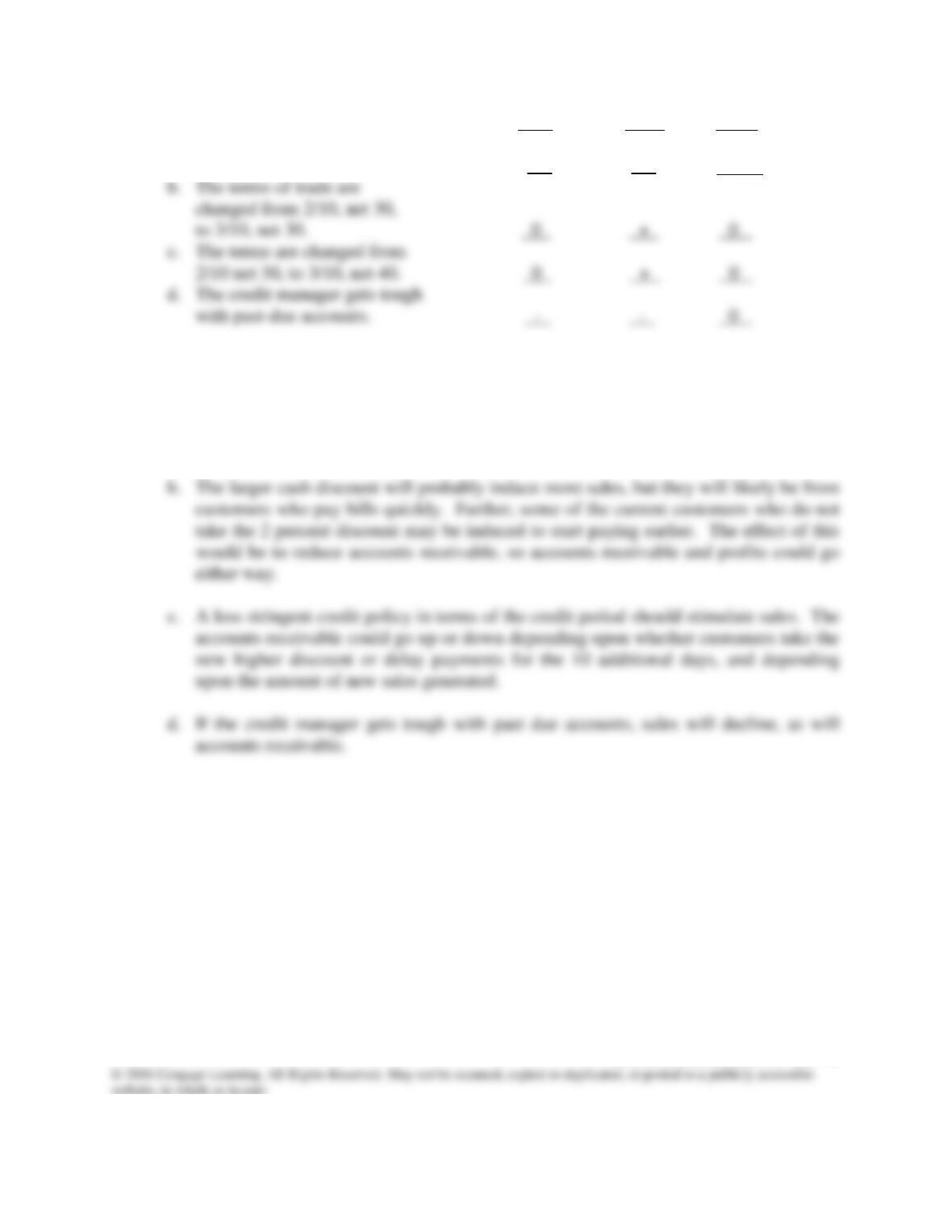
22-5 AR Sales Profit
a. The firm tightens its credit
standards. – – 0
Explanations:
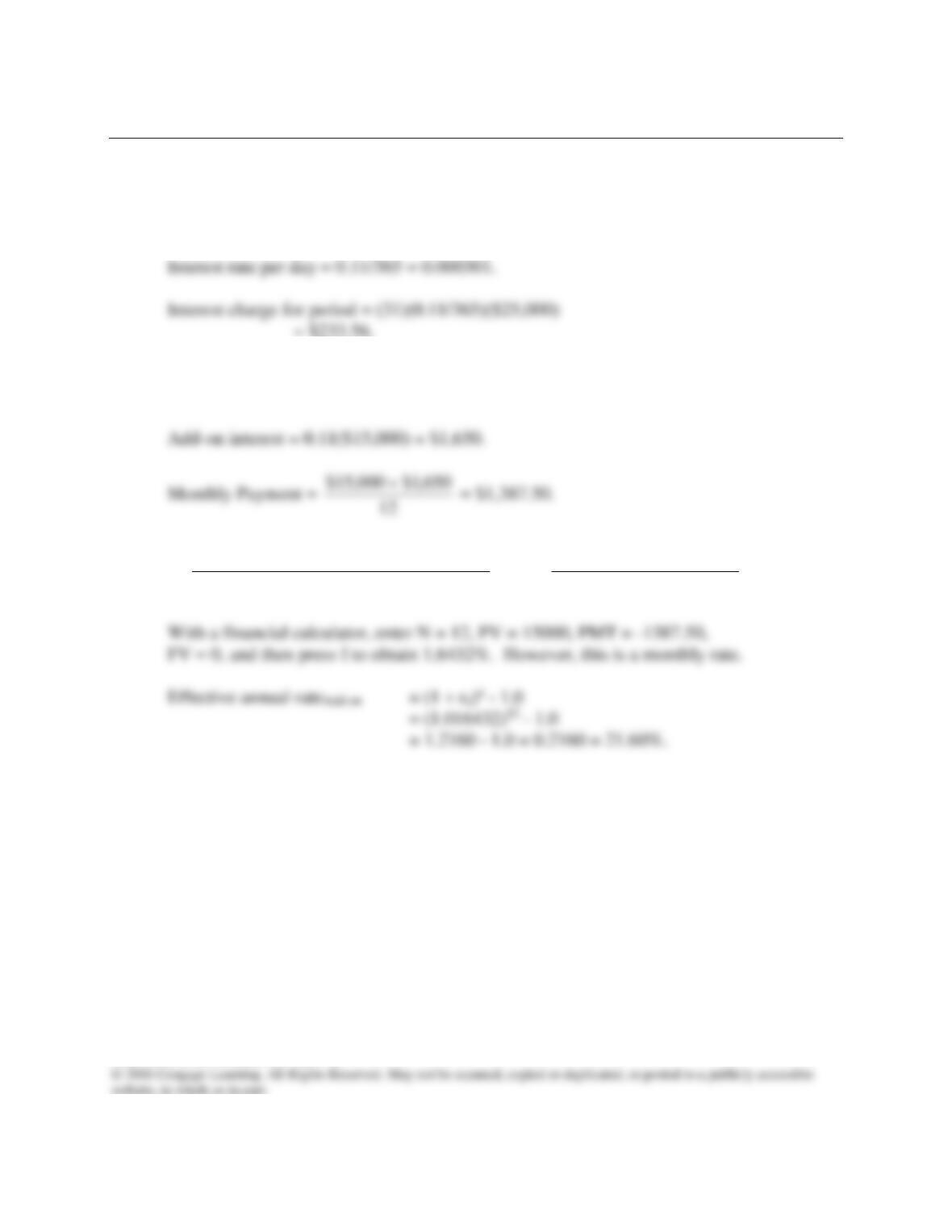
a. When a firm “tightens” its credit standards, it sells on credit more selectively. It will
likely sell less and certainly will make fewer credit sales. Profit may be affected in
either direction.
Answers and Solutions: 22 – 5
SOLUTIONS TO END-OF-CHAPTER PROBLEMS
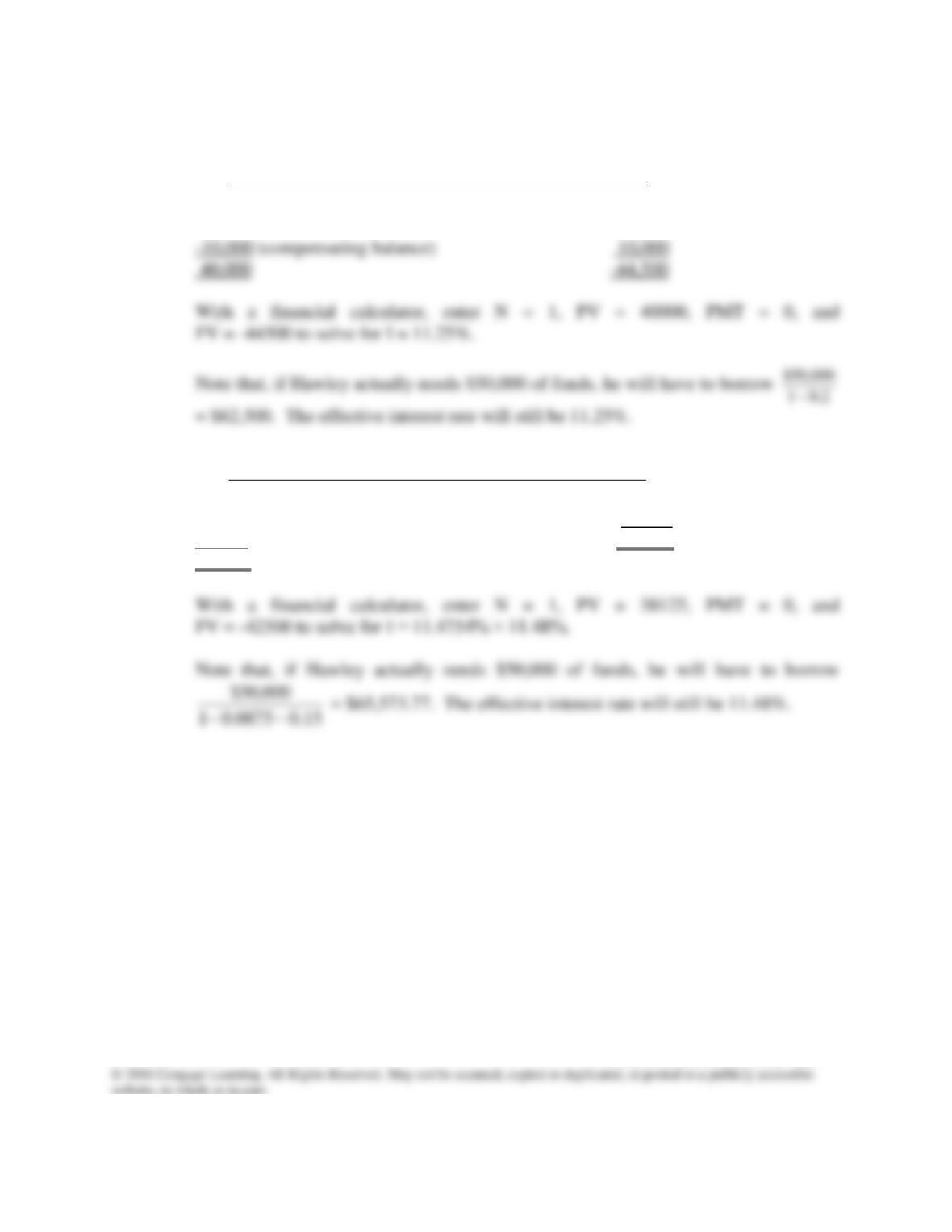
22-1 $25,000 interest–only loan, 11% nominal rate. Interest calculated as simple interest based
on 365-day year. Interest for 1st month = ?
22-2 $15,000 installment loan, 11% nominal rate.
Effective annual rate, assuming a 365–day year = ?
0 1 2 11 12
| | | • • • | |
15,000 -1,387.50 -1,387.50 -1,387.50 -1,387.50
i = ?
Answers and Solutions: 22 – 6
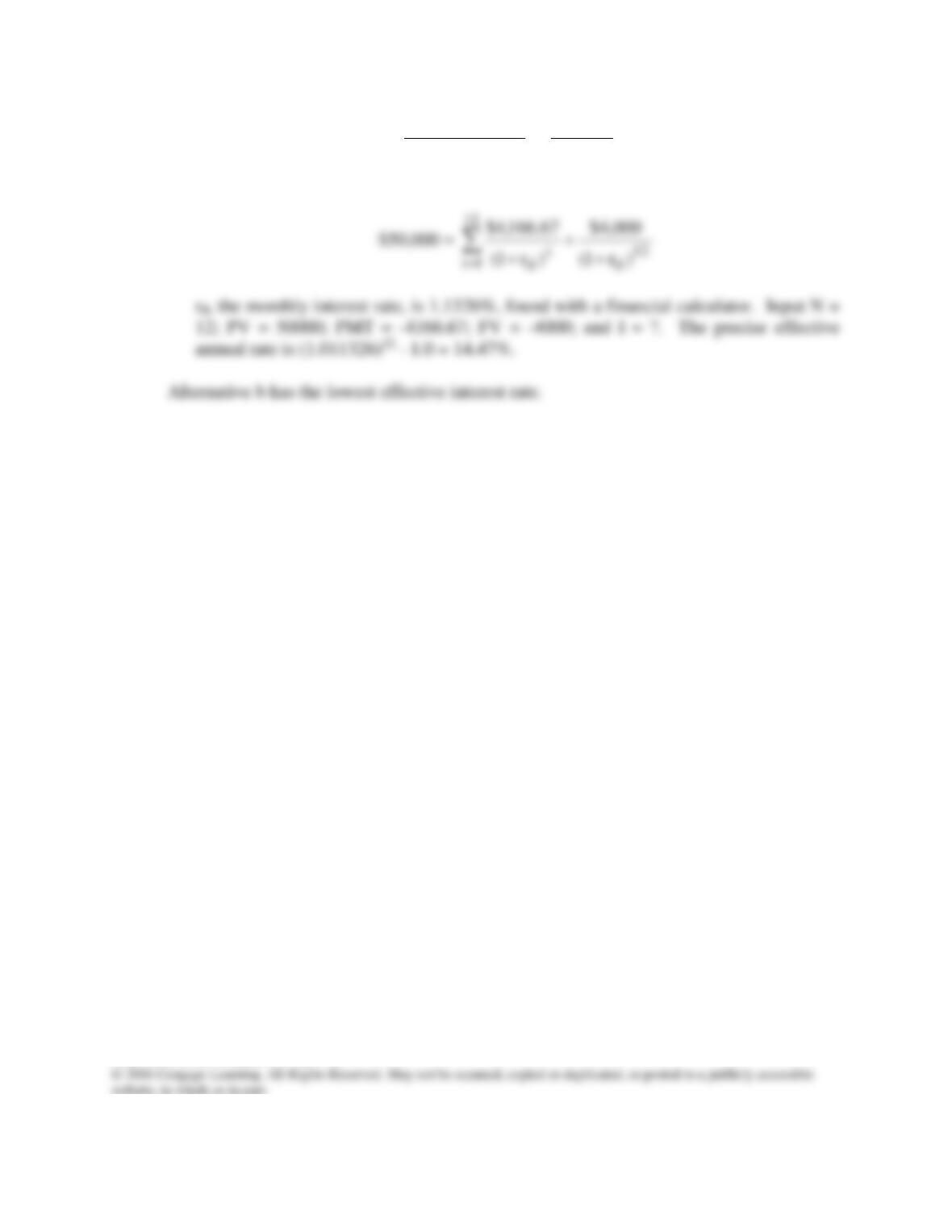
22-3 a. Effective rate = 12%.
b. 0 1
| |
50,000 -50,000
– 4,500
c. 0 1
| |
50,000 -50,000
– 4,375 (discount interest) 7,500
– 7,500 (compensating balance) -42,500
38,125
i = ?
i = ?
Answers and Solutions: 22 – 7
d. Approximate annual rate =
)/2000,50($
)000,50)($08.0(
=
000,25$
000,4$
= 16%.
Precise effective rate:
Answers and Solutions: 22 – 8
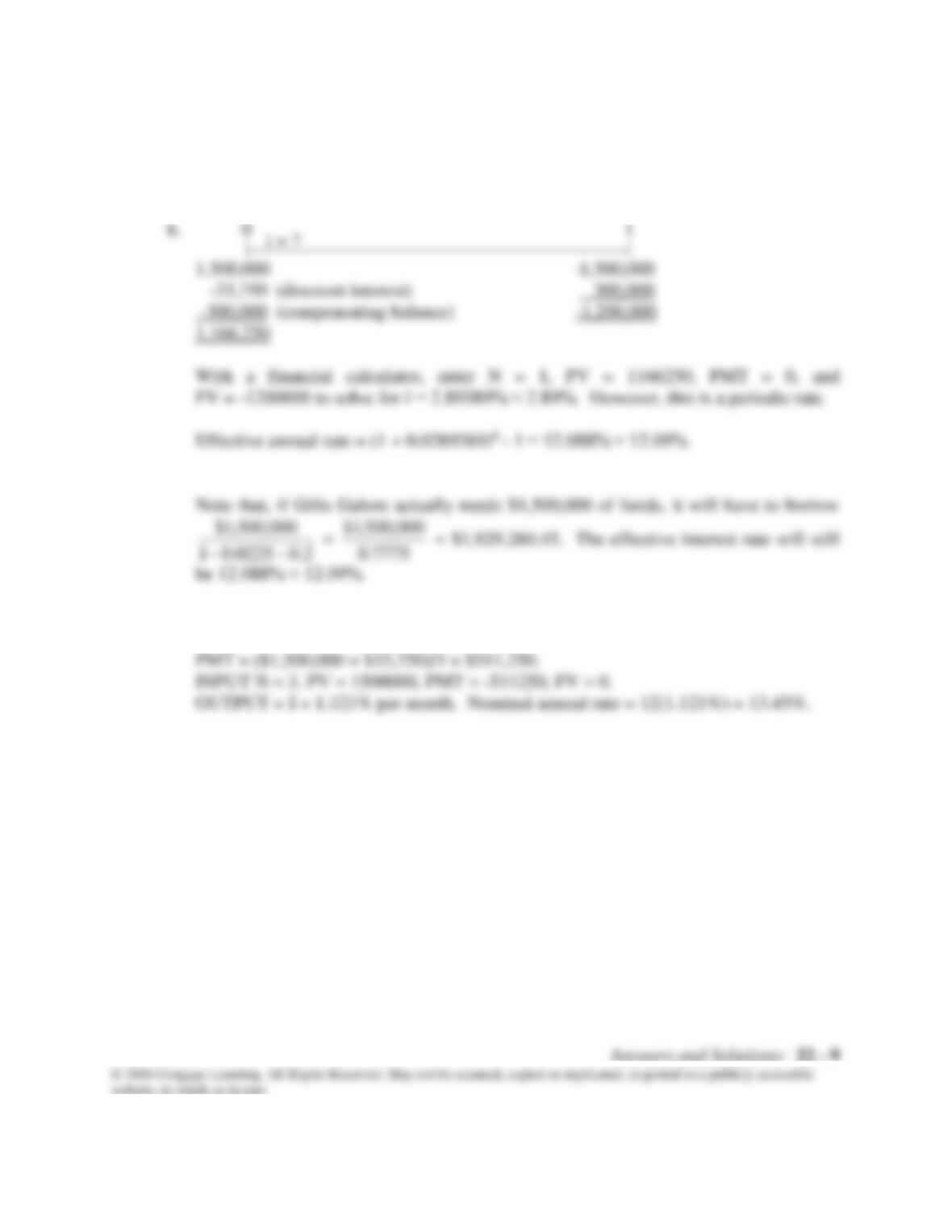
22-4 a. The quarterly interest rate is equal to 11.25%/4 = 2.8125%.
Effective annual rate = (1 + 0.028125)4 – 1
= 1.117336 – 1 = 0.117336 = 11.73%.
c. Installment loan:
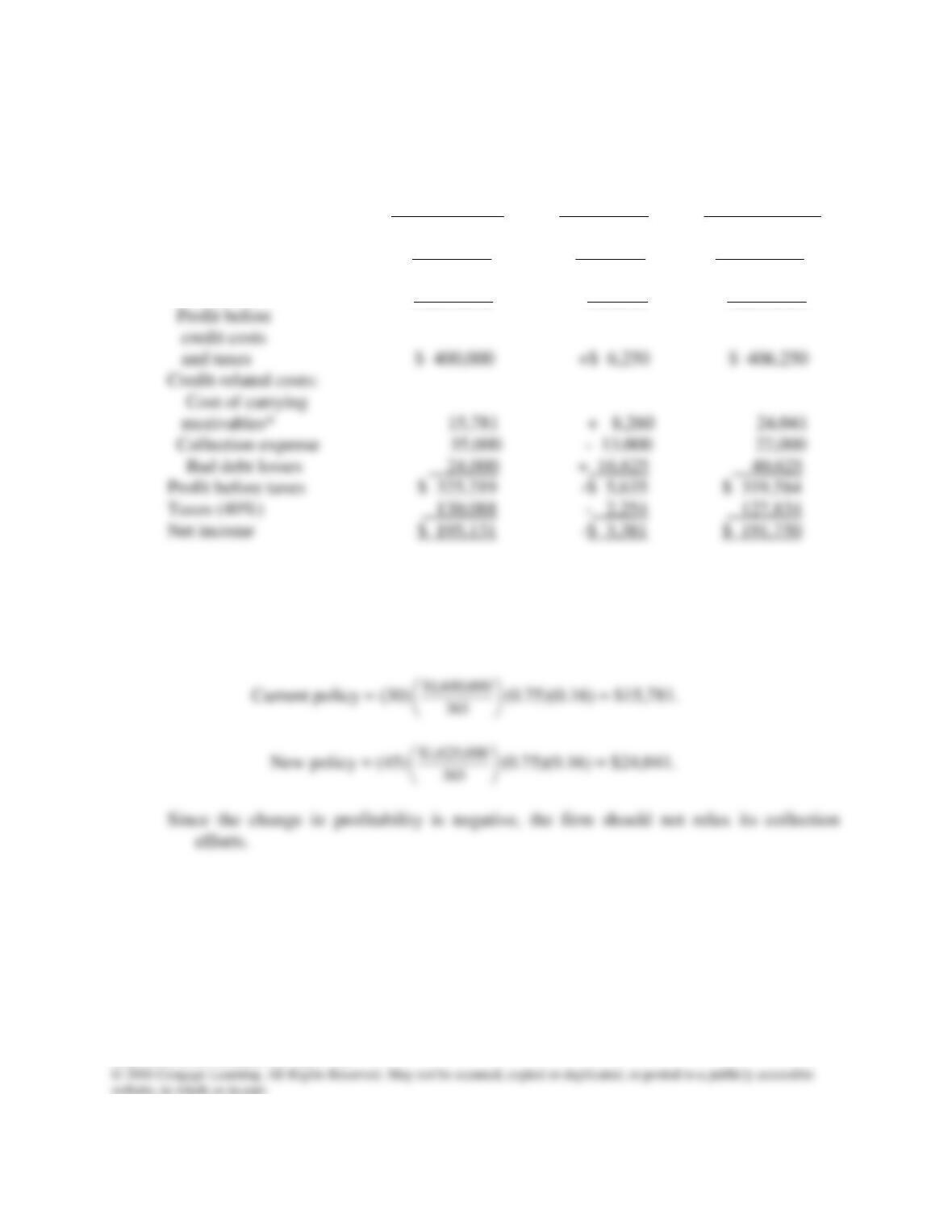
22-5 Analysis of change:
Projected Income Projected Income
Statement Effect of Statement
Under Current Credit Policy Under New
Credit Policy Change Credit Policy
Gross sales $1,600,000 +$ 25,000 $1,625,000
Less: Discounts 0 0 0
Net sales $1,600,000 +$ 25,000 $1,625,000
Variable costs 1,200,000 + 18,750 1,218,750
*Cost of carrying receivables:
( )
funds
ofCost
ratiocost
Variable
dayper
Sales
DSO
.
Answers and Solutions: 22 – 10
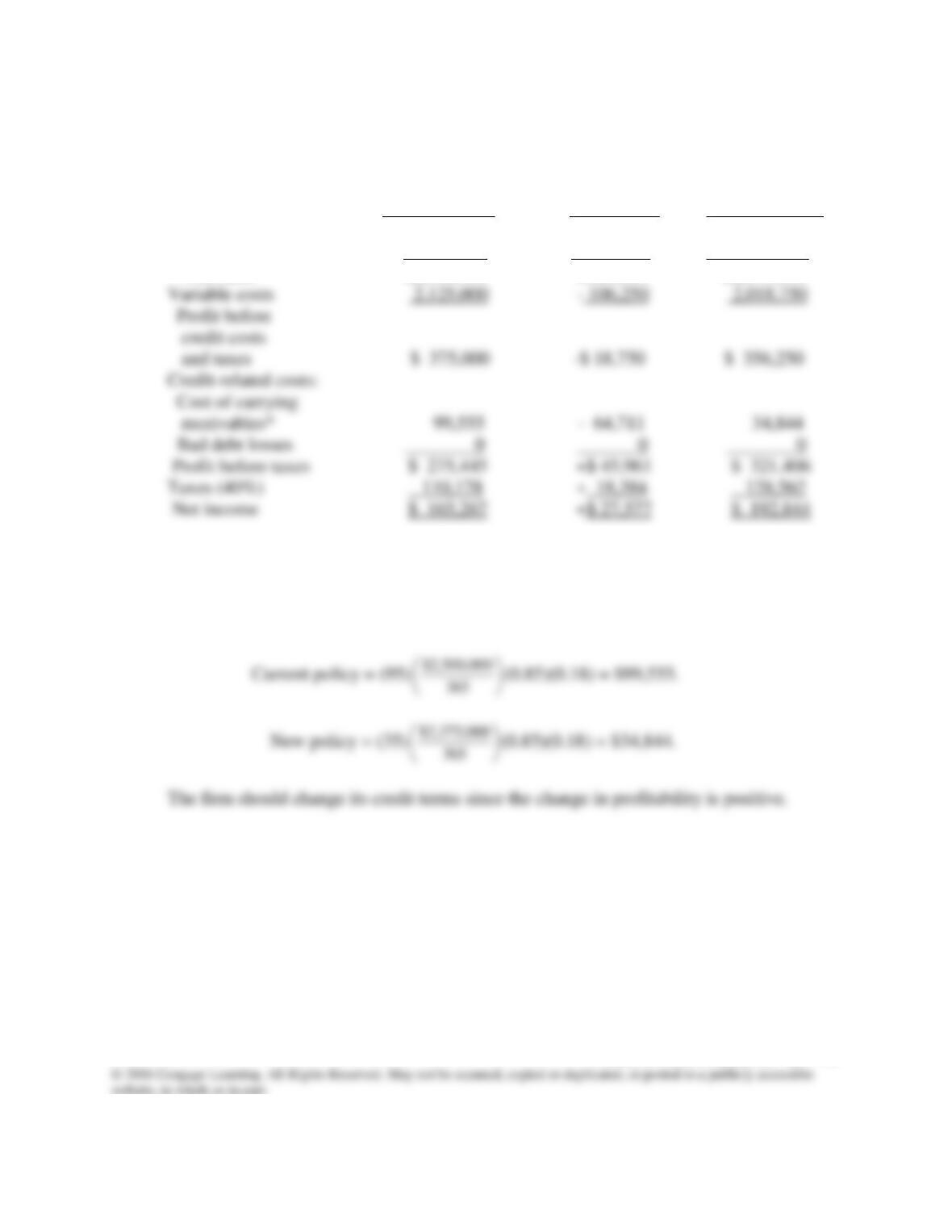
22-6 Analysis of change:
Projected Income Projected Income
Statement Effect of Statement
Under Current Credit Policy Under New
Credit Policy Change Credit Policy
Gross sales $2,500,000 -$125,000 $2,375,000
Less: Discounts 0 0 0
Net sales $2,500,000 -$125,000 $2,375,000
*Cost of carrying receivables:
( )
funds
ofCost
ratiocost
Variable
dayper
Sales
DSO
.
Answers and Solutions: 22 – 11
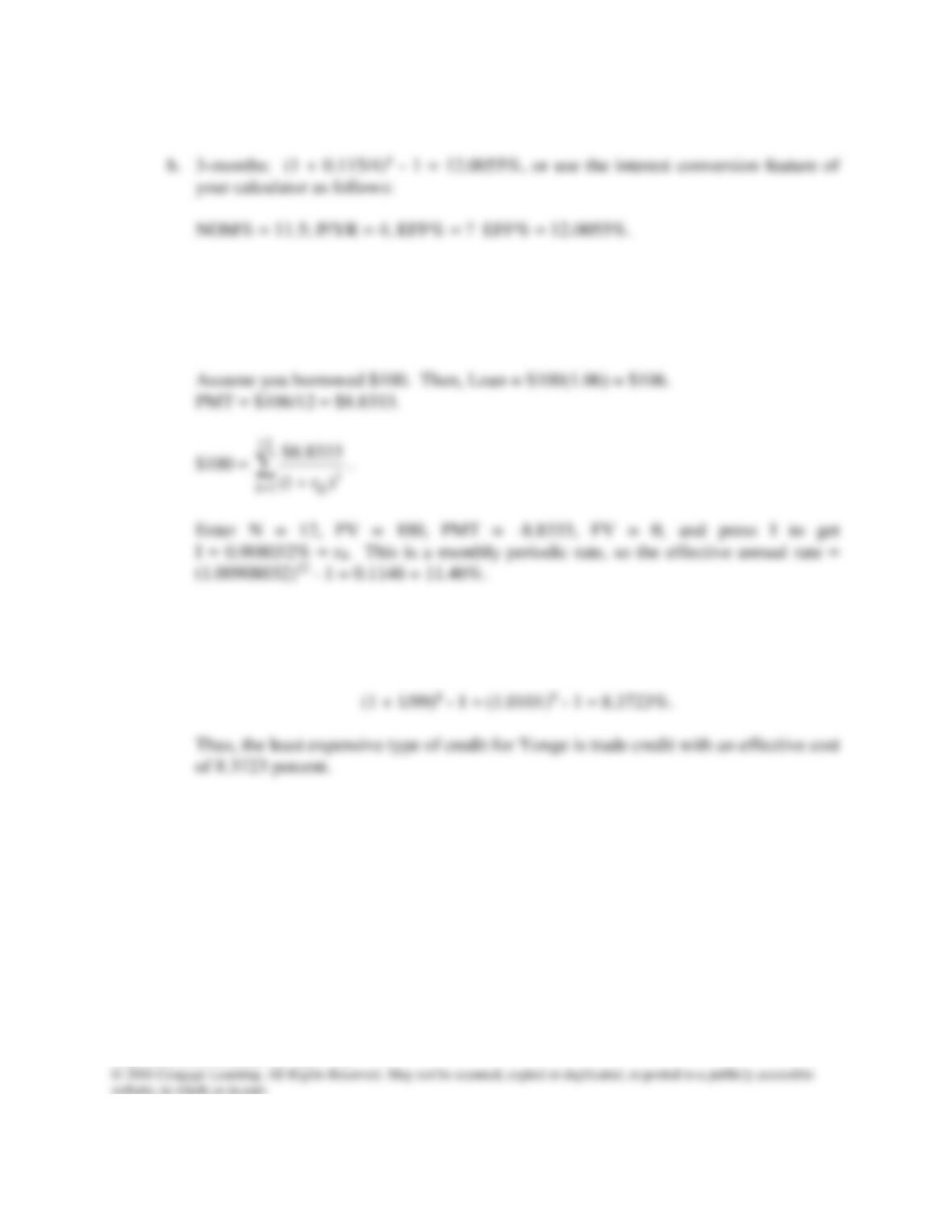
22-7 a. Simple interest: 12%.
c. Add-on: Interest = Funds needed(rd).
Loan = Funds needed(1 + rd).
PMT = Loan/12.
d. Trade credit: 1/99 = 1.01% on discount if pay in 15 days, otherwise pay 45 days
later. So, get 60 – 15 = 45 days of credit at a cost of 1/99 = 1.01%. There are 360/45
= 8 periods, so the effective cost rate is:
Answers and Solutions: 22 – 12
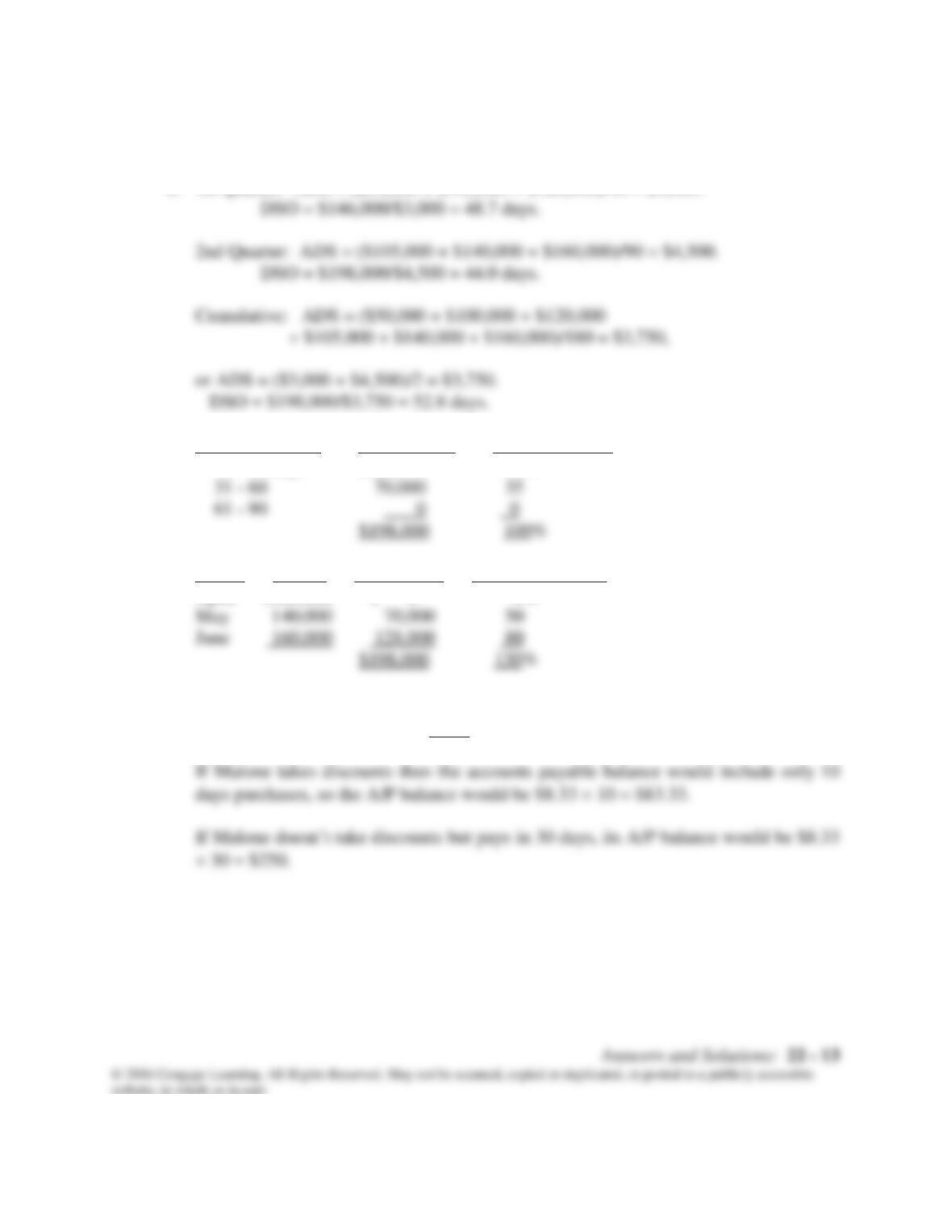
22-8 a. March receivables = $120,000(0.8) + $100,000(0.5) = $146,000.
June receivables = $160,000(0.8) + $140,000(0.5) = $198,000.
b. 1st Quarter: ADS = ($50,000 + $100,000 + $120,000)/90 = $3,000.
c. Age of Accounts Dollar Value Percent of Total
0 – 30 days $128,000 65%
d. Month Sales Receivables Receivables/Sales
April $105,000 $ 0 0%
22-9 a. Malone’s current accounts payable balance represents 60 days purchases. Daily
purchases can be calculated as
60
500$
= $8.33.
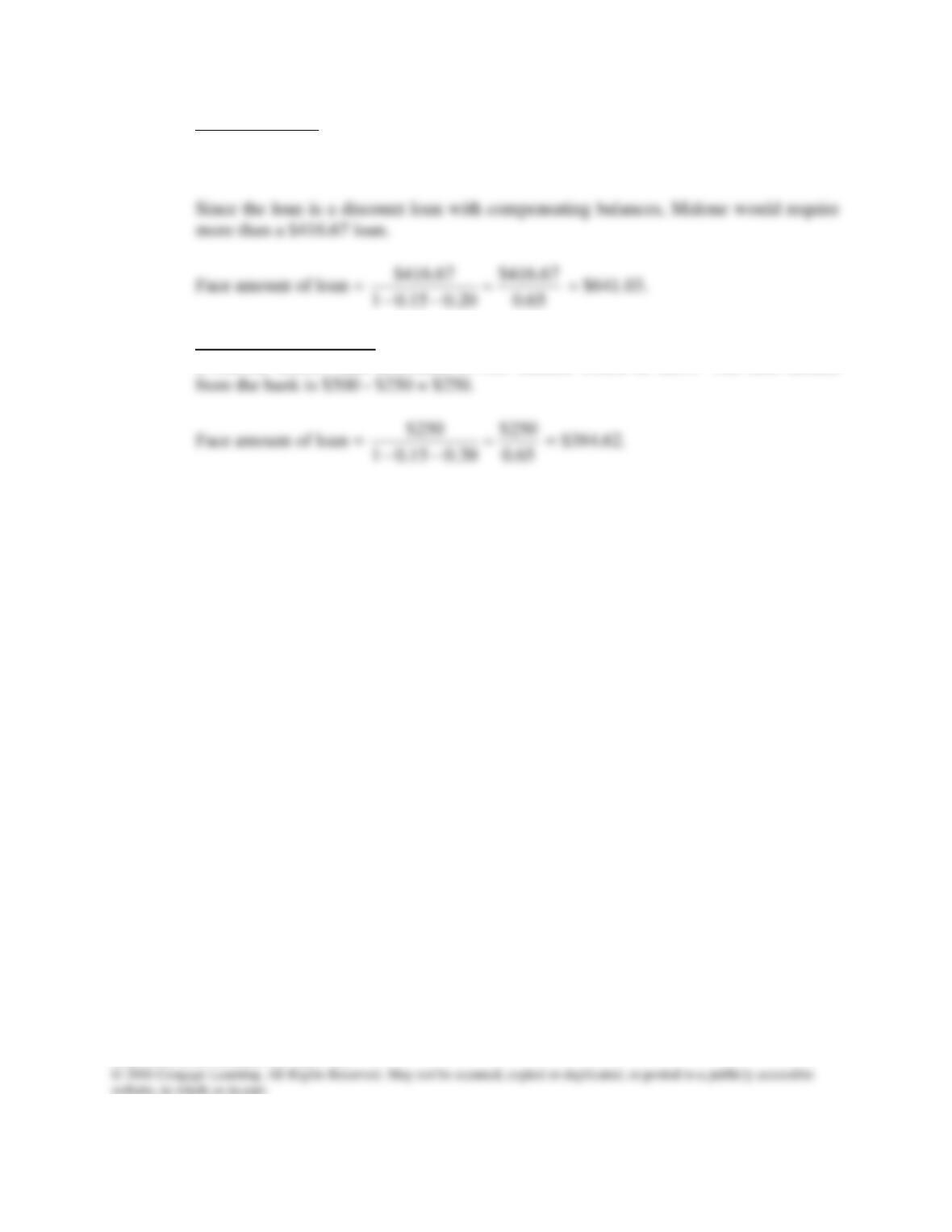
b. Takes Discounts:
If Malone takes discounts its A/P balance would be $83.33. The cash it would need
to be loaned is $500 – $83.33 = $416.67.
Doesn’t Take Discounts:
If Malone doesn’t take discounts, its A/P balance would be $250. The cash needed
Answers and Solutions: 22 – 14
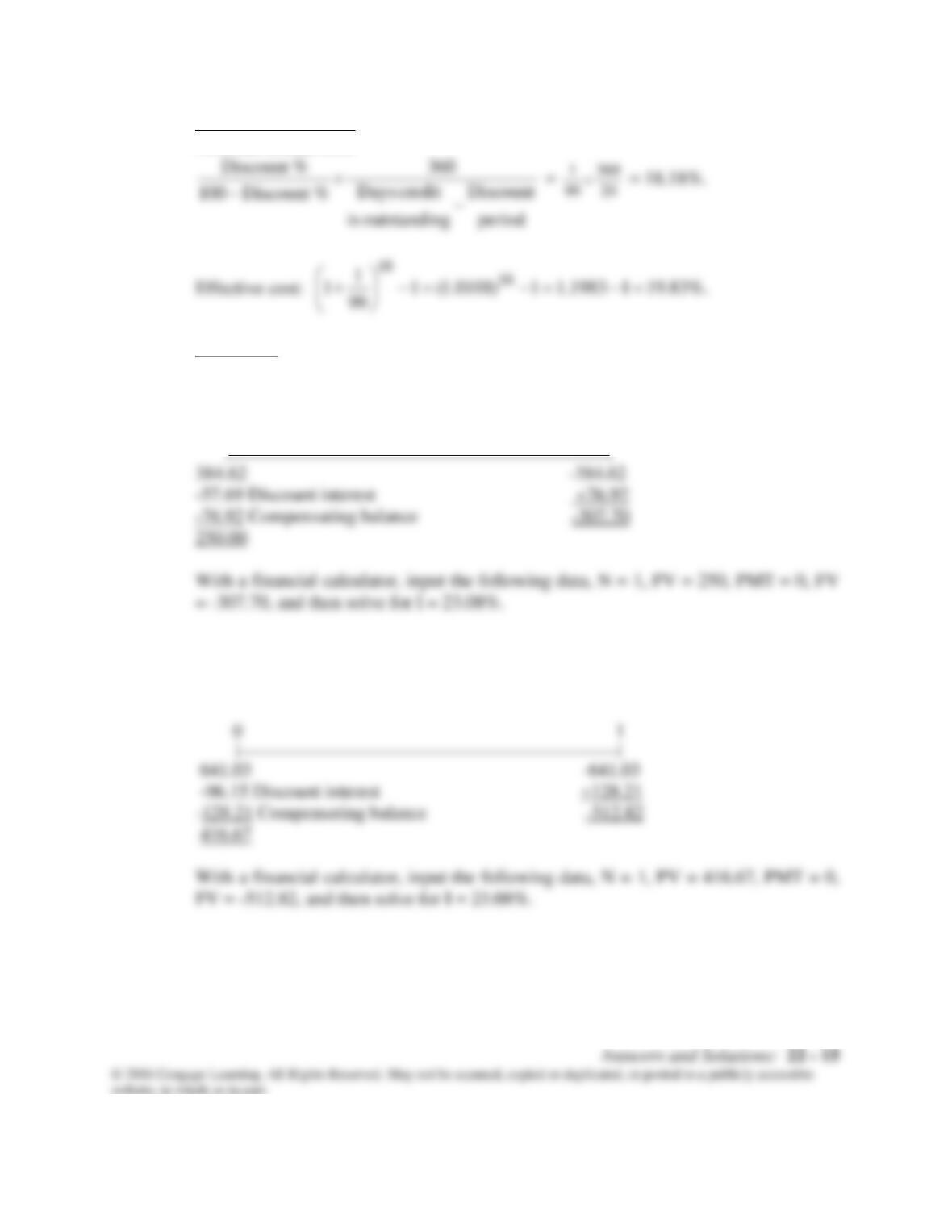
c. Nonfree Trade Credit:
Nominal annual cost:
Bank Loan: 15% Discount Loan with 20% compensating balance.
Assume the firm doesn’t take discounts so it needs $250 and borrows $384.62. (The
cost will be the same regardless of how much the firm borrows.)
0 1
Just to show you that it doesn’t matter how much the firm borrows, assume the firm
takes discounts and it reduces A/P to $83.33 so it needs $416.67 cash and borrows
$641.03.
Because the cost of nonfree trade credit is less than the cost of the bank loan, Malone
should forge discounts and reduce its payables only to $250,000.
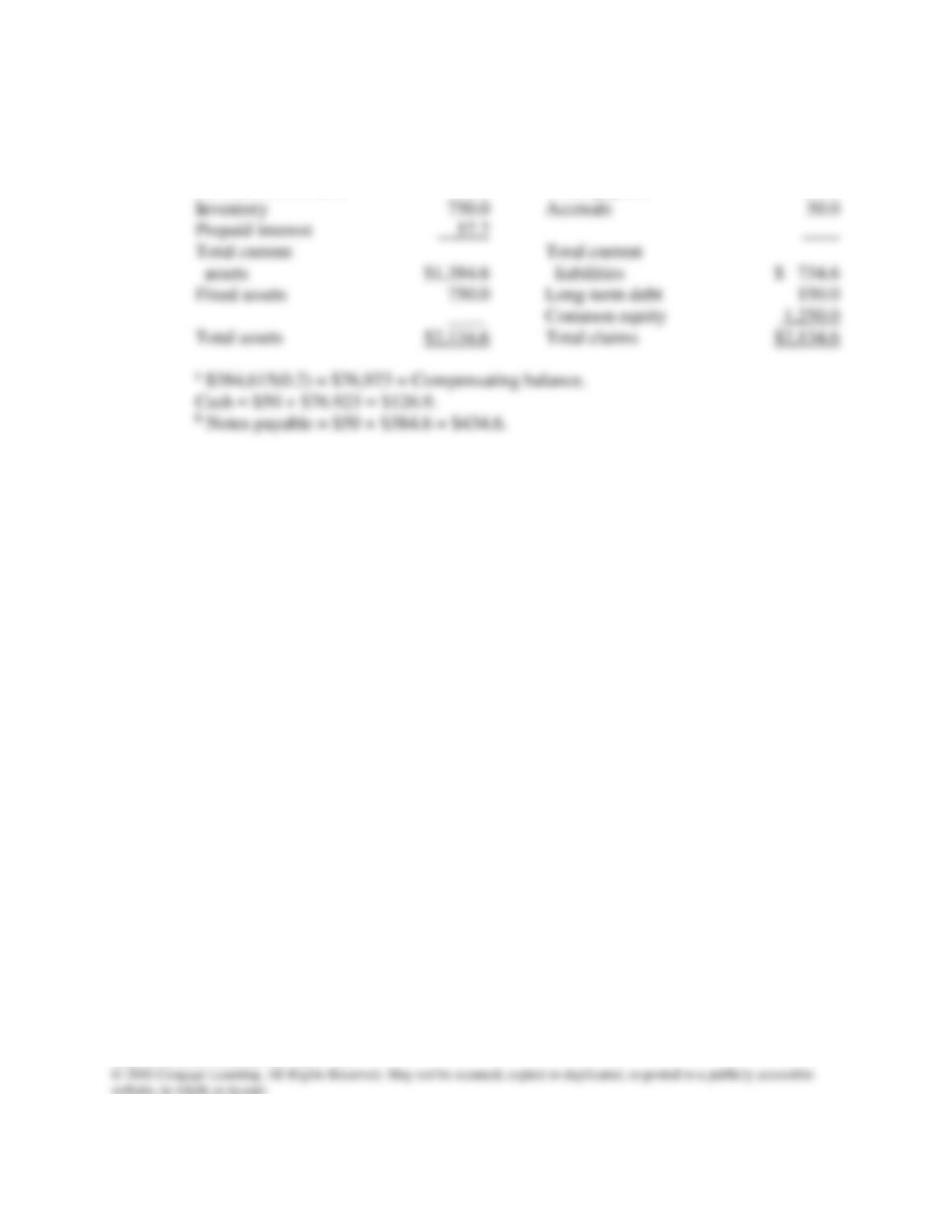
d. Pro Forma Balance Sheet (Thousands of Dollars):
Casha $ 126.9 Accounts payable $ 250.0
Accounts receivable 450.0 Notes payableb 434.6
Answers and Solutions: 22 – 16
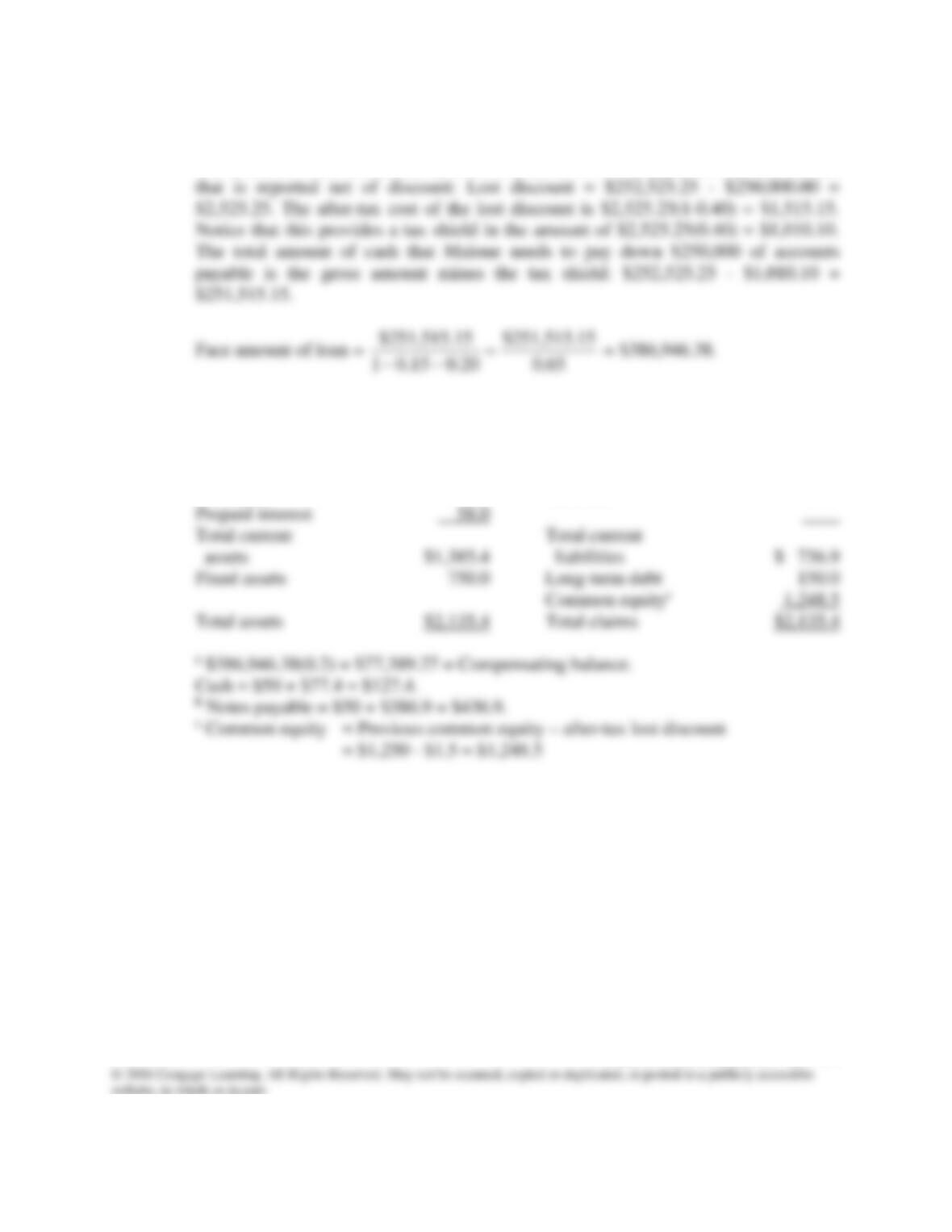
e. To reduce the accounts payable by $250,000, which reflects the 1% discount, Malone
must pay the full cost of the payables, which is $250,000/0.99 = $252,525.25. The
lost discount is the difference between the full cost of the payables and the amount
Pro Forma Balance Sheet (Thousands of Dollars):
Casha $ 127.4 Accounts payable $ 250.0
Accounts receivable 450.0 Notes payableb 436.9
Inventory 750.0 Accruals 50.0
Answers and Solutions: 22 – 17
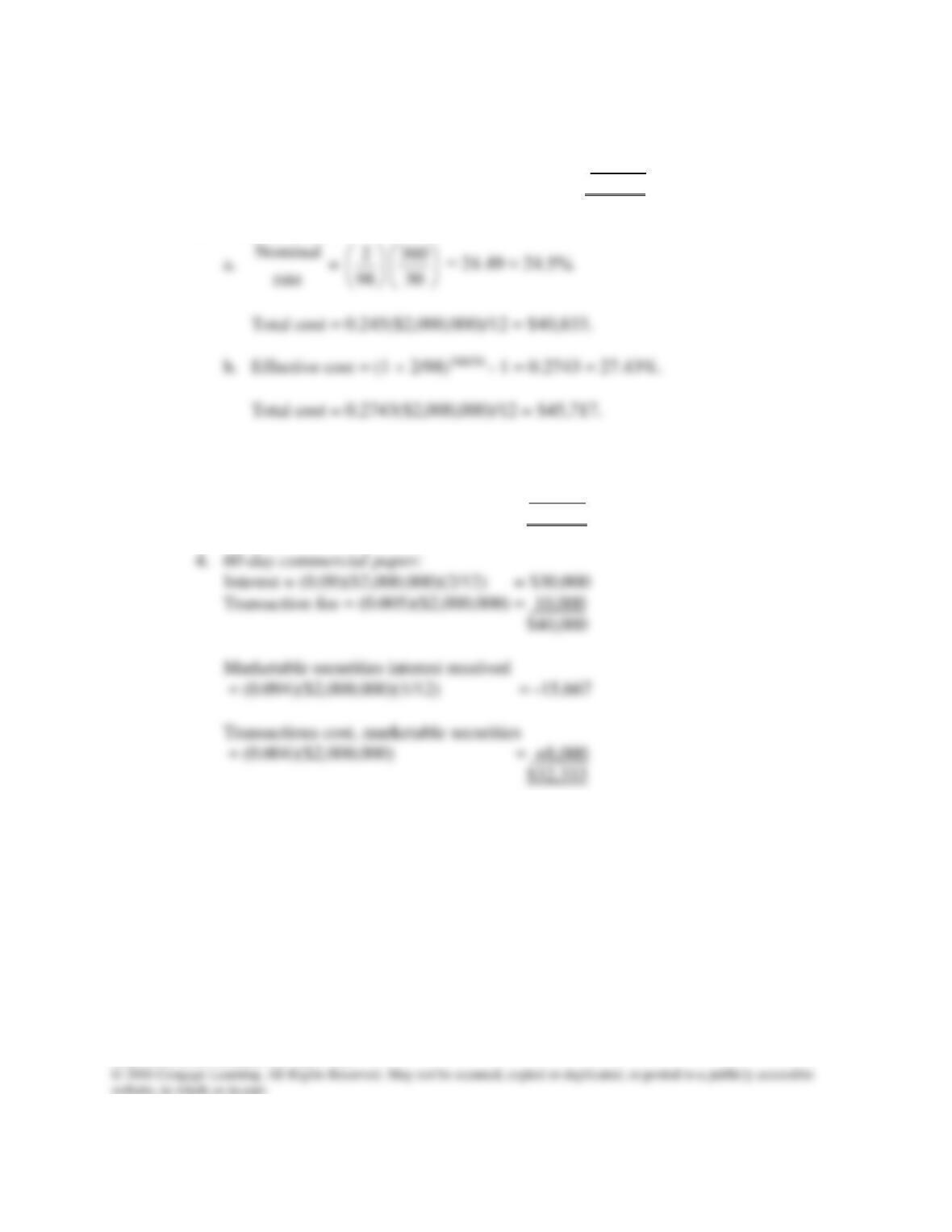
22-10 a. 1. Line of credit:
Commitment fee = (0.005)($2,000,000)(11/12) = $ 9,167
Interest = (0.11)(1/12)($2,000,000) = 18,333
Total $27,500
2. Trade discount:
3. 30-day commercial paper:
Interest = (0.095)($2,000,000)(1/12) = $15,833
Transaction fee = (0.005)($2,000,000) = 10,000
$25,833
The 30-day commercial paper has the lowest cost.
Answers and Solutions: 22 – 18
b. The lowest cost of financing is not necessarily the best. The use of 30-day
commercial paper is the cheapest; however, sometimes the commercial paper market
Answers and Solutions: 22 – 19

SOLUTION TO SPREADSHEET PROBLEMS
22-11 The detailed solution for the spreadsheet problem, Ch22 P11 Build a Model Solution.xls,
is available on the textbook’s Web site.
Answers and Solutions: 22 – 20